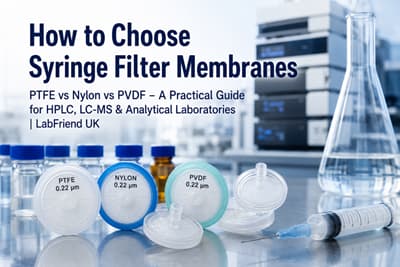
PTFE vs Nylon vs PVDF Syringe Filters - Which Membrane Should You Choose?
33 mins read
PTFE vs Nylon vs PVDF Syringe Filters - Which Membrane Should You Choose?
By Donal O’Sullivan, BSc. Reviewed by Michael Anderson, MBA.
Executive Summary
Selecting the correct syringe filter membrane is one of the most important decisions made during laboratory sample preparation. Although membrane selection may appear to be a relatively small part of an analytical workflow, the chemistry of the membrane can influence analyte recovery, solvent compatibility, filtration efficiency, instrument protection and ultimately the reliability of analytical results.
This article is written primarily for analytical chemists, laboratory managers and QC/QA scientists who are responsible for selecting filtration consumables as part of validated analytical methods.
Many scientists become familiar with membrane materials such as PTFE, Nylon and PVDF early in their careers, yet uncertainty often remains about when one should be selected instead of another. It is not uncommon to hear questions such as, "Is PTFE always the best option for HPLC?", "Can Nylon be used with organic solvents?" or "When should I choose PVDF over PTFE?" These are sensible questions because there is rarely a single membrane that is universally superior across every laboratory application.
Experienced laboratories do not begin membrane selection by asking which membrane is the "best". Instead, they begin by understanding the sample, the analytical technique and the scientific objective of the filtration step. Only then do they determine which membrane characteristics are most appropriate.
This article explains how PTFE, Nylon and PVDF membranes differ, where each performs particularly well and where limitations should be considered. Rather than simply comparing specifications, it explores the scientific reasoning behind membrane selection so that laboratories can make evidence-based decisions with confidence.
At a glance: PTFE is generally selected for its chemical resistance in solvent-intensive work; Nylon is generally selected for its general-purpose versatility in routine analytical work; PVDF is generally selected where biological compatibility and analyte recovery are priorities. The sections below explain the scientific reasoning behind each of these choices in detail.
If you are new to laboratory filtration or would like a broader introduction to filtration principles, begin with our cornerstone guide:
The Ultimate Guide to Laboratory Filtration for UK Laboratories
Why Membrane Chemistry Matters More Than Many Laboratories Realise
When scientists first begin working with syringe filters, attention is often focused on pore size. Questions surrounding 0.22 µm and 0.45 µm membranes are common because pore size directly influences particle retention and instrument protection.
Pore size and membrane chemistry are, however, selected independently of one another: a 0.22 µm or 0.45 µm membrane may be manufactured in PTFE, Nylon or PVDF, and pore size alone does not indicate chemical compatibility with a given sample.
However, experienced analytical laboratories recognise that membrane chemistry frequently has an even greater influence on analytical performance.
A syringe filter is not simply a mechanical barrier. Every sample passing through the filter interacts with the membrane material itself. Those interactions may be beneficial, neutral or, in some cases, undesirable.
The membrane can influence:
- chemical compatibility with the sample solvent;
- adsorption of target analytes;
- filtration flow characteristics;
- extractables released into sensitive analytical methods;
- recovery of low-concentration compounds; and
- long-term reproducibility.
For routine laboratory work these effects may appear insignificant. Yet as analytical methods become more sensitive, particularly within HPLC, UHPLC and LC-MS workflows, even small differences in membrane behaviour can influence confidence in the resulting data.
Extractables, in this context, refers to trace substances that can leach from the membrane material itself into the sample. This is particularly relevant where surfactants are used to render PTFE or PVDF membranes hydrophilic, as these treatments can themselves become a source of extractables in trace-level LC-MS methods.
This explains why leading analytical laboratories often spend considerable time validating membrane selection rather than simply purchasing filters based on availability or historical habit.
Membrane Selection Is a Scientific Decision, Not a Purchasing Decision
One of the most common misconceptions encountered in laboratories is that syringe filters are largely interchangeable provided they share the same pore size.
This assumption is understandable. Externally, many filters look almost identical. They may all be 13 mm diameter devices with a 0.22 µm membrane and standard luer connections. From a procurement perspective, they appear to perform the same function.
Scientifically, however, the membrane is the functional component of the device.
Changing the membrane changes the interaction between the sample and the filter.
It is also worth distinguishing the membrane from the filter housing itself. The housing material, commonly polypropylene or polyethylene, has its own solvent compatibility limits that are independent of the membrane, so a chemically resistant membrane fitted within an incompatible housing can still fail; housing compatibility should therefore be checked separately from membrane chemistry.
An analytical chemist preparing pharmaceutical samples dissolved in acetonitrile will evaluate membrane selection differently from a researcher filtering aqueous protein solutions. Likewise, an environmental laboratory analysing groundwater has different priorities from a biotechnology laboratory working with biological macromolecules.
The syringe filter may appear similar.
The scientific requirements are not.
Understanding this distinction allows laboratories to move beyond selecting membranes by habit and instead choose materials that actively support analytical quality.
Readers seeking a broader understanding of syringe filter construction and membrane technologies should also refer to:
The Ultimate Syringe Filter Guide: Pore Size, Membranes and Applications
Understanding PTFE Membranes
Among all commonly available syringe filter membranes, PTFE (polytetrafluoroethylene) has earned a particularly strong reputation for its chemical resistance.
Its molecular structure provides exceptional stability when exposed to many aggressive organic solvents, making PTFE the membrane that many analytical chemists immediately associate with solvent-intensive applications.
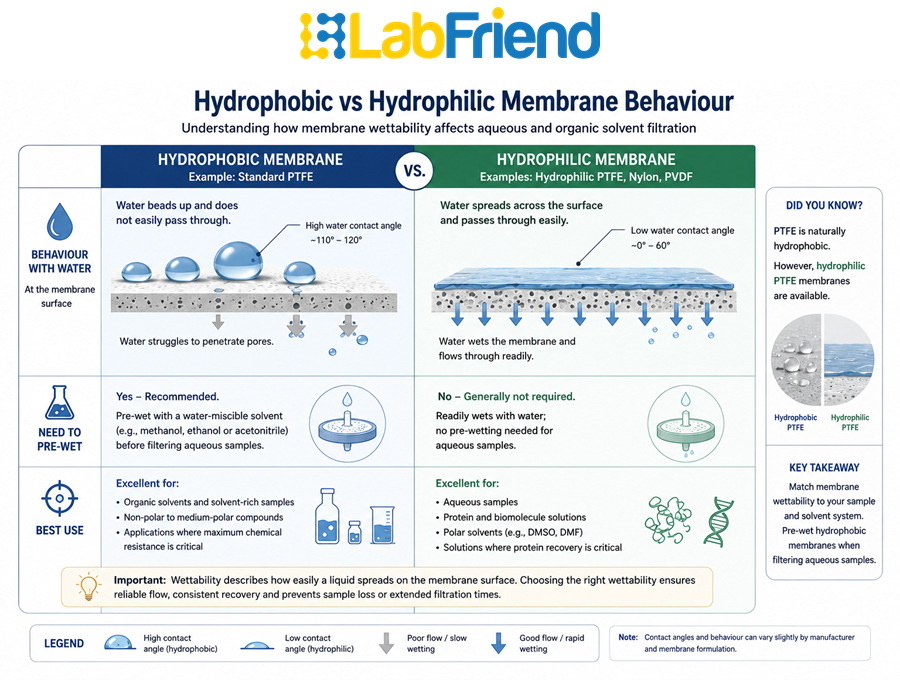
It is worth noting that standard PTFE membranes are inherently hydrophobic, meaning water-based liquids do not readily pass through them; aqueous samples typically require pre-wetting with a solvent such as methanol, or the use of a hydrophilic-modified PTFE membrane manufactured specifically for aqueous use.
This reputation is well deserved.
Laboratories routinely working with acetonitrile, methanol, isopropanol, acetone, tetrahydrofuran (THF) and other challenging solvents frequently rely on PTFE because it remains chemically stable under conditions that may be unsuitable for other membrane materials.
However, understanding why PTFE performs well is more valuable than simply remembering that it is "good with solvents."
PTFE possesses a highly fluorinated molecular structure that exhibits extremely low chemical reactivity. This inertness means that many organic solvents pass through the membrane without causing significant degradation or structural change. For analytical laboratories, this translates into reliable performance across a broad range of solvent-based workflows.
Why PTFE Has Become Closely Associated with Chromatography
Chromatography laboratories often represent the environment in which PTFE membranes are most frequently encountered.
Many HPLC and UHPLC methods rely heavily on organic solvents during sample preparation or mobile phase composition. Because PTFE demonstrates excellent compatibility with these solvents, it naturally becomes a popular choice.
However, solvent compatibility is only part of the explanation.
Chromatography laboratories also value consistency.
A membrane that performs reliably across multiple solvent systems simplifies method development and reduces uncertainty when preparing analytical samples.
For this reason, PTFE often appears in laboratories involved in:
- pharmaceutical quality control;
- environmental analysis;
- forensic science;
- chemical manufacturing; and
- analytical research.
This does not mean PTFE should automatically become the default membrane for chromatography.
Experienced scientists recognise that chromatography encompasses many different sample types. Some methods involve predominantly aqueous samples, while others analyse biological materials where adsorption characteristics become more important than solvent resistance.
Consequently, PTFE should be viewed as one option within a broader membrane selection strategy rather than a universal solution.
Readers interested specifically in solvent-driven membrane selection should also explore:
Choosing the Right Syringe Filter for Organic Solvents
Practical Laboratory Scenario — Pharmaceutical Quality Control
Imagine a pharmaceutical quality control laboratory responsible for analysing finished drug products using an established HPLC method.
The analytical procedure requires samples to be prepared in a mobile phase containing a high proportion of acetonitrile.
A newly appointed analyst notices that several membrane options are available in the laboratory and asks whether Nylon filters would perform equally well.
Rather than answering with a simple yes or no, the senior scientist explains the reasoning behind the laboratory's validated procedure.
The decision to use PTFE was not made because PTFE is inherently "better". It was made because the method involves repeated exposure to aggressive organic solvents, and PTFE provides the chemical stability required under those operating conditions.
The conversation illustrates an important principle.
Experienced laboratories validate membrane selection against the analytical method itself.
Once validated, the membrane becomes part of the method rather than an interchangeable consumable.
Strengths of PTFE Membranes
PTFE membranes are particularly valued where chemical resistance is the dominant consideration.
They are widely recognised for:
- excellent compatibility with many organic solvents;
- strong chemical inertness;
- suitability for demanding analytical applications;
- reliable performance within solvent-intensive chromatography workflows; and
- broad acceptance across analytical laboratories.
These strengths explain why PTFE occupies such an important position within laboratory filtration.
Yet focusing only on these advantages risks overlooking an equally important point.
Every membrane technology represents a compromise between different performance characteristics.
PTFE is exceptionally strong in some areas.
Other membrane materials may perform better where biological compatibility, protein recovery or different sample chemistries are involved.
Understanding those differences is what allows scientists to select the most appropriate membrane rather than simply the most familiar one.
Understanding Nylon Membranes
Where PTFE is often associated with chemical resistance, Nylon has traditionally been recognised as one of the most versatile general-purpose membrane materials used in analytical laboratories.
Its popularity has developed over many years because it combines good mechanical strength with broad applicability across a wide variety of routine laboratory workflows.
Many scientists first encounter Nylon membranes during routine analytical work where samples contain predominantly aqueous solutions or mixed solvent systems. Because Nylon performs reliably in numerous everyday applications, laboratories often keep it as part of their standard consumables inventory.
However, describing Nylon simply as a "general-purpose membrane" understates the reasons why it continues to be widely used.
Its popularity reflects a balance of characteristics rather than excellence in any single area.
Understanding that balance is essential when comparing Nylon with PTFE and PVDF.
Unlike PTFE, whose reputation is largely built upon exceptional chemical resistance, Nylon's strength lies in its versatility. To understand when Nylon is the better choice, it is necessary to examine how its physical and chemical characteristics influence real laboratory workflows.
It should also be noted that Nylon is generally unsuitable for strong acids, strong bases and certain aggressive solvents such as DMSO and DMF, which can degrade the membrane; laboratories working with these reagents typically require PTFE or another validated alternative instead.
Nylon Membranes
Nylon membranes have been used in analytical laboratories for decades and remain one of the most familiar membrane materials available. Their continued popularity is not simply the result of tradition. Rather, it reflects a combination of mechanical robustness, broad solvent compatibility and reliable performance across many routine filtration applications.
This balance makes Nylon particularly attractive for laboratories that process diverse sample types. Unlike membranes developed primarily for highly specialised applications, Nylon is often capable of supporting a wide range of analytical workflows without requiring laboratories to maintain an extensive inventory of different membrane materials.
However, versatility should never be mistaken for universality.
Every membrane technology reflects a series of engineering compromises. The characteristics that make Nylon an excellent choice for one application may make another membrane more suitable elsewhere. Understanding those trade-offs is far more valuable than memorising lists of compatible solvents or applications.
Why Laboratories Continue to Use Nylon
One of Nylon's greatest strengths is its adaptability.
Many quality control laboratories, environmental testing facilities and university research laboratories routinely analyse samples with varying compositions. Maintaining a practical, reliable membrane that performs well across many of these applications simplifies both purchasing and laboratory standardisation.
This explains why Nylon often appears within laboratories undertaking:
- routine analytical chemistry;
- environmental monitoring;
- food and beverage testing;
- chemical manufacturing;
- academic research.
In these environments, the membrane's combination of strength, durability and dependable filtration characteristics often provides an excellent balance between technical performance and operational practicality.
It is worth noting that Nylon carries a slight inherent affinity for certain basic or cationic compounds, which is why method validation is recommended before adopting Nylon for trace-level or basic analyte quantification.
Nevertheless, experienced laboratories recognise that this versatility does not eliminate the need to evaluate compatibility for each analytical method.
Practical Laboratory Scenario — Environmental Testing
Consider an environmental laboratory responsible for analysing river water collected from multiple sampling locations.
Unlike pharmaceutical laboratories, where sample composition is tightly controlled, environmental samples frequently vary in particulate loading, dissolved organic material and chemical composition.
The laboratory therefore requires a membrane capable of coping with changing sample conditions while maintaining consistent filtration performance.
Nylon proves effective because it provides dependable mechanical performance across many routine analyses. However, before introducing the membrane into newly validated analytical methods, the laboratory still confirms that membrane interactions do not influence analyte recovery or chromatographic performance.
The important lesson is that laboratories do not choose Nylon because it is universally applicable.
They choose it because, following evaluation, it provides the most appropriate balance of performance for the applications they routinely perform.
Understanding PVDF Membranes
PVDF (polyvinylidene fluoride) occupies an interesting position within laboratory filtration because its strengths become particularly valuable where biological and analytical science intersect.
Scientists working with proteins, enzymes or other biologically significant molecules frequently encounter discussions surrounding PVDF because of its favourable adsorption characteristics compared with many alternative membrane materials.
For this reason, PVDF has become well established within biotechnology, pharmaceutical research and life science laboratories where maintaining sample integrity is especially important.
Nylon and PVDF membranes are also commonly available in sterile, autoclavable formats, which is often relevant for biotechnology and cell culture workflows; PTFE device compatibility with autoclaving varies by product and should be checked against the specific manufacturer's specification.
However, as with every membrane discussed in this article, PVDF should not be viewed as the "best" membrane.
Its value depends entirely upon the analytical context.
Understanding why PVDF performs well in particular applications provides much greater insight than simply remembering where it is commonly used.
Why Protein Binding Matters
Many analytical samples contain compounds that interact readily with membrane surfaces.
If these interactions are significant, the amount of analyte reaching the analytical instrument may differ from the amount originally present within the sample.
In highly sensitive analytical methods, even relatively small losses may influence quantitative results.
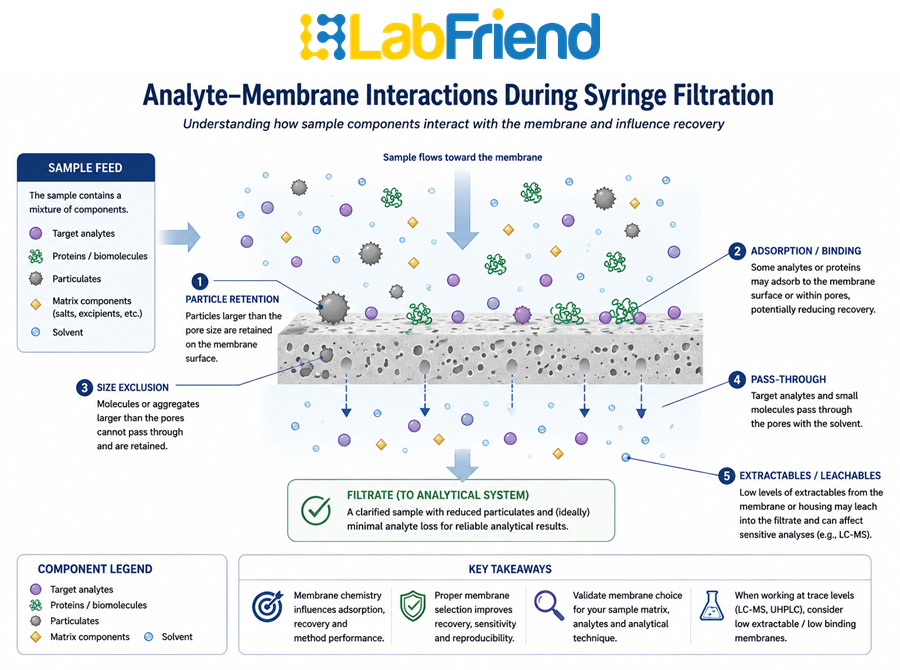
Consequently, laboratories working with biological samples frequently consider adsorption characteristics alongside more familiar properties such as solvent compatibility and pore size.
PVDF has therefore become an important option for applications where preserving biological sample integrity is a priority.
It is not selected because it filters particles more effectively than other membranes.
It is selected because its interaction with particular sample types may be advantageous within carefully defined analytical workflows.
Practical Laboratory Scenario — Biotechnology Research
Imagine a biotechnology research laboratory investigating recombinant proteins.
Scientists routinely prepare small-volume samples before chromatographic analysis.
The laboratory has previously used PTFE membranes successfully for solvent-based analytical methods. However, when applying the same membrane to protein-containing samples, recovery studies indicate that an alternative membrane provides more favourable analytical performance.
Following method validation, PVDF becomes the standard membrane for that workflow.
Nothing about the PTFE membrane has changed.
The sample has changed.
This distinction illustrates one of the most important principles within laboratory filtration.
Membrane selection should always reflect the chemistry of the sample rather than the familiarity of the membrane.
Direct Comparison — PTFE vs Nylon vs PVDF
Having examined each membrane individually, the next step is understanding how they compare when evaluated side by side.
One of the most common mistakes laboratories make is assuming that comparison tables alone provide sufficient guidance.
In reality, comparison tables are useful summaries, but they cannot replace scientific judgement.
The value of the following comparisons lies not simply in the individual ratings but in understanding why those differences exist.
Comparison Table — General Membrane Characteristics
The table below summarises how PTFE, Nylon and PVDF typically compare across key selection criteria:
|
Characteristic |
PTFE |
Nylon |
PVDF |
|
Typical Strength |
Chemical resistance |
General versatility |
Biological compatibility |
|
Organic solvent performance |
Excellent |
Good to very good (application dependent) |
Good (application dependent) |
|
Aqueous sample suitability |
Often requires consideration of membrane wettability |
Commonly used |
Commonly used |
|
Biological applications |
Application dependent |
Application dependent |
Frequently preferred where biological compatibility is important |
|
Routine analytical versatility |
High within solvent-intensive work |
Very high |
High within life science applications |
Note on the table above: the PTFE “wettability” consideration means that untreated, hydrophobic PTFE may show inconsistent flow or air-locking with aqueous samples unless a hydrophilic PTFE membrane is used; the PVDF “aqueous” rating refers specifically to hydrophilic PVDF, since hydrophobic PVDF variants are intended for different applications such as gas venting; and Nylon’s organic solvent rating excludes strong acids, strong bases and solvents such as DMSO and DMF, which are generally incompatible with Nylon.
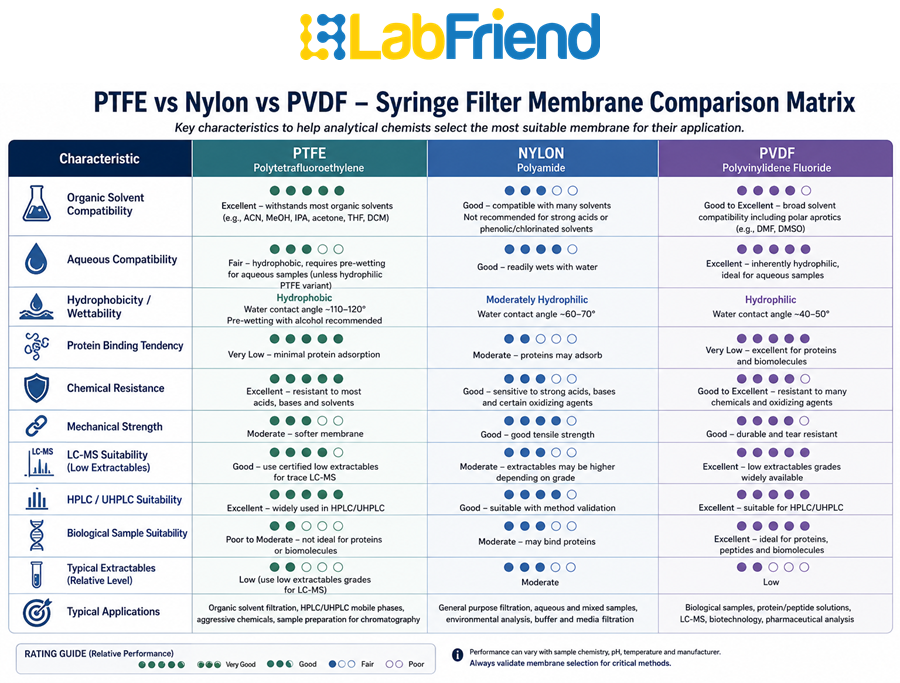
This comparison highlights that no membrane dominates every category.
PTFE clearly excels where chemical resistance is critical.
Nylon demonstrates excellent versatility across many routine analytical applications.
PVDF becomes particularly attractive when biological sample characteristics influence membrane selection.
Understanding these strengths helps laboratories ask a more useful question:
"Which membrane best matches this analytical method?"
rather than
"Which membrane is generally regarded as the best?"
Comparison Table — Typical Laboratory Applications
The table below illustrates the membrane most frequently considered within different laboratory environments:
|
Laboratory Environment |
Membrane Frequently Considered |
|
Organic solvent filtration |
PTFE |
|
Pharmaceutical HPLC |
PTFE or application-validated alternative |
|
Routine analytical chemistry |
Nylon |
|
Environmental monitoring |
Nylon (following method validation) |
|
Biotechnology |
PVDF |
|
Protein analysis |
PVDF |
|
Academic research |
Application dependent |
Again, this table should never be interpreted as a rigid set of rules.
Many laboratories legitimately reach different conclusions based upon sample composition, analytical method and validation requirements.
The purpose of the table is to illustrate trends rather than prescribe mandatory choices.
It is also worth considering device diameter alongside membrane chemistry: syringe filters are commonly available in diameters such as 4 mm, 13 mm, 25 mm and 33 mm, and larger diameters increase membrane surface area, improving flow rate and throughput for higher sample volumes or samples with heavier particulate loading.
Which Membrane Should You Choose?
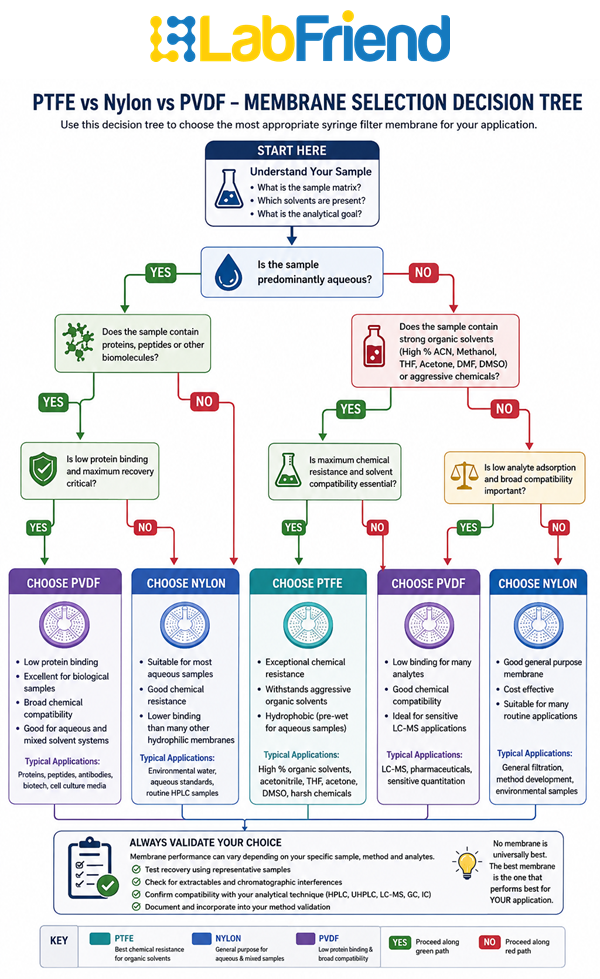
After comparing the characteristics of PTFE, Nylon and PVDF, it becomes clear that membrane selection is fundamentally an exercise in understanding the analytical problem rather than selecting the membrane with the longest list of desirable properties.
Experienced laboratories rarely begin with the membrane.
They begin with the sample.
Questions typically include:
- What solvents are present?
- Are biological molecules involved?
- What analytical technique will follow filtration?
- Is analyte adsorption a concern?
- What has previous validation demonstrated?
Only after answering these questions does membrane selection become straightforward.
This approach explains why different laboratories often adopt different membrane strategies while all achieving excellent analytical performance.
Their decisions reflect different scientific requirements rather than differing levels of expertise.
Practical Laboratory Scenario — University Research
A university research group is developing a new analytical method involving several experimental sample matrices.
Rather than committing immediately to one membrane material, the scientists compare PTFE, Nylon and PVDF under representative operating conditions.
Recovery studies, chromatographic performance and reproducibility are evaluated before the method is finalised.
Although this process requires additional work during development, it produces a validated filtration procedure that remains robust throughout the lifetime of the research programme.
The additional effort invested at the beginning prevents far greater troubleshooting later.
This philosophy underpins many successful analytical laboratories.
Filtration is viewed not as a routine consumable decision but as part of analytical method development itself.
Common Membrane Selection Mistakes
Interestingly, many membrane selection errors occur not because scientists misunderstand membrane chemistry, but because they attempt to simplify membrane selection into fixed rules.
Examples include:
- assuming PTFE is always the best membrane;
- choosing Nylon purely because it is already stocked;
- selecting PVDF whenever biological samples are mentioned without considering the analytical method;
- overlooking compatibility validation; or
- assuming previous success automatically guarantees future suitability.
These decisions are understandable.
They also illustrate why laboratories benefit from structured filtration guidance and documented validation procedures.
Readers wishing to explore these wider issues should also consult:
Common Filtration Mistakes in Analytical Laboratories and How to Avoid Them
Recognising the Symptoms of an Incorrect Membrane Choice
An incorrect membrane choice does not always announce itself immediately, but several symptoms are worth watching for: unexpectedly low analyte recovery, slow or inconsistent filtration flow, air-locking with aqueous samples, unexpected or elevated background peaks in chromatographic data, or premature membrane clogging. Any of these may indicate that the membrane chemistry, rather than the pore size or technique, should be reviewed.
Storage and handling also affect membrane performance. Syringe filters should generally be kept in their original packaging until immediately before use, handled to avoid contamination of the membrane surface, and stored according to the manufacturer's recommended shelf-life and storage conditions.
Having compared the three membrane materials in detail, the final step is understanding how experienced laboratories convert these technical comparisons into consistent, evidence-based membrane selection procedures.
Selecting the correct membrane is not simply about knowing the strengths of PTFE, Nylon or PVDF. It is about applying that knowledge consistently across different projects, different analysts and different analytical methods. The laboratories that achieve the highest levels of reproducibility are rarely those with the largest product ranges. More often, they are the laboratories that have developed a structured approach to membrane selection and validation.
Building an Evidence-Based Membrane Selection Strategy
One of the defining characteristics of mature analytical laboratories is that membrane selection is documented rather than improvised.
When a new analytical method is developed, membrane selection is considered alongside several other factors. These include column chemistry, mobile phase composition, calibration strategy and sample preparation. Once the optimum membrane has been demonstrated through validation, that decision becomes part of the analytical method itself.
This approach offers several important advantages.
Scientists spend less time questioning routine filtration decisions because validated guidance already exists.
Purchasing teams benefit from a rationalised range of approved membrane products rather than an expanding inventory driven by personal preference.
Training becomes simpler because new laboratory staff learn the reasoning behind membrane selection rather than inheriting undocumented habits.
Most importantly, analytical performance becomes more consistent because membrane choice is no longer an uncontrolled variable.
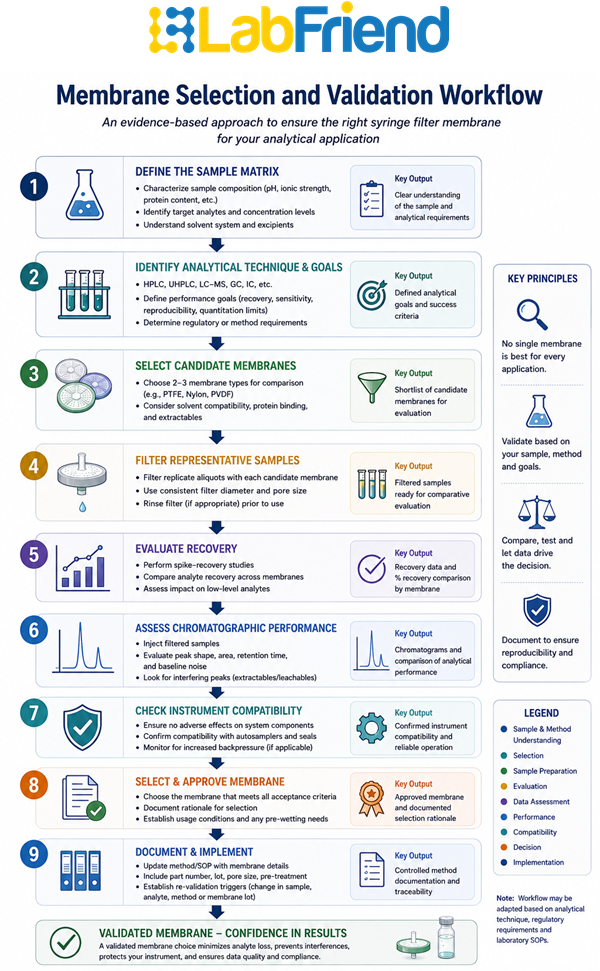
A Practical Membrane Selection Framework
Although every laboratory has unique requirements, the underlying decision-making process is remarkably consistent.
Rather than asking which membrane is generally regarded as the best, experienced scientists work through a logical sequence of technical questions.
Step 1 — Understand the Sample
The first consideration should always be the sample itself.
Questions include:
- Is the sample predominantly aqueous?
- Does it contain aggressive organic solvents?
- Are proteins or other biological molecules present?
- Could membrane adsorption influence recovery?
- Does the sample contain significant particulate material?
Understanding the chemistry of the sample provides the foundation for every subsequent filtration decision.
Step 2 — Consider the Analytical Technique
Different analytical techniques place different demands on filtration.
For example, an HPLC method designed to quantify trace impurities may require a different membrane strategy from a routine quality control assay. This is because the two methods typically differ in both sample matrix and required analytical sensitivity.
Similarly, biotechnology laboratories frequently prioritise sample recovery characteristics that may be less critical within environmental monitoring or industrial chemistry.
The analytical objective therefore becomes just as important as the sample composition.
Step 3 — Evaluate Membrane Characteristics
Only after understanding the analytical context should the laboratory evaluate membrane options.
For PTFE, the question may centre on solvent resistance.
For Nylon, versatility and routine analytical performance may be the priority.
For PVDF, biological compatibility and recovery characteristics may be particularly important.
The membrane is selected because its properties support the analytical objective, not because it performs well in unrelated applications.
Step 4 — Validate the Decision
Compatibility charts, technical literature and previous experience all provide valuable guidance.
However, none should replace practical validation.
Where analytical performance is critical, membrane selection should be confirmed using representative samples under normal operating conditions.
Validation transforms membrane selection from informed opinion into documented laboratory knowledge.
Regulated laboratories, particularly within pharmaceutical quality control, may also need to reference relevant compendial or standards guidance, such as USP or ISO filtration and compatibility requirements, as part of this documented validation.
Readers seeking a detailed discussion of compatibility assessment should also refer to:
How UK Laboratories Can Validate Filtration Membrane Chemical Compatibility
Comparison Matrix — Selecting Between PTFE, Nylon and PVDF
The matrix below summarises how a primary sample requirement typically maps to a recommended membrane and the underlying rationale:
|
Primary Requirement |
Membrane Frequently Selected |
Why |
|
High exposure to organic solvents |
PTFE |
Excellent chemical resistance across many solvent systems |
|
General-purpose analytical laboratory |
Nylon |
Broad applicability and dependable routine performance |
|
Protein-containing samples |
PVDF |
Often selected where biological compatibility is an important consideration |
|
Method development |
Application dependent |
Selection should be based on validation rather than assumption |
|
Mixed analytical portfolio |
Combination of validated membranes |
Different workflows may legitimately require different solutions |
This comparison reinforces an important theme that has run throughout the article.
The question is rarely whether PTFE is superior to Nylon or whether PVDF is preferable to both.
The more useful question is:
"Which membrane characteristics best support this analytical method?"
Once that perspective is adopted, membrane selection becomes significantly more straightforward.
Practical Laboratory Scenario — Contract Testing Laboratory
A contract testing laboratory performs pharmaceutical, environmental and food analyses within the same facility.
Historically, each department purchased syringe filters independently.
Over time the laboratory accumulated numerous membrane types, several of which served overlapping purposes.
Following a technical review, scientists evaluated the analytical methods used across each department.
Rather than attempting to standardise on a single membrane, they identified a small number of validated membrane combinations capable of supporting the majority of routine workflows.
The result was not only improved purchasing efficiency but also greater consistency between departments, simplified staff training and reduced uncertainty when new methods were introduced.
This illustrates that standardisation does not require fewer scientific choices.
It requires better scientific decisions.
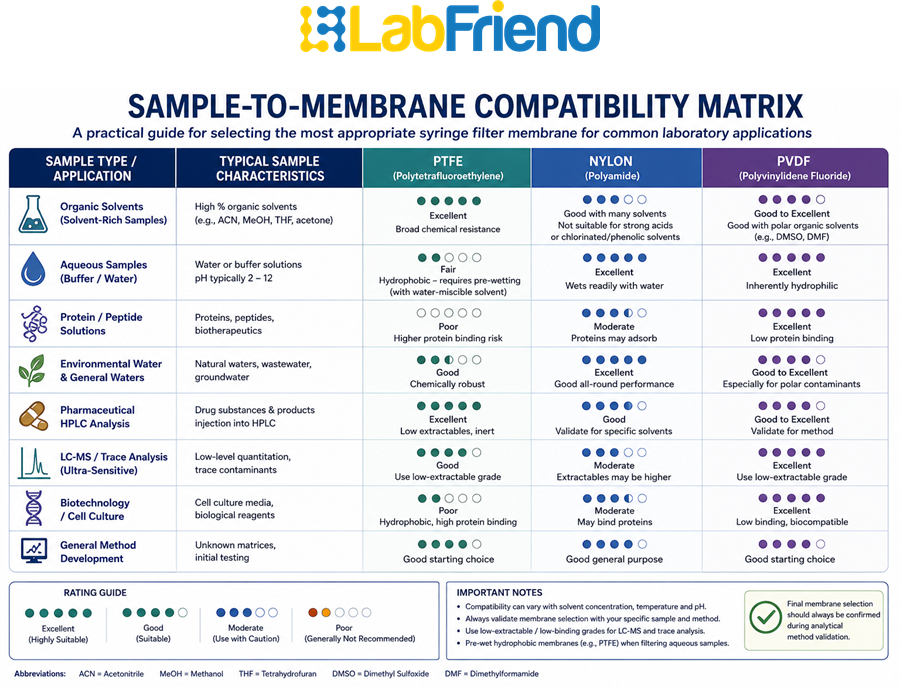
Membrane type can also influence unit cost, and standardising on a small number of validated membranes, as illustrated in the scenario above, often supports more efficient purchasing alongside improved analytical consistency.
Frequently Asked Questions
Which membrane is best: PTFE, Nylon or PVDF?
There is no universally "best" membrane. The most appropriate choice depends on the sample chemistry, analytical technique and validation requirements.
Is PTFE always the best choice for HPLC?
No. PTFE is frequently selected because of its excellent solvent resistance. However, HPLC methods should always use the membrane that has been validated for that specific analytical application.
When should Nylon syringe filters be used?
Nylon is widely used for routine analytical applications where its balance of versatility and mechanical performance supports the analytical method.
When is PVDF a good choice?
PVDF is commonly considered where biological compatibility and sample recovery characteristics are particularly important.
Which membrane performs best with organic solvents?
PTFE is widely recognised for its compatibility with many aggressive organic solvents and is therefore frequently selected for solvent-intensive applications.
Can one membrane replace all others?
In practice, no. Most analytical laboratories benefit from maintaining a small number of validated membrane options suited to different analytical requirements.
Why is membrane validation important?
Validation confirms that the chosen membrane performs appropriately under the actual conditions of the analytical method rather than relying solely on theoretical compatibility.
Can membrane choice influence analytical recovery?
Yes. Interactions between the membrane and the sample may influence recovery in some analytical applications.
Does pore size determine membrane compatibility?
No. Pore size and membrane chemistry address different aspects of filtration and should be considered independently.
Should laboratories standardise membrane selection?
Yes, where appropriate. Standardisation improves consistency while still allowing specialised membranes for applications that genuinely require them.
Can the wrong membrane damage analytical instruments?
Indirectly, yes. Inappropriate filtration may allow particulate material or unwanted contaminants to reach sensitive instrumentation.
Is chemical compatibility the only consideration?
No. Adsorption characteristics, sample recovery, analytical sensitivity and intended application should also influence membrane selection.
Why do different laboratories choose different membranes?
Because their samples, analytical methods and validation requirements differ. Different membrane choices can all be technically correct when supported by evidence.
How often should membrane selection be reviewed?
Whenever analytical methods, sample matrices or laboratory requirements change significantly.
Where can I learn more about syringe filter selection?
LabFriend's laboratory filtration knowledge centre provides detailed guidance covering membrane chemistry, pore size, compatibility, chromatography and filtration best practice.
Further Reading
For a broader understanding of laboratory filtration and membrane selection, explore the following authority resources:
The Ultimate Guide to Laboratory Filtration for UK Laboratories
The Ultimate Syringe Filter Guide: Pore Size, Membranes and Applications
Why Regenerated Cellulose (RC) Membranes Are The Universal Standard for Lab Filtration
0.22 µm vs 0.45 µm Syringe Filters: When Should You Use Each?
Best Syringe Filters for HPLC and UHPLC Sample Preparation
Choosing the Right Syringe Filter for Organic Solvents
Hydrophilic vs Hydrophobic Membranes: How to Choose the Right Filter for Your Laboratory Application
The Complete Guide to Chromatography Consumables for UK Laboratories
Conclusion
Comparing PTFE, Nylon and PVDF syringe filters is ultimately less about identifying a winner and more about understanding how membrane chemistry influences analytical performance.
Each membrane has evolved to address different laboratory challenges. PTFE offers exceptional chemical resistance that makes it well suited to many solvent-intensive workflows. Nylon provides dependable versatility across a broad spectrum of routine analytical applications. PVDF offers characteristics that make it particularly valuable where biological sample integrity and recovery are important considerations.
This article has focused on PTFE, Nylon and PVDF as the three membranes most frequently encountered in analytical laboratories; other materials, such as PES, cellulose acetate, mixed cellulose ester, glass fibre and regenerated cellulose, exist for more specific applications outside this article's scope. Readers wishing to explore regenerated cellulose specifically can refer to the Further Reading section above.
The laboratories that achieve the greatest analytical consistency recognise that membrane selection is neither arbitrary nor purely historical. It is an evidence-based decision that forms part of method development, validation and quality assurance.
Rather than asking which membrane is universally best, experienced scientists ask which membrane has been demonstrated to be the most appropriate for the analytical method being performed.
That subtle change in perspective transforms membrane selection from a consumables decision into a scientific decision.
As analytical methods continue to evolve and instrument sensitivity increases, thoughtful membrane selection will remain an essential part of producing reliable, reproducible and defensible laboratory data.
Explore LabFriend's Laboratory Filtration Solutions
Whether you are validating a new analytical method, comparing membrane materials or standardising laboratory filtration procedures, LabFriend provides a comprehensive range of syringe filters and laboratory filtration products supported by practical technical guidance.
Explore our Laboratory Filtration Equipment:
Browse our Syringe Filters:
For membrane-specific browsing, PTFE, Nylon and PVDF syringe filters can each be filtered directly within the Syringe Filters category above using the membrane material filter.
Written by: Donal O’Sullivan, BSc, Co-Founder and Sales Director, LabFriend UK. Donal brings deep chemistry-led technical expertise across analytical chemistry, biochemistry, environmental monitoring, laboratory instrumentation, consumables and scientific product selection.
Reviewed by: Michael Anderson, MBA, Founder and Managing Director, LabFriend UK. Michael reviews LabFriend UK content for customer relevance, commercial accuracy, operational practicality and alignment with LabFriend UK’s laboratory supply model.
Frequently asked questions
Delivery times vary by product and supplier. Each product page shows current stock levels and the expected lead time, and we confirm this when you place your order. Most items arrive within 2 to 3 weeks. Specialised items can take longer if they are not in stock. If you need something by a certain date, contact us and we’ll check for you.
Yes. Register for a commercial account and, once it’s approved, you will be able to process orders via PO Once you have a commercial account, you can directly email your purchase orders
Add products to your cart and click Get a Quote. You’ll get a formal quote instantly, ready to send to your email address. For bulk orders or custom requirements, send us your product list and we’ll reply with itemized pricing.
If your item is faulty, not as described or sent in error, let us know within 14 days of delivery and we’ll arrange a return. Change of mind returns are only accepted if the item is unused and in its original packaging. A restocking fee will apply and you pay the return freight. Read our full Returns Policy for details.
Yes, prices are shown including VAT by default. Use the Prices Inc. VAT toggle at the top of the page to view prices without VAT.