

Share :
Hydrophilic vs Hydrophobic Membranes: How to Choose the Right Filter for Your Laboratory Application
Updated On 07/17/2026

By Donal O’Sullivan, BSc. Reviewed by Michael Anderson, MBA.
Executive SummarySelecting the correct membrane is one of the most important decisions in laboratory filtration. While scientists often focus on pore size, membrane wettability frequently has a greater influence on filtration performance, sample compatibility and analytical reliability. The first question laboratories should ask is: "Am I filtering an aqueous sample or an organic solvent?" The answer often determines whether a hydrophilic or hydrophobic membrane is most appropriate. However, membrane wettability should not be considered in isolation. Chemical compatibility between the membrane and the sample remains the primary selection criterion, and several hydrophilic membranes (particularly regenerated cellulose) are widely used with mixed aqueous-organic solvent systems. |
As a general guide:
|
Sample Type |
Typical Membrane Choice |
|
Water |
Hydrophilic |
|
Buffers |
Hydrophilic |
|
Cell Culture Media |
Hydrophilic |
|
Biological Samples |
Hydrophilic |
|
Protein Solutions |
Hydrophilic |
|
Organic Solvents |
Hydrophobic |
|
Acetonitrile Solutions |
Hydrophobic |
|
Methanol Solutions |
Hydrophobic |
|
IPA Solutions |
Hydrophobic |
Hydrophilic membranes are designed to interact readily with water-based samples.
Hydrophobic membranes repel water but often provide superior compatibility with organic solvents and gas filtration applications.
Understanding this distinction helps laboratories:
- Improve filtration efficiency
- Reduce membrane selection errors
- Improve analytical reproducibility
- Protect chromatography systems
- Standardise laboratory workflows
- Simplify purchasing decisions
For a broader understanding of filtration technologies and laboratory filtration workflows, see:
The Ultimate Guide to Laboratory Filtration for UK Laboratories
Why Membrane Selection Is More Important Than Many Laboratories Realise
When laboratories experience filtration problems, attention is often directed towards:
- Pore size
- Filter diameter
- Flow rate
- Sample viscosity
While these factors are important, many filtration issues actually originate from incorrect membrane selection.
Examples include:
- Water failing to pass through a hydrophobic membrane
- Poor recovery of biological samples
- Reduced filtration efficiency
- Unexpected analytical variability
- Solvent incompatibility
- Premature filter blockage
These issues frequently arise because membrane wettability was not considered during filter selection.
Understanding membrane behaviour is therefore fundamental to effective laboratory filtration.
Before selecting membrane technologies, laboratories should understand the broader principles of laboratory filtration.
Read the Ultimate Guide to Laboratory Filtration for UK Laboratories
Why Membrane Wettability Matters in Laboratory Filtration
Membrane wettability describes how easily a liquid spreads across and penetrates a membrane surface.
This seemingly simple characteristic influences almost every aspect of filtration performance.
A membrane that readily interacts with water behaves very differently from one that naturally repels it.
The consequences affect:
- Filtration speed
- Sample compatibility
- Recovery rates
- Workflow efficiency
- Method robustness
In practical terms, wettability determines whether a membrane is naturally suited to:
- Water-based solutions
- Organic solvent systems
- Gas filtration
- Biological samples
- Chromatography sample preparation
For many laboratories, membrane wettability is the single most important factor influencing filtration success.
Hydrophilic versus hydrophobic behaviour should be considered the first stage of membrane selection. Once wettability requirements have been established, membrane chemistry, analyte recovery, protein binding and extractables become equally important selection criteria.
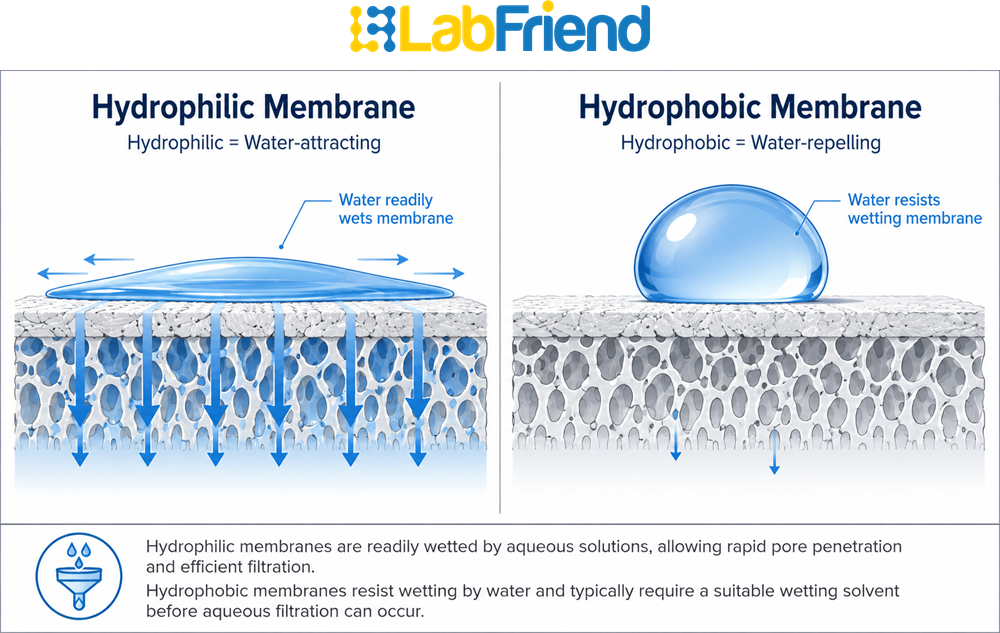
Understanding Surface Energy
The reason membranes behave differently lies in surface chemistry.
Hydrophilic materials possess surface characteristics that attract water molecules.
Hydrophobic materials possess surface characteristics that repel water molecules.
This influences how liquids interact with the membrane surface.
A hydrophilic membrane allows water to rapidly wet the membrane.
A hydrophobic membrane resists wetting and may prevent water from passing through unless special procedures are used.
This difference becomes critically important during routine laboratory filtration.
Hydrophobic membranes require sufficient pressure to overcome capillary forces within the pores, which is why aqueous solutions often fail to pass through unwetted hydrophobic membranes.
Real Laboratory Example
Consider two laboratories filtering the same aqueous buffer solution.
Laboratory A selects a hydrophilic regenerated cellulose membrane.
The buffer rapidly wets the membrane and filtration proceeds efficiently.
Laboratory B selects a hydrophobic PTFE membrane.
The buffer struggles to penetrate the membrane surface and filtration may be extremely slow or ineffective unless the membrane is pre-wetted with a suitable wetting solvent.
The difference is not pore size.
The difference is membrane wettability.
This example illustrates why understanding hydrophilic and hydrophobic behaviour is essential for successful membrane selection.
What Is a Hydrophilic Membrane?
A hydrophilic membrane is a membrane that naturally attracts water.
When an aqueous solution contacts a hydrophilic membrane surface, the liquid readily spreads across the membrane and enters the pore structure.
This makes hydrophilic membranes particularly suitable for:
- Water
- Aqueous buffers
- Cell culture media
- Biological samples
- Protein solutions
- Many analytical chemistry applications
Because no pre-wetting is normally required, hydrophilic membranes are often easier to use for routine laboratory filtration.
Characteristics of Hydrophilic Membranes
Hydrophilic membranes typically exhibit:
- Rapid wetting by water
- Efficient aqueous filtration
- Strong compatibility with biological samples
- Good flow performance
- Reduced user intervention
For laboratories processing primarily aqueous samples, hydrophilic membranes are usually the preferred starting point.
Advantages of Hydrophilic Membranes
Ease of Use
Hydrophilic membranes generally require little preparation before filtration.
Water-based samples can often be filtered immediately.
Faster Workflow Integration
Because wetting occurs naturally, filtration procedures can be simpler and more reproducible.
Better Compatibility with Biological Samples
Many biological workflows involve aqueous solutions.
Hydrophilic membranes are therefore widely used in:
- Cell culture
- Biotechnology
- Pharmaceutical development
- Protein research
Strong Chromatography Utility
Many chromatography workflows utilise aqueous or mixed aqueous-organic samples.
As a result, hydrophilic membranes are commonly used for:
- HPLC sample preparation
- UHPLC sample preparation
- LC-MS sample preparation
- Analytical chemistry workflows
For chromatography-specific filtration guidance, see:
Best Syringe Filters for HPLC and UHPLC Sample Preparation
Common Hydrophilic Membrane Families
Several membrane technologies fall within the hydrophilic category.
Each offers different performance characteristics and application strengths.
Understanding these differences allows laboratories to select the most appropriate membrane for specific workflows.
Regenerated Cellulose (RC)
Regenerated cellulose is one of the most versatile hydrophilic membrane materials available.
It is widely used because it combines:
- Broad chemical compatibility
- Low extractables
- Low protein binding
- High sample recovery
- Compatibility with aqueous and mixed solvent systems
These characteristics make RC membranes particularly attractive for laboratories seeking to standardise filtration procedures.
Many laboratories use RC membranes across:
- HPLC workflows
- UHPLC workflows
- Environmental testing
- Food analysis
- Pharmaceutical QC
- Academic research
Because RC performs well across a wide range of aqueous and mixed-solvent applications, it is often regarded as one of the most versatile membrane technologies available.
For a detailed discussion of RC membrane technology, see:
Why Regenerated Cellulose (RC) Membranes Are The Universal Standard for Lab Filtration
Polyethersulfone (PES)
PES membranes are another important hydrophilic membrane technology.
They are particularly valued for:
- High flow rates
- Low protein binding
- Excellent aqueous compatibility
PES membranes are commonly used in:
- Biological laboratories
- Cell culture workflows
- Buffer preparation
- Protein filtration
For many biotechnology applications, PES provides excellent performance.
Nylon
Nylon membranes are naturally hydrophilic and have historically been used across a wide range of analytical laboratories.
Advantages include:
- Good chemical resistance
- Broad application range
- Strong mechanical durability
Nylon remains popular in many routine analytical workflows.
However, depending on the application, some laboratories may prefer RC or PES membranes where lower protein binding is important.
Hydrophilic PVDF
Hydrophilic variants of PVDF combine:
- Low protein binding
- Good chemical compatibility
- Strong sample recovery
These characteristics make hydrophilic PVDF attractive for sensitive biological and analytical applications.
Hydrophilic PTFE
Hydrophilic PTFE membranes combine the broad chemical resistance associated with PTFE with improved compatibility for aqueous and mixed-solvent samples.
They are increasingly used in analytical laboratories where:
- Broad solvent compatibility is required
- Mixed aqueous-organic samples are common
- Low extractables are important
Hydrophilic PTFE can provide a useful alternative in selected HPLC, UHPLC and LC-MS sample preparation workflows.
Hydrophilic Membrane Selection Matrix
|
Membrane |
Water |
Buffers |
Proteins |
HPLC/UHPLC |
General Laboratory Use |
|
RC |
Excellent |
Excellent |
Excellent |
Excellent |
Excellent |
|
PES |
Excellent |
Excellent |
Excellent |
Good |
Good |
|
Nylon |
Good |
Good |
Moderate |
Good |
Excellent |
|
Hydrophilic PVDF |
Excellent |
Excellent |
Excellent |
Good |
Good |
The table demonstrates why regenerated cellulose frequently becomes the preferred standardisation membrane across many laboratory environments.
Discover why regenerated cellulose membranes have become one of the most versatile filtration technologies used throughout modern analytical laboratories.
Why Regenerated Cellulose (RC) Membranes Are The Universal Standard for Lab Filtration
While hydrophilic membranes dominate aqueous filtration workflows, hydrophobic membranes play an equally important role in laboratory filtration.
Understanding when to use hydrophobic membranes—and when not to use them—is essential for effective membrane selection.
What Is a Hydrophobic Membrane?
A hydrophobic membrane is a membrane that naturally repels water.
Unlike hydrophilic membranes, water does not readily spread across the membrane surface.
Instead, water tends to bead on the surface, making it difficult for aqueous solutions to penetrate the membrane pores.
This behaviour is often viewed as a limitation.
In reality, it is one of the key reasons hydrophobic membranes are so valuable in certain applications.
Hydrophobic membranes excel in:
- Organic solvent filtration
- Aggressive chemical filtration
- Gas filtration
- Vent filtration
- Air sterilisation
- Solvent-intensive chromatography workflows
For these applications, hydrophobic membranes frequently outperform hydrophilic alternatives.
Characteristics of Hydrophobic Membranes
Hydrophobic membranes typically exhibit:
- Water repellence
- Strong organic solvent compatibility
- High chemical resistance
- Excellent gas permeability
- Strong durability in aggressive environments
Because of these properties, hydrophobic membranes are often selected when filtration conditions become chemically challenging.
Why Hydrophobic Membranes Are Important
Many scientists initially assume hydrophobic membranes are inferior because they are more difficult to use with water.
However, this perspective overlooks their primary purpose.
Hydrophobic membranes are designed for situations where:
- Water compatibility is not the priority
- Solvent resistance is critical
- Gas transfer is required
- Chemical durability is essential
Within these applications, hydrophobic membranes may be the most appropriate option available.
Common Hydrophobic Membrane Families
Several membrane technologies are classified as hydrophobic.
The most important for laboratory filtration are PTFE and hydrophobic PVDF.
Although standard PTFE membranes are hydrophobic, hydrophilic PTFE variants are also available for specialised aqueous filtration applications.
PTFE (Polytetrafluoroethylene)
PTFE is arguably the best-known hydrophobic membrane material.
Its popularity stems from its exceptional chemical resistance.
PTFE membranes can tolerate many aggressive solvents that may challenge other membrane materials.
Compatibility should nevertheless be verified for the complete filter device, as housings and support materials may have different chemical resistance characteristics from the membrane itself.
Common solvent systems include:
- Methanol
- Acetonitrile
- Isopropanol
- Acetone
- DMSO
- THF
Advantages include:
- Excellent solvent compatibility
- Exceptional chemical resistance
- Low extractables
- Strong analytical performance
These characteristics make PTFE one of the most important membrane technologies used in analytical laboratories.
PTFE in Chromatography
PTFE membranes are frequently selected for chromatography sample preparation involving organic solvents.
Examples include:
- Reversed-phase HPLC
- UHPLC solvent systems
- Pharmaceutical method development
- Analytical chemistry workflows
- Organic synthesis support
Many laboratories use PTFE whenever solvent compatibility becomes the dominant selection criterion.
For a more detailed discussion of solvent filtration:
Choosing the Right Syringe Filter for Organic Solvents
Hydrophobic PVDF
Hydrophobic PVDF membranes provide an alternative to PTFE in some specialist applications.
Advantages include:
- Good chemical resistance
- Protein adsorption characteristics that may be advantageous in selected applications
- Strong filtration performance
- Useful gas filtration characteristics
Hydrophobic PVDF is often encountered in:
- Vent filtration
- Sterile gas filtration
- Specialist analytical workflows
Although less common than PTFE, it remains an important membrane technology.
Hydrophilic vs Hydrophobic Membranes: Side-by-Side Comparison
The following comparison table summarises the key differences between hydrophilic and hydrophobic membranes.
|
Characteristic |
Hydrophilic Membranes |
Hydrophobic Membranes |
|
Water Compatibility |
Excellent |
Poor |
|
Organic Solvent Compatibility |
Good to Excellent |
Excellent |
|
Ease of Wetting |
Excellent |
Limited |
|
Biological Samples |
Excellent |
Limited |
|
Protein Solutions |
Excellent |
Limited |
|
Gas Filtration |
Limited |
Excellent |
|
Vent Filtration |
Limited |
Excellent |
|
Chromatography Applications |
Frequently Used |
Frequently Used (solvent dependent) |
|
Typical Membranes |
RC, PES, Nylon, Hydrophilic PVDF |
PTFE, Hydrophobic PVDF |
For many laboratories, this comparison forms the foundation of membrane selection.
Which Membrane Should You Use for Aqueous Samples?
In most cases, aqueous samples should be filtered using hydrophilic membranes.
Examples include:
- Water
- Buffers
- Cell culture media
- Biological fluids
- Protein solutions
- Aqueous analytical standards
The reason is simple.
Hydrophilic membranes naturally interact with water.
This enables:
- Faster filtration
- Easier handling
- Improved workflow efficiency
- Reduced risk of user error
Membrane wettability should not be confused with sterile filtration capability. Sterile filtration depends primarily on pore size and validated microbial retention characteristics, while membrane wettability determines sample compatibility.
Recommended Hydrophilic Membranes for Aqueous Samples
Regenerated Cellulose
Often the most versatile option.
Suitable for:
- General laboratory filtration
- Chromatography sample preparation
- Mixed aqueous-organic solutions
PES
Particularly useful for:
- Cell culture
- Biological samples
- Protein filtration
Hydrophilic PVDF
Useful when low protein binding is important.
Which Membrane Should You Use for Organic Solvents?
Organic solvents present different challenges.
Water compatibility becomes less important while chemical resistance becomes critical.
Common solvents include:
- Methanol
- Acetonitrile
- IPA
- Acetone
- DMSO
- THF
For these applications, hydrophobic membranes often provide the best solution.
Recommended Hydrophobic Membranes for Organic Solvents
PTFE
PTFE is widely regarded as a preferred membrane for many aggressive solvent filtration applications because of its broad chemical resistance.
Recommended for:
- HPLC sample preparation
- UHPLC sample preparation
- Solvent purification
- Analytical chemistry workflows
Hydrophobic PVDF
Can be useful in certain specialist workflows where solvent compatibility and low adsorption characteristics are both important.
Learn how PTFE membranes perform in solvent-intensive laboratory applications.
Choosing the Right Syringe Filter for Organic Solvents
Membrane Selection for HPLC and UHPLC Sample Preparation
Chromatography laboratories often work with both aqueous and organic solvent systems.
As a result, membrane selection can become more complex.
A scientist preparing a biological sample may require a hydrophilic membrane.
The same scientist may require a hydrophobic PTFE membrane later that day when filtering a solvent-rich sample.
Understanding membrane wettability therefore becomes particularly important within chromatography workflows.
Why Chromatography Laboratories Need a Structured Selection Process
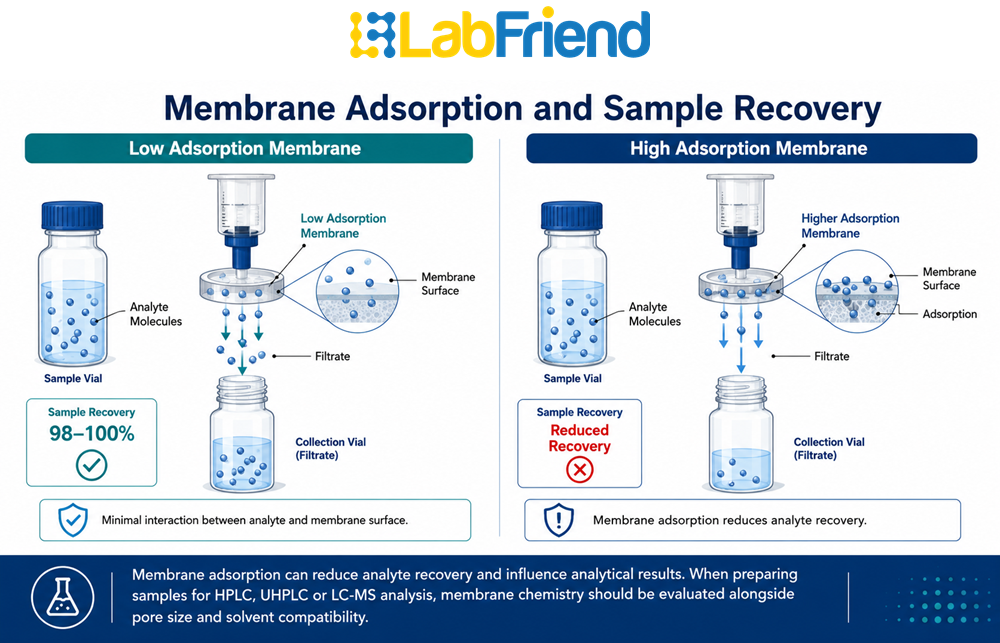
Chromatography systems are sensitive analytical instruments.
Improper membrane selection can contribute to:
- Sample loss
- Contamination
- Reduced reproducibility
- Increased troubleshooting
- Analyte adsorption and reduced recovery
Filtration should therefore be viewed as part of a wider chromatography workflow rather than an isolated laboratory activity.
For detailed chromatography filtration guidance, see:
Best Syringe Filters for HPLC and UHPLC Sample Preparation
Effective chromatography performance depends on more than filtration alone.
Columns, vials, septa, syringe filters and sample preparation consumables all influence analytical performance.
Laboratories seeking a broader understanding of chromatography workflow optimisation should also read:
The Complete Guide to Chromatography Consumables for UK Laboratories
Application Selection Matrix
The following matrix provides a practical starting point for membrane selection.
|
Application |
Recommended Membrane Category |
Typical Membrane |
|
Water Filtration |
Hydrophilic |
RC |
|
Buffer Filtration |
Hydrophilic |
RC or PES |
|
Cell Culture Media |
Hydrophilic |
PES |
|
Protein Samples |
Hydrophilic |
RC, PES or PVDF |
|
HPLC Sample Preparation |
Application Dependent |
RC or PTFE |
|
UHPLC Sample Preparation |
Application Dependent |
RC or PTFE |
|
Organic Solvent Filtration |
Hydrophobic |
PTFE |
|
Acetonitrile Filtration |
Hydrophobic |
PTFE |
|
Methanol Filtration |
Hydrophobic |
PTFE |
|
Gas Filtration |
Hydrophobic |
PTFE |
|
Vent Filtration |
Hydrophobic |
PTFE or PVDF |
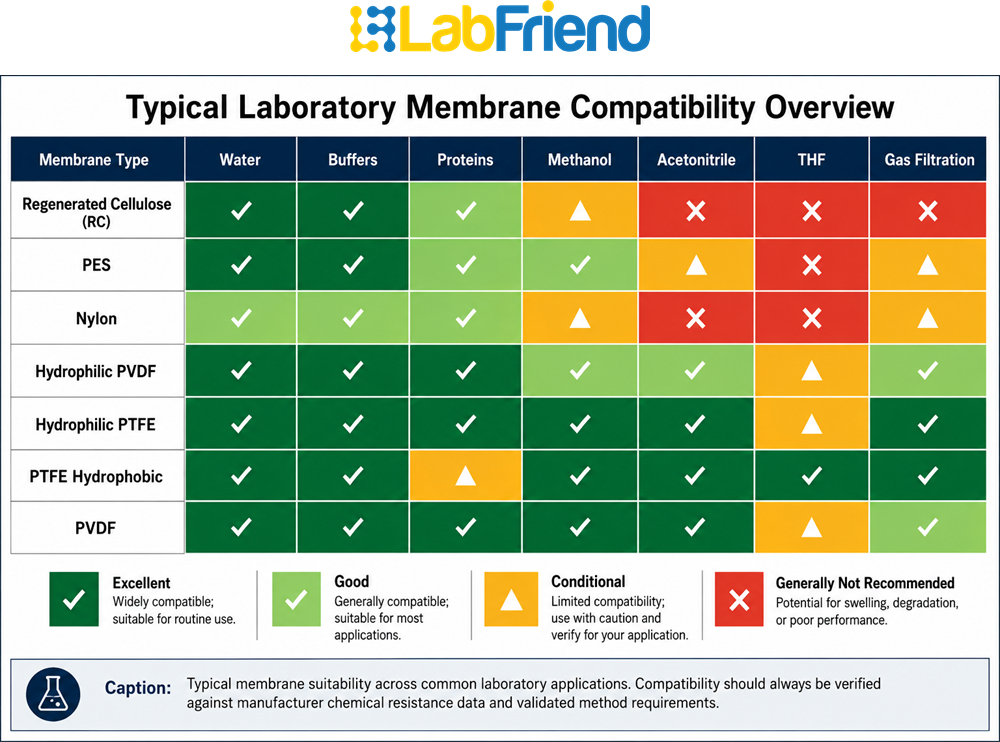
This matrix should be used as a starting point only.
Final membrane selection should always consider:
- Method requirements
- Sample chemistry
- Regulatory requirements
- Validation data
- Manufacturer guidance
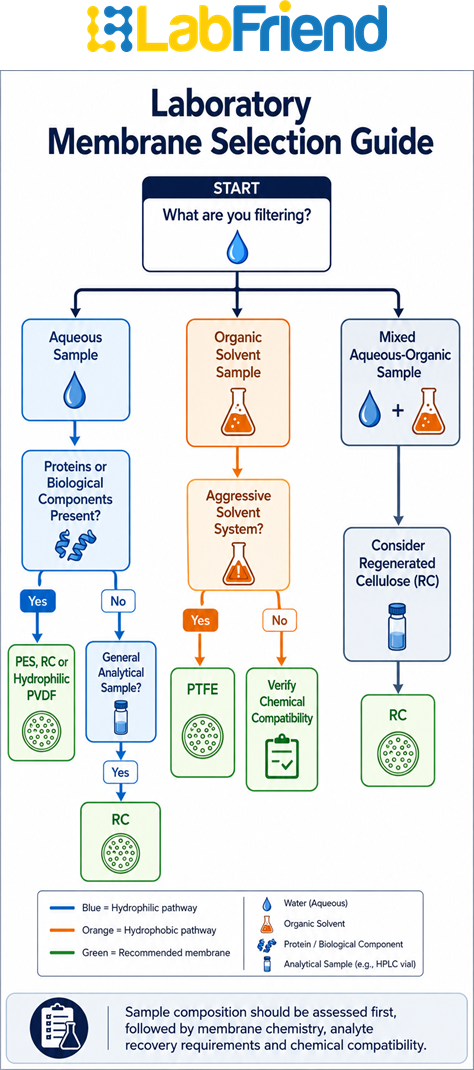
Quick Selection Guide
If your sample is primarily water-based:
→ Start with a hydrophilic membrane.
If your sample is primarily solvent-based:
→ Start with a hydrophobic membrane.
If your sample contains both water and solvents:
→ Evaluate regenerated cellulose first because of its broad compatibility profile.
If you are unsure:
→ Review solvent compatibility before selecting pore size.
For many laboratories, this simple framework eliminates the majority of membrane selection errors.
Although understanding membrane wettability solves many filtration challenges, laboratories still make a number of avoidable membrane selection mistakes.
These errors can affect analytical performance, increase operational costs and create unnecessary troubleshooting work.
Fortunately, most can be prevented through a structured membrane selection process.
Common Membrane Selection Mistakes
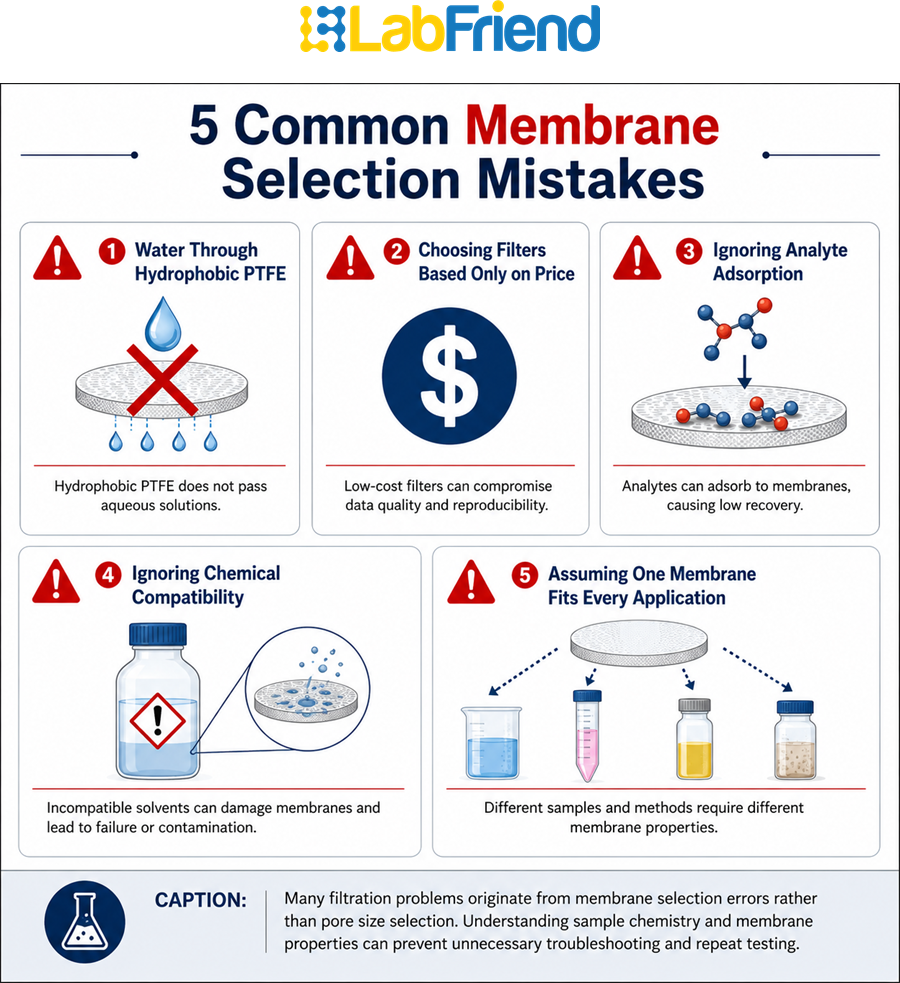
Membrane technology is often treated as a secondary consideration during filtration planning.
In reality, membrane choice can directly influence:
- Sample recovery
- Analytical reproducibility
- Instrument protection
- Regulatory compliance
- Laboratory efficiency
Understanding the most common mistakes helps laboratories build more robust filtration workflows.
Mistake 1: Selecting Membranes Based Solely on Price
Price is often the most visible purchasing metric.
However, selecting membranes purely because they are the lowest-cost option can create hidden costs elsewhere.
Examples include:
- Increased repeat testing
- Poor sample recovery
- Reduced analytical reproducibility
- Additional troubleshooting
- Higher consumable consumption
The true cost of filtration should be assessed across the entire analytical workflow rather than the purchase price alone.
Mistake 2: Ignoring Membrane Wettability
Many filtration problems occur because users do not understand the difference between hydrophilic and hydrophobic membranes.
Common examples include:
- Attempting to filter aqueous buffers through hydrophobic PTFE membranes
- Using biological samples with inappropriate membrane materials
- Selecting membranes without considering sample chemistry
In many cases, understanding wettability immediately resolves the issue.
Mistake 3: Choosing a Membrane Before Understanding the Sample
Filtration should always begin with the sample.
Questions should include:
- Is the sample aqueous?
- Does the sample contain organic solvents?
- Are proteins present?
- Is analyte recovery critical?
- Is the method regulated?
Only after answering these questions should membrane selection begin.
Mistake 4: Assuming One Membrane Is Best for Every Application
No membrane technology is universally optimal.
PTFE, RC, PES, Nylon and PVDF all possess strengths and limitations.
Laboratories should focus on:
- Application suitability
- Compatibility
- Performance requirements
rather than searching for a single universal membrane.
Mistake 5: Overlooking Extractables and Adsorption
In sensitive analytical methods, membrane interactions can influence results.
Factors may include:
- Extractables
- Leachables
- Protein adsorption
- Analyte binding
- Small-molecule analyte adsorption
These considerations become increasingly important in:
- LC-MS
- UHPLC
- Pharmaceutical analysis
- Trace analysis
A Practical Membrane Selection Decision Framework
Laboratories often ask:
"What membrane should I choose?"
The following framework provides a practical decision-making process.
Step 1
What type of sample are you filtering?
Primarily Aqueous
Proceed towards hydrophilic membrane evaluation.
Primarily Organic Solvent
Proceed towards hydrophobic membrane evaluation.
Mixed Solvent System
Evaluate broad compatibility membranes such as regenerated cellulose.
Step 2
Does the sample contain proteins or biological components?
Yes
Consider:
- PES
- RC
- Hydrophilic PVDF
No
Proceed to Step 3.
Step 3
Is solvent compatibility critical?
Yes
Evaluate:
- PTFE
- RC (where appropriate)
No
Proceed to Step 4.
Step 4
Is the application chromatography-related?
Yes
Review:
- membrane compatibility
- extractables
- recovery characteristics
and consult:
Best Syringe Filters for HPLC and UHPLC Sample Preparation
(Publication Sequence #6)
No
Proceed with application-specific selection.
Step 5
Can membrane standardisation simplify operations?
If yes:
Review opportunities to consolidate filtration products across multiple workflows.
How Laboratories Can Standardise Membrane Selection
One of the largest opportunities available to many laboratories is reducing unnecessary membrane complexity.
Over time, laboratories often accumulate:
- Multiple suppliers
- Multiple membrane technologies
- Multiple catalogue references
- Multiple purchasing routes
This frequently creates unnecessary operational inefficiency.
Benefits of Standardisation
Reduced Inventory
Fewer products simplify stock management.
Simplified Procurement
Purchasing teams manage fewer SKUs.
Improved Staff Training
Scientists become familiar with a smaller number of filtration products.
Reduced Selection Errors
Fewer choices often result in more consistent membrane selection.
Improved Purchasing Leverage
Consolidated purchasing can improve commercial terms.
Practical Example
Many laboratories discover that a relatively small filtration portfolio can support most routine applications.
For example:
Hydrophilic Workflows
Primary membrane:
- Regenerated Cellulose
Secondary membrane:
- PES
Hydrophobic Workflows
Primary membrane:
- PTFE
This approach often supports the majority of laboratory filtration requirements while significantly reducing complexity.
Frequently Asked Questions
What is a hydrophilic membrane?
A hydrophilic membrane is a membrane that naturally attracts water, allowing aqueous solutions to wet and pass through the membrane efficiently.
What is a hydrophobic membrane?
A hydrophobic membrane repels water and is commonly used for organic solvent filtration, gas filtration and vent filtration applications.
Which membrane is best for water filtration?
Hydrophilic membranes such as regenerated cellulose, PES and hydrophilic PVDF are generally preferred for water-based samples.
Which membrane is best for organic solvents?
PTFE membranes are often considered the preferred choice for many organic solvent filtration applications because of their excellent chemical resistance.
Is PTFE hydrophobic?
Yes.
Standard PTFE membranes are naturally hydrophobic.
Can hydrophobic membranes filter water?
They can, particularly if the membrane is pre-wetted using a suitable wetting solvent, but hydrophilic membranes are generally preferred for direct aqueous filtration.
Hydrophilic membranes are usually preferred for aqueous filtration.
Is regenerated cellulose hydrophilic?
Yes.
Regenerated cellulose is naturally hydrophilic and widely used for aqueous and mixed solvent applications.
Is PES hydrophilic?
Yes.
PES membranes are hydrophilic and commonly used for biological and aqueous filtration.
Which membrane is best for HPLC sample preparation?
The answer depends on sample composition.
RC membranes are often selected for aqueous and mixed solvent systems, while PTFE is commonly used for solvent-intensive applications.
Which membrane is best for UHPLC sample preparation?
Many UHPLC workflows utilise RC or PTFE membranes depending on solvent composition and analytical requirements.
Why does membrane wettability matter?
Wettability influences how liquids interact with the membrane and directly affects filtration performance, compatibility and workflow efficiency.
Can one membrane be used for every application?
No.
Although some membranes offer broad compatibility, no single membrane is ideal for every filtration challenge.
How can laboratories reduce membrane selection complexity?
By standardising around a small number of versatile membrane technologies that support the majority of routine applications.
Are hydrophilic membranes always better than hydrophobic membranes?
No.
The best membrane depends entirely on the sample and application.
Hydrophilic and hydrophobic membranes each play important roles within laboratory filtration.
Read More
Explore additional membrane technology and laboratory filtration resources.
The Ultimate Guide to Laboratory Filtration for UK Laboratories
The Ultimate Syringe Filter Guide: Pore Size, Membranes and Applications
Why Regenerated Cellulose (RC) Membranes Are The Universal Standard for Lab Filtration
Choosing the Right Syringe Filter for Organic Solvents
0.22 µm vs 0.45 µm Syringe Filters: When Should You Use Each?
Best Syringe Filters for HPLC and UHPLC Sample Preparation
The Complete Guide to Chromatography Consumables for UK Laboratories
Conclusion
Hydrophilic and hydrophobic membranes are not competing technologies.
They are complementary tools designed for different filtration challenges.
Hydrophilic membranes excel when filtering:
- Water
- Buffers
- Biological samples
- Protein solutions
- Many chromatography samples
Hydrophobic membranes excel when filtering:
- Organic solvents
- Aggressive chemical systems
- Air and gases
- Vent filtration applications
Understanding membrane wettability provides laboratories with a practical framework for selecting the most appropriate filtration technology.
Rather than choosing membranes based on habit, availability or price alone, laboratories should evaluate:
- Sample chemistry
- Compatibility requirements
- Analytical objectives
- Operational efficiency
This structured approach improves filtration performance while reducing unnecessary complexity.
For many laboratories, a carefully selected combination of regenerated cellulose, PES and PTFE membranes can support the vast majority of routine filtration workflows.
Written by: Donal O’Sullivan, BSc, Co-Founder and Sales Director, LabFriend UK. Donal brings deep chemistry-led technical expertise across analytical chemistry, biochemistry, environmental monitoring, laboratory instrumentation, consumables and scientific product selection.
Reviewed by: Michael Anderson, MBA, Founder and Managing Director, LabFriend UK. Michael reviews LabFriend UK content for customer relevance, commercial accuracy, operational practicality and alignment with LabFriend UK’s laboratory supply model.
Explore LabFriend's Laboratory Filtration Solutions
Discover syringe filters, membrane filters and laboratory filtration products designed to support reliable, reproducible laboratory workflows.
Laboratory Filtration Equipment
Chromatography Sample Preparation
Reliable. Precise. Delivered.
Related Stories

Choosing Centrifuge Tubes for Molecular Biology and PCR Workflows
Choosing Centrifuge Tubes for Molecular Biology and PCR Workflows

How UK Laboratories Can Validate Filtration Membrane Chemical Compatibility
How UK Laboratories Can Validate Filtration Membrane Chemical Compatibility | LabFriend UK

Understanding RCF RPM and Rotor Compatibility for Centrifuge Tubes
Understanding RCF, RPM and Rotor Compatibility for Centrifuge Tubes

Complete Guide to Centrifuge Tubes
Complete Guide to Centrifuge Tubes