

Share :
The Complete Guide to Chromatography Consumables for UK Laboratories
Updated On 07/24/2026

By Donal O’Sullivan, BSc. Reviewed by Michael Anderson, MBA.
Chromatography consumables are the routine products used to prepare, contain, inject, separate, protect and store samples in HPLC, UHPLC, GC, headspace, SPE and TLC workflows.
For UK laboratories, the most important chromatography consumables usually include autosampler vials, caps, septa, syringe filters, HPLC columns, guard columns, GC liners, ferrules, microsyringes, solvent handling accessories, tubing, fittings, SPE consumables and TLC plates.
Choosing the correct consumable matters because chromatography workflows are highly sensitive to contamination, compatibility, leakage, poor sealing, dead volume, sample loss and inconsistent handling. A low-cost vial, septum, liner or filter can become expensive if it causes failed runs, repeat injections, damaged columns, poor reproducibility or delays to client work.
This guide is written for scientists, lab managers, QA/QC teams, CROs, analytical testing laboratories, SME biotech companies and procurement teams who need practical guidance on selecting chromatography consumables for repeatable laboratory workflows.
LabFriend UK supplies chromatography consumables and related laboratory products through its online catalogue, supporting UK laboratories with specification-led product selection, competitive pricing, practical ordering routes and access to a broad range of laboratory brands.
For many UK laboratories, chromatography consumables are not occasional purchases. CROs, independent testing laboratories, QA/QC teams, SME biotech companies and university research groups often use the same vials, septa, filters, liners, columns and fittings repeatedly across validated or semi-standardised workflows. Treating these products as a repeat purchasing category helps reduce stockouts, avoid incorrect substitutions and make reordering simpler for both scientific and procurement teams.
Who this guide is for
This guide is designed for UK-based laboratory teams that need practical, repeatable and cost-conscious chromatography purchasing decisions. It is especially relevant for:
|
Laboratory buyer |
What they need from chromatography consumables |
|
Analytical scientists |
Technically suitable products that protect method performance and reproducibility |
|
QA/QC managers |
Consistent consumables, documented specifications and controlled substitution decisions |
|
CRO operations teams |
Reliable availability to protect client deadlines and avoid workflow delays |
|
Laboratory managers |
Standardised product lists, fewer stockouts and easier repeat ordering |
|
Procurement teams |
Clear specifications, approved alternatives, pack-size visibility and quote support |
|
University research groups |
Flexible purchasing routes and dependable consumables for changing project needs |
For these buyers, the best consumable is not simply the cheapest option. It is the product that fits the method, can be reordered confidently and supports consistent laboratory output.
What are chromatography consumables?
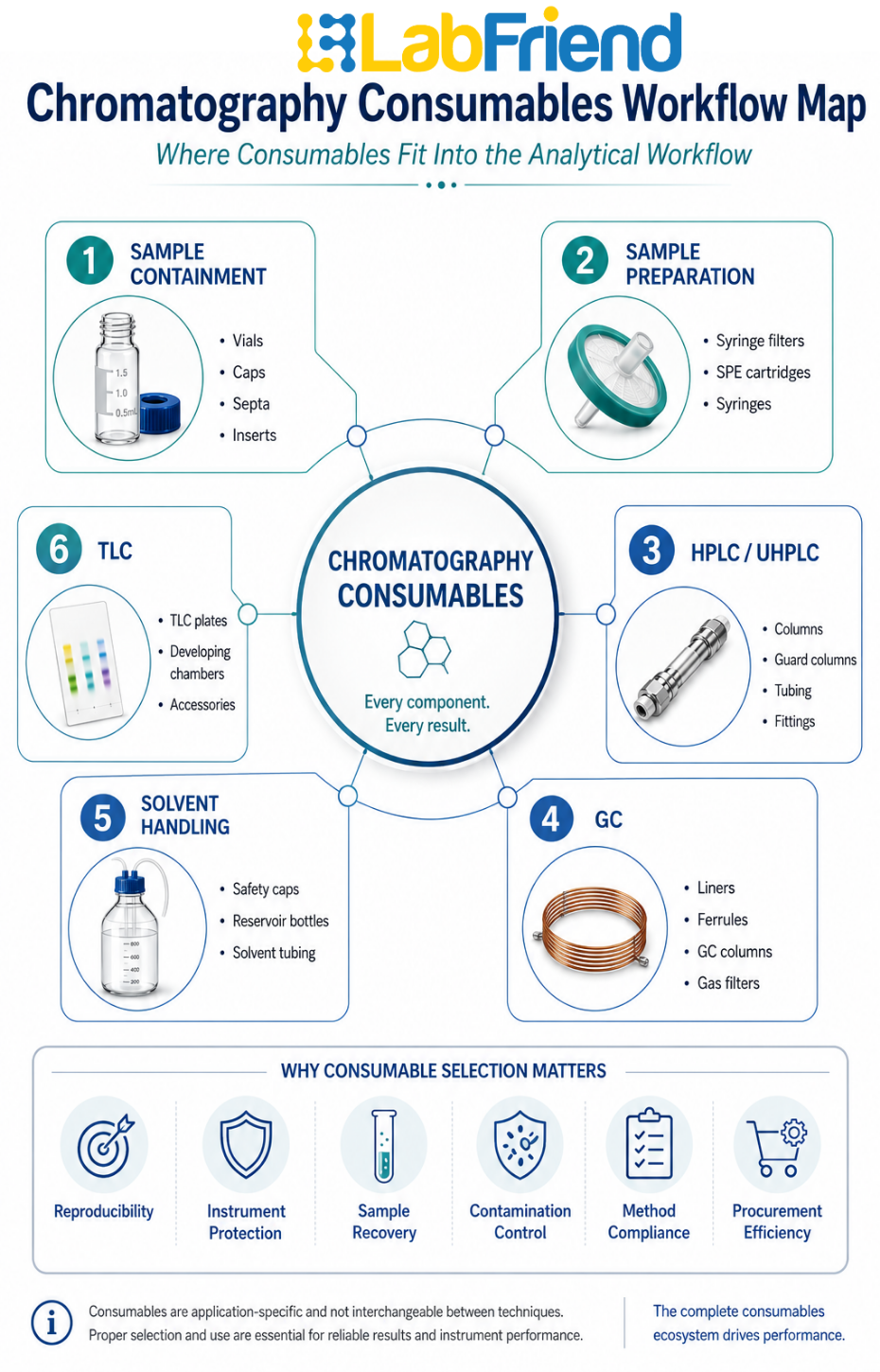
Chromatography consumables are products that are used, replaced or replenished during chromatography workflows. They are not usually the main instrument itself. Instead, they are the supporting products that allow samples, solvents and methods to run reliably.
Common chromatography consumables include:
|
Workflow area |
Typical consumables |
|
Sample containment |
Autosampler vials, headspace vials, inserts, caps, septa |
|
Sample preparation |
Syringe filters, syringes, filter membranes, SPE cartridges, reservoirs |
|
Liquid chromatography |
HPLC columns, UHPLC columns, guard columns, tubing, fittings, solvent caps |
|
Gas chromatography |
GC columns, liners, septa, ferrules, microsyringes, gas filters |
|
Solvent handling |
Mobile phase bottles, safety caps, waste caps, PTFE tubing, connectors |
|
Thin-layer chromatography |
TLC plates, developing tanks, capillaries, sprayers, detection accessories |
|
Workflow support |
Racks, vial trays, storage boxes, labels, crimpers and decappers |
In routine laboratories, these products are often reordered weekly or monthly. Once a workflow has been validated or standardised, the same consumables are usually purchased repeatedly to maintain consistency.
Chromatography Consumables Covered in This Guide
|
Topic |
Best for |
Related guide |
|
Vials and septa |
HPLC, GC, LC-MS and headspace workflows |
How to Choose Chromatography Vials and Septa |
|
Syringe filters |
HPLC/UHPLC sample preparation |
Syringe Filter Guide |
|
GC consumables |
Liners, ferrules, syringes and gas filters |
GC Consumables Guide |
|
HPLC columns |
Column selection and method control |
HPLC Column Selection Guide |
|
SPE consumables |
Sample cleanup and concentration |
SPE Consumables Guide |
|
Solvent handling |
HPLC mobile phase and waste handling |
HPLC Solvent Handling Guide |
Why chromatography consumable selection matters
Chromatography is a precision workflow. Small consumable differences can affect results.
The wrong vial, cap, septum, filter or fitting may contribute to:
- sample contamination
- analyte adsorption or loss
- extractables or leachables
- poor injection reproducibility
- blocked columns
- pressure instability
- ghost peaks
- carryover
- solvent evaporation
- vial leakage
- poor autosampler compatibility
- increased downtime
- unnecessary repeat analysis
For QA/QC laboratories, CROs, food testing laboratories, environmental laboratories and pharmaceutical support labs, these failures are not just technical inconveniences. They can delay reporting, interrupt client projects, increase solvent and consumable costs, and create avoidable investigation work.
Adsorption may occur at multiple points within the workflow, including vials, inserts, filters, tubing and sample preparation devices.
The right chromatography consumable should do three things:
- Match the method and instrument.
The product must be compatible with the autosampler, detector, solvent system, temperature, pressure and sample type. - Protect analytical consistency.
Consumables should support reproducible injections, stable baselines, clean separations and consistent sample handling. - Be easy to reorder.
For repeat workflows, the specification should be clear enough for scientists, lab managers and procurement teams to reorder the same product without ambiguity.
Contamination Control and Extractables in Modern Chromatography
Modern chromatography methods, particularly LC-MS/MS, UHPLC and trace-level environmental analysis, are increasingly sensitive to contamination from consumables. Vials, septa, syringe filters, tubing, SPE materials and solvent handling components can all contribute background signals, extractables or analyte losses.
Where analytical sensitivity is critical, laboratories should consider low-background consumables, verify compatibility during method development and avoid unvalidated substitutions.
Main types of chromatography consumables
1. Chromatography vials
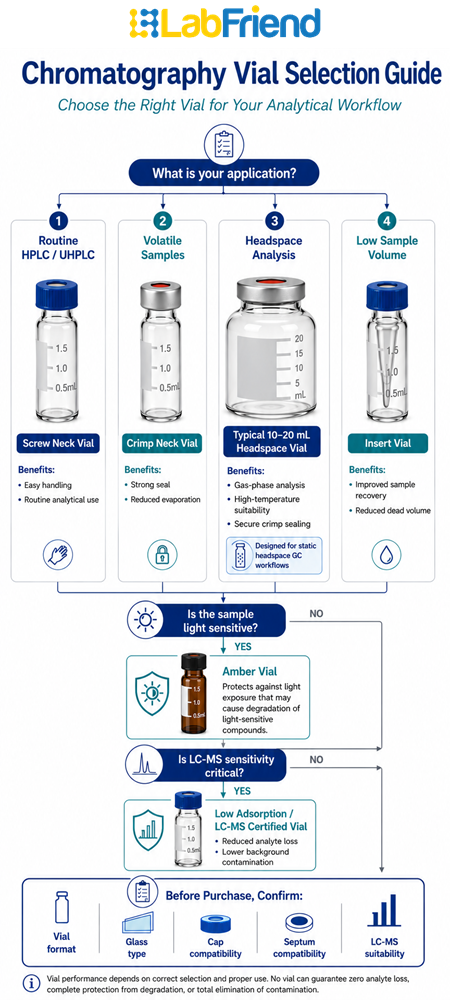
Chromatography vials are one of the most frequently reordered consumables in analytical laboratories. They are used to hold samples before injection into HPLC, UHPLC, GC and headspace systems.
Key vial variables include:
|
Selection factor |
Why it matters |
|
Volume |
Must suit sample volume, autosampler requirements and headspace needs |
|
Neck type |
Determines cap compatibility and sealing method |
|
Glass type |
Glass type can affect chemical resistance, sample stability, adsorption behaviour and suitability for trace analytical applications. |
|
Clear vs amber |
Amber vials help protect light-sensitive samples |
|
Insert type |
Useful for low-volume samples |
|
Bottom type |
Must suit autosampler tray and sampling depth |
|
Pack size |
Important for repeat purchasing and cost control |
Common vial types include screw neck vials, crimp neck vials, snap ring vials, headspace vials and micro-insert vials. Depending on the application, laboratories may also evaluate low-bind, low-protein-binding or low-analyte-adsorption vial technologies.
For LC-MS and trace analytical workflows, laboratories may also consider low-adsorption, low-extractable or certified LC-MS vials where sample recovery or background contamination is critical.
For routine HPLC and GC work, many laboratories standardise around a small number of vial formats to reduce purchasing complexity and avoid autosampler compatibility problems.
Commercial note for UK labs: if a vial is used daily, procurement should record the full specification, including neck size, volume, glass colour, cap type, septum material, pack size and manufacturer reference. This reduces the risk of accidental substitutions.
Need to standardise vials and septa?
Browse chromatography vials and septa or request a quote for repeat-use pack sizes.
2. Caps and septa
Caps and septa are just as important as the vial. A correctly chosen vial with the wrong septum can still cause problems.
Septa selection affects:
- solvent compatibility
- needle penetration
- resealing behaviour
- evaporation control
- extractables and leachables risk
- sample contamination
- autosampler performance
Common septa materials include PTFE-lined silicone, PTFE/red rubber, butyl/PTFE and other application-specific combinations. PTFE-facing layers are commonly used because they provide chemical resistance at the sample-facing side, while the backing material supports sealing and needle penetration.
Typical considerations:
|
Question |
Why it matters |
|
Is the sample aqueous, organic or solvent-rich? |
Solvent compatibility affects septum suitability |
|
Will the vial be pierced once or repeatedly? |
Resealing behaviour may matter |
|
Is the sample volatile? |
Poor sealing can cause evaporation |
|
Is the method trace-sensitive? |
Septa contamination may affect results |
|
Is the vial used for headspace GC? |
Temperature and pressure requirements are more demanding |
For headspace workflows, cap and septum selection is particularly important because the vial may be heated and pressurised. Always confirm compatibility with the instrument method and manufacturer guidance.
3. Syringe filters for HPLC and UHPLC sample preparation
Syringe filters are used to remove particulates before injection. They help protect HPLC and UHPLC columns, reduce blockages and improve sample cleanliness.
The most important syringe filter selection variables are:
|
Factor |
Typical options |
Selection logic |
|
Pore size |
0.22 µm, 0.45 µm |
Smaller pore sizes remove finer particles but may clog more easily |
|
Membrane |
PTFE, PES, nylon, PVDF, RC, CA |
Match to solvent, analyte and application |
|
Diameter |
13 mm, 25 mm and others |
Match to sample volume and throughput |
|
Sterility |
Sterile or non-sterile |
Relevant where sterile filtration or contamination-sensitive biological workflows are required. |
|
Housing |
PP and other materials |
Check solvent compatibility |
|
Binding |
Low-binding variants |
Important for sensitive analytes |
0.22 µm vs 0.45 µm filters
For many HPLC applications, 0.45 µm filtration is used for general particulate removal. For UHPLC or fine-particle-sensitive workflows, 0.22 µm may be preferred. However, the best choice depends on the method, column, particle load and sample matrix.
Do not choose pore size by habit alone. Consider:
- column particle size
- expected particulate load
- sample viscosity
- risk of filter clogging
- analyte recovery
- method requirements
- instrument sensitivity
Membrane compatibility
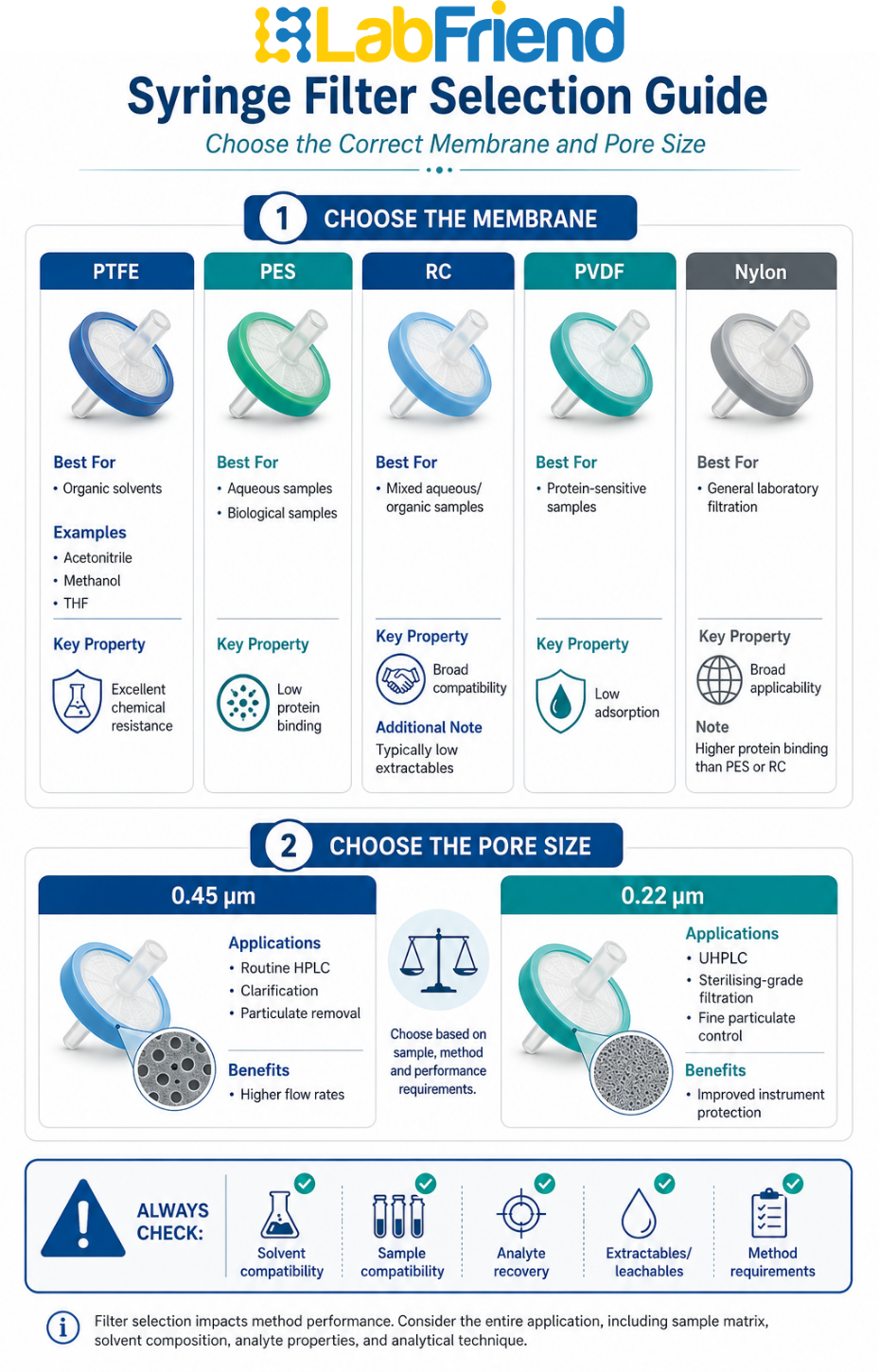
Membrane chemistry should be matched to the sample and solvent.
|
Membrane |
Typical use considerations |
|
PTFE |
Often selected for organic solvents and aggressive solvent compatibility |
|
PES |
Often used for aqueous samples and biological workflows |
|
Nylon |
Broad use but may bind some analytes; check method suitability |
|
PVDF |
Often considered where low protein binding is needed |
|
RC |
Useful across many aqueous and organic solvent workflows where compatibility allows |
|
CA |
Often used in aqueous/biological contexts, but chemical compatibility must be checked |
Always confirm compatibility with the specific solvent mixture, analyte and method requirements.
For LC-MS, trace analysis and contamination-sensitive methods, membrane-derived extractables and leachables should also be considered during filter selection and method development.
Preparing samples for HPLC or UHPLC?
Compare syringe filters by membrane, pore size and solvent compatibility.
Relevant LabFriend reading:
The Ultimate Syringe Filter Guide
The Ultimate Guide to Laboratory Filtration for UK Laboratories
4. HPLC and UHPLC columns
HPLC and UHPLC columns are not always treated as routine consumables in the same way as vials or filters, but they are replaced over time and are central to method performance.
Column selection affects:
- retention
- selectivity
- resolution
- backpressure
- run time
- method transfer
- reproducibility
- solvent consumption
- column lifetime
Key column variables include:
|
Column variable |
Why it matters |
|
Stationary phase |
Determines separation chemistry |
|
Particle size |
Affects efficiency and pressure |
|
Pore size |
Relevant to analyte size and mass transfer |
|
Column length |
Affects resolution and run time |
|
Internal diameter |
Affects sensitivity, flow rate and solvent use |
|
Endcapping |
Can influence peak shape and silanol interactions |
|
Hardware compatibility |
Must match system pressure and fittings |
|
Guard column use |
Helps protect analytical columns from contamination |
C18 reversed-phase columns are widely used, but that does not mean they are interchangeable across methods. Method-controlled environments should avoid casual substitution unless performance, documentation and validation requirements have been considered. Columns with apparently similar stationary phase descriptions may still differ in selectivity, silica properties, surface chemistry and performance characteristics.
Guard columns
Guard columns or guard cartridges are used to protect the analytical column from particulates, strongly retained contaminants and matrix components. For dirty samples, complex matrices or high-throughput environments, guard columns can extend analytical column lifetime, but they do not eliminate the need for appropriate sample preparation or system maintenance.
Relevant LabFriend categories:
Browse HPLC Columns
Browse Liquid Chromatography Equipment
5. HPLC accessories: tubing, fittings and solvent handling
HPLC accessories are often overlooked until something leaks, blocks or introduces instability.
Important HPLC accessories include:
- PEEK tubing
- stainless steel tubing
- fingertight fittings
- ferrules
- connectors
- solvent bottle caps
- waste caps
- check valves
- inline filters
- solvent inlet filters
- mobile phase bottles
- tubing cutters
These products influence system integrity and solvent handling. Poorly matched fittings or tubing can create leaks, dead volume, carryover, pressure instability or poor peak shape. In UHPLC systems, excessive dead volume can significantly affect peak shape, efficiency and method transfer performance.
PEEK tubing and fittings
PEEK is widely used in HPLC fluid paths because of its chemical resistance and ease of handling, but it has pressure and solvent limitations. Always check tubing internal diameter, pressure rating, fitting compatibility and solvent suitability. Some UHPLC applications may require stainless steel components or pressure-rated PEEK systems depending on operating pressures and solvent conditions.
Solvent bottle caps and safety caps
Solvent handling accessories help reduce evaporation, vapour exposure, contamination risk and messy mobile phase management. Safety caps and venting systems may be particularly useful for laboratories managing multiple HPLC systems and solvent bottles. Mobile phase quality, solvent grade and container cleanliness can also influence chromatographic performance and baseline stability.
Relevant LabFriend categories:
Browse HPLC Accessories
6. GC consumables
GC consumables are central to injection quality, chromatographic performance and system reliability.
Common GC consumables include:
- inlet liners
- septa
- ferrules
- capillary columns
- microsyringes
- gas filters
- traps
- column nuts
- O-rings
- headspace vials and caps
These products are exposed to heat, carrier gases, volatile compounds and repeated injections. They should be inspected and replaced according to method use, sample matrix and instrument behaviour.
GC liners
GC inlet liners help vaporise and transfer the sample into the column. Liner geometry, volume, deactivation and packing can affect peak shape, sensitivity, discrimination and contamination.
Common liner-related issues include:
- carryover
- peak tailing
- poor reproducibility
- active-site interactions
- contamination build-up
- poor vaporisation
Ferrules
Ferrules create seals at the column connection points. Incorrect ferrule material, poor installation or reuse can contribute to leaks and unstable results.
Graphite ferrules are commonly used because they are flexible and temperature-resistant, but they may not be ideal for every application. Graphite, graphite/Vespel® blends and other ferrule materials may be selected depending on operating temperature, leak sensitivity and instrument requirements.
GC syringes
Microsyringes affect injection precision and reproducibility. Needle style, volume, plunger type and sample compatibility should match the injection method.
For high-throughput laboratories, syringe wear can become a routine maintenance issue. Bent needles, sticky plungers or poor washing can increase variability.
Gas filters and traps
Carrier gas purity matters in GC. Oxygen, moisture and hydrocarbon contamination can affect detector performance, column life and baseline stability. This is particularly important for oxygen-sensitive columns and detectors, where contamination can shorten component lifetime and affect performance. Gas filters and traps are used to protect the system and improve consistency.
Running regular GC methods?
Review liners, ferrules, septa, syringes and gas filters as part of your routine replacement list.
Relevant LabFriend categories:
Browse GC Consumables
Browse GC Columns
7. SPE consumables for chromatography sample preparation
Solid phase extraction, or SPE, is used to clean up, concentrate or selectively extract analytes before chromatography analysis.
Common SPE consumables include:
- SPE cartridges
- SPE plates
- frits
- reservoirs
- collection tubes
- vacuum manifolds
- adapters
- caps
- sample loading accessories
SPE product selection depends on sample matrix, analyte chemistry, solvent system, extraction mode and required recovery.
Common SPE modes include:
|
SPE mode |
Typical use |
|
Reversed phase |
Non-polar to moderately polar analytes |
|
Normal phase |
Polar compounds in non-polar matrices |
|
Ion exchange |
Charged analytes |
|
Mixed-mode |
More selective cleanup or extraction |
|
Size exclusion or size-based cleanup |
Used in some workflows to separate components based on molecular size. |
SPE is often used in environmental testing, food testing, pharmaceutical analysis, forensic workflows, clinical-adjacent research and analytical sample cleanup.
Because SPE methods can be sensitive to sorbent chemistry and protocol details, substitutions should be made carefully.
Relevant LabFriend category:
Browse Chromatography Sample Preparation
8. TLC consumables and accessories
Thin-layer chromatography remains useful for teaching, reaction monitoring, compound screening and some QC workflows.
TLC consumables and accessories include:
- TLC plates
- developing chambers
- capillary spotters
- solvent tanks
- sprayers
- UV viewing cabinets
- plate storage products
- detection reagents where applicable
Key TLC plate considerations include:
|
Selection factor |
Why it matters |
|
Stationary phase |
Silica gel, alumina or modified surfaces affect separation |
|
Backing material |
Glass, aluminium or plastic affects handling and durability |
|
Layer thickness |
Affects resolution and loading |
|
Indicator |
Fluorescent indicators support UV detection |
|
Plate size |
Must suit workflow and chamber |
Although TLC consumables are often lower-cost than many HPLC or GC consumables, they still support teaching labs, synthetic chemistry groups and routine screening environments.
Relevant LabFriend category:
Browse Thin-Layer Chromatography Equipment
How to choose chromatography consumables by workflow
HPLC and UHPLC workflows
For HPLC and UHPLC, prioritise:
- vial compatibility with the autosampler
- low-contamination caps and septa
- suitable syringe filter membrane and pore size
- clean mobile phase handling
- appropriate HPLC column chemistry
- guard column use where sample matrices are dirty
- low-dead-volume fittings
- compatible tubing and connectors
Typical repeat consumables:
- autosampler vials
- caps and septa
- syringe filters
- syringes
- HPLC columns
- guard cartridges
- tubing
- fittings
- solvent bottle caps
- mobile phase bottles
GC workflows
For GC, prioritise:
- correct vial and septum selection
- inlet liner suitability
- ferrule material and fit
- syringe condition
- gas purity
- leak-free column installation
- carrier gas filter replacement
- column compatibility with method requirements
Typical repeat consumables:
- GC vials
- headspace vials
- caps and septa
- GC liners
- ferrules
- microsyringes
- gas filters
- capillary columns
SPE workflows
For SPE, prioritise:
- sorbent chemistry
- cartridge or plate format
- sample volume
- analyte recovery
- matrix cleanup needs
- solvent compatibility
- vacuum manifold compatibility
- method documentation
Typical repeat consumables:
- SPE cartridges
- SPE plates
- collection tubes
- frits
- reservoirs
- syringes
- filters
- vials
TLC workflows
For TLC, prioritise:
- stationary phase
- plate backing
- solvent compatibility
- detection method
- sample loading approach
- storage and handling
Typical repeat consumables:
- TLC plates
- capillaries
- solvents
- chamber accessories
- detection accessories
Common mistakes when buying chromatography consumables
Mistake 1: Choosing vials by volume only
Volume is only one variable. Neck type, cap compatibility, septum material, glass type, insert use, autosampler compatibility and sample chemistry also matter.
A 2 mL vial is not automatically interchangeable with another 2 mL vial.
Mistake 2: Ignoring septum compatibility
The septum is in direct contact with the sample environment. Repeated needle penetration can cause septum coring, where small fragments are removed from the septum and potentially introduced into the vial or injection pathway. Poor septum selection can contribute to contamination, evaporation, coring or poor resealing.
For solvent-rich or volatile samples, septum selection should be reviewed carefully.
Mistake 3: Using the same syringe filter for every sample
One membrane chemistry will not suit every solvent, analyte or matrix. PTFE, PES, nylon, PVDF, RC and CA membranes behave differently.
Incorrect membrane selection can cause analyte loss, filter failure, contamination or poor recovery.
Mistake 4: Over-specifying where it is not needed
Some laboratories buy premium consumables for routine workflows where a correctly specified standard product would be sufficient. Over-specification increases cost without necessarily improving results.
The right question is not “What is the most expensive option?” It is “What specification does this workflow actually require?”
Mistake 5: Substituting consumables without technical review
Substitution may be acceptable for routine workflows, but it should not be blind. Check dimensions, materials, compatibility, documentation, pack size and method requirements.
For validated, regulated or client-specified methods, substitution may require approval.
Mistake 6: Not recording the exact reorder specification
Chromatography buyers often remember a product visually or by partial description. That creates purchasing risk.
Record:
- product name
- manufacturer reference
- LabFriend SKU where available
- pack size
- vial dimensions
- cap and septum specification
- membrane type
- pore size
- column dimensions
- stationary phase
- tubing internal diameter
- fitting type
This makes repeat ordering easier and reduces avoidable errors.
Procurement considerations for UK laboratories
For scientists, the priority is technical suitability. For lab managers and procurement teams, the purchasing process also needs to be simple, repeatable and cost-controlled.
When buying chromatography consumables, procurement teams should check:
|
Procurement check |
Why it matters |
|
Full specification |
Prevents incorrect substitutions |
|
Pack size |
Affects unit cost and stock planning |
|
Reorder frequency |
Supports stock control |
|
Supplier availability |
Reduces workflow interruption |
|
Equivalent options |
Helps manage cost and continuity |
|
Delivery expectations |
Important for time-sensitive projects |
|
Quote route |
Useful for larger repeat orders |
|
Account setup |
Simplifies ongoing purchasing |
|
User approval |
Avoids buying technically unsuitable products |
For busy laboratories, the most efficient approach is often to build a standard chromatography consumables list. This can include approved vials, caps, septa, syringe filters, columns, liners, ferrules and solvent handling accessories.
A standard list helps laboratories:
- reduce duplicate SKUs
- avoid accidental substitutions
- improve reorder speed
- control spend
- reduce stockouts
- support method consistency
- simplify onboarding of new staff
- consolidate repeat purchasing
Where LLG Labware fits
LLG Labware can be relevant where laboratories need dependable, professional-grade consumables for routine workflows and want strong price-performance without unnecessary over-specification.
This can be particularly useful for UK laboratories looking to control routine consumables spend without creating unnecessary technical risk. Where a consumable is used frequently and the specification can be matched clearly, an approved LLG Labware option may help support repeat purchasing, cost control and supply continuity.
For chromatography workflows, LLG Labware may be particularly relevant for:
- chromatography vials
- caps and septa
- syringe filtration
- sample preparation
- routine analytical workflows
- repeat consumables purchasing
The key is to match the product to the workflow, not to substitute blindly. Consider LLG Labware alternatives where:
- the product is used routinely
- the method is not locked to a specific validated consumable
- the specification can be matched clearly
- repeat availability matters
- procurement wants better value
- standardisation is possible
Do not substitute where the consumable is method-specified, validation-locked, client-approved, contamination-critical or documentation-dependent unless the alternative has been reviewed and approved.
Relevant LabFriend category:
Explore LLG Labware
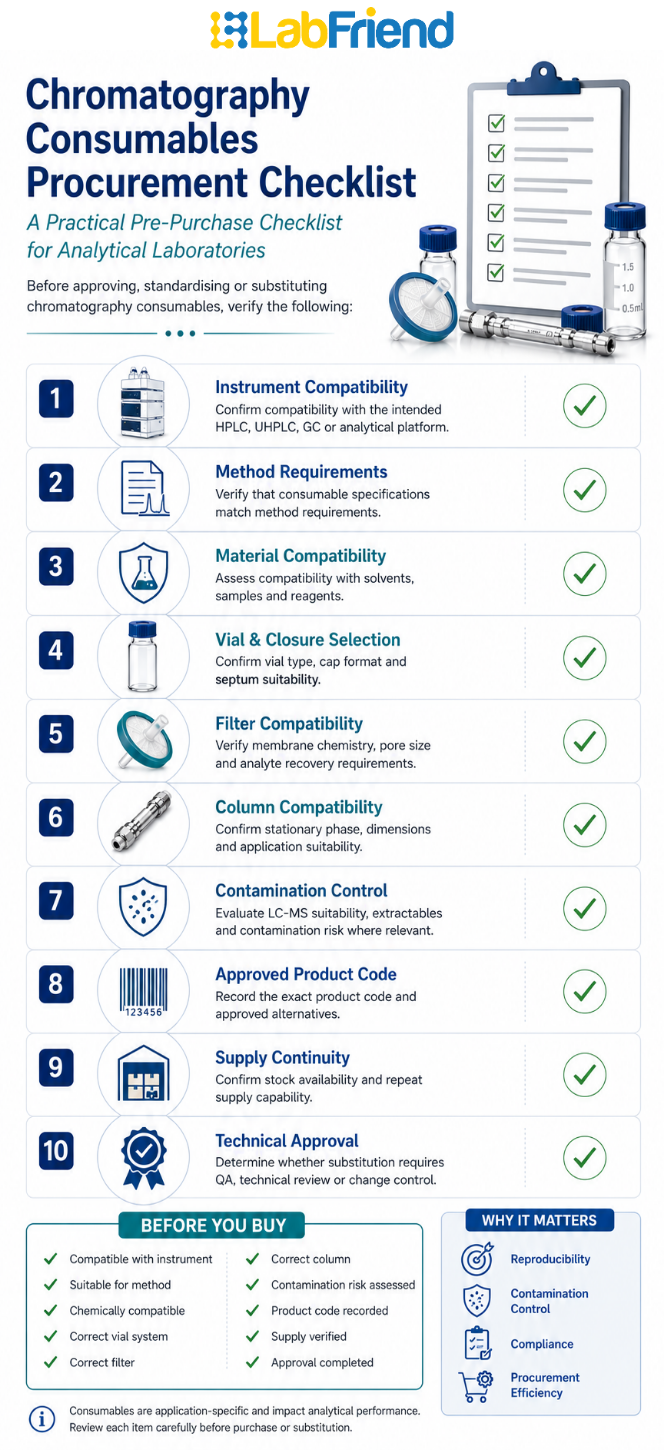
Practical chromatography consumables checklist
Before purchasing, check the following.
For vials, caps and septa
- Autosampler compatibility
- Vial volume
- Neck type
- Glass colour
- Glass or plastic material
- Insert requirement
- Cap type
- Septum material
- Temperature requirements
- Volatility of sample
- Pack size
- Reorder reference
- LC-MS suitability or low-background requirements
For syringe filters
- Sample solvent
- Analyte sensitivity
- Membrane chemistry
- Pore size
- Filter diameter
- Sample volume
- Sterility requirement
- Binding risk
- Housing compatibility
- Expected particulate load
- Potential extractables/leachables profile
For HPLC columns
- Method requirements
- Stationary phase
- Particle size
- Pore size
- Column length
- Internal diameter
- Pressure rating
- Guard column compatibility
- Solvent compatibility
- Documentation requirements
For GC consumables
- Instrument compatibility
- Inlet type
- Liner geometry
- Septum type
- Ferrule material
- Column dimensions
- Gas purity requirements
- Syringe volume
- Needle type
- Replacement schedule
For solvent handling
- Bottle material
- Cap thread
- Tubing material
- Waste connection
- Vapour handling
- Solvent compatibility
- Safety requirements
- Local laboratory procedures
Recommended LabFriend chromatography product areas
LabFriend UK supports chromatography workflows across a range of relevant product categories.
Browse core chromatography categories:
- Chromatography
- Vials and Septa
- Laboratory Vials
- Chromatography Sample Preparation
- HPLC Columns
- HPLC Accessories
- GC Consumables
- GC Columns
- Thin-Layer Chromatography Equipment
Frequently asked questions
What are the most commonly reordered chromatography consumables?
The most commonly reordered chromatography consumables are usually vials, caps, septa, syringe filters, syringes, GC liners, ferrules, gas filters, guard cartridges, tubing, fittings and sample preparation consumables. The exact reorder profile depends on whether the laboratory mainly runs HPLC, UHPLC, GC, headspace, SPE or TLC workflows.
What is the difference between HPLC and GC consumables?
HPLC consumables are mainly used for liquid mobile phase workflows and include autosampler vials, syringe filters, HPLC columns, guard columns, tubing, fittings and solvent handling accessories. GC consumables are used in gas-phase separations and include GC columns, inlet liners, septa, ferrules, microsyringes, gas filters and headspace vials.
How do I choose chromatography vials?
Choose chromatography vials by checking autosampler compatibility, volume, neck type, glass colour, material, insert requirement, cap type and septum compatibility. Do not select by vial volume alone. The vial, cap and septum must work together as a complete system.
Are screw neck, crimp neck and snap ring vials interchangeable?
Not necessarily. Screw neck, crimp neck and snap ring vials use different closure systems and may not be compatible with the same autosampler or sealing requirements. Screw neck vials are convenient for routine handling, crimp neck vials provide secure closure integrity, and snap ring vials can be useful for fast handling where compatible.
What pore size should I use for HPLC sample filtration?
Many HPLC workflows use 0.45 µm filtration, while UHPLC or finer-particle-sensitive workflows may use 0.22 µm filtration. The right pore size depends on the method, column, sample matrix, particulate load and instrument requirements.
Which syringe filter membrane is best for HPLC?
There is no single best membrane for every HPLC method. PTFE is often selected for organic solvents, PES for many aqueous workflows, nylon for broad general use where analyte compatibility is suitable, PVDF for some low-binding needs, and RC for broad solvent compatibility where appropriate. Always check solvent and analyte compatibility.
When should GC liners and septa be replaced?
GC liners and septa should be inspected and replaced according to method requirements, sample cleanliness, injection frequency and instrument performance. Signs that replacement may be needed include ghost peaks, poor reproducibility, carryover, leaks, peak tailing or contamination build-up.
Should laboratories standardise chromatography consumables?
Yes, where workflows are routine and repeatable. Standardising approved vials, caps, septa, filters, syringes, liners and fittings can reduce purchasing errors, improve reorder speed, control costs and support more consistent analytical workflows.
Can chromatography consumables be substituted for lower-cost alternatives?
Sometimes, but not blindly. Substitution may be suitable where the workflow is routine and the specification can be matched. Avoid substitution without review where the method is validated, client-specified, contamination-sensitive or documentation-dependent.
How can procurement teams reduce chromatography consumable stockouts?
Procurement teams can reduce stockouts by recording approved product specifications, monitoring monthly usage, setting reorder points, consolidating routine consumables, using account pricing where appropriate and creating repeat-order reminders for high-use items.
What information should procurement record when standardising chromatography consumables?
When standardising chromatography consumables, procurement teams should record more than the product description alone. Useful information typically includes the manufacturer, product code, pack size, dimensions, material specifications, compatibility requirements, approved supplier route and any approved alternatives. Where consumables are linked to validated methods or regulated workflows, laboratories should also document any technical restrictions on substitution to help maintain consistency and reduce purchasing errors.
When should chromatography consumable substitutions require technical approval?
Consumable substitutions should be reviewed carefully whenever they could affect analytical performance, method suitability or compliance requirements. This is particularly important for validated methods, pharmaceutical QC testing, clinical or diagnostic workflows, LC-MS applications, contamination-sensitive analysis and client-specified methods. Even consumables that appear similar may differ in dimensions, materials, adsorption characteristics, extractables profiles or chromatographic performance. Technical review or change control may therefore be required before introducing an alternative product.
How can laboratories reduce contamination risk from chromatography consumables?
Contamination risk can be reduced by selecting consumables that are appropriate for the analytical method and sensitivity requirements. Examples include using low-background or LC-MS-certified vials where appropriate, selecting compatible septa and syringe filter membranes, maintaining clean solvent handling practices and verifying consumable suitability during method development. Laboratories should also avoid unvalidated substitutions and ensure that consumables are stored and handled in a way that minimises particulate, chemical or biological contamination.
Managing chromatography consumables as a repeat purchasing category
For laboratories that run chromatography methods regularly, consumables should be managed with the same discipline as other critical workflow supplies. Vials, septa, filters, liners, columns, tubing and fittings may be individually low-cost compared with instrumentation, but they directly affect method consistency, instrument uptime and laboratory productivity.
A practical repeat purchasing approach should include:
|
Requirement |
Why it matters |
|
Approved product list |
Reduces incorrect substitutions |
|
Clear technical specifications |
Helps procurement reorder accurately |
|
Approved alternatives |
Supports continuity when stock is unavailable |
|
Reorder points |
Reduces urgent purchasing and stockouts |
|
Technical review rules |
Protects validated or sensitive methods |
|
Quote route for repeat items |
Helps control recurring spend |
|
Supplier consolidation |
Reduces purchasing fragmentation |
For CROs, QA/QC laboratories, private testing laboratories, SME biotech companies and university research groups, this approach can reduce avoidable disruption and make chromatography purchasing more predictable.
Written by: Donal O’Sullivan, BSc, Co-Founder and Sales Director, LabFriend UK. Donal brings deep chemistry-led technical expertise across analytical chemistry, biochemistry, environmental monitoring, laboratory instrumentation, consumables and scientific product selection.
Reviewed by: Michael Anderson, MBA, Founder and Managing Director, LabFriend UK. Michael reviews LabFriend UK content for customer relevance, commercial accuracy, operational practicality and alignment with LabFriend UK’s laboratory supply model.
Final recommendation
For most UK laboratories, the best chromatography consumable is not simply the cheapest or most premium option. It is the product that matches the workflow precisely, protects analytical consistency, can be reordered reliably and avoids unnecessary purchasing complexity.
Start with the method and instrument requirements. Confirm vial, cap, septum, filter, column, tubing, fitting and solvent compatibility. Then document the approved specification so the product can be reordered consistently.
For laboratories running regular HPLC, UHPLC, GC, SPE or TLC workflows, chromatography consumables should be managed as a repeat purchasing category rather than a series of one-off orders. That means recording approved specifications, agreeing substitution rules, monitoring usage, setting reorder points and creating a clear route for quotes and repeat supply. This approach reduces stockouts, improves workflow continuity and gives scientists, lab managers and procurement teams a more reliable way to manage critical consumables.
Browse chromatography consumables at LabFriend UK or request a quote for repeat-use vials, filters, GC consumables, HPLC accessories and sample preparation products.
Related Stories

HPLC Sample Preparation Consumables - Filters Vials Syringes and Solvent Handling
HPLC Sample Preparation Consumables - Filters Vials Syringes and Solvent Handling

HPLC Sample Preparation Consumables for CROs and High-Throughput Testing Laboratories
HPLC Sample Preparation Consumables for CROs and High-Throughput Testing Laboratories

0.22µm vs 0.45µm Filters for HPLC and UHPLC Sample Preparation
0.22µm vs 0.45µm Filters for HPLC and UHPLC Sample Preparation

Syringe Filter Membrane Compatibility for HPLC UHPLC and Chromatography Solvents
Syringe Filter Membrane Compatibility for HPLC UHPLC and Chromatography Solvents