

Share :
Common Filtration Mistakes in Analytical Laboratories and How to Avoid Them
Updated On 07/17/2026

By Donal O’Sullivan, BSc. Reviewed by Michael Anderson, MBA.
Summary
Laboratory filtration is often regarded as one of the simplest stages of sample preparation. Compared with instrument calibration, method development or analytical interpretation, passing a sample through a syringe filter can appear almost routine. Yet experienced scientists recognise that many of the problems encountered later in an analytical workflow originate long before a sample reaches the instrument.
Filtration is not simply a cleaning step. It is a critical control point that influences sample integrity, analytical reproducibility, instrument protection, including protection of injectors, valves, tubing, detector flow cells and analytical columns from particulate contamination and ultimately the quality of the data produced.
Small decisions made during filtration—such as selecting the wrong membrane material, choosing an inappropriate pore size or overlooking chemical compatibility—can introduce variability that is difficult to identify once analysis has begun. These issues rarely present themselves as obvious filtration failures. Instead, they often emerge as inconsistent recoveries, unexpected chromatographic behaviour, elevated system backpressure or unnecessary troubleshooting.
One reason these problems persist is that filtration is frequently viewed as a consumables decision rather than an analytical decision. Laboratories may invest significant effort in selecting chromatography columns, developing robust analytical methods and validating instruments, while assuming that any suitable syringe filter will perform equally well. In reality, filtration deserves the same systematic approach applied elsewhere in the analytical workflow.
This guide examines the mistakes most commonly encountered in analytical laboratories, explains why they occur and demonstrates how experienced laboratories minimise their impact through evidence-based filtration practices. Rather than focusing on individual products, the article explores the thinking behind good filtration, helping laboratories improve consistency, reduce avoidable errors and strengthen analytical confidence.
For readers seeking a comprehensive introduction to filtration principles, this article complements our cornerstone resource, The Ultimate Guide to Laboratory Filtration for UK Laboratories
Why Laboratory Filtration Is Often Underestimated
Analytical laboratories devote considerable attention to maintaining instrument performance, validating methods and controlling environmental conditions. These activities are rightly viewed as essential because they directly influence data quality and regulatory confidence.
Filtration, however, often occupies a different position. Because it is quick, inexpensive and performed countless times each day, it can be perceived as a straightforward preparatory task requiring little technical consideration.
Ironically, this perception is one of the reasons filtration mistakes remain so common.
The purpose of filtration is not simply to remove visible particles. It is to prepare a sample in a way that preserves its analytical integrity while protecting downstream equipment. Achieving both objectives requires an understanding of membrane chemistry, pore size, sample composition and the analytical technique being employed.
A scientist preparing environmental samples for HPLC may face very different filtration challenges from a colleague working with protein solutions or pharmaceutical formulations. Yet both rely on the same underlying principles. The filtration device must remove unwanted particulate material without altering the composition of the sample or introducing new variables that could affect interpretation.
When filtration is approached as a deliberate part of method design rather than an isolated consumable purchase, many recurring laboratory problems disappear before they have an opportunity to develop.
The Hidden Cost of Minor Filtration Errors
Most filtration mistakes do not lead to immediate or catastrophic failure.
Instead, they accumulate gradually.
A membrane that adsorbs a small proportion of an analyte may reduce recovery just enough to increase result variability. A filter selected without considering solvent compatibility may contribute trace extractables that appear as unexplained chromatographic peaks. A pore size chosen primarily for convenience may allow fine particulates to reach an instrument, shortening column life over many months rather than causing an obvious blockage during a single analysis.
Because these effects are incremental, they are often attributed to other causes.
Scientists may investigate instrument performance, mobile phase preparation or analytical technique before considering whether the filtration process itself contributed to the problem.
Experienced laboratories recognise that robust analytical performance begins long before a sample enters the instrument. Filtration therefore becomes part of the laboratory's overall quality strategy rather than an isolated preparation step.
Learning From Patterns Rather Than Individual Failures
One of the most valuable observations made by quality-focused laboratories is that filtration problems are rarely unique.
The same mistakes tend to appear repeatedly across different sectors, including pharmaceutical analysis, environmental testing, food laboratories, contract research organisations and academic research facilities.
Although the samples differ, the underlying causes remain remarkably consistent.
Scientists select membrane materials based on habit rather than compatibility.
Pore size decisions are made without considering analytical objectives.
Filters are chosen because they are available rather than because they are appropriate.
Compatibility guidance is overlooked.
Routine procedures evolve over time without formal review.
Understanding these recurring patterns allows laboratories to move beyond reactive troubleshooting. Instead of solving individual incidents, they can prevent entire categories of problems through better filtration practices.
The following sections explore the most significant of these recurring mistakes.
Mistake 1 — Choosing the Wrong Membrane Material
Perhaps the most fundamental filtration mistake is assuming that membrane materials are largely interchangeable.
At first glance, this assumption is understandable. Many syringe filters appear almost identical, share similar dimensions and may even be available with the same pore size. From a purchasing perspective they can seem to perform the same function.
Scientifically, however, the membrane is the heart of the filtration device.
Its chemistry determines how the sample interacts with the filter, influencing compatibility, adsorption, recovery, flow characteristics and analytical performance.
Selecting an inappropriate membrane rarely results in dramatic failure. More commonly, it creates subtle issues that become increasingly difficult to diagnose as they propagate through the analytical workflow.
For example, a membrane chosen because it was readily available may perform adequately for routine aqueous samples yet prove far less suitable when the laboratory begins filtering mixed solvent systems or protein-containing solutions. The filtration step appears unchanged, but the analytical outcome becomes progressively less reliable.
This is why experienced laboratories begin membrane selection by asking a simple question:
What characteristics does this sample require from the membrane?
Where quantitative recovery is critical, laboratories should verify that the selected membrane does not cause unacceptable analyte adsorption under the intended analytical conditions.
Only after answering that question do they consider individual membrane materials.
Understanding Why Different Membranes Exist
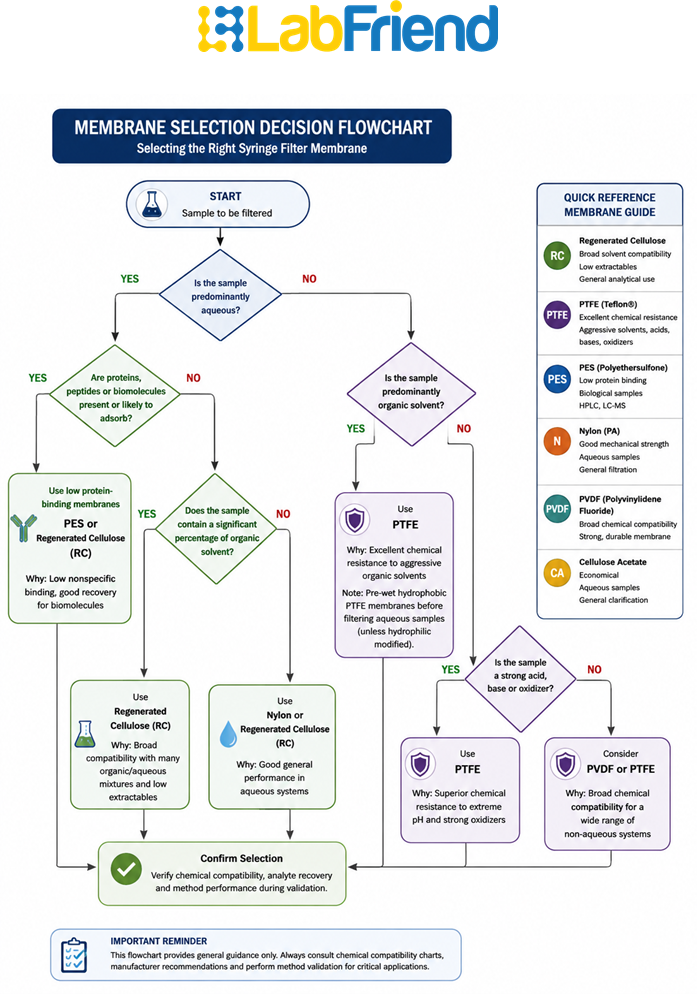
No single membrane has been developed to perform optimally under every laboratory condition.
Instead, each membrane technology reflects a different balance between chemical compatibility, wettability, adsorption characteristics and intended application.
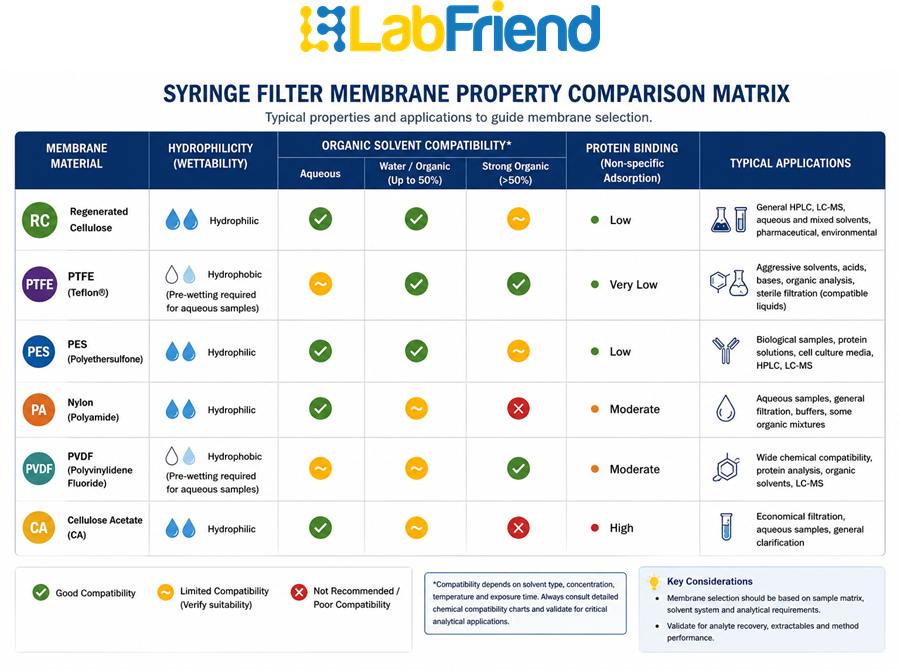
Regenerated cellulose, for example, is widely used because it offers broad compatibility with many aqueous and mixed organic/aqueous solvent systems together with relatively low nonspecific adsorption. However, it is not universally suitable for every solvent system or analytical application, and membrane selection should always be based on validated compatibility with the sample matrix and analytical method. PTFE is frequently selected for aggressive organic solvents because of its excellent chemical resistance. Hydrophobic PTFE membranes generally require pre-wetting before filtration of aqueous samples unless supplied in a hydrophilic modified form. PES is often favoured for biological workflows because of its low protein binding characteristics.
These differences are not marketing distinctions; they are consequences of membrane chemistry.
Selecting a membrane therefore becomes less about brand preference and more about matching material properties to analytical requirements.
Readers seeking a deeper understanding of membrane technologies should also explore:
- The Ultimate Syringe Filter Guide: Pore Size, Membranes and Applications
- Why Regenerated Cellulose (RC) Membranes Are The Universal Standard for Lab Filtration
- PTFE vs PES Syringe Filters: Which Membrane Should You Choose?
Quick Membrane Selection Guide
|
Sample characteristic |
Common membrane starting point* |
|
Predominantly aqueous |
Regenerated cellulose (RC), nylon or PES depending on analyte and application |
|
Mixed aqueous/organic solvents |
Regenerated cellulose (RC) where compatible |
|
Aggressive organic solvents |
PTFE (verify compatibility and sample wettability requirements) |
|
Protein-containing samples |
Low protein-binding membranes such as PES or regenerated cellulose where validated |
*Final membrane selection should always be confirmed during method development or validation.
Practical Laboratory Example
Imagine two quality control laboratories analysing the same pharmaceutical formulation.
Both laboratories use identical HPLC systems, identical columns and identical analytical methods.
The only difference is the syringe filter selected during sample preparation.
One laboratory chooses a membrane based on compatibility with the formulation. The other uses the membrane routinely stocked in the laboratory because it has "always worked before."
Initially both laboratories obtain acceptable results.
Over time, however, the second laboratory begins investigating inconsistent recoveries and occasional changes in chromatographic background.
The filtration procedure itself has not failed.
Rather, the membrane has introduced unnecessary variability that could have been avoided through more deliberate selection.
This illustrates why membrane choice should always be viewed as part of analytical method design rather than simply a purchasing decision.
Mistake 2 — Ignoring Chemical Compatibility
Once an appropriate membrane family has been identified, the next challenge is determining whether that membrane is chemically compatible with the sample being filtered.
Chemical compatibility is frequently misunderstood because laboratories often interpret compatibility charts as definitive answers.
In reality, compatibility charts are valuable starting points rather than final validation tools.
Most compatibility charts primarily indicate whether prolonged solvent exposure is expected to damage the membrane material. They generally do not predict analyte adsorption, extractables, leachables, changes in recovery or analytical interference under specific analytical conditions. They do not necessarily predict how the membrane will behave within a specific analytical method, nor do they account for mixed solvent systems, trace-level analysis or unique sample matrices.
For this reason, compatibility should always be considered within the context of the complete analytical workflow.
A membrane may survive prolonged exposure to a solvent while still influencing analyte recovery or contributing extractable compounds that interfere with highly sensitive analytical methods.
Experienced laboratories therefore treat compatibility assessment as part of method validation rather than as an administrative exercise completed during product selection.
This principle becomes particularly important when laboratories work with organic solvents, complex formulations or chromatography methods that demand exceptional reproducibility.
Further guidance is available in:
- Choosing the Right Syringe Filter for Organic Solvents
- Hydrophilic vs Hydrophobic Membranes: How to Choose the Right Filter for Your Laboratory Application
- How UK Laboratories Can Validate Filtration Membrane Chemical Compatibility
The consequences of overlooking compatibility are often subtle, but in high-performance analytical laboratories they can influence confidence in every result generated.
Although membrane selection and chemical compatibility account for many filtration problems, they are by no means the only sources of analytical error. Even when the correct membrane has been chosen, inappropriate pore size selection or poor sample preparation can compromise the entire workflow.
One of the defining characteristics of high-performing laboratories is that they rarely consider any filtration decision in isolation. Membrane material, pore size, sample composition and analytical technique are viewed as interconnected variables. Optimising only one while overlooking the others often results in an acceptable filtration process but a less robust analytical method.
The next three mistakes illustrate this principle particularly well.
Mistake — Failing to Validate Filter Extractables and Analyte Recovery
Selecting a chemically compatible membrane does not guarantee that the filtration process will have no effect on analytical results. In trace analysis and quantitative methods, laboratories should confirm that filtration does not introduce unacceptable extractables, leachables or analyte losses. Validation commonly involves comparing filtered and unfiltered samples, assessing analyte recovery, evaluating chromatographic background and confirming that no new interfering peaks are introduced. Where filtration has the potential to influence analytical performance, these assessments should form part of method development or validation.
Mistake 3 — Selecting the Wrong Pore Size
If membrane material determines how the filter interacts chemically with the sample, pore size determines what is physically retained during filtration.
Selecting the correct pore size is therefore a balance between protecting downstream instrumentation and preserving efficient sample throughput.
Many laboratories become accustomed to routinely using either 0.22 µm or 0.45 µm syringe filters without fully considering why one may be more appropriate than the other. Habit often replaces scientific reasoning, particularly where historical methods have been inherited rather than developed internally.
In reality, pore size should always reflect the objective of the filtration step.
For example, when preparing samples for HPLC analysis, the primary objective is generally to remove particulate matter that could damage injector components, increase system backpressure or shorten column life. In microbiological applications, however, the objective may be sterile filtration of compatible liquids using a validated sterilising-grade membrane rather than simple clarification. Achievement of sterile filtration depends upon use of an appropriately validated sterilising-grade filter and validated operating conditions rather than pore size alone. These are fundamentally different filtration challenges, even though both may utilise syringe filters.
Understanding this distinction helps explain why experienced laboratories rarely standardise on a single pore size for every application.
Why Smaller Is Not Always Better
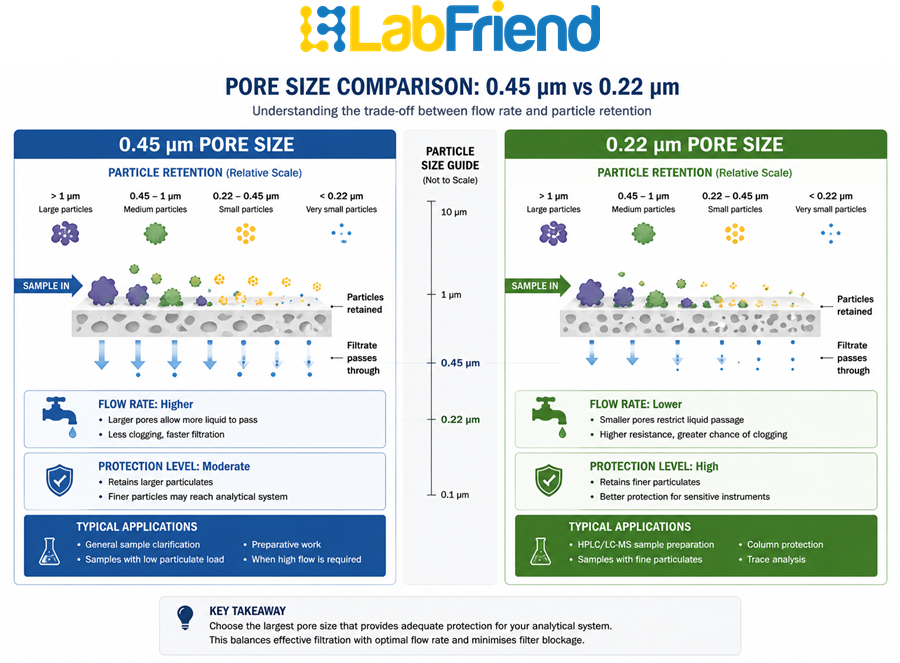
A common misconception is that selecting the smallest available pore size automatically produces the best filtration result.
At first glance this seems logical. Smaller pores retain smaller particles, so surely they provide greater protection.
The reality is more nuanced.
Reducing pore size generally increases flow resistance. Samples containing significant particulate matter may therefore filter more slowly and place greater stress on the membrane. Premature filter blockage becomes more likely, increasing both consumable usage and operator frustration.
Conversely, selecting a pore size that is too large may permit fine particles to pass into sensitive analytical instruments. While this may not create an immediate problem, repeated exposure can contribute to increased maintenance requirements, elevated system pressures and reduced column lifetime.
The most effective laboratories therefore select pore size according to analytical need rather than perceived performance.
Readers requiring a more detailed discussion should also refer to:
0.22 µm vs 0.45 µm Syringe Filters: When Should You Use Each?
Practical Example
Consider an environmental laboratory analysing groundwater samples.
A scientist notices that filtration has become increasingly slow and several syringe filters are required to process each sample. The instinctive response might be to question filter quality or change supplier.
A review of the workflow, however, reveals that samples contain unusually high particulate loading following periods of heavy rainfall. The filtration issue is not the membrane itself but the relationship between sample condition, pore size and filter capacity.
Rather than repeatedly replacing blocked filters, the laboratory introduces an appropriate pre-filtration step for heavily contaminated samples while retaining the final membrane filtration stage required for analytical protection.
The analytical method remains unchanged, but efficiency improves significantly because the root cause has been correctly identified.
This illustrates an important principle: filtration problems are often process problems rather than product problems.
Comparison Table – Common Pore Size Selection Errors
|
Common Decision |
Likely Consequence |
Better Approach |
|
Selecting 0.22 µm for every application |
Slower filtration and unnecessary membrane blockage |
Match pore size to analytical objective and sample characteristics |
|
Selecting 0.45 µm purely to improve flow |
Increased risk of fine particulate reaching instrumentation |
Evaluate instrument sensitivity and sample cleanliness before selecting pore size |
|
Assuming pore size determines chemical compatibility |
Incorrect membrane selection |
Evaluate membrane chemistry separately from pore size |
The important observation from this comparison is that pore size and membrane material answer different scientific questions. Confusing one with the other remains one of the most common causes of inappropriate filter selection.
Mistake 4 — Poor Sample Preparation Before Filtration
Filtration is often expected to compensate for problems that originate much earlier in the analytical workflow.
Scientists occasionally assume that if a sample appears difficult to filter, a different syringe filter will solve the problem. While changing membrane material or pore size may sometimes improve performance, it rarely addresses the underlying cause.
In many cases the sample itself has not been adequately prepared.
Poorly mixed suspensions, excessive particulate loading, precipitation caused by solvent changes or the presence of undissolved material all increase the burden placed upon the filtration device. Even the highest quality membrane cannot perform optimally when asked to compensate for avoidable sample preparation issues.
For this reason, experienced laboratories view filtration as one component within a broader sample preparation strategy.
Understanding Particulate Loading
Every syringe filter has a finite capacity.
As particulate matter accumulates on the membrane surface, resistance to flow increases. Eventually filtration slows dramatically or stops altogether.
This behaviour is entirely predictable and does not necessarily indicate that the membrane is defective.
Instead, it reflects the interaction between sample composition and filtration capacity.
Highly contaminated environmental samples, fermentation broths, biological extracts and some food matrices frequently challenge filtration systems because they contain far more suspended material than routine analytical solutions.
Rather than repeatedly replacing blocked filters, experienced laboratories consider whether upstream preparation can reduce particulate loading before the final analytical filtration step.
Such measures may include allowing larger particles to settle naturally, employing a suitable pre-filtration stage where method validation permits, or reviewing whether the sample preparation protocol itself can be refined.
These changes often produce greater improvements than changing syringe filter brand or membrane type.
Filtration Should Never Become the First Troubleshooting Step
An experienced scientist encountering repeated filtration difficulties rarely begins by replacing consumables.
Instead, they ask a sequence of diagnostic questions.
Has the sample changed?
Has the preparation procedure changed?
Has the solvent composition altered?
Has particulate loading increased?
Only after understanding these factors do they evaluate whether the filtration device remains appropriate.
This systematic approach reduces unnecessary troubleshooting while improving confidence that any changes made genuinely address the root cause.
Mistake — Neglecting Filter Flush or Conditioning Where Appropriate
Some analytical methods benefit from conditioning or flushing the membrane before sample collection, particularly when analysing trace-level compounds or when manufacturer guidance recommends this practice. Any conditioning procedure should be validated to ensure it improves analytical performance without altering sample composition. Laboratories should always follow the filter manufacturer's instructions and their own validated analytical procedures.
Mistake 5 — Using the Wrong Filter for Chromatography Samples
Chromatography places particularly demanding requirements on filtration because the consequences of poor sample preparation are often magnified once the sample enters a high-performance analytical system.
Particles that would appear insignificant during routine observation may contribute to increased injector wear, elevated system pressures or reduced column performance over time.
Equally important, inappropriate membrane selection may influence analytical recovery or introduce background signals that complicate interpretation.
For these reasons, chromatography laboratories generally apply more rigorous filtration selection criteria than laboratories performing less demanding applications.
Protecting More Than the Column
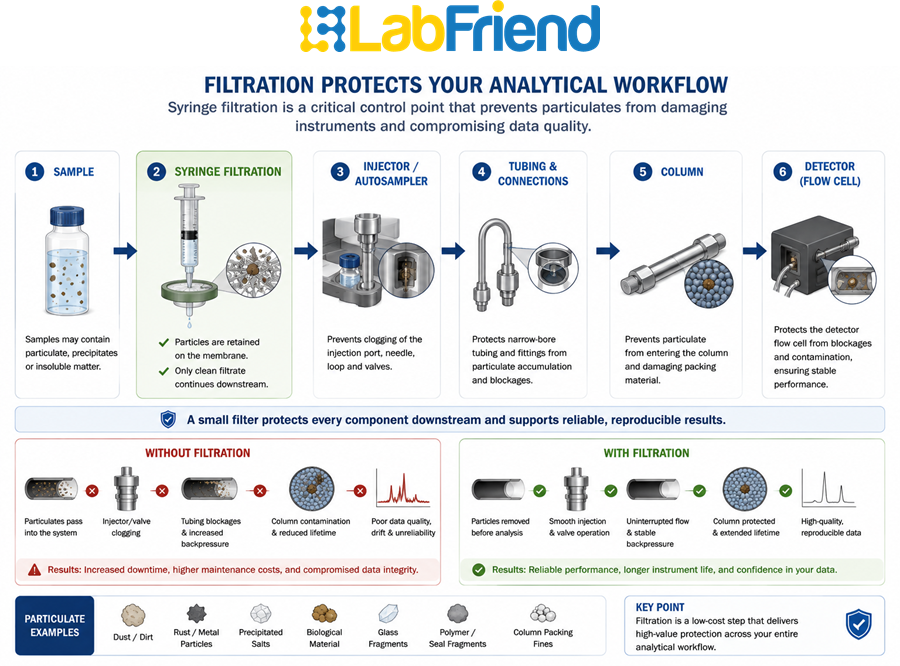
A common misconception is that syringe filtration exists solely to protect the chromatography column.
Column protection is certainly important, but it is only one part of the picture.
Effective filtration also contributes to:
- improved method reproducibility;
- reduced instrument downtime;
- more consistent peak shapes;
- lower maintenance requirements; and
- greater confidence in analytical data.
Viewed in this context, filtration becomes an investment in overall laboratory productivity rather than simply a consumable expense.
Laboratories developing or optimising chromatography methods should also refer to:
Best Syringe Filters for HPLC and UHPLC Sample Preparation
Filtration should also be considered alongside the wider chromatography workflow, including sample vials, septa, columns and associated consumables.
For a broader discussion of this relationship, see:
The Complete Guide to Chromatography Consumables for UK Laboratories
Mistake 6 — Assuming All Syringe Filters Perform the Same
Perhaps the most persistent misconception in laboratory filtration is the belief that syringe filters are largely interchangeable provided they share the same dimensions and pore size.
This assumption usually develops because routine applications often appear forgiving. Two filters may produce similar short-term results, encouraging the belief that performance differences are negligible.
As analytical methods become more demanding, however, those differences become increasingly significant.
Membrane chemistry influences adsorption characteristics.
Manufacturing quality influences consistency.
Housing design affects pressure tolerance.
Quality control influences batch-to-batch reproducibility.
Extractable and leachable profiles may vary between membrane materials and manufacturers, potentially influencing highly sensitive analytical methods if not appropriately evaluated.
Taken individually, each factor may appear modest. Collectively they can determine whether a laboratory enjoys years of consistent analytical performance or spends valuable time investigating unexplained variability.
Experienced laboratories therefore evaluate filtration products in exactly the same evidence-based manner that they evaluate analytical columns, reagents or reference materials.
Filtration is not simply about selecting a filter.
It is about selecting a filtration system that consistently supports the quality objectives of the laboratory.
Recognising individual filtration mistakes is only the first step. The laboratories that consistently achieve robust analytical performance are those that transform individual good decisions into standardised laboratory practice.
Filtration excellence is rarely the result of one highly knowledgeable scientist making the right decision on a particular day. Instead, it reflects a laboratory culture in which best practice has been documented, validated, reviewed and shared across the organisation. When filtration decisions become systematic rather than individual, laboratories experience fewer investigations, greater analytical consistency and more efficient use of both consumables and instrumentation.
This final section explores how laboratories move from reactive troubleshooting towards proactive filtration management.
Mistake 7 — Failing to Standardise Routine Filtration Workflows
One of the most overlooked causes of inconsistent analytical performance is variation in routine working practices.
Within many organisations, different scientists develop their own preferred approaches to filtration over time. One analyst may routinely select regenerated cellulose membranes for almost every application, while another prefers PTFE because it has historically worked well with a particular method. A third may simply choose whichever filter happens to be available in the laboratory.
Each individual decision may appear reasonable.
Collectively, however, these variations introduce unnecessary inconsistency into the analytical process.
Standardisation is not about removing scientific judgement. It is about ensuring that routine decisions are supported by evidence and that every member of the laboratory understands why particular filtration procedures have been adopted.
When filtration methods are standardised, laboratories benefit in several ways.
Training becomes simpler because new staff follow documented procedures rather than informal practices passed from colleague to colleague. Purchasing becomes more efficient because the number of approved products can often be reduced without compromising technical capability. Investigations become easier because fewer uncontrolled variables exist within the workflow.
Perhaps most importantly, standardisation allows laboratories to learn from experience. Once a membrane has been validated for a particular application, that knowledge becomes an organisational asset rather than remaining with an individual scientist.
Standardisation Does Not Mean Using One Filter for Everything
A common misunderstanding is that standardisation requires every application to use the same membrane and pore size.
That is rarely appropriate.
Good standardisation identifies where consistency adds value while recognising where different applications genuinely require different filtration solutions.
For example, a laboratory may standardise on regenerated cellulose membranes for the majority of aqueous and mixed-solvent analytical work while maintaining PTFE membranes for aggressive organic solvents and PES membranes for selected biological applications.
The objective is not uniformity for its own sake.
The objective is reducing unnecessary variation while preserving scientific suitability.
This balanced approach supports analytical quality without limiting flexibility.
Building a Filtration Best Practice Culture
Laboratories that consistently produce reliable analytical data rarely regard filtration as an isolated consumables decision.
Instead, filtration forms part of a wider quality culture that values prevention over correction.
When a filtration issue occurs, the immediate response is not simply to replace the syringe filter and continue. Instead, the laboratory seeks to understand why the issue occurred and whether improvements to procedures, training or product selection could prevent similar events in future.
Over time this approach creates a valuable body of institutional knowledge.
Scientists become increasingly confident in membrane selection.
Method development becomes more efficient.
Troubleshooting becomes faster because recurring issues have already been documented and understood.
Perhaps most importantly, filtration becomes recognised as an integral component of analytical quality rather than a routine laboratory task.
A Practical Filtration Troubleshooting Framework
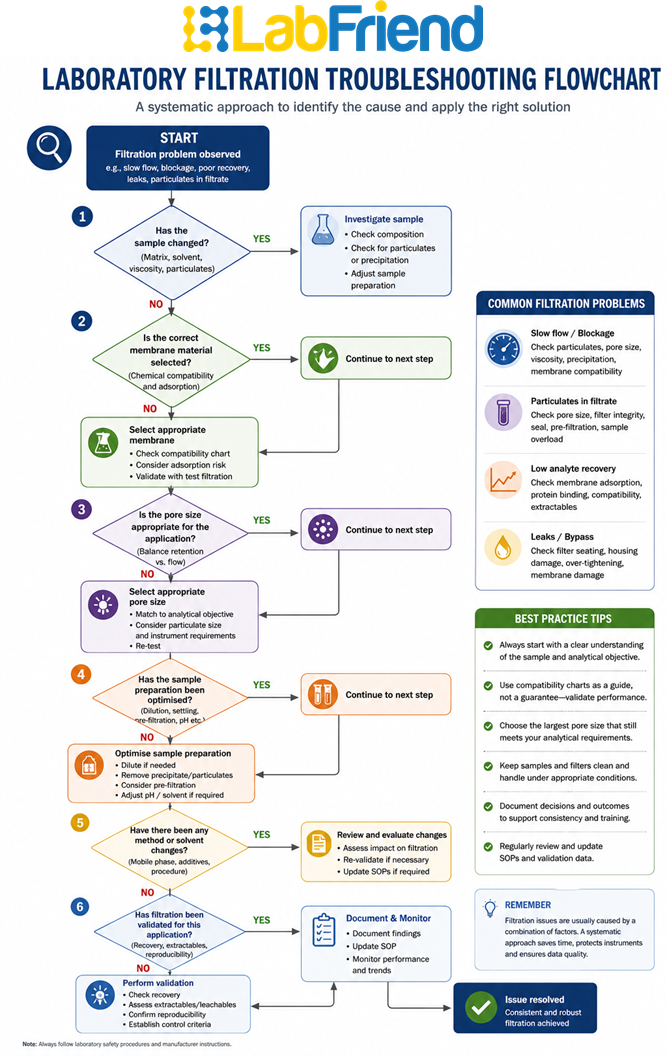
Although every laboratory operates differently, experienced analytical teams often follow a structured thought process whenever filtration performance is questioned.
Rather than immediately changing products, they work systematically through the factors most likely to influence performance.
Step 1 — Review the Sample
Has anything about the sample changed?
Consider:
- solvent composition;
- particulate loading;
- sample concentration;
- biological content; or
- storage conditions.
Changes at this stage frequently explain unexpected filtration behaviour.
Step 2 — Review Membrane Selection
Confirm that the membrane remains appropriate for:
- the sample chemistry;
- analytical technique;
- recovery requirements; and
- compatibility profile.
If uncertainty exists, revisit the dedicated membrane guidance rather than relying solely on historical practice.
Step 3 — Review Pore Size
Confirm that the selected pore size reflects the objective of the filtration step.
The aim should be to balance analytical protection with efficient sample throughput.
Step 4 — Review the Method
Has the analytical procedure evolved?
Even relatively small changes to sample preparation, solvent composition or instrument sensitivity may justify reviewing filtration practices.
Step 5 — Validate Before Standardising
Where improvements are identified, they should be validated and documented before becoming part of routine laboratory practice.
This transforms troubleshooting into continual improvement rather than repeated firefighting.
Changes to filtration materials, pore size or sample preparation should be evaluated in accordance with the laboratory's method validation or change control procedures before implementation.
Comparison Table – Common Filtration Mistakes and Corrective Actions
|
Common Mistake |
Likely Consequence |
Recommended Approach |
|
Choosing membrane by habit |
Reduced recovery or compatibility issues |
Select membrane according to sample chemistry and analytical requirements |
|
Ignoring chemical compatibility |
Membrane degradation, dimensional changes, analyte adsorption and/or increased extractables that may interfere with analysis. |
Validate compatibility using representative samples |
|
Selecting inappropriate pore size |
Poor throughput or inadequate particulate removal |
Match pore size to the analytical objective |
|
Inadequate sample preparation |
Premature filter blockage and inconsistent flow |
Optimise sample preparation before filtration |
|
Assuming all syringe filters are equivalent |
Increased analytical variability |
Evaluate membrane quality and application suitability |
|
Lack of documented procedures |
Operator-to-operator inconsistency |
Develop and maintain standard filtration SOPs |
The value of this table lies not in the individual recommendations—many laboratories will already recognise them—but in demonstrating that most filtration problems originate from decisions made before the sample reaches the filter.
The Role of Continuous Improvement
Analytical laboratories continually refine chromatography methods, calibration procedures and quality systems. Filtration should receive the same level of attention.
Regularly reviewing filtration performance can identify opportunities to:
- simplify approved membrane ranges;
- reduce consumable usage;
- improve analytical reproducibility;
- decrease instrument maintenance;
- strengthen staff training; and
- improve purchasing efficiency.
Even modest improvements in these areas can produce measurable operational benefits when applied across hundreds or thousands of routine analyses.
Frequently Asked Questions
What is the most common filtration mistake in analytical laboratories?
Selecting a membrane without considering sample chemistry is one of the most frequent causes of avoidable filtration problems. Membrane compatibility should always be evaluated alongside analytical requirements.
Can the wrong syringe filter affect analytical results?
Yes. Inappropriate membrane selection may influence analyte recovery, introduce extractables or reduce method reproducibility even if filtration appears successful.
Should analyte recovery be verified after filtration?
Yes. Where quantitative accuracy is important, laboratories should demonstrate that filtration does not cause unacceptable analyte adsorption or loss by comparing filtered and unfiltered samples or by performing suitable recovery studies during method validation.
Why do syringe filters become blocked?
Premature blockage is usually caused by excessive particulate loading, precipitation during sample preparation, inappropriate pore size, high sample viscosity or inadequate upstream sample preparation rather than an inherent fault with the filter.
Does pore size affect chromatography performance?
Indirectly, yes. Appropriate pore size helps protect chromatography systems from particulate contamination while maintaining efficient sample preparation.
Should compatibility charts be trusted?
Compatibility charts are valuable guidance documents but should be regarded as starting points rather than substitutes for method validation.
Should filter extractables be evaluated?
Yes. For sensitive chromatographic and mass spectrometric methods, laboratories should assess whether membrane extractables or leachables contribute detectable background signals or interfere with analyte measurement under the intended analytical conditions.
Why do experienced laboratories standardise filtration?
Standardisation reduces operator variability, simplifies purchasing, improves training and strengthens analytical consistency.
Is regenerated cellulose suitable for every application?
No. Although regenerated cellulose is highly versatile, membrane selection should always reflect sample chemistry and analytical objectives.
Are all syringe filters manufactured to the same standard?
No. Differences in membrane quality, manufacturing consistency and extractable profiles can influence analytical performance.
How often should filtration procedures be reviewed?
Procedures should be reviewed whenever significant changes occur in sample composition, analytical methods, instrumentation or regulatory requirements.
Can filtration reduce instrument maintenance?
Yes. Effective filtration helps minimise particulate contamination reaching analytical systems, reducing wear and extending component life.
Why is sample preparation important before filtration?
Poor sample preparation increases particulate loading, leading to slower filtration, premature blockage and unnecessary consumable usage.
How should a laboratory investigate recurring filtration problems?
Begin by reviewing the sample, membrane, pore size and analytical method before changing products. Root-cause analysis is more effective than trial-and-error replacement.
Does filtration influence analytical reproducibility?
Yes. Consistent filtration practices contribute significantly to reliable analytical results.
Should filtration be included in method validation?
Where filtration has the potential to influence analytical outcomes, it should form part of the overall validation strategy.
Where can I learn more about membrane selection?
LabFriend's dedicated filtration authority articles provide detailed guidance on membrane materials, pore size selection, chemical compatibility and chromatography sample preparation.
Continue Your Filtration Learning
To explore the specialist topics discussed throughout this guide, we recommend the following resources:
- The Ultimate Guide to Laboratory Filtration for UK Laboratories
- The Ultimate Syringe Filter Guide: Pore Size, Membranes and Applications
- Why Regenerated Cellulose (RC) Membranes Are The Universal Standard for Lab Filtration
- 0.22 µm vs 0.45 µm Syringe Filters: When Should You Use Each?
- Best Syringe Filters for HPLC and UHPLC Sample Preparation
- Choosing the Right Syringe Filter for Organic Solvents
- Hydrophilic vs Hydrophobic Membranes: How to Choose the Right Filter for Your Laboratory Application
- The Complete Guide to Chromatography Consumables for UK Laboratories
Conclusion
The most effective analytical laboratories recognise that filtration is not a routine administrative step but a scientifically significant part of sample preparation.
Every filtration decision should balance protection of analytical instrumentation, preservation of sample integrity and generation of reliable, reproducible analytical data.
The encouraging reality is that most filtration problems are avoidable.
They rarely arise because modern filtration products are inherently inadequate. More often they result from understandable decisions made without fully considering membrane chemistry, pore size, chemical compatibility or sample preparation.
By adopting a structured, evidence-based approach to filtration, laboratories can reduce troubleshooting, improve analytical confidence and build workflows that remain robust as methods evolve.
Ultimately, the goal is not simply to filter a sample successfully.
It is to ensure that every filtration step contributes positively to the quality, reliability and reproducibility of the analytical data that follows.
Explore Laboratory Filtration Solutions from LabFriend
Whether you are developing a new analytical method, standardising laboratory procedures or selecting syringe filters for routine sample preparation, LabFriend offers a comprehensive range of laboratory filtration products supported by expert technical guidance.
Explore our Laboratory Filtration Equipment:
Browse our range of Syringe Filters:
Written by: Donal O’Sullivan, BSc, Co-Founder and Sales Director, LabFriend UK. Donal brings deep chemistry-led technical expertise across analytical chemistry, biochemistry, environmental monitoring, laboratory instrumentation, consumables and scientific product selection.
Reviewed by: Michael Anderson, MBA, Founder and Managing Director, LabFriend UK. Michael reviews LabFriend UK content for customer relevance, commercial accuracy, operational practicality and alignment with LabFriend UK’s laboratory supply model.
Related Stories

Complete Guide to Centrifuge Tubes
Complete Guide to Centrifuge Tubes

The Ultimate Guide to Laboratory Filtration for UK Laboratories
The Ultimate Guide to Laboratory Filtration for UK Laboratories

Polypropylene vs Polystyrene Centrifuge Tubes
Polypropylene vs Polystyrene Centrifuge Tubes: Which Is Best for Laboratory Workflows?

PTFE vs PES Syringe Filters: Which Membrane Should You Choose?
PTFE vs PES Syringe Filters: Differences, Solvent Compatibility and Laboratory Applications