

Share :
How UK Laboratories Can Validate Filtration Membrane Chemical Compatibility
Updated On 07/17/2026

By Donal O’Sullivan, BSc. Reviewed by Michael Anderson, MBA.
Executive Summary
|
Filtration is often treated as a relatively straightforward laboratory process. A scientist selects an appropriate pore size, chooses a filter format and proceeds with sample preparation. Yet experienced analytical chemists know that filtration problems rarely arise because a membrane was the wrong diameter or because the pore size differed slightly from the method specification. More commonly, the underlying issue is membrane compatibility. Every filtration membrane is manufactured from a material with its own chemical properties, strengths and limitations. Those properties influence how the membrane interacts with solvents, buffers, biological samples and analytical compounds. When the membrane and sample are compatible, filtration proceeds efficiently and reproducibly. When they are not, the consequences can range from reduced analyte recovery through to complete filtration failure. The challenge for modern laboratories is that compatibility is not always obvious. A membrane may appear to tolerate a solvent perfectly well while still affecting chromatography results through adsorption, extractables or subtle changes in sample composition. This is particularly important in HPLC, UHPLC and LC-MS workflows where even small changes can influence analytical outcomes. As laboratories become increasingly focused on method robustness, reproducibility and regulatory compliance, membrane compatibility validation is evolving from a niche technical consideration into a routine part of good laboratory practice.
|
This guide explains how laboratories can evaluate membrane compatibility systematically, reduce filtration risk and establish validation processes that support long-term analytical reliability.
Who should read this guide?
This guide is intended for analytical chemists, laboratory scientists, quality control personnel, method development specialists, laboratory managers and procurement teams responsible for selecting filtration membranes for analytical applications.
Why Membrane Compatibility Deserves More Attention
Many laboratories rely heavily on compatibility charts provided by filter manufacturers. These charts are valuable resources and often represent the best available starting point when evaluating a membrane for a new application.
However, compatibility charts have limitations.
Most charts are designed to indicate whether a membrane will physically tolerate exposure to a particular solvent. They are not normally intended to predict how the membrane will behave within a specific analytical workflow. As a result, a membrane classified as compatible may still prove unsuitable for a particular method.
Consider a common chromatography scenario. A method development scientist is preparing samples dissolved in acetonitrile and water. A compatibility chart indicates that both regenerated cellulose and PTFE are suitable. From a purely chemical perspective, that may be entirely correct. Yet once analytical performance is considered, the picture becomes more complex.
The scientist may discover differences in:
- analyte recovery
- background extractables
- filtration speed
- reproducibility
- sample stability
Both membranes remain chemically compatible, but one may ultimately prove more appropriate for the application.
This distinction is one of the most important concepts in filtration science and is frequently overlooked when compatibility assessments are reduced to a simple pass-or-fail decision.
For a broader overview of laboratory filtration principles, laboratories should first review the Ultimate Guide to Laboratory Filtration for UK Laboratories:
What Is Filtration Membrane Chemical Compatibility?
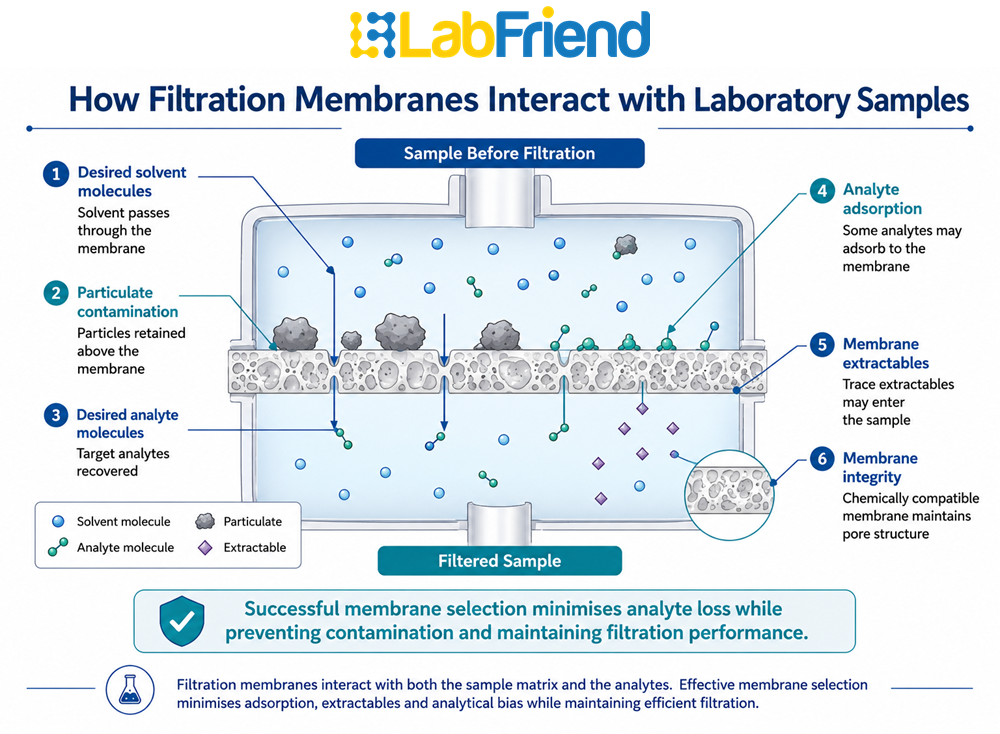
At its simplest level, membrane chemical compatibility describes how a membrane behaves when exposed to a sample, solvent or reagent.
A chemically compatible membrane should maintain its physical integrity and continue to perform as intended throughout the filtration process. The membrane should not dissolve, swell excessively, crack, soften or otherwise degrade under the conditions in which it is used.
Chemical compatibility also includes maintaining pore structure and filtration performance throughout the intended operating conditions.
For many routine laboratory applications this definition appears sufficient. In practice, however, experienced laboratories typically work with a broader definition.
A membrane may be considered truly compatible only when it satisfies three separate criteria.
First, it must remain physically stable during filtration.
Second, it must not adversely affect the sample.
Third, it must not compromise the analytical result.
This distinction becomes increasingly important as methods become more sensitive.
In a routine quality control laboratory analysing high-concentration samples, a small amount of membrane interaction may have little practical significance. In contrast, an LC-MS laboratory measuring trace-level compounds may find that even minor interactions influence analytical performance.
Consequently, compatibility should always be considered within the context of the intended application rather than in isolation.
The Difference Between Physical Compatibility and Analytical Compatibility
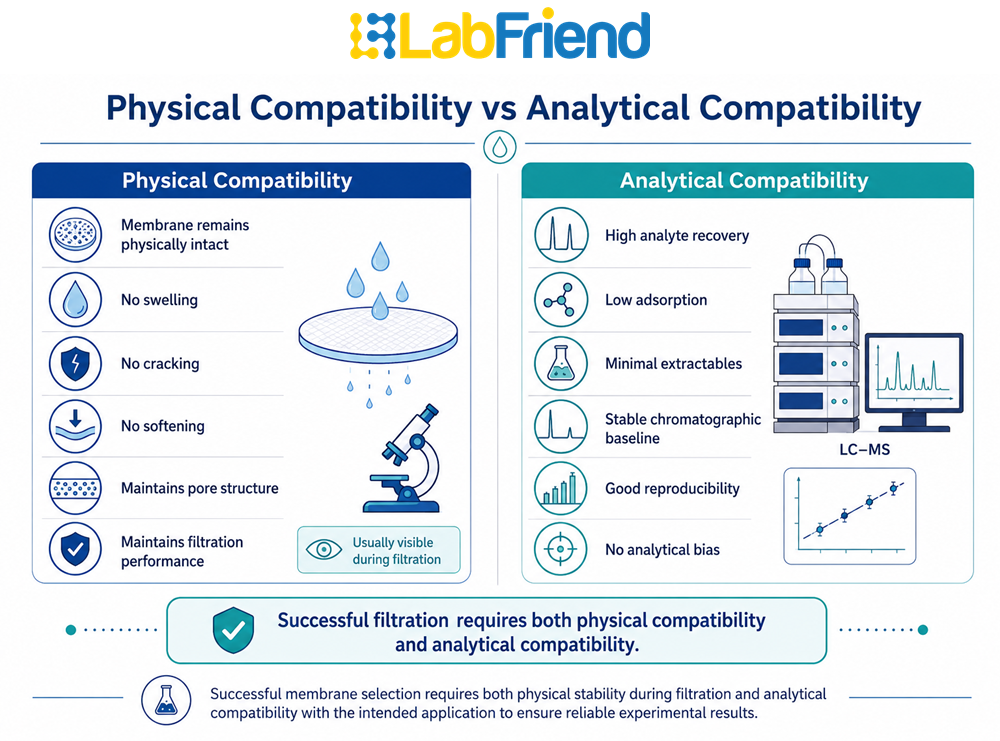
One of the most useful concepts for scientists evaluating filtration systems is the distinction between physical compatibility and analytical compatibility.
Physical compatibility concerns the membrane itself.
Analytical compatibility concerns the data generated after filtration.
A membrane that is physically incompatible with a solvent will usually reveal problems quickly. Signs may include visible swelling, membrane distortion, reduced flow rates or complete filtration failure. These issues are often easy to identify because they are immediately observable.
Analytical compatibility is more subtle.
A membrane may appear completely stable while still introducing unwanted analytical effects. These effects can arise through analyte adsorption, absorption within the membrane matrix, release of extractable compounds, or physicochemical interactions that alter sample composition.
Because analytical compatibility issues are often invisible, they are frequently misdiagnosed. Scientists may suspect instrument performance, column degradation or sample preparation errors long before considering the filtration membrane.
This is one reason why compatibility validation should form part of method development rather than being treated as a procurement decision.
Why Compatibility Failures Occur
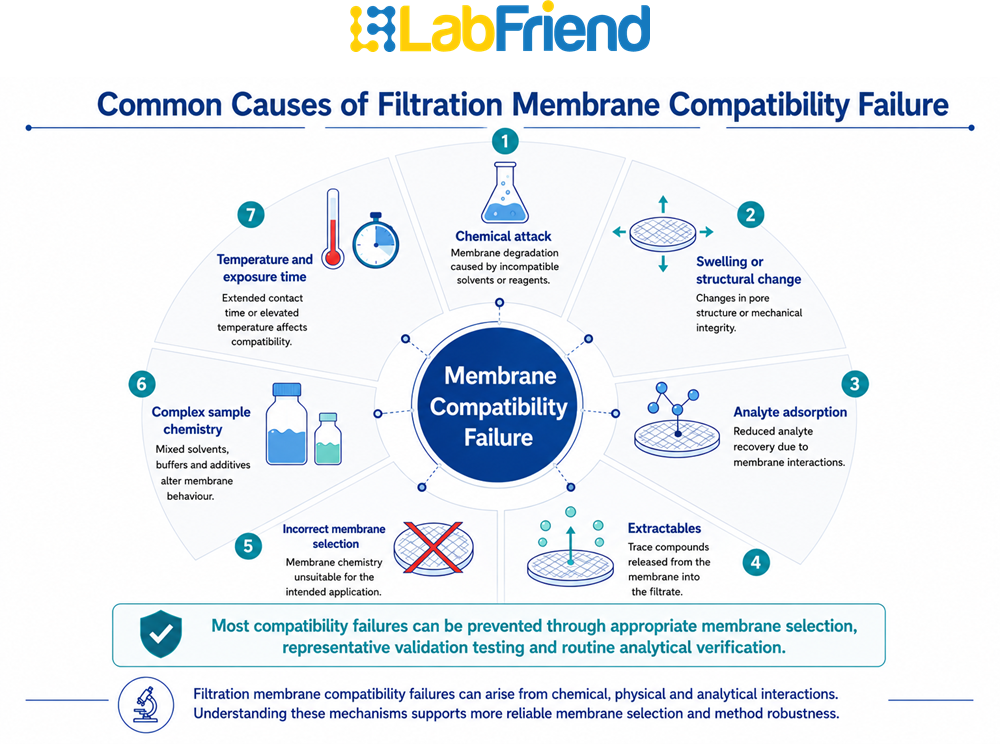
Compatibility failures rarely occur because a membrane is inherently poor. More often they occur because the membrane is being used outside the environment for which it is best suited.
Every membrane material possesses a unique balance of chemical resistance, wettability, extractable profile and adsorption behaviour. These characteristics determine where the membrane performs well and where it may encounter limitations.
When laboratories experience compatibility issues, the root cause generally falls into one of several broad categories.
The first is direct chemical interaction between the membrane and the sample. Certain solvents can alter membrane structure, affect pore characteristics or reduce mechanical stability. The severity of these effects depends upon solvent strength, concentration, temperature and contact time.
The second category involves adsorption. In these situations the membrane remains physically stable but interacts with compounds within the sample. The result may be reduced analyte recovery or altered concentration measurements.
The third category involves extractables and leachables. Here the membrane contributes trace compounds to the filtered sample. Although often insignificant in routine applications, these effects become increasingly important in highly sensitive analytical methods.
Finally, compatibility issues may arise through inappropriate membrane selection rather than membrane failure. A laboratory may choose a membrane that technically works but is suboptimal compared with available alternatives. While this does not always cause immediate problems, it can reduce efficiency, increase costs and limit method robustness over time.
Understanding these mechanisms provides the foundation for effective compatibility validation.
Understanding the Most Common Laboratory Membrane Materials
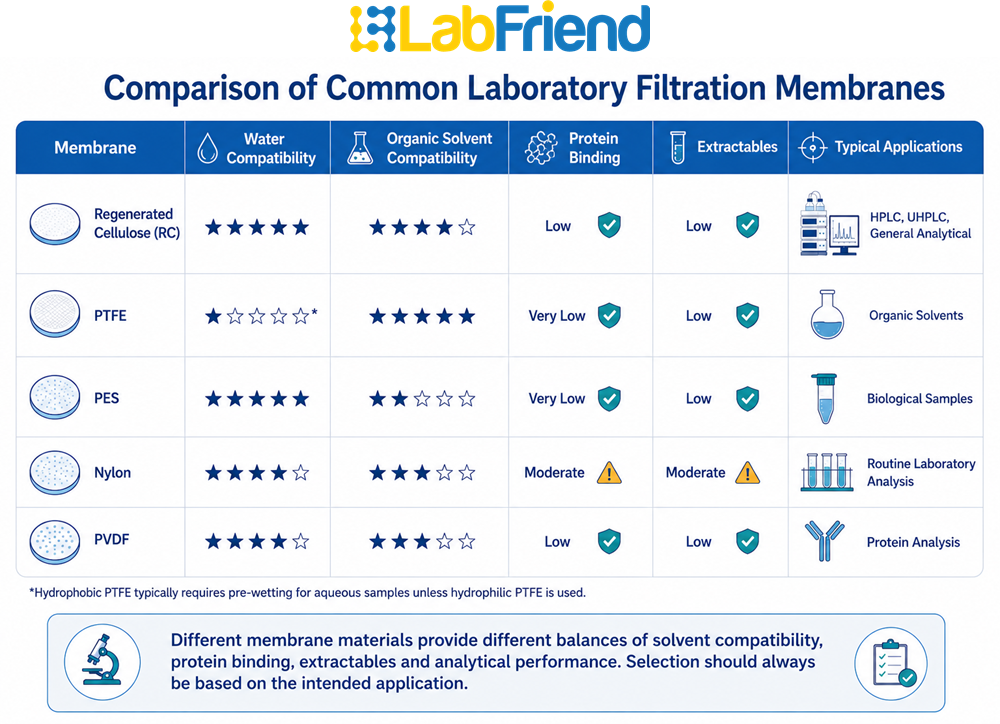
Before a laboratory can validate compatibility effectively, it must understand the characteristics of the membrane materials available.
Different membrane chemistries exist because no single membrane can provide optimal performance across every application.
Some membranes prioritise solvent resistance. Others prioritise biological compatibility. Some offer exceptionally low extractables, while others provide broad chemical versatility.
Understanding these strengths and limitations allows scientists to make more informed compatibility decisions and reduces reliance on trial-and-error selection.
The five membrane families most commonly encountered within laboratory filtration are regenerated cellulose, PTFE, PES, nylon and PVDF.
Each occupies its own position within the compatibility landscape and each serves different laboratory requirements.
Among all commonly used membrane materials, regenerated cellulose occupies a particularly interesting position because its compatibility profile spans a broader range of applications than many scientists initially realise.
This observation provides an important starting point for understanding compatibility assessment.
Understanding Membrane Compatibility in Practice
One of the reasons membrane compatibility can appear confusing is that scientists are often presented with compatibility charts before they fully understand the behaviour of the membrane materials themselves.
As a result, compatibility assessment sometimes becomes a process of matching a solvent against a table rather than understanding the underlying scientific principles.
Experienced laboratories generally take the opposite approach.
Rather than beginning with the solvent, they begin with the membrane.
They ask:
"What is this membrane designed to do?"
"What are its strengths?"
"What are its limitations?"
"How has it historically been used within analytical workflows?"
Once those questions have been answered, compatibility decisions become significantly easier.
Regenerated Cellulose: Why It Is Often the Starting Point
Regenerated cellulose (RC) is widely regarded as one of the most versatile membrane materials for many analytical laboratory applications, particularly aqueous and mixed aqueous-organic sample preparation.
This reputation has not emerged by accident.
Over many years, laboratories have discovered that RC performs well across a surprisingly diverse range of filtration applications.
Unlike some membrane materials that excel in a relatively narrow operating window, RC offers a balance of:
- broad chemical compatibility
- low extractables
- low protein binding
- strong analyte recovery
- suitability for aqueous and mixed solvent systems
The practical consequence is that many laboratories can standardise a significant proportion of their aqueous and mixed-solvent filtration activities around RC membranes while retaining alternative membrane chemistries for applications requiring different chemical or biological performance characteristics.
This does not mean RC is always the optimal choice.
Rather, it means RC often provides a highly reliable starting point when evaluating compatibility.
For laboratories seeking to reduce SKU complexity and simplify membrane selection, this characteristic can be extremely valuable.
The topic is explored in greater depth in:
Why Regenerated Cellulose (RC) Membranes Are The Universal Standard for Lab Filtration
PTFE: The Solvent Compatibility Specialist
If RC is often viewed as the versatile all-rounder, PTFE is commonly regarded as the solvent compatibility specialist.
Many scientists first encounter PTFE membranes during chromatography sample preparation.
This is unsurprising because PTFE performs exceptionally well when exposed to many aggressive organic solvents.
Because PTFE is naturally hydrophobic, aqueous samples generally require either membrane pre-wetting with a compatible water-miscible solvent or the use of hydrophilic PTFE membranes specifically manufactured for aqueous applications.
In solvent-intensive workflows, PTFE often provides a level of chemical resistance that is difficult for other membrane materials to match.
This explains why PTFE appears so frequently in applications involving:
- acetonitrile
- methanol
- isopropanol
- acetone
- tetrahydrofuran
- DMSO
However, one of the most common compatibility mistakes occurs when laboratories begin treating PTFE as a universal solution.
The logic seems reasonable.
If PTFE tolerates aggressive solvents, surely it can be used everywhere.
Unfortunately, filtration is rarely that simple.
The membrane best suited to an aggressive solvent system may not be the best membrane for a biological sample, an aqueous buffer or a sensitive analytical method.
Compatibility therefore remains application dependent.
For a detailed discussion of solvent-driven membrane selection:
Choosing the Right Syringe Filter for Organic Solvents
PES, Nylon and PVDF: Understanding Their Roles
The remaining membrane families often occupy more specialised positions within the laboratory compatibility landscape.
PES has become particularly important within biotechnology and biological research because of its excellent performance with aqueous solutions and low protein binding characteristics.
PES membranes generally exhibit limited compatibility with many strong organic solvents, making verification of solvent compatibility particularly important before use in solvent-intensive analytical workflows.
A scientist filtering cell culture media is often evaluating a very different set of priorities compared with a scientist filtering an HPLC sample dissolved in acetonitrile.
Compatibility assessment must therefore consider intended use rather than simply solvent resistance.
Nylon occupies an interesting middle ground.
Nylon membranes can exhibit relatively high protein binding and may adsorb certain analytes. Their suitability should therefore be confirmed when maximum analyte recovery is required, particularly for proteins and some pharmaceutical compounds.
Its broad utility has made it a popular membrane material across many routine analytical laboratories.
While it may not always represent the optimal solution for highly specialised workflows, it often provides reliable performance across a diverse range of applications.
PVDF is similarly versatile and is available in hydrophilic and hydrophobic forms. Hydrophilic PVDF is often selected where relatively low protein binding is required, although membrane performance should always be verified for the specific analyte and application.
This makes it particularly relevant when biological and analytical requirements intersect.
The important lesson is that compatibility cannot be reduced to a single ranking of membrane materials.
Each membrane possesses strengths that become more or less important depending upon the application.
Why Solvents Matter So Much
Although membrane chemistry provides the foundation for compatibility assessment, solvents often determine the final decision.
A membrane that performs exceptionally well with water may behave very differently when exposed to strong organic solvents.
Similarly, a membrane that tolerates aggressive solvents may provide little advantage within a predominantly aqueous workflow.
Consequently, many compatibility evaluations begin with an assessment of solvent composition.
This is particularly important in chromatography laboratories where mixed solvent systems are common.
A sample may contain:
- water
- acetonitrile
- methanol
- buffers
- modifiers
all within the same preparation workflow.
In these situations, compatibility assessment becomes significantly more nuanced than simply matching one solvent to one membrane.
The Most Common Laboratory Solvents
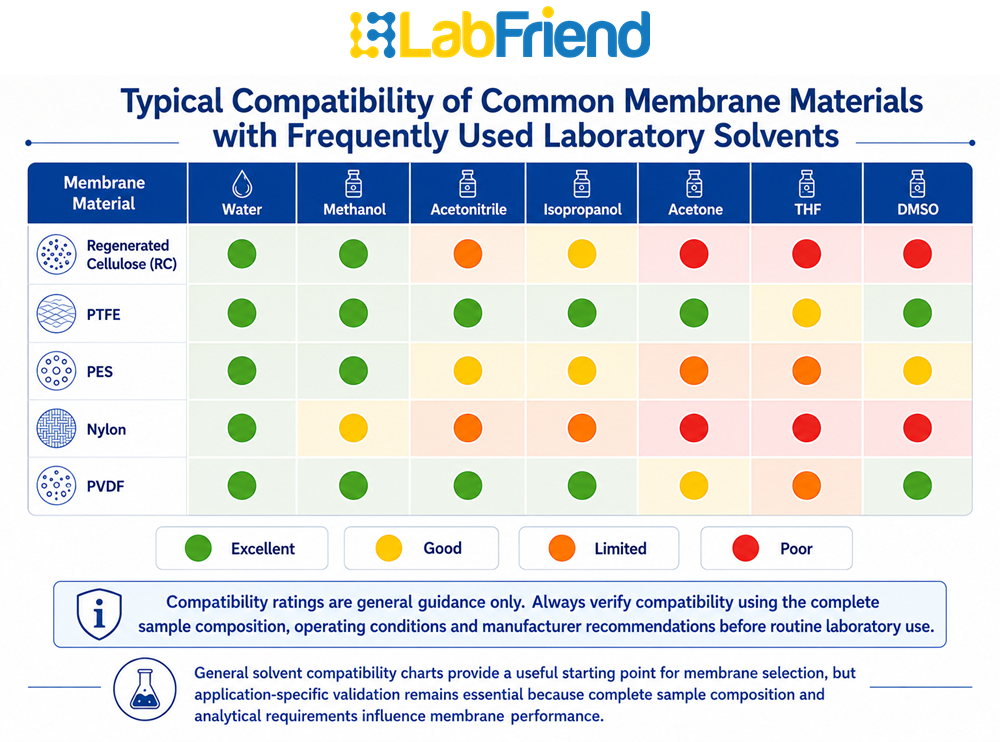
Across UK analytical laboratories, a relatively small number of solvents account for the majority of compatibility evaluations.
Understanding how these solvents influence membrane behaviour provides a useful framework for filtration planning.
Water remains the most common filtration medium encountered in laboratories.
Because water is inherently compatible with many hydrophilic membrane materials, compatibility assessment is often straightforward.
The complexity increases when organic solvents are introduced.
Methanol and acetonitrile dominate many chromatography workflows.
These solvents are routinely encountered during:
- HPLC analysis
- UHPLC analysis
- method development
- pharmaceutical analysis
- environmental testing
The widespread use of these solvents explains why PTFE and RC membranes feature so prominently within analytical laboratories.
Other solvents such as DMSO, THF and acetone introduce additional compatibility considerations because of their more aggressive chemical characteristics.
The greater the solvent strength, the more important compatibility validation becomes.
Laboratories should always verify membrane compatibility using the actual solvent composition employed during routine analysis rather than relying solely on compatibility information for individual pure solvents.
Why Mixed Solvent Systems Create Additional Challenges
One of the most common mistakes laboratories make is evaluating compatibility as though samples contain only a single solvent.
In reality, many analytical samples are mixtures.
A chromatography sample may contain:
- 70% water
- 30% acetonitrile
Another may contain:
- buffer salts
- methanol
- analytes
- stabilisers
Each component influences compatibility.
The membrane therefore experiences the chemistry of the complete sample rather than the chemistry of an individual solvent.
This is why experienced laboratories often treat compatibility charts as screening tools rather than definitive answers.
Charts provide valuable guidance, but they cannot account for every possible sample composition.
Ultimately, validation must occur under conditions that closely resemble routine use.
Temperature and Contact Time
Solvent compatibility is influenced not only by solvent composition but also by exposure time and operating temperature. A membrane that remains chemically stable during a brief room-temperature filtration may behave differently during prolonged exposure or at elevated temperatures. Laboratories should therefore validate compatibility using conditions that reflect normal operating practice whenever these variables differ significantly from routine sample preparation.
How Laboratories Should Approach Compatibility Validation
The strongest compatibility programmes are based on evidence rather than assumptions.
Rather than asking whether a membrane is theoretically compatible, laboratories should ask whether the membrane performs acceptably within the intended application.
This distinction is subtle but important.
The objective is not simply to avoid membrane failure.
The objective is to ensure reliable analytical performance.
Consequently, compatibility validation should be approached as a structured exercise in risk reduction.
The process typically begins with a review of available compatibility information.
Supplier guidance, published application data and historical laboratory experience all provide useful starting points.
However, these sources should be viewed as preliminary evidence rather than final proof.
Where analytical performance is important, laboratories should perform practical evaluations under representative conditions.
Only then can compatibility be assessed with confidence.
A Practical Example
Consider a laboratory developing a new UHPLC method.
The sample contains:
- water
- acetonitrile
- trace-level analytes
A compatibility chart suggests that both RC and PTFE are suitable.
At this stage, many laboratories would consider the compatibility assessment complete.
A more rigorous laboratory would proceed further.
They would evaluate:
- filtration efficiency
- analyte recovery
- chromatographic background
- reproducibility
- instrument cleanliness
The results may reveal that one membrane performs measurably better than the other within the specific workflow.
Both membranes remain chemically compatible.
Yet only one may be operationally optimal.
This example highlights why validation is ultimately an analytical exercise rather than a purely chemical one.
The example is illustrative and should not be interpreted as demonstrating that one membrane material will consistently outperform another across all UHPLC methods.
Once laboratories recognise that compatibility validation is fundamentally an exercise in risk reduction, the next question becomes how to formalise that process within routine operations.
This is where the distinction between an experienced laboratory and an inexperienced laboratory often becomes most visible.
Less mature organisations frequently rely on individual knowledge. A scientist remembers that a particular membrane worked well in a previous project and the same approach is adopted again. While this may be entirely reasonable for low-risk applications, it becomes increasingly problematic as methods become more sensitive, regulated or commercially important.
More advanced laboratories aim to make membrane compatibility a repeatable process rather than an individual judgement.
The goal is not bureaucracy.
The goal is consistency.
Building a Practical Compatibility Validation Process
Compatibility validation does not need to be complicated.
In fact, the most successful systems are often surprisingly simple.
They recognise that not every filtration activity carries the same level of risk.
Filtering a routine aqueous buffer used in general laboratory work requires a very different level of scrutiny compared with preparing samples for an LC-MS method operating at trace concentrations.
Consequently, compatibility validation should be proportionate to the potential impact of failure.
A useful approach is to think of validation as a staged process.
The first stage involves understanding the sample.
The second involves understanding the membrane.
The third involves understanding the analytical consequences of combining the two.
Only when all three factors have been considered can compatibility be assessed with confidence.
The workflow below provides a practical framework rather than a regulatory requirement. Laboratories should adapt the level of validation to the analytical risk, regulatory expectations and intended application.
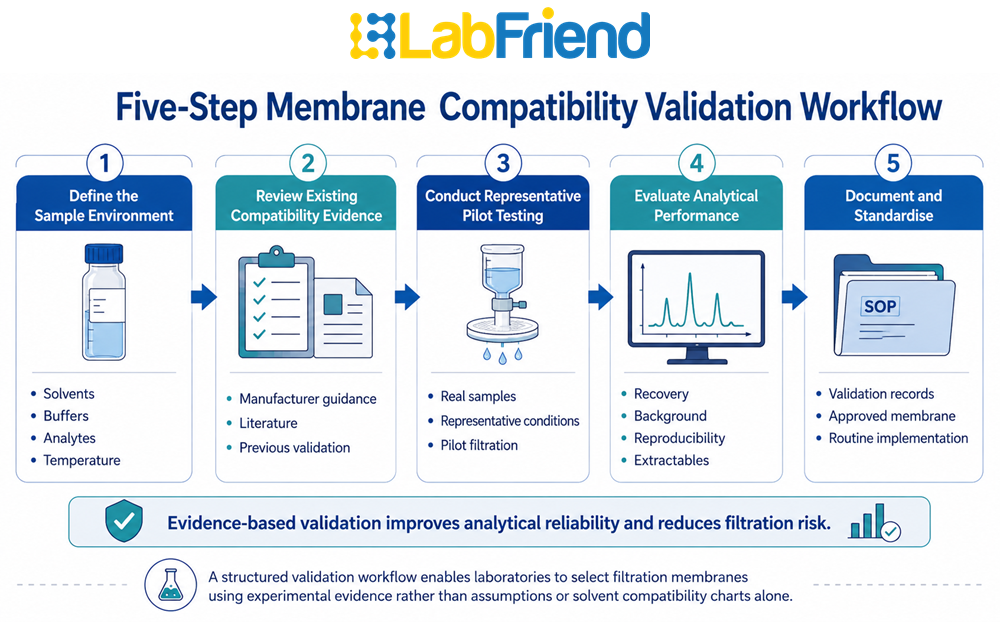
The Five-Step Compatibility Validation Workflow
Experienced laboratories often follow a process that looks remarkably similar regardless of discipline.
Whether the application involves chromatography, pharmaceutical analysis, environmental testing or academic research, the same principles tend to apply.
Step 1: Define the Sample Environment
Before evaluating any membrane, the laboratory should fully understand the sample being filtered.
This sounds obvious, yet many compatibility problems originate because attention is focused on the analyte while the overall sample composition receives less scrutiny.
Questions worth asking include:
- What solvents are present?
- Are buffers involved?
- What concentrations are being used?
- Does the sample contain proteins or biological materials?
- Are there surfactants or modifiers present?
- What temperature conditions apply?
The objective is to understand the complete filtration environment rather than isolated components.
Step 2: Review Existing Compatibility Evidence
Once the sample environment has been defined, laboratories should review available evidence.
This may include:
- manufacturer compatibility guides
- published application data
- historical laboratory experience
- scientific literature
- internal validation reports
The objective is not to make a final decision.
The objective is to identify suitable candidates for evaluation.
Step 3: Conduct Representative Pilot Testing
This is often the stage that separates theoretical compatibility from practical compatibility.
The membrane should be evaluated under conditions that closely resemble routine use.
Ideally this means using:
- real samples
- real solvents
- real concentrations
- representative filtration volumes
Where appropriate, pilot testing should include comparison of filtered and unfiltered control samples to assess analyte recovery, chromatographic background and any filtration-induced bias.
A membrane that performs well in a simplified laboratory test may behave differently under operational conditions.
Step 4: Evaluate Analytical Performance
This stage is frequently overlooked.
Scientists naturally focus on whether the membrane survives filtration.
The more important question is whether the analytical result remains acceptable.
Areas worth evaluating include:
- comparison against appropriate control samples
- replicate filtration precision
- analyte recovery
- chromatographic background
- reproducibility
- peak integrity
- contamination risk
For many advanced methods, this stage ultimately determines membrane suitability.
Where chromatographic methods are involved, laboratories may also monitor changes in retention time stability, baseline noise, peak area precision and the appearance of unexpected chromatographic peaks following filtration. These observations can provide additional evidence that the membrane is not adversely affecting analytical performance.
Step 5: Formalise and Standardise
Once compatibility has been demonstrated, the findings should be documented and incorporated into routine laboratory procedures.
This transforms compatibility assessment from an individual decision into an organisational capability.
Over time, laboratories build an internal compatibility knowledge base that reduces future validation effort.
Why Chromatography Laboratories Require Additional Rigour
Compatibility validation becomes particularly important in chromatography laboratories.
Modern HPLC and UHPLC systems are capable of detecting extremely small variations within samples.
As instrument sensitivity increases, the impact of filtration decisions becomes more significant.
A membrane that appears acceptable during routine observation may still influence:
- analyte recovery
- peak shape
- baseline stability
- method reproducibility
- instrument cleanliness
This is one reason chromatography laboratories often invest considerably more effort into membrane evaluation than might initially appear necessary.
The filtration step is not simply protecting the column.
It is helping to protect the integrity of the entire analytical workflow.
Laboratories seeking guidance on chromatography-specific filtration should also review:
Best Syringe Filters for HPLC and UHPLC Sample Preparation
Compatibility assessment should also be considered within the wider chromatography consumables ecosystem.
Columns, vials, septa, sample preparation devices and filtration products all interact to influence overall analytical performance.
For a broader discussion of this relationship:
The Complete Guide to Chromatography Consumables for UK Laboratories
The Role of Standardisation
One of the most valuable outcomes of compatibility validation is standardisation.
Many laboratories accumulate membrane types over time.
A membrane is introduced for one project.
Another is adopted for a specialised method.
A third arrives as part of a supplier recommendation.
Several years later the laboratory may be managing a surprisingly complex filtration portfolio.
This complexity often introduces hidden costs.
Scientists spend more time selecting products.
Purchasing teams manage more SKUs.
Training requirements increase.
The likelihood of user error rises.
Compatibility validation frequently reveals that a relatively small number of carefully selected membrane technologies can support the majority of routine applications.
This does not eliminate specialised products.
Rather, it ensures specialised products remain genuinely specialised.
The result is a filtration programme that is easier to manage, easier to train and easier to scale.
Common Misconceptions About Membrane Compatibility
Perhaps the most persistent misconception is that compatibility charts provide definitive answers.
They do not.
Compatibility charts are essential resources, but they are starting points rather than final conclusions.
Another misconception is that solvent resistance automatically equates to analytical suitability.
As discussed earlier, physical compatibility and analytical compatibility are not the same thing.
Finally, many laboratories assume compatibility assessment is only necessary for unusual solvents.
In reality, compatibility validation often delivers value within routine workflows because it helps laboratories understand recovery, reproducibility and long-term method robustness.
Frequently Asked Questions
What is membrane chemical compatibility?
Membrane chemical compatibility describes how a membrane material behaves when exposed to a particular solvent, sample or reagent and whether it remains suitable for the intended analytical application.
Which membrane is often considered to have one of the broadest compatibility profiles?
Regenerated cellulose is often considered one of the most versatile membrane materials because it performs well across many aqueous and mixed solvent applications.
Is PTFE always the best membrane for solvents?
No. PTFE offers exceptional solvent resistance, but the most appropriate membrane depends upon the complete application, including recovery requirements and analytical sensitivity.
Hydrophobic PTFE may also require pre-wetting before filtration of aqueous-containing samples unless a hydrophilic PTFE membrane is being used.
Why should compatibility be validated if a supplier chart already exists?
Compatibility charts provide valuable guidance, but they cannot account for every sample matrix, analyte or analytical method.
What is the difference between physical and analytical compatibility?
Physical compatibility concerns membrane stability. Analytical compatibility concerns the effect of the membrane on analytical results.
Can membrane compatibility affect chromatography results?
Yes. Compatibility can influence recovery, reproducibility, extractables and chromatographic performance.
How often should compatibility be reviewed?
Compatibility should be reviewed whenever significant changes occur in sample composition, method conditions or membrane selection.
Are compatibility issues common?
Severe failures are relatively uncommon, but subtle compatibility issues are more common than many laboratories realise.
Can compatibility affect analyte recovery?
Yes. Membrane interactions can influence the amount of analyte recovered after filtration.
Why are mixed solvent systems challenging?
Because membrane behaviour is influenced by the complete sample composition rather than a single solvent.
Is compatibility validation necessary for routine laboratories?
The level of validation should reflect the level of analytical risk, but even routine laboratories benefit from understanding membrane suitability.
What role does temperature play?
Temperature can influence chemical interactions and should be considered during compatibility assessment.
Can compatibility influence instrument maintenance?
Indirectly, yes. Inappropriate membrane selection may contribute to contamination and increased troubleshooting.
Should compatibility assessment be documented?
Yes. Documentation improves consistency, supports training and reduces future validation effort.
What is the biggest mistake laboratories make?
Treating compatibility as a procurement decision rather than an analytical performance decision.
Documenting Compatibility Decisions
Once compatibility has been demonstrated, laboratories should document the membrane selected, sample matrix, solvent composition, validation observations, acceptance criteria and justification for selection. Maintaining this information supports method transfer, training, quality management systems and future investigations should analytical performance change.
Conclusion
The most effective filtration programmes are not built around membrane products. They are built around understanding.
Understanding how membranes interact with solvents.
Understanding how membranes influence analytical performance.
Understanding how compatibility affects method robustness, reproducibility and long-term laboratory efficiency.
When viewed in this way, membrane compatibility ceases to be a narrow technical topic and becomes part of a broader strategy for analytical quality.
Compatibility charts remain valuable. Supplier guidance remains valuable. Historical experience remains valuable.
Yet none of these should replace validation.
The laboratories that achieve the most reliable outcomes are typically those that treat compatibility assessment as an evidence-based process rather than an assumption.
By combining scientific understanding, practical evaluation and structured validation, laboratories can significantly reduce filtration risk while improving analytical confidence.
Ultimately, compatibility validation is not about proving that a membrane works.
It is about proving that it works reliably within the exact environment in which it will be used.
Written by: Donal O’Sullivan, BSc, Co-Founder and Sales Director, LabFriend UK. Donal brings deep chemistry-led technical expertise across analytical chemistry, biochemistry, environmental monitoring, laboratory instrumentation, consumables and scientific product selection.
Reviewed by: Michael Anderson, MBA, Founder and Managing Director, LabFriend UK. Michael reviews LabFriend UK content for customer relevance, commercial accuracy, operational practicality and alignment with LabFriend UK’s laboratory supply model.
Further Reading
For laboratories seeking to build a deeper understanding of membrane selection and filtration science, the following resources provide additional guidance:
The Ultimate Guide to Laboratory Filtration for UK Laboratories
The Ultimate Syringe Filter Guide: Pore Size, Membranes and Applications
Why Regenerated Cellulose (RC) Membranes Are The Universal Standard for Lab Filtration
Choosing the Right Syringe Filter for Organic Solvents
Hydrophilic vs Hydrophobic Membranes: How to Choose the Right Filter for Your Laboratory Application
0.22 µm vs 0.45 µm Syringe Filters: When Should You Use Each?
Explore LabFriend's Laboratory Filtration Solutions
Discover syringe filters, membrane filters and laboratory filtration products designed to support reproducible analytical workflows across research, quality control and chromatography laboratories.
Laboratory Filtration Equipment
Chromatography Sample Preparation
Related Stories

Hydrophilic vs Hydrophobic Membranes: How to Choose the Right Filter for Your Laboratory Application
Hydrophilic vs Hydrophobic Membranes: How to Choose the Right Filter for Your Laboratory Application

Choosing Centrifuge Tubes for Molecular Biology and PCR Workflows
Choosing Centrifuge Tubes for Molecular Biology and PCR Workflows

Understanding RCF RPM and Rotor Compatibility for Centrifuge Tubes
Understanding RCF, RPM and Rotor Compatibility for Centrifuge Tubes

Complete Guide to Centrifuge Tubes
Complete Guide to Centrifuge Tubes