

Share :
Best Syringe Filters for HPLC and UHPLC Sample Preparation
Updated On 07/17/2026

By Donal O’Sullivan, BSc. Reviewed by Michael Anderson, MBA.
Executive Summary
Proper sample filtration is one of the most important yet frequently overlooked aspects of HPLC and UHPLC sample preparation.
While modern chromatography systems are capable of delivering exceptional analytical sensitivity and reproducibility, they remain highly vulnerable to particulate contamination introduced during routine sample handling. Even small amounts of particulate matter can contribute to increased system backpressure, blocked frits, reduced column lifetime, poor peak shape and unnecessary instrument downtime.
For many laboratories, selecting the correct syringe filter can significantly improve analytical reliability while simultaneously reducing maintenance costs and extending the life of expensive chromatography columns.
In general:
- Regenerated cellulose (RC) membranes are often the preferred starting point for routine HPLC and UHPLC applications because of their broad compatibility and low extractables profile.
- PTFE membranes are frequently selected when samples contain aggressive organic solvents such as methanol or acetonitrile.
- For aqueous or highly aqueous samples, standard hydrophobic PTFE membranes may not wet effectively unless pre-wetted with a suitable solvent or supplied in a hydrophilic PTFE format.
- UHPLC methods often benefit from 0.22µm filtration because the smaller frit pore structures and sub-2 µm packing materials used in many UHPLC columns increase sensitivity to particulate contamination.
- Many routine HPLC methods continue to perform effectively with 0.45µm filtration where method requirements permit.
- Membrane compatibility should always be considered before pore size selection.
For a broader overview of laboratory filtration principles, workflows and technologies, readers should first review LabFriend's Ultimate Guide to Laboratory Filtration for UK Laboratories:
This article focuses specifically on filtration strategies for chromatography laboratories and explains how to select the most appropriate syringe filters for HPLC and UHPLC sample preparation.
Why Sample Preparation Matters in Chromatography
Every chromatography laboratory invests significant resources into:
- High-performance instrumentation
- Analytical columns
- Certified reference standards
- Method validation
- Staff training
- Regulatory compliance
Yet the quality of the final chromatographic result is often determined long before the sample reaches the detector.
Poor sample preparation can undermine even the most sophisticated analytical method.
Contaminants introduced during sample handling may affect:
- Retention time stability
- Peak shape
- Baseline noise
- System pressure
- Column performance
- Method reproducibility
In contrast, properly prepared and filtered samples contribute to:
- Improved data quality
- Greater analytical confidence
- Reduced instrument maintenance
- Longer column lifetimes
- More reliable regulatory compliance
Filtration therefore should not be viewed simply as a laboratory housekeeping activity. It is a critical component of analytical quality assurance.
Effective chromatography performance depends on more than just filtration. Columns, vials, septa, syringe filters and other sample preparation consumables all contribute to analytical reliability. Laboratories seeking a broader understanding of chromatography workflow optimisation should also read our Complete Guide to Chromatography Consumables for UK Laboratories.
Before selecting a syringe filter, it is helpful to understand the wider principles of laboratory filtration.
Read the Ultimate Guide to Laboratory Filtration for UK Laboratories
HPLC vs UHPLC Fundamentals
Understanding the differences between HPLC and UHPLC systems is essential when selecting filtration consumables.
Although both techniques rely on the same chromatographic principles, UHPLC systems operate under significantly more demanding conditions.
These differences directly influence filtration requirements.
What Is HPLC?
High Performance Liquid Chromatography (HPLC) is one of the most widely used analytical techniques in modern laboratories.
Applications include:
- Pharmaceutical quality control
- Environmental testing
- Food analysis
- Clinical research
- Academic research
- Contract analytical services
Traditional HPLC systems typically operate using:
- Column particle sizes between 3 µm and 5 µm
- Moderate operating pressures
- Standard analytical flow rates
While these systems remain sensitive to contamination, they generally tolerate slightly larger particulate loads than UHPLC systems.
What Is UHPLC?
Ultra High Performance Liquid Chromatography (UHPLC) represents an evolution of traditional HPLC technology.
UHPLC systems typically use:
- Sub-2 µm stationary phase particles
- Much higher operating pressures
- Enhanced chromatographic efficiency
- Faster analysis times
- Improved resolution
These benefits come at a cost.
UHPLC systems are significantly less forgiving of particulate contamination.
Small particles that may pass through inadequate sample preparation procedures can quickly affect system performance.
As a result, filtration becomes even more important within UHPLC workflows.
Why UHPLC Systems Demand Cleaner Samples
The smaller particle sizes used within UHPLC columns create narrower flow pathways throughout the chromatographic system.
This increases sensitivity to contamination.
Potential consequences include:
- Elevated backpressure
- Reduced flow efficiency
- Blocked inlet frits
- Reduced column lifetime
- Increased maintenance frequency
For this reason, many UHPLC laboratories adopt more stringent filtration procedures than those traditionally used for HPLC methods.
HPLC vs UHPLC Filtration Comparison
|
Characteristic |
HPLC |
UHPLC |
|
Typical Column Particle Size |
3–5 µm |
<2 µm |
|
Typical Operating Pressure |
Lower |
Significantly Higher |
|
Sensitivity to Particulates |
Moderate |
High |
|
Typical Filter Choice |
0.45µm |
0.22µm |
|
Instrument Tolerance |
Greater |
Lower |
|
Importance of Filtration |
Important |
Critical |
This table should not be interpreted as a universal rule.
Validated methods, regulatory requirements and manufacturer recommendations should always take precedence.
However, it illustrates why filtration requirements often differ between HPLC and UHPLC workflows.
Why Filtration Matters Before Chromatographic Analysis
Filtration serves a simple purpose:
To remove particulate contaminants before they enter the chromatography system.
Although simple in principle, the impact can be substantial.
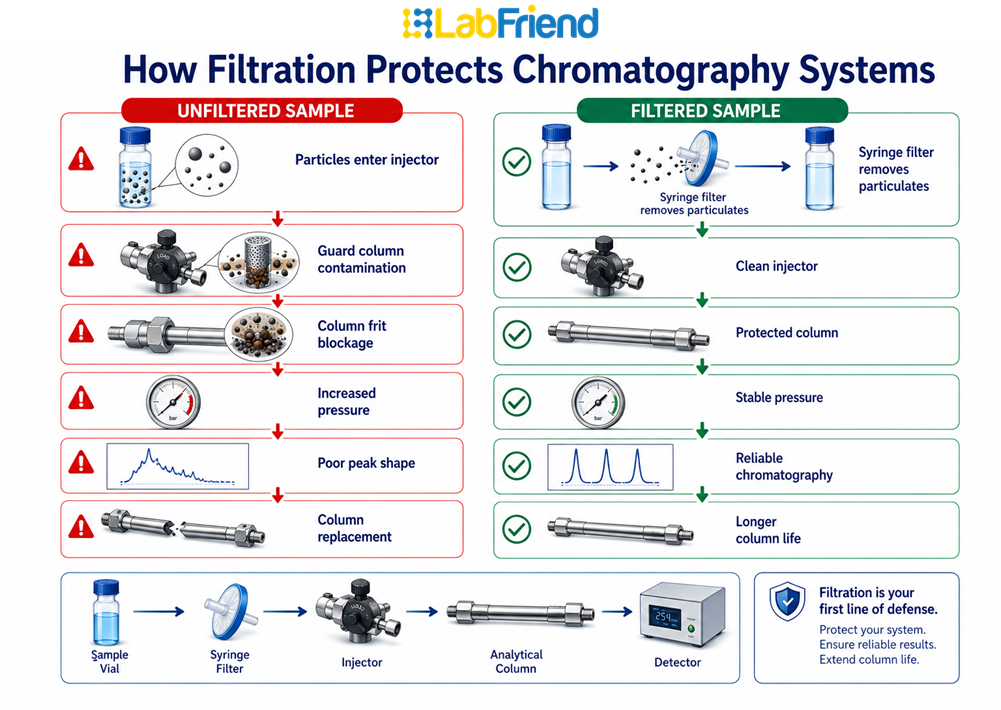
Protecting Analytical Columns
Chromatography columns are among the most valuable consumables used within analytical laboratories.
Many advanced columns represent a significant investment.
Particulate contamination can contribute to:
- Column fouling
- Increased pressure
- Reduced separation efficiency
- Shortened operational life
Replacing damaged columns is often far more expensive than implementing robust filtration procedures.
Filtration therefore represents a highly cost-effective preventative measure.
Improving Analytical Reproducibility
Analytical reproducibility depends upon consistency.
Particulates present in one sample but absent in another may contribute to variability between injections.
Proper filtration helps create greater consistency by reducing uncontrolled particulate variation.
Benefits include:
- More stable retention times
- Improved peak symmetry
- Reliable quantitative performance
- Greater confidence in reported results
Supporting Regulatory Compliance
Many laboratories operate within regulated environments.
Examples include:
- GMP laboratories
- Pharmaceutical QC facilities
- Environmental testing laboratories
- Contract testing organisations
In these environments, analytical reliability is critical.
Consistent sample preparation procedures help support:
- Method robustness
- Audit readiness
- Validation requirements
- Data integrity objectives
Reducing Instrument Downtime
Unscheduled instrument downtime is costly.
Potential consequences include:
- Delayed projects
- Reduced laboratory throughput
- Increased maintenance costs
- Lost productivity
Routine filtration can significantly reduce contamination-related maintenance events.
For laboratories operating multiple chromatography systems, even modest reductions in downtime can create substantial operational benefits.
What Happens When Samples Are Not Properly Filtered?
The consequences of poor filtration are rarely immediate.
Instead, problems often develop gradually over time.
This makes filtration-related issues difficult to diagnose.
Laboratories frequently blame:
- Instrument hardware
- Pump performance
- Columns
- Method design
when the underlying cause is inadequate sample preparation.
Increased System Backpressure
One of the earliest warning signs is increased system pressure.
Particulates accumulate within:
- Guard columns
- Inlet frits
- Column heads
- Tubing restrictions
As contamination builds, flow resistance increases.
This may eventually trigger:
- Pressure alarms
- Flow instability
- Method interruptions
Reduced Column Lifetime
Column contamination is cumulative.
Each poorly filtered sample introduces additional particulate burden.
Over time this can contribute to:
- Reduced efficiency
- Broadened peaks
- Increased tailing
- Loss of resolution
Columns that should last months may require replacement significantly earlier.
Poor Peak Shape and Resolution
Particulates can interfere with chromatographic performance.
Potential symptoms include:
- Peak broadening
- Peak tailing
- Reduced sensitivity
- Increased baseline disturbance
- Inconsistent integration
These issues may compromise analytical confidence and trigger unnecessary investigations.
Increased Maintenance Requirements
Contamination can affect multiple components throughout the system.
Examples include:
- Injector valves
- Sample loops
- Capillaries
- Detector flow cells
- Column frits
Maintenance events increase laboratory costs and reduce productivity.
Many of these issues can be minimised through appropriate filtration practices.
How Filtration Protects Chromatography Columns
Column protection is one of the strongest commercial and technical justifications for routine filtration.
Chromatography columns are precision-engineered separation devices.
The stationary phases contained within modern columns are designed to deliver highly reproducible separations under tightly controlled conditions.
Particulates compromise those conditions.
When particles enter the column, they can accumulate at the inlet and gradually restrict flow.
Initially, the effect may be negligible.
Over time, however, the consequences become increasingly apparent.
Pressure begins to rise.
Peak shape deteriorates.
Resolution decreases.
Column performance becomes less predictable.
Eventually, replacement becomes necessary.
Routine syringe filtration dramatically reduces the number of particulates reaching the column and helps maintain long-term chromatographic performance.
For laboratories seeking to maximise return on investment from chromatography consumables, filtration should be viewed as an essential component of column protection rather than an optional preparatory step.
Selecting the correct membrane is the next critical decision in HPLC and UHPLC sample preparation.
While pore size determines the size of particles removed from a sample, membrane selection determines how the filter interacts with the sample itself.
Different membrane materials exhibit different characteristics relating to:
- Chemical compatibility
- Solvent resistance
- Extractables profile
- Protein binding
- Flow characteristics
- Sample recovery
The wrong membrane can compromise analytical performance even when the correct pore size has been selected.
In addition to chemical compatibility, laboratories should consider the potential for analyte adsorption onto membrane surfaces, particularly when working with proteins, peptides, highly polar compounds or trace-level analytes.
For this reason, chromatography laboratories should always evaluate membrane compatibility before finalising filtration procedures.
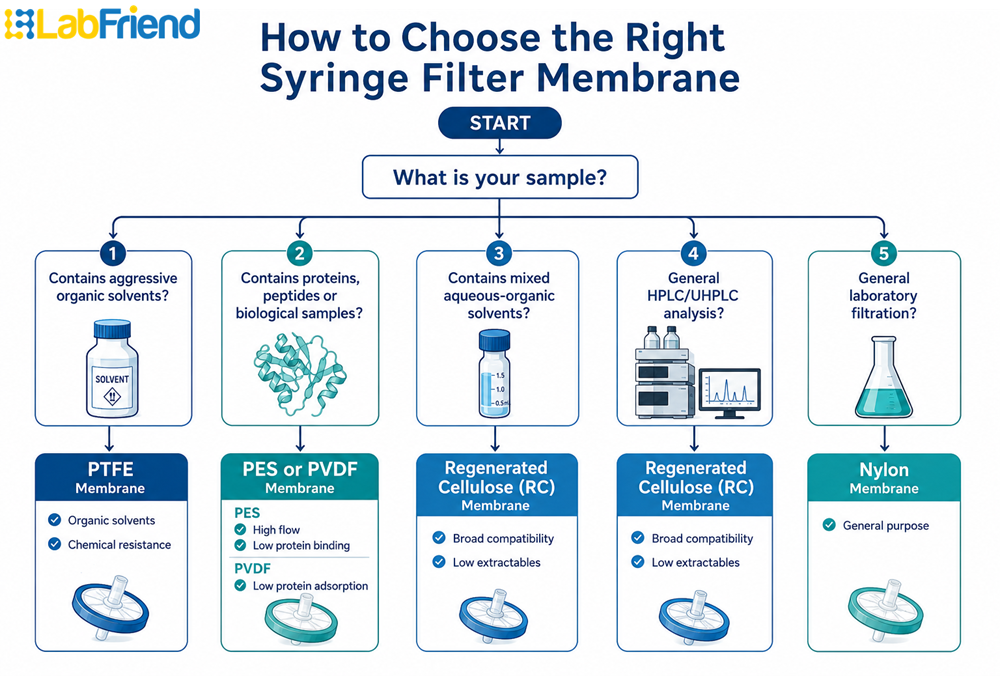
Choosing the Right Syringe Filter Membrane
Many laboratories initially focus on pore size when selecting a syringe filter.
In reality, membrane selection often has a greater impact on analytical performance.
A membrane that is chemically incompatible with the sample may:
- Leach contaminants
- Adsorb analytes
- Reduce recovery
- Introduce chromatographic artefacts
- Cause inconsistent results
Understanding the strengths and limitations of each membrane technology helps laboratories make more informed decisions.
Regenerated Cellulose (RC) Membranes
Regenerated cellulose (RC) membranes are widely regarded as one of the most versatile filtration media available for chromatography sample preparation.
Because RC membranes exhibit broad compatibility with both aqueous and mixed aqueous-organic solutions, they are often selected as a standardised filtration solution across multiple analytical workflows.
Advantages include:
- Broad compatibility with aqueous solutions and many common organic solvents used in HPLC and UHPLC
- Low extractables
- Low protein binding
- High sample recovery
- Excellent performance in mixed solvent systems
- Suitable for HPLC, UHPLC and many LC-MS workflows where membrane-derived extractables and analyte recovery have been evaluated during method development
These characteristics make RC membranes particularly attractive for laboratories seeking to simplify purchasing and standardise filtration procedures.
For a detailed discussion of RC membrane technology, see: Why Regenerated Cellulose (RC) Membranes are The Universal Standard for Lab Filtration
Typical RC Applications
RC membranes are frequently used for:
- Pharmaceutical QC testing
- Method development
- Environmental analysis
- Food testing
- Academic research
- Contract analytical services
Many laboratories find that RC membranes provide an excellent balance between performance, versatility and simplicity.
PTFE Membranes
Polytetrafluoroethylene (PTFE) membranes are best known for their exceptional chemical resistance.
PTFE is frequently selected when samples contain aggressive organic solvents that may not be compatible with other membrane types.
Common solvent systems include:
- Methanol
- Acetonitrile
- Isopropanol
- Acetone
- Tetrahydrofuran (THF)
- DMSO
Advantages include:
- Excellent solvent resistance
- Low extractables Caution: Extractables profiles may vary between manufacturers and device constructions, particularly where support layers or housing materials differ.
- Broad organic solvent compatibility
- Strong chemical durability
Limitations include:
- Hydrophobic nature
- Less suitable for purely aqueous samples unless specifically modified
For laboratories working extensively with organic solvents, PTFE often represents the safest membrane choice.
For further guidance see Choosing the Right Syringe Filter for Organic Solvents
Typical PTFE Applications
PTFE membranes are commonly used for:
- Organic solvent filtration
- HPLC mobile phase preparation where solvent compatibility and method requirements are appropriate
- Pharmaceutical method development
- Solvent extraction workflows
- Organic chemistry applications
Polyethersulfone (PES) Membranes
PES membranes are frequently selected for biological and aqueous applications.
They are known for:
- High flow rates
- Low protein binding
- Excellent aqueous compatibility
Advantages include:
- Fast filtration
- Excellent performance with biological samples
- Good recovery of sensitive biomolecules
Limitations include:
- Reduced compatibility with some organic solvents
- Less versatile than RC for mixed solvent applications
Typical PES Applications
PES membranes are often used for:
- Protein solutions
- Biological samples
- Cell culture media
- Aqueous buffer preparation
While highly effective within these workflows, they are not always the most flexible choice for multi-purpose analytical laboratories.
Nylon Membranes
Nylon membranes have historically been popular within analytical laboratories because of their broad chemical compatibility.
Advantages include:
- Good mechanical strength
- Compatibility with many aqueous and organic solvent systems commonly encountered in analytical laboratories
- Good resistance to many laboratory chemicals
Potential limitations include:
- Higher protein binding compared with RC and PES
- Possible analyte interaction in some applications
Typical Nylon Applications
Nylon membranes are often used for:
- General analytical testing
- Routine laboratory filtration
- Sample clarification
However, laboratories working with proteins or highly sensitive analytical methods may prefer lower-binding alternatives.
PVDF Membranes
Polyvinylidene fluoride (PVDF) membranes offer a balance between chemical compatibility and low protein binding.
Advantages include:
- Low extractables
- Low protein adsorption
- Good chemical resistance
- Broad application range
PVDF is frequently selected when laboratories require:
- High sample recovery
- Biological compatibility
- Strong analytical performance
Typical PVDF Applications
PVDF membranes are commonly used for:
- Protein-containing samples
- Biopharmaceutical workflows
- Sensitive analytical methods
Membrane Selection Matrix
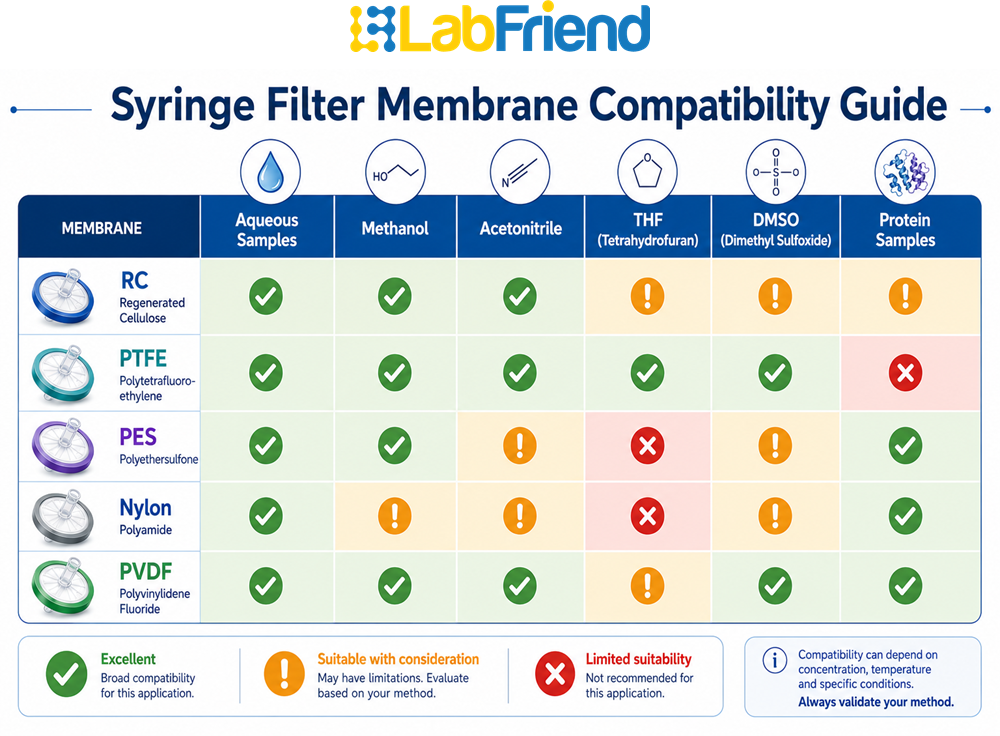
The following table provides a practical starting point for membrane selection.
|
Membrane |
Aqueous Samples |
Organic Solvents |
Mixed Solvent Systems |
Protein Binding |
Typical HPLC/UHPLC Use |
|
RC |
Excellent |
Excellent |
Excellent |
Low |
General chromatography |
|
PTFE |
Limited |
Excellent |
Good |
Low |
Organic solvent analysis |
|
PES |
Excellent |
Limited |
Moderate |
Very Low |
Biological samples |
|
Nylon |
Good |
Good |
Good |
Moderate |
General analytical testing |
|
PVDF |
Good |
Good |
Good |
Low |
Biological and analytical applications |
This matrix should be used as an initial guide only.
Final membrane selection should always consider:
- Method requirements
- Sample composition
- Validation requirements
- Regulatory expectations
Explore LabFriend's syringe filter range to compare membrane materials and identify the most appropriate filtration solution for your chromatography workflow see the range of syringe filters available from LabFriend.co.uk
Choosing the Best Membrane for Different Chromatography Applications
Although membrane properties are important, laboratories rarely choose filters based on membrane specifications alone.
Instead, filtration decisions are typically driven by application requirements.
Understanding how different workflows influence membrane selection helps reduce complexity and improve analytical consistency.
Pharmaceutical Quality Control
Pharmaceutical QC laboratories often prioritise:
- Method robustness
- Reproducibility
- Regulatory compliance
- Consistent recovery
Because validated methods frequently remain in use for many years, filtration procedures must support long-term consistency.
RC membranes are often attractive because of their broad compatibility profile, while PTFE may be preferred when solvent-intensive methods are used.
Environmental Testing Laboratories
Environmental laboratories frequently encounter diverse sample matrices.
These may include:
- Groundwater samples
- Surface water samples
- Soil extracts
- Wastewater samples
Filtration requirements can vary significantly between methods.
As a result, many environmental laboratories standardise around a small number of versatile membrane types capable of supporting multiple workflows.
Food and Beverage Analysis
Food testing laboratories often analyse complex matrices containing:
- Proteins
- Sugars
- Fats
- Suspended particulates
Effective filtration is essential to prevent contamination of chromatography systems while maintaining acceptable analyte recovery.
RC membranes are frequently selected because of their versatility across diverse food testing applications.
Academic Research Laboratories
Research laboratories often work with evolving methods and novel sample matrices.
Flexibility becomes particularly important.
In these environments, RC membranes often provide a useful starting point because they perform well across a broad range of applications without requiring extensive filter rationalisation.
Contract Research and Testing Organisations
Contract laboratories must often support multiple clients, analytical platforms and sample types simultaneously.
This diversity creates pressure to:
- Simplify inventory
- Maintain method flexibility
- Support rapid project onboarding
Standardising around a limited number of high-performance membrane technologies can help reduce operational complexity while maintaining analytical quality.
Choosing Between µm and 0.45µm Filters
Once membrane compatibility has been established, the next decision is pore size selection.
This is one of the most common questions encountered within chromatography laboratories and one of the most frequently searched filtration topics online.
Many scientists ask:
- Should I use 0.22µm or 0.45µm?
- Is smaller always better?
- Does UHPLC require 0.22µm filtration?
- Will a 0.45µm filter damage a UHPLC column?
The answer depends upon the analytical application, the sample matrix and the validated method requirements.
There is no universal filtration standard suitable for every chromatography workflow.
In some applications, laboratories should also evaluate whether smaller pore sizes affect filtration throughput, filter blockage propensity or analyte recovery.
However, understanding the strengths and limitations of each pore size helps laboratories make more informed decisions.
For a detailed discussion of pore size selection see our guide 0.22µm vs 0.45µm Syringe Filters: When Should You Use Each?
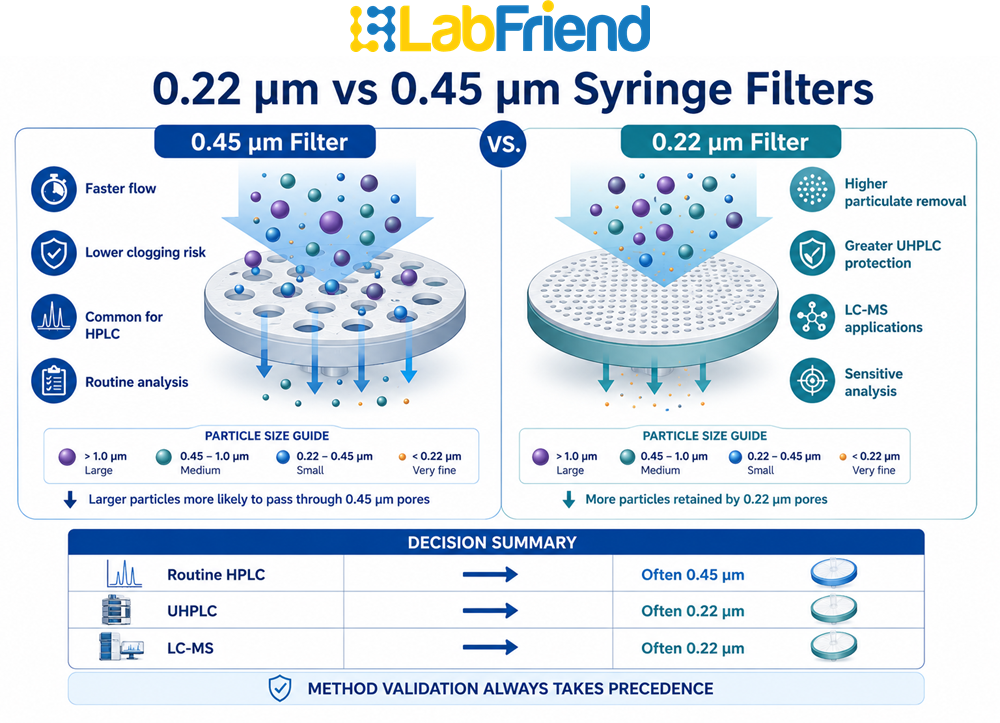
Understanding 0.45µm Filtration
Historically, 0.45µm filtration became the standard for many HPLC applications.
Its popularity was driven by:
- Strong particulate removal
- Good flow characteristics
- Broad method adoption
- Ease of use
Advantages include:
- Faster filtration
- Lower backpressure during filtration
- Reduced risk of filter blockage
- Suitable for many routine HPLC workflows
Typical applications include:
- Pharmaceutical QC
- Environmental analysis
- Food testing
- Routine analytical methods
For many laboratories, 0.45µm filtration remains an entirely appropriate choice.
Understanding 0.22µm Filtration
A 0.22µm filter removes smaller particles than a 0.45µm filter.
The reduction in particulate load may improve protection of highly sensitive chromatographic systems, although the optimal pore size should always be determined by validated method requirements and sample characteristics.
As chromatography systems have become increasingly sensitive, the use of 0.22µm filtration has become more common.
Advantages include:
- Greater particulate removal
- Enhanced UHPLC protection
- Reduced risk of column contamination
- Improved suitability for highly sensitive methods
Typical applications include:
- UHPLC
- LC-MS
- Trace analysis
- Advanced method development
Many laboratories regard 0.22µm filtration as a conservative approach for protecting high-value UHPLC systems.
HPLC and UHPLC Decision Framework
The following framework provides a practical starting point.
Question 1
Are you using UHPLC?
If yes:
Begin evaluation with 0.22µm filtration.
If no:
Proceed to Question 2.
Question 2
Does the validated method specify pore size?
If yes:
Follow the validated method.
If no:
Proceed to Question 3.
Question 3
Is the sample matrix heavily contaminated with particulates?
If yes:
Additional prefiltration or filtration optimisation may be required.
If no:
Proceed to Question 4.
Question 4
Is the sample intended for highly sensitive analysis?
If yes:
Consider 0.22µm filtration.
If no:
0.45µm filtration may be entirely appropriate.
Quick Selection Table
|
Application |
Typical Membrane |
Typical Pore Size |
|
Routine HPLC |
RC |
0.45µm |
|
UHPLC |
RC |
0.22µm |
|
LC-MS |
RC |
0.22µm |
|
Organic Solvent Analysis |
PTFE |
0.22µm or 0.45µm |
|
Pharmaceutical QC |
RC |
Method Dependent |
|
Environmental Testing |
RC/PTFE |
Method Dependent |
|
Food Testing |
RC |
Method Dependent |
|
Method Development |
RC/PTFE |
Method Dependent |
Standardising Filtration Consumables Across the Laboratory
One of the most overlooked opportunities in chromatography laboratories is filtration standardisation.
Over time, many laboratories accumulate:
- Multiple membrane types
- Multiple pore sizes
- Multiple suppliers
- Multiple catalogue references
This often creates unnecessary complexity.
Common consequences include:
- Procurement inefficiency
- Excess inventory
- Increased training requirements
- Greater risk of user error
- Reduced purchasing leverage
Many successful laboratories review filtration usage annually and identify opportunities to consolidate products wherever scientifically appropriate.
For example:
Instead of maintaining numerous niche filtration products, a laboratory may determine that a small number of carefully selected RC and PTFE filters can support the majority of chromatography workflows.
Benefits include:
- Simpler procurement
- Improved stock control
- Reduced inventory costs
- Easier training
- Improved consistency
This approach can be particularly valuable for growing laboratories seeking to scale analytical operations efficiently.
Common Filtration Mistakes in HPLC and UHPLC Laboratories
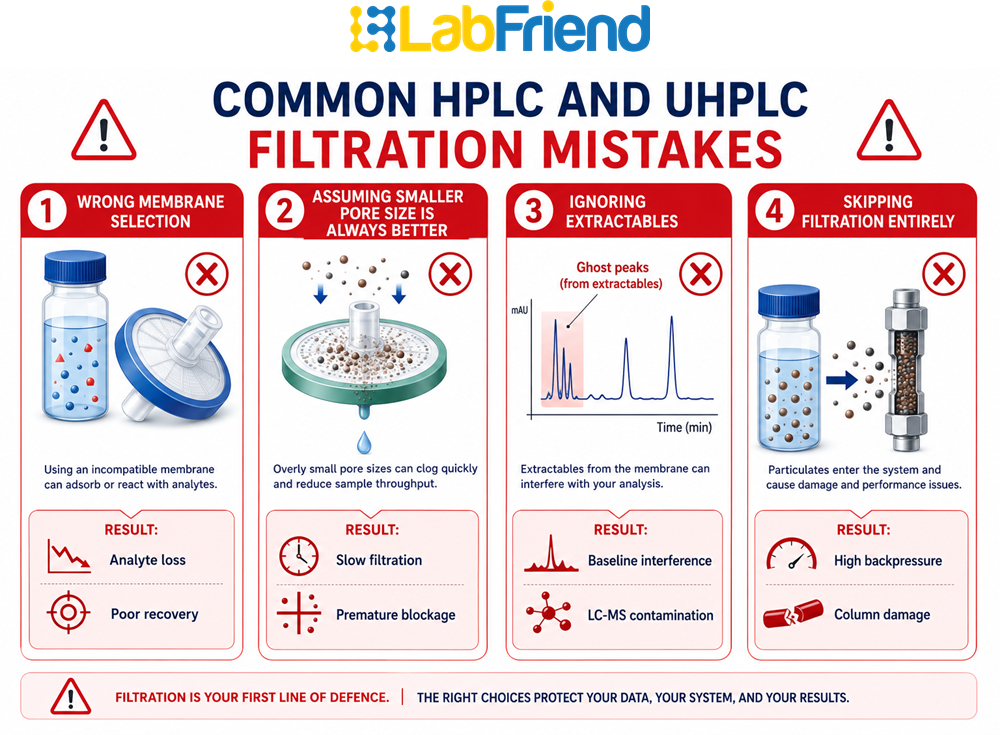
Even experienced laboratories occasionally make avoidable filtration mistakes.
Understanding these issues can improve analytical performance and reduce troubleshooting requirements.
Selecting a Membrane Before Evaluating Compatibility
Membranes should be selected based on the sample and analytical method.
Choosing a membrane purely because it is familiar or readily available may introduce unnecessary risk.
Always evaluate:
- Solvent compatibility
- Sample composition
- Method requirements
before making a final selection.
Assuming Smaller Pore Sizes Are Always Better
A common misconception is that smaller pore sizes are universally superior.
In reality:
- Smaller pore sizes may increase filtration time.
- Heavily contaminated samples may block filters more quickly.
- Method requirements remain the primary decision factor.
Selection should always be application driven.
Ignoring Extractables
Filtration devices are analytical consumables.
In highly sensitive methods, extractables can influence analytical results.
Potential impacts include chromatographic ghost peaks, elevated baseline noise, ion suppression in LC-MS systems and false-positive signals in trace-level analyses.
This is particularly important within:
- LC-MS
- Trace analysis
- Pharmaceutical applications
Low-extractable membrane technologies may provide advantages in these environments.
Failing to Standardise Filtration Procedures
Inconsistent filtration practices can introduce variability between analysts and laboratories.
Documented procedures help improve:
- Reproducibility
- Training
- Method consistency
- Audit readiness
Treating Filtration as an Optional Step
Filtration should be viewed as a core component of analytical quality assurance.
The cost of a syringe filter is minimal when compared with:
- Column replacement
- Instrument maintenance
- Repeat testing
- Investigation time
The most effective filtration programme is preventative rather than reactive.
Frequently Asked Questions
What is the best syringe filter for HPLC?
For many routine HPLC applications, regenerated cellulose (RC) syringe filters provide an excellent balance of compatibility, low extractables and analytical performance.
What is the best syringe filter for UHPLC?
Many UHPLC laboratories utilise 0.22µm regenerated cellulose filters because they provide fine particulate removal and broad compatibility with aqueous and mixed-solvent mobile phase systems.
Should all HPLC samples be filtered?
Most chromatography methods benefit from filtration because filtration helps remove particulates that may affect columns, injectors and system performance.
What pore size should I use for HPLC?
Many routine HPLC workflows successfully use 0.45µm filters. Final selection should always align with validated methods and analytical requirements.
What pore size should I use for UHPLC?
Many UHPLC applications utilise 0.22µm filtration because UHPLC systems are particularly sensitive to particulate contamination.
Is regenerated cellulose suitable for chromatography?
Yes. RC membranes are widely used across HPLC, UHPLC and many LC-MS workflows because of their broad compatibility profile and low extractables.
When should PTFE membranes be used?
PTFE membranes are frequently selected for samples containing aggressive organic solvents such as methanol, acetonitrile, DMSO and THF.
Why is filtration important before chromatography?
Filtration helps:
- Protect columns
- Reduce contamination
- Improve reproducibility
- Extend instrument life
- Support method robustness
Can filtration improve chromatographic reproducibility?
Yes. Removing particulates helps create more consistent sample conditions and can contribute to improved analytical repeatability.
Does filtration reduce instrument maintenance?
Routine filtration can reduce contamination-related maintenance events and help minimise downtime.
Are syringe filters important for LC-MS?
Yes. LC-MS systems are highly sensitive analytical platforms and often benefit from robust filtration practices to reduce contamination risks.
Can one membrane be used for every application?
No. While RC membranes offer exceptional versatility, membrane selection should always consider sample composition, solvent compatibility and analytical requirements.
Read More
For additional guidance, explore the following resources:
The Ultimate Guide to Laboratory Filtration for UK Laboratories
The Ultimate Syringe Filter Guide: Pore Size, Membranes and Applications
Why Regenerated Cellulose (RC) Membranes Are The Universal Standard for Lab Filtration
Choosing the Right Syringe Filter for Organic Solvents
0.22µm vs 0.45µm Syringe Filters: When Should You Use Each?
The Complete Guide to Chromatography Consumables for UK Laboratories
Written by: Donal O’Sullivan, BSc, Co-Founder and Sales Director, LabFriend UK. Donal brings deep chemistry-led technical expertise across analytical chemistry, biochemistry, environmental monitoring, laboratory instrumentation, consumables and scientific product selection.
Reviewed by: Michael Anderson, MBA, Founder and Managing Director, LabFriend UK. Michael reviews LabFriend UK content for customer relevance, commercial accuracy, operational practicality and alignment with LabFriend UK’s laboratory supply model.
Conclusion
Selecting the best syringe filter for HPLC and UHPLC sample preparation requires consideration of both membrane compatibility and pore size selection.
While no single filter is suitable for every application, a structured approach allows laboratories to make informed decisions that support analytical performance, instrument protection and long-term operational efficiency.
For many routine chromatography workflows, regenerated cellulose membranes provide an excellent starting point because of their broad compatibility and low extractables profile.
Where aggressive organic solvents are involved, PTFE membranes frequently offer the most appropriate solution.
Equally important is selecting the correct pore size. Many routine HPLC methods continue to perform effectively with 0.45µm filtration, while UHPLC and highly sensitive analytical workflows often benefit from 0.22µm filtration.
Ultimately, the best syringe filter is the one that aligns with:
- The analytical method
- The sample matrix
- Regulatory requirements
- Instrument requirements
- Laboratory objectives
By adopting a structured filtration strategy, laboratories can improve reproducibility, reduce downtime and maximise the value of their chromatography systems.
Explore LabFriend's Chromatography Filtration Solutions
Discover syringe filters and chromatography sample preparation products designed to support reliable, reproducible HPLC and UHPLC analysis.
Chromatography Sample Preparation
Related Stories

Complete Guide to Centrifuge Tubes
Complete Guide to Centrifuge Tubes

The Ultimate Guide to Laboratory Filtration for UK Laboratories
The Ultimate Guide to Laboratory Filtration for UK Laboratories

Polypropylene vs Polystyrene Centrifuge Tubes
Polypropylene vs Polystyrene Centrifuge Tubes: Which Is Best for Laboratory Workflows?

PTFE vs PES Syringe Filters: Which Membrane Should You Choose?
PTFE vs PES Syringe Filters: Differences, Solvent Compatibility and Laboratory Applications