

Share :
Choosing the Right Syringe Filter for Organic Solvents
Updated On 07/17/2026

By Donal O’Sullivan, BSc. Reviewed by Michael Anderson, MBA.
Organic solvents are widely used throughout analytical chemistry, pharmaceutical testing, biotechnology research and environmental laboratories. Whether preparing samples for HPLC analysis, filtering extraction solutions or removing particulates before instrumental testing, selecting the correct syringe filter is critical to obtaining reliable and reproducible results.
While pore size often receives significant attention, membrane compatibility with the solvent system is frequently the factor that determines filtration success. Choosing an unsuitable membrane can result in reduced flow rates, membrane degradation, contamination, poor sample recovery or complete filtration failure.
This guide explains how UK laboratories can select the most appropriate syringe filter for organic solvent applications and avoid common filtration mistakes. For broader context, see our laboratory filtration guide.
Why Organic Solvents Require Careful Filter Selection
Organic solvents interact differently with filtration membranes than aqueous samples.
Depending on the membrane material and solvent being used, laboratories may encounter:
- Membrane swelling
- Reduced chemical resistance
- Increased extractables
- Changes in flow characteristics
- Reduced filtration efficiency
- Premature filter failure
For this reason, membrane compatibility should always be considered alongside:
- Pore size
- Filter diameter
- Sample volume
- Analytical method requirements
- Sample composition
- Housing material compatibility, especially for aggressive organic solvents
For a broader overview of membrane types, pore sizes and filtration fundamentals, see our Ultimate Syringe Filter Guide: Pore Size, Membranes and Applications.
Common Organic Solvents Used in Laboratories
|
Solvent |
Typical Applications |
|
Methanol |
HPLC mobile phases, sample preparation |
|
Acetonitrile |
HPLC and UHPLC analysis |
|
Isopropanol (IPA) |
Cleaning, extraction and analytical workflows |
|
DMSO |
Pharmaceutical and biotechnology research |
|
Acetone |
Sample preparation and extraction |
|
THF |
Polymer and materials analysis |
|
Hexane |
Environmental and chemical testing |
Each solvent presents different challenges and compatibility requirements.
Quick Solvent Selection Guide
The membrane choices below are indicative starting points only. Final selection should account for membrane type, hydrophilic or hydrophobic treatment, housing material, solvent concentration, contact time, temperature and the analytical method.
|
Solvent Type |
Common Membrane Choice |
|
Methanol |
PTFE |
|
Acetonitrile |
PTFE |
|
DMSO |
PTFE or regenerated cellulose (RC), depending on device-specific compatibility data |
|
IPA |
PTFE or Nylon |
|
Acetone |
PTFE |
|
THF |
PTFE |
|
Mixed Aqueous/Organic Samples |
RC, hydrophilic PTFE, nylon or PVDF, depending on solvent ratio, analyte binding and method requirements |
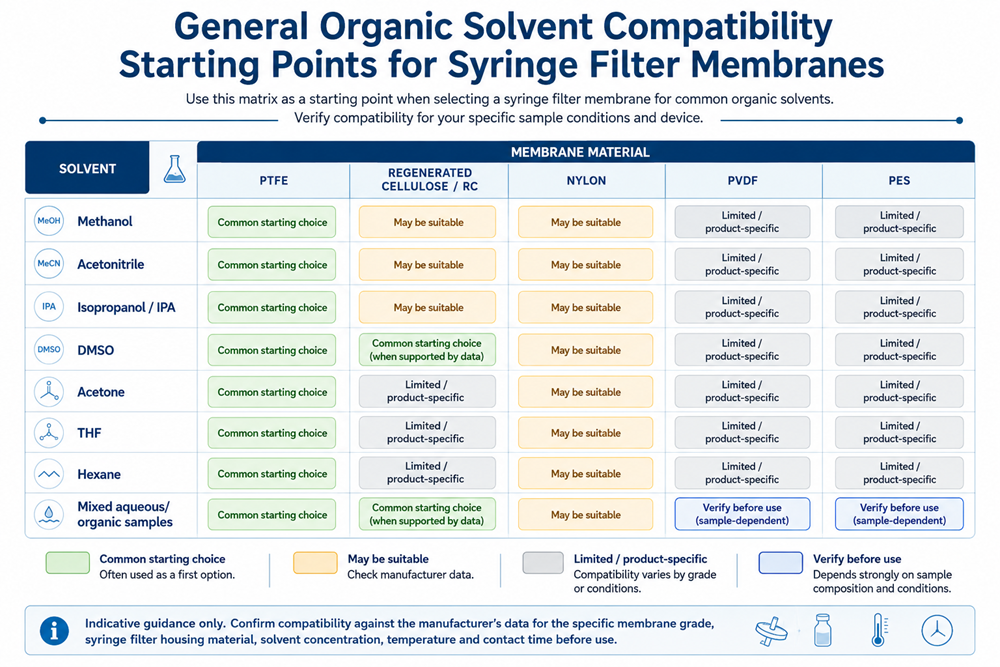
Important: Membrane compatibility should always be verified against the manufacturer’s solvent compatibility guidance before use. Sample composition, concentration, temperature and analytical requirements can all influence membrane suitability.
PTFE: The Preferred Choice for Many Organic Solvent Applications
Polytetrafluoroethylene (PTFE) membranes are widely regarded as one of the most chemically resistant membrane materials available for laboratory filtration.
PTFE syringe filters offer:
- Excellent chemical resistance
- Broad compatibility with organic solvents
- Low extractables when an appropriate HPLC/UHPLC-certified grade is selected
- Resistance to aggressive solvents
- Strong suitability for analytical sample preparation
For these reasons PTFE is frequently selected for:
- Methanol filtration
- Acetonitrile filtration
- DMSO-containing samples
- Organic synthesis workflows
- Pharmaceutical analysis
- HPLC sample preparation
Explore LabFriend’s syringe filter range to identify filters suitable for methanol, acetonitrile, DMSO and other organic solvent applications.
When PTFE May Not Be the Best Option
Although PTFE performs exceptionally well with many organic solvents, it is not automatically the correct choice for every application.
Standard hydrophobic PTFE is generally best suited to organic solvents; aqueous or high-water-content samples may require hydrophilic PTFE, pre-wetting, or an alternative hydrophilic membrane.
Alternative membrane materials may be preferable when:
- Samples contain significant aqueous components
- Low protein binding is required
- Low adsorption of the target analyte is critical
- Biological samples are being analysed
- Method-specific requirements exist
In these situations, regenerated cellulose (RC), PVDF or nylon membranes may provide advantages depending on the workflow.
For mixed aqueous and organic samples, regenerated cellulose membranes may be worth considering.
Comparing Common Membranes for Organic Solvent Filtration
|
Membrane |
Organic Solvent Compatibility |
Typical Applications |
|
PTFE |
Excellent |
HPLC, UHPLC, aggressive solvents |
|
Regenerated Cellulose (RC) |
Very Good |
Mixed aqueous/organic samples |
|
PVDF |
Solvent-specific; good for some alcohols and biological/low-protein-binding workflows, but unsuitable for some strong solvents |
Alcohol-containing samples, selected biological or analytical workflows |
|
Nylon |
Good |
Analytical chemistry applications |
|
PES |
Limited for many organic solvents; product-specific |
Primarily aqueous buffers, culture media and selected low-protein-binding applications |
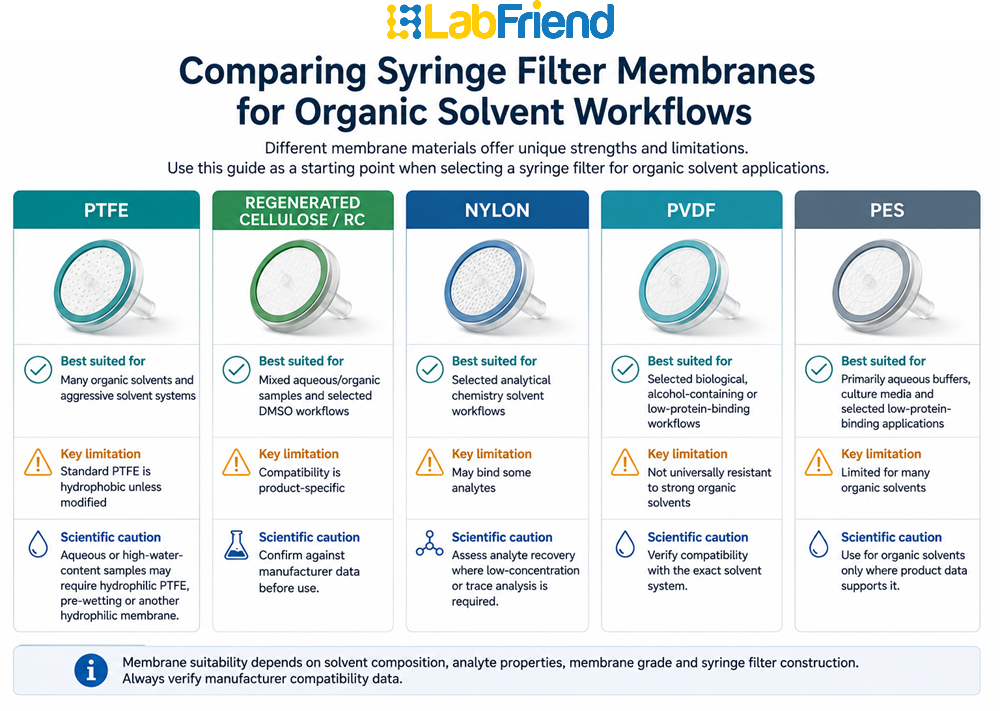
Important: This comparison is intended as a general guide. Compatibility should always be confirmed against the manufacturer’s solvent compatibility data before use.
Need a solvent-compatible filter for your application? Browse LabFriend’s laboratory filtration range to compare membrane options for analytical laboratories.
For HPLC and sample preparation workflows, explore LabFriend’s chromatography sample preparation products.
Choosing a Filter for Common Laboratory Solvents
Methanol
PTFE membranes are widely used due to their strong chemical resistance and broad solvent compatibility.
Acetonitrile
PTFE remains one of the most commonly selected membrane materials for acetonitrile-based HPLC and UHPLC workflows.
DMSO
Because DMSO can challenge certain membrane materials, PTFE or regenerated cellulose may be selected where supported by the manufacturer’s compatibility data.
IPA
PTFE and nylon membranes may both be suitable depending on sample composition and analytical requirements.
Mixed Aqueous and Organic Samples
Regenerated cellulose membranes often provide a useful balance of compatibility where both aqueous and organic components are present. See our article on regenerated cellulose membranes for more detail.
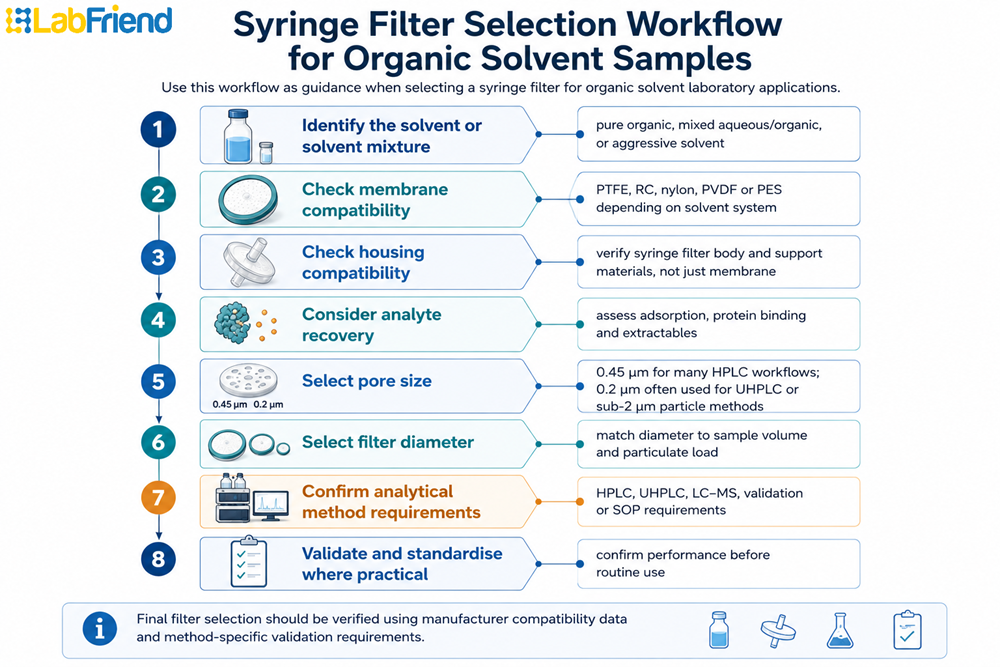
A Practical Syringe Filter Selection Workflow
Step 1
Identify the solvent or solvent mixture.
Step 2
Confirm membrane compatibility.
Step 3
Determine the required pore size.
Step 4
Select an appropriate filter diameter. As a general guide, smaller diameters are used for low sample volumes, while larger diameters are used for higher volumes or particulate-heavy samples to reduce blockage and hold-up losses.
Step 5
Confirm compatibility with the analytical method.
Step 6
Standardise validated filter types where practical.
This approach can help improve consistency, simplify procurement and reduce inventory complexity.
Common Mistakes When Filtering Organic Solvent Samples
Selecting Membranes Based Solely on Pore Size
Pore size is important, but membrane compatibility is often the more critical factor when working with solvents.
Assuming All Organic Solvents Behave Similarly
Methanol, acetonitrile, DMSO and THF can interact differently with membrane materials.
Overlooking Mixed Solvent Systems
Samples containing both aqueous and organic components may require different membrane choices than pure solvent systems.
Failing to Standardise Validated Filters
Using multiple filter types for similar workflows can increase purchasing complexity and create unnecessary variability.
Not Reviewing Manufacturer Compatibility Information
Compatibility guidance should always be reviewed before introducing a filter into a validated workflow.
Why Standardisation Matters
Many laboratories accumulate multiple syringe filter types over time.
This often creates:
- Procurement complexity
- Inventory duplication
- Increased purchasing costs
- Greater risk of selection errors
- Difficulty maintaining workflow consistency
Where analytical requirements permit, standardising on a small number of validated syringe filter types can simplify purchasing and improve operational efficiency.
Looking to simplify purchasing and reduce consumable complexity? Browse LabFriend’s laboratory filtration equipment or contact the LabFriend team to discuss filtration standardisation opportunities.
Frequently Asked Questions
What is the best syringe filter for organic solvents?
PTFE syringe filters are commonly regarded as one of the best choices for many organic solvent applications because of their excellent chemical resistance and broad compatibility.
Can PTFE syringe filters be used with methanol?
Yes. PTFE membranes are widely used for methanol filtration in analytical laboratories.
Which syringe filter should I use for acetonitrile?
PTFE membranes are commonly selected for acetonitrile-based HPLC and UHPLC workflows due to their solvent compatibility.
Are nylon syringe filters compatible with organic solvents?
Many nylon membranes are compatible with a range of organic solvents, although suitability should always be verified against the specific solvent system being used.
Is regenerated cellulose suitable for organic solvent filtration?
Regenerated cellulose membranes can perform well with many mixed aqueous and organic solvent applications and are often selected where broad compatibility is required.
Why is membrane compatibility important?
Incorrect membrane selection can lead to reduced filtration performance, contamination, sample loss or filter failure, potentially affecting analytical results.
What pore size should I choose for solvent filtration?
Pore size selection depends on the analytical objective and sample characteristics. Many HPLC sample preparation workflows use 0.45 µm filters for routine particulate removal, while UHPLC or methods using sub-2 µm particles often use 0.2 µm filters; the method and instrument requirements should determine the final choice.
How can laboratories reduce syringe filter purchasing complexity?
Many laboratories reduce complexity by standardising validated filter types for common workflows, reducing stockholding requirements and simplifying procurement.
Written by: Donal O’Sullivan, BSc, Co-Founder and Sales Director, LabFriend UK. Donal brings deep chemistry-led technical expertise across analytical chemistry, biochemistry, environmental monitoring, laboratory instrumentation, consumables and scientific product selection.
Reviewed by: Michael Anderson, MBA, Founder and Managing Director, LabFriend UK. Michael reviews LabFriend UK content for customer relevance, commercial accuracy, operational practicality and alignment with LabFriend UK’s laboratory supply model.
Read More
Explore more practical laboratory filtration guidance, membrane selection advice and sample preparation resources in the LabFriend Insights Centre.
- The Ultimate Guide to Laboratory Filtration for UK Laboratories
- The Ultimate Syringe Filter Guide: Pore Size, Membranes and Applications
- Why Regenerated Cellulose (RC) Membranes Are the Universal Standard for Lab Filtration
Conclusion
Choosing the right syringe filter for organic solvents is about more than selecting a pore size. Membrane compatibility plays a critical role in ensuring reliable filtration performance, protecting sample integrity and supporting accurate analytical results.
By understanding the strengths of PTFE, regenerated cellulose, nylon and other membrane materials, laboratories can make more informed filtration decisions, reduce method variability and improve procurement efficiency.
Whether you are preparing HPLC samples, validating analytical methods or standardising laboratory consumables, selecting the correct syringe filter helps ensure reliable, precise and repeatable outcomes.
Browse LabFriend’s laboratory filtration range to find reliable syringe filters for analytical chemistry, HPLC sample preparation and routine laboratory testing.
Reliable. Precise. Delivered.
Related Stories

DWK Life Sciences UK Distributor | DURAN, WHEATON, KIMBLE Glassware
DWK Overview

The Ultimate Guide to Choosing the Right Laboratory Mixer
Explanation of the different types of mixers used in laboratories

The Scientist’s Guide to Laboratory Glassware: Material, Precision, and Selection
Guide to choosing glassware

Laboratory Centrifuge Maintenance: A Guide to Safety and Longevity
Centrifuge Maintenance Guide