

Share :
Standardising Polypropylene vs Polystyrene Centrifuge Tubes Across Laboratory Workflows
Updated On 07/17/2026

By Donal O’Sullivan, BSc. Reviewed by Michael Anderson, MBA.
Laboratories can often reduce procurement complexity by standardising centrifuge tube materials across compatible workflows. Polypropylene tubes are commonly selected as the broader-use option because they are often suitable for routine centrifugation, sample preparation, molecular biology workflows, refrigerated use and some freezer-storage applications, where supported by manufacturer specifications. Cryogenic or ultra-low-temperature use should only be assumed when explicitly stated by the manufacturer. Polystyrene tubes may still be useful where optical clarity is important and chemical, temperature or centrifugation demands are lower.
For procurement managers, the objective is not to force one material into every workflow. It is to reduce unnecessary SKU duplication while protecting scientific suitability, workflow reliability and supply continuity.
Why This Matters to Procurement Managers
Centrifuge tubes are low-cost items individually, but they are high-frequency, workflow-critical consumables. In a busy CRO, private testing laboratory, SME biotech company or university research group, even small inefficiencies in tube purchasing can multiply across departments, projects and reorder cycles.
Procurement teams often inherit a fragmented product list: several tube brands, overlapping sterile and non-sterile variants, multiple pack sizes, duplicated 15mL and 50mL formats, and legacy products that remain in use simply because nobody has reviewed them. This creates unnecessary complexity in purchasing, stockholding and supplier management.
If your laboratory is buying multiple similar tube variants across different teams, start by reviewing LabFriend UK’s centrifuge tube range and identifying where standardisation may be possible.
The Core Procurement Problem: Too Many Similar Tube SKUs
In many laboratories, centrifuge tube purchasing evolves informally. A scientist selects one tube for a specific method. Another team chooses a different supplier. A third department adds a sterile version. Over time, the organisation may be buying several products that perform similar functions.
This can create four practical problems. First, procurement loses visibility over true usage. Second, stockholding becomes harder to manage. Third, supplier consolidation becomes more difficult. Fourth, laboratories may experience avoidable stockouts because purchasing volume is spread across too many low-volume SKUs.
Standardisation helps procurement teams simplify the range, but it must be done carefully. Technical suitability comes first. Price, availability and ordering convenience should be considered after the product’s specification, compatibility and documentation requirements have been confirmed.
Polypropylene vs Polystyrene: Procurement-Level Comparison
|
Selection Factor |
Polypropylene Centrifuge Tubes |
Polystyrene Centrifuge Tubes |
|
Typical procurement role |
Broad-use standard option for many routine and specialist workflows |
More selective use where clarity is important |
|
Common workflow fit |
Sample preparation, molecular biology, refrigerated centrifugation, many routine workflows |
Visual inspection, routine lower-stress handling |
|
Chemical resistance |
Generally stronger, but reagent-specific checks are still required Analyte interaction / extractables — Polypropylene: generally suitable for many workflows, but adsorption and extractables should be assessed for trace or sensitive analysis. Polystyrene: may be suitable for visual workflows, but compatibility with analytes and solvents should be checked.” |
More limited; compatibility must be checked carefully |
|
Temperature tolerance |
Often broader, depending on product specification |
Generally lower |
|
Autoclaving |
May be suitable where specified by the manufacturer |
Generally not preferred |
|
Cryogenic use |
May be suitable only where the product is specified for low-temperature or cryogenic use |
Usually limited |
|
Standardisation potential |
High, if validated across workflows |
Lower, but may remain justified for specific use cases |
The important point for procurement is that polypropylene may offer stronger standardisation potential, but it should not be treated as universally suitable. RCF rating, rotor compatibility, cap seal integrity, chemical exposure, fill volume, temperature range and manufacturer documentation must still be checked.
For laboratories reviewing material standardisation, compare available polypropylene centrifuge tubes and related tube formats before reducing approved product lists.
When Polypropylene Standardisation Makes Commercial Sense
Polypropylene is often the logical candidate for standardisation because it can support many common laboratory workflows. It is commonly selected for 15mL and 50mL centrifuge tubes, microcentrifuge tubes, molecular biology workflows, refrigerated centrifugation and general sample preparation.
For procurement teams, this can create an opportunity to reduce overlapping products. For example, if three departments are buying separate 50mL polypropylene tubes for routine sample preparation, it may be possible to define one approved product or a smaller approved range.
However, procurement should not assume equivalence based on material alone. Two polypropylene tubes can differ in RCF rating, cap design, sterility, DNase/RNase-free status, working volume, packaging format and documentation. Sterile does not automatically mean DNase-free or RNase-free. Autoclavable does not automatically mean suitable for repeated autoclave cycles unless specified.
Where polypropylene is suitable for your workflows, LabFriend UK can help you review options across routine, sterile and molecular biology-compatible tube formats.
Read our article Polypropylene vs Polystyrene Centrifuge Tubes | Explore Polypropylene Tubes
When Polystyrene Should Remain in the Range
Standardisation does not mean removing every alternative material. Polystyrene tubes may still have a valid place where optical clarity is important, such as visual inspection, colour assessment, turbidity observation or workflows where tube transparency supports method consistency. While Polystyrene generally offers excellent clarity but is more brittle than polypropylene and is less suitable for high-stress centrifugation, impact, freezing or demanding chemical exposure unless specifically validated.
Procurement teams should be cautious about replacing polystyrene with polypropylene purely for simplicity. If visual inspection, method continuity or user preference is important, a controlled review is better than a forced substitution.
The best approach is to classify polystyrene tubes as either essential, replaceable or legacy. Essential products remain approved. Replaceable products are reviewed with laboratory users. Legacy products are phased out only when there is no technical or workflow reason to keep them.
Read our article Polypropylene vs Polystyrene Centrifuge Tubes | Explore Polystyrene Centrifuge Tubes
A Practical Standardisation Framework for Procurement Teams
A useful procurement review starts with the current product list. Capture tube size, material, sterility status, cap type, pack size, supplier, annual usage and department. This quickly reveals duplication and low-volume variants.
Next, group products by workflow rather than by supplier. For centrifuge tubes, useful workflow groups might include routine sample preparation, molecular biology, cell culture, environmental testing, cryogenic storage and quality control. This helps procurement identify where one tube can support several workflows and where specialist products must remain separate.
The final step is user validation. Scientists, laboratory managers and quality teams should confirm whether proposed substitutions or standardisations are acceptable. In accredited, regulated or validated workflows, switching consumables may require documented change control, equivalence checks, method suitability testing or revalidation depending on the laboratory quality system. Examples include validated analytical methods, clinical or diagnostic workflows, GMP sample handling, ISO 17025-accredited methods and long-running stability or comparability studies.
Need help reviewing tube SKUs?
If you are rationalising centrifuge tube purchasing across teams or sites, LabFriend UK can help you compare suitable product options and identify commercially practical routes for repeat ordering.
Contact LabFriend UK for Help Choosing Centrifuge Tubes
What to Check Before Purchase
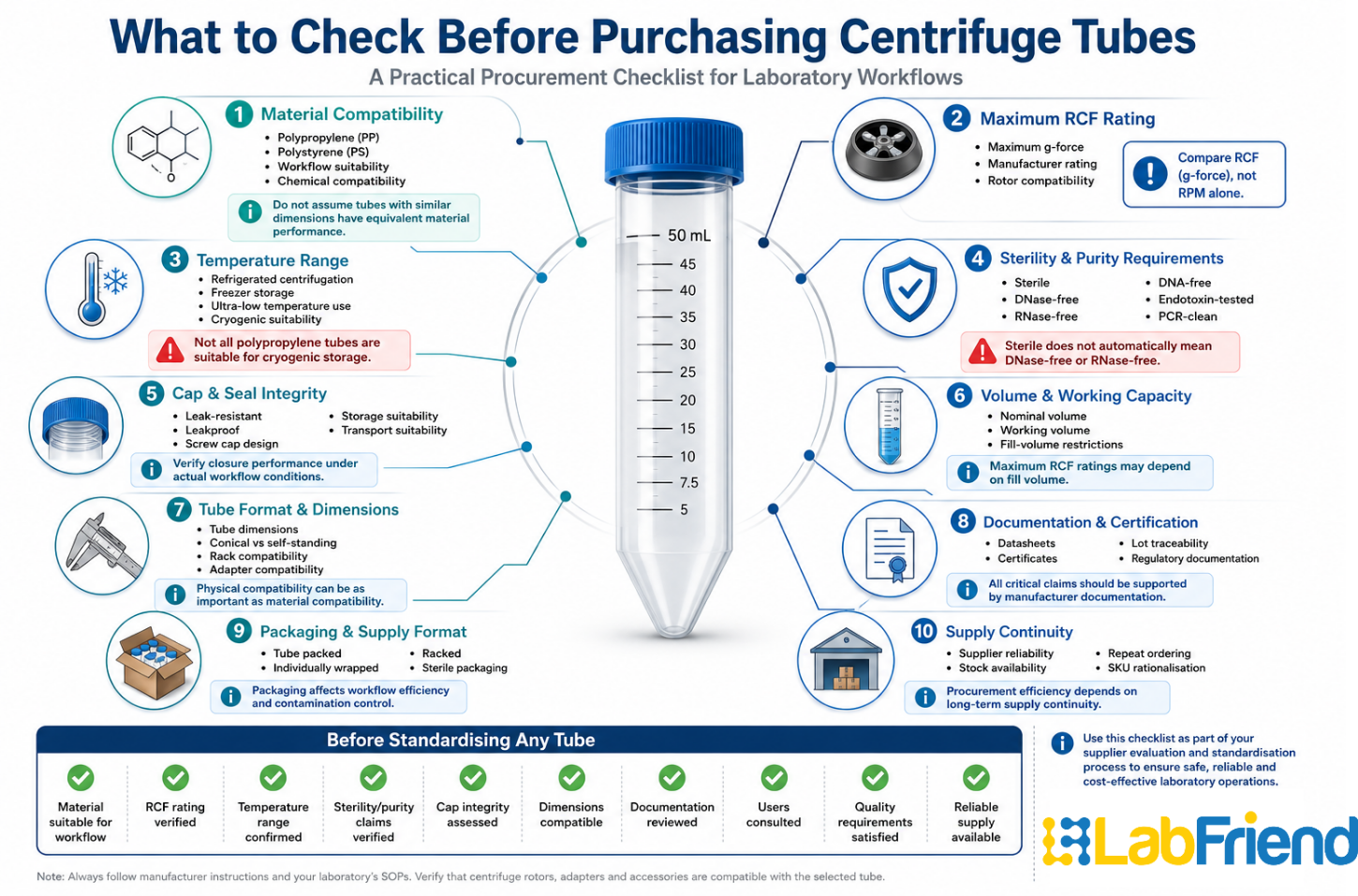
Before standardising any centrifuge tube, procurement should confirm the product is technically suitable for the workflow. The key checks include manufacturer specifications, nominal volume and working volume, tube material, RCF rating, rotor and adapter compatibility, cap seal integrity, fill volume, sample density, chemical compatibility, temperature range, sterility or purity requirements, autoclavability, graduation accuracy, writable labelling area, skirted vs non-skirted base, conical-bottom format and compatibility with existing racks or storage systems and required documentation. Check whether the closure is described as leak-resistant, leakproof or suitable only for general handling, and confirm whether that claim applies during centrifugation, transport, storage or all three.
For molecular biology workflows, check whether DNase-free, RNase-free, DNA-free, endotoxin-tested or other purity claims are required and whether those claims are supported by the manufacturer’s documentation. Where sterile tubes are required, confirm the sterilisation method, sterility assurance claim where provided, packaging format, expiry dating and whether sterility is maintained for single tubes, racks or bags after opening.
For cryogenic or ultra-low-temperature workflows, confirm whether the product is specified for the intended storage conditions, including whether liquid nitrogen vapour phase or liquid phase storage is relevant. Standard 15 mL and 50 mL centrifuge tubes should not be treated as substitutes for certified cryogenic vials unless the manufacturer explicitly specifies suitability for the intended storage condition.
Procurement should compare maximum ratings using RCF/g-force rather than RPM alone, because applied force depends on rotor radius as well as rotational speed. A tube should never be assumed safe at a given speed based on appearance, volume or general laboratory use. Maximum RCF ratings may depend on correct fill volume, cap closure, rotor type and sample density; do not extrapolate beyond manufacturer instructions.
Common Procurement Mistakes to Avoid
The first mistake is focusing only on unit price. A low-cost tube that causes leakage, cracking, stockouts or user rejection may create higher operational cost than a slightly higher-priced but better-suited product.
The second mistake is treating material as the only specification. Polypropylene is a useful standardisation candidate, but material alone does not define sterility, purity, RCF rating, closure performance or cryogenic suitability.
The third mistake is standardising without laboratory input. Procurement efficiency is valuable, but it should not replace technical suitability checks, compatibility confirmation or workflow validation where these are required.
The fourth mistake is keeping legacy SKUs indefinitely. If a product has no clear technical owner, low usage and a suitable approved alternative, it should be reviewed for removal from the purchasing list.
UK Laboratory Purchasing Considerations
For UK laboratories with recurring consumables demand, centrifuge tube standardisation can support better purchasing discipline. It can also improve forecasting, reduce emergency ordering and help procurement teams build stronger supplier relationships.
This is particularly relevant for CROs, independent testing laboratories and SME biotech companies where project-driven demand can change quickly. These organisations often need reliable supply, transparent pricing and responsive support, without the complexity of large tender-driven procurement structures.
A well-managed tube portfolio can support both laboratory users and procurement teams: scientists get products that fit their workflows, while procurement gains better control over spend, supply continuity and repeat ordering.
Simplify recurring consumables ordering
For laboratories using centrifuge tubes regularly, LabFriend UK can support repeat purchasing, quote requests and practical product comparison across suitable tube formats.
Request an Instant Quote for Centrifuge Tubes
How LabFriend UK Supports Centrifuge Tube Standardisation
LabFriend UK supports laboratories across the UK with access to centrifuge tubes and related laboratory consumables for routine and specialist workflows. For procurement teams, the value is not only product access. It is the ability to compare options, support repeat ordering and simplify purchasing where product suitability has been confirmed.
Relevant product routes may include polypropylene centrifuge tubes, sterile centrifuge tubes, molecular biology-compatible tubes, where supported by claims such as DNase-free, RNase-free, DNA-free, PCR-clean or endotoxin-tested documentation, cryogenic-compatible tube options and broader laboratory consumables for recurring operational demand.
Reliable. Precise. Delivered.
FAQs
Why do laboratories standardise centrifuge tube materials?
Laboratories standardise centrifuge tube materials to reduce unnecessary SKU complexity, improve inventory control, simplify purchasing and support consistent workflows. Standardisation should always be based on technical suitability, not procurement convenience alone.
Is polypropylene usually better than polystyrene for centrifuge tubes?
Polypropylene is generally the more versatile material for many centrifuge tube workflows because it often provides stronger chemical resistance, broader temperature tolerance and better durability. Polystyrene may still be appropriate where optical clarity is the main requirement and workflow conditions are less demanding.
Can procurement replace polystyrene tubes with polypropylene tubes?
At minimum, compare material, dimensions, cap type, RCF rating, temperature range, sterility or purity claims, packaging format and user acceptance before substitution. Procurement teams should confirm workflow suitability, user acceptance, manufacturer specifications and any quality-system requirements before replacing one tube material with another.
What documentation should laboratories check before standardising centrifuge tubes?
Laboratories should check manufacturer datasheets, RCF ratings, temperature range, sterility or purity documentation where required, lot traceability, chemical compatibility information and any product-specific claims relevant to the workflow.
Does sterile mean DNase-free or RNase-free?
No. Sterile does not automatically mean DNase-free, RNase-free, DNA-free, endotoxin-tested or PCR-clean. These claims are not interchangeable and should be confirmed against the exact product code and certificate or datasheet.
Conclusion
Standardising polypropylene and polystyrene centrifuge tubes can help laboratories reduce procurement complexity, improve stock control and support more consistent workflows. For many organisations, polypropylene offers the strongest standardisation potential because of its broad use across routine and specialist applications.
However, standardisation must be handled carefully. The right approach is to reduce unnecessary duplication while preserving products that are technically required for specific workflows. Procurement efficiency should support scientific suitability, not replace it.
If your laboratory is reviewing centrifuge tube purchasing, LabFriend UK can help you compare suitable options, simplify repeat ordering and support a more practical consumables strategy.
Contact LabFriend UK for Help Choosing Centrifuge Tubes
Read More:
Complete Guide to Centrifuge Tubes
Written by: Donal O’Sullivan, BSc, Co-Founder and Sales Director, LabFriend UK. Donal brings deep chemistry-led technical expertise across analytical chemistry, biochemistry, environmental monitoring, laboratory instrumentation, consumables and scientific product selection.
Reviewed by: Michael Anderson, MBA, Founder and Managing Director, LabFriend UK. Michael reviews LabFriend UK content for customer relevance, commercial accuracy, operational practicality and alignment with LabFriend UK’s laboratory supply model.
Related Stories

Complete Guide to Centrifuge Tubes
Complete Guide to Centrifuge Tubes

The Ultimate Guide to Laboratory Filtration for UK Laboratories
The Ultimate Guide to Laboratory Filtration for UK Laboratories

Polypropylene vs Polystyrene Centrifuge Tubes
Polypropylene vs Polystyrene Centrifuge Tubes: Which Is Best for Laboratory Workflows?

PTFE vs PES Syringe Filters: Which Membrane Should You Choose?
PTFE vs PES Syringe Filters: Differences, Solvent Compatibility and Laboratory Applications