

Share :
PTFE vs PES Syringe Filters: Which Membrane Should You Choose?
Updated On 07/17/2026

By Donal O’Sullivan, BSc. Reviewed by Michael Anderson, MBA.
Choosing the Correct Syringe Filter Membrane Matters
Selecting the correct syringe filter membrane is one of the most important decisions in laboratory sample preparation.
The wrong membrane can lead to:
- poor analyte recovery,
- membrane incompatibility,
- low flow rates,
- sample contamination,
- instrument downtime,
- or inconsistent analytical results.
Two of the most commonly used syringe filter membrane materials in laboratories are:
- PTFE (Polytetrafluoroethylene)
- PES (Polyethersulfone)
Both are widely used across:
- analytical chemistry,
- pharmaceutical QC,
- biotechnology,
- environmental testing,
- and research laboratories.
However, PTFE and PES membranes are designed for very different applications.
Understanding when to use each membrane helps laboratories:
- improve analytical reliability,
- reduce filtration failures,
- standardise workflows,
- and protect sensitive instrumentation.
Reliable. Precise. Delivered.
What Is a PTFE Syringe Filter?
PTFE (Polytetrafluoroethylene) is a highly chemically resistant membrane material widely used for aggressive solvents and demanding chemical applications.
PTFE syringe filters are commonly used for:
- organic solvent filtration,
- HPLC sample preparation,
- UHPLC sample preparation,
- aggressive chemical filtration,
- and low-extractable analytical workflows when the specific filter is qualified for that use.
PTFE membranes are naturally hydrophobic.
Standard PTFE filters are therefore typically most suitable for:
- organic solvents,
- non-aqueous samples,
- and gas filtration applications.
Where aqueous filtration is required, laboratories should select a hydrophilic PTFE product or validate an appropriate pre-wetting procedure.
What Is a PES Syringe Filter?
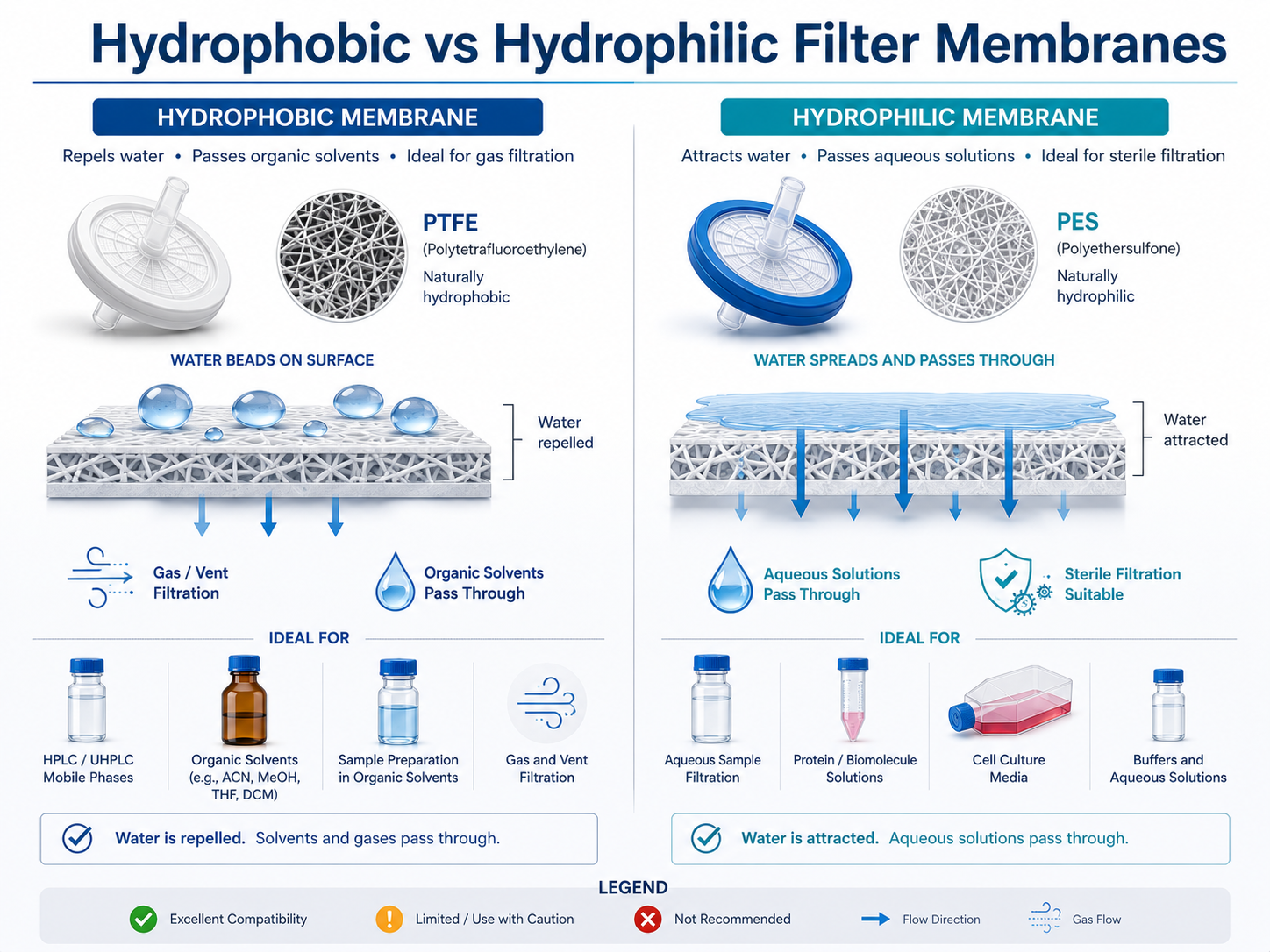
PES (Polyethersulfone) is a hydrophilic membrane material widely used for aqueous and biological filtration applications.
PES syringe filters are commonly used for:
- aqueous sample filtration,
- biological samples,
- sterile filtration,
- cell culture workflows,
- protein-sensitive applications,
- and buffer filtration.
PES membranes are known for:
- high flow rates,
- low protein binding,
- strong throughput performance,
- and broad compatibility with aqueous solutions.
PTFE vs PES Syringe Filters: Quick Comparison
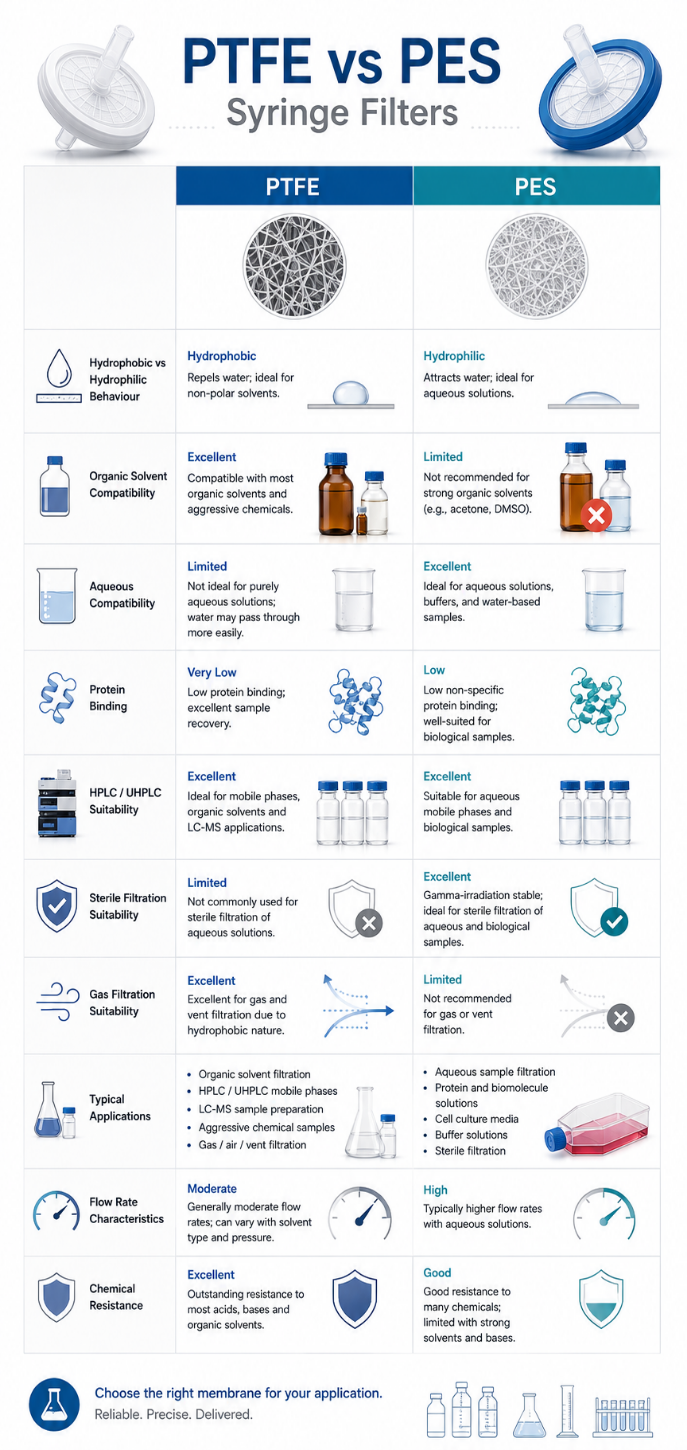
Hydrophilic or Hydrophobic
PTFE:
Standard/native PTFE is hydrophobic. Hydrophilic PTFE variants are available for aqueous applications.
PES:
Hydrophilic membrane, well suited to aqueous filtration.
Best Overall Use
PTFE:
Best suited to organic solvents, non-aqueous samples, aggressive solvent systems, and gas or vent filtration.
PES:
Best suited to aqueous samples, buffers, biological solutions, cell culture media, and protein-containing samples.
Chemical Resistance
PTFE:
Broad chemical resistance, especially with many organic solvents and aggressive solvent systems. Confirm compatibility for the complete filter device.
PES:
Good compatibility with aqueous solutions and many biological buffers. Not generally preferred for aggressive organic solvents unless manufacturer compatibility data support use.
Organic Solvent Compatibility
PTFE:
Usually a strong choice for solvent-rich workflows, including many HPLC, UHPLC, and LC-MS sample-preparation applications.
PES:
May tolerate some mild aqueous-organic mixtures, but suitability depends on solvent type, concentration, exposure time, and device construction.
Aqueous Compatibility
PTFE:
Standard hydrophobic PTFE is not ideal for aqueous samples unless pre-wetted or replaced with a hydrophilic PTFE variant.
PES:
Excellent aqueous compatibility and generally good flow with water-based samples.
Protein Binding
PTFE:
Variable. Standard hydrophobic PTFE is usually not the first choice for aqueous protein samples and may require validation for protein recovery.
PES:
Generally low protein binding and commonly selected for aqueous biological and protein-containing solutions.
Flow Rate
PTFE:
Good flow with compatible organic solvents. Aqueous flow may be poor with standard hydrophobic PTFE unless pre-wetted or hydrophilic PTFE is used.
PES:
Generally high flow in aqueous workflows, although performance still depends on pore size, filter diameter, sample viscosity, and particulate load.
Sterile Filtration Use
PTFE:
Well suited to sterile gas and vent filtration. Not generally preferred for routine sterile aqueous liquid filtration unless hydrophilic PTFE or validated pre-wetting is used.
PES:
Commonly preferred for sterile aqueous filtration, but only when the specific filter is sterile, appropriately packaged, and validated for the intended use.
Gas and Vent Filtration
PTFE:
Excellent suitability because standard PTFE is hydrophobic and resists wetting.
PES:
Not usually the first choice for gas or vent filtration because PES is hydrophilic and intended mainly for aqueous liquid workflows.
Common Applications
PTFE:
Organic solvent filtration, HPLC/UHPLC sample preparation, LC-MS solvent-rich workflows, aggressive chemical filtration, and vent filtration.
PES:
Buffer filtration, sterile aqueous filtration, cell culture media, biological samples, protein solutions, and microbiology workflows.
When Should You Use PTFE Syringe Filters?
PTFE syringe filters are typically preferred when working with aggressive organic solvents or chemically demanding analytical workflows.
Common PTFE Applications
PTFE filters are commonly used for:
- acetonitrile filtration,
- methanol filtration,
- DMSO filtration,
- THF filtration,
- solvent-heavy HPLC samples,
- LC-MS sample preparation,
- organic mobile phases,
- and aggressive chemical mixtures.
Why Laboratories Choose PTFE Membranes
PTFE membranes are popular because they offer:
- exceptional chemical resistance,
- broad solvent compatibility,
- availability of low-extractable product options,
- strong analytical suitability,
- and compatibility with many chromatographic workflows.
PTFE membranes are particularly valuable in:
- pharmaceutical QC,
- analytical chemistry,
- environmental testing,
- and chromatography laboratories.
When Should You Use PES Syringe Filters?
PES syringe filters are generally preferred for aqueous and biological filtration workflows.
Common PES Applications
PES membranes are widely used for:
- sterile filtration,
- cell culture media,
- biological buffers,
- protein solutions,
- aqueous analytical samples,
- microbiology workflows,
- and biotechnology applications.
Why Laboratories Choose PES Membranes
PES membranes are commonly selected because they provide:
- excellent aqueous flow rates,
- low protein binding,
- low adsorption characteristics,
- strong throughput,
- and efficient sterile filtration performance.
PES membranes are especially common in:
- biotech laboratories,
- cell culture facilities,
- microbiology laboratories,
- and life science research.
Explore Our Range Of Syringe Filters
PTFE vs PES: Solvent Compatibility
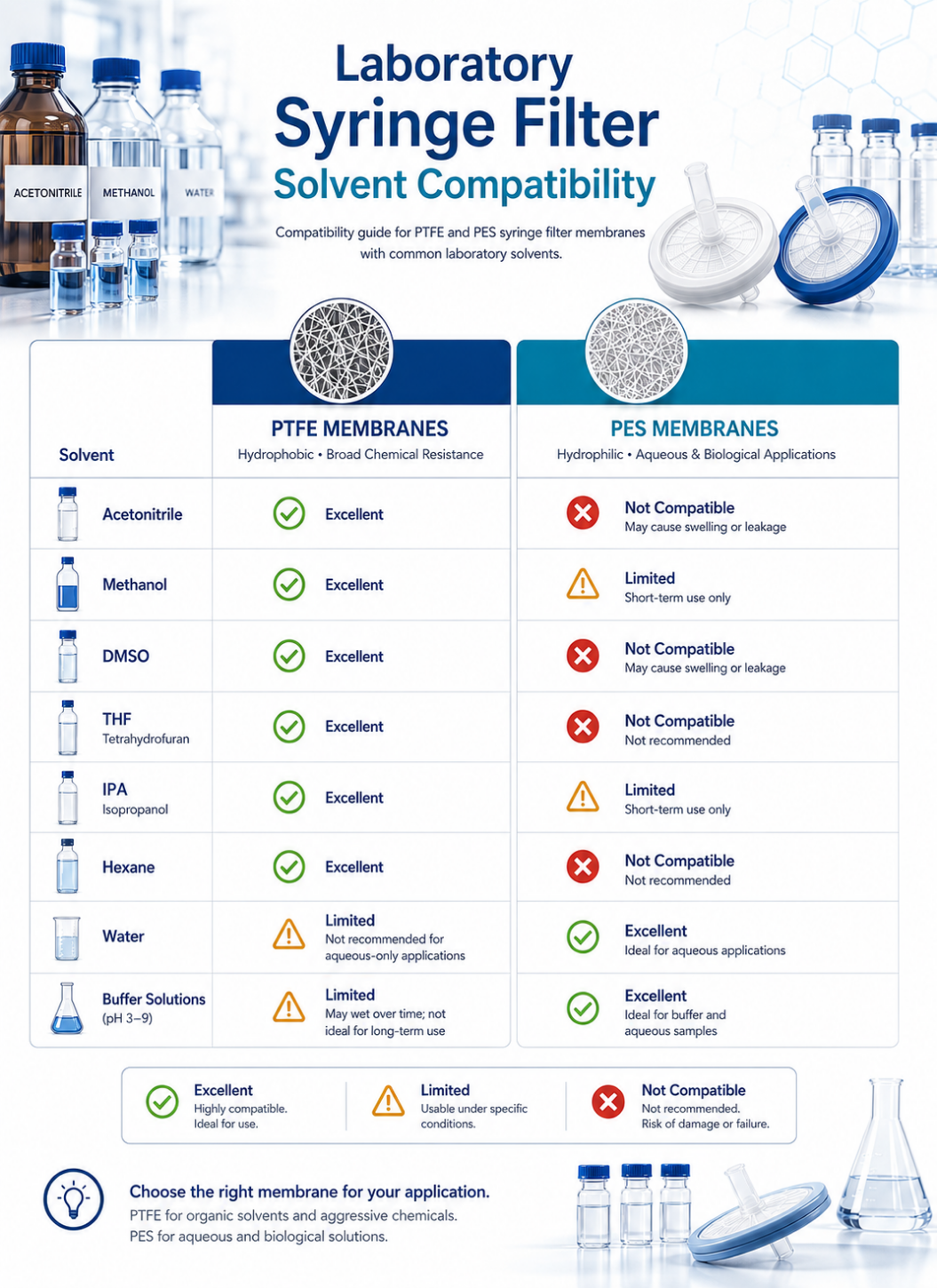
One of the biggest differences between PTFE and PES membranes is solvent compatibility.
PTFE Solvent Compatibility
PTFE membranes generally show broad resistance to many organic solvents, solvent-rich analytical samples, and aggressive chemical mixtures. They may also show good resistance to many acids, but compatibility with concentrated or oxidising acids must be confirmed for the specific filter device and operating conditions.
Typical compatible solvents include:
- acetonitrile,
- methanol,
- isopropanol,
- DMSO,
- THF,
- and hexane.
PTFE is often a strong first choice for many aggressive organic solvent systems, but compatibility should be verified against the complete manufacturer compatibility table for the specific filter device, including membrane, housing, and seals.
PES Solvent Compatibility
PES membranes are highly suitable for:
- aqueous solutions,
- biological samples,
- buffers,
- media,
- and many mild analytical solutions.
However, PES may not be suitable for:
- highly aggressive solvents,
- strong non-polar solvents,
- or certain harsh chemical mixtures.
Laboratories should always verify compatibility using manufacturer solvent compatibility data before use. PES should not be assumed compatible with common HPLC organic solvents such as high-percentage acetonitrile, THF, DMF, DMSO, chlorinated solvents, ketones, or non-polar hydrocarbons unless the specific manufacturer compatibility chart confirms suitability.
PTFE vs PES for HPLC and UHPLC Sample Preparation
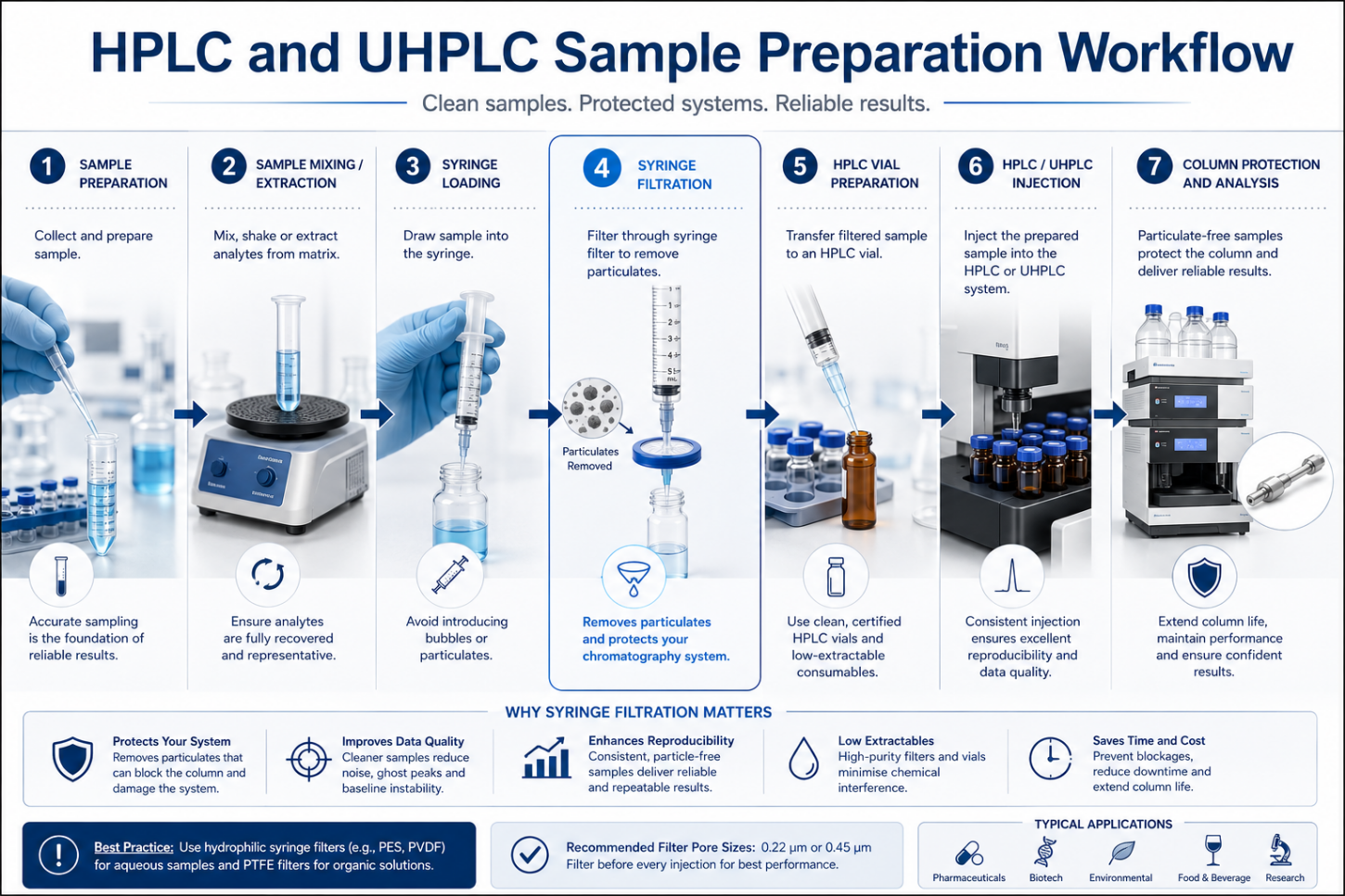
Both PTFE and PES membranes are used in chromatography workflows, but the correct choice depends heavily on sample chemistry.
PTFE for HPLC and UHPLC
PTFE is commonly preferred for:
- solvent-rich samples,
- organic mobile phases,
- aggressive analytical solvents,
- LC-MS workflows,
- and low extractable analytical procedures.
PTFE is widely used in:
- pharmaceutical QC,
- environmental analysis,
- and analytical chemistry laboratories.
PES for HPLC and UHPLC
PES may be suitable for:
- aqueous HPLC samples,
- biological analytical workflows,
- and protein-sensitive samples.
PES is often preferred when:
- aqueous compatibility,
- low protein binding,
- and high flow rates
are more important than aggressive solvent resistance.
Membrane material should be selected alongside pore size. For chromatography, 0.45µm syringe filters are commonly used for general HPLC sample clarification, whereas 0.2µm syringe filters /0.22 µm syringe filters are often selected for UHPLC, fine particulates, or methods requiring tighter particulate control.
Sterile Filtration: What PES Can and Cannot Guarantee
PES is commonly used for sterile filtration of aqueous solutions because it is hydrophilic, provides high aqueous flow rates, and is well suited to many biological buffers, media, and protein-containing solutions. However, PES membrane material alone does not guarantee sterility.
For sterile filtration, users must select a filter that is specifically designed, supplied, and validated for the intended sterile filtration application.
Pore Size
Sterile filtration usually requires a filter with an appropriate bacteria-retentive pore size, commonly 0.2 µm or 0.22 µm for many aqueous laboratory workflows.
However, pore size alone does not prove that a filter is sterile or validated for sterilising filtration. A non-sterile 0.22 µm PES syringe filter should not be treated as a sterile filter unless it has been appropriately sterilised and validated for the intended use.
Sterile Packaging
For aseptic workflows, the filter should be supplied sterile, appropriately packaged, and used before its stated expiry date.
Users should confirm whether the syringe filter is individually packaged, gamma-sterilised or otherwise sterilised, and suitable for the intended laboratory, microbiological, cell culture, or biopharmaceutical application.
Validated Bacterial Retention
A PES membrane may be suitable for sterile aqueous filtration only when the specific product has documented bacterial-retention performance.
For sterilising-grade filtration, users should check the manufacturer’s product claims and technical documentation for bacterial retention, pore size rating, integrity expectations, and intended use. Membrane type alone is not sufficient evidence of sterile filtration performance.
Aseptic Handling
Even a sterile, validated PES syringe filter can produce a contaminated filtrate if it is handled incorrectly.
Sterile filtration should be performed using appropriate aseptic technique, including sterile receiving vessels, clean connections, controlled handling of caps and fittings, and avoidance of contact with non-sterile surfaces. The filtrate should not be considered sterile if downstream handling compromises asepsis.
Product-Specific Claims
Not all PES syringe filters have the same specifications. Products may differ in pore size, housing material, sterilisation method, extractables, endotoxin control, maximum pressure, hold-up volume, flow rate, and validated applications.
Before using PES for sterile filtration, confirm the specific product’s:
- sterility status,
· pore size,
· bacterial-retention claim,
· packaging format,
· expiry date,
· endotoxin or pyrogen specification, if relevant,
· maximum pressure rating,
· sample volume suitability,
· chemical compatibility,
· and manufacturer-stated intended use.
In summary, PES can provide excellent performance for sterile aqueous filtration, but it cannot by itself guarantee sterility. Sterility depends on using the correct validated filter product and maintaining aseptic technique throughout the workflow.
PTFE vs PES for Sterile Filtration
For routine sterile aqueous liquid filtration, PES is commonly preferred because it is hydrophilic and provides good aqueous flow. However, only sterile, validated filters with appropriate pore size and documented bacterial-retention performance should be used. Standard hydrophobic PTFE is generally better suited to sterile gas, vent, or solvent-compatible workflows rather than routine aqueous sterile filtration.
Is PTFE Suitable for Sterile Filtration?
Hydrophobic PTFE membranes are generally less suitable for routine aqueous sterile filtration unless:
- hydrophilic PTFE variants are used,
- or membranes are properly pre-wetted.
Pre-wetting hydrophobic PTFE usually involves a water-miscible organic solvent, such as methanol or isopropanol, followed by equilibration or rinsing. This can introduce solvent into the workflow and may be unsuitable for biological samples, trace analysis, solvent-sensitive analytes, or sterile aqueous applications unless the procedure has been validated.
However, PTFE is highly suitable for:
- gas filtration,
- vent filtration,
- and aggressive solvent filtration workflows.
Compare 0.22 µm Syringe Filters
PTFE vs PES for Protein and Biological Samples
Both membranes offer relatively low protein binding, but PES is often preferred for biological workflows.
Why PES Is Commonly Preferred
PES combines:
- low protein adsorption,
- strong aqueous compatibility,
- and excellent flow rates.
This makes PES particularly suitable for:
- protein samples,
- enzymes,
- cell culture media,
- and biological buffers.
When PTFE May Still Be Used
PTFE may still be appropriate for:
- mixed aqueous-organic biological samples,
- solvent-containing protein workflows,
- or specialised analytical methods.
However, hydrophobic PTFE may not always be ideal for purely aqueous biological samples.
PTFE vs PES Flow Rates
Flow rate performance can significantly affect laboratory productivity. Flow rate comparisons are sample-dependent: PES generally provides high flow for aqueous samples, while PTFE provides good flow for compatible organic solvents. Standard hydrophobic PTFE may show poor water flow unless the membrane is pre-wetted or a hydrophilic PTFE variant is used.
PES Flow Rates
PES membranes generally provide high flow rates in aqueous workflows and are often suitable for higher-throughput filtration of buffers, media, and biological solutions. However, flow and fouling behaviour still depend on pore size, filter diameter, sample viscosity, particulate burden, protein concentration, and whether prefiltration is used.
This makes PES highly effective for:
- larger sample volumes,
- sterile filtration,
- and repetitive laboratory workflows.
PTFE Flow Rates
PTFE membranes can provide good flow with compatible organic solvents. Standard hydrophobic PTFE is not inherently suitable for aqueous flow, and water-based samples may filter slowly or fail to pass unless a hydrophilic PTFE membrane or validated pre-wetting procedure is used.
However:
- aqueous samples may flow poorly through hydrophobic PTFE membranes,
- unless hydrophilic PTFE variants are used.
PTFE vs PES: Which Membrane Is Better?
Neither membrane is universally “better”.
The correct choice depends entirely on:
- sample chemistry,
- workflow requirements,
- sterility requirements,
- analytical sensitivity,
- and solvent compatibility.
For quantitative analytical workflows, analyte recovery should also be validated. A chemically compatible membrane may still be unsuitable if it adsorbs the target analyte or contributes interfering extractables.
Other Syringe Filter Selection Factors Beyond Membrane Material
Choosing between PTFE and PES is important, but membrane material alone does not determine whether a syringe filter is suitable for a specific workflow. Laboratories should also consider pore size, filter diameter, sterility status, housing compatibility, hold-up volume, pressure rating, extractables, and analyte recovery before standardising a filter.
Pore Size
Pore size determines the size of particles the filter is intended to retain. Common syringe filter pore sizes include 0.45µm syringe filters and 0.2µm syringe filters /0.22 µm syringe filters.
For general HPLC sample clarification, 0.45 µm filters are commonly used to remove visible or larger particulates. For UHPLC workflows, fine particulate control, or sterile filtration applications, 0.2/0.22 µm filters are often selected. However, pore size should always be matched to the method, sample matrix, column requirements, and intended use.
For sterile filtration, membrane material alone is not sufficient. The filter must be an appropriate sterile, validated product with a suitable pore size and documented bacterial-retention performance.
Filter Diameter and Sample Volume
Filter diameter affects effective filtration area, throughput, backpressure, and hold-up volume. Smaller-diameter filters may be suitable for low-volume or precious samples, while larger-diameter filters are typically better for higher sample volumes or more particulate-laden samples.
Using a filter that is too small for the sample volume can result in slow filtration, clogging, excessive pressure, or poor recovery.
Sterility Status
A PES or PTFE membrane is not automatically sterile simply because it is suitable for a sterile filtration workflow. Syringe filters may be supplied sterile or non-sterile, and this distinction is critical for cell culture, microbiology, and aseptic sample preparation.
For sterile applications, confirm that the product is supplied sterile, individually packaged where required, and validated for the intended use. Where relevant, also check endotoxin, pyrogen, or bioburden specifications.
Housing and Device Compatibility
Chemical compatibility depends on the complete syringe filter device, not only the membrane. The housing, support materials, seals, adhesives, and luer connections may have different solvent or chemical resistance from the membrane itself.
For aggressive solvents, strong acids or bases, mixed solvent systems, or unusual sample matrices, laboratories should confirm compatibility using the manufacturer’s data for the complete filter device.
Hold-Up Volume
Hold-up volume is the amount of liquid retained inside the filter after filtration. This is especially important when working with low-volume, high-value, or limited-availability samples.
A filter with a large hold-up volume may reduce sample recovery, affect quantitative analysis, or lead to unnecessary sample loss. Low hold-up-volume designs may be preferable for small-volume analytical samples.
Pressure Rating and Backpressure
Each syringe filter has a maximum pressure rating. High-viscosity samples, small pore sizes, clogged membranes, or excessive manual force can generate high backpressure.
Exceeding the pressure limit may cause leakage, membrane rupture, device failure, or sample loss. Users should follow the manufacturer’s pressure limits and avoid forcing blocked filters.
Extractables and Leachables
For sensitive analytical workflows, especially LC-MS, trace analysis, pharmaceutical QC, and low-level impurity testing, extractables and leachables from the filter can interfere with results.
Membrane type is only one factor. Extractables may also arise from the housing, wetting agents, additives, packaging, or manufacturing residues. Where background contamination matters, laboratories should use low-extractable or application-qualified filters and consider pre-rinsing if recommended by the manufacturer and compatible with the method.
Analyte Recovery and Adsorption
A filter can be chemically compatible but still unsuitable if the target analyte binds to the membrane or device materials. This is particularly important for proteins, peptides, hydrophobic compounds, trace-level analytes, preservatives, and some pharmaceutical or environmental contaminants.
Where quantitative recovery is important, laboratories should compare filtered and unfiltered standards or perform matrix-matched recovery checks before adopting a filter into routine use.
Practical Selection Checklist
Before selecting a PTFE or PES syringe filter, confirm:
- sample chemistry and solvent compatibility,
· membrane compatibility,
· housing and device compatibility,
· pore size,
· filter diameter and sample volume,
· sterility status,
· hold-up volume,
· pressure rating,
· extractables and leachables risk,
· analyte recovery,
· and whether pre-rinsing or pre-wetting is required.
This ensures that the selected syringe filter is suitable not only for the sample type, but also for the analytical, biological, or sterile workflow in which it will be used.
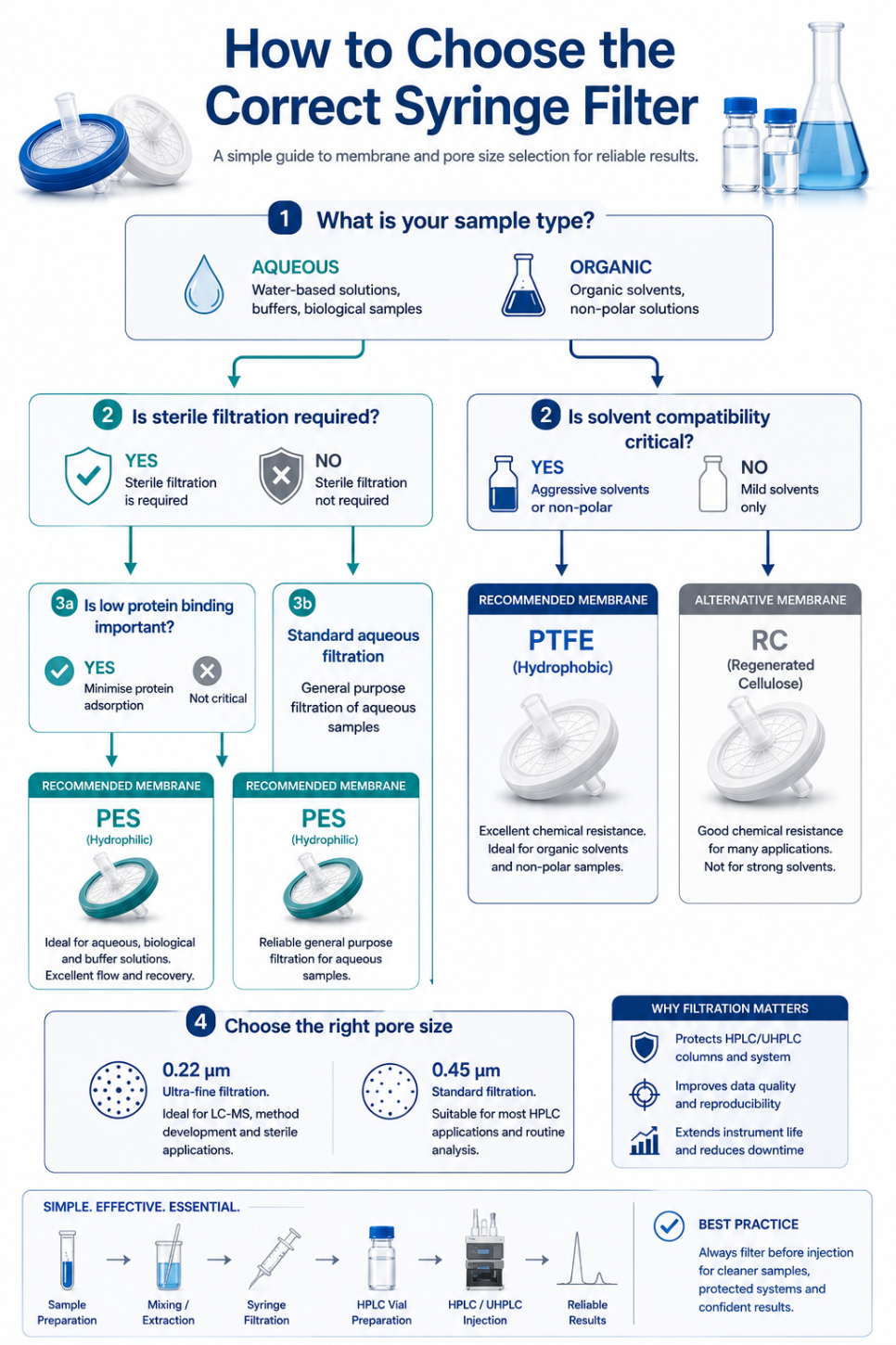
General Selection Guidelines
|
Application |
Typically Preferred Membrane |
|
Organic solvent filtration |
PTFE |
|
Aggressive chemical filtration |
PTFE |
|
Aqueous biological samples |
PES |
|
Cell culture media |
PES |
|
Sterile aqueous filtration |
PES |
|
Gas and vent filtration |
PTFE |
|
Protein-sensitive samples |
PES |
|
Solvent-heavy HPLC workflows |
PTFE |
|
High aqueous flow applications |
PES |
Where recovery is critical, compare filtered and unfiltered standards or perform matrix-matched recovery checks before standardising a membrane.
Common PTFE vs PES Selection Mistakes
Using PES with Aggressive Solvents
Highly aggressive solvents may:
- damage PES membranes,
- reduce membrane integrity,
- or affect filtration performance.
Using Hydrophobic PTFE with Aqueous Samples
Hydrophobic PTFE membranes may:
- resist aqueous flow,
- cause slow filtration,
- or prevent proper sample passage.
Hydrophilic PTFE variants may be required for aqueous applications.
Choosing Membranes Based Only on Price
The lowest-cost membrane may not provide:
- suitable compatibility,
- acceptable recovery,
- or reliable analytical performance.
Incorrect membrane selection can increase:
- instrument downtime,
- failed analyses,
- sample loss,
- and consumables waste.
How Laboratories Standardise PTFE and PES Filtration Workflows
Many laboratories standardise:
- PTFE membranes for solvent-heavy analytical workflows,
- and PES membranes for aqueous and biological procedures.
This approach helps:
- simplify procurement,
- improve consistency,
- reduce selection errors,
- and support SOP-driven workflows.
Operational consistency is particularly important for:
- CROs,
- analytical laboratories,
- biotech companies,
- and regulated testing environments.
Frequently Asked Questions About PTFE vs PES Syringe Filters
What is the main difference between PTFE and PES syringe filters?
PTFE membranes are primarily used for aggressive organic solvents and chemically resistant filtration, while PES membranes are generally preferred for aqueous and biological applications.
Which membrane is better for HPLC sample preparation?
It depends on the sample chemistry.
PTFE is often preferred for solvent-rich HPLC samples and organic mobile phases, while PES is commonly used for aqueous or biological analytical samples.
View HPLC Sample Preparation Filters
Can PES filters be used with organic solvents?
PES membranes are compatible with many mild aqueous-organic solutions but may not be suitable for aggressive solvents or harsh chemical mixtures.
Laboratories should always verify solvent compatibility before use.
Can I use PES with 50% acetonitrile?
PES may be compatible with some aqueous-organic mixtures, but it should not be assumed suitable for 50% acetonitrile unless the specific syringe filter manufacturer confirms compatibility.
Acetonitrile concentration, exposure time, pressure, filter housing material, and analyte sensitivity can all affect suitability. For high-organic HPLC or LC-MS samples, PTFE is often the safer membrane choice, provided the full filter device is compatible with the solvent system.
Why are PTFE membranes hydrophobic?
PTFE naturally repels water due to its fluoropolymer structure.
This makes standard PTFE membranes highly suitable for:
- organic solvents,
- gases,
- and non-aqueous applications.
Are PTFE filters suitable for aqueous samples?
Standard hydrophobic PTFE membranes may not perform well with aqueous samples unless:
- hydrophilic PTFE variants are used,
- or the membrane is pre-wetted.
Pre-wetting may help aqueous flow through hydrophobic PTFE, but it can introduce residual solvent or affect sensitive analytes, so it should not be assumed suitable without validation.
Does 0.22 µm always mean sterile?
No. A 0.22 µm pore size does not automatically mean that a syringe filter is sterile or suitable for sterile filtration.
For sterile filtration, the product must be supplied sterile or sterilised appropriately, and it should be validated for the intended sterilising application. Users should confirm the filter’s sterility status, bacterial-retention claims, packaging, expiry date, and manufacturer instructions before use.
Which membrane has lower protein binding: PTFE or PES?
Both membranes offer relatively low protein binding, but PES is generally preferred for biological and protein-sensitive workflows due to its hydrophilic properties and excellent aqueous compatibility.
Which membrane is better for sterile filtration?
PES membranes are commonly preferred for sterile filtration of aqueous solutions because they provide:
- high flow rates,
- good biological compatibility,
- and strong throughput performance.
PES is commonly preferred for sterile aqueous filtration, but only sterile, validated filters with an appropriate pore size should be used for sterilising applications. A non-sterile PES syringe filter should not be treated as a sterilising filter.
Which membrane is best for proteins in aqueous buffer?
PES is generally preferred for proteins in aqueous buffer because it is hydrophilic, provides good aqueous flow, and is commonly selected for low protein-binding biological workflows.
Standard hydrophobic PTFE is usually not the first choice for purely aqueous protein samples because it may resist aqueous flow unless pre-wetted or modified. Pre-wetting with organic solvent may also be unsuitable for sensitive proteins unless the procedure has been validated.
Should I pre-rinse syringe filters before LC-MS?
Pre-rinsing may be appropriate for some LC-MS workflows, especially where extractables, leachables, or background contamination could affect trace analysis.
However, pre-rinsing should only be performed if it is compatible with the method, analytes, and sample matrix. The rinse solvent should match or be compatible with the analytical method, and users should follow manufacturer recommendations. For quantitative LC-MS, laboratories should evaluate blanks, recovery, and potential ion-suppression effects before routine use.
Does the filter housing affect solvent compatibility?
Yes. Solvent compatibility depends on the complete syringe filter device, not only the membrane.
The housing, support layers, seals, adhesives, and luer fittings may have different chemical resistance from the membrane itself. A PTFE membrane may be compatible with a solvent, but the assembled syringe filter may not be. For aggressive solvents, strong acids or bases, or mixed solvent systems, users should check the manufacturer’s compatibility data for the complete filter device.
Which membrane is better for LC-MS applications?
Low-extractable or LC-MS-certified PTFE filters are commonly selected for solvent-rich LC-MS workflows, provided the specific product has been evaluated for relevant extractables and analyte recovery.
The optimal choice depends on:
- analyte chemistry,
- solvent composition,
- and method sensitivity.
Why do laboratories standardise membrane selection?
Standardising membrane selection helps laboratories:
- reduce workflow variability,
- simplify procurement,
- minimise compatibility errors,
- improve reproducibility,
- and streamline staff training.
Next read suggestions:
The Ultimate Syringe Filter Guide: Pore Size, Membranes, and Applications
Written by: Donal O’Sullivan, BSc, Co-Founder and Sales Director, LabFriend UK. Donal brings deep chemistry-led technical expertise across analytical chemistry, biochemistry, environmental monitoring, laboratory instrumentation, consumables and scientific product selection.
Reviewed by: Michael Anderson, MBA, Founder and Managing Director, LabFriend UK. Michael reviews LabFriend UK content for customer relevance, commercial accuracy, operational practicality and alignment with LabFriend UK’s laboratory supply model.
Related Stories

Complete Guide to Centrifuge Tubes
Complete Guide to Centrifuge Tubes

The Ultimate Guide to Laboratory Filtration for UK Laboratories
The Ultimate Guide to Laboratory Filtration for UK Laboratories

Polypropylene vs Polystyrene Centrifuge Tubes
Polypropylene vs Polystyrene Centrifuge Tubes: Which Is Best for Laboratory Workflows?

Standardising Polypropylene vs Polystyrene Centrifuge Tubes Across Laboratory Workflows
Standardising Polypropylene vs Polystyrene Centrifuge Tubes Across Laboratory Workflows