

Share :
Why Regenerated Cellulose (RC) Membranes are The Universal Standard for Lab Filtration
Updated On 09/08/2026
%20Membranes%20Is%20The%20Universal%20Standard%20for%20Lab%20Filtration_0.png&w=3840&q=75)
In UK laboratories, clinical settings, and pharmaceutical plants, one material quietly ensures the integrity of analytical data: regenerated cellulose. Often hailed as the "universal" filter membrane, it is the go-to choice for everything from HPLC sample prep to protein purification.
But what makes Regenerated Cellulose (RC) membranes so indispensable? We explore why this material is a staple in the LabFriend range.
What is Regenerated Cellulose?
Regenerated cellulose (RC) is a highly purified form of cellulose derived from wood pulp or cotton fibres. Through a specialised process, it is dissolved and reformed into a uniform, macro-porous structure. Unlike standard filter paper, RC membranes are engineered for:
- Precise Pore Sizes: Typically available in 0.22µm and 0.45 µm for sterile filtration and clarification.
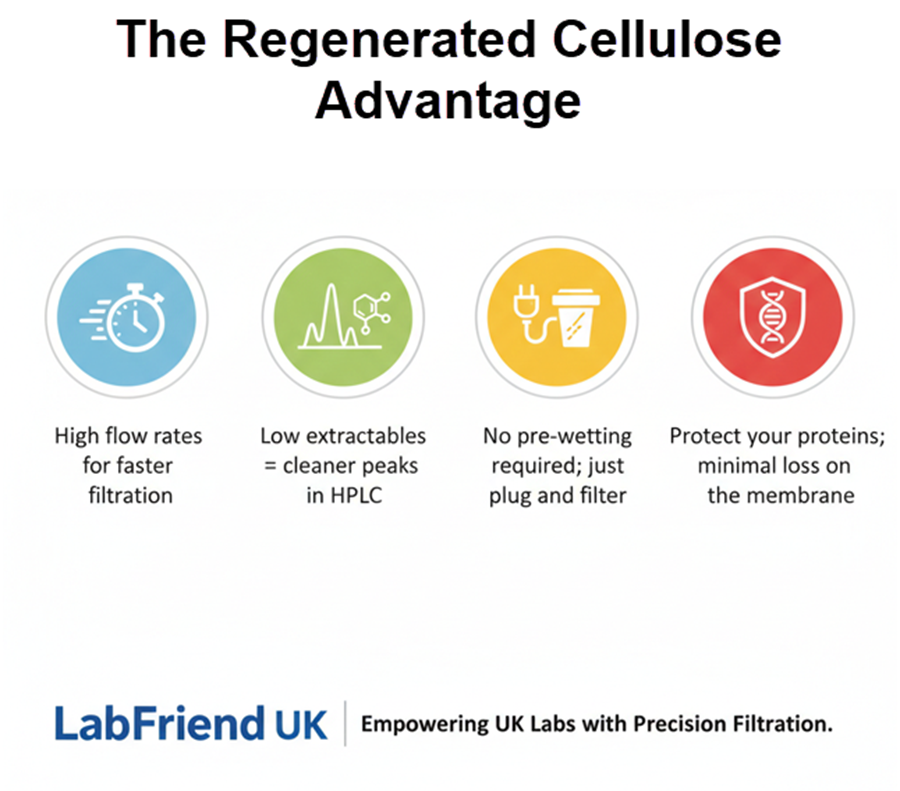
- High Purity: Minimal extractables ensure no background interference during sensitive HPLC or GC analysis.
Why RC is the "Universal" Choice for Professionals
- Unmatched Hydrophilicity
Unlike hydrophobic membranes like PTFE or PVDF, Regenerated Cellulose is naturally hydrophilic.
- The Benefit: No pre-wetting with alcohols (like Isopropanol) is required for aqueous samples. This eliminates a step in your workflow and reduces the risk of solvent contamination in your filtrate.
- Ultra-Low Protein Binding
For life sciences and biotech, sample recovery is paramount. RC membranes exhibit significantly lower non-specific protein binding compared to Nylon or PES.
- The Result: Higher recovery of valuable biomolecules and more accurate quantitative results in proteomics.
- Broad Chemical Resistance
RC offers a "best-of-both-worlds" chemical profile. It is resistant to:
- Most aqueous solutions (pH 3–12).
- Common HPLC solvents like Acetonitrile and Methanol.
- Biological buffers and alcohols.
At a Glance: Filtration Membrane Comparison Table
|
Property |
Regenerated Cellulose (RC) |
PVDF |
PTFE |
|
Hydrophilicity |
Naturally Hydrophilic |
Hydrophobic (usually) |
Highly Hydrophobic |
|
Protein Binding |
Very Low |
Moderate |
Low |
|
Best Used For |
HPLC Prep / Aqueous / Solvents |
Western Blotting / Proteins |
Aggressive Chemicals / Gas |
|
Pre-Wetting |
No |
Often Required |
Always (for aqueous) |
Key UK Laboratory Applications for Regenerated Cellulose
- Syringe Filters for HPLC: RC is the standard for sample clarification because it won't leach "ghost peaks" into your chromatogram.
- Biological Purification: Its high flow rate and low binding make it ideal for filtering temperature-sensitive nutrients.
- Mobile Phase Degassing: Its mechanical stability allows for reliable mobile phase filtration and degassing under vacuum.
Other useful Membranes available from Labfriend UK and their applications
|
Membrane |
|||
|
Hydrophilicity |
Highly Hydrophobic |
Hydrophobic (usually) |
Highly Hydrophobic |
|
Protein Binding |
Very Low |
Moderate |
Low |
|
Best Used For |
Western Blotting / Proteins |
Aggressive Chemicals / Gas |
Sustainability in the Lab
As UK labs move toward "Green Lab" certifications, RC membranes offer a distinct advantage. Being plant-based and biodegradable, they present a more sustainable footprint than 100% synthetic petroleum-based polymers.
The Bottom Line
Regenerated cellulose isn't just a filter; it's a reliability insurance policy for your lab. Whether you are in a university research setting or a high-throughput QC lab, RC membranes provide the consistency needed for reproducible science.
Explore More Laboratory Filtration Insights:
The Ultimate Guide to Laboratory Filtration for UK Laboratories | LabFriend UK
See the Full Range of RC Filters at LabFriend UK and find the perfect pore size for your application.
Related Stories

Extractables and Leachables in Analytical Filtration Explained
Extractables and Leachables in Analytical Filtration Explained

How Lab Managers Can Standardise Centrifuge Tube Purchasing Without Increasing Technical Risk
How Lab Managers Can Standardise Centrifuge Tube Purchasing Without Increasing Technical Risk

Low Protein Binding Membranes Explained for Laboratory Filtration
Low Protein Binding Membranes Explained for Laboratory Filtration

Choosing Tube Racks for 15mL and 50mL Centrifuge Tubes
Choosing Tube Racks for 15mL and 50mL Centrifuge Tubes