

Share :
How UK Laboratories Validate Third-Party Compatible Pipette Tips
Updated On 06/27/2026

By Donal O’Sullivan, BSc. Reviewed by Michael Anderson, MBA.
Laboratories across the UK are under increasing pressure to balance scientific performance, procurement efficiency and supply chain resilience. As a result, many organisations periodically review alternative laboratory consumables, including pipette tips, to determine whether compatible products from third-party suppliers could support their workflows.
However, changing pipette tip suppliers should never be viewed solely as a purchasing exercise. Pipette tips play a direct role in liquid handling performance, contamination control and workflow reproducibility. Before introducing a new consumable into routine use, laboratories need confidence that the proposed product is suitable for its intended application.
This is why many laboratories perform a structured compatibility assessment before switching suppliers.
For a broader understanding of pipette tip selection and compatibility considerations, laboratories may find LabFriend UK's Complete Guide to Pipette Tips, Pipetting Accuracy & Laboratory Liquid Handling useful:
Why Laboratories Validate Alternative Consumables
Laboratories routinely validate equipment, methods and processes. In many environments, consumables are assessed with a similar mindset.
Although pipette tips may appear relatively simple, they form a critical interface between the pipette and the liquid being transferred. Even small differences in fit, seal integrity or handling characteristics can influence workflow performance.
When evaluating a third-party compatible pipette tip, the objective is not necessarily to prove that the alternative product is identical to an existing supplier's offering. Instead, the goal is to determine whether the proposed tip is suitable for the intended laboratory workflow.
Typical reasons for assessing alternative pipette tips include:
- Supplier diversification
- Procurement flexibility
- Improved stock availability
- Laboratory standardisation
- Consolidation of consumable purchasing
- Evaluation of compatible alternatives
Many UK laboratories successfully use compatible pipette tips across research, testing, biotechnology and pharmaceutical environments. The key requirement is ensuring that compatibility and performance expectations are properly assessed before implementation.
What Does Third-Party Compatible Pipette Tip Validation Mean?
The term validation can mean different things in different laboratory environments.
In the context of pipette tip selection, validation does not necessarily imply a formal regulatory validation exercise. Instead, laboratories are often conducting a structured assessment to determine whether a proposed pipette tip can support the intended workflow without introducing unacceptable risks.
|
Third-party compatible pipette tip validation is the process of assessing whether an alternative pipette tip provides suitable compatibility, performance and workflow suitability before routine laboratory use. |
The exact scope of assessment will vary depending on:
- The application
- Laboratory procedures
- Quality-system requirements
- Risk profile of the workflow
- Customer or accreditation expectations
For some laboratories, the process may be relatively straightforward. For others, especially those operating under formal quality systems, additional documentation and review may be appropriate.
Validation Starts with Compatibility
The first question most laboratories ask is simple:
Does the pipette tip fit the pipette?
While this is an important starting point, it is not sufficient on its own.
As discussed in Why Pipette Tip Fit Matters for Accurate Laboratory Pipetting
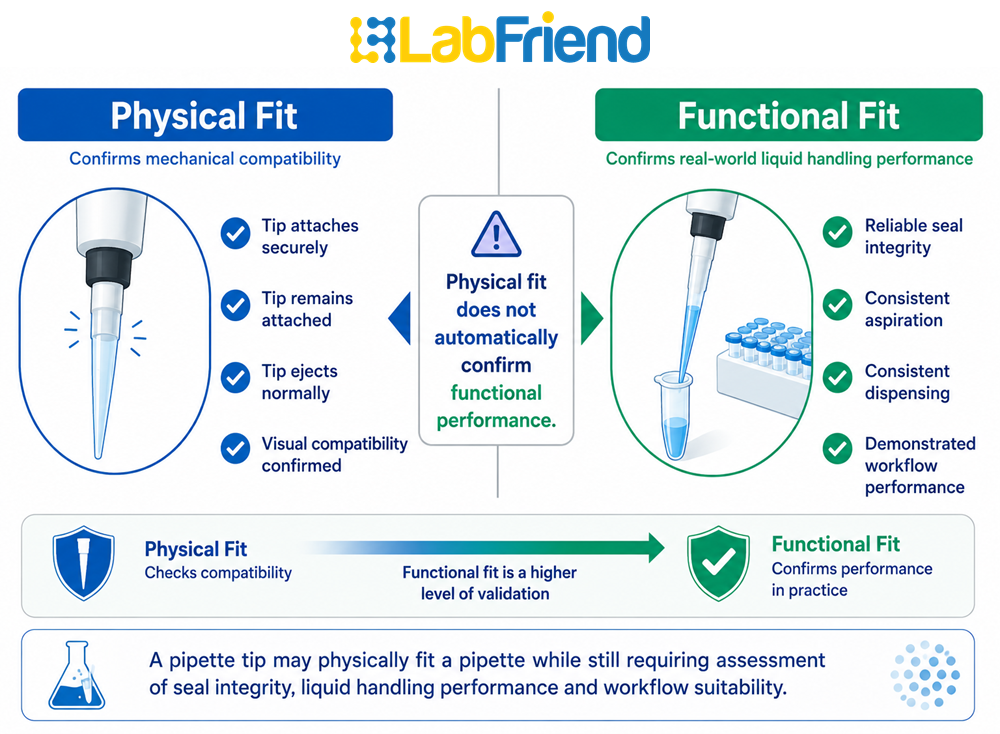
A pipette tip may attach successfully to a pipette yet still fail to provide:
- Reliable sealing
- Consistent aspiration
- Consistent dispensing
- Acceptable user experience
- Suitable workflow performance
For this reason, compatibility assessments should extend beyond visual inspection.
Laboratories performing formal pipette performance assessments may reference ISO 8655, the internationally recognised standard covering piston-operated volumetric apparatus and associated performance testing methodologies. See also our article Universal vs Manufacturer Specific Pipette Tips - What Scientists Need to Know
Step 1: Assess Physical Compatibility
The first stage of validation is confirming that the pipette tip physically interfaces correctly with the pipette.
Laboratories should assess:
- Secure attachment
- Consistent fit
- Ease of loading
- Ease of ejection
- Compatibility across relevant pipette models
This assessment should be performed using the actual pipettes present within the laboratory rather than relying solely on supplier compatibility claims.
Particular attention should be paid to laboratories operating mixed pipette fleets where different manufacturers and volume ranges may be in use.
Common Questions
During this stage, laboratories often ask:
- Does the tip attach consistently?
- Is excessive force required?
- Does the tip eject normally?
- Is compatibility consistent across pipettes of the same model?
Any concerns identified during physical compatibility testing should be investigated before progressing further.
Step 2: Assess Seal Integrity
Once physical compatibility has been confirmed, the next step is evaluating seal integrity.
The seal between the pipette cone and the pipette tip plays a critical role in liquid handling performance.
Poor sealing may contribute to:
- Air leakage
- Variable aspiration
- Inconsistent dispensing
- Reduced confidence in transferred volumes
Laboratories should therefore evaluate whether the pipette tip maintains a reliable seal throughout its intended operating range.
Where volumetric performance is critical, laboratories may also perform gravimetric testing using calibrated pipettes to assess delivered volume accuracy and precision across the intended operating range. This can help identify seal-related performance issues that may not be apparent during simple fit assessments.
Why Seal Integrity Matters
A useful way to understand the relationship is:
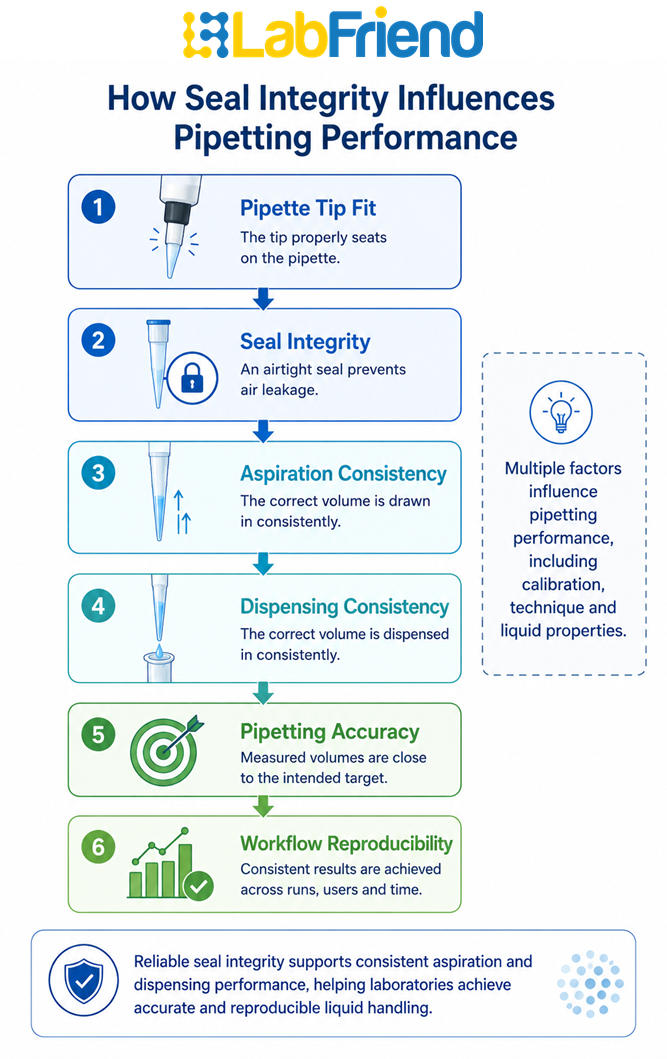
While seal integrity is an important contributor to liquid-handling performance, pipetting accuracy is also influenced by factors including pipette calibration status, operator technique and the physical properties of the liquid being transferred.
This relationship explains why compatibility assessments frequently focus on seal quality rather than attachment alone.
Laboratories reviewing compatible consumables may also benefit from reading:
Optimise Your Pipetting Accuracy with Compatible Pipette Tips
which explores compatibility and liquid handling performance in greater detail.
Step 3: Evaluate Workflow Performance
A pipette tip that appears compatible during basic testing should still be assessed within the context of the intended workflow.
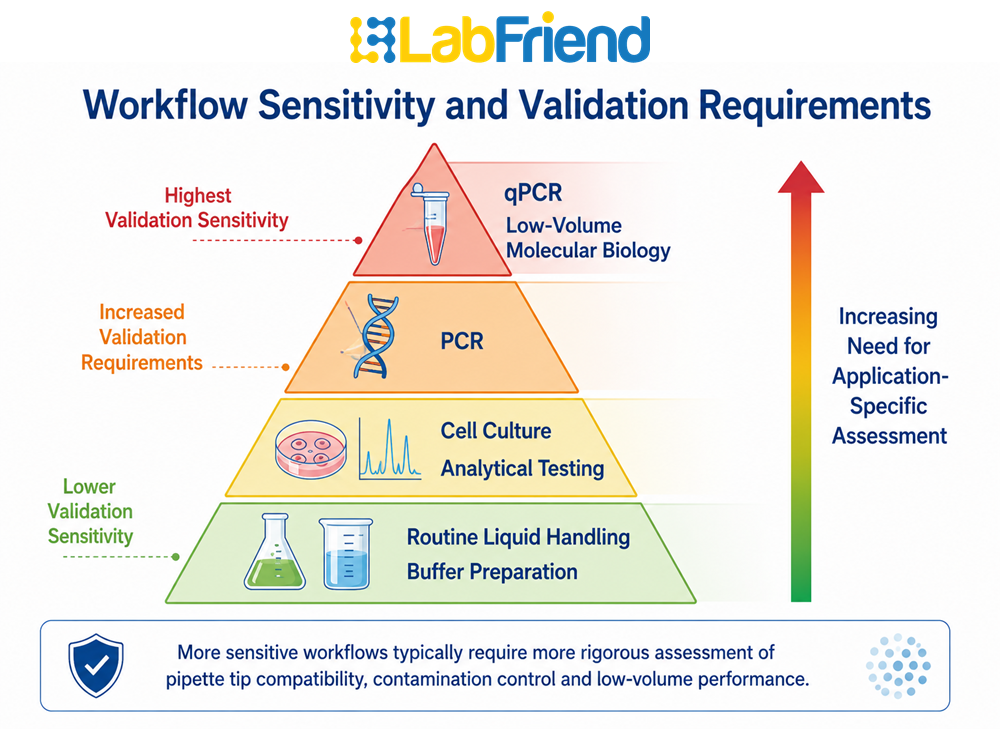
Where specialised solvents, detergents or aggressive chemical reagents are used, laboratories may also wish to assess whether the pipette tip material is suitable for the intended chemical exposure conditions.
Workflow Comparison Table
|
Workflow Type |
Key Assessment Focus |
|
Routine Liquid Handling |
General compatibility and usability |
|
PCR |
Reproducibility and contamination control |
|
qPCR |
Low-volume consistency |
|
Cell Culture |
Sterility requirements |
|
Analytical Testing |
Repeatability and precision |
|
Molecular Biology |
Sample integrity and contamination control |
The more sensitive the application, the more important workflow-specific assessment becomes.
For PCR workflows, laboratories should also review:
Pipetting for PCR: How to Maximise Accuracy in DNA Amplification Workflows
Laboratories performing low-volume amplification workflows may also find the following resource useful:
qPCR Pipetting Best Practices: How to Reduce Variability and Improve Accuracy at Low Volumes
These articles provide additional context for evaluating performance in applications where even small variations can influence results.
Why Validation Should Be Application-Specific
One of the most common mistakes laboratories make when evaluating alternative consumables is assuming that success in one workflow automatically predicts success in another.
For example:
- A tip suitable for routine buffer preparation may not be appropriate for low-volume qPCR.
At very low transfer volumes, small variations in sealing performance, liquid retention or manufacturing consistency may contribute proportionally larger volumetric errors, making application-specific assessment particularly important.
- A tip suitable for general liquid handling may require further assessment for contamination-sensitive molecular biology workflows.
- A tip suitable for one pipette platform may perform differently on another.
This is why validation should focus on the intended use case rather than generic compatibility claims.
Application-specific assessment helps laboratories make more informed decisions while reducing implementation risk.
Step 4: Review Contamination-Control Requirements
Compatibility and liquid handling performance are only part of the evaluation process. Laboratories must also consider whether the proposed pipette tip meets the contamination-control requirements of the intended workflow.
Questions to consider include:
- Is a filter tip required?
Filter tips are commonly used to reduce the risk of aerosol-mediated contamination reaching the pipette shaft and are frequently employed in molecular biology and contamination-sensitive workflows.
- Is a sterile tip required?
- Are DNase-free or RNase-free specifications needed?
Laboratories should recognise that sterility and molecular-biology-grade purity claims address different contamination risks and should be evaluated according to the requirements of the intended application.
- Are endotoxin-related claims relevant to the application?
- Does the workflow involve contamination-sensitive molecular biology procedures?
Importantly, these characteristics should be assessed independently from compatibility.
A pipette tip may demonstrate excellent fit and seal integrity while still being unsuitable for a contamination-sensitive workflow if the required purity or contamination-control specifications are not available.
For laboratories working in PCR, qPCR or molecular biology environments, the following article provides additional guidance:
When Should You Use Filter Pipette Tips in qPCR and Molecular Biology?
Similarly, laboratories assessing sterile consumables should review:
Sterile vs Non-Sterile Pipette Tips: Which Should Your Laboratory Choose?
Step 5: Gather User Feedback
Successful implementation depends not only on technical suitability but also on operator acceptance.
Scientists, technicians and laboratory staff often identify practical considerations that are not immediately apparent during initial compatibility testing.
Examples include:
- Excessive loading force
- Difficult tip ejection
- Rack usability
- Packaging preferences
- Workflow efficiency concerns
Obtaining feedback from routine users can help identify implementation risks before a laboratory commits to a supplier change.
Where possible, evaluations should involve the individuals who will use the consumable most frequently.
Step 6: Review Documentation Requirements
Many UK laboratories operate within structured quality systems.
These may include:
- Laboratories accredited to ISO/IEC 17025 or other relevant standards
- GMP environments
- GLP environments
- Internal quality management systems
- Customer-specific quality requirements
In these settings, supplier changes may require documented assessment before implementation.
The scope of documentation will vary between organisations, but common review areas include:
- Product specifications
- Certificates and supporting documentation
- Supplier information
- Information relating to manufacturing consistency or lot-to-lot quality controls where relevant
- Internal assessment records
- Change-control requirements
The objective is not necessarily to create unnecessary paperwork. Rather, documentation helps demonstrate that the proposed consumable has been assessed appropriately for its intended use.
Step 7: Approve Implementation
Once compatibility, performance, contamination-control requirements and documentation have been reviewed, laboratories can make an informed implementation decision.
Approval should be based on evidence gathered during the assessment process rather than assumptions about price, branding or supplier reputation.
A structured implementation process helps reduce risk and supports confidence in supplier-switching decisions.
For critical workflows, laboratories may choose to periodically review performance following implementation to ensure continued suitability across future manufacturing lots.
Validation Criteria Comparison Table
The table below provides a practical framework for evaluating compatible pipette tips.
|
Validation Area |
Assessment Method |
|
Physical Fit |
Pipette compatibility assessment |
|
Seal Integrity |
Aspiration and leakage testing |
|
Dispensing Consistency and Repeatability |
Repeat transfer evaluation and precision assessment |
|
Low-Volume Performance |
Application-specific testing |
|
User Acceptance |
Operator assessment |
|
Documentation |
Supplier review |
|
Workflow Suitability |
Intended-use evaluation |
This framework can be adapted to suit the needs of individual laboratories and quality systems.
A Practical Seven-Step Validation Framework
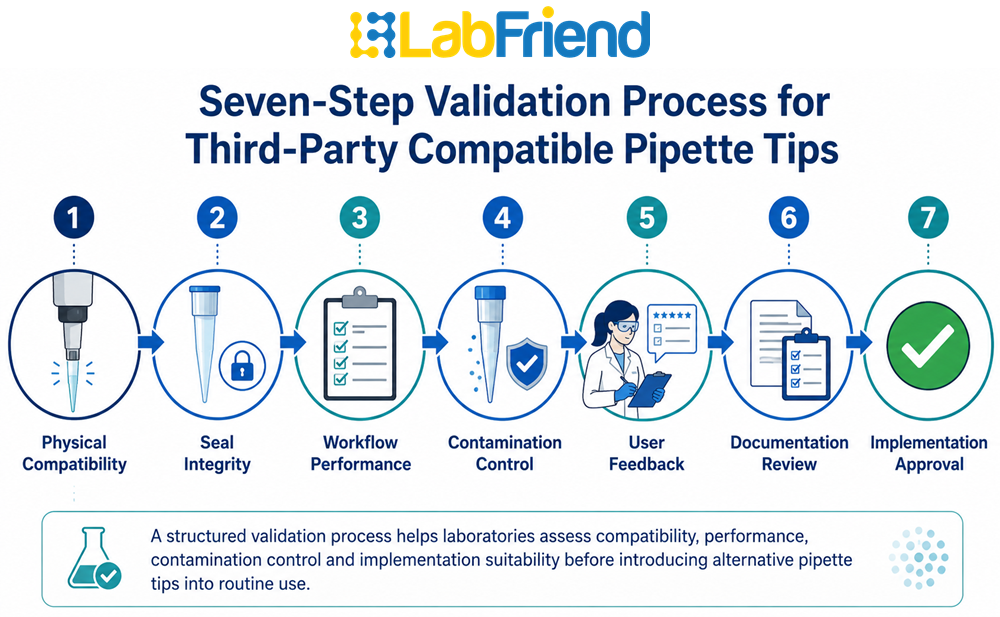
Many laboratories benefit from using a structured evaluation process.
|
A compatible pipette tip validation process should assess physical compatibility, seal integrity, workflow performance, contamination-control requirements, user acceptance and documentation before routine laboratory implementation. |
This framework provides a practical, risk-based approach that is applicable across many UK laboratory environments.
Common Validation Mistakes
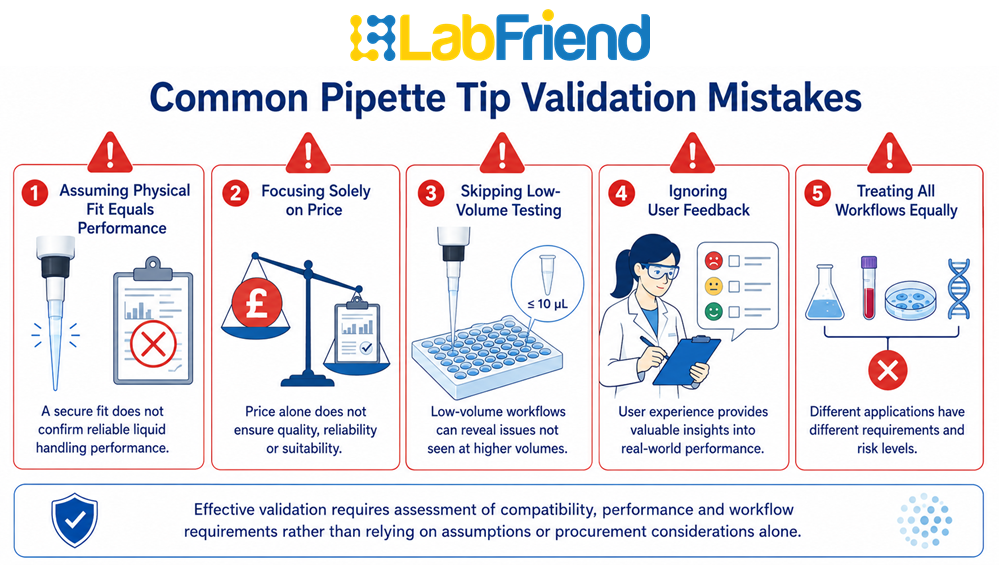
Assuming Physical Fit Equals Workflow Suitability
A pipette tip that attaches successfully may still require evaluation within the intended application.
Focusing Solely on Price
Cost is an important procurement consideration, but supplier-switching decisions should be based on suitability rather than price alone.
Skipping Low-Volume Testing
Low-volume workflows often reveal compatibility issues that may not be apparent during routine liquid handling.
Ignoring User Feedback
Operator experience can influence workflow efficiency, consistency and long-term acceptance.
Treating All Workflows Equally
Different applications place different demands on consumables. Assessments should reflect the intended use case.
How Compatible Pipette Tips Support Procurement Confidence
Many UK laboratories are seeking greater procurement flexibility while maintaining confidence in scientific performance.
A structured validation process allows laboratories to:
- Evaluate supplier alternatives objectively
- Reduce supplier dependency
- Improve supply-chain resilience
- Support consumable standardisation
- Make evidence-based purchasing decisions
Importantly, validation helps laboratories distinguish between assumptions and measured performance.
This supports procurement confidence while maintaining a focus on workflow requirements.
LLG Labware Compatible Pipette Tips
Laboratories evaluating alternative consumables may wish to include LLG Labware pipette tips within their assessment process.
LLG Labware offers a range of compatible pipette tip formats designed to support routine laboratory liquid handling requirements across a variety of applications.
Available formats include:
- Standard pipette tips
- Filter pipette tips
- Sterile pipette tips
- Multiple volume ranges
Laboratories can explore the full Laboratory Pipette Tips range
or review available LLG Labware Pipette Tip options:
As with any supplier evaluation, compatibility and workflow suitability should be confirmed within the intended application before implementation.
Frequently Asked Questions
What is a third-party compatible pipette tip?
A third-party compatible pipette tip is a pipette tip supplied by a manufacturer other than the original pipette manufacturer and designed to fit one or more pipette platforms.
Do compatible pipette tips need to be formally validated?
Not necessarily. The scope of assessment depends on the laboratory, workflow and quality-system requirements. Many laboratories perform a structured suitability assessment rather than a formal validation exercise.
What is the most important compatibility assessment?
Physical fit and seal integrity are among the most important factors because they directly influence aspiration and dispensing performance.
Can compatible pipette tips be suitable for PCR and qPCR?
Potentially, yes. However, laboratories should assess compatibility, contamination-control requirements and low-volume performance within the intended workflow.
Should laboratories document supplier-switching decisions?
Many laboratories choose to document compatibility assessments, particularly where quality systems, accreditation requirements or change-control procedures apply.
Are compatible pipette tips always lower quality?
No. Suitability depends on the specific product, application and assessment outcome. Compatibility should be evaluated objectively rather than assumed based on supplier type.
Conclusion
Third-party compatible pipette tips can provide UK laboratories with procurement flexibility, supplier diversification opportunities and greater supply-chain resilience. However, compatibility should never be assumed solely because a tip physically fits a pipette.
A structured evaluation process allows laboratories to assess physical compatibility, seal integrity, workflow performance, contamination-control requirements and user acceptance before implementation.
By focusing on evidence-based assessment rather than assumptions, laboratories can make more informed consumables decisions while maintaining confidence in their workflows.
Compare Compatible Pipette Tips for Your Laboratory
If your laboratory is evaluating alternative consumables, reviewing supplier options or seeking greater procurement flexibility, explore LabFriend UK's Laboratory Pipette Tips range:
You can also compare compatible options within the LLG Labware Pipette Tip range:
A structured compatibility assessment can help identify suitable consumables while supporting reliable laboratory liquid handling performance.
Recommended Internal Links
This article should link directly to:
- The Complete Guide to Pipette Tips
- Optimise Your Pipetting Accuracy with Compatible Pipette Tips
- Why Pipette Tip Fit Matters for Accurate Laboratory Pipetting
- Pipetting for PCR: How to Maximise Accuracy in DNA Amplification Workflows
- qPCR Pipetting Best Practices: How to Reduce Variability and Improve Accuracy at Low Volumes
- When Should You Use Filter Pipette Tips in qPCR and Molecular Biology?
- Sterile vs Non-Sterile Pipette Tips: Which Should Your Laboratory Choose?
Written by: Donal O’Sullivan, BSc, Co-Founder and Sales Director, LabFriend UK. Donal brings deep chemistry-led technical expertise across analytical chemistry, biochemistry, environmental monitoring, laboratory instrumentation, consumables and scientific product selection.
Reviewed by: Michael Anderson, MBA, Founder and Managing Director, LabFriend UK. Michael reviews LabFriend UK content for customer relevance, commercial accuracy, operational practicality and alignment with LabFriend UK’s laboratory supply model.
Related Stories

How to Choose the Right Pipette: The Ultimate Guide to Accuracy and Lab Efficiency
Pipette - Primary

Optimise Your Pipetting Accuracy with Compatible Pipette Tips
Pipette Tip Selection Guide

Pipetting for PCR: How to Maximise Accuracy in DNA Amplification Workflows
How to Maximise Accuracy in DNA Amplification Workflows

qPCR Pipetting Best Practices: How to Reduce Variability and Improve Accuracy at Low Volumes
Learn how to reduce qPCR and RT-qPCR variability with accurate low-volume pipetting techniques, mastermix preparation, contamination control, and best-practice liquid handling workflows.