

Share :
Universal vs Manufacturer Specific Pipette Tips - What Scientists Need to Know
Updated On 07/17/2026

By Donal O’Sullivan, BSc. Reviewed by Michael Anderson, MBA.
Many laboratories eventually face the same question: should they continue purchasing manufacturer-specific pipette tips, or can universal-compatible alternatives deliver reliable performance within their workflows?
For scientists, the answer is not simply a matter of price. Pipette tip selection can influence liquid handling performance, seal integrity, contamination control, low-volume reproducibility and workflow confidence. The right choice depends on the pipette, the liquid, the application and the level of verification required.
For a broader overview of pipette tip selection, compatibility and workflow considerations, see LabFriend UK’s Complete Guide to Pipette Tips.
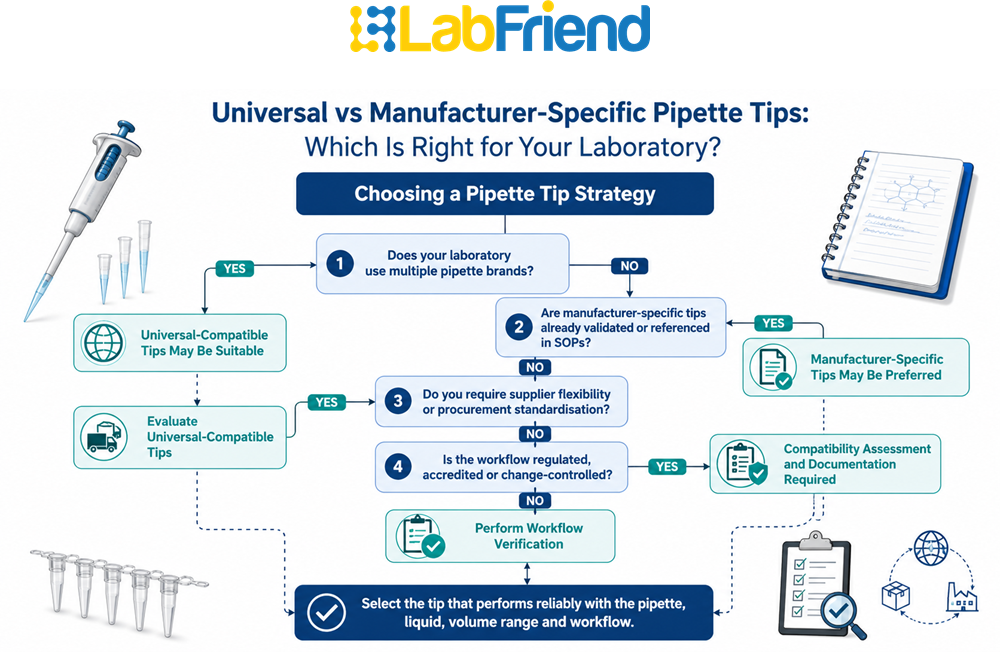
What Are Manufacturer-Specific Pipette Tips?
Manufacturer-specific pipette tips are designed and supplied by the same manufacturer that produces the pipette. These systems are often used because they are familiar, already referenced in protocols, or previously assessed within established workflows.
Examples include laboratories using Eppendorf tips with Eppendorf pipettes, Gilson tips with Gilson pipettes, or Sartorius tips with Sartorius pipettes. In these cases, the pipette-and-tip combination may already be part of routine practice, local SOPs or historical validation work.
A manufacturer-specific tip is not automatically better for every workflow, but it may reduce uncertainty where a laboratory has already assessed performance and documentation requirements.
What Are Universal-Compatible Pipette Tips?
Universal-compatible pipette tips are designed to fit multiple pipette brands rather than one manufacturer platform. They are commonly selected where laboratories want procurement flexibility, supplier diversification or a more standardised approach across mixed pipette fleets.
Universal-compatible tips may be suitable for routine and specialist workflows where compatibility and performance have been confirmed. However, “universal” does not mean validated with every pipette, every liquid or every workflow.
For a deeper discussion of fit, seal integrity and compatibility considerations, see Optimise Your Pipetting Accuracy with Compatible Pipette Tips.
Universal Does Not Mean Identical
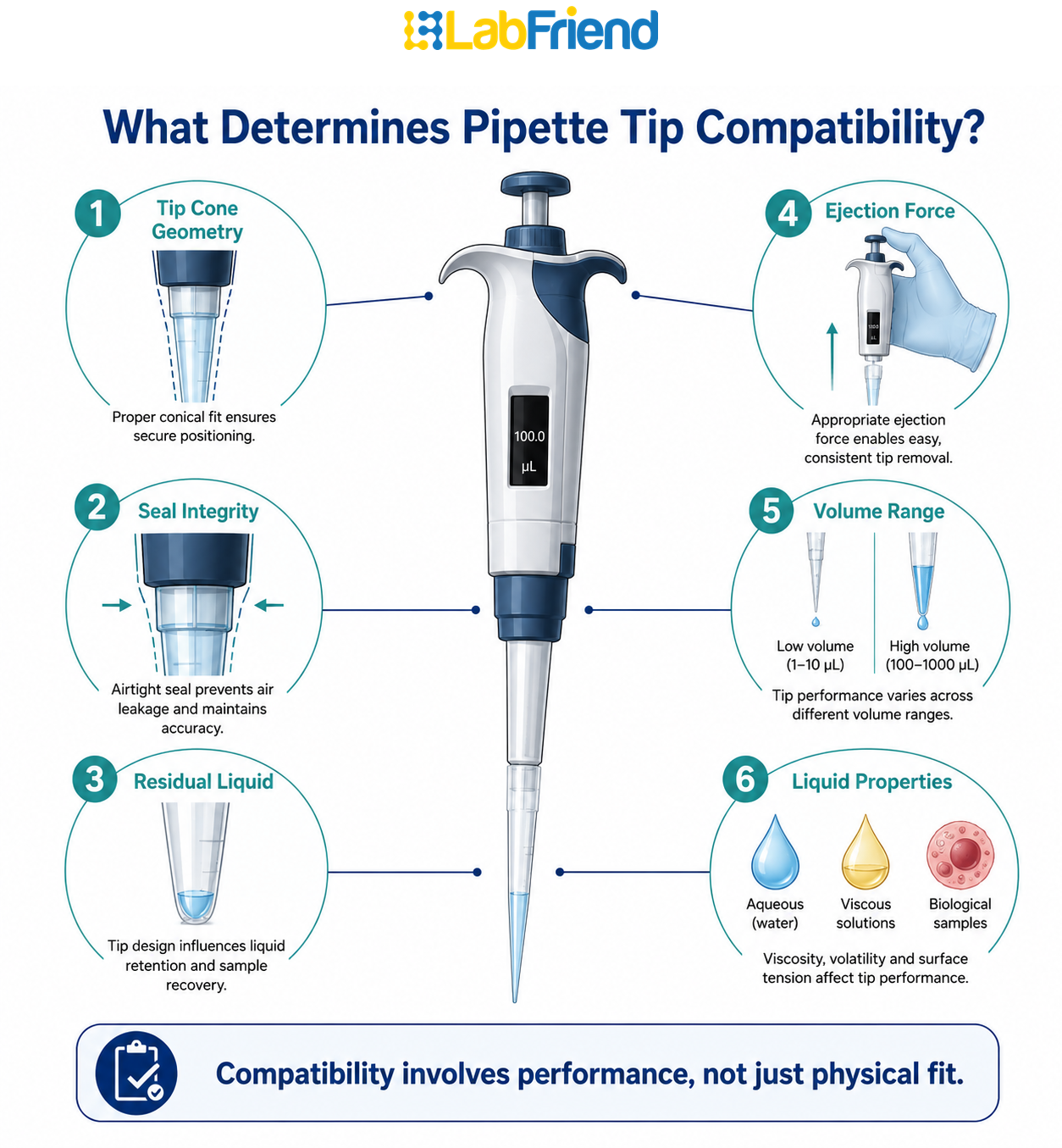
One of the most important points for scientists is that two tips can appear similar and still behave differently in practice. For air-displacement pipettes, compatibility depends on tip cone geometry, seal integrity, ejection force, dead volume, residual liquid, volume range and the liquid being handled.
A tip that performs well for routine buffer transfer may still need further assessment for low-volume qPCR, viscous liquids or contamination-sensitive workflows. Equally, a manufacturer-specific tip may still require verification if the method, liquid type, pipette model or quality requirements change.
The correct comparison is not “branded versus cheaper”. It is “which tip performs appropriately in this workflow with this pipette and this liquid?”
Universal vs Manufacturer-Specific Pipette Tips: Comparison Table
|
Feature |
Universal-Compatible Pipette Tips |
Manufacturer-Specific Pipette Tips |
|
Intended fit |
Designed to fit multiple pipette brands |
Designed for a specific manufacturer’s pipettes |
|
Procurement flexibility |
Usually higher |
Usually lower |
|
Mixed pipette fleets |
Often useful where compatibility is confirmed |
May require multiple tip ranges |
|
Historical validation |
Application dependent |
Often already established in existing workflows |
|
Supplier switching |
Can support supplier diversification |
May reinforce single-brand dependency |
|
Scientific suitability |
Must be verified for the workflow |
Still workflow dependent |
|
Cost optimisation |
May offer opportunities |
Depends on supplier and format |
|
Risk before switching |
Compatibility must be assessed |
Lower if already used and validated locally |
Neither option is universally better. The most appropriate choice depends on the laboratory workflow, pipette model, liquid properties, contamination-control requirements and documentation expectations.
How Scientists Should Evaluate Pipette Tip Compatibility
Scientists should evaluate pipette tips as part of the wider pipette–tip–liquid–operator system. Tip choice alone does not determine liquid-handling accuracy. Pipette calibration, tip fit, seal integrity, technique, liquid viscosity, surface tension and volume range all influence performance.
A practical evaluation should start with seal integrity. Poor sealing can contribute to leakage, variable aspiration volume and inconsistent dispensing. Ejection force is also important because excessive force can affect user comfort and consistency over repeated pipetting.
Low-volume workflows, particularly those operating near the lower end of the pipette’s specified volume range, need particular attention. Small differences in aspiration, residual liquid or dispensing consistency can become more significant when working at low microlitre volumes. For amplification workflows, the article Pipetting for PCR: How to Maximise Accuracy in DNA Amplification Workflows provides useful workflow context.
When Universal-Compatible Tips May Be Appropriate
Universal-compatible tips may be appropriate where a laboratory has multiple pipette brands, wants to reduce purchasing complexity, or needs supplier flexibility for recurring consumables.
They are often considered by CROs, SME biotechnology companies, independent testing laboratories and university research groups that use pipette tips at scale. In these environments, standardising compatible tips can support repeat ordering and procurement efficiency, provided the selected tips are suitable for the relevant workflows.
For qPCR and other low-volume applications, compatibility should be assessed carefully. Laboratories working at low volumes may also benefit from reviewing qPCR Pipetting Best Practices: How to Reduce Variability and Improve Accuracy at Low Volumes.
When Manufacturer-Specific Tips May Be Preferred
Manufacturer-specific tips may be preferred where the laboratory has already validated a particular pipette-and-tip combination, where protocols explicitly reference the original manufacturer’s consumables, or where change control would be burdensome.
They may also be retained for highly sensitive workflows where even small changes in fit, residual volume or handling characteristics could affect confidence in the method. This is especially relevant in regulated, accredited or internally validated workflows, where changing a consumable may require documented assessment.
However, manufacturer-specific does not automatically mean scientifically superior in every application. It means the laboratory may have a clearer existing basis for use.
Contamination-Control Considerations
Compatibility is only one part of pipette tip selection. In molecular biology workflows, laboratories should also consider whether filter tips, sterile formats or specific purity claims are required.
Filter tips are commonly selected where aerosol-mediated contamination control and pipette protection are important. They are not automatically sterile, DNase-free or RNase-free unless those claims are supported by manufacturer documentation. For more detail, see When Should You Use Filter Pipette Tips in qPCR and Molecular Biology?.
Where sterility is part of the selection decision, laboratories should also distinguish between sterile, filtered, DNase-free, RNase-free and endotoxin-tested claims. These are separate specifications. For more on this distinction, see [Sterile vs Non-Sterile Pipette Tips: Which Should Your Laboratory Choose?](URL REQUIRED).
What Universal-Compatible Tips Do Not Solve
Universal-compatible tips can support supplier flexibility and procurement standardisation, but they do not remove the need for workflow assessment. They do not guarantee compatibility with every pipette, accuracy in every volume range, suitability for every liquid, or acceptance in every quality system.
Similarly, manufacturer-specific tips do not guarantee success in every workflow. They still need to be suitable for the liquid, volume, contamination-control requirement and local procedures.
The safest approach is to treat tip selection as a workflow decision rather than a brand decision.
What to Check Before Switching Pipette Tips
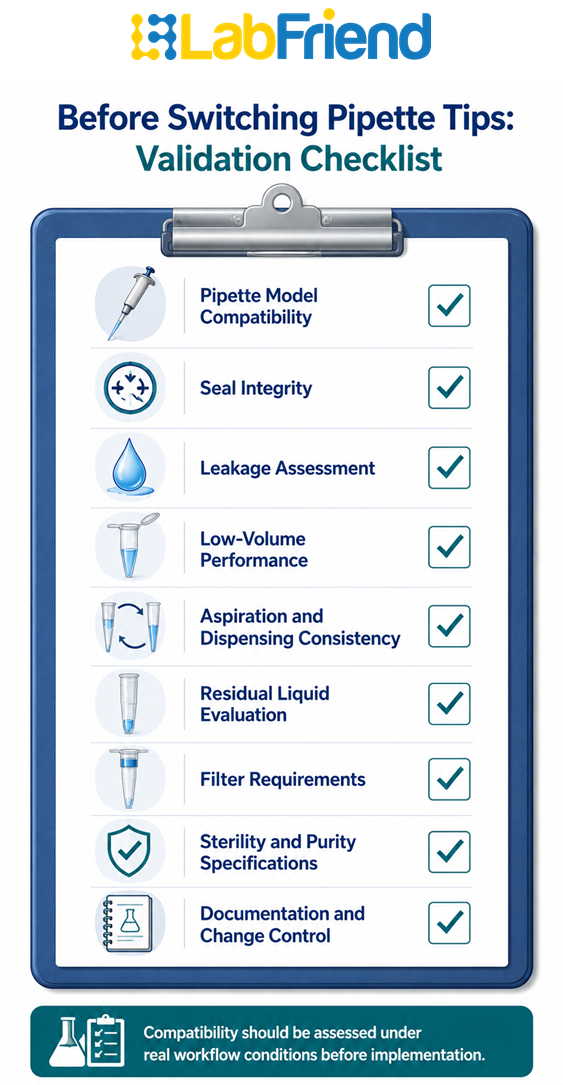
Before switching from manufacturer-specific to universal-compatible tips, scientists should confirm the intended use case and evaluate the tip under realistic workflow conditions.
Key checks include pipette model compatibility, seal integrity, leakage risk, ejection force, aspiration and dispensing consistency, residual liquid, volume range, filter or purity requirements and documentation needs.
|
Check |
Why It Matters |
|
Pipette model compatibility |
Confirms the tip fits the pipette cone appropriately |
|
Seal integrity |
Helps reduce leakage and aspiration variability |
|
Low-volume performance |
Important for PCR, qPCR and precision workflows |
|
Ejection force |
Affects operator comfort and repeatability |
|
Residual liquid |
Relevant for recovery-sensitive applications |
|
Filter requirement |
Important where aerosol contamination control is needed |
|
Sterility or purity claims |
Must be confirmed from manufacturer documentation |
|
Workflow documentation |
Required where SOPs, validation or change control apply |
In regulated, accredited or validated workflows, changing pipette tips may require documented change control, equivalence checks or local method verification depending on the laboratory quality system.
LLG Labware Universal Pipette Tips
LLG Labware universal pipette tips provide laboratories with an option to evaluate compatible pipette tips across commonly used pipette systems. They may be relevant where laboratories are reviewing supplier diversification, repeat-order standardisation or procurement flexibility.
Scientists should still confirm compatibility and suitability within their own workflows before implementation. This includes checking fit, seal integrity, volume performance, contamination-control requirements and any required documentation.
Laboratories can review LabFriend UK’s laboratory pipette tips range or compare LLG Labware pipette tips as part of a structured consumables evaluation.
UK Laboratory Purchasing Considerations
For many UK laboratories, pipette tips are not occasional purchases. They are recurring consumables used across multiple teams, workflows and workstations. That makes standardisation valuable, but only after technical suitability has been confirmed.
CROs, independent testing laboratories and SME biotechnology companies often need to balance reproducibility, supply continuity, pricing, documentation and ordering efficiency. Universal-compatible tips can support that balance where they are properly assessed, but procurement convenience should not replace scientific verification.
A sensible purchasing process is to confirm workflow suitability first, then compare supplier options, pack formats and repeat-order requirements.
Frequently Asked Questions
Are universal pipette tips as accurate as manufacturer-specific tips?
Accuracy and precision are performance characteristics of the complete pipette–tip system, including pipette condition, tip fit, seal integrity, liquid properties, operator technique and workflow verification. Universal-compatible tips may perform well where compatibility has been confirmed.
Do universal pipette tips fit every pipette?
No. Universal-compatible tips are designed to fit multiple pipette brands, but they are not validated with every pipette, every instrument or every workflow. Compatibility should be confirmed before routine use.
Why do laboratories switch to compatible pipette tips?
Laboratories often consider compatible tips to improve procurement flexibility, reduce supplier dependency, simplify ordering across mixed pipette fleets or support repeat purchasing. These benefits should follow, not replace, technical suitability checks.
Can changing pipette tips affect PCR performance?
Yes, potentially. PCR workflows can be sensitive to low-volume variability, contamination-control requirements and pipette-tip compatibility. Laboratories should assess fit, dispensing consistency and filter or purity requirements before switching.
Should scientists validate compatible pipette tips before use?
Compatibility, seal integrity, low-volume performance, residual liquid and workflow suitability should be assessed before implementing alternative consumables in routine use. In regulated, accredited or internally validated workflows, formal verification or change-control procedures may also be required.
Conclusion
The choice between universal-compatible and manufacturer-specific pipette tips should be based on workflow suitability rather than brand preference alone. Manufacturer-specific tips may be appropriate where they are already established or validated. Universal-compatible tips may offer flexibility and procurement advantages where compatibility and performance have been confirmed.
For scientists, the key question is not whether one category is universally better. The key question is whether the selected tip performs reliably with the pipette, liquid, volume range and workflow being used.
Written by: Donal O’Sullivan, BSc, Co-Founder and Sales Director, LabFriend UK. Donal brings deep chemistry-led technical expertise across analytical chemistry, biochemistry, environmental monitoring, laboratory instrumentation, consumables and scientific product selection.
Reviewed by: Michael Anderson, MBA, Founder and Managing Director, LabFriend UK. Michael reviews LabFriend UK content for customer relevance, commercial accuracy, operational practicality and alignment with LabFriend UK’s laboratory supply model.
CTA: Explore Compatible Pipette Tip Options for Your Laboratory
If your laboratory is evaluating supplier alternatives, reviewing consumables standardisation or assessing compatibility across multiple pipette platforms, explore LabFriend UK’s laboratory pipette tips range to compare available formats.
Laboratories assessing supplier diversification can also review LLG Labware pipette tips as part of a structured compatibility and procurement evaluation.
Related Stories

How to Choose the Right Pipette: The Ultimate Guide to Accuracy and Lab Efficiency
Pipette - Primary

Optimise Your Pipetting Accuracy with Compatible Pipette Tips
Pipette Tip Selection Guide

Pipetting for PCR: How to Maximise Accuracy in DNA Amplification Workflows
How to Maximise Accuracy in DNA Amplification Workflows

qPCR Pipetting Best Practices: How to Reduce Variability and Improve Accuracy at Low Volumes
Learn how to reduce qPCR and RT-qPCR variability with accurate low-volume pipetting techniques, mastermix preparation, contamination control, and best-practice liquid handling workflows.