

Share :
Sterile vs Non-Sterile Pipette Tips - Which Should Your Laboratory Choose
Updated On 07/17/2026

By Donal O’Sullivan, BSc. Reviewed by Michael Anderson, MBA.
Sterile pipette tips are commonly used in workflows where contamination control is a significant consideration, such as cell culture, molecular biology and certain PCR applications. Non-sterile pipette tips are often suitable for routine liquid handling, analytical testing and general laboratory work where sterility is not required. The most appropriate choice depends on the application, contamination risk, documentation requirements and laboratory quality procedures.
For laboratories evaluating liquid handling consumables more broadly, our Complete Guide to Pipette Tips, Pipetting Accuracy & Laboratory Liquid Handling provides a wider overview of pipette tip selection, compatibility, contamination control and workflow optimisation.
Understanding when sterility genuinely adds value, and when non-sterile alternatives may be appropriate, can help laboratories improve contamination-control strategies while maintaining procurement efficiency and cost control.
Why This Matters to Laboratory Managers
For laboratory managers, pipette tip selection is not simply a purchasing decision. It affects workflow reliability, contamination control, consumables budgets, staff training requirements and repeat-order standardisation.
Many laboratories use a mixture of sterile and non-sterile pipette tips across different departments. For example, a molecular biology team may require sterile or filtered formats for contamination-sensitive work, while an analytical chemistry team may use non-sterile tips for routine reagent preparation. A cell culture laboratory may specify sterile consumables as part of its aseptic technique, while a teaching laboratory may not require the same level of contamination control.
The risk is at both extremes. Unnecessary use of sterile consumables can increase operating costs without improving a routine workflow. At the same time, using non-sterile consumables in contamination-sensitive workflows may introduce avoidable risk. A structured approach allows laboratory managers to standardise purchasing without ignoring application-specific requirements.
What Is the Difference Between Sterile and Non-Sterile Pipette Tips?
The primary distinction is whether the pipette tip has undergone a validated sterilisation process before packaging and whether the manufacturer supplies documentation to support that claim.
Sterilisation methods may include gamma irradiation, electron-beam treatment or other validated processes depending on the manufacturer.
Sterile pipette tips are supplied following a validated sterilisation process and packaged in a manner intended to maintain sterility until use, where supported by manufacturer documentation.
Non-sterile pipette tips are pipette tips supplied without a sterilisation process intended to maintain sterility during packaging and storage.
This distinction matters, but it is only one part of pipette tip selection. Sterility does not determine pipetting accuracy, tip fit, low-retention behaviour, filter performance or compatibility with a specific pipette. Those factors must be assessed separately within the wider pipette–tip–liquid–operator system.
Low-retention performance is a separate tip characteristic intended to reduce sample adhesion and improve recovery of challenging liquids.
Laboratories reviewing the broader range of tip formats may also find Types of Pipette Tips Explained for Modern Laboratory Workflows useful as a supporting guide to standard, filter, low-retention, sterile and conductive tip types.
Sterile Does Not Automatically Mean DNase-Free, RNase-Free or Endotoxin-Free
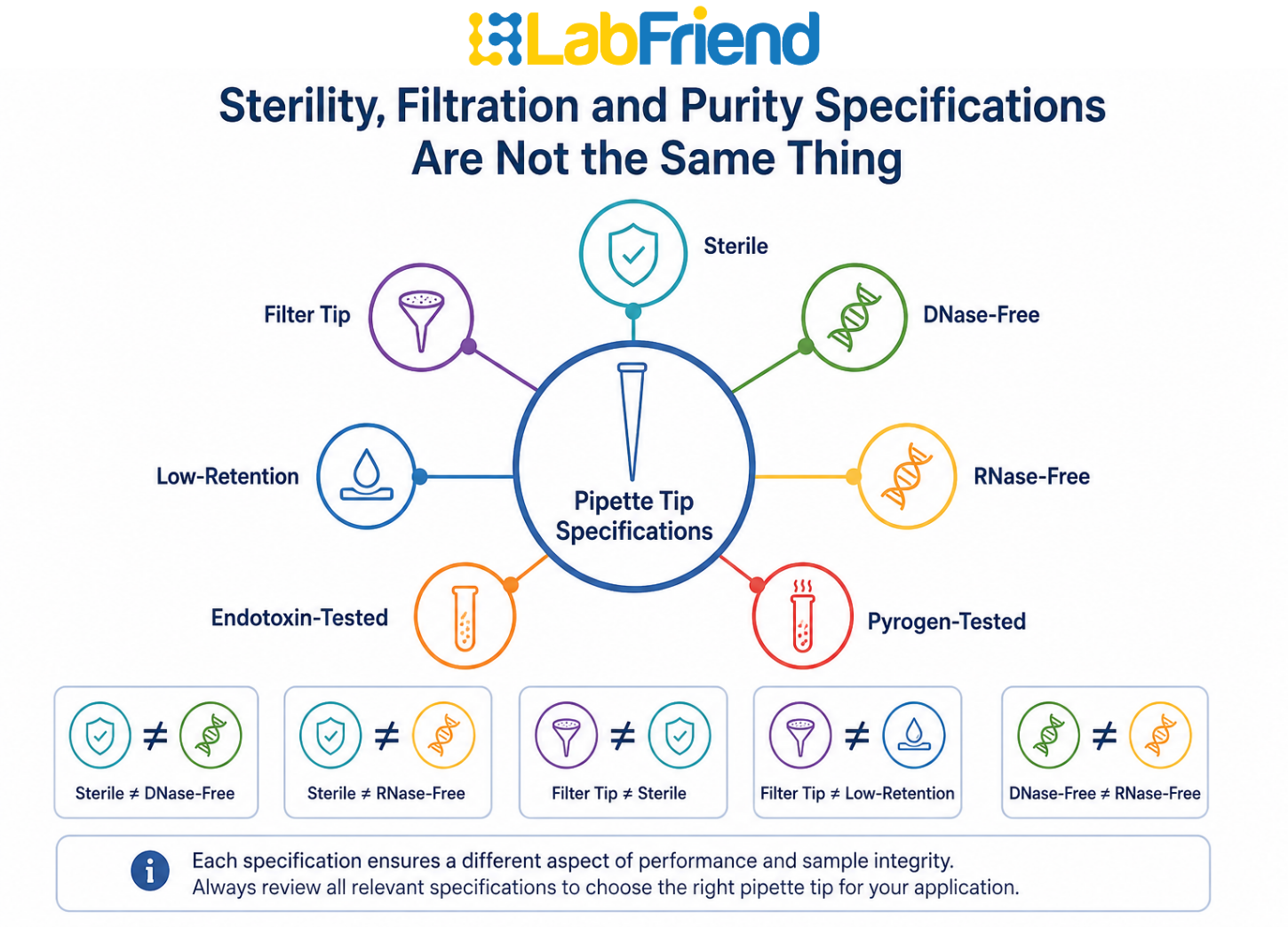
One of the most common mistakes in laboratory purchasing is assuming that sterile pipette tips automatically meet every purity requirement.
A sterile pipette tip may or may not also be DNase-free, RNase-free, DNA-free, endotoxin-tested or pyrogen-tested. These are separate specifications and should be verified independently against the manufacturer’s documentation for the specific product or range.
Claims such as endotoxin-tested, low endotoxin and non-pyrogenic are not necessarily equivalent and should be verified against the manufacturer’s documentation.
The same principle applies in reverse. A pipette tip described as DNase-free or RNase-free is not automatically sterile unless the manufacturer also confirms sterility. Filter tips are also not automatically sterile, and sterile tips are not automatically filter tips.
This distinction is especially important in PCR, qPCR, molecular biology, cell culture and contamination-sensitive biological workflows. Laboratories performing PCR, qPCR and molecular biology workflows should also understand the difference between sterility and aerosol contamination control. Sterility helps address one aspect of contamination risk, while filter pipette tips are primarily intended to reduce aerosol and liquid carryover into the pipette shaft and between samples. Our article When Should You Use Filter Pipette Tips in qPCR and Molecular Biology? explains when aerosol-barrier tips may be appropriate alongside sterility requirements.
In PCR and qPCR laboratories, contamination from previously amplified nucleic acids is often a greater concern than viable microbial contamination, which is one reason aerosol-barrier tips are commonly used.
A practical way to frame the distinction is this:
|
Specification |
What It Indicates |
What It Does Not Automatically Confirm |
|
Sterile |
Treated to remove viable microorganisms, where documented |
DNase-free, RNase-free, endotoxin-free or filter barrier |
|
Filtered |
Contains an aerosol barrier |
Sterile, nuclease-free or low-retention |
|
DNase-free |
Tested or manufactured to support DNase-free claim, where documented |
Sterile or RNase-free |
|
RNase-free |
Tested or manufactured to support RNase-free claim, where documented |
Sterile or DNase-free |
|
Endotoxin-tested |
Endotoxin status has been assessed, where documented |
Sterility or molecular biology suitability |
|
DNA-free |
Documented reduction or control of DNA contamination |
Sterility, RNase-free or DNase-free status |
Laboratories should always check the manufacturer’s documentation for the specific certification, lot traceability and application-specific claims required before purchase.
For many biological applications, pyrogen-related claims may refer to bacterial endotoxins specifically, but terminology should always be confirmed against supplier documentation.
Understanding Purity Claims Beyond Sterility
In many biological workflows, sterility is only one specification among several that may be required. Laboratories may also evaluate DNase-free, RNase-free, DNA-free, low-endotoxin, non-pyrogenic or PCR-suitable claims depending on the application. These specifications should be treated independently and verified through manufacturer documentation rather than assumed from a sterile label alone.
When Are Sterile Pipette Tips Commonly Used?
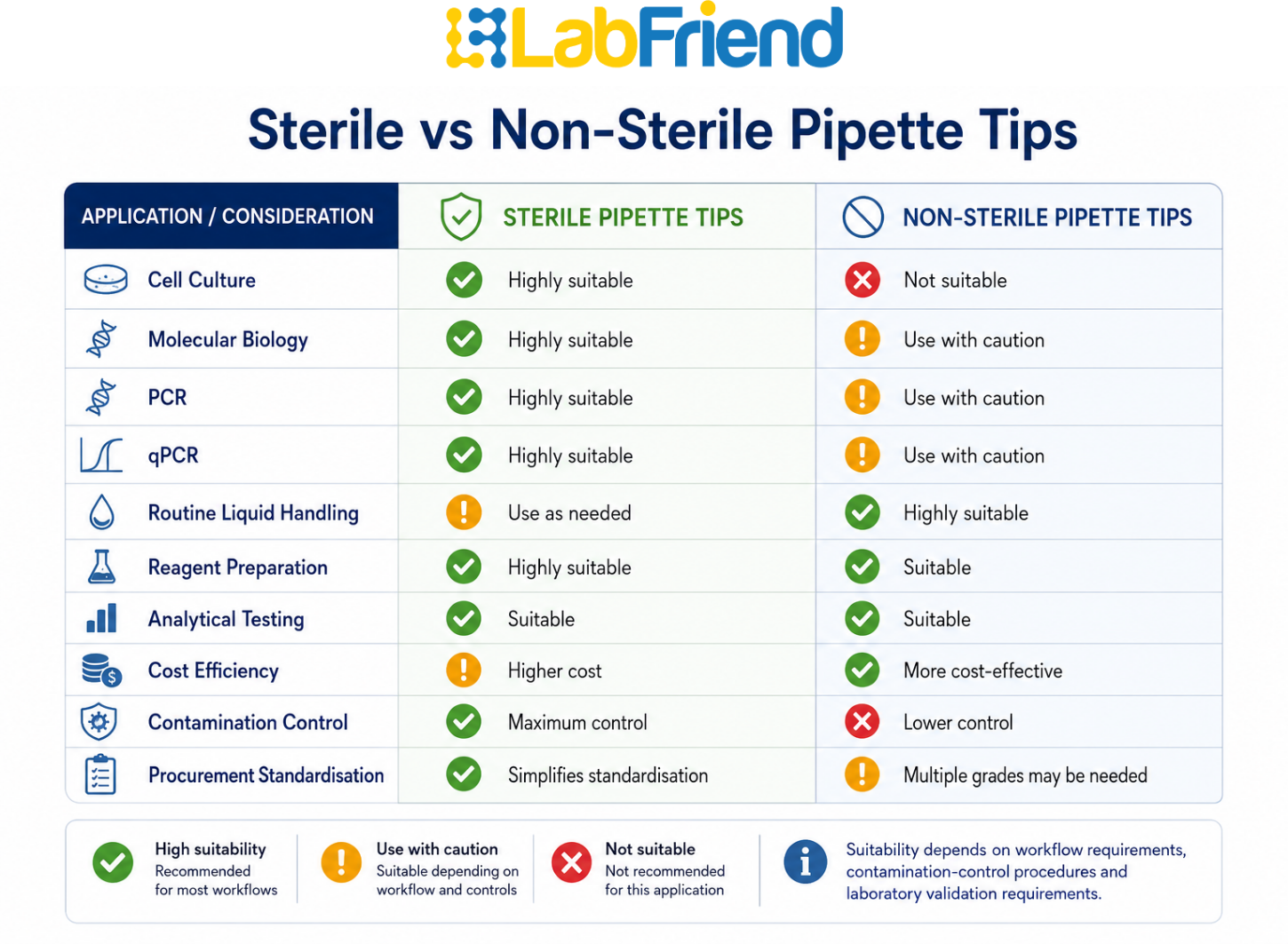
Sterile pipette tips are often selected when the workflow involves biological samples, aseptic handling or contamination-sensitive procedures. They are commonly used in cell culture, microbiology, molecular biology, sterile reagent preparation and some PCR or qPCR workflows.
In cell culture, sterile consumables are often part of the wider aseptic handling process. In molecular biology, sterility may be required alongside additional purity specifications, depending on the sample type and downstream method. In microbiology and biological sample handling, sterility may help reduce the risk of introducing viable microorganisms into the workflow.
The use of sterile consumables alone does not create aseptic conditions and must be combined with appropriate technique, environmental controls and workflow practices.
In amplification workflows, contamination control is influenced by both consumable selection and pipetting technique. Laboratories working with amplified DNA or RNA may benefit from reviewing our guides on Pipetting for PCR: How to Maximise Accuracy in DNA Amplification Workflows and qPCR Pipetting Best Practices: How to Reduce Variability and Improve Accuracy at Low Volumes when assessing workflow reproducibility and contamination-control procedures.
Sterile pipette tips are commonly selected for these workflows where the laboratory’s SOP, risk assessment or quality system requires sterile consumables. They should not, however, be treated as a universal substitute for good technique, clean workflow design or documented method controls.
When Are Non-Sterile Pipette Tips Commonly Used?
Non-sterile pipette tips are widely used in routine laboratory liquid handling where sterility is not required. They may be appropriate for buffer preparation, reagent transfer, teaching laboratories, many routine analytical chemistry, environmental testing and quality-control workflows and general sample handling.
For these workflows, factors such as pipette compatibility, seal integrity, volume range, packaging format and repeat purchasing consistency may be more important than sterility. In many cases, laboratories can reduce unnecessary consumables expenditure by reserving sterile formats for workflows where sterility is genuinely required.
This does not mean non-sterile tips are “lower quality”. It means they are specified for different use cases. A non-sterile tip may be appropriate for a routine analytical workflow, while a sterile or filtered tip may be more appropriate for a contamination-sensitive biological workflow.
For highly sensitive trace analytical methods, laboratories may also evaluate extractables, leachables or background contamination characteristics independently of sterility status.
Sterile vs Non-Sterile Pipette Tips: Comparison Table
|
Feature |
Sterile Pipette Tips |
Non-Sterile Pipette Tips |
|
Primary purpose |
Additional contamination control where sterility is required |
Routine liquid handling where sterility is not required |
|
Typical workflows |
Cell culture, microbiology, molecular biology, some PCR/qPCR workflows |
Analytical testing, buffer preparation, reagent transfer, teaching labs |
|
Documentation |
Sterility documentation should be checked where required |
Documentation requirements depend on workflow |
|
Purity claims |
Must be checked separately |
Must be checked separately if required |
|
Cost profile |
Typically higher than equivalent non-sterile formats |
Typically lower for routine use |
|
Packaging |
Often supplied in racked or protected formats |
Available in racked, bagged or reload formats depending on product |
|
Main risk if misused |
Overspecification can increase costs |
Under specification can increase contamination risk |
|
Key check before purchase |
Sterility and any required purity documentation |
Compatibility and suitability for the intended workflow |
Neither option is universally better. The correct choice depends on the workflow, contamination risk, documentation requirement and how the laboratory manages consumables standardisation.
A Practical Decision Framework for Laboratory Managers
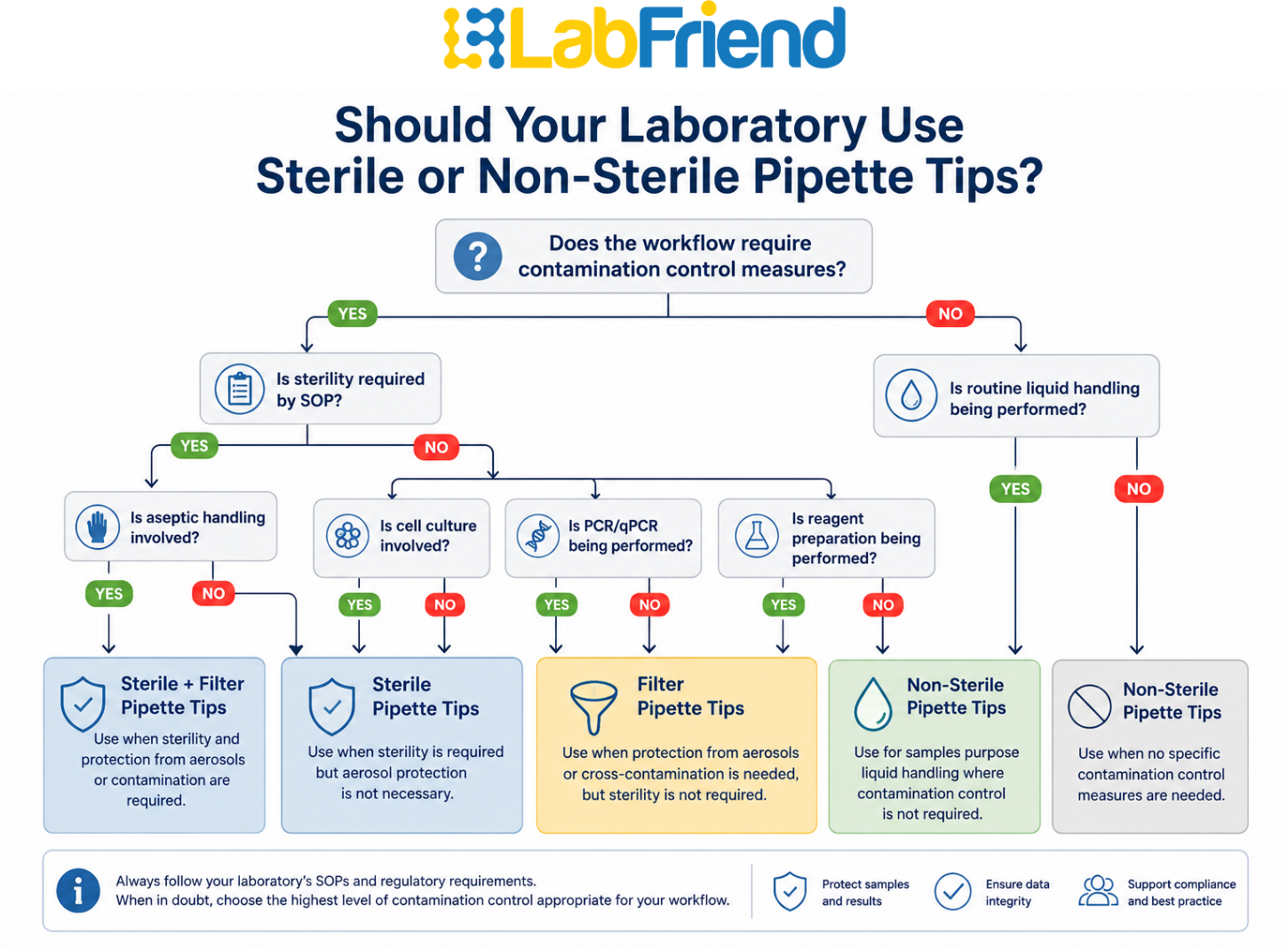
A useful decision framework is to start with the workflow, not the catalogue description.
First, determine whether the procedure requires sterility under the laboratory’s SOP, quality system or risk assessment. If sterility is required, sterile tips should be selected and the relevant documentation checked. If sterility is not required, a non-sterile format may be suitable, provided the tip is compatible with the pipette and appropriate for the liquid being handled.
Second, consider whether the workflow requires additional specifications beyond sterility. PCR and qPCR workflows may require contamination-control measures such as filter tips and nuclease-related claims, depending on the procedure. Cell culture may require sterile consumables, but other purity or cytotoxicity-related claims should only be assumed where documented.
Third, evaluate whether standardisation is possible. Many laboratories benefit from maintaining a clear internal matrix that defines which tip types are used for which workflows. This can reduce accidental overspecification, prevent inappropriate substitution and simplify repeat ordering.
Common Mistakes Laboratories Make
One common mistake is assuming that sterile pipette tips improve pipetting accuracy. Sterility does not determine accuracy. Pipetting performance depends on pipette calibration, tip fit, seal integrity, volume range, liquid properties and operator technique.
Another common mistake is using sterile tips for every workflow by default. This may simplify purchasing at first, but it can increase consumables costs unnecessarily. For routine workflows that do not require sterility, non-sterile alternatives may be appropriate when compatibility and performance requirements are met.
A third mistake is confusing filter tips with sterile tips. Filter tips contain an aerosol barrier, while sterile tips have undergone a sterilisation process. Some tips may be both filtered and sterile, but one specification does not automatically imply the other.
Filter tips may also help protect the internal components of the pipette from aerosolised droplets and accidental liquid aspiration.
Laboratories also sometimes overlook the effect of supplier changes. If a laboratory switches from one pipette tip range to another, compatibility, seal integrity, ejection force, low-volume performance and any required documentation should be assessed before implementation. Our article Optimise Your Pipetting Accuracy with Compatible Pipette Tips explains key compatibility considerations when evaluating manufacturer-compatible and universal pipette tip options.
What Sterile and Non-Sterile Pipette Tips Do Not Solve
Sterile pipette tips can support contamination-control workflows, but they do not guarantee contamination-free results. They do not replace good laboratory practice, clean technique, pipette maintenance, workflow separation or documented procedures.
Non-sterile pipette tips may be suitable for many routine workflows, but they are not appropriate where the laboratory requires sterility. They also do not remove the need to check compatibility, volume range, packaging format, material suitability or documentation requirements.
Both sterile and non-sterile tips must be considered as part of the wider workflow. Tip choice alone does not determine liquid-handling accuracy or reproducibility.
What to Check Before Purchase
Before purchasing sterile or non-sterile pipette tips, laboratories should confirm the intended workflow and the level of contamination control required. The most important checks include pipette compatibility, volume range, seal integrity, sterility status, filter requirement, packaging format and any required purity documentation.
For molecular biology workflows, check whether DNase-free, RNase-free, DNA-free or PCR inhibitor-related claims are required and documented. For cell culture or microbiology workflows, check whether sterility documentation and packaging format are suitable for the laboratory’s procedures. For regulated, accredited or validated workflows, confirm whether consumable changes require change control, equivalence checks or local workflow verification.
Examples may include ISO 17025-accredited methods, GMP environments, validated PCR assays, clinical testing workflows and other documented procedures.
Packaging integrity, packaging configuration and handling after opening may also influence contamination-control practices.
A practical purchasing checklist is:
|
Check |
Why It Matters |
|
Pipette compatibility |
Poor fit can affect seal integrity and dispensing consistency |
|
Volume range |
The tip must match the intended transfer volume |
|
Sterility status |
Required for workflows where sterile consumables are specified |
|
Filter requirement |
Relevant where aerosol contamination control is needed |
|
Purity claims |
DNase-free, RNase-free and endotoxin-tested claims are separate from sterility |
|
Packaging format |
Affects storage, handling and contamination-control procedures Consider whether racked, reload or bulk-pack formats best support workflow efficiency and contamination-control requirements. |
|
Documentation |
Supports quality-system and purchasing requirements |
|
Supplier change impact |
May require workflow verification or validation checks |
Procurement efficiency is valuable, but it should not replace technical suitability checks, compatibility confirmation or workflow validation where these are required.
UK Laboratory Purchasing Considerations
Many UK laboratories are trying to balance contamination control, supply reliability, procurement efficiency and repeat-order simplicity. This is particularly relevant for CROs, independent testing laboratories, SME biotechnology companies and university research groups with recurring consumables demand.
Laboratory managers often need to support multiple workflows with different requirements. A single purchasing policy may not be appropriate if one team performs cell culture while another handles routine analytical preparation. A more effective approach is to define which workflows require sterile tips, which require filter tips, which require additional purity specifications, and which can use non-sterile routine formats.
Laboratories reviewing supplier-switching opportunities or cost-optimisation initiatives may also wish to compare LLG Labware pipette tips with existing consumables. A structured evaluation of compatibility, documentation and workflow suitability can help support procurement decisions while maintaining scientific confidence and operational consistency.
Relevant LabFriend UK Product and Category Connections
Laboratories reviewing sterile versus non-sterile options may wish to compare standard pipette tips, sterile pipette tips, filter pipette tips and compatible pipette tips as part of a wider liquid handling review.
For contamination-sensitive PCR and molecular biology workflows, filter-tip selection should be considered alongside sterility requirements. For laboratories standardising procurement across teams, compatible formats and LLG Labware options may support supplier flexibility, provided suitability is confirmed for the intended workflow.
LabFriend UK can support laboratories comparing pipette tip formats by helping buyers move from workflow requirements to product category selection. The commercial decision should follow the technical decision: confirm the workflow requirement first, then compare compatible options, packaging formats and repeat-order suitability.
Frequently Asked Questions
Do PCR workflows always require sterile pipette tips?
Not necessarily. PCR requirements depend on the laboratory’s contamination-control procedures, SOPs and validation expectations. Some PCR workflows may use sterile tips, filter tips, or tips with specific purity claims, but these specifications should be confirmed against the workflow and manufacturer documentation.
Are sterile pipette tips automatically DNase-free?
No. Sterility and DNase-free status are separate specifications. A sterile tip is not automatically DNase-free, RNase-free, DNA-free, endotoxin-tested or pyrogen-tested unless the manufacturer documents those claims for the specific product.
Are non-sterile pipette tips suitable for routine laboratory work?
Yes, non-sterile pipette tips are commonly used for routine liquid handling where sterility is not required. Suitability still depends on pipette compatibility, volume range, liquid properties and workflow requirements.
Are filter tips the same as sterile tips?
No. Filter tips contain an aerosol barrier, while sterile tips have undergone a sterilisation process. Some products may combine both features, but one does not automatically imply the other.
Can changing pipette tip suppliers affect laboratory workflows?
Yes, it can. Laboratories considering alternative consumables should assess compatible pipette tips and validation considerations before implementing supplier changes, particularly where workflow verification or quality-system documentation may be required.
Do sterile pipette tips improve pipetting accuracy?
No. Sterility does not determine pipetting accuracy. Accuracy and precision are influenced by pipette calibration, tip compatibility, liquid properties, operator technique and the overall liquid-handling workflow. Sterility and pipetting performance should be assessed as separate characteristics.
When Should a Laboratory Standardise on Sterile Pipette Tips?
Laboratories should consider standardising on sterile pipette tips when contamination-sensitive workflows form a significant proportion of routine work, or where SOPs, quality-system requirements or regulatory expectations specify sterile consumables. Examples may include cell culture, microbiology, certain molecular biology workflows and other procedures where maintaining sterility forms part of the documented process.
However, standardising exclusively on sterile tips is not always the most efficient approach. Many laboratories benefit from maintaining separate sterile and non-sterile tip standards, allowing contamination-sensitive workflows to use sterile consumables while routine liquid handling uses appropriately specified non-sterile formats. This approach can help balance contamination control, procurement efficiency and consumables costs without compromising workflow suitability.
What Should Procurement Teams Verify Before Approving a New Pipette Tip Supplier?
Before approving a new pipette tip supplier, procurement teams should verify that the proposed tips are suitable for the intended workflows and compatible with existing equipment. Important considerations include pipette compatibility, tip fit, seal integrity, volume range suitability, packaging format, sterility status and any required purity claims such as DNase-free, RNase-free or endotoxin-related specifications.
Where laboratories operate under accredited, regulated or validated procedures, procurement teams should also determine whether supplier changes require technical review, workflow verification, equivalence testing or formal change control. Even tips that appear equivalent may differ in fit, ejection force, low-retention performance, filter construction, documentation support or manufacturing specifications. Confirming these factors before implementation can help reduce operational risk and maintain consistency across laboratory workflows.
Conclusion
The choice between sterile and non-sterile pipette tips should be driven by workflow requirements, not habit or assumption. Sterile pipette tips are commonly used where sterility is required as part of a contamination-control process, while non-sterile pipette tips remain appropriate for many routine laboratory applications.
Laboratory managers can reduce risk and improve procurement efficiency by defining where sterility is required, where filter tips or additional purity specifications are necessary, and where non-sterile routine formats are suitable. This structured approach supports workflow reliability, consumables standardisation and repeat purchasing without overspecifying every liquid handling task.
CTA: Compare Sterile and Non-Sterile Pipette Tip Options for Your Laboratory
If your laboratory is reviewing contamination-control procedures, standardising liquid handling consumables or evaluating supplier options, explore LabFriend UK’s laboratory pipette tips range to compare sterile, non-sterile, filter and compatible formats.
For contamination-sensitive PCR and molecular biology workflows, you may also wish to review our guidance on filter pipette tips for qPCR and molecular biology workflows, pipetting accuracy in PCR workflows, and qPCR pipetting best practices.
Laboratories assessing alternative suppliers or procurement standardisation initiatives can also compare LLG Labware pipette tips as part of a structured consumables evaluation process.
Related Stories

How to Choose the Right Pipette: The Ultimate Guide to Accuracy and Lab Efficiency
Pipette - Primary

Optimise Your Pipetting Accuracy with Compatible Pipette Tips
Pipette Tip Selection Guide

Pipetting for PCR: How to Maximise Accuracy in DNA Amplification Workflows
How to Maximise Accuracy in DNA Amplification Workflows

qPCR Pipetting Best Practices: How to Reduce Variability and Improve Accuracy at Low Volumes
Learn how to reduce qPCR and RT-qPCR variability with accurate low-volume pipetting techniques, mastermix preparation, contamination control, and best-practice liquid handling workflows.