

Share :
When Should You Use Filter Pipette Tips in qPCR and Molecular Biology
Updated On 07/17/2026

By Donal O’Sullivan, BSc. Reviewed by Michael Anderson, MBA.
|
Filter pipette tips are strongly recommended in qPCR, RT-qPCR, and RNA workflows where aerosol contamination can affect assay accuracy. The internal aerosol barrier helps prevent carryover contamination, false positives, and pipette shaft contamination during sensitive molecular biology applications. |
What Are Filter Pipette Tips
Filter pipette tips are pipette tips that contain a porous barrier (usually polyethylene or aerosol-resistant material) inside the upper portion of the tip. Their main purpose is to prevent aerosols, liquid droplets, and contaminants from entering the pipette shaft during pipetting.
They are especially important in PCR, qPCR, molecular biology, microbiology, and diagnostic workflows, where contamination can cause false results.
How They Work
When you pipette liquids, tiny aerosol droplets can form inside the tip. Without a filter:
- Aerosols may enter the pipette body
- DNA/RNA samples can contaminate the pipette internally
- Cross-contamination can occur between samples
The filter acts as a physical barrier that substantially reduces:
- Aerosols
- Splashback
- Accidental over-aspiration of liquid
while still allowing air displacement needed for normal pipette operation.
In UK molecular biology laboratories, filter pipette tips are widely used in qPCR, RT-qPCR, and RNA workflows to reduce the risk of aerosol-mediated contamination during liquid handling. By helping prevent amplified PCR products, template DNA, and help reduce the risk of RNase transfer into the pipette shaft, aerosol barrier tips support more reliable assay performance and reduce the likelihood of false positives, unexpected Ct variation, and cross-sample contamination.
Laboratories performing high-sensitivity nucleic acid analysis, particularly in multi-user research, CRO, diagnostic, or university environments, typically select sterile filter tips certified free from DNase, RNase, and pyrogens as part of a broader contamination control strategy that also includes workflow separation, dedicated pipettes, and regular decontamination procedures.
The Role of Filter Pipette Tips in qPCR
Filter pipette tips are widely used in molecular biology as a contamination control measure. For experienced laboratory personnel, their role should be understood not as a generic precaution, but as a quantitative risk mitigation tool—particularly in qPCR and RT-qPCR workflows where trace contamination can directly influence Ct values.
Barrier tips typically contain a porous polyethylene matrix that help prevent aerosolised droplets and liquid carryover from entering the pipette shaft. This reduces both sample-to-sample contamination and pipette-mediated cross-contamination.
However, their effectiveness depends on correct usage, manufacturing quality, and integration with broader contamination control strategies.
How Contamination Occurs in PCR Workflows
During pipetting, especially under rapid aspiration or dispensing, microscopic aerosolised droplets can form. These droplets may contain:
- Amplified PCR products (high copy number)
- Template DNA
- RNases (in RNA workflows)
These contamination sources can be broadly categorised as:
- Carryover contamination (amplicons): The most significant risk in PCR workflows due to extremely high copy number
- Cross-sample contamination: Transfer between samples during handling or pipetting
- Environmental contamination: Background DNA or RNases from surfaces, air, or reagents
Filter tips primarily mitigate aerosol-mediated carryover and cross-sample contamination, but have limited impact on environmental sources.
Without a barrier:
- Aerosols can be aspirated into the pipette shaft
- Subsequent dispensing can release contaminants into future samples
In qPCR, even femtogram-level DNA contamination can result in detectable amplification (often appearing at Ct ~30–35 depending on assay sensitivity), leading to:
- False positives
- Reduced assay specificity
- Abnormal amplification curves or elevated background amplification
Why Filter Tips Matter in qPCR Accuracy
Filter tips contribute to data quality by reducing contamination-driven variability, but their impact is indirect and must be interpreted correctly.
Key quantitative effects:
- Ct Stability: Reduced risk of sporadic low-level contamination improves replicate consistency
- Baseline Fluorescence: Reduces the risk of background amplification caused by contaminating amplicons.
- False Positives in NTCs: Minimises carryover amplification. From a best-practice perspective (e.g., MIQE guidelines), contamination control should be evaluated using defined acceptance criteria:
- No amplification in NTCs, or amplification only at very late cycles (e.g., Ct > 38–40, assay-dependent)
- For well-optimized technical replicates under controlled conditions
Filter tips contribute to meeting these criteria by reducing contamination-driven artefacts, but do not replace the need for assay validation.
- Inter-run Reproducibility: Limits persistent pipette contamination across experiments
Important: Filter tips do not improve intrinsic reaction efficiency (90–110%)—they improve the reliability of measured efficiency by reducing artefacts.
Explore sterile aerosol barrier pipette tips for qPCR applications.
Filter Tips vs Pipetting Accuracy: Understanding the Difference
Filter tips should be considered alongside pipetting technique, not as a substitute.
- A ~10% volumetric error may produce approximately 0.1–0.2 Ct variation under typical assay conditions
- A 2-fold concentration difference ≈ 1 Ct shift
Contamination introduces an additional, non-linear source of variation:
Pipetting error → predictable Ct shift
Contamination → unpredictable Ct distortion (often late amplification)
Optimal qPCR performance requires control of both variables simultaneously.
When Filter Tips Are Functionally Required
For experienced users, the question is not whether filter tips are beneficial, but when they are necessary.
Strongly recommended / effectively mandatory:
- qPCR and RT-qPCR setup
- Handling low-copy or high-sensitivity targets
- RNA workflows (RNase risk)
- Clinical or diagnostic assays
- Multi-user laboratory environments
Situational use:
- Pre-PCR reagent preparation in controlled environments
- High-throughput automated systems (depending on system design)
Lower-risk scenarios:
- Bulk buffer preparation
- Non-biological liquid handling
Limitations of Filter Tips
Filter tips are often treated as a complete solution to contamination—they are not.
1. Incomplete Aerosol Blocking
- High-quality filters significantly reduce aerosol transfer
- Poor-quality or saturated filters may allow breakthrough
2. No Protection Against External Contamination
Filter tips do not prevent contamination from:
- Gloves
- Work surfaces
- Reagents
- Airborne particulates
3. No Correction for Pipetting Error
They do not address:
- Volume inaccuracy
- Inconsistent technique
- Tip retention effects
4. Potential Impact on Pipetting Performance
- Increased back pressure may affect aspiration in low-volume pipetting
- Poor tip-pipette fit can introduce air leaks → volumetric inaccuracy
Best Practices for PCR Contamination Control
Effective contamination control in qPCR requires a layered approach:
Lab design → Workflow separation → Technique → Consumables
Essential components:
- Physical separation of pre- and post-PCR areas
- Dedicated pipettes for qPCR setup
- Regular decontamination (e.g., bleach, UV)
- Proper control inclusion (NTC, –RT)
Filter tips are one layer in this system—not a standalone solution.
How to Choose High-Quality Filter Pipette Tips
1. Filter Quality
- Uniform pore structure
- Resistance to liquid penetration
- Consistent manufacturing
- Manufacturing methods (e.g., injection-mould vs. post-insert filters)
- Certification types:
- DNase/RNase-free
- PCR inhibitor-free
2. Tip Fit and Seal Integrity
Poor fit can result in:
- Air leakage
- Reduced volumetric accuracy
- Increased variability (Ct spread)
3. Low-Retention Surfaces
- Reduce liquid adhesion via hydrophobic treatment
- Improve precision when handling enzymes and mastermixes
Note: This primarily improves consistency, not absolute accuracy.
Sourcing Pipette Tips
Selecting the correct filter tip depends on assay sensitivity, pipette compatibility, sterility requirements, and workflow type. We supply a fantastic range of pipette tips from brands such as
- AHN Biotechnologie
- Brand
- Eppendorf
- Gilson
- Ratiolab
- Sartorius
- Socorex
- Thermo Scientific
- and our own best value LLG Labware range of pipette tips designed to deliver a secure, leak-proof seal for all major manufacturers.
Common Misconceptions (Corrected)
|
Misconception |
Reality |
|
Filter tips eliminate contamination |
They reduce, but do not eliminate risk |
|
All filter tips perform equally |
Manufacturing quality significantly varies |
|
Filter tips improve qPCR efficiency |
They improve reliability, not intrinsic efficiency |
|
They replace good technique |
Technique remains the dominant factor |
Practical Recommendations for qPCR Workflows
For optimal performance, combine filter tips with best practices from the pipetting guide qPCR Pipetting Best Practices: How to Reduce Variability and Improve Accuracy at Low Volumes
- Use filter tips for all qPCR and RT-qPCR setup steps
- Standardise pipetting technique across operators
- Use mastermixes to reduce handling steps
- Monitor Ct variability (target SD ≤ 0.2–0.3)
- Evaluate NTCs for contamination signals
Decision Tree: When Are Filter Tips Required?
A simple logic flow:
- Is amplification involved? → Yes → Use filter tips
- Is sample low copy? → Yes → Mandatory
- Is workflow post-PCR? → Always mandatory
Practical rule: In any workflow where contamination would affect interpretation, filter tips should be treated as standard.
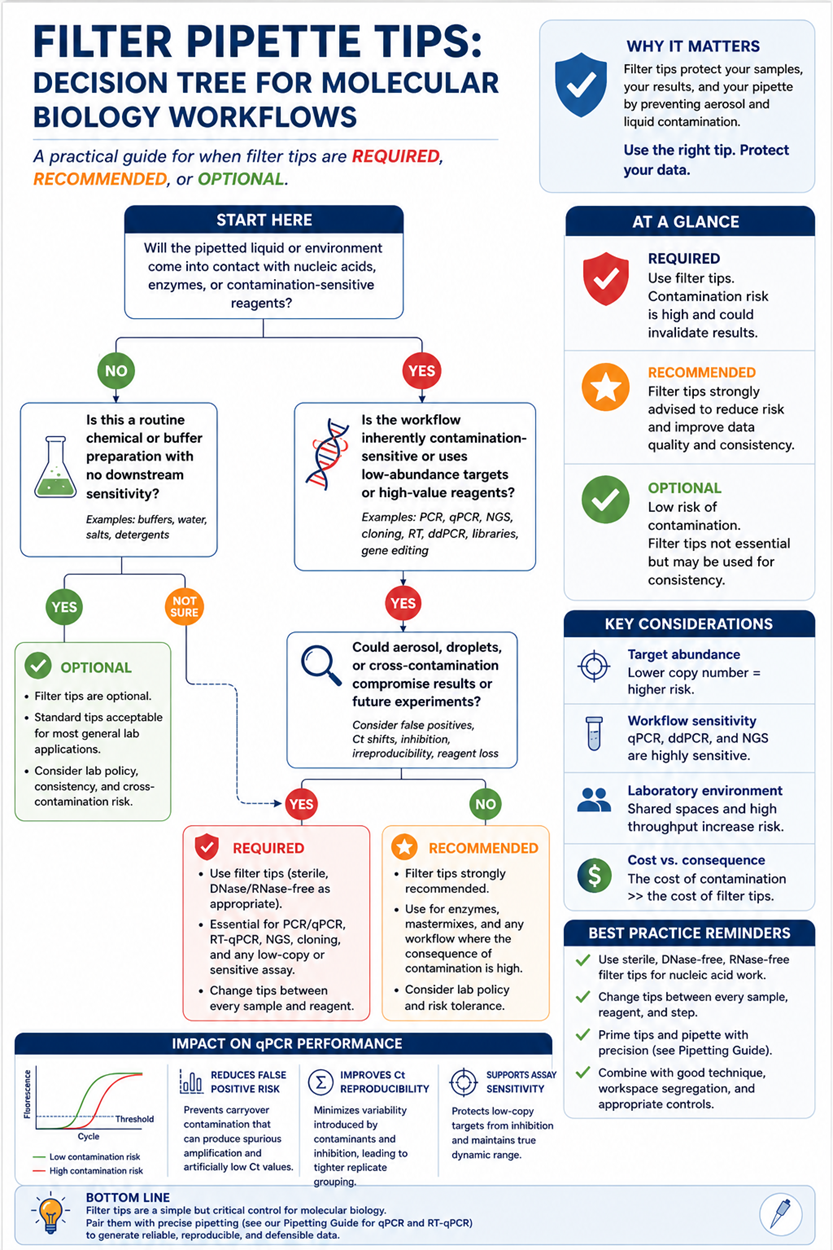
Filter pipette tips help reduce contamination risk in molecular biology workflows, but they do not compensate for poor pipetting technique or incompatibility between the pipette and tip. Even small volumetric inconsistencies can influence qPCR reproducibility and Ct values, particularly when working with low-volume or high-sensitivity assays.
Laboratories should therefore consider filter tip selection and pipetting accuracy together, ensuring tips provide a secure fit, consistent aspiration performance, and reliable dispensing characteristics. For additional insights see our related guides
- Pipetting for PCR: How to Maximise Accuracy in DNA Amplification Workflows for more insights
- Optimise Your Pipetting Accuracy with Compatible Pipette Tips
Summary
Filter pipette tips are a critical component of contamination control in molecular biology, particularly for qPCR and RT-qPCR.
Their primary value lies in:
- Reducing aerosol-mediated contamination
- Protecting pipette integrity
- Improving reproducibility of quantitative data
However, they must be used with an understanding of their limitations and in conjunction with rigorous pipetting technique and experimental design.
In quantitative workflows, reliable data emerges not from any single intervention, but from the integration of precision, contamination control, and methodological consistency.
|
Workflow |
Filter Tips Required? |
Why |
|
qPCR |
Yes |
Contamination control |
|
RT-qPCR |
Mandatory |
RNase contamination risk |
|
Buffer prep |
Optional |
Low contamination sensitivity |
|
Clinical PCR |
Mandatory |
Diagnostic integrity |
Frequently Asked Questions about Filter Pipette Tips in qPCR and Molecular Biology
Do filter tips eliminate contamination risk in qPCR?
No. They significantly reduce aerosol-mediated contamination but do not protect against contamination from surfaces, reagents, or poor technique.
Can filter tips affect pipetting accuracy?
Indirectly. Increased back pressure or poor fit can affect aspiration, particularly at very low volumes. High-quality, compatible tips minimise this effect.
Do filter tips improve Ct values?
Not directly. They improve the reliability of Ct values by reducing contamination-driven artefacts such as false positives or abnormal amplification signals.
Are filter tips always necessary for experienced users?
Even experienced users benefit from them in contamination-sensitive workflows. Skill reduces risk, but does not eliminate aerosol formation or carryover.
How do filter tips compare to good pipetting technique?
They address different problems. Technique controls volumetric accuracy (Ct precision), while filter tips reduce contamination (Ct validity). Both are required for reliable qPCR data.
When can I safely avoid using filter tips?
In low-risk workflows such as buffer preparation or non-biological liquid handling. However, many labs standardise their use to minimise variability and risk.
Looking to optimise your pipetting further?
Read next:
- The Complete Guide to Pipette Tips, Pipetting Accuracy & Laboratory Liquid Handling
- Optimise Your Pipetting Accuracy with Compatible Pipette Tips
- How to Choose the Right Pipette: The Ultimate Guide to Accuracy and Lab Efficiency
- Pipetting for PCR How to Maximise Accuracy in DNA Amplification Workflows
- qPCR Pipetting Best Practices: How to Reduce Variability and Improve Accuracy at Low Volumes
Written by: Donal O’Sullivan, BSc, Co-Founder and Sales Director, LabFriend UK. Donal brings deep chemistry-led technical expertise across analytical chemistry, biochemistry, environmental monitoring, laboratory instrumentation, consumables and scientific product selection.
Reviewed by: Michael Anderson, MBA, Founder and Managing Director, LabFriend UK. Michael reviews LabFriend UK content for customer relevance, commercial accuracy, operational practicality and alignment with LabFriend UK’s laboratory supply model.
Related Stories

How to Choose the Right Pipette: The Ultimate Guide to Accuracy and Lab Efficiency
Pipette - Primary

Optimise Your Pipetting Accuracy with Compatible Pipette Tips
Pipette Tip Selection Guide

Pipetting for PCR: How to Maximise Accuracy in DNA Amplification Workflows
How to Maximise Accuracy in DNA Amplification Workflows

qPCR Pipetting Best Practices: How to Reduce Variability and Improve Accuracy at Low Volumes
Learn how to reduce qPCR and RT-qPCR variability with accurate low-volume pipetting techniques, mastermix preparation, contamination control, and best-practice liquid handling workflows.