

Share :
The Complete Guide to Pipette Tips, Pipetting Accuracy & Laboratory Liquid Handling
Updated On 07/17/2026

By Donal O’Sullivan, BSc. Reviewed by Michael Anderson, MBA.
Reliable. Precise. Delivered.
Laboratory pipette tips are often treated as routine consumables, but in practice they play a critical role in experimental accuracy, precision, contamination control, reproducibility, workflow efficiency, and laboratory procurement strategy.
Choosing the correct pipette tip can affect:
- pipetting accuracy and precision
- sample integrity
- PCR and qPCR reproducibility
- contamination prevention
- operator consistency
- liquid handling efficiency
- instrument compatibility
- consumables cost control
- repeatability across workflows
For laboratories performing molecular biology, microbiology, analytical chemistry, biotechnology, environmental testing, food testing, pharmaceutical QC, and research workflows, pipette tips are not simply disposable plastics — they are precision liquid handling components.
This guide explains:
- the major types of pipette tips
- when filter pipette tips should be used
- how compatibility affects pipetting performance
- how to reduce pipetting variability
- how laboratories can optimise procurement and repeat purchasing
- how to select the correct tip for different laboratory applications
Whether you are a scientist, laboratory manager, procurement professional, or technical buyer, this guide will help support more reliable liquid handling decisions.
Why Pipette Tips Matter More Than Many Laboratories Realise
Many laboratories focus heavily on pipette calibration while underestimating the influence pipette tips have on workflow performance.
Poor tip selection or poor tip fit can contribute to:
- inconsistent liquid aspiration
- inaccurate dispensing
- poor precision and repeatability
- aerosol contamination
- poor seal integrity
- sample retention
- cross contamination
- low-volume variability
- increased risk of PCR variability or amplification failure
- wasted reagents
- operator fatigue and frustration
In high-sensitivity workflows such as PCR, qPCR, sequencing preparation, digital PCR, and low-volume analytical methods, even small pipetting inconsistencies can significantly affect reproducibility.
At the same time, laboratories increasingly balance:
- workflow reliability
- contamination control
- procurement efficiency
- supplier consolidation
- stock availability
- budget pressures
- standardisation across departments
As a result, selecting the correct pipette tip is both a technical and operational decision.
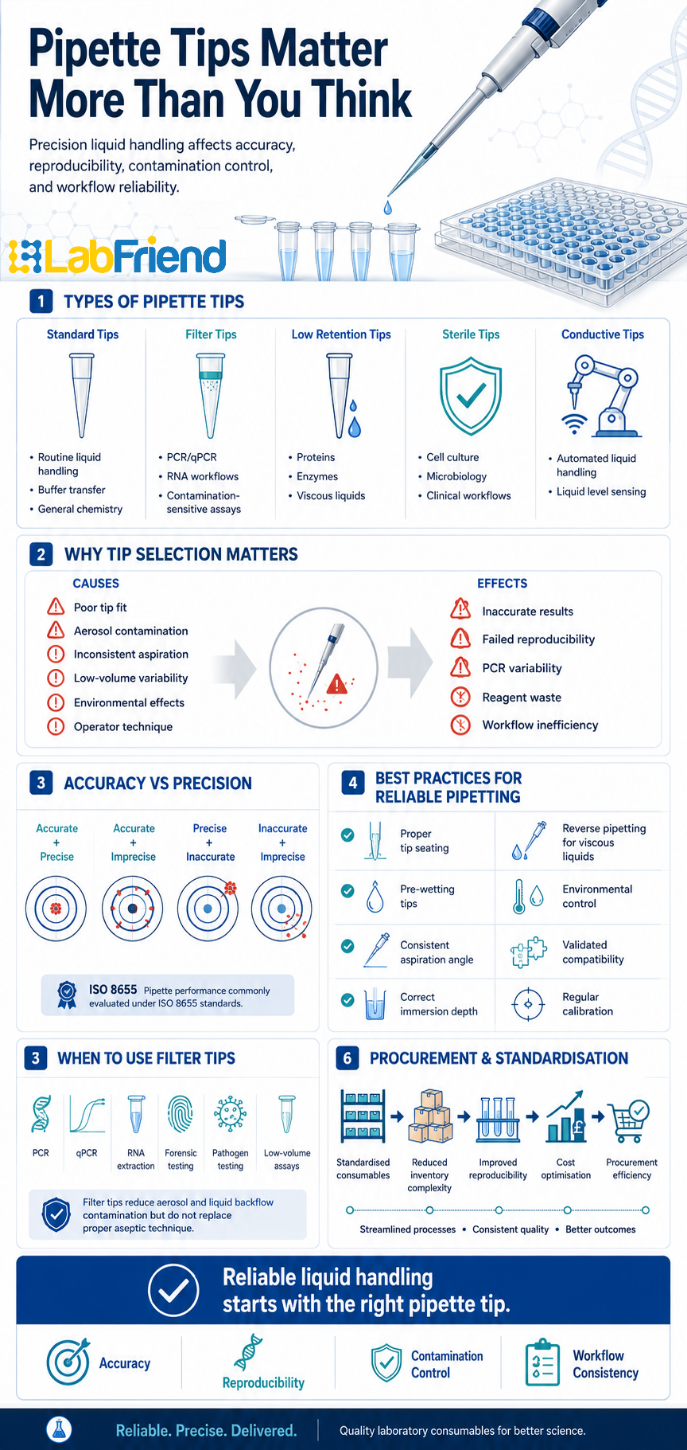
Understanding Pipetting Accuracy vs Precision
Accuracy and precision are related but distinct concepts in laboratory liquid handling.
- Accuracy refers to how close a dispensed volume is to the intended target volume.
- Precision refers to how reproducibly the same volume can be dispensed repeatedly.
A pipette may produce highly precise results that are consistently inaccurate if calibration or sealing is poor. Conversely, variable technique or poor-quality consumables may reduce precision even when average volumes appear correct.
Pipette performance is commonly evaluated gravimetrically according to ISO 8655 standards, which define acceptable limits for systematic error (accuracy) and random error (precision).
Understanding Different Types of Pipette Tips
Modern laboratories use a wide range of pipette tip formats depending on workflow requirements, contamination risk, automation requirements, compatibility needs, and liquid properties.
Standard Pipette Tips
Standard pipette tips are suitable for general laboratory liquid handling where contamination risk is relatively low.
Typical applications include:
- buffer preparation
- routine sample transfer
- reagent dispensing
- educational laboratories
- general chemistry workflows
These are often the most economical option for high-volume routine pipetting.
Filter Pipette Tips
Filter pipette tips contain a porous aerosol barrier designed primarily to reduce aerosol and liquid backflow contamination into the pipette and sample.
They are commonly used in:
- PCR
- qPCR
- RT-PCR
- molecular biology
- RNA workflows
- forensic applications
- pathogen testing
- sensitive low-volume assays
Filter tips help reduce:
- aerosol contamination
- pipette contamination
- sample carryover
- cross-contamination risk
They may also help reduce aerosol transfer within pipetting workflows, although they should not be considered substitutes for appropriate biosafety procedures or aseptic technique.
Filter tips are especially important when handling:
- nucleic acids
- infectious materials
- highly sensitive amplification assays
It is important to note that sterility and aerosol protection are not equivalent to nuclease-free certification. Sterile tips are not necessarily RNase-free, DNase-free, endotoxin-free, or PCR inhibitor-free unless specifically certified by the manufacturer.
Low Retention Pipette Tips
Low retention pipette tips are designed to minimise liquid adhesion to the internal tip surface through specialised polymer treatments or modified surface chemistry.
They are particularly useful when working with:
- proteins
- enzymes
- viscous liquids
- detergents
- low surface tension liquids
- precious or low-volume samples
Potential benefits include:
- improved sample recovery
- reduced sample waste
- improved reproducibility
- greater consistency at low volumes
Performance improvements depend on liquid composition, surface tension, viscosity, and the quality of the tip surface treatment. Low-retention tips are particularly beneficial in workflows involving expensive biological reagents or adsorption-prone biomolecules.
Sterile Pipette Tips
Sterile pipette tips are used where contamination control is critical.
They are commonly used in:
- cell culture
- microbiology
- molecular biology
- pharmaceutical QC
- clinical laboratories
Sterile tips help reduce:
- biological contamination
- workflow carryover
- false positives
- culture contamination
However, sterility alone does not guarantee absence of:
- RNase
- DNase
- pyrogens/endotoxins
- PCR inhibitors
Laboratories performing highly sensitive molecular biology workflows should confirm the required certification specifications before use.
Conductive Pipette Tips
Conductive pipette tips are primarily used in automated liquid handling systems employing capacitive liquid level sensing (cLLD).
These tips support:
- liquid level detection
- robotic liquid handling
- automated dispensing systems
- high-throughput screening
- assay automation workflows
Automation environments require highly consistent tip geometry, manufacturing tolerances, and conductive performance characteristics. Not all robotic liquid handling systems require conductive tips, so compatibility should always be verified against the specific automation platform.
Choosing the Right Pipette Tip for Your Application
Different workflows place different demands on pipette tips. Selecting the correct tip should consider:
- contamination sensitivity
- sample viscosity
- liquid volume
- reproducibility requirements
- automation compatibility
- sterility requirements
- chemical compatibility
- procurement standardisation
- solvent exposure
- regulatory requirements where applicable
PCR and qPCR Workflows
PCR and qPCR workflows are highly sensitive to contamination and low-volume variability.
Important considerations include:
- filter tip usage
- low-volume precision
- seal integrity
- contamination prevention
- reproducibility across replicates
- evaporation control
- consistent operator technique
Pre-wetting pipette tips before aspiration can improve consistency during low-volume pipetting by reducing evaporation effects and improving liquid film equilibration inside the tip. Environmental conditions such as temperature and humidity can also significantly affect low-volume air-displacement pipetting performance.
Recommended Reading
- Pipetting for PCR: How to Maximise Accuracy in DNA Amplification Workflows
- qPCR Pipetting Best Practices: How to Reduce Variability and Improve Accuracy at Low Volumes
- When Should You Use Filter Pipette Tips in qPCR and Molecular Biology?
Cell Culture Applications
Cell culture workflows typically require:
- sterile consumables
- contamination prevention
- reproducible liquid transfer
- ergonomic handling
- reliable aseptic technique
Cross contamination risks make sterile and filtered options particularly important in many cell culture laboratories.
Recommended Reading
- Choosing Pipette Tips for Cell Culture Applications
Protein and Enzyme Work
Protein workflows often benefit from low-retention tip technologies. Reducing sample adhesion can improve:
- protein recovery
- assay consistency
- enzyme handling
- expensive reagent utilisation
Reverse pipetting techniques are also commonly recommended for viscous or foam-forming liquids because they improve dispensing consistency and reduce bubble formation.
Recommended Reading
- Low Retention Pipette Tips for Protein and Enzyme Work
High-Throughput & Automation Workflows
Automation environments demand:
- dimensional consistency
- precise manufacturing tolerances
- reliable robotic engagement
- liquid level sensing compatibility
- consistent rack geometry
- validated automation compatibility
Even small dimensional inconsistencies can affect robotic performance, tip pickup reliability, and dispensing reproducibility.
Recommended Reading
- Automation-Compatible Pipette Tips
- Conductive Pipette Tips Explained
Pipette Tip Compatibility & Seal Integrity
One of the most common causes of poor pipetting performance is incorrect tip compatibility. Even small variations in fit can affect:
- aspiration consistency
- dispensing accuracy
- precision
- operator force requirements
- aerosol generation
- seal reliability
Many laboratories now use compatible third-party pipette tips to:
- reduce consumables costs
- improve stock availability
- simplify procurement
- avoid supplier lock-in
However, compatibility should always be validated properly.
Why Compatibility Matters
Poor-fitting tips may:
- leak air
- loosen during use
- increase operator fatigue
- reduce dispensing precision
- compromise low-volume work
- increase ejection force
- accelerate pipette wear
Universal compatibility claims vary between manufacturers and should always be validated against the specific pipette model and application in use.
High-quality compatible tips validated for the intended pipette system are generally unlikely to damage pipettes under normal use. However, poorly fitting consumables may increase cone wear, seal stress, or shaft deformation over time.
Compatibility validation may include:
- gravimetric performance testing
- leak testing
- seal force assessment
- repeatability studies
- fit testing across pipette models
Recommended Reading
- Optimise Your Pipetting Accuracy with Compatible Pipette Tips
- Why Pipette Tip Fit Matters
- How to Validate Third-Party Pipette Tips
Pipetting Accuracy & Workflow Best Practices
Pipetting accuracy depends on more than pipette calibration alone. Critical workflow variables include:
- operator technique
- aspiration angle
- immersion depth
- dispensing speed
- tip compatibility
- liquid properties
- environmental conditions
- tip quality
- pipette maintenance
- pre-wetting technique
Even experienced operators can introduce variability if workflows are not standardised.
Low-Volume Pipetting
Low-volume workflows are especially sensitive to variability. Important considerations include:
- consistent aspiration speed
- proper tip seating
- pre-wetting techniques
- low-retention tips
- evaporation control
- environmental stability
- filter tips where appropriate
Temperature differences between reagents, pipettes, and ambient air can also influence air-displacement accuracy at very low volumes.
Recommended Reading
- qPCR Pipetting Best Practices: How to Reduce Variability and Improve Accuracy at Low Volumes
- Troubleshooting Low Volume Pipetting
Reducing Variability Across Operators
Laboratories with multiple operators benefit from:
- standardised consumables
- validated compatible tips
- workflow training
- consistent pipetting procedures
- procurement standardisation
- routine competency assessment
Reducing variability supports:
- reproducibility
- QA consistency
- workflow reliability
- reduced reagent waste
- more reliable analytical data
Recommended Reading
- Common Causes of Pipetting Error
- Pipetting Technique Errors That Affect Results
When Filter Pipette Tips Should Be Used
Filter tips are particularly valuable in workflows where contamination could compromise results. Typical use cases include:
- PCR
- qPCR
- RNA extraction
- forensic workflows
- pathogen testing
- sensitive low-volume assays
Filter tips help reduce:
- aerosol contamination
- pipette contamination
- sample carryover
- false-positive risk
Filter suitability should also consider solvent compatibility and workflow requirements. Certain aggressive organic solvents or highly volatile chemicals may not be suitable for some filter materials.
Recommended Reading
· When Should You Use Filter Pipette Tips in qPCR and Molecular Biology?
Chemical Compatibility Considerations
Most pipette tips are manufactured from polypropylene due to its broad chemical resistance and low extractables profile. However, some chemicals may affect tip integrity or performance, including:
- chlorinated solvents
- strong oxidising agents
- aggressive aromatic solvents
- highly volatile organic solvents
Chemical compatibility should be assessed when handling non-aqueous or chemically aggressive reagents, particularly in analytical chemistry or industrial laboratory environments.
Common Causes of Pipetting Error
Many pipetting problems originate from routine workflow issues rather than instrument failure. Common causes include:
- poor tip fit
- inconsistent technique
- incorrect aspiration angle
- damaged tips
- incorrect tip selection
- incompatible liquids
- environmental instability
- low-quality consumables
- inadequate pipette maintenance
Symptoms may include:
- inconsistent dispensing
- dripping tips
- bubbles
- inaccurate volumes
- poor repeatability
- amplification variability
- inconsistent analytical data
Recommended Reading
- Common Causes of Pipetting Error
- Why Pipette Tips Leak or Fall Off
- Why Pipetting Results Become Inconsistent
Choosing Pipette Tips for Procurement & Repeat Purchasing
Pipette tips are among the most frequently purchased laboratory consumables. For many laboratories, procurement considerations include:
- pricing consistency
- stock availability
- repeat ordering efficiency
- compatibility standardisation
- contamination control
- supplier responsiveness
- workflow reliability
- validated compatibility data
Laboratories increasingly seek suppliers capable of providing:
- broad product availability
- rapid delivery
- transparent pricing
- technical support
- compatible alternatives
- repeat-order reliability
Standardising Pipette Consumables
Standardising tip formats across departments may help laboratories:
- reduce procurement complexity
- simplify inventory management
- improve operator familiarity
- reduce stock duplication
- streamline reordering
- improve workflow consistency
Recommended Reading
- How Laboratories Reduce Pipette Consumables Costs
- Bulk Purchasing Pipette Tips Without Overstocking
- How to Standardise Pipette Tip Procurement
Frequently Asked Questions About Pipette Tips
What are filter pipette tips used for?
Filter pipette tips are commonly used to reduce aerosol and liquid backflow contamination in sensitive workflows such as PCR, qPCR, RNA handling, and forensic analysis.
Are universal pipette tips reliable?
High-quality universal pipette tips can provide reliable performance when properly validated for compatibility, seal integrity, and pipetting performance with the intended pipette model.
When should low-retention tips be used?
Low-retention tips are particularly useful for proteins, enzymes, viscous liquids, detergents, and low-volume workflows where maximising sample recovery is important.
Why are my pipetting results inconsistent?
Inconsistent results may result from technique variation, poor tip compatibility, environmental conditions, inadequate pipette maintenance, evaporation effects, or inappropriate tip selection.
Do pipette tips affect PCR accuracy?
Yes. Pipette tip quality, contamination control, compatibility, and low-volume handling performance can significantly influence PCR and qPCR reproducibility.
Can third-party compatible pipette tips damage pipettes?
High-quality compatible tips validated for the intended pipette system are generally unlikely to damage pipettes under normal use. However, poorly fitting consumables may increase wear or seal stress over time.
Written by: Donal O’Sullivan, BSc, Co-Founder and Sales Director, LabFriend UK. Donal brings deep chemistry-led technical expertise across analytical chemistry, biochemistry, environmental monitoring, laboratory instrumentation, consumables and scientific product selection.
Reviewed by: Michael Anderson, MBA, Founder and Managing Director, LabFriend UK. Michael reviews LabFriend UK content for customer relevance, commercial accuracy, operational practicality and alignment with LabFriend UK’s laboratory supply model.
Explore Pipette Tips & Laboratory Liquid Handling Products
LabFriend UK supplies a broad range of laboratory liquid handling consumables including:
- filter pipette tips
- sterile pipette tips
- low-retention tips
- compatible pipette tips
- automation-compatible tips
- molecular biology consumables
- liquid handling products
Our focus is helping laboratories improve workflow reliability, procurement efficiency, reproducibility, and operational consistency.
Reliable. Precise. Delivered.
Related Stories

How to Choose the Right Pipette: The Ultimate Guide to Accuracy and Lab Efficiency
Pipette - Primary

Optimise Your Pipetting Accuracy with Compatible Pipette Tips
Pipette Tip Selection Guide

Pipetting for PCR: How to Maximise Accuracy in DNA Amplification Workflows
How to Maximise Accuracy in DNA Amplification Workflows

qPCR Pipetting Best Practices: How to Reduce Variability and Improve Accuracy at Low Volumes
Learn how to reduce qPCR and RT-qPCR variability with accurate low-volume pipetting techniques, mastermix preparation, contamination control, and best-practice liquid handling workflows.