

Share :
Pipetting for PCR: How to Maximise Accuracy in DNA Amplification Workflows
Updated On 07/17/2026

By Donal O’Sullivan, BSc. Reviewed by Michael Anderson, MBA.
PCR Pipetting Accuracy Quick Guide
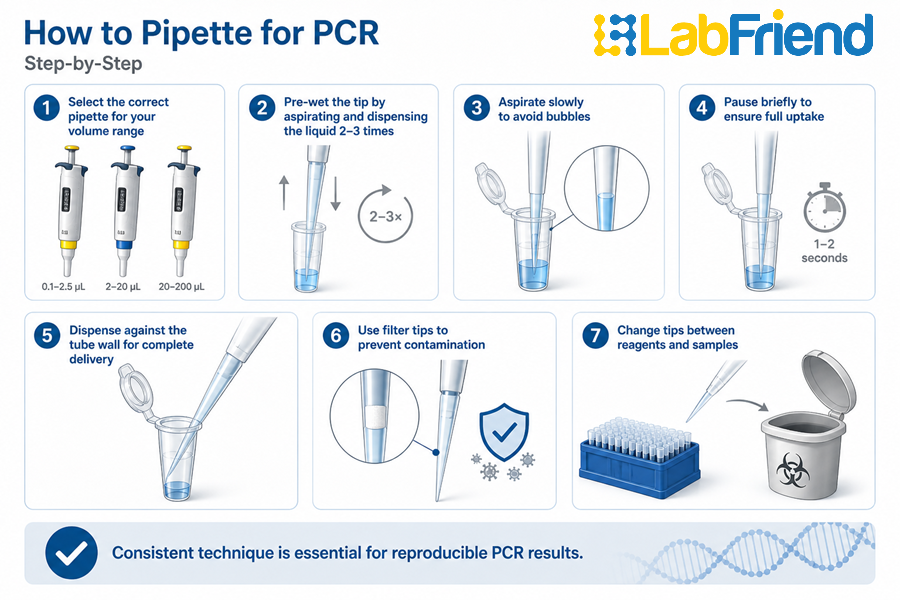
1. Use the Right Pipette and Tip Combination
Always match the pipette to the required volume range and use high-quality compatible tips. For PCR workflows, filter tips are strongly recommended to minimise contamination risk.
2. Pipette Slowly and Consistently
Aspirate and dispense liquids smoothly to avoid bubbles and inconsistent volumes. Pre-wet tips before handling critical reagents such as enzymes or mastermixes.
3. Reduce Variability Wherever Possible
Prepare mastermixes, change tips between samples, and work in a clean PCR setup area to improve reproducibility and reduce the risk of amplification errors.
👉 Small improvements in pipetting technique can significantly improve PCR reliability and consistency.
Why Pipetting Accuracy Matters in PCR
Polymerase Chain Reaction (PCR) is one of the most widely used techniques in molecular biology. Whether you're amplifying DNA for cloning, diagnostics, or sequencing, pipetting accuracy directly impacts your results.
Small errors in volume can lead to:
- Failed amplification
- Poor reproducibility
- Variability in yield
- False negatives or inconsistent bands
In PCR, you're often working with microlitre or sub-microlitre volumes, where even inconsistencies alter reagent concentrations, which in turn affect enzyme kinetics, primer annealing efficiency, and overall reaction performance.
Why is pipetting accuracy important in PCR?
Pipetting accuracy is essential in PCR because even minor volume errors can lead to failed amplification, poor reproducibility, or inconsistent DNA yield. PCR reactions rely on precise reagent concentrations, making accurate liquid handling critical for reliable results.
Understanding the Critical Components of a PCR Reaction
Before focusing on technique, it’s important to understand what you’re pipetting:
- DNA template
- Primers
- dNTPs
- Polymerase (often viscous)
- Buffer (including Mg²⁺, typically supplied as MgCl₂, which is a critical determinant of polymerase activity, primer annealing specificity, and amplification fidelity)
- Nuclease-free water
Each component has different physical properties, meaning pipetting technique must adapt accordingly.
Common Pipetting Challenges in PCR Workflows
1. Low Volume Handling
PCR reactions typically range from 10–50 µL, with some components added in volumes <1 µL, where pipetting error and evaporation effects are disproportionately large relative to total reaction volume.
Risk: Inaccurate delivery at low volumes
Impact: Reaction imbalance and poor amplification
2. Viscous Reagents (e.g. Polymerases, Mastermixes)
Enzymes and mastermixes exhibit higher viscosity and altered surface tension compared to aqueous solutions.
Risk: Incomplete aspiration or dispensing
Impact: Reduced enzyme concentration → weak or failed PCR
3. Contamination
PCR is highly sensitive to even trace levels of contaminating nucleic acids.
Risk: Aerosols, carryover, or environmental DNA
Impact: False positives or non-specific amplification
4. Evaporation & Handling Errors
Small volumes are prone to evaporation, especially during setup. Keep reactions on ice where appropriate, minimise setup time, and use properly sealed PCR tubes or caps to prevent volume loss and concentration shifts.
Risk: Concentration changes
Impact: Reduced reproducibility
- Temperature Control
Keep temperature-sensitive reagents (e.g. polymerases) on ice during setup to preserve activity and reduce non-specific amplification prior to thermocycling.
Explore Our Range Of PCR Tubes, Plates & Films
What Are The Best Practices for Accurate PCR Pipetting
Use the Correct Pipette for the Volume Range
- For optimal accuracy, operate pipettes within ~20–100% of their nominal range, noting that accuracy and precision decrease significantly below ~30% depending on manufacturer specifications.
- Avoid using a 1000 µL pipette for 10 µL volumes
For PCR setups, 10, 20, and 200 µL pipettes are typically optimal. For highly viscous or volatile reagents, positive displacement pipettes may offer improved accuracy compared to air-displacement systems.
Pre-Wet Pipette Tips
Before dispensing critical reagents:
- Aspirate and dispense the liquid 2–3 times
Why it matters:
Improves accuracy by conditioning the air cushion and reducing volume loss.
Pipette Slowly and Consistently
- Maintain a consistent tip immersion depth (~2–3 mm) to avoid volume variability due to hydrostatic pressure differences.
- Aspirate slowly to avoid bubbles
- Hold the pipette vertically during aspiration to ensure accurate volume uptake.
- Pause (~1 second) after aspiration to allow complete liquid uptake and pressure equilibration
- Dispense against the tube wall and use the second stop (blow-out) to ensure complete delivery when using air-displacement pipettes. For volumes <2 µL, verify droplet release to avoid retention on tube walls.
Use Reverse Pipetting for Viscous Reagents
Use reverse pipetting for viscous reagents (e.g. polymerases, glycerol-containing mastermixes) to reduce under-delivery. Note that reverse pipetting alters the aspiration/dispense dynamic and is not recommended where absolute volumetric accuracy is critical (e.g. qPCR standard preparation).
Mix Properly (But Gently)
- Avoid vortexing isolated enzymes unless explicitly specified. Commercial mastermixes are typically vortex-safe, brief mixing followed by a quick spin-down can be recommended to ensure homogeneity.
- Use gentle pipette mixing for reaction homogeneity
Choose the Right Pipette Tips for PCR
Your pipette tip selection is just as important as your technique.
Use Filter Tips for PCR Work
Filter tips:
- Prevent aerosol contamination
- Protect both samples and pipettes
Filter tips are strongly recommended for DNA amplification and high-sensitivity workflows to minimise aerosol-mediated contamination.
Consider Low Retention Tips
Low retention tips reduce:
- Sample loss
- Reagent sticking (especially enzymes)
Particularly valuable when working with:
- Mastermixes
- Low-volume reagents
Ensure Compatibility with Your Pipette
Poorly fitting tips can cause:
- Air leaks
- Inconsistent volumes
Always choose high-quality, well-fitting tips for reliable performance.
For more information on tip compatibility see our post on Pipette Tip Compatibility Guide: Accuracy & Selection | LabFriend UK
Setting Up PCR Reactions Efficiently
Use Mastermixes Where Possible
Instead of pipetting each component individually:
- Prepare a mastermix for multiple reactions
Benefits:
- Reduces pipetting steps
- Minimises error
- Improves consistency across samples
Work in a Clean, Controlled Area
- Use designated PCR workspaces, physically separate pre- and post-PCR areas, and regularly decontaminate surfaces using DNA-degrading agents (e.g. hypochlorite or commercial DNA removal solutions).
- Use dedicated pipettes for PCR setup and minimise aerosol generation when opening tubes (e.g. brief centrifugation before opening, slow cap removal).
- Consider use of laminar flow hoods or PCR workstations for high-sensitivity applications.
Plan Your Workflow
Before starting:
- Label tubes clearly
- Organise reagents
- Prepare a pipetting sequence
A structured workflow reduces handling errors.
Include appropriate controls in all PCR workflows:
- No-template control (NTC) to detect contamination
- Positive control to confirm reaction competence
- Optional internal control for inhibition assessment
Common PCR Pipetting Mistakes (and How to Avoid Them)
|
Mistake |
Impact |
Fix |
|
Using wrong pipette size |
Inaccurate volumes |
Match pipette to volume |
|
Skipping pre-wetting |
Volume inconsistency |
Pre-wet tips |
|
Fast aspiration |
Bubbles, under-delivery |
Slow down |
|
No filter tips |
Contamination risk |
Use filter tips |
|
Poor mixing |
Reaction variability |
Mix gently but thoroughly |
How Better Pipetting Improves Your PCR Results
When pipetting is optimised, you’ll see:
- Higher amplification success rates
- Improved reproducibility
- Cleaner, more consistent bands
- Reduced troubleshooting time
Ultimately, improved pipetting precision leads to more reliable and reproducible results.
LabFriend’s View: Precision Starts with the Right Setup
At LabFriend, we understand that PCR success isn’t just about reagents—it’s about precision, consistency, and control at every step.
That’s why we offer:
- High-quality pipette tips (including filter and low-retention options)
- Reliable everyday consumables through the LLG Labware range
- Practical solutions designed for real laboratory workflows
Explore our full range of pipette tips and liquid handling solutions to support your PCR workflows.
Final Thoughts
PCR is unforgiving when it comes to pipetting errors—but the good news is that most issues are preventable.
By combining:
- The right technique
- The right consumables
- A structured workflow
You can dramatically improve both accuracy and efficiency in your molecular biology work.
Sourcing Pipette Tips
Here at LabFriend we can supply more than 800 tip variants from brands such as AHN Biotechnologie, Brand, Eppendorf, Gilson, Ratiolab, Sartorius, Socorex, Thermo Scientific, and our own best value LLG Labware range.
PCR Pipetting FAQs
What is the most common pipetting error in PCR?
The most common error is inaccurate volume transfer, especially at low volumes, which can lead to failed or inconsistent amplification.
Do I need filter tips for PCR?
Yes, filter tips help prevent contamination and are recommended for all PCR workflows, particularly when working with sensitive DNA samples.
How can I improve pipetting accuracy in PCR?
Use the correct pipette size, pre-wet tips, pipette slowly, and use high-quality compatible tips.
Why does pipetting technique affect PCR results?
PCR depends on precise reagent concentrations. Poor technique can alter these concentrations, affecting enzyme efficiency and DNA amplification.
Looking to optimise your pipetting further?
Read next:
- The Complete Guide to Pipette Tips, Pipetting Accuracy & Laboratory Liquid Handling
- Optimise Your Pipetting Accuracy with Compatible Pipette Tips
- How to Choose the Right Pipette: The Ultimate Guide to Accuracy and Lab Efficiency
- qPCR Pipetting Best Practices: How to Reduce Variability and Improve Accuracy at Low Volumes
Written by: Donal O’Sullivan, BSc, Co-Founder and Sales Director, LabFriend UK. Donal brings deep chemistry-led technical expertise across analytical chemistry, biochemistry, environmental monitoring, laboratory instrumentation, consumables and scientific product selection.
Reviewed by: Michael Anderson, MBA, Founder and Managing Director, LabFriend UK. Michael reviews LabFriend UK content for customer relevance, commercial accuracy, operational practicality and alignment with LabFriend UK’s laboratory supply model.
Related Stories

How to Choose the Right Pipette: The Ultimate Guide to Accuracy and Lab Efficiency
Pipette - Primary

Optimise Your Pipetting Accuracy with Compatible Pipette Tips
Pipette Tip Selection Guide

qPCR Pipetting Best Practices: How to Reduce Variability and Improve Accuracy at Low Volumes
Learn how to reduce qPCR and RT-qPCR variability with accurate low-volume pipetting techniques, mastermix preparation, contamination control, and best-practice liquid handling workflows.

When Should You Use Filter Pipette Tips in qPCR and Molecular Biology
When Should You Use Filter Pipette Tips in qPCR? | PCR Contamination Control Guide | LabFriend UK