

Share :
Why Pipette Tip Fit Matters for Accurate Laboratory Pipetting
Updated On 07/17/2026

By Donal O’Sullivan, BSc. Reviewed by Michael Anderson, MBA.
Many laboratory professionals assume that if a pipette tip physically attaches to a pipette, it will perform correctly. In reality, pipette tip fit is one of the most important—and often overlooked—factors affecting liquid handling accuracy, reproducibility and workflow reliability.
A poorly fitting tip may still remain attached during use, yet contribute to inconsistent aspiration, variable dispensing performance, leakage, tip ejection problems or reduced confidence in experimental results. These issues are often mistaken for pipette calibration problems when the root cause is actually compatibility between the pipette and the disposable tip.
For laboratories seeking reliable liquid handling performance, pipette tip fit should be considered as part of the complete pipette–tip–liquid–operator system rather than as an isolated consumable choice.
For a broader overview of pipette tip selection, compatibility, contamination control and workflow optimisation, see LabFriend UK's Complete Guide to Pipette Tips, Pipetting Accuracy & Laboratory Liquid Handling:
Why Pipette Tip Fit Is More Important Than Many Laboratories Realise
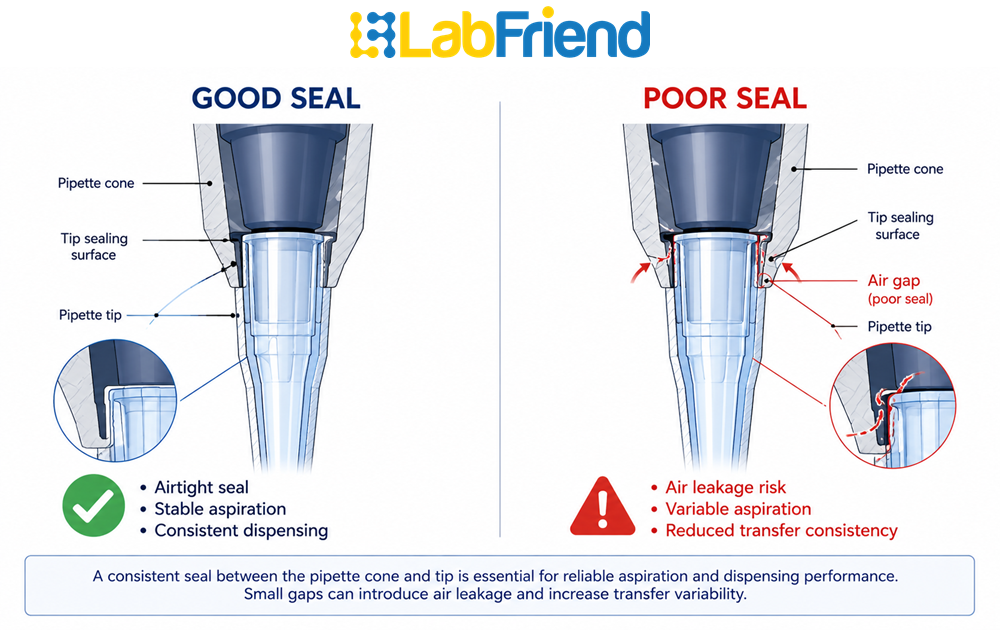
Every aspiration and dispensing action depends on a consistent seal between the pipette cone and the pipette tip.
Modern laboratory pipettes are precision instruments designed to transfer highly accurate liquid volumes. However, their performance ultimately depends on the quality of the interface between the instrument and the disposable tip. If that interface is inconsistent, even a properly calibrated pipette may struggle to deliver repeatable performance.
A properly fitting pipette tip helps support:
- Seal integrity
- Aspiration consistency
- Dispensing consistency
- Operator confidence
- Workflow reproducibility
Conversely, a poorly fitting tip may contribute to:
- Air leakage
- Variable aspiration volumes
- Inconsistent dispensing
- Sample loss
- Tip detachment
- Excessive loading force
- Increased troubleshooting
For laboratories operating multiple pipette brands or evaluating alternative consumable suppliers, understanding pipette tip fit becomes particularly important because compatibility issues can directly affect workflow performance.
The Relationship Between Tip Fit and Pipetting Accuracy
Pipetting accuracy is often discussed in terms of calibration, maintenance and operator technique. While these factors are essential, pipette tip fit is equally important because it influences every stage of the liquid handling process.
The relationship can be visualised as:
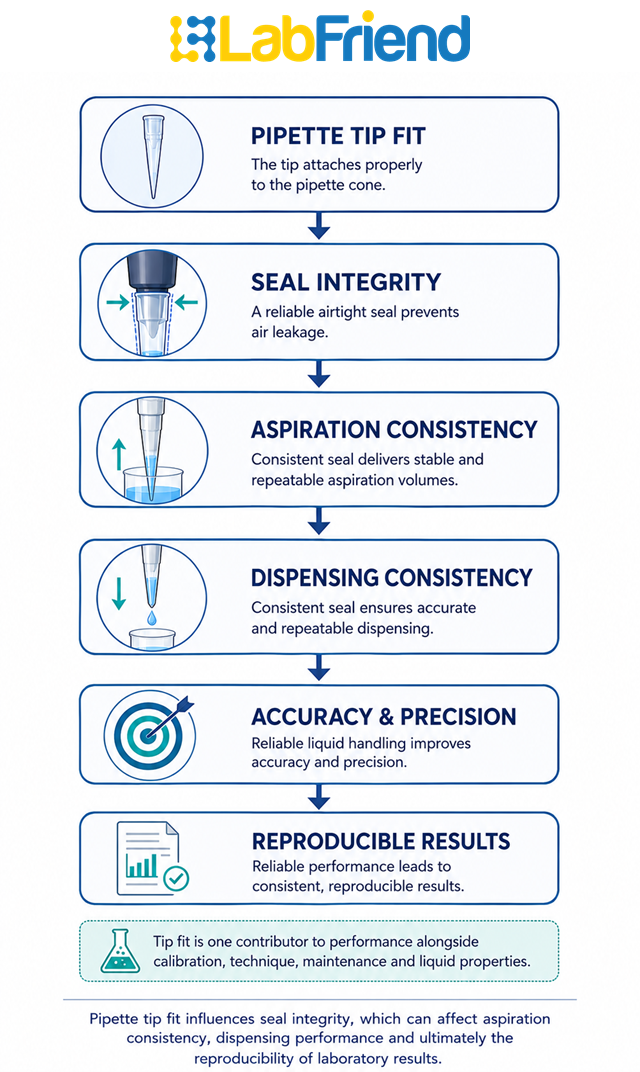
If the seal between pipette and tip is compromised, aspiration and dispensing performance may become inconsistent. This can affect liquid transfer volumes, increase variability and ultimately reduce confidence in laboratory results.
This is one reason why laboratories should avoid assuming that all physically compatible tips perform identically.
While seal integrity is an important contributor to pipetting performance, overall accuracy is also influenced by pipette calibration, operator technique, liquid properties, environmental conditions and instrument condition.
What Creates a Good Pipette Tip Fit?
Several factors influence how well a pipette tip fits a pipette.
These include:
- Pipette cone geometry
- Tip cone geometry
- Manufacturing tolerances
- Material properties
- Loading force
- Ejection force
- Pipette design
Surface finish and moulding consistency can also influence seal formation and reproducibility between manufacturing lots.
A good fit is not simply about whether the tip remains attached during use. It should provide a secure seal while allowing practical loading and ejection during routine laboratory operation.
Scientists frequently encounter situations where a tip appears secure but still exhibits inconsistent performance during aspiration or dispensing. In many cases, the underlying issue relates to the quality of the seal rather than the visible attachment.
This distinction becomes particularly important when evaluating compatible or universal pipette tips.
Physical Fit vs Functional Fit
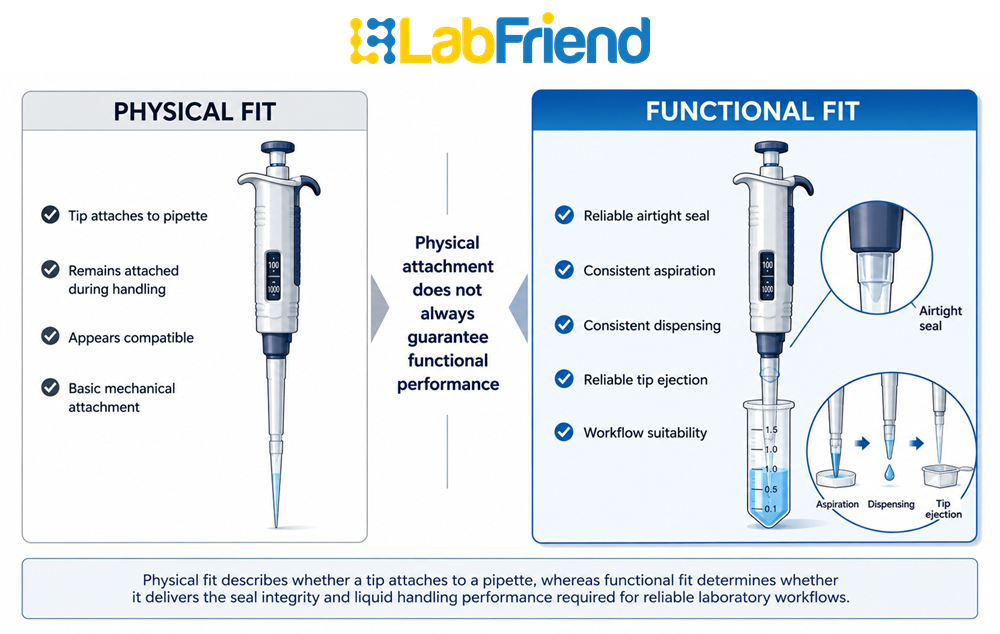
One of the most useful concepts when assessing pipette tip compatibility is the difference between physical fit and functional fit.
Physical Fit
Physical fit describes whether a pipette tip can be attached to a pipette.
A tip may appear secure and remain attached during normal handling, yet still fail to provide optimal liquid handling performance.
Functional Fit
Functional fit describes whether a pipette tip:
- Forms a reliable seal
- Aspirates consistently
- Dispenses consistently
- Ejects reliably
- Supports the intended workflow
Many compatibility problems occur because physical fit is mistaken for functional fit.
Physical fit describes whether a pipette tip attaches to a pipette. Functional fit describes whether that tip provides the seal integrity, liquid handling performance and operational reliability required for the intended laboratory workflow.
This distinction is especially important when evaluating compatible pipette tips supplied by alternative manufacturers.
Common Signs of Poor Pipette Tip Fit
Compatibility problems are not always obvious.
Laboratories may experience symptoms that initially appear to be calibration or technique issues when the underlying cause is actually poor fit between pipette and tip.
Liquid Leakage
One of the most common indicators is leakage after aspiration.
If air enters the system because the seal is inconsistent, aspiration performance may be affected and, in some circumstances, liquid may drip from the tip before dispensing.
Variable Liquid Transfer
Poor sealing can contribute to variability in aspiration volume and dispensing performance.
This may be particularly noticeable when handling small liquid volumes.
Excessive Loading Force
If users must apply unusual force to achieve a seal, compatibility should be investigated.
Excessive loading force may also increase the risk of repetitive strain injuries and contribute to inconsistent tip seating between operators.
Difficult Tip Ejection
Excessive ejection force may indicate poor compatibility between the pipette and the tip.
Tips Falling Off
In more severe cases, tips may detach during normal laboratory use.
These symptoms should always prompt laboratories to evaluate compatibility alongside calibration, maintenance and operator technique.
Why Universal-Compatible Tips Require Careful Evaluation
Compatible pipette tips can provide significant benefits for laboratories.
These may include:
- Procurement flexibility
- Supplier diversification
- Reduced supplier dependency
- Standardisation across mixed pipette fleets
- Improved purchasing efficiency
However, compatibility should never be assumed solely because a tip physically attaches to a pipette.
Differences in pipette cone dimensions, manufacturing tolerances and proprietary design features between pipette manufacturers can influence how consistently a universal-compatible tip performs across different platforms.
For a detailed discussion of compatibility and performance considerations, see:
Optimise Your Pipetting Accuracy with Compatible Pipette Tips
The key question is not:
"Does the tip fit?"
The more important question is:
"Does the tip provide a reliable seal and support the required workflow performance?"
A compatible tip may be entirely suitable for one application while requiring additional assessment in another.
Why Tip Fit Matters in PCR and qPCR Workflows
Low-volume workflows are particularly sensitive to compatibility issues.
PCR and qPCR procedures often involve transferring very small liquid volumes where even minor inconsistencies can have a proportionally larger impact on reproducibility and experimental confidence.
Laboratories performing amplification workflows should consider how pipette tip fit influences aspiration consistency, dispensing behaviour and contamination-control practices.
For additional guidance, see:
Pipetting for PCR: How to Maximise Accuracy in DNA Amplification Workflows
and
qPCR Pipetting Best Practices: How to Reduce Variability and Improve Accuracy at Low Volumes
Where contamination control is also a consideration, laboratories should review:
When Should You Use Filter Pipette Tips in qPCR and Molecular Biology?
In these workflows, poor seal integrity may contribute to liquid transfer variability which, if sufficiently large relative to the transferred volume, may affect assay precision and reproducibility.
How Laboratories Can Assess Pipette Tip Fit
A structured assessment process helps laboratories evaluate compatibility more objectively and reduces the risk of introducing unsuitable consumables into routine workflows.
Where quantitative verification is required, laboratories may supplement compatibility assessments with gravimetric testing in accordance with ISO 8655 principles.
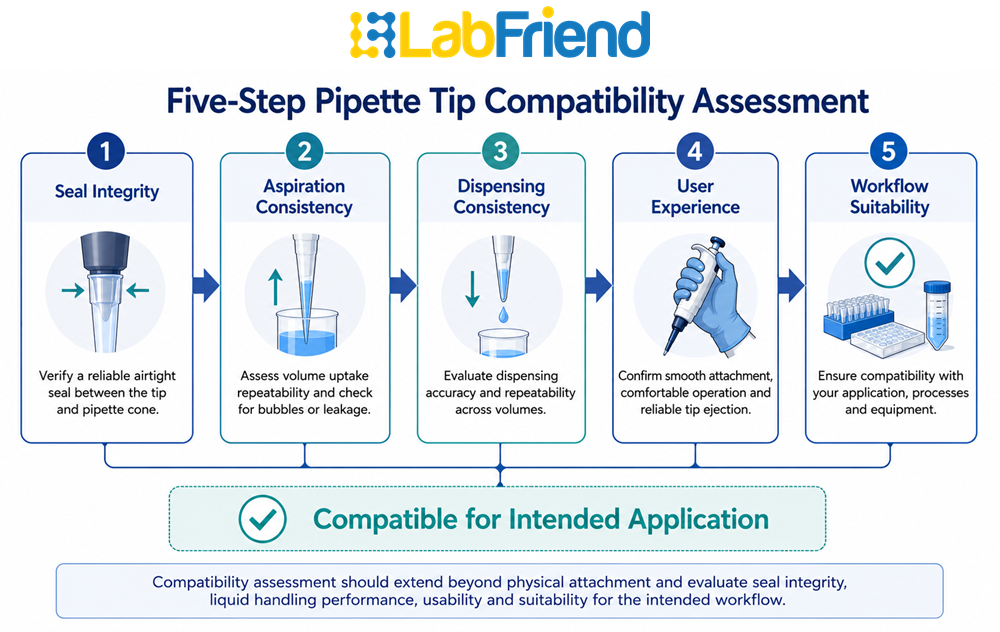
The goal is not to prove that one tip is universally superior to another. Instead, the objective is to determine whether a specific tip performs appropriately within the intended application.
Step 1: Assess Seal Integrity
The first assessment should focus on whether the tip forms a reliable seal with the pipette.
Scientists should evaluate:
- Consistency of attachment
- Ease of loading
- Stability during aspiration
- Stability during dispensing
Where possible, assessments should be conducted using the actual liquids handled within the workflow rather than water alone.
Step 2: Evaluate Aspiration Consistency
Repeated aspiration cycles can help identify variability that may not be obvious during occasional use.
Laboratories should look for:
- Consistent liquid uptake
- Absence of leakage
- Consistent liquid appearance within the tip following aspiration
- Stable transfer performance
Step 3: Evaluate Dispensing Consistency
Dispensing behaviour should remain predictable across the intended volume range.
Particular attention should be paid to:
- Low-volume transfers
- Repetitive dispensing
- Viscous liquids
- High-throughput workflows
When evaluating viscous liquids, laboratories should recognise that liquid properties themselves may influence performance independently of tip compatibility.
Step 4: Assess User Experience
A technically compatible tip may still create operational challenges if it is difficult to use.
Areas worth assessing include:
- Loading force
- Ejection force
- Rack design
- Packaging format
- General handling characteristics
User acceptance is often overlooked during compatibility reviews but can significantly influence implementation success.
Step 5: Evaluate Workflow Suitability
Ultimately, compatibility should be assessed within the intended application.
A tip suitable for routine buffer preparation may not necessarily be appropriate for:
- PCR workflows
- qPCR workflows
- Cell culture applications
- Molecular biology workflows
- Precision analytical testing
This is why workflow-specific assessment is generally more valuable than generic compatibility claims.
Pipette Tip Fit and Supplier Switching
Many laboratories begin investigating pipette tip fit when considering a supplier change.
Supplier diversification can provide:
- Improved procurement flexibility
- Greater supply resilience
- Reduced dependence on a single manufacturer
- Potential cost optimisation opportunities
However, supplier-switching decisions should be based on compatibility and workflow suitability rather than purchasing considerations alone.
For laboratories comparing manufacturer-specific and compatible alternatives, the following article provides additional context:
Universal vs Manufacturer-Specific Pipette Tips: What Scientists Need to Know
A structured compatibility review can help laboratories evaluate alternative suppliers while maintaining confidence in liquid handling performance.
Pipette Tip Fit and Contamination Control
Although pipette tip fit influences liquid handling performance, it should not be confused with contamination-control features.
Fit does not automatically determine:
- Sterility
- Filter performance
- DNase-free status
- RNase-free status
- Endotoxin-related claims
These characteristics should be assessed independently based on workflow requirements.
For a broader discussion of contamination-control specifications, laboratories should review:
Sterile vs Non-Sterile Pipette Tips: Which Should Your Laboratory Choose?
Understanding the distinction between compatibility and contamination control helps laboratories make more informed consumables decisions.
What Pipette Tip Fit Does Not Guarantee
Good pipette tip fit is important, but it does not guarantee successful liquid handling on its own.
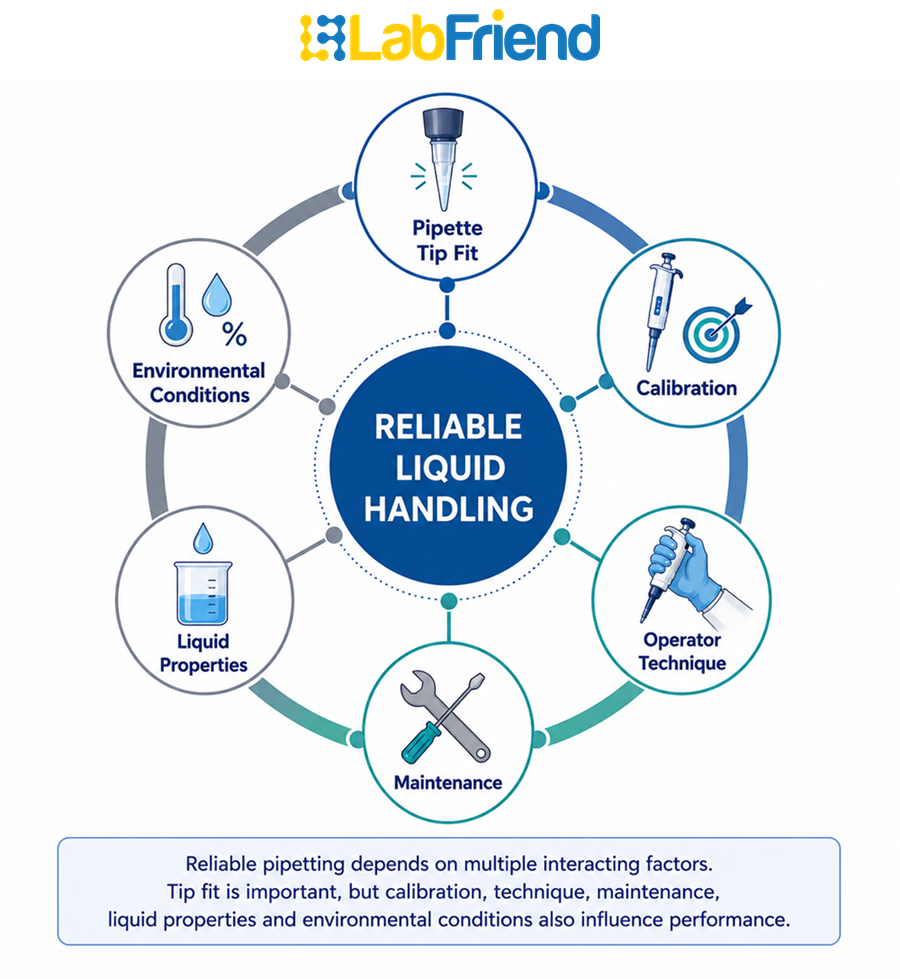
Even with excellent compatibility, laboratories must still consider:
- Pipette calibration
- Operator technique
- Pipette maintenance
- Liquid properties
- Environmental conditions
- Workflow design
Pipette tip fit should therefore be viewed as one component within a wider liquid handling system.
The most reliable results are achieved when all elements of that system work together effectively.
LLG Labware Compatible Pipette Tips
Laboratories evaluating compatible consumables may wish to compare LLG Labware pipette tips as part of a structured compatibility assessment.
LLG Labware offers a broad range of pipette tip formats designed to support routine laboratory liquid handling applications, including:
- Standard pipette tips
- Filter pipette tips
- Sterile pipette tips
- Multiple volume ranges
Laboratories can explore the full Laboratory Pipette Tips category:
or compare available LLG Labware Pipette Tip options:
As with any consumable change, suitability should be assessed within the intended workflow before implementation.
Frequently Asked Questions
Why do pipette tips sometimes leak?
Leakage can occur for several reasons, including poor seal integrity, damaged tips, incorrect loading technique or pipette maintenance issues. Compatibility between the pipette and tip should always be considered during troubleshooting.
Why do pipette tips fall off during use?
Tips may detach if compatibility is poor, the tip is not seated correctly or the fit between pipette and tip is inconsistent.
Does pipette tip fit affect accuracy?
Yes. Pipette tip fit can influence both accuracy and precision by affecting seal integrity, aspiration consistency and dispensing consistency.
Are universal-compatible pipette tips reliable?
Many laboratories successfully use compatible pipette tips. However, compatibility and workflow suitability should be assessed before implementation.
How can laboratories evaluate pipette tip compatibility?
Compatibility assessments typically include evaluating fit, seal integrity, aspiration performance, dispensing consistency, user acceptance and workflow suitability.
Is a tight-fitting pipette tip always better?
Not necessarily. Excessive loading force may create user discomfort and operational challenges. The goal is a reliable seal combined with practical day-to-day usability.
Can pipette tip fit affect PCR and qPCR performance?
Potentially. Poor seal integrity may contribute to variability in low-volume liquid transfers, which can become more significant in amplification workflows.
Key Takeaways
- Pipette tip fit influences seal integrity, aspiration consistency and dispensing consistency.
- Physical fit and functional fit are not the same thing.
- A tip that attaches successfully may still require workflow assessment.
- Compatibility should be evaluated within the intended application.
- Supplier-switching decisions should be based on workflow suitability rather than assumptions.
- Pipette tip fit supports reliable liquid handling but does not replace good technique, calibration or maintenance.
Conclusion
Pipette tip fit is one of the most important contributors to reliable liquid handling performance, yet it is frequently overlooked during consumables selection.
While calibration, maintenance and operator technique remain critical, even a well-maintained pipette can be affected by an incompatible or poorly fitting tip.
Laboratories should focus on functional fit rather than simple physical attachment. By evaluating seal integrity, aspiration consistency, dispensing behaviour and workflow suitability, scientists and laboratory managers can make more informed consumables decisions and reduce the risk of troubleshooting issues later.
Understanding the relationship between pipette tip fit and pipetting performance helps improve reproducibility, supports procurement confidence and contributes to more reliable laboratory workflows.
Written by: Donal O’Sullivan, BSc, Co-Founder and Sales Director, LabFriend UK. Donal brings deep chemistry-led technical expertise across analytical chemistry, biochemistry, environmental monitoring, laboratory instrumentation, consumables and scientific product selection.
Reviewed by: Michael Anderson, MBA, Founder and Managing Director, LabFriend UK. Michael reviews LabFriend UK content for customer relevance, commercial accuracy, operational practicality and alignment with LabFriend UK’s laboratory supply model.
Explore Compatible Pipette Tips for Your Laboratory
If your laboratory is reviewing pipette tip compatibility, evaluating alternative suppliers or looking to standardise consumables across multiple pipette platforms, explore LabFriend UK's laboratory pipette tips range:
Laboratories considering supplier diversification can also compare:
Selecting the right tip is not simply about whether it fits. It is about whether it supports consistent, reliable liquid handling performance throughout the entire workflow.
Related Stories

How to Choose the Right Pipette: The Ultimate Guide to Accuracy and Lab Efficiency
Pipette - Primary

Optimise Your Pipetting Accuracy with Compatible Pipette Tips
Pipette Tip Selection Guide

Pipetting for PCR: How to Maximise Accuracy in DNA Amplification Workflows
How to Maximise Accuracy in DNA Amplification Workflows

qPCR Pipetting Best Practices: How to Reduce Variability and Improve Accuracy at Low Volumes
Learn how to reduce qPCR and RT-qPCR variability with accurate low-volume pipetting techniques, mastermix preparation, contamination control, and best-practice liquid handling workflows.