

Share :
Glass vs Plastic Laboratory Bottles for Procurement Teams: Balancing Cost, Risk and Suitability
Updated On 08/05/2026

By Donal O’Sullivan, BSc. Reviewed by Michael Anderson, MBA.
Quick answer
Procurement teams should compare glass and plastic laboratory bottles by total risk and suitability, not unit price alone. The right choice depends on the application, stored substance, chemical compatibility, breakage risk, handling requirements, cap and closure system, documentation needs, repeat-order control and whether alternatives can be accepted without changing the laboratory workflow.
Glass bottles may be the better procurement choice were visibility, reagent storage, amber protection or an established laboratory specification matters. Plastic bottles may be the better choice where reduced breakage risk, lower weight, routine handling or transport practicality are more important. Neither option should be treated as automatically equivalent.
For the wider technical context, procurement teams should first refer to LabFriend UK’s Laboratory Bottles: Selection Guide for UK Laboratories. Where the decision is specifically glass versus plastic, the scientist-facing comparison article, Glass vs Plastic Laboratory Bottles: Which Should UK Labs Choose?, provides the technical workflow view. The live scientist article states that there is no single best material for every laboratory bottle workflow and that chemical compatibility should be checked against the bottle and closure system.
Why this decision matters to procurement
Glass and plastic laboratory bottles are often treated as simple purchasing alternatives. In practice, they represent different risk profiles. A buyer may see two products with similar volumes, similar shapes and apparently similar descriptions, but that does not mean they are interchangeable.
For procurement, the danger is not only buying the wrong item once. The larger risk is allowing an unsuitable substitution into a recurring laboratory supply process. If a laboratory has standardised on a glass reagent bottle for a chemical storage workflow, switching to plastic without technical review may create compatibility, closure or documentation issues. Equally, insisting on glass where plastic would be technically suitable may increase breakage risk, handling burden or cost unnecessarily.
The procurement task is therefore to control the decision. A good purchasing decision protects technical suitability, manages cost, reduces reorder errors and gives the laboratory a stable route for repeat supply.
When the requirement is still broad, LabFriend UK’s laboratory vessels category is the natural starting point for comparing bottle and vessel options. Where procurement already knows the laboratory is looking for glass options, LabFriend’s glass bottles search results provide a focused product discovery route. Where plastic is the likely route, the plastic bottles search results can support the same comparison process.
Why unit price is not enough
A lower unit price can be attractive, especially where bottles are purchased in quantity. However, the cheapest bottle is not always the lowest-cost bottle in real laboratory use.
A glass bottle may cost more to buy but may be preferred for visibility, chemical storage practice or repeat use where suitable. A plastic bottle may reduce breakage risk, simplify transport and make handling easier, but it may not be suitable for every chemical, storage period, temperature or sample requirement. A procurement decision that focuses only on price can miss the cost of breakage, unsuitable substitutions, wasted stock, user complaints, failed compatibility checks or repeated reordering errors.
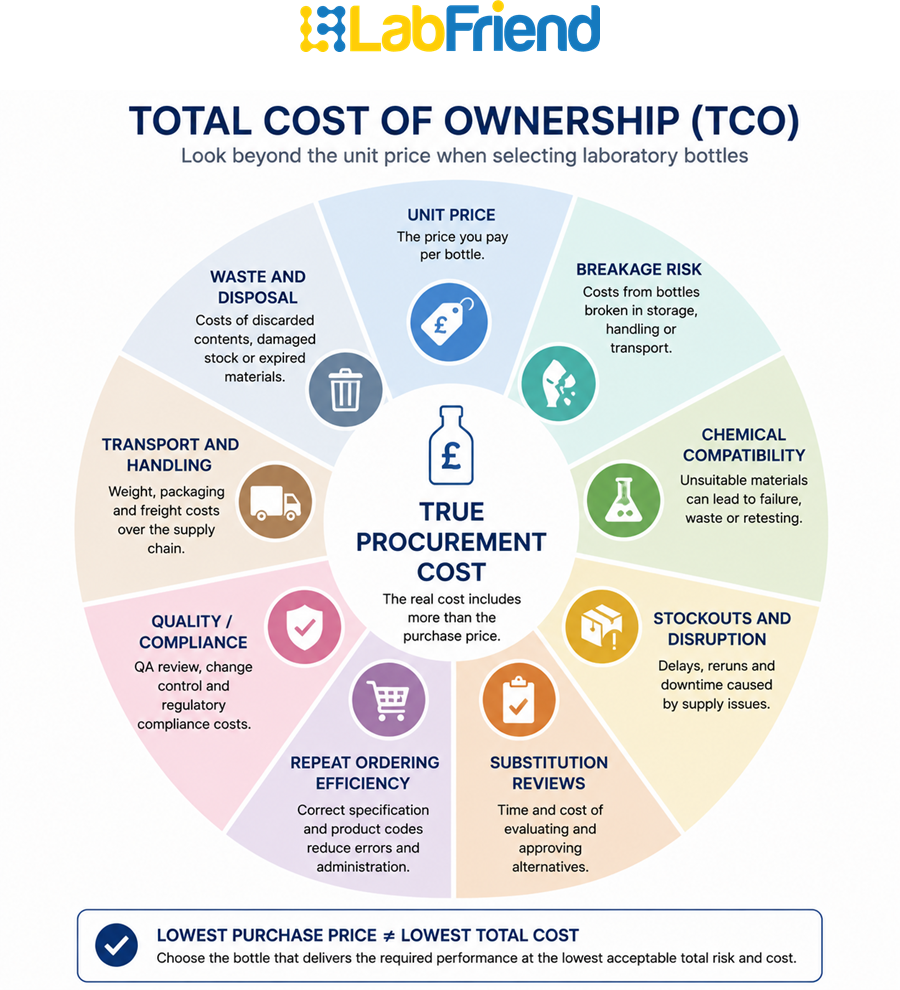
A more useful procurement question is:
Which bottle gives the laboratory the required technical suitability at the lowest acceptable total risk?
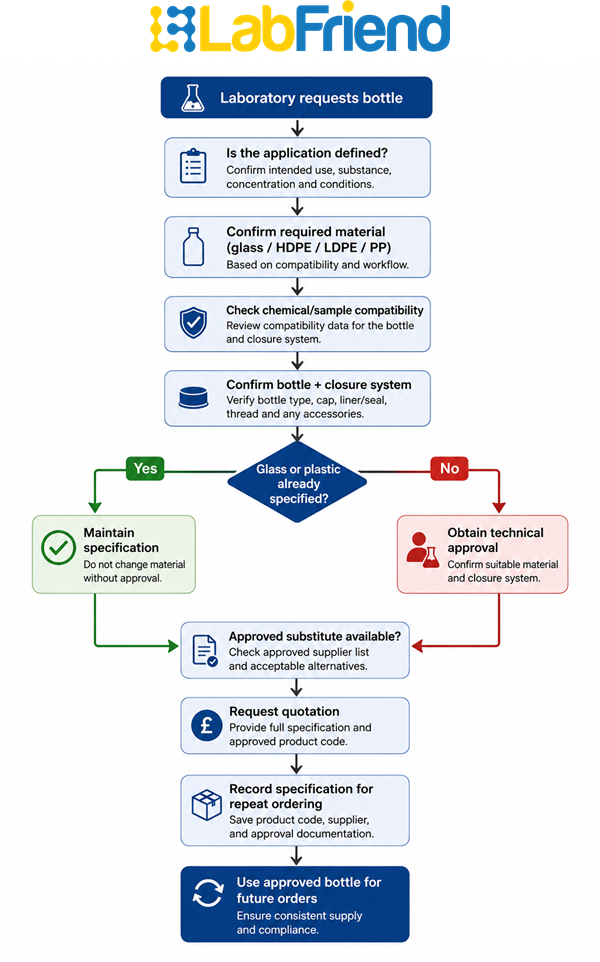
That question changes the buying process. It encourages procurement to confirm the application, material, closure, volume, documentation and repeat-order specification before requesting a quote.
When glass may be the better procurement choice
Glass laboratory bottles are commonly selected where visibility, reagent storage, prepared solutions or established laboratory bottle specifications matter. Clear glass allows users to inspect contents, fill level and visible residues. Amber glass may be used where reduced light exposure is required and the application supports that choice.
For procurement teams, glass may be the stronger buying route where the laboratory has already validated a glass bottle format, where the bottle is used for routine reagent storage, or where the technical user has specified glass because of the workflow. Procurement should be cautious about substituting plastic for glass unless the technical requirement allows it.
This does not mean glass is automatically suitable for every chemical or workflow. Glass can break, and breakage risk may be important in teaching laboratories, transport workflows, shared facilities or busy stock areas. Glass bottle suitability still depends on the stored substance, concentration, temperature, exposure duration and closure system.
Where the buying requirement is reagent-led, procurement should move from a general bottle comparison to the more specific laboratory reagent bottles category. For a reagent-specific technical article, use LabFriend UK’s How to Select Laboratory Reagent Bottles for Chemical Storage, which is now live and supports the chemical-storage selection path.
When plastic may be the better procurement choice
Plastic laboratory bottles are commonly selected where lower breakage risk, lower weight, easier transport or routine handling practicality matters. In field sampling, teaching environments, sample movement, general storage and some larger-volume workflows, plastic can be commercially and operationally attractive.
For procurement teams, plastic may reduce the cost and disruption associated with breakage. It may also be easier to handle in larger volumes or where bottles are moved frequently. However, “plastic” is not a single material. HDPE, LDPE and PP can behave differently, and compatibility must be checked at product level.
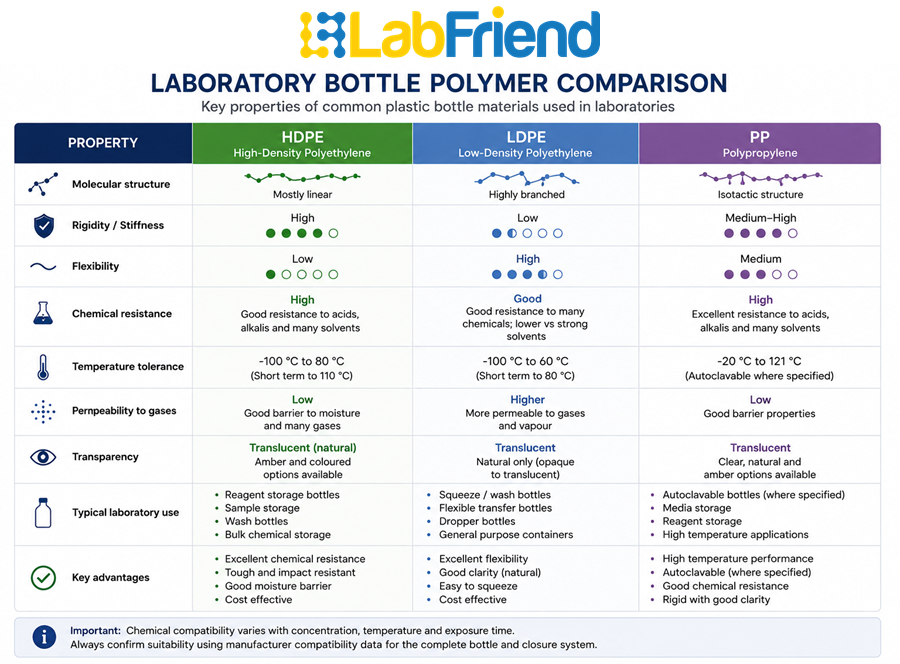
Plastic should not be substituted for glass simply because it appears cheaper or less fragile. Procurement should check the intended contents, concentration, temperature, storage duration, cap and liner compatibility, and whether the method or SOP specifies a particular material.
For deeper material understanding, link procurement readers to LabFriend UK’s live guide, Laboratory Bottle Materials Explained. That article gives the material-reference layer behind procurement decisions.
Procurement comparison framework
|
Procurement factor |
Glass bottles |
Plastic bottles |
Procurement decision point |
|
Unit cost |
May be higher depending on format and specification |
May be lower depending on material and format |
Do not compare price without checking suitability |
|
Breakage risk |
Higher than plastic |
Lower than glass |
Important for transport, teaching and shared-use areas |
|
Weight |
Heavier |
Lighter |
Matters for handling, shipping and large-volume use |
|
Visibility |
Clear glass gives strong visibility |
Varies by plastic type and opacity |
Important for inspection and stockroom use |
|
Light protection |
Amber glass may support reduced light exposure |
Depends on product format |
Do not assume protection without specification check |
|
Chemical compatibility |
Application-specific |
Highly material-specific |
Must be checked against contents and closure |
|
Repeat ordering |
Strong where lab has standardised on a format |
Strong where product code and material are controlled |
Record exact specification and approved alternatives |
|
Substitution risk |
Risk if replaced with plastic without review |
Risk if replaced with glass without review |
Procurement must confirm whether substitution is acceptable |
This table is a starting point, not a substitute for technical review. Procurement should use it to structure questions for the laboratory, not to override scientific or QA requirements.
Where substitution risk appears
Substitution risk is one of the most important issues in glass versus plastic bottle procurement. A substitution may look minor to a buyer but significant to the laboratory.
Common examples include replacing amber glass with clear glass, replacing glass with plastic, replacing HDPE with PP, changing cap type, changing liner material, changing mouth style, changing volume, or offering a bottle with a similar description but different product code. Any of these changes may affect compatibility, handling, visibility, light exposure, leakage risk or repeat-order control.
The safest procurement approach is to classify alternatives before ordering:
|
Substitution type |
Procurement position |
|
Same product code, same specification |
Usually acceptable if available |
|
Same material, same volume, same closure, different brand |
May be acceptable after technical review |
|
Glass changed to plastic |
Requires technical approval |
|
Plastic material changed, such as HDPE to PP |
Requires technical approval |
|
Clear changed to amber |
Requires review; may affect visibility or method expectations |
|
Amber changed to clear |
High caution where light sensitivity may matter |
|
Cap, liner or thread changed |
Requires compatibility check |
|
Certified, sterile or pre-cleaned status changed |
Do not substitute without documented approval |
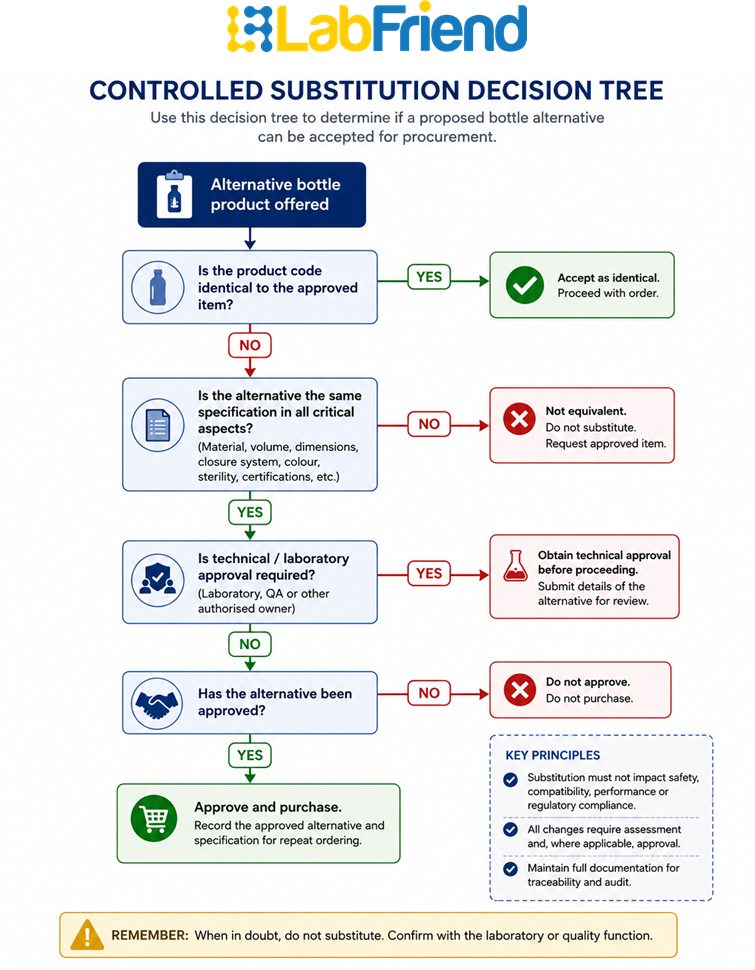
This is where LabFriend’s model can support procurement well. If the laboratory can define approved specifications and acceptable alternatives, procurement can request quotes without creating uncontrolled technical risk.
Cost, risk and repeat-order logic
Procurement teams should think beyond the first order. Laboratory bottles are often recurring consumables, and the real value is in creating a repeatable purchasing route.
A useful procurement record should capture the product code, material, volume, mouth style, cap/thread, pack size, clear or amber format, whether alternatives are permitted, and who approved the specification. This record reduces repeated searches, prevents uncontrolled substitutions and helps inside sales or account support identify repeat-supply opportunities.
For example, if a QA/QC team orders amber glass reagent bottles every quarter, procurement should not treat each order as a fresh sourcing exercise. The better approach is to establish the specification, confirm any acceptable alternatives, and request pricing based on repeat demand. This saves time and improves control.
Where value alternatives are appropriate, procurement can review LLG Labware as part of a controlled supplier-switching discussion. The important word is “controlled”. A value alternative should be assessed against specification, application, material, closure and documentation requirements before it is accepted.
What procurement should check before requesting a quote
Before requesting a quote for glass or plastic laboratory bottles, procurement should confirm the buying specification. This reduces back-and-forth and improves the quality of the quote.
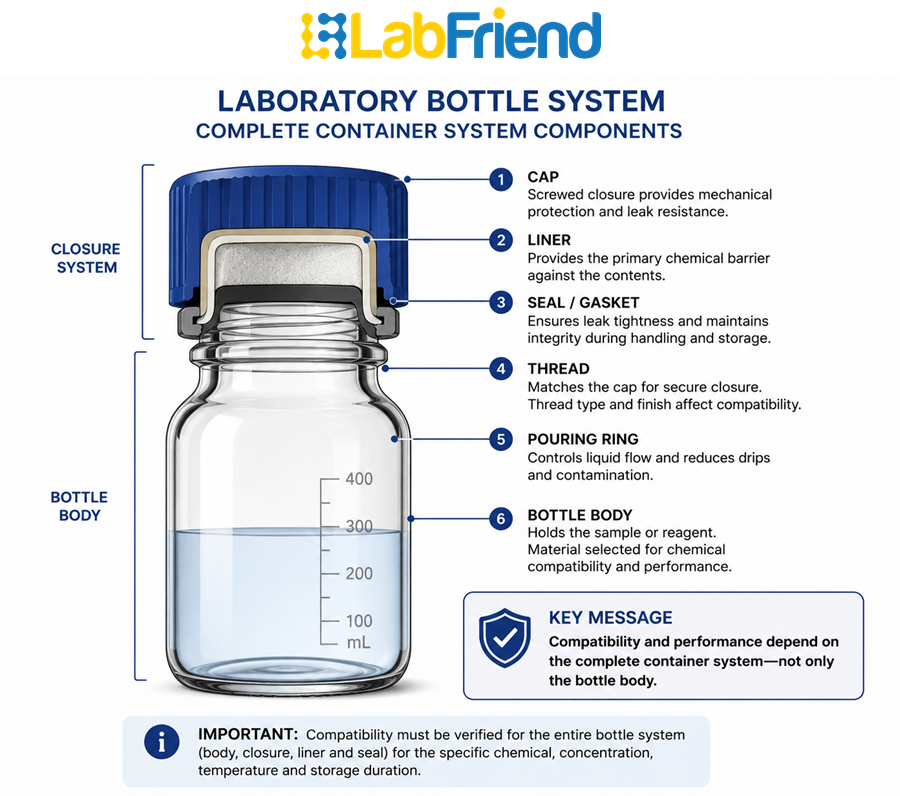
|
Specification item |
Why it matters |
|
Application |
Defines whether the bottle is for reagent storage, samples, transport, dispensing or general storage |
|
Required material |
Prevents uncontrolled glass/plastic substitution |
|
Chemical or sample type |
Drives compatibility checks |
|
Volume |
Affects handling, storage, headspace and pack quantity |
|
Mouth style |
Determines filling, pouring and cleaning practicality |
|
Cap/thread |
Prevents mismatch and reorder errors |
|
Liner/seal |
May affect leakage, evaporation or compatibility |
|
Clear or amber format |
Controls visibility and light-exposure requirements |
|
Sterile/certified requirement |
Must be confirmed separately where needed |
|
Product code |
Supports repeat ordering |
|
Approved alternatives |
Allows controlled substitution where acceptable |
|
Expected reorder frequency |
Helps quote and supply planning |
Once the specification is clear, procurement can compare relevant LabFriend UK bottle options and use the product-page quote function or the contact-us route for quotation support. The contact page is live and provides a validated route for enquiries.
How to use glass and plastic search routes responsibly
The glass and plastic search URLs are useful product-discovery routes, but they should not replace specification control.
Use the glass bottles search results when the laboratory has confirmed glass is required or preferred. Use the plastic bottles search results when the application allows plastic and the material type can be checked. Both search routes are live LabFriend UK pages, but procurement still needs to validate the selected product against the laboratory requirement.
For broader comparison, start with laboratory vessels. For chemical storage, move to laboratory reagent bottles. For value-alternative discussions, use LLG Labware only where specification review supports the substitution.
What this article does not solve
This article helps procurement compare glass and plastic laboratory bottles, but it does not replace technical approval from the laboratory.
It does not confirm chemical compatibility, method suitability, sterility, DNase-free status, RNase-free status, endotoxin status, autoclave suitability, pressure suitability, vacuum suitability, certification or regulatory suitability. Those must be checked from the product specification, manufacturer documentation, SDS, COSHH assessment, method requirements and local laboratory procedures.
Procurement efficiency is valuable, but it should not replace technical suitability assessment.
FAQs
Should procurement choose glass or plastic laboratory bottles?
Procurement should choose based on the application, technical specification and total risk. Glass may be suitable where visibility, reagent storage or amber protection matter. Plastic may be suitable where lower breakage risk, lighter handling or transport practicality matter. Neither should be substituted for the other without checking suitability.
Are plastic laboratory bottles cheaper than glass bottles?
Plastic bottles may have a lower unit cost in some cases, but procurement should consider total cost. Breakage, suitability, repeat ordering, handling, documentation and substitution risk can all affect the real cost of ownership.
When should procurement not substitute plastic for glass?
Procurement should avoid substituting plastic for glass where the laboratory has specified glass, where chemical compatibility is uncertain, where amber glass is required, where the method specifies a container type, or where the closure system has not been checked.
When should procurement not substitute glass for plastic?
Glass should not be substituted for plastic where reduced breakage risk, transport practicality, weight reduction or a plastic-specific workflow requirement matters. The laboratory should confirm whether glass is acceptable.
What should a bottle quote request include?
A strong quote request should include application, material, volume, mouth style, cap/thread, clear or amber format, sterility or certification requirements, product code, pack size, approved alternatives and expected reorder frequency.
Are LLG Labware bottle alternatives suitable replacements?
They may be suitable where the specification matches the workflow requirements and the laboratory accepts the alternative. Procurement should not assume equivalence without checking material, format, closure, documentation and application suitability.
Can procurement use search results to choose glass or plastic bottles?
Search results are useful for product discovery, but the final selection should be based on the specification. Procurement should use search routes to shortlist options, then confirm suitability before ordering or requesting a quote.
Conclusion
For procurement teams, glass versus plastic laboratory bottle selection is a cost, risk and suitability decision. The aim is not simply to buy the cheapest bottle or the closest-looking alternative. The aim is to buy a bottle that fits the laboratory workflow, can be reordered consistently and does not introduce avoidable technical or operational risk.
Glass may be the stronger choice where reagent storage, visibility, amber protection or an established specification matters. Plastic may be the stronger choice where lower breakage risk, lighter handling or transport practicality matters. The right answer depends on the application, material, closure, documentation and repeat-order requirement.
Once the specification is clear, compare LabFriend UK’s laboratory vessels, laboratory reagent bottles, glass bottle options, plastic bottle options or LLG Labware where a value alternative is appropriate.
Request a quote for glass or plastic laboratory bottles
Confirm the required bottle material, format, volume, cap/thread, documentation needs and acceptable alternatives, then request pricing through LabFriend UK. Use product-page quote generation where available, or contact LabFriend UK through the contact-us page for support with specification-led bottle supply.
Written by: Donal O’Sullivan, BSc, Co-Founder and Sales Director, LabFriend UK. Donal brings deep chemistry-led technical expertise across analytical chemistry, biochemistry, environmental monitoring, laboratory instrumentation, consumables and scientific product selection.
Reviewed by: Michael Anderson, MBA, Founder and Managing Director, LabFriend UK. Michael reviews LabFriend UK content for customer relevance, commercial accuracy, operational practicality and alignment with LabFriend UK’s laboratory supply model.
Related Stories

Laboratory Bottle Selection for Lab Managers - Standardising Everyday Storage and Handling
Learn how UK lab managers can standardise laboratory bottle selection by material, volume, mouth style, closure, sterility, compatibility and reorder requirements to reduce stockouts and simplify repeat purchasing.

Glass vs Plastic Laboratory Bottles - Which Should UK Labs Choose
Glass vs Plastic Laboratory Bottles - Which Should UK Labs Choose

Laboratory Bottle Materials Explained - Borosilicate Glass - Amber Glass - HDPE - LDPE and PP
Laboratory Bottle Materials Explained - Borosilicate Glass - Amber Glass - HDPE - LDPE and PP

How to Select Laboratory Reagent Bottles for Chemical Storage
How to Select Laboratory Reagent Bottles for Chemical Storage