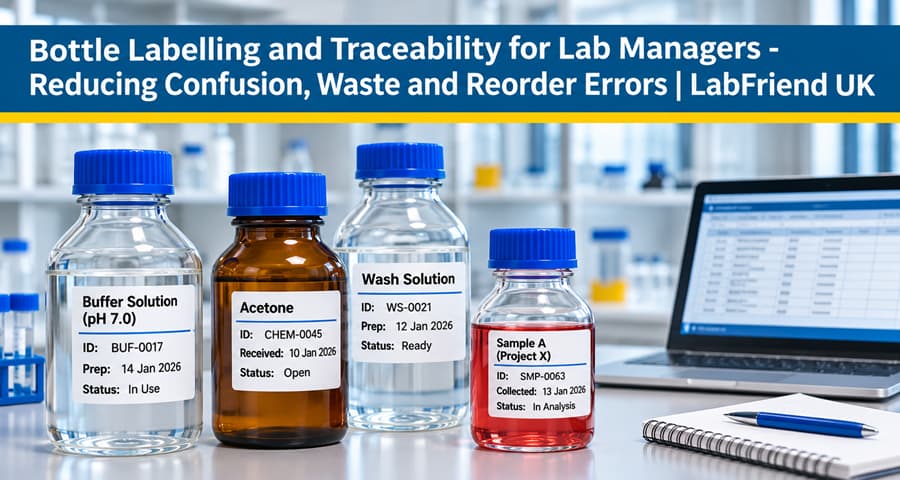
Bottle Labelling and Traceability for Lab Managers - Reducing Confusion, Waste and Reorder Errors
24 mins read
Bottle Labelling and Traceability for Lab Managers - Reducing Confusion, Waste and Reorder Errors
By Donal O’Sullivan, BSc. Reviewed by Michael Anderson, MBA.
In a busy laboratory, inconsistent bottle labelling can
create more than identification problems. It can make it harder to determine
what is already in stock, whether two containers hold the same material, which
record belongs to a bottle and whether a new order is actually required. |
Key Takeaways
- Standardise
the labelling process, rather than forcing every bottle to carry
exactly the same information.
- Use
consistent names, identifiers, date conventions and status terminology
across the laboratory.
- Make
the relationship between the physical bottle and its associated laboratory
or inventory record clear.
- Control
relabelling, transfers and status changes so that traceability is not
lost.
- Use
clear identification to reduce confusion between similar bottles and avoid
unnecessary duplicate orders.
- Keep
bottle-labelling standards separate from detailed stock-control and
reorder-point calculations.
- Review the system periodically to identify recurring errors and improve the standard.
Why Does Bottle Labelling Need to Be Standardised?
Laboratories often accumulate bottles through different
routes. Some may contain commercially supplied reagents, others
laboratory-prepared solutions, samples or routine materials. Different teams
may also use different abbreviations, date formats or identification
conventions.
That inconsistency can create practical problems.
A Lab Manager may encounter:
- two
bottles with similar names but different contents;
- several
descriptions for the same material;
- labels
that use different abbreviations;
- bottles
that cannot easily be matched to an associated record;
- unclear
preparation or status information;
- duplicate
containers created because existing stock cannot be identified
confidently; or
- orders
placed because the team cannot determine whether a suitable bottle or
material is already available.
The problem is therefore not simply whether a label exists.
The useful question is:
Can the laboratory identify the bottle consistently,
understand its status and connect it to the information needed to manage it?
A standardised approach makes that process more predictable.
What Should a Laboratory Standardise?
The first step is to decide which parts of bottle
identification should be consistent throughout the laboratory.

A useful standard may cover:
- naming
conventions;
- abbreviations;
- unique
identifiers where required;
- date
formats;
- status
terminology;
- batch
or lot references where relevant;
- links
to associated records;
- responsibility
or location information where needed; and
- rules for relabelling and transferring material.
The standard should define how the laboratory handles
these fields, rather than assuming that every bottle requires every field.
For example, a prepared solution may need a preparation
reference and date, while an unopened commercial product may rely more heavily
on manufacturer identification and batch information.
The objective is consistency in the method of
identification, while retaining flexibility for legitimate workflow
differences.
Standardise Names and Abbreviations
Inconsistent terminology is one of the simplest sources of
avoidable confusion.
One team member may label a material using a full name,
while another uses an abbreviation. A third may use a local shorthand that is
familiar only within one work area.
A laboratory-wide standard should therefore define:
- approved
material names;
- permitted
abbreviations;
- units
and notation where relevant;
- capitalisation
conventions where useful; and
- terms
that should not be used because they are ambiguous.
The standard should be practical enough that staff can apply
it without having to interpret the convention each time.
Avoid unnecessary complexity
A labelling standard can become counterproductive if it
requires too many fields or complicated codes.
Every additional field creates another opportunity for:
- inconsistent
entry;
- transcription
errors;
- outdated
information;
- labels
that become difficult to read; or
- staff
creating informal alternatives.
A better approach is to define the minimum information
needed for reliable identification and add application-specific information
only where it serves a clear purpose.
Establish a Consistent Identifier
Where the laboratory needs to connect a physical bottle to
an associated record, a consistent identifier can provide that link.

The identifier might relate to:
- the
physical container;
- a
preparation;
- a
sample;
- a
batch;
- or
another controlled record.
These identifiers should not automatically be treated as
interchangeable.
For example, a physical container may have its own
identifier while the material inside it is associated with a preparation or
sample reference. If that material is transferred to another bottle, the
laboratory needs to know which identity must remain connected to the material
and which relates only to the original container.
The standard should therefore define:
- when
an identifier is required;
- what
the identifier identifies;
- where
the corresponding record is maintained; and
- how
the relationship is retained if the material or container changes.
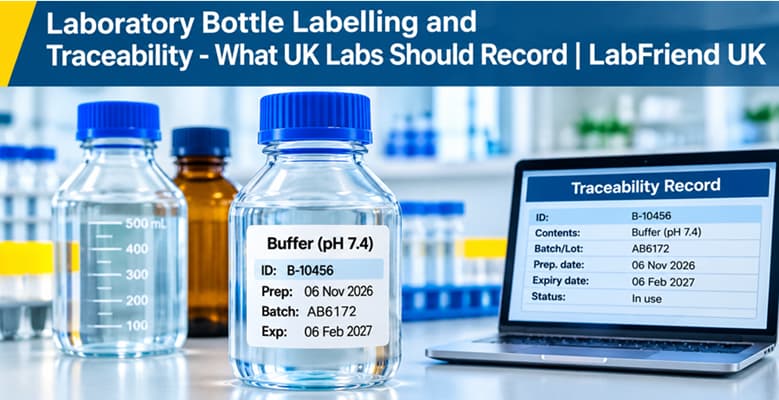
For a broader explanation of what laboratories should
record, see Laboratory Bottle Labelling and Traceability - What UK Labs Should Record.
Connect the Physical Bottle to the Existing Record
A label is only one part of the traceability system.
If the laboratory already maintains an electronic inventory,
laboratory record, sample record or other controlled system, the bottle should
be identifiable in a way that allows the relevant information to be retrieved
reliably.
The exact system will vary between laboratories.
The important requirement is that a person handling the
bottle can determine, without unnecessary interpretation:
- what
the bottle contains or represents;
- which
record belongs to it;
- what
its current status is; and
- which
additional information is relevant to its use or management.
Do not create a second record system simply because the
physical label needs to be standardised.
Where an existing controlled record already performs the
required function, the labelling standard should support that system.
Standardise Dates and Status Information
Dates are a frequent source of ambiguity.
A laboratory should decide how relevant dates are
represented and what each date means.
Depending on the workflow, dates may relate to:
- preparation;
- receipt;
- opening;
- review;
- expiry
or use-by status; or
- another
controlled event.
A preparation date should not automatically be treated as an
expiry date. Where an expiry or use-by date is required, its basis should come
from the applicable manufacturer information, validated stability information,
analytical method or controlled laboratory procedure.
Status terminology should be equally clear.
If the laboratory uses terms such as:
- approved;
- pending;
- quarantined;
- rejected;
or
- expired,
the standard should define what each status means and how it
is controlled.
A coloured label or handwritten status should not become the
only source of information if the laboratory's controlled record says something
different.
Control Relabelling
Relabelling is an important part of a traceability standard
because a new label can unintentionally break the connection to the previous
identity.
The laboratory should establish when relabelling is
permitted and what information must be retained.
Before replacing a label, consider:
- why
the bottle is being relabelled;
- whether
the bottle identity is changing;
- whether
the material identity is changing;
- whether
the original identifier must remain traceable;
- whether
the associated record needs updating; and
- who
is authorised to make the change.
A replacement label should not simply overwrite information
that is needed to understand the history of the material or container.
The process should be simple enough to use routinely, but
controlled enough to prevent an informal relabelling practice becoming the
laboratory standard.
Maintain Traceability During Transfers
Transferring material between bottles can create a similar
problem.
For example, material may be moved because the original
bottle is damaged, unsuitable for continued use, too large for the working
application or being replaced as part of routine laboratory operations.
The new container should remain connected to the relevant
material record.
Depending on the workflow, the laboratory may need to:
- retain
the original material identifier;
- assign
a new container identifier;
- record
the transfer;
- record
the date;
- identify
the person responsible; or
- update
the associated record.

The correct approach depends on the laboratory's established
procedure.
The important point for a Lab Manager is that the
physical transfer should not silently break the traceability chain.
Reduce Duplicate and Unclear Bottles
Inconsistent labelling can contribute to duplicate stock.
A team member may find a bottle with an unfamiliar
description and reasonably conclude that the required material is not
available. Another bottle containing the same or sufficiently similar material
may already be present elsewhere.
The result can be unnecessary purchasing, additional storage
and more containers that subsequently need to be managed.
A standardised labelling system can reduce this risk by
making existing bottles easier to recognise.
It should provide enough information to answer:
- What
is this?
- Which
record does it belong to?
- What
is its current status?
- Is
this the same material or product identity as another bottle?
- Is
it available for the intended use?
This does not mean that two bottles with the same or
similar identification should automatically be treated as technically
interchangeable.
Technical suitability, material, concentration, preparation,
container specification and other workflow requirements may still need to be
checked before one product or material is used in place of another.
The purpose of standardised labelling is to reduce
identification uncertainty and improve operational control, not to establish
technical equivalence or suitability.
Use Bottle Identification to Reduce Reorder Errors
Poor identification can also affect repeat purchasing.
Consider a simple sequence:
Unclear bottle → uncertainty about what is already held →
incorrect or duplicate order
A consistent labelling system can help interrupt that
sequence.
For example, if the laboratory has standardised:
- product
or material naming;
- relevant
identifiers;
- bottle
status;
- location
information where needed; and
- the
connection to purchasing or inventory records,
a Lab Manager can more readily determine whether the
laboratory already holds the required item.
This can help reduce avoidable ordering errors.
However, bottle labelling is not a substitute for inventory
control.
Detailed reorder points, minimum-stock levels, usage
monitoring and stockout prevention are separate management activities. The
labelling system should make those activities easier by improving
identification rather than attempting to perform them itself.
Keep the Labelling Standard Separate From Product Standardisation
There is an important distinction between:
standardising how bottles are identified
and
standardising which bottles the laboratory purchases.
A laboratory may decide that all relevant bottles should use
a common identification format while continuing to maintain several technically
appropriate bottle types.
Conversely, a laboratory may later decide that some bottle
formats should be consolidated for purchasing efficiency.
Those are separate decisions.
A labelling standard should not be used to force technically
unsuitable products into one common format simply because they are easier to
manage.
Where a purchasing standard is required, the technical
requirements should be established first and the appropriate product range
agreed separately.
Build a Practical Standardisation Process
A useful implementation process is:
The standard should also have a clearly defined owner and
should be communicated to the staff who use, label, transfer or manage
laboratory bottles. A technically sound standard will not reduce operational
errors if different users continue to apply different conventions.

1. Review the current system
Look at the bottles already in use and identify recurring
problems.
Examples might include:
- inconsistent
names;
- missing
identifiers;
- unclear
dates;
- duplicate
descriptions;
- inconsistent
status markings; or
- bottles
that cannot easily be connected to records.
2. Define the minimum standard
Specify the information and conventions that should normally
be used.
Keep the standard proportionate. Do not require fields that
do not serve a defined purpose.
3. Define exceptions
Some workflows will require additional information.
Document when application-specific fields are needed rather
than creating multiple informal labelling systems.
4. Standardise terminology
Agree the names, abbreviations, units and date conventions
that staff should use.
5. Connect the label to the record
Confirm where the associated information is stored and how
the physical bottle is linked to it.
6. Control changes
Define the process for relabelling, transferring material,
changing status or retiring a bottle.
7. Review the result
After implementation, check whether the standard has
actually reduced confusion and avoidable errors.
8. Verify continued application
Check periodically that the agreed labelling conventions are
still being followed across the relevant laboratory areas. Review recurring
deviations, unclear labels and identification-related errors, and update the
standard or user guidance where the same problem continues to occur.
A standard that staff cannot apply consistently is not an
effective operational standard.
Common Problems With Bottle-Labelling Standardisation
Making every label identical
Different materials and workflows can require different
information.
Better approach: standardise the core identification
conventions while allowing controlled differences where particular materials,
samples or workflows require additional information.
Using too many abbreviations
Short labels can become difficult to interpret outside the
immediate work area.
Better approach: use agreed terminology and
abbreviations that remain understandable to the wider laboratory team.
Creating identifiers without defining what they mean
A number has little value if staff cannot determine what it
identifies or where its associated record is maintained.
Better approach: define the identifier's purpose and
maintain the corresponding record.
Relabelling without preserving the required history
Replacing a label can remove useful information about the
container or material.
Better approach: define a controlled relabelling
process.
Treating similar descriptions as equivalent products
A similar name does not establish that two materials or
products are technically interchangeable.
Better approach: use labelling to identify items
clearly, then assess technical suitability separately when required.
Using labels as an inventory system
A label can identify a bottle but cannot by itself provide
accurate stock levels or reorder triggers.
Better approach: connect the labelling system to the
laboratory's existing inventory or purchasing controls.
Adding fields because they seem useful
More information can make labels harder to maintain.
Better approach: include information that has a
defined operational purpose.
Lab Manager's Bottle-Labelling Checklist
|
Check |
Question |
|
Naming |
Are bottle names and material descriptions consistent
across the laboratory? |
|
Abbreviations |
Are approved abbreviations defined and used consistently? |
|
Identifier |
Is it clear when an identifier is required and what it
identifies? |
|
Dates |
Are relevant dates clearly defined and consistently
formatted? |
|
Status |
Are status terms defined and controlled? |
|
Associated record |
Can the physical bottle be connected reliably to the
relevant record? |
|
Relabelling |
Is there a controlled process for replacing or updating a
label? |
|
Transfers |
Can traceability be maintained when material moves between
bottles? |
|
Duplicate stock |
Can staff distinguish existing stock from genuinely
different material or products? |
|
Reordering |
Does the identification system reduce uncertainty when
checking whether an item needs to be ordered? |
|
Readability |
Will labels remain readable under the intended storage and
handling conditions? |
|
Review |
Is the labelling standard periodically checked and updated
when necessary? |
The checklist should be used as an operational review rather
than treated as a universal regulatory requirement.
How to Know Whether the Standard Is Working
A labelling standard should be reviewed against the problems
it was intended to reduce.
Useful indicators may include recurring examples of:
- unidentified
or ambiguously labelled bottles;
- duplicate
bottles created because existing stock could not be recognised;
- incorrect
orders caused by unclear product or material identification;
- records
that cannot be matched confidently to physical bottles;
- inconsistent
terminology between laboratory areas; or
- repeated
requests for clarification about bottle contents or status.
The laboratory does not need to create an elaborate
measurement programme for every labelling change.
A periodic review of recurring operational errors may be
enough to identify whether the standard is practical and whether parts of it
need adjustment.
If the same problem continues to occur, the solution may be
to simplify the standard rather than add another field.
Frequently Asked Questions
How can a laboratory standardise bottle labelling?
A laboratory can standardise bottle labelling by defining
consistent naming, identifier, date and status conventions, establishing which
information should normally appear on a label, linking bottles to associated
records and defining controlled processes for relabelling and transfers. The
standard should allow additional application-specific information where the
workflow requires it.
Should every laboratory bottle use the same label format?
No. A laboratory should standardise its core identification
conventions while allowing controlled differences where particular materials,
samples or workflows require additional information. The aim is consistency
without forcing every bottle into an unsuitable format.
Can standardised bottle labels reduce reorder errors?
Standardised bottle labels can help reduce avoidable reorder
errors by making existing bottles easier to identify and connect to relevant
records. However, labelling does not replace inventory management or reorder
controls, and it does not establish that similarly labelled products are
technically interchangeable.
How should a laboratory control bottle relabelling?
The laboratory should control bottle relabelling by defining
when relabelling is permitted, which identity or history must be retained,
whether the associated record needs updating and who is authorised to make the
change. The process should preserve the required connection between the
physical bottle and its relevant records.
Can bottle labels be linked to existing laboratory
records?
Yes. Where the laboratory already maintains an inventory,
sample, preparation or other controlled record, a bottle identifier can be used
to connect the physical container with that information. The exact
implementation should follow the laboratory's existing procedures and systems.
How often should a laboratory review its bottle-labelling
standard?
There is no universal review interval for every laboratory.
The standard should be reviewed when recurring identification, transfer, status
or ordering errors indicate that it is not working effectively, and whenever
relevant laboratory processes change. The review frequency should therefore
reflect the laboratory's own procedures and operational needs.
Conclusion: Standardise the Process, Not Every Bottle
Effective bottle labelling is an operational control rather
than simply a labelling exercise.
A useful laboratory standard should make it clear:
- what
the bottle contains or represents;
- which
information needs to be visible;
- which
record is associated with the bottle;
- how
status and dates are handled;
- what
happens when material is transferred or a label is replaced; and
- how
the system supports accurate stock and purchasing decisions.
The aim is not to make every bottle identical. It is to
make identification consistent enough that people can recognise what they are
handling, find the relevant information and make better operational decisions.
Where the laboratory has established its bottle requirements
and is ready to standardise the physical products it uses, browse Laboratory Glassware.
Read More
- Laboratory Bottles: Selection Guide for UK Laboratories
- Laboratory Bottle Labelling and Traceability - What UK Labs Should Record
Explore More
Written by: Donal O’Sullivan, BSc, Co-Founder and Sales Director, LabFriend UK. Donal brings deep chemistry-led technical expertise across analytical chemistry, biochemistry, environmental monitoring, laboratory instrumentation, consumables and scientific product selection.
Reviewed by: Michael Anderson, MBA, Founder and Managing Director, LabFriend UK. Michael reviews LabFriend UK content for customer relevance, commercial accuracy, operational practicality and alignment with LabFriend UK’s laboratory supply model.
Frequently asked questions
Delivery times vary by product and supplier. Each product page shows current stock levels and the expected lead time, and we confirm this when you place your order. Most items arrive within 2 to 3 weeks. Specialised items can take longer if they are not in stock. If you need something by a certain date, contact us and we’ll check for you.
Yes. Register for a commercial account and, once it’s approved, you will be able to process orders via PO Once you have a commercial account, you can directly email your purchase orders
Add products to your cart and click Get a Quote. You’ll get a formal quote instantly, ready to send to your email address. For bulk orders or custom requirements, send us your product list and we’ll reply with itemized pricing.
If your item is faulty, not as described or sent in error, let us know within 14 days of delivery and we’ll arrange a return. Change of mind returns are only accepted if the item is unused and in its original packaging. A restocking fee will apply and you pay the return freight. Read our full Returns Policy for details.
Yes, prices are shown including VAT by default. Use the Prices Inc. VAT toggle at the top of the page to view prices without VAT.