Certified and Pre-Cleaned Laboratory Bottles - When Trace Analysis Requires More Than Standard Containers
25 mins read
Certified and Pre-Cleaned Laboratory Bottles - When Trace Analysis Requires More Than Standard Containers
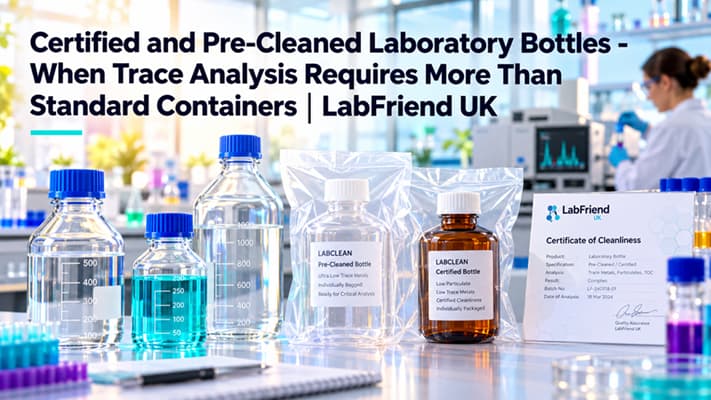
By Donal O’Sullivan, BSc. Reviewed by Michael Anderson, MBA.
A standard laboratory bottle may be entirely appropriate for
many routine applications. However, when analytical measurements are sensitive
to contamination, background or residues from the sample container, the
container itself can become part of the analytical control. For trace-sensitive work, the relevant question is therefore
not simply whether a bottle is clean. It is whether the container
characteristics and supporting documentation are appropriate for the analytical
requirement. |
Key Takeaways
- Start
with the analytical method, analyte and contamination risk before
deciding whether a certified or pre-cleaned bottle is required.
- A
standard laboratory bottle, a clean bottle, a pre-cleaned bottle and a
certified bottle are not automatically interchangeable descriptions.
- Container
material and surface characteristics can affect sample integrity through
adsorption, absorption or substances released from the container.
- Certification
is meaningful only in relation to what the documentation actually
covers.
- Do
not assume that a general cleanliness claim establishes suitability for a
particular analyte, concentration range or analytical method.
- Where
documented container characteristics are critical, record the required
specification rather than relying on a generic description.
- Technical suitability should be established before considering purchasing convenience or product availability.
Why Can the Laboratory Bottle Matter in Trace Analysis?
At higher analyte concentrations, a small contribution from
the container may have little practical significance. In trace-sensitive work,
however, relatively small amounts of contamination or analyte loss can become
more important to the analytical result.
The bottle is in direct contact with the sample, sometimes
for a significant period. Depending on the application, the container may
therefore contribute to analytical risk through:
- residues
remaining on the container surface;
- substances
released from the container into the sample;
- adsorption
of analytes onto the container surface;
- absorption
of substances into the container material;
- inadequate
cleaning;
- inappropriate
packaging or handling; or
- a
container characteristic that does not match the analytical method.

This does not mean that every trace-analysis workflow
requires a certified bottle.
The appropriate level of container control depends on the
analytical method, the substances being measured, the sensitivity of the
determination, the sample matrix and the consequences of contamination or
analyte loss.
The starting point should therefore be the actual
analytical requirement, rather than the product description.
When Is a Standard Laboratory Bottle Potentially Insufficient?
A standard laboratory bottle may be insufficient where the
container itself could materially affect the analysis and the required
container characteristics cannot be established from the normal product
information.
Questions to consider include:
- Could
container-derived contamination affect the result?
- Could
the analyte adsorb onto the container surface?
- Could
the container release substances into the sample?
- Does
the analytical method specify a particular container preparation or
cleanliness requirement?
- Is
the required contamination limit lower than would reasonably be controlled
by a general laboratory bottle?
- Does
the workflow require documented evidence of a particular container
characteristic?
- Does
the laboratory need traceability to a particular lot or product
specification?
Where the answer to one or more of these questions is yes,
additional container controls may need to be considered.
The correct response is not automatically to select the most
highly specified bottle available. Instead, establish which characteristic
needs to be controlled and what evidence is required to demonstrate it.
Certified, Pre-Cleaned and Standard Bottles Are Not the Same Thing
The terms used to describe laboratory bottles can refer to
different characteristics.
Standard laboratory bottle
A standard laboratory bottle is generally selected according
to characteristics such as material, volume, closure and intended laboratory
use.
That may be sufficient for many routine applications, but
the product description alone should not be assumed to establish specialist
trace-analysis cleanliness.
Pre-cleaned laboratory bottle
A pre-cleaned bottle has undergone cleaning before supply,
but the term alone does not establish which cleaning procedure was used,
whether that procedure was documented, or what level of cleanliness was
achieved.
The important question is what the cleaning process is
intended to control and whether that control is relevant to the intended
analytical application.
“Pre-cleaned” should therefore not be treated as a universal
statement of suitability for every trace analysis.
Certified laboratory bottle
A certified bottle is supplied with documentation relating
to specified product characteristics.
The useful question is not simply whether a certificate is
supplied, but what the certificate establishes.
Depending on the product and application, documentation may
relate to defined cleanliness characteristics, residues, specific analytes or
other controlled attributes.
Sterile laboratory bottle
Sterility is a separate characteristic.
A sterile bottle should not automatically be assumed to have
the cleanliness characteristics required for a particular trace-analysis
application, and a certified or pre-cleaned bottle should not automatically be
described as sterile.
The terminology should therefore remain tied to the actual
documented characteristic.

Start With the Analytical Requirement
Before choosing a certified or pre-cleaned bottle, define
what the analytical workflow actually requires.
A useful specification can include:
|
Requirement |
Question to establish |
|
Analyte |
What substance or substances are being measured? |
|
Analytical sensitivity |
How sensitive is the determination to container-derived
background or analyte loss? |
|
Sample matrix |
What material will contact the container? |
|
Contact conditions |
How long and under what conditions will the sample remain
in the bottle? |
|
Material |
Is a particular bottle material required? |
|
Cleanliness |
What cleanliness characteristic needs to be controlled? |
|
Preparation |
Does the method require a particular cleaning or
preparation process? |
|
Certification |
Is documented evidence required? If so, what must it
establish? |
|
Packaging |
Does packaging need to protect the required container
condition? |
|
Traceability |
Does the workflow require product or lot information to be
retained? |
This is more useful than specifying simply “certified
bottle”.
A technical requirement should describe what needs to be
controlled, not just the purchasing label attached to the product.
Consider Container Material and Surface Interactions
Material selection can become particularly important when
trace-level measurements are involved.
Different container materials can have different
characteristics relating to:
- chemical
interaction;
- surface
properties;
- adsorption;
- absorption;
- extractable
substances;
- handling;
- temperature
exposure; and
- compatibility
with the sample matrix.
The relevant concern is not necessarily whether the bottle
material is chemically resistant in a general sense.
A material may resist the sample without being analytically
neutral for the particular determination.
For example, an analyte may interact with the container
surface even where there is no obvious chemical attack on the bottle.
Conversely, substances associated with the container may contribute background
to a sensitive measurement.
Where such effects could influence the result, assess the
complete sample-contacting container system against the analytical requirement.
This includes the bottle body, cap, liner, seal or septum, where present,
because these components can introduce contamination, interact with analytes or
affect sample integrity. Confirm that the materials and complete container
configuration are suitable for the analyte, sample matrix, contact conditions
and applicable method.
For broader information on common laboratory bottle
materials, see Laboratory Bottle Materials Explained - Borosilicate Glass, Amber Glass, HDPE, LDPE and PP.
Consider Residues and Container-Derived Background
Cleaning is intended to remove unwanted material, but the
relevant question for trace analysis is whether the resulting container
condition is appropriate for the intended application.
Potential concerns can include:
- residues
from previous use;
- cleaning-agent
residues;
- organic
contamination;
- inorganic
contamination;
- particles;
- substances
released from the container itself; and
- background
from packaging or handling.
The importance of each depends on the analytical method.
A general statement such as “clean laboratory bottle” does
not establish that the container has been assessed for every possible
contaminant.
Where a particular contaminant could affect the
determination, the relevant specification should be identified explicitly.
What Does a Certificate Actually Tell You?
A certificate should be considered in terms of its scope,
rather than simply its existence.
Before relying on certification, establish:
- what
product or lot the documentation applies to;
- which
characteristic has been assessed;
- what
test or specification is being reported;
- whether
the result relates to a particular contaminant, residue or cleanliness
characteristic;
- whether
any stated limit is relevant to the analytical requirement; and
- whether
the documentation applies to the exact product configuration being used.
A certificate that establishes one characteristic does not
automatically establish every other characteristic that may matter to the
laboratory.
For example, evidence relating to one class of contamination
should not automatically be interpreted as evidence that the container is
suitable for an unrelated analytical requirement.
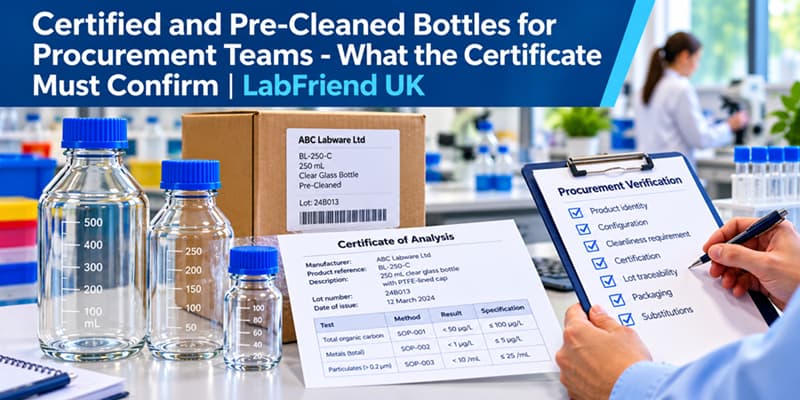
The detailed process for checking certificates and
procurement documentation belongs in Certified
and Pre-Cleaned Bottles for Procurement Teams - What the Certificate Must
Confirm.
Match the Container to the Analytical Method
Where the analytical method specifies a container
characteristic, that requirement should control the selection.
The method may specify or imply requirements concerning:
- container
material;
- volume;
- cleanliness;
- preparation;
- preservation;
- contamination
control;
- sample
storage;
- holding
conditions; or
- other
sample-contacting characteristics.
Do not replace a method-specific requirement with a generic
statement that a bottle is “certified”, “pre-cleaned” or “high purity”.
The relevant question is whether the documented
characteristic addresses the actual requirement.
Where the method does not specify a particular container but
the laboratory has identified a contamination risk, the laboratory should
establish an appropriate container specification based on the analytical
requirements and its own controlled procedures.
When Is Certification Worth Considering?
Certification or documented pre-cleaning may be relevant
where container-derived contamination, residues or analyte loss could
materially affect the analytical result.
This can include workflows involving:
- trace-level
determinations;
- contamination-sensitive
measurements;
- defined
cleanliness requirements;
- method-specific
container preparation;
- analyte-specific
background concerns; or
- laboratory
procedures that require documented container characteristics.
These examples are not a universal list of applications
requiring certified bottles. The decision should remain based on the analytical
method, analyte, sample matrix, required analytical performance and the
specific container characteristic that needs to be controlled.
Where a standard laboratory bottle provides the
characteristics required by the method and the laboratory's quality controls,
additional certification may add little value. Where the required
characteristic cannot be established adequately from standard product
information, a documented certified or pre-cleaned option may provide a more
appropriate basis for selection.
Packaging and Handling Still Matter
A container's documented condition can be undermined if the
packaging or subsequent handling does not maintain the required state.
Consider:
- how
the bottles are packaged;
- whether
individual containers are protected from contamination;
- how
packaging is opened;
- how
unused bottles are stored;
- whether
the bottle remains protected until use; and
- whether
the laboratory has defined handling requirements.

The specific controls required will depend on the product
and laboratory procedure.
The important principle is that container cleanliness is
not solely a property of the bottle before it reaches the laboratory. The
condition required for the application also needs to be maintained through
storage and handling.
Do Not Treat Certification as a Substitute for Method Control
A certified or pre-cleaned bottle can address a defined
container characteristic, but it does not replace the wider analytical
controls.
Sample integrity can also depend on:
- the
sampling procedure;
- preservation;
- transport;
- storage;
- preparation;
- analytical
method;
- laboratory
handling; and
- contamination
controls elsewhere in the workflow.
Certification should therefore be regarded as one part of a
controlled analytical workflow where it is required.
The presence of a certificate does not by itself establish
that the entire sampling or analytical process is suitable.
A Practical Certified and Pre-Cleaned Bottle Selection Framework
Use this sequence to apply the selection principles above to
a specific laboratory requirement:

1. Define the analytical requirement
Identify the analyte, sample matrix and applicable method.
2. Identify the container-related risk
Establish whether contamination, residues, adsorption,
absorption or other container interactions could affect the result.
3. Define the characteristic that needs to be controlled
Specify whether the requirement concerns material,
cleanliness, preparation, residue level, certification or another documented
characteristic.
4. Determine whether the available evidence is sufficient
Review the product information against the defined
requirement. Where product information does not adequately establish analytical
suitability, consider whether existing method validation data, relevant
container blank results or other laboratory verification evidence support the
proposed container. Do not assume that a bottle is unsuitable solely because it
lacks a certificate, or suitable solely because a certificate is supplied.
5. Select an appropriate container
Where additional documented characteristics are justified,
consider a certified or pre-cleaned option whose documented characteristics
address the defined requirement.
6. Check the supporting documentation
Confirm that the documentation relates to the relevant
product and characteristic and is meaningful for the intended workflow.
7. Confirm storage and handling
Ensure that the required container condition can be
maintained through storage and handling until use.
This framework should be applied to the actual analytical
requirement rather than used as a rule that certification is always preferable.
Common Selection Mistakes
Assuming every trace-analysis application requires
certification
Trace analysis covers a wide range of analytical
requirements.
Better approach: establish the actual contamination,
material and documentation requirements of the method.
Treating “pre-cleaned” as a universal cleanliness
specification
Pre-cleaning describes a process, not necessarily the
complete analytical suitability of the resulting container.
Better approach: establish what the cleaning process
controls and whether that matches the application.
Assuming certification means suitability for every
analyte
A certificate may address a defined characteristic or set of
characteristics.
Better approach: examine the documented scope against
the actual analytical requirement.
Confusing sterile with trace-clean
Sterility and analytical cleanliness answer different
questions.
Better approach: specify the characteristic required
by the workflow rather than using one term as a substitute for another.
Selecting by bottle material alone
Material identity does not establish that a container is
analytically neutral for every application.
Better approach: consider material, surface
interactions, sample matrix and method requirements together.
Ignoring the sample matrix
Container suitability can depend on what is actually placed
in the bottle.
Better approach: assess the complete sample-container
interaction rather than selecting by analyte name alone.
Treating a certificate as proof of complete method
suitability
A container certificate does not validate the analytical
method or the entire sample-handling process.
Better approach: use certification to support the
specific container characteristic it documents.
Focusing on the certificate but ignoring packaging
A required container condition needs to be maintained
through storage and handling.
Better approach: consider packaging and handling as
part of the complete workflow.
Certified and Pre-Cleaned Bottle Selection Checklist
|
Check |
Question |
|
Analytical requirement |
What analyte or determination is being performed? |
|
Method |
Does the applicable method specify a container
requirement? |
|
Contamination risk |
Could container-derived background or residues affect the
result? |
|
Material |
Is the bottle material appropriate for the sample and
analytical requirement? |
|
Surface interaction |
Could adsorption, absorption or container-derived
substances affect the analysis? |
|
Contact and storage conditions |
Are the container and closure suitable for the expected
sample contact time, temperature, preservation conditions and any applicable
transport or storage requirements? |
|
Cleanliness |
What specific cleanliness characteristic needs to be
controlled? |
|
Preparation |
Is a defined cleaning or preparation process required? |
|
Certification |
Is documented evidence required for the relevant
characteristic? |
|
Documentation scope |
Does the supporting documentation actually cover the
required characteristic? |
|
Packaging |
Will the packaging maintain the required container
condition? |
|
Handling |
Are storage and handling controls appropriate? |
|
Traceability |
Does the workflow require product or lot information to be
retained? |
If a critical requirement cannot be established, resolve it
before treating the container as suitable for the intended application.
Frequently Asked Questions
When do laboratories need certified or pre-cleaned
bottles?
Laboratories may need certified or pre-cleaned bottles when
the analytical method or contamination risk makes defined container
cleanliness, preparation or documented characteristics important to the result.
Not every trace-analysis application requires certification. The appropriate
container depends on the analyte, sample matrix, method and potential effect of
container-derived contamination or analyte loss.
Are certified and pre-cleaned laboratory bottles the same
thing?
No. A pre-cleaned bottle has undergone cleaning before
supply, but the term alone does not establish which cleaning procedure was
used, whether that procedure was documented, or what level of cleanliness was
achieved. Certification refers to documentation supporting specified product
characteristics. The two descriptions can overlap, but neither term should
automatically be treated as establishing suitability for every analytical
application.
Does a sterile bottle provide the same assurance as a
certified pre-cleaned bottle?
No. Sterility and analytical cleanliness are different
characteristics. A sterile bottle is not automatically suitable for a
trace-analysis requirement involving specific residues, analytes or
contamination limits. Conversely, a certified or pre-cleaned bottle should not
automatically be described as sterile. Select the container characteristic
required by the analytical method and workflow.
What should a laboratory establish before choosing a
certified bottle?
First establish the analytical requirement, including the
analyte, sample matrix, applicable method and potential container-related
contamination risk. Then identify the specific container characteristic that
needs to be controlled and determine whether the product documentation supports
it. A general certification claim should not be treated as evidence of
suitability for every analytical requirement.
Can a standard laboratory bottle be used for trace
analysis?
Yes, where the standard bottle provides the characteristics
required by the analytical method and the laboratory's contamination controls.
Trace analysis does not automatically require a certified or pre-cleaned
bottle. The decision should be based on the sensitivity of the determination,
sample matrix, container interactions and any method-specific or
laboratory-defined requirements.
Choosing the Right Level of Container Control
The objective is not to select the most highly specified
bottle available. It is to select a container with characteristics and
supporting evidence appropriate to the analytical requirement.
Start with the method, analyte and sample matrix. Define the
container characteristic that needs to be controlled, then assess whether the
available product information and laboratory evidence provide sufficient
support.
Where additional documented cleanliness or certification is
justified, confirm that the selected product's documentation addresses the
relevant requirement. Maintain the required container condition through
packaging, storage and handling, and retain appropriate product or lot
information where the workflow requires it.
For laboratories looking to compare suitable options, browse certified laboratory bottle options. For broader bottle formats, browse Laboratory Consumables & Glassware.
Read More
- Laboratory Bottles: Selection Guide for UK Laboratories
- Laboratory Bottle Materials Explained - Borosilicate Glass, Amber Glass, HDPE, LDPE and PP
Explore More
Written by: Donal O’Sullivan, BSc, Co-Founder and Sales Director, LabFriend UK. Donal brings deep chemistry-led technical expertise across analytical chemistry, biochemistry, environmental monitoring, laboratory instrumentation, consumables and scientific product selection.
Reviewed by: Michael Anderson, MBA, Founder and Managing Director, LabFriend UK. Michael reviews LabFriend UK content for customer relevance, commercial accuracy, operational practicality and alignment with LabFriend UK’s laboratory supply model.
Frequently asked questions
Delivery times vary by product and supplier. Each product page shows current stock levels and the expected lead time, and we confirm this when you place your order. Most items arrive within 2 to 3 weeks. Specialised items can take longer if they are not in stock. If you need something by a certain date, contact us and we’ll check for you.
Yes. Register for a commercial account and, once it’s approved, you will be able to process orders via PO Once you have a commercial account, you can directly email your purchase orders
Add products to your cart and click Get a Quote. You’ll get a formal quote instantly, ready to send to your email address. For bulk orders or custom requirements, send us your product list and we’ll reply with itemized pricing.
If your item is faulty, not as described or sent in error, let us know within 14 days of delivery and we’ll arrange a return. Change of mind returns are only accepted if the item is unused and in its original packaging. A restocking fee will apply and you pay the return freight. Read our full Returns Policy for details.
Yes, prices are shown including GST by default. Use the Prices Inc. GST toggle at the top of the page to view prices without GST.