

Share :
Laboratory Bottles: Selection Guide for UK Laboratories
Updated On 07/17/2026

By Donal O’Sullivan, BSc. Reviewed by Michael Anderson, MBA.
Quick Links
Choosing the right laboratory bottle is not just a matter of volume. The correct bottle depends on what you are storing, how the bottle will be handled, whether the contents are light-sensitive, whether sterility matters, whether the bottle needs to be autoclaved, and how often the product will be reordered.
Quick answer: how to choose a laboratory bottle
|
Choose a laboratory bottle by first checking the substance or sample requirements, then confirming chemical compatibility, sample integrity, bottle material, mouth style, closure system, sterility or autoclavability requirements, and repeat-order availability. For hazardous substances, always check the SDS, COSHH assessment and local laboratory procedures before selecting the bottle. |
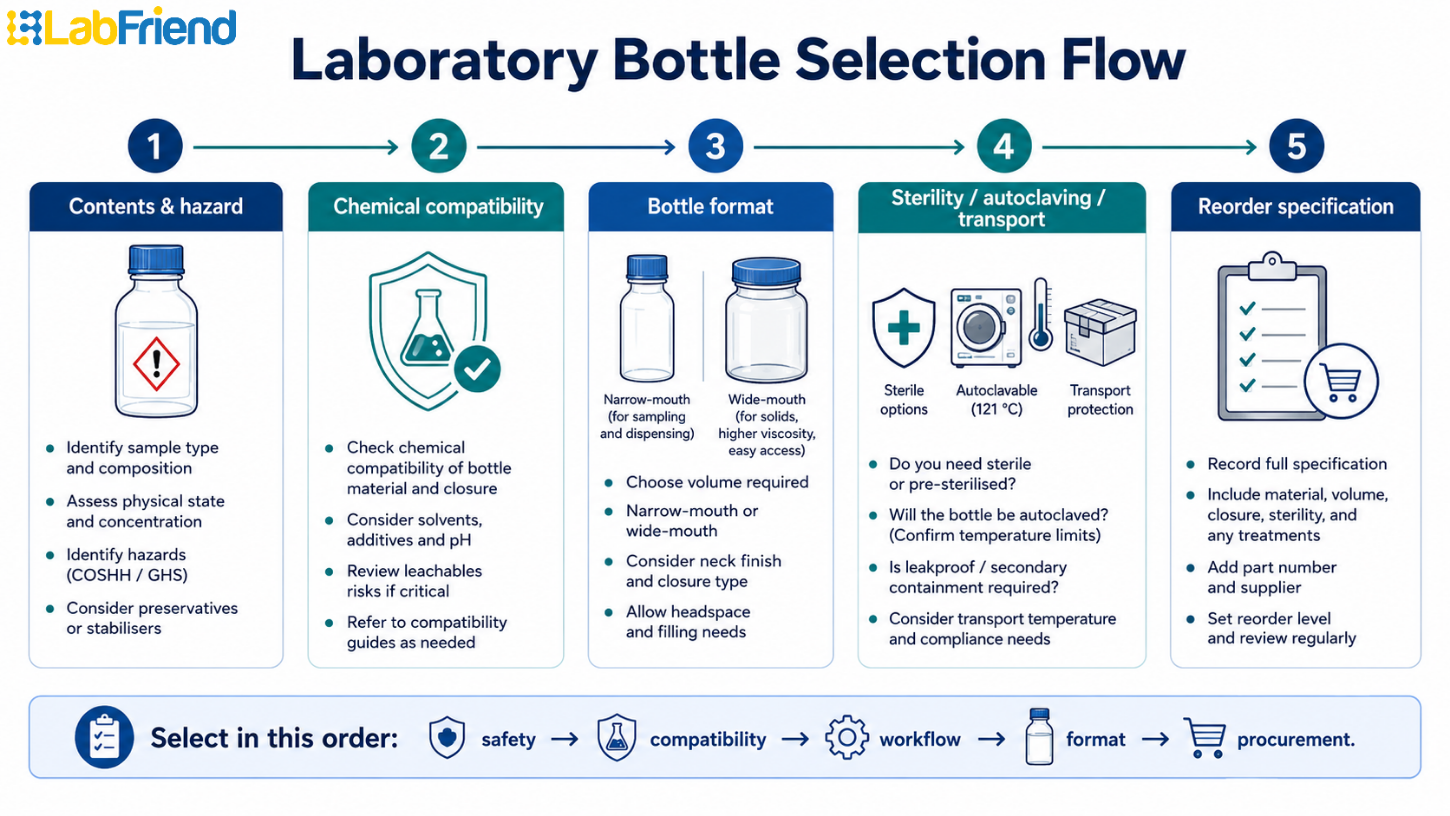
The 5-step laboratory bottle selection framework
For UK laboratories, the practical decision usually comes down to five questions:
- What will the bottle contain and what do the SDS/COSHH assessment require?
- Could the bottle or closure affect chemical compatibility or sample integrity?
- What format is needed for filling, pouring, storage or cleaning?
- Are sterility, autoclaving, temperature or transport requirements relevant?
- Can the exact specification be reordered consistently?
Who this guide is for:
- scientists selecting bottles for reagents, samples and routine workflows
- lab managers standardising bottle types and reducing stockouts
- procurement teams comparing specifications, quote requirements and repeat supply options
- CROs, testing labs and biotech teams that need reliable consumables supply
LabFriend UK supplies a wide range of laboratory vessels and bottle types through its online catalogue, supporting UK laboratories with specification-led product selection, transparent pricing and practical ordering routes. This aligns with LabFriend’s wider role as a 100% online UK laboratory equipment and consumables supplier focused on value, specification clarity and efficient purchasing.
Why laboratory bottle selection matters
Laboratory bottles are often treated as simple consumables, but the wrong bottle can create practical problems:
- poor chemical compatibility
- contamination risk
- sample loss or leakage
- unsuitable caps or closures
- difficult filling, pouring or cleaning
- unnecessary over-specification
- stockouts in recurring workflows
- fragmented purchasing across too many SKUs
For routine laboratories, especially CROs, independent testing laboratories, SME biotech companies and university research groups, bottles are part of the operational infrastructure that keeps sample handling, reagent storage and day-to-day workflows moving. These customer groups typically value availability, clear specifications, price transparency and reliable supply over legacy supplier loyalty.
Sample integrity considerations: For analytical work, confirm that the bottle material and closure will not adsorb analytes, leach contaminants, alter pH, permit unacceptable evaporation/permeation, or compromise trace-level analysis.
For hazardous chemicals, bottle selection should be made alongside the substance SDS, COSHH assessment, chemical compatibility data, segregation requirements and local storage procedures. Container material suitability does not replace hazardous-substance storage controls.
The right bottle choice supports three outcomes:
Reliable storage and handling.
Precise matching of product specification to workflow.
Delivered through a purchasing process that is simple, quick and repeatable.
Quick selection guide: which laboratory bottle should you choose (two parts)?
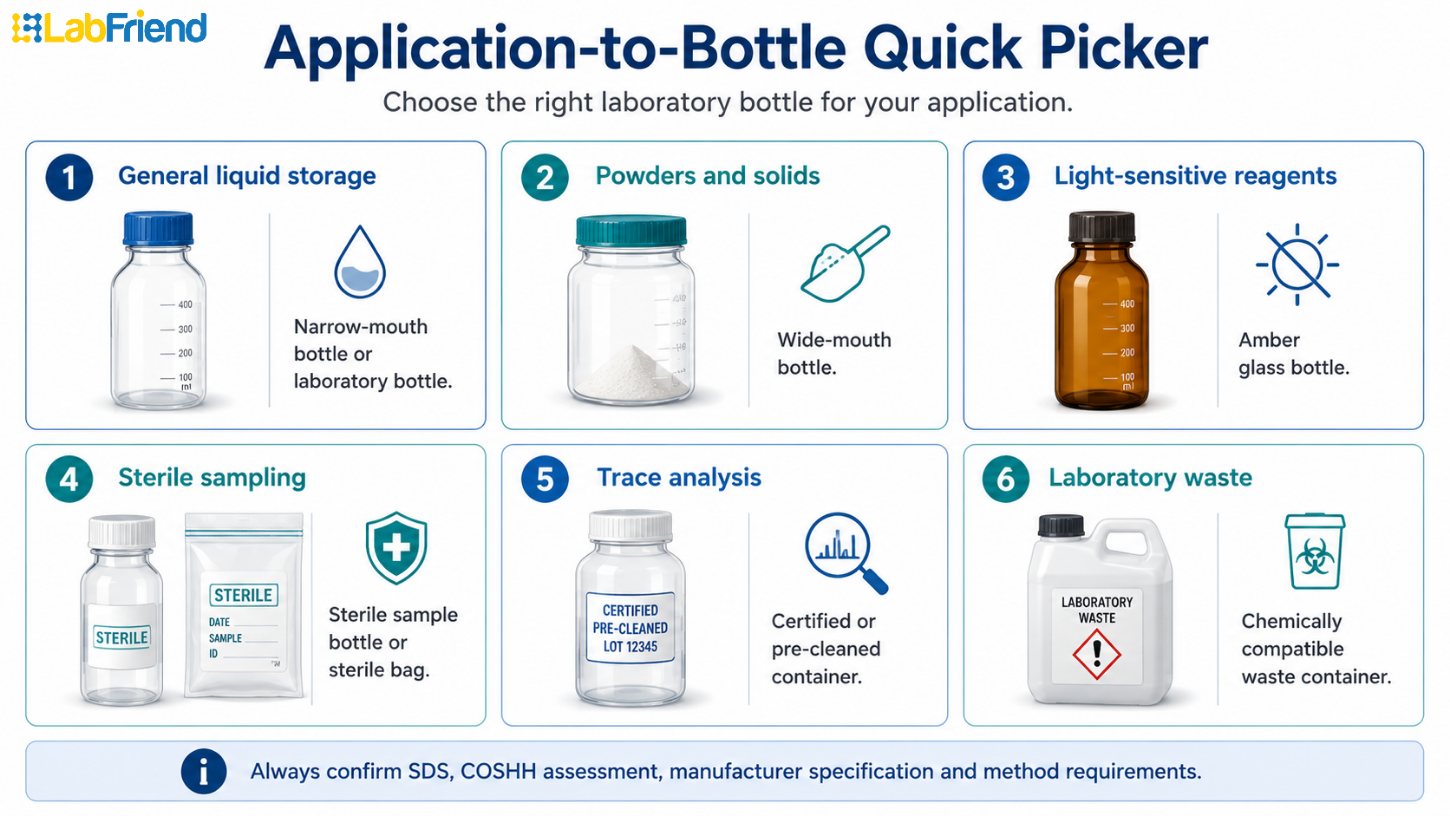
Table 1 Application, bottle type and material
|
Application |
Common bottle type |
Typical material options |
|
General liquid storage |
Laboratory bottle, narrow-mouth bottle |
Glass, HDPE, PP |
|
Reagent storage |
Reagent bottle |
Borosilicate glass, amber glass, suitable plastic where specified |
|
Powder or solid storage |
Wide-mouth bottle |
HDPE, PP, glass |
|
Space-efficient storage |
Square bottle |
Plastic or glass depending on range |
|
Sterile sampling |
Sterile bottles or sterile bags |
Product-specific sterile formats |
|
Controlled pouring |
Narrow-mouth bottle |
Glass, HDPE, LDPE, PP |
|
Washing/rinsing |
Wash bottle |
LDPE or suitable plastic |
|
Larger-volume storage |
Carboy or aspirator bottle |
Plastic or glass depending on application |
|
Sample transport or field collection |
Sample bottle, sterile bottle, transport container |
HDPE, PP, glass, amber glass, sterile formats as required |
|
Trace analysis or regulated testing |
Certified/pre-cleaned or method-specified bottle |
Glass, amber glass, HDPE, PP, certified or pre-cleaned formats |
|
Laboratory waste collection |
Waste bottle or chemically compatible waste container |
HDPE, PP, glass or product-specific container |
Table 2 Application and risk-critical checks
|
Application |
Key selection checks |
Do not overlook |
|
General liquid storage |
Volume, cap type, chemical compatibility, graduation |
SDS/COSHH assessment Closure liner compatibility Storage temperature, Evaporation, permeation or degradation risk |
|
Reagent storage |
Light sensitivity, cap/thread, chemical resistance, labelling field |
Specific reagent, Concentration, Storage duration, Amber protection, Secondary containment and contamination risk |
|
Powder or solid storage |
Opening diameter, ease of filling, closure fit |
Dust exposure, Hygroscopicity, Moisture sensitivity, Static charge, Cross-contamination risk and seal integrity |
|
Space-efficient storage |
Bench, fridge or storage footprint; labelling area; cap compatibility |
Rack/fridge fit, Stability, Cleaning practicality, Label visibility Compatibility with storage conditions |
|
Sterile sampling |
Sterility status, packaging, volume, closure integrity |
Sterility documentation, Lot traceability, Expiry date, Packaging integrity, Preservatives, DNase/RNase-free or endotoxin status where relevant |
|
Controlled pouring |
Pouring control, cap compatibility, spillage risk |
Viscosity suitability, Venting needs, Safe handling of corrosive or volatile liquids, Compatibility of cap, liner and pouring ring |
|
Washing/rinsing |
Dispensing nozzle, chemical suitability, labelling |
Solvent compatibility, Nozzle material compatibility, Clear hazard labelling Whether contents are suitable for open dispensing |
|
Larger-volume storage |
Capacity, tap/closure, handling, storage location |
Do not connect to pressure, vacuum or dispensing systems unless the
Are each rated for that use. |
|
Sample transport or field collection |
Sample volume, closure integrity, sterility, labelling, storage conditions |
Method-specific container requirements,
|
|
Trace analysis or regulated testing |
Method suitability, contamination control, closure type, documentation |
Analyte adsorption, Extractables/leachables, Trace-metal or organic contamination, Certificate availability, What the certificate covers, Lot traceability and chain-of-custody requirements. |
|
Laboratory waste collection |
Waste stream compatibility, cap/seal, labelling, fill level, secondary containment |
Incompatible waste mixing, Gas generation, Pressure build-up, Flammable vapours, Corrosivity, Local waste procedures, Disposal contractor requirements, And use of vented caps only where specified by the waste procedure and compatible with the hazard |
Main types of laboratory bottles
1. Laboratory reagent bottles
Reagent bottles are designed for storing reagents, chemicals, solutions and prepared laboratory liquids. They are often available in clear or amber formats, depending on whether the contents need protection from light.
They are commonly used in:
- QA/QC laboratories
- analytical laboratories
- university research labs
- industrial testing laboratories
- biotech and CRO workflows
- teaching laboratories
When choosing reagent bottles, check:
- material
- volume
- thread type
- cap material
- graduation
- labelling area
- clear or amber format
- autoclavability where specified
- manufacturer specification and chemical compatibility data.
Amber reagent bottles are generally selected when the contents are light-sensitive. Clear bottles are useful where visibility of the contents is important. Always confirm product suitability against the manufacturer’s specification and the chemicals or solutions being stored.
Need reagent bottles for routine laboratory use?
Compare laboratory reagent bottles by material, volume, cap type and clear or amber format. If you are standardising repeat supply across your lab, LabFriend UK can help you identify suitable options and provide a quote.
Browse Laboratory Reagent Bottles | Request an Instant Quote
2. Narrow-mouth laboratory bottles
Narrow-mouth bottles are often preferred where controlled pouring is important. The smaller opening can help reduce spillage risk when transferring liquids, especially during routine bench work.
They are commonly used for:
- liquid storage
- reagent handling
- sample storage
- controlled dispensing
- routine laboratory workflows
Narrow-mouth bottles are usually less suitable where users need to add powders, solids or viscous materials, or where the bottle needs frequent manual cleaning.
Best for: controlled pouring and routine liquid handling.
Check before buying: cap/thread compatibility, material suitability and required volume.
Need bottles for controlled liquid handling?
Narrow-mouth laboratory bottles are useful where controlled pouring, routine liquid storage and reduced spillage risk matter. Choose by material, volume, cap/thread compatibility and the chemical or sample requirements of the workflow
Browse Narrow-Mouth Bottles | Request an Instant Quote
3. Wide-mouth laboratory bottles
Wide-mouth bottles have a larger opening, making them easier to fill, empty and clean. They are useful where powders, solids, samples or larger-volume materials need to be transferred into or out of the bottle.
They are commonly used for:
- powders
- solids
- samples
- easier filling
- cleaning access
- bulk storage of compatible materials
For lab managers, wide-mouth bottles can reduce handling frustration where teams frequently transfer materials into containers manually.
Best for: powders, solids, samples and easier access.
Check before buying: closure fit, material compatibility, sample handling requirements and storage conditions.
Handling powders, solids or samples?
Wide-mouth laboratory bottles make filling, emptying and cleaning easier where powders, solids, samples or viscous materials are involved. Compare options by material, opening size, closure type, volume and storage conditions before ordering.
Browse Wide-Mouth Bottles | Request an Instant Quote
4. Square laboratory bottles
Square bottles are useful where storage efficiency matters. Their shape can make better use of space in cupboards, refrigerators, storage trays and sample organisation systems.
They are commonly used for:
- sample storage
- organised bench storage
- fridge or cold-room storage
- stockroom standardisation
- laboratories with limited storage space
Square bottles are especially relevant for lab managers who want to rationalise storage areas and reduce wasted space.
Best for: space-saving storage and organised sample handling.
Check before buying: material, cap type, labelling area, volume and whether the bottle shape suits the storage location.
Need to improve storage space and bottle organisation?
Square laboratory bottles can help labs make better use of bench, cupboard, fridge or sample storage space. They are especially useful where visibility, labelling, standardisation and efficient storage layout matter.
Browse Square Bottles | Request an Instant Quote
5. Sterile bottles and sterile sample containers
Sterile bottles and related sterile containers are used where contamination control is important. This includes microbiology, environmental testing, water testing, food testing and certain biotech workflows.
Before choosing a sterile bottle, check:
- whether the product is supplied sterile
- packaging format
- volume
- closure type
- intended application
- sample transport requirements
- documentation provided by the manufacturer
Do not assume that a bottle is sterile, autoclavable or suitable for a regulated workflow unless this is clearly stated in the manufacturer’s product specification.
For regulated or contamination-sensitive workflows, confirm the sterility assurance information, lot traceability, certificate availability, expiry/shelf life, packaging integrity and any application-specific requirements. Examples may include sodium thiosulfate for specified chlorinated-water sampling, DNase/RNase-free status for molecular workflows, or endotoxin control for pyrogen-sensitive applications.
Best for: contamination-sensitive sampling and workflows requiring sterile containers.
Check before buying: sterility status, packaging and intended use.
Working with sterile or contamination-sensitive samples?
Sterile bottles and sterile sample containers should be selected by sterility status, packaging integrity, closure type, volume, expiry or shelf life, and any workflow-specific requirements such as preservatives, trace analysis, DNase/RNase-free status or endotoxin control.
Browse Sterile Bottles and Bags
Contact LabFriend UK for Help Choosing
Glass vs plastic laboratory bottles
One of the most important selection decisions is whether to choose glass or plastic.
Glass laboratory bottles
Glass bottles are widely used for reagent storage, chemical handling and laboratory workflows where clarity, chemical resistance and reusability are important. Borosilicate glass is commonly used in laboratory glassware because it offers better resistance to thermal shock than soda-lime glass, although suitability still depends on the product and application.
Glass bottles may be preferred when:
- visibility is important
- the bottle needs to resist staining
- the workflow involves certain reagents or solvents
- the lab wants reusable storage vessels
- amber glass is needed for light-sensitive contents because it reduces exposure to selected wavelengths, particularly in the UV/visible region, but protection depends on the substance, light source, exposure time and bottle specification.
Potential limitations include breakage risk, higher weight and the need to confirm thermal and chemical suitability.
Glass is not universally compatible. For example, hydrofluoric acid and some strong alkaline or aggressive conditions can attack glass. Confirm compatibility for the specific chemical, concentration, temperature and storage duration.
Plastic laboratory bottles
Plastic bottles are often selected for routine storage, transport, sample handling and applications where breakage risk or weight matters. Common materials include HDPE, LDPE and PP, depending on the product range and application.
Plastic bottles may be preferred when:
- breakage risk must be reduced
- lightweight handling is useful
- samples need to be transported
- routine consumable cost matters
- glass is not required by the method, chemical compatibility assessment or sample-integrity requirements.
Potential limitations include chemical compatibility, temperature limits, staining, permeability and suitability for sterilisation or reuse. Reuse should depend on cleaning effectiveness, inspection, closure condition, previous contents and the sensitivity of the intended application. Regulated or trace workflows may require defined cleaning procedures or single-use containers.
Avoid reusing bottles for trace, sterile or biological workflows if prior contents could adsorb to the container, leave residues, compromise sterility or interfere with the intended analysis.
Plastic compatibility should be checked at the intended concentration, temperature and storage duration. Solvent permeation, swelling, stress cracking or loss of mechanical strength may occur even where short-term exposure appears acceptable.
Glass or plastic: quick comparison
|
Selection factor |
Glass bottles |
Plastic bottles |
|
Visibility |
Usually excellent |
Varies by material |
|
Breakage risk |
Higher |
Lower |
|
Weight |
Heavier |
Lighter |
|
Chemical compatibility |
Often strong, but application-specific |
Highly material-dependent |
|
Reusability |
Often suitable where cleaned correctly |
Depends on product and workflow |
|
Autoclavability |
Product-specific |
Product-specific |
|
Light-sensitive contents |
Amber glass often useful |
Opaque or amber plastic may be available depending on range |
|
Transport handling |
Less ideal due to breakage |
Often easier |
|
Cost control |
May have higher upfront cost |
Often practical for routine usage |
Practical rule: choose the material based on the stored substance, handling conditions, cleaning/sterilisation needs and manufacturer specification — not price alone.
Laboratory bottle materials explained
Borosilicate glass
Borosilicate glass is commonly used in laboratory bottles and glassware because it is durable and suitable for many routine laboratory applications. It is often chosen for reagent bottles and general laboratory storage.
Use cases may include:
- reagent storage
- general chemical handling
- laboratory solution storage
- workflows needing visibility
- reusable vessel systems
Check the product specification for thermal resistance, cap compatibility, thread type and any application limitations. Where relevant, check whether glass bottles conform to recognised laboratory glassware standards such as ISO 4796-1 and whether the material is borosilicate 3.3 or another specified glass type.
Amber glass
Amber glass bottles help reduce light exposure and are commonly selected for light-sensitive substances.
Use cases may include:
- light-sensitive reagents
- prepared solutions requiring reduced light exposure
- certain analytical or QA/QC workflows
Amber glass should not be treated as a universal protection method. Always check the requirements of the stored material and relevant manufacturer or method guidance.
HDPE
HDPE bottles are widely used in laboratories for robust plastic storage and handling. They are often selected where breakage resistance, weight reduction and practical everyday use matter.
Use cases may include:
- routine liquid storage
- sample handling
- general lab storage
- field or testing workflows where plastic is preferred
Chemical compatibility must always be checked.
LDPE
LDPE is flexible and commonly associated with wash bottles and dispensing applications.
Use cases may include:
- wash bottles
- rinse bottles
- flexible dispensing containers
Check chemical compatibility, labelling needs and dispensing nozzle requirements.
PP
Polypropylene is commonly used in laboratory consumables and may be selected where product-specific temperature or sterilisation properties are required.
Use cases may include:
- certain autoclavable containers where specified
- sample handling
- routine lab storage
- compatible closure systems
Always confirm the manufacturer’s specification before using PP bottles in autoclave or temperature-sensitive workflows.
Narrow-mouth vs wide-mouth bottles
Choosing the opening style is often as important as choosing the material.
Choose narrow-mouth bottles when:
- the contents are liquids
- controlled pouring matters
- spillage reduction is important
- the bottle does not need frequent manual cleaning
- the contents are transferred through a funnel or controlled pour
Choose wide-mouth bottles when:
- the contents are powders or solids
- users need easier filling
- access for cleaning is important
- samples are added manually
- the bottle is used in practical bench workflows with frequent handling
Choose square bottles when:
- storage space is limited
- bottles need to be arranged neatly
- the lab wants better fridge or cupboard utilisation
- sample organisation matters
- labelling and visibility are important
Square bottles can improve storage density, but confirm rack fit, access, cleaning practicality, label visibility and closure compatibility before standardising.
Caps, closures and thread compatibility
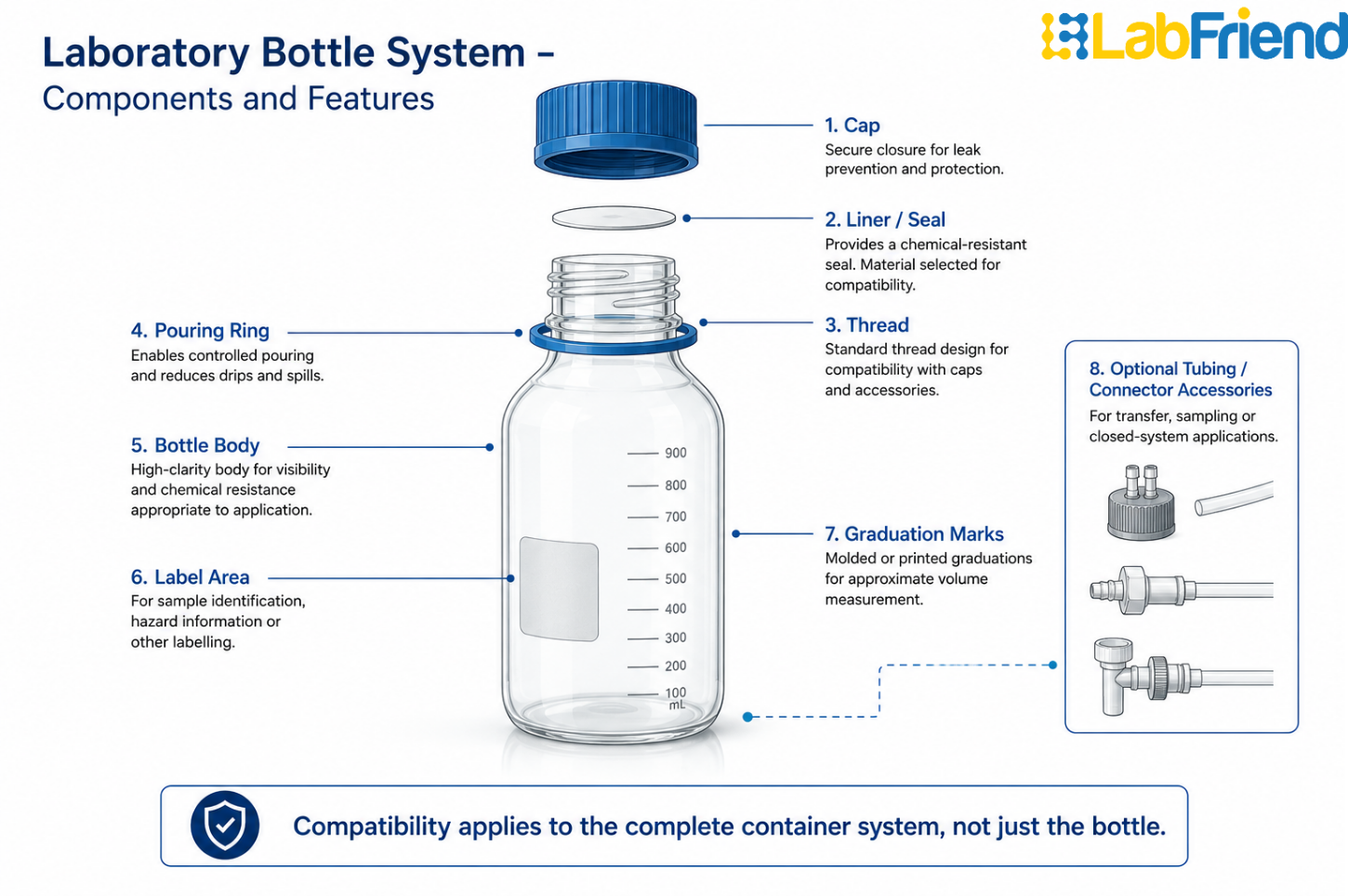
A laboratory bottle is only useful if the closure is suitable for the workflow. Mismatched caps or closures can lead to leakage, evaporation, contamination risk, poor sealing or reorder errors.
Before purchasing or reordering bottles and caps, check:
- thread type
- cap material
- liner or seal type if relevant
- compatibility with the bottle material
- temperature or autoclave suitability where specified
- chemical exposure
- leak resistance requirements
- manufacturer part number
- pack size
For procurement teams, cap compatibility is a common source of purchasing errors. When requesting a quote, provide the bottle brand, thread type, volume, material and any existing product code where possible.
Remember, assess the complete container system: bottle body, cap, liner, seal, pouring ring and any tubing or connector accessories. A chemically resistant bottle body does not guarantee that the closure system is suitable.
Autoclavable laboratory bottles: what to check
Some laboratory bottles are suitable for autoclaving, but this must never be assumed.
Before using any bottle in an autoclave, check:
- whether the bottle itself is specified as autoclavable
- whether the cap is autoclavable
- whether the pouring ring is autoclavable
- whether the bottle can be autoclaved with the cap fitted or loosened
- maximum temperature and pressure guidance
- manufacturer instructions
- whether repeated autoclaving may affect product performance
- whether the application requires sterile product supplied from the manufacturer instead
Important: “Autoclavable” and “supplied sterile” are not the same thing. A product may be autoclavable without being supplied sterile, and a sterile product may not necessarily be suitable for repeated autoclaving unless specified.
Never autoclave a sealed non-vented bottle unless the manufacturer specifically permits it. For liquid loads, follow the manufacturer’s fill-volume, cap-loosening/venting, cooling and handling instructions to reduce pressure and breakage risk.
Standard laboratory bottles are storage vessels, not pressure-rated vessels. Do not use them for sealed heating, gas-generating reactions, vacuum service or pressure transfer unless the specific bottle system is rated for that use.
UK laboratory safety and compliance considerations
For UK laboratories, bottle selection should be based on safety, compatibility and sample integrity — not volume or price alone. Where bottles are used for chemicals, reagents, solvents, samples or waste, the choice should align with the laboratory’s COSHH assessment, safety data sheet and any method-specific requirements.
Before selecting a bottle, check:
- Chemical compatibility
Confirm that the bottle body, cap, liner, seal and pouring ring are compatible with the specific substance, concentration, temperature and storage duration. Compatibility applies to the full container system, not just the bottle material
- Hazard and storage requirements
Use the SDS and local risk assessment to identify whether the material is flammable, corrosive, oxidising, toxic, volatile, light-sensitive or moisture-sensitive. Check whether segregation, secondary containment, ventilated storage or special labelling is required.
- Sterility and sample integrity
For microbiology, water, food, environmental, biotech or analytical workflows, confirm whether the bottle must be sterile, lot-traceable, preservative-treated, DNase/RNase-free, endotoxin-controlled or suitable for trace analysis. The container should not adsorb analytes, leach contaminants or compromise the sample.
- Autoclaving and temperature use
Do not assume glass or plastic bottles are autoclavable. Confirm the bottle, cap and accessories are suitable for the intended temperature and pressure conditions. Never autoclave a sealed, non-vented bottle unless the manufacturer specifically permits it.
- Transport and external sampling
If bottles are used outside the laboratory, check whether the sample or chemical requires compliant transport packaging, secondary containment, absorbent material, labelling or documentation. A standard storage bottle may not be sufficient for regulated transport.
- Labelling and traceability
Bottles should support clear labelling of contents, concentration, hazards, preparation date, expiry or review date, owner, and storage conditions. For controlled or accredited workflows, product codes, batch numbers, sterility status and expiry dates may also need to be recorded.
Avoid decanting hazardous substances into unlabelled or poorly labelled secondary containers. Any secondary container should be labelled clearly enough to identify the contents, concentration where relevant, hazards, preparation or transfer date, and responsible user.
In practice, UK laboratories should select bottles in this order: safety and compliance first, then chemical/sample compatibility, workflow requirements, physical format and procurement convenience.
Laboratory bottles for common UK laboratory workflows
Reagent preparation and storage
For reagent preparation, the most important factors are material compatibility, volume, closure, labelling area and whether amber protection is required. Bottle choice should also reflect the reagent’s concentration, storage temperature, light sensitivity and expected storage duration.
Common choices include:
- clear glass reagent bottles for general reagent visibility;
- amber glass reagent bottles for light-sensitive reagents or prepared solutions;
- suitable plastic storage bottles where chemical compatibility has been confirmed;
- bottles with graduation marks for approximate volume checks;
- bottles with secure screw caps and compatible liners or seals.
For hazardous or reactive reagents, selection should be checked against the SDS, COSHH assessment, segregation requirements and manufacturer compatibility data.
Environmental, water and food testing
Testing laboratories often use bottles as part of recurring sample collection, sample transport and sample storage workflows. In these settings, the bottle may be part of the analytical method, not just a container.
Selection factors include:
- sample volume;
- sterile or non-sterile requirement;
- closure integrity;
- transport handling;
- labelling area;
- contamination risk;
- repeat supply availability;
- storage conditions;
- preservative requirements;
- holding time and temperature control.
Technical examples include water-testing bottles containing sodium thiosulfate where required for chlorinated samples, amber bottles for light-sensitive analytes, or pre-cleaned containers for trace organic or trace-metal analysis. For external transport, especially hazardous, biological or regulated samples, confirm applicable packaging, labelling and documentation requirements; a storage bottle alone may not constitute compliant transport packaging.
For food testing, confirm that the container does not introduce target analytes, residues or contaminants that could interfere with the test method.
CRO and contract research workflows
CROs need bottle supply that supports active projects and avoids disruption. In these environments, bottle selection may be tied to a client-approved protocol, validated method or study-specific sampling plan, so uncontrolled substitutions can affect data consistency or regulatory acceptability.
Selection factors include:
- repeat availability;
- consistent product specification;
- project-specific bottle types;
- approved manufacturer or product codes;
- lot traceability where required;
- closure and liner consistency;
- account-level pricing;
- reorder reminders;
- quote speed;
- ability to standardise commonly used bottle formats.
Technical examples include method-locked container specifications for validated analytical studies, amber glass bottles for photolabile test articles, or certified/pre-cleaned containers where trace contamination could affect results. For regulated or client-audited work, any substitute bottle should be reviewed against the protocol, method validation assumptions and required documentation before use. Where applicable, substitutions should follow the laboratory’s change-control process.
SME biotech workflows
SME biotech laboratories often need flexible supply without the purchasing complexity of large pharma. Bottles may be used across reagent preparation, buffer storage, sterile workflows, sample handling, media preparation and general laboratory storage.
Selection factors include:
- reliable supply;
- ability to reorder quickly;
- product consistency;
- cost control;
- suitability for scaling workflows;
- simple quote and account setup;
- sterility or cleanliness requirements;
- compatibility with cold storage, autoclaving or aseptic handling.
Technical examples include sterile bottles for media or buffer handling, DNase/RNase-free containers for molecular biology workflows, and autoclavable bottles for reusable liquid storage where manufacturer instructions permit. For cell culture, microbiology or molecular workflows, confirm sterility status, packaging integrity, lot traceability and whether the bottle or closure could introduce contaminants, leachables or nucleases.
University research and teaching laboratories
University labs often need practical, cost-conscious bottle options for teaching, research and general laboratory work. Purchasing volumes may vary, but product clarity, suitability and ease of ordering remain important.
Selection factors include:
- budget;
- volume range;
- robustness;
- ease of use;
- suitability for teaching labs;
- repeat availability for core items;
- product alternatives where budgets are constrained;
- clear labelling and safe handling;
- breakage risk and cleaning practicality.
Technical examples include plastic bottles where reduced breakage risk is important in teaching laboratories, wide-mouth bottles for practical classes involving powders or solids, and clearly labelled reagent bottles for shared research spaces. For student-facing environments, prioritise robust containers, secure closures, legible hazard labelling and bottle formats that reduce spills, confusion and glass-breakage risk.
Procurement considerations for laboratory bottles
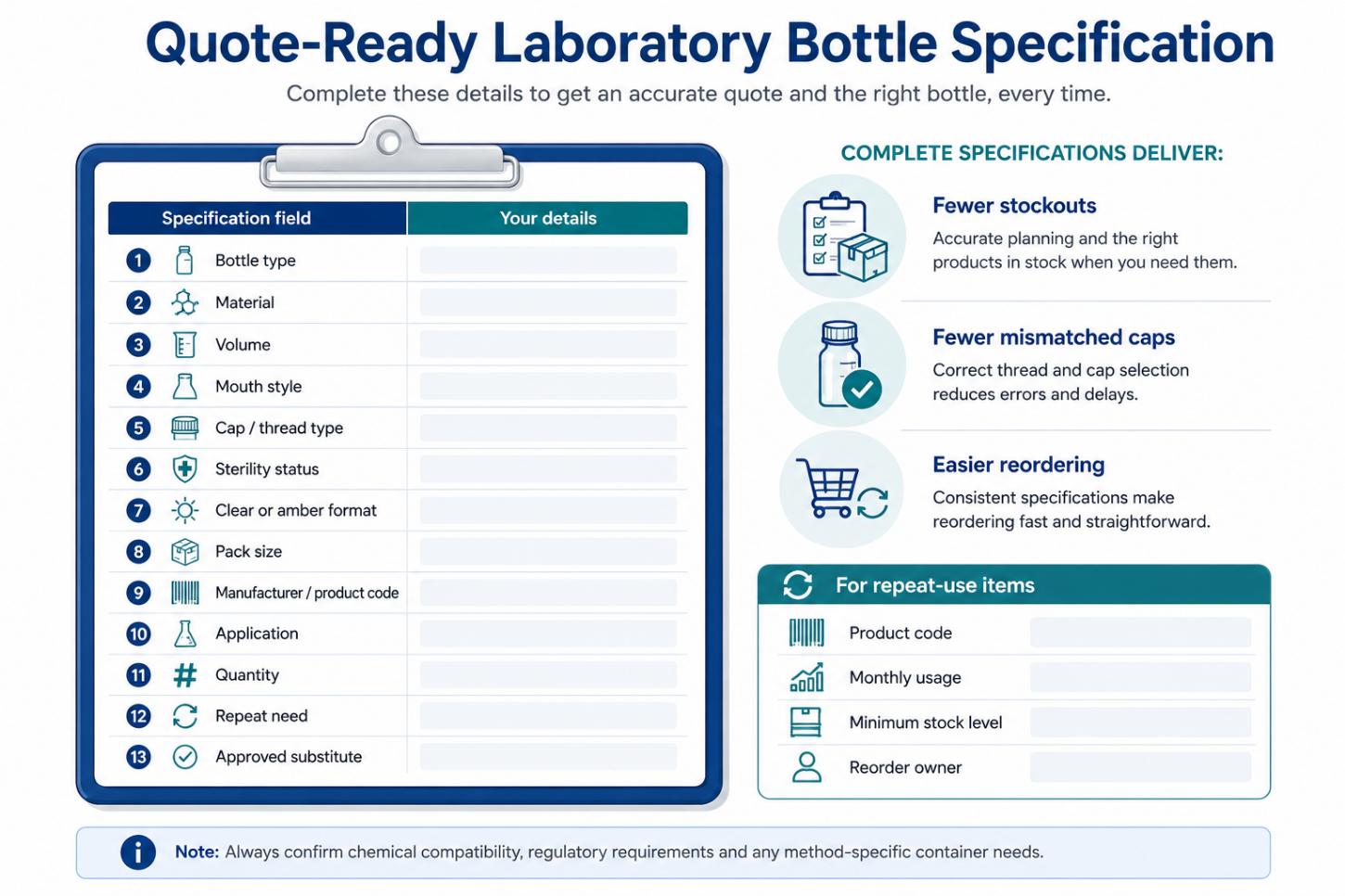
Procurement teams need enough technical information to buy correctly without overcomplicating the process. A good laboratory bottle purchase should specify:
- bottle type
- material
- volume
- mouth style
- cap/thread type
- sterility status if relevant
- clear or amber format
- pack size
- manufacturer or product code
- required delivery timeline
- whether the item is for one-off use or repeat supply
Quote-ready checklist
Before requesting a quote, gather:
|
Requirement |
Example |
|
Bottle type |
Reagent bottle, wide-mouth bottle, sterile sample bottle |
|
Material |
Glass, amber glass, HDPE, LDPE, PP |
|
Volume |
100 ml, 250 ml, 500 ml, 1 L, 2 L |
|
Closure |
Screw cap, GL thread, product-specific cap |
|
Sterile requirement |
Sterile / non-sterile / not required |
|
Application |
Reagent storage, sample collection, general storage |
|
Quantity |
Pack size or estimated monthly use |
|
Repeat need |
One-off / recurring / standing requirement |
|
Current supplier or product code |
Useful for matching or substitution |
For bottles used weekly or monthly, record:
- product code
- material
- volume
- cap/thread
- pack size
- monthly usage
- minimum stock level
- approved substitutes
- reorder owner
- preferred quote route
This helps LabFriend provide a faster and more accurate quote.
Contact us for a Quote | Generate That Quote Instantly yourself, find the product you want, add to basket and click “Request Quote”
Standardising laboratory bottle purchasing
For lab managers, one of the biggest opportunities is standardisation. Many laboratories accumulate too many bottle types over time, leading to duplicated SKUs, mismatched caps, inefficient storage and avoidable stockouts.
A practical standard bottle range might include:
- one or two common reagent bottle sizes
- one narrow-mouth bottle range for liquids
- one wide-mouth bottle range for powders or samples
- one square bottle option for storage efficiency
- one sterile bottle or sample container range where needed
- defined replacement caps or closures
- agreed reorder points for high-use items
This helps reduce:
- emergency purchases
- incorrect substitutions
- stockroom clutter
- inconsistent ordering
- time spent searching for equivalent products
LabFriend’s repeat-sales workflow already supports this style of account development: first orders from business customers should be reviewed for repeat potential, followed up after delivery, and developed into reorder reminders or repeat purchasing opportunities where relevant.
Where LLG Labware fits
LLG Labware can play an important role where laboratories want value alternatives for routine consumables and general laboratory products. LLG-Labware is positioned around price-performance, broad range, quality management and availability, making it relevant for laboratories seeking dependable everyday supplies without unnecessary over-specification.
Consider LLG Labware alternatives where:
- the bottle is used routinely
- the workflow is not locked to a specific validated product
- the required material, volume and closure can be matched
- the lab wants better value without unnecessary over-specification
- repeat availability matters
- procurement is consolidating routine conumables
Do not substitute where the bottle is method-specified, validation-locked, client-approved, contamination-critical or documentation-dependent unless the substitute has been reviewed and approved.
The key is not to substitute blindly. Any alternative should be matched against the required material, volume, closure, sterility status, application and manufacturer specification.
Looking for value alternatives for routine bottle supply?
LLG Labware may be suitable where the bottle is used routinely, the specification can be matched and the workflow is not locked to a validated or client-approved product.
Explore LLG Labware Alternatives
Contact LabFriend UK for Help Choosing
Common mistakes when buying laboratory bottles
Safety Technical Issues
Mistake 1: Choosing by volume only
Volume matters, but it is only one variable. Material, cap type, opening style and application suitability are equally important. Select nominal volume with appropriate headspace for mixing, thermal expansion, freezing or autoclaving, following manufacturer instructions.
For frozen storage, confirm low-temperature suitability and leave adequate headspace for expansion; some plastics become brittle at low temperature.
Mistake 2: Assuming all plastic bottles behave the same
HDPE, LDPE and PP have different properties. Always check material suitability against the application.
Mistake 3: Confusing sterile and autoclavable
A bottle supplied sterile is not automatically suitable for autoclaving. An autoclavable bottle is not automatically supplied sterile.
Mistake 4: Ignoring cap compatibility
Replacement caps and closures must match the bottle thread and material requirements.
Mistake 5: Laboratory bottles are generally not pressure vessels
Do not use standard laboratory bottles for pressure, vacuum, gas generation, solvent expansion or sealed heating unless the bottle system is specifically rated for that use.
Operational / Procurement Issues
Mistake 6: Over-specifying routine bottle purchases
Not every workflow requires premium specification. For routine storage, a suitable value alternative may be commercially sensible.
Mistake 7: Not planning repeat supply
If the bottle is used in a recurring workflow, treat it as a repeat consumable, not a one-off purchase.
Frequently asked questions
What are laboratory bottles used for?
Laboratory bottles are used for storing, preparing, transporting and handling liquids, reagents, samples, powders and general laboratory materials. The correct bottle depends on the material being stored, the handling workflow, sterility requirements, closure type and storage conditions.
What is the difference between a laboratory bottle and a reagent bottle?
A reagent bottle is a type of laboratory bottle commonly used for storing reagents, chemicals or prepared solutions. Laboratory bottle is the broader term and can include reagent bottles, storage bottles, sample bottles, narrow-mouth bottles, wide-mouth bottles, wash bottles and sterile containers.
Should I choose glass or plastic laboratory bottles?
Choose glass where clarity, chemical resistance, reusability or amber protection are important. Choose plastic where breakage resistance, lower weight, transport handling or routine cost control matter. Always check the manufacturer’s specification and chemical compatibility before purchase.
When should I use amber laboratory bottles?
Amber bottles are commonly used where contents are light-sensitive. They help reduce light exposure but should not be assumed suitable for every light-sensitive material without checking the requirements of the substance and the bottle specification.
What are narrow-mouth laboratory bottles best for?
Narrow-mouth bottles are usually best for liquids where controlled pouring is important. They can help reduce spillage risk compared with wide-mouth formats.
What are wide-mouth laboratory bottles best for?
Wide-mouth bottles are useful for powders, solids, samples and workflows where easier filling, emptying or cleaning access is required.
Are laboratory bottles autoclavable?
Some laboratory bottles are autoclavable where specified by the manufacturer. Always check the bottle, cap and accessory specifications before autoclaving. Do not assume that every glass or plastic bottle is suitable for autoclave use.
Are sterile bottles the same as autoclavable bottles?
No. Sterile bottles are supplied sterile where specified. Autoclavable bottles are designed to tolerate autoclave conditions where specified. These are different product characteristics and should be checked separately.
Can I use laboratory bottle graduations for accurate measuring?
No. Graduation marks on laboratory bottles are generally intended for approximate volume indication only, unless the manufacturer specifically states otherwise. They are useful for quick visual checks during storage, filling or dispensing, but they should not replace calibrated volumetric glassware or validated measuring equipment when accurate volume preparation is required.
Can laboratory bottles be used under pressure or vacuum?
Standard laboratory bottles should not be used under pressure, vacuum, for gas-generating reactions, or for sealed heating unless the specific bottle system is rated for that use. This includes the bottle body, cap, liner, tubing and any fittings. Use only manufacturer-rated vessels or assemblies for pressure or vacuum applications.
What should I check before using bottles for laboratory waste?
Check waste-stream compatibility, cap and seal suitability, fill level, labelling, secondary containment and local waste procedures. Do not mix incompatible wastes, and consider risks such as gas generation, pressure build-up, flammable vapours, corrosivity and disposal contractor requirements. Use vented caps only where specified by the waste procedure and compatible with the hazard.
When do I need certified or pre-cleaned laboratory bottles?
Certified or pre-cleaned bottles may be needed for trace analysis, regulated testing, environmental sampling, microbiology, molecular biology or any workflow where contamination could affect results. Confirm what the certificate covers, such as sterility, trace metals, organic residues, endotoxin, DNase/RNase-free status, cleanliness, lot conformance or chain-of-custody requirements.
Can I reuse laboratory bottles?
Reuse depends on the bottle material, previous contents, cleaning effectiveness, closure condition and the sensitivity of the intended application. Avoid reusing bottles for trace, sterile or biological workflows if prior contents could adsorb to the container, leave residues, compromise sterility or interfere with the analysis. Regulated workflows may require defined cleaning procedures or single-use containers.
What should procurement teams check before buying laboratory bottles?
Procurement teams should check bottle type, material, volume, cap/thread, pack size, sterility status, manufacturer code, application requirements and whether the item is needed as a repeat purchase.
How can laboratories reduce bottle stockouts?
Labs can reduce stockouts by standardising common bottle types, setting reorder points, recording monthly usage, consolidating suppliers and setting up reorder reminders or repeat supply arrangements.
Final recommendation
Start with the SDS/COSHH assessment, chemical and sample compatibility, and any method-specific requirements. Then select the bottle material, format, closure, sterility/autoclave status and volume. If the bottle is used regularly, document the exact specification so it can be reordered consistently.
For most UK laboratories, the best laboratory bottle is the one that matches the workflow precisely without adding unnecessary cost or purchasing complexity.
LabFriend UK can support bottle selection, product comparison, quote requests and repeat supply across routine laboratory bottle categories.
Browse Laboratory Bottles
Get In Touch to Explore Procurement Initiatives
Explore LLG Labware Alternatives
Lab Managers see our guide Laboratory Bottle Selection for Lab Managers - Standardising Everyday Storage and Handling
Written by: Donal O’Sullivan, BSc, Co-Founder and Sales Director, LabFriend UK. Donal brings deep chemistry-led technical expertise across analytical chemistry, biochemistry, environmental monitoring, laboratory instrumentation, consumables and scientific product selection.
Reviewed by: Michael Anderson, MBA, Founder and Managing Director, LabFriend UK. Michael reviews LabFriend UK content for customer relevance, commercial accuracy, operational practicality and alignment with LabFriend UK’s laboratory supply model.
Glossary
|
Term |
Explanation |
|
Borosilicate 3.3 |
A type of laboratory glass with good resistance to thermal shock and chemical attack in many routine applications. Suitability still depends on the chemical, temperature and use case. |
|
ISO 4796-1 |
A standard covering screw-neck glass bottles for general laboratory use. Relevant where bottles are sold or specified against this standard, but not applicable to every bottle type. |
|
GL thread / GL45 |
A standardised screw-thread format used on many laboratory bottles and caps. GL45 is a common size, especially on reagent and media bottles. Cap, liner and accessory compatibility should still be checked. |
|
HDPE |
High-density polyethylene, a robust plastic commonly used for laboratory bottles where breakage resistance, lower weight and general chemical resistance are useful. Compatibility is chemical-specific. |
|
LDPE |
Low-density polyethylene, a more flexible plastic often used for wash bottles and dispensing containers. Chemical and solvent compatibility should be checked before use. |
|
PP |
Polypropylene, a plastic used in many laboratory consumables and some bottles. It may be suitable for higher-temperature or autoclavable applications where the manufacturer specifies this. |
|
Amber glass |
Brown-tinted glass used to reduce light exposure for light-sensitive contents. It does not provide universal protection against all wavelengths or all photodegradation risks. |
|
Sterile |
Supplied free from viable microorganisms to the stated sterility specification. Sterile does not automatically mean autoclavable, DNase/RNase-free or endotoxin-controlled. |
|
Autoclavable |
Suitable for sterilisation in an autoclave under specified conditions. The bottle, cap, liner and accessories should all be checked, and sealed non-vented bottles should not be autoclaved unless specifically permitted. |
|
Certified/pre-cleaned |
A bottle supplied with documentation or preparation for a defined cleanliness requirement, such as trace metals, organic residues or other contamination controls. The certificate should be checked to confirm exactly what it covers. |
|
DNase/RNase-free |
Indicates that the product is controlled or tested for enzymes that can degrade DNA or RNA. Relevant for molecular biology workflows, but separate from general sterility. |
|
Endotoxin-controlled |
Indicates control or testing for bacterial endotoxins, which may be important in pyrogen-sensitive, cell culture or pharmaceutical-related workflows. This is different from being sterile. |
|
SDS |
Safety Data Sheet. A document supplied for chemicals that gives hazard, handling, storage, compatibility and emergency information. It should be checked before selecting a container for hazardous substances. |
|
COSHH |
Control of Substances Hazardous to Health. UK regulations requiring employers to assess and control risks from hazardous substances. Bottle choice should align with the COSHH assessment and local laboratory procedures. |
Related Stories

DWK Life Sciences UK Distributor | DURAN, WHEATON, KIMBLE Glassware
DWK Overview

The Ultimate Guide to Choosing the Right Laboratory Mixer
Explanation of the different types of mixers used in laboratories

The Scientist’s Guide to Laboratory Glassware: Material, Precision, and Selection
Guide to choosing glassware

Laboratory Centrifuge Maintenance: A Guide to Safety and Longevity
Centrifuge Maintenance Guide