Certified and Pre-Cleaned Bottles for Procurement Teams - What the Certificate Must Confirm
21 mins read
Certified and Pre-Cleaned Bottles for Procurement Teams - What the Certificate Must Confirm
By Donal O’Sullivan, BSc. Reviewed by Michael Anderson, MBA.
Buying a certified or pre-cleaned laboratory bottle is not
simply a matter of finding a product described as “certified” or “pre-cleaned”.
For procurement teams, the important question is whether the product
documentation supports the specific characteristic the laboratory has asked for. A certificate can provide useful evidence, but its value
depends on what it covers, which product or lot it applies to, and whether the
documented characteristic matches the laboratory requirement. |
Key Takeaways
- Check
that the certificate relates to the exact product and, where
applicable, the relevant lot.
- Establish
what characteristic the certificate actually documents rather than relying
on the word “certified”.
- Compare
the documented characteristic with the laboratory's approved
requirement.
- Do
not assume that a certificate establishes suitability for every analytical
method, analyte or application.
- Treat
“pre-cleaned” as a product description that requires clarification of what
was actually done and documented where that matters to the purchase.
- Do
not approve a substitute simply because it has a similar appearance,
material, volume or catalogue description.
- Where the documentation is incomplete or ambiguous, obtain clarification or technical approval before purchasing.
What Should a Certificate Establish?
A laboratory bottle certificate is useful only if it
provides evidence relevant to the characteristic being controlled.
Depending on the product and supplier documentation, this
may relate to characteristics such as:
- cleanliness;
- residue
or contamination limits;
- specified
analytical characteristics;
- product
or lot identity;
- preparation
or processing;
- testing
against a stated specification; or
- other
product-specific characteristics.
The precise information available will vary between
products.
Procurement should therefore avoid treating a certificate as
a generic assurance of overall product suitability. The first question should
be:
What requirement is this certificate intended to demonstrate?
That requirement should already have been established by the
laboratory or responsible technical function.
If the requirement is unclear, procurement should not
attempt to create a technical specification from the certificate alone.
Start With the Approved Bottle Specification
Before checking the certificate, make sure the purchase
specification is clear.
Useful information can include:

This distinction is important because procurement should be
checking the supplier's evidence against an established requirement, not
using the certificate to determine technical suitability from scratch.
For the technical question of when certified or pre-cleaned
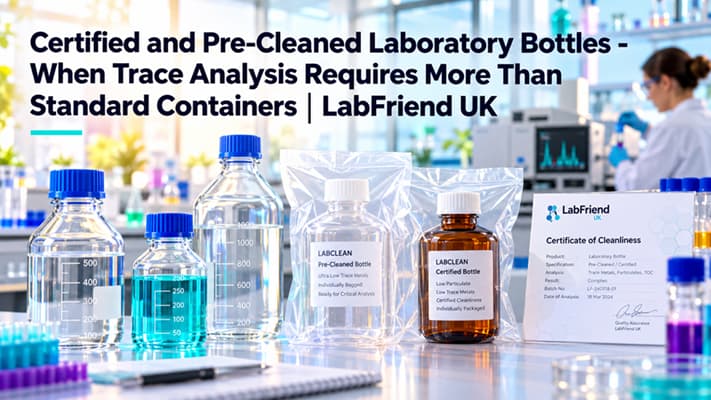
bottles may be required, see Certified and Pre-Cleaned Laboratory Bottles - When Trace Analysis Requires More ThanStandard Containers.
Check the Exact Product Covered by the Documentation
One of the simplest procurement controls is also one of the
easiest to overlook: confirm that the certificate actually relates to the
product being purchased.
Check, where applicable:
- manufacturer;
- product
reference;
- product
description;
- size
or volume;
- configuration;
- lot
or batch information; and
- any
other identifying information supplied with the documentation.

A certificate associated with one product configuration
should not automatically be treated as evidence for another.
This is particularly important where a supplier offers
several bottle sizes, materials, closures or packaging configurations that
appear similar.
The procurement record should make it clear which product
was checked and which supporting documentation was used.
Check What Characteristic Has Actually Been Documented
A certificate may document one characteristic without
establishing others. It is also important to distinguish between a statement
that a product conforms to a specified requirement and a certificate reporting
analytical test results. Depending on the supplier's certification
arrangements, evidence may relate to a product specification, a manufacturing
or cleaning process, or testing of a particular lot. Procurement should
establish which type of evidence is provided and whether it meets the
laboratory's approved documentation requirement. A statement of conformity
should not be assumed to provide individual analytical results or lot-specific
test evidence unless these are explicitly included.

The relevant question is:
Does the documented characteristic correspond to the
requirement in the approved specification?
If it does, the documentation can support the procurement
decision.
If it does not, or if the relationship is unclear, the issue
should be resolved before the product is treated as an approved match.
Check the Scope of Any Stated Test or Limit
Where documentation gives a test result, specification or
limit, establish what it actually applies to.
Procurement should check:
- What
characteristic was tested or documented?
- Which
product does the result apply to?
- Does
it apply to the relevant lot or production batch where required?
- Is a
test method or specification identified?
- Is a
numerical or qualitative limit stated?
- Does
that limit correspond to the laboratory's requirement?
- Are
there qualifications or conditions attached to the result?
A numerical value can appear precise without necessarily
answering the laboratory's question. For a reported contaminant result or
cleanliness limit, the relevant analyte or characteristic, units, reporting
limit or acceptance criterion, and applicable test or specification must be
sufficiently clear to allow comparison with the approved requirement. A result
reported below a specified analytical reporting limit does not demonstrate that
the contaminant is completely absent, or that the bottle meets a more stringent
requirement. Similarly, a documented result relating to one contaminant or
cleanliness characteristic does not establish suitability for an unrelated
analytical requirement. Where these distinctions affect acceptance, the
responsible technical function should determine whether the evidence is
sufficient.
Where interpretation of the technical significance is
required, procurement should obtain input from the responsible laboratory or
technical function rather than making the interpretation independently.
What Does “Pre-Cleaned” Confirm?
The term pre-cleaned should be treated carefully.
It indicates that cleaning has occurred before supply, but
the term alone does not necessarily establish:
- which
cleaning procedure was used;
- whether
the procedure was documented;
- what
cleanliness level was achieved;
- which
contaminants were controlled;
- whether
a certificate is supplied; or
- whether
the resulting condition meets a particular analytical requirement.
For procurement purposes, the question is therefore not
simply:
Is the product described as pre-cleaned?
It is:
Does the available documentation establish the cleaning
or cleanliness characteristic required by the approved specification?
If the requirement is important to the purchase and the
available product information does not answer that question, clarification
should be obtained before approval.
Check the Complete Product Configuration
Procurement should avoid assuming that documentation
relating to a bottle body automatically covers every component of the
configuration.
Where relevant, check whether the specification also
requires:
- cap;
- liner;
- seal;
- septum;
- closure
configuration;
- packaging;
- accessories;
or
- another
component that forms part of the supplied product.
This does not mean procurement must independently perform a
technical compatibility assessment.
It means the purchasing record should identify the complete
product configuration that has been approved, so that a superficially
similar component is not substituted without the appropriate review.
What If the Certificate Does Not Match the Product?
Do not simply attach the certificate to the purchase record
and assume that the requirement has been met.
Where there is a mismatch, establish the reason.
Examples include:
- the
certificate identifies a different product reference;
- the
lot information does not correspond;
- the
bottle size differs;
- the
configuration differs;
- the
documented characteristic differs from the approved requirement;
- the
certificate is incomplete; or
- the
supplier's terminology is unclear.
The appropriate response depends on the reason for the
discrepancy.
Where the discrepancy is purely administrative, supplier
clarification may resolve it.
Where it could affect technical suitability, the matter
should be referred to the responsible technical or QA/QC function before
purchase or release for use.
Do Not Treat Similar Products as Automatically Equivalent
A common procurement pressure is to accept a product that
appears similar to the approved bottle.
Similarity in:
- material;
- nominal
volume;
- appearance;
- closure
type;
- packaging;
or
- catalogue
description
does not, by itself, establish equivalence.
A substitute may have different cleanliness characteristics,
documentation, manufacturing controls or product configuration.
If substitution is necessary, compare the proposed product
against the approved specification, not merely against the original
product's appearance or headline description.
Where technical suitability cannot be established from
procurement information alone, obtain the required technical approval before
adopting the substitute.
A Practical Certificate-Checking Workflow
Use the following sequence before approving a certified or
pre-cleaned bottle purchase.

1. Confirm the approved requirement
Know what the laboratory has actually specified.
2. Identify the exact product
Confirm manufacturer, product reference, format and relevant
configuration.
3. Obtain the supporting documentation
Locate the certificate or other product-specific evidence
required by the approved specification. If lot-specific documentation will only
be available when the goods are supplied, confirm that the supplier can provide
it and ensure that the required document and product-to-lot match are verified
before the bottles are released for laboratory use. Where certification
evidence is required before purchase approval, do not proceed without that
evidence or the appropriate authorised approval.
4. Match the documentation to the product
Check product and, where relevant, lot or batch
identification.
5. Identify what the documentation establishes
Determine the characteristic, test, specification or limit
actually covered.
6. Compare it with the approved requirement
Do not assume that any certificate is sufficient simply
because one exists.
7. Resolve gaps
Ask the supplier for clarification or escalate to the
responsible technical function where interpretation is required.
8. Record the purchasing decision
Retain the relevant product identity and supporting
documentation in accordance with the laboratory's normal procurement and
quality processes.
9. Control substitutions
Do not approve a different product simply because it appears
equivalent.
This process keeps procurement responsible for document
control and purchasing accuracy without transferring technical suitability
decisions away from the appropriate laboratory function.
Procurement Checklist
|
Check |
Question |
|
Approved specification |
Is there a defined laboratory requirement to purchase
against? |
|
Product identity |
Does the certificate identify the exact product being
purchased? |
|
Lot / batch |
Does the documentation provide the required lot or batch
information? |
|
Characteristic |
What specific product characteristic does the certificate
establish? |
|
Test / specification |
Is the relevant test, specification or limit identified
where applicable? |
|
Requirement match |
Does the documented characteristic match the approved
laboratory requirement? |
|
Configuration |
Does the documentation relate to the complete required
product configuration? |
|
Pre-cleaned status |
Is the cleaning or cleanliness information sufficient for
the stated requirement? |
|
Documentation gap |
Is any important information missing or ambiguous? |
|
Technical escalation |
Has an unresolved technical question been referred to the
appropriate person? |
|
Substitution |
Has any alternative product been technically approved
where required? |
|
Purchasing record |
Are the approved product identity and supporting documents
retained appropriately? |
If a critical check cannot be completed, do not infer the
answer from a generic product description.
Common Procurement Mistakes
Treating “certified” as a complete specification
A certificate may relate to one defined characteristic.
Better approach: identify exactly what it establishes
and compare that characteristic with the approved requirement.
Accepting a certificate without checking the product
reference
A document is not useful evidence for a product it does not
identify appropriately.
Better approach: match the documentation to the exact
product and, where relevant, lot.
Assuming pre-cleaned means a defined cleanliness level
The term alone does not establish the cleaning process or
resulting cleanliness.
Better approach: check the available product-specific
information against the laboratory requirement.
Asking procurement to decide technical suitability
Procurement can verify documentation and purchasing
information, but some questions require technical interpretation.
Better approach: escalate unresolved technical
suitability questions to the responsible laboratory or QA/QC function.
Accepting a similar product as an equivalent substitute
Similar appearance or specifications do not establish
equivalence.
Better approach: compare the proposed alternative
against the approved specification and follow the applicable substitution
process.
Treating a certificate as method validation
A bottle certificate does not validate the laboratory's
analytical method.
Better approach: use supplier documentation to
support the specific product characteristic it documents.
Failing to retain the evidence used for purchasing
If the documentation cannot be traced back to the purchasing
decision, repeat ordering becomes more difficult to control.
Better approach: retain the relevant product identity
and supporting documentation in accordance with the laboratory's normal
processes.
Frequently Asked Questions
What should procurement check on a certificate for a
laboratory bottle?
Procurement should first confirm that the certificate
relates to the exact product being purchased and, where relevant, the
appropriate lot or batch. Then identify what characteristic, test,
specification or limit the document actually establishes and compare that
information with the laboratory's approved requirement. If the documentation
does not clearly support the requirement, obtain clarification or technical
approval rather than assuming suitability.
Does a certificate prove that a laboratory bottle is
suitable for any application?
No. A certificate normally provides evidence about specified
product characteristics; it does not automatically establish suitability for
every analytical method, analyte, sample matrix or laboratory application.
Procurement should compare the documented characteristic with the approved
technical requirement and refer questions about analytical suitability to the
responsible technical function.
Should procurement accept a pre-cleaned bottle without a
certificate?
Procurement should accept a pre-cleaned bottle without a
certificate only when the approved specification does not require certificate
evidence. A pre-cleaned description indicates that cleaning has occurred, but
the term alone does not establish which procedure was used, whether it was
documented or what level of cleanliness was achieved. Where certification
evidence is required, the missing documentation should be resolved before
approval.
What should procurement do if the certificate does not
match the product reference?
Procurement should not assume that a certificate applies to
a product with a different reference. First clarify the discrepancy with the
supplier. If the difference could affect the technical suitability of the
bottle, refer the issue to the responsible laboratory or QA/QC function before
approving the purchase or substitute product.
Can a similar laboratory bottle be accepted as a
substitute?
No. A similar appearance or specification does not by itself
establish that a laboratory bottle is an acceptable substitute. Differences in
material, volume, closure, cleanliness characteristics, documentation or
configuration may affect suitability. A proposed substitute should be compared
against the approved specification and follow the laboratory's applicable
technical approval or change-control process before adoption.
What if the lot-specific certificate is only available
when the bottles are supplied?
A lot-specific certificate can be checked at receipt when
the approved specification allows the documentation to be supplied with the
goods rather than before purchase. Procurement should confirm before ordering
that the supplier can provide the required document, then verify the
product-to-lot match before the bottles are released for laboratory use. If
certification is required before purchase approval, the required evidence
should be obtained before proceeding.
Request a Quote for Certified Bottles
Once the laboratory requirement has been established and the
relevant documentation requirements are understood, procurement can request a
quote for a suitable certified bottle.
A specific certified trace-analysis option is available
through LabFriend UK. The product page provides product-specific information
and a Request a quote route, allowing the procurement requirement to be
considered against the actual product specification.
Request a quote for certified trace-analysis laboratory bottles
For broader product discovery where the required
specification does not match that particular format, browse Laboratory
Glassware.
Read More
Explore More
Written by: Donal O’Sullivan, BSc, Co-Founder and Sales Director, LabFriend UK. Donal brings deep chemistry-led technical expertise across analytical chemistry, biochemistry, environmental monitoring, laboratory instrumentation, consumables and scientific product selection.
Reviewed by: Michael Anderson, MBA, Founder and Managing Director, LabFriend UK. Michael reviews LabFriend UK content for customer relevance, commercial accuracy, operational practicality and alignment with LabFriend UK’s laboratory supply model.
Frequently asked questions
Delivery times vary by product and supplier. Each product page shows current stock levels and the expected lead time, and we confirm this when you place your order. Most items arrive within 2 to 3 weeks. Specialised items can take longer if they are not in stock. If you need something by a certain date, contact us and we’ll check for you.
Yes. Register for a commercial account and, once it’s approved, you will be able to process orders via PO Once you have a commercial account, you can directly email your purchase orders
Add products to your cart and click Get a Quote. You’ll get a formal quote instantly, ready to send to your email address. For bulk orders or custom requirements, send us your product list and we’ll reply with itemized pricing.
If your item is faulty, not as described or sent in error, let us know within 14 days of delivery and we’ll arrange a return. Change of mind returns are only accepted if the item is unused and in its original packaging. A restocking fee will apply and you pay the return freight. Read our full Returns Policy for details.
Yes, prices are shown including GST by default. Use the Prices Inc. GST toggle at the top of the page to view prices without GST.