

Share :
Glass vs Plastic Laboratory Bottles - Which Should UK Labs Choose
Updated On 07/17/2026

By Donal O’Sullivan, BSc. Reviewed by Michael Anderson, MBA.
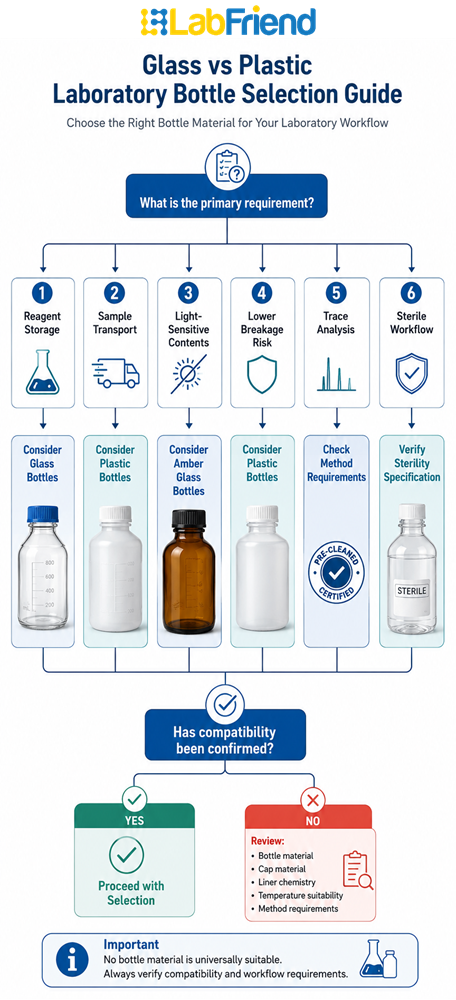
Glass laboratory bottles are commonly selected where visibility, reusable storage, reagent handling or amber protection are important. Plastic laboratory bottles are often preferred where reduced breakage risk, lower weight, routine sample handling or transport practicality matter.
The right choice depends on the application, chemical compatibility, closure system, temperature conditions, sterility or autoclaving requirements and manufacturer specifications. There is no single “best” material for every laboratory bottle workflow.
Chemical compatibility should always be verified against both the bottle material and the closure system because bottle caps, liners and seals may have different compatibility characteristics from the bottle body itself.
For UK laboratories, the practical decision is not simply glass versus plastic. It is about choosing the right bottle material, format, cap and volume for the substance, sample or workflow being handled.
Why this matters to scientists and researchers
Laboratory bottles are used every day for storing reagents, preparing solutions, handling samples, transporting liquids and organising routine workflows. Because they are common consumables, it is easy to assume that any suitable-looking bottle will do the job.
That assumption can create problems.
The wrong bottle material may affect:
- chemical compatibility
- sample integrity
- visibility of contents
- light protection
- evaporation or permeation risk
- breakage risk
- transport practicality
- contamination control
- reusability
- cap and closure performance
- repeat ordering accuracy
For scientists and researchers, bottle selection is part of experimental reliability. A bottle is not just a container. It is part of the storage, handling and sample-control system.
When the application is still broad, start with LabFriend UK’s laboratory vessels category, then narrow the selection by material, volume, closure and bottle format. LabFriend’s vessel category is live and positioned under laboratory consumables/vessels.
Quick comparison: glass vs plastic laboratory bottles
|
Selection factor |
Glass laboratory bottles |
Plastic laboratory bottles |
|
Common laboratory use |
Reagent storage, prepared solutions, routine chemical storage, visibility-led workflows |
Routine storage, sample handling, field use, transport, dispensing and lower-breakage workflows |
|
Common materials |
Borosilicate glass, amber glass |
HDPE, LDPE, PP and other specified plastics |
|
Visibility |
Usually excellent in clear glass formats |
Varies by material and bottle type |
|
Light protection |
Amber glass is commonly selected for light-sensitive contents where appropriate |
Opaque or tinted plastic may be available depending on product range and specification |
|
Breakage risk |
Higher than plastic |
Lower than glass |
|
Weight |
Heavier |
Lighter |
|
Chemical compatibility |
Often strong, but still application-specific |
Highly dependent on plastic material, concentration, temperature and storage duration |
|
Reuse potential |
Often suitable for repeat use where cleaning and workflow permit |
Depends on material, prior contents, cleaning process and application |
|
Autoclaving |
Product-specific |
Product-specific |
|
Transport practicality |
More fragile and heavier |
Often more practical for transport or field handling |
|
Procurement consideration |
Useful where a standard reagent bottle format is required |
Useful where lower breakage, lighter handling or repeat routine use matters |
Direct answer: choose glass where visibility, reagent storage, amber protection or reusable storage are important and compatibility is confirmed. Choose plastic where lower breakage risk, lighter handling, transport practicality or routine sample handling are more important and compatibility is confirmed.
Ready to compare bottle options?
Use the comparison above to decide what matters most: material, visibility, breakage risk, closure compatibility or workflow type. Then browse LabFriend UK’s laboratory vessels as the broad starting point for bottle and vessel selection.
When should you choose glass laboratory bottles?
Glass laboratory bottles are commonly used where scientists need good visibility, stable routine storage and compatibility with a wide range of laboratory workflows. They are often selected for reagent bottles, prepared solutions and applications where users need to see the contents clearly.
Glass bottles are commonly selected for:
- routine reagent storage
- prepared solutions
- visible liquid storage
- applications where bottle staining is a concern
- workflows where reusable bottles are appropriate
- light-sensitive contents where amber glass is specified or suitable
- storage applications where the laboratory has already standardised on glass reagent bottles
Key advantages of glass laboratory bottles
Glass offers several practical benefits in a laboratory setting.
Clear glass makes it easier to inspect contents, check fill level and spot visible contamination or residue. Amber glass can help reduce light exposure where the contents are light-sensitive and where the application supports its use.
Borosilicate glass bottles are commonly associated with laboratory reagent storage and temperature-resistant applications, but suitability must always be checked against the manufacturer’s specification and the intended workflow.
Although glass is often selected for chemically demanding applications, it should not be assumed to be universally inert. Certain highly alkaline solutions, hydrofluoric acid and other specialised applications may require alternative container materials.
Important glass bottle cautions
Glass is not automatically suitable for every substance or workflow.
Before selecting a glass bottle, check:
- chemical compatibility
- temperature conditions
- whether the bottle and cap are suitable for the intended use
- whether amber or clear glass is required
- whether the bottle is intended for pressure, vacuum or autoclave use
- cleaning and reuse requirements
- breakage risk in the working area
- transport and handling conditions
Glass can break. In shared spaces, teaching laboratories, field sampling or transport-heavy workflows, that may be an important operational consideration.
Choosing glass for reagent workflows?
If your workflow points towards glass bottles for prepared solutions, chemical storage or routine reagent handling, compare LabFriend UK’s laboratory reagent bottles by material, volume, cap/thread and clear or amber format before requesting a quote. The LabFriend reagent bottle category is live under the vessels section.
When should you choose plastic laboratory bottles?
Plastic laboratory bottles are commonly selected where lower breakage risk, lighter handling and routine practicality matter. They can be useful in sample transport, field collection, shared laboratories, wash bottle use and many general storage workflows.
However, “plastic” is not one material. HDPE, LDPE and PP can behave differently, so the correct plastic type must be selected for the application.
Plastic bottles are commonly selected for:
- sample handling
- field sampling
- transport between locations
- lower-breakage laboratory environments
- routine liquid storage where compatible
- dispensing or wash bottle workflows
- teaching or shared-use laboratories
- workflows where lighter containers are useful
- larger volume handling where glass weight or breakage risk is a concern
Key advantages of plastic laboratory bottles
Plastic bottles are usually lighter than glass and less likely to break during routine handling. This can make them practical for transport, sample collection and busy working environments where bottles are moved frequently.
Plastic bottles may also be useful where the lab wants to reduce breakage risk or simplify handling for routine, non-critical workflows.
Important plastic bottle cautions
Plastic bottle suitability depends heavily on the specific plastic material and the application.
Before choosing a plastic bottle, check:
- chemical compatibility
- temperature limits
- storage duration
- concentration of the substance
- permeability risk
- adsorption risk
- potential staining
- cap and liner compatibility
- whether the bottle is suitable for autoclaving, if required
- whether the plastic is suitable for the sample or analytical method
A plastic bottle that is suitable for one workflow may be unsuitable for another.
Adsorption can be particularly important for proteins, biomolecules, trace analytes and other concentration-sensitive samples where losses to container surfaces may affect results.
Choosing plastic for handling, transport or routine storage?
If lower breakage risk, lighter handling or routine sample movement is the priority, start with LabFriend UK’s laboratory vessels, then narrow the choice by plastic type, bottle format, closure and volume.
Material selection is not just glass vs plastic
The most useful question is not simply:
Should I use glass or plastic?
A better question is:
Which bottle material is suitable for this substance, sample, workflow and closure system?
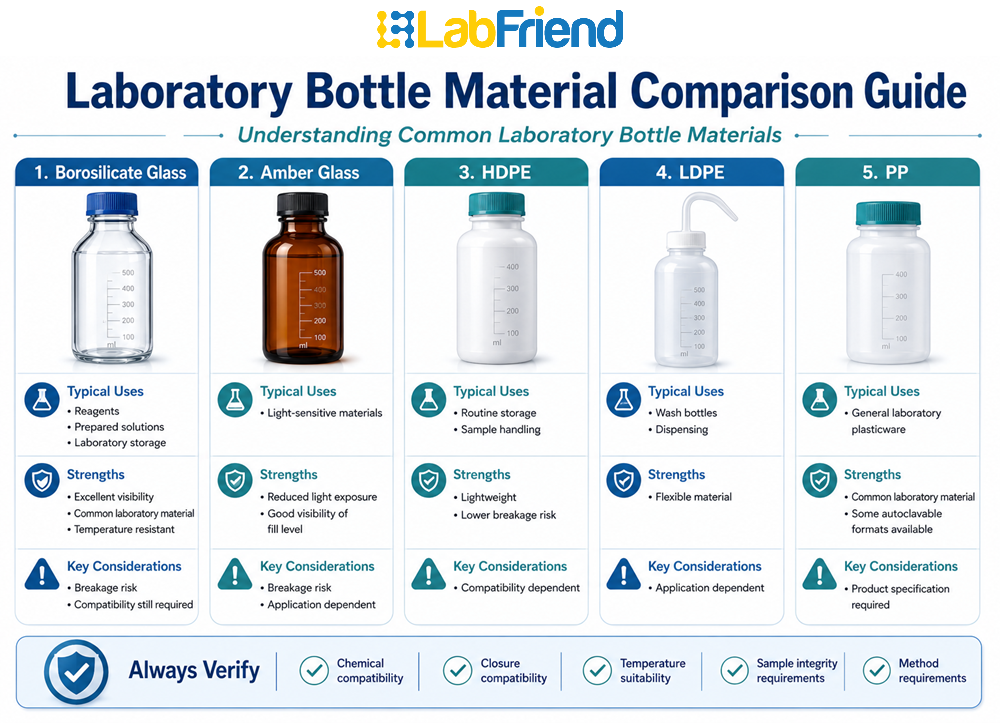
Common laboratory bottle materials include:
|
Material |
Common use considerations |
|
Borosilicate glass |
Commonly selected for many laboratory reagent and solution storage workflows where visibility and glass properties are useful |
|
Amber glass |
Commonly selected where light exposure needs to be reduced for suitable light-sensitive substances |
|
HDPE |
Often used for routine plastic bottle applications where chemical compatibility and handling requirements are suitable |
|
LDPE |
Often associated with flexible dispensing and wash bottle applications |
|
PP |
Often used in laboratory plasticware where the product specification supports the workflow |
This article gives the glass-versus-plastic decision framework.
Application-based selection guide
|
Application |
Usually consider |
Why |
|
General reagent storage |
Glass or suitable plastic |
Depends on chemical compatibility, visibility and lab standardisation |
|
Light-sensitive reagents |
Amber glass or another specified light-protective container |
Helps reduce light exposure where required |
|
Sample transport |
Plastic where suitable |
Lower breakage risk and lighter handling |
|
Powders or solids |
Wide-mouth glass or plastic |
Easier filling, access and removal |
|
Routine liquid storage |
Narrow-mouth glass or plastic |
Helps with controlled pouring and routine storage |
|
Sterile workflows |
Sterile bottle or sterile sample container where specified |
Sterility status must be confirmed |
|
Trace analysis |
Certified, pre-cleaned or method-specified bottle where required |
Helps manage contamination-sensitive requirements |
|
Teaching laboratories |
Plastic may be useful where technically suitable |
Reduces breakage risk in high-use environments |
|
Fridge or stockroom storage |
Square glass or plastic bottle where suitable |
Helps improve storage density and organisation |
|
Larger-volume storage |
Plastic bottle or carboy where suitable |
Can reduce weight and breakage risk compared with glass |
This table should be treated as a practical starting point, not a substitute for checking product specifications, method requirements or local laboratory procedures.
Match the bottle format to the workflow
If the application is mainly liquid storage or controlled pouring, view narrow-mouth laboratory bottles. If the workflow involves powders, solids, samples or easier filling and emptying, browse wide-mouth laboratory bottles. LabFriend has live narrow-mouth and wide-mouth bottle category pages under vessels.
If bench, fridge, cupboard or stockroom space is a constraint, compare square laboratory bottles as part of the material and format decision. The square bottle category is also live under LabFriend’s vessels section.
Chemical compatibility and sample integrity checks
Container Systems Matter: Bottles, Caps and Closures
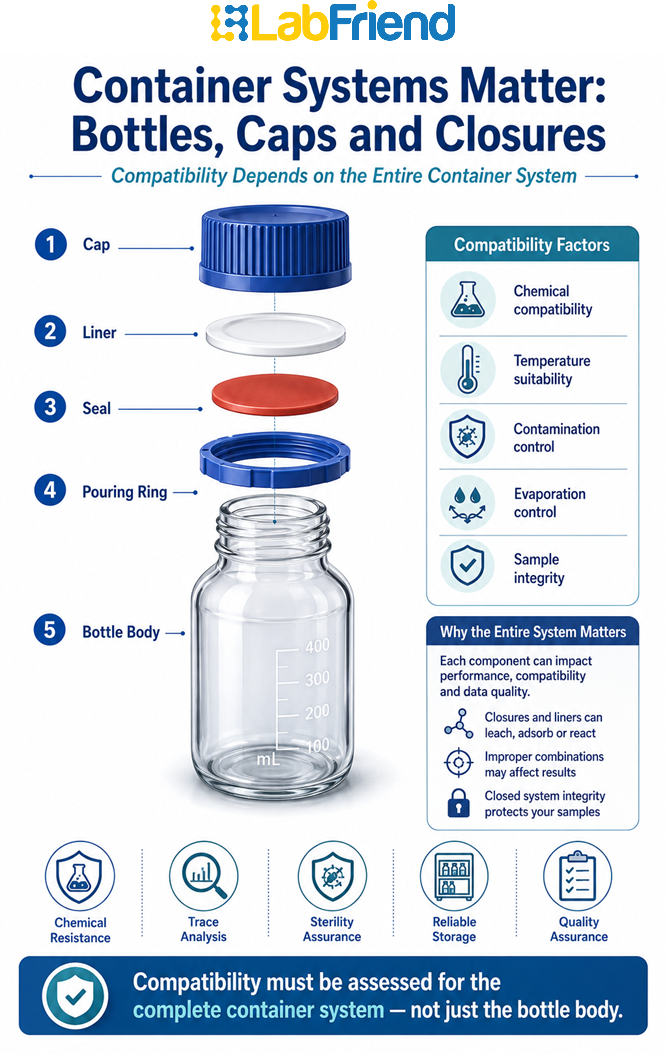
Laboratory bottle suitability should be assessed as a complete container system rather than as a bottle body alone. Cap materials, liner chemistry, seals, pouring rings and other closure components may affect compatibility, contamination control, evaporation risk and sample integrity. When evaluating bottle options, laboratories should review all components that may come into contact with the stored substance.
Chemical compatibility is one of the most important factors when comparing glass and plastic laboratory bottles.
A bottle should be selected as a complete container system, not as a bottle body alone. The cap, liner, seal, pouring ring and closure material may all affect suitability.
Check the full bottle system
Before choosing between glass and plastic, check:
- bottle body material
- cap material
- liner chemistry
- liner or seal material
- thread compatibility
- pouring ring or accessory compatibility
- substance or sample type
- concentration
- storage temperature
- expected storage duration
- exposure to light
- whether the contents are volatile
- whether the contents are contamination-sensitive
- whether the workflow is method-specified or validated
Sample integrity considerations
For some workflows, the bottle material can influence the sample or stored substance.
For highly sensitive analytical methods, laboratories may also evaluate extractables, leachables and background contamination characteristics of bottle materials and closures, particularly for trace analysis, chromatography and mass spectrometry applications.
Consider whether the material could contribute to:
- adsorption
- leaching
- permeability
- evaporation
- staining
- pH change
- residue carryover
- trace contamination
- microbial contamination
- loss of analyte
- interaction with cap or liner materials
Permeation through some plastic materials may be relevant for volatile compounds, long-term storage applications or substances sensitive to moisture or gas exchange.
Where sample integrity matters, avoid informal substitutions. Check the product specification and the method or workflow requirements before switching bottle material.
Need a broad starting point before narrowing the specification?
Where compatibility checks are still being worked through, start from LabFriend UK’s laboratory vessels category and narrow the selection by bottle type, material, format and closure once your workflow requirements are clear.
Glass vs plastic for reagent storage
Reagent storage is one of the most common reasons scientists compare glass and plastic laboratory bottles.
Glass reagent bottles are commonly selected where visibility, routine laboratory use and established storage practices matter. Amber glass may be used where light exposure needs to be reduced for suitable contents.
Plastic reagent or storage bottles may be suitable where the stored substance is compatible, where reduced breakage risk matters, or where lighter handling is useful.
What to check for reagent storage
Before choosing a reagent bottle, check:
- chemical compatibility
- clear or amber format
- volume
- cap/thread type
- closure compatibility
- labelling area
- storage temperature
- whether the contents are light-sensitive
- whether the bottle will be reused
- whether the product code needs to be repeated for future orders
Ready to compare reagent bottle options?
If you are choosing bottles for prepared solutions, routine reagents or chemical storage, start by comparing LabFriend UK’s laboratory reagent bottles by material, volume, closure type and clear or amber format.
Glass vs plastic for sample collection and transport
Sample collection and transport introduce different priorities from bench-top reagent storage.
Plastic bottles are often practical where lower breakage risk, lighter handling and field transport matter. This can be useful for environmental, water, food and routine sample collection workflows, provided the plastic material is suitable for the sample and method.
Glass may be preferred or required for some analytical workflows, especially where the method, sample type or contamination-control requirements specify it.
What to check for sample workflows
Before choosing sample bottles, consider:
- sample type
- analytical method
- container cleanliness requirement
- sterile requirement
- preservative requirement
- transport conditions
- closure integrity
- chain-of-custody or labelling requirements
- whether certified or pre-cleaned bottles are required
For trace or contamination-sensitive analysis, a standard glass or plastic bottle may not be enough. The workflow may require certified, pre-cleaned or otherwise specified containers.
Choosing bottles for sample handling?
For general sample handling and transport, begin with LabFriend UK’s laboratory vessels, then narrow the choice by material, mouth style, volume and closure. If the workflow requires sterility or contamination-sensitive handling, review LabFriend UK’s sterile bottles and bags and confirm the sterility status, packaging format and product specification before ordering.
Autoclaving and sterility considerations
Autoclavability and sterility are often misunderstood when comparing glass and plastic laboratory bottles.
A bottle being glass does not automatically mean it should be autoclaved. A bottle being plastic does not automatically mean it cannot be autoclaved. Suitability depends on the manufacturer’s specification for the bottle, cap and closure system.
Important distinction
|
Term |
What it means |
|
Sterile |
Supplied sterile where specified by the manufacturer |
|
Autoclavable |
Suitable for autoclaving only where the product specification confirms this |
|
Sterile and autoclavable |
Only true where both characteristics are specified |
|
Non-sterile |
Not supplied sterile; may still have other useful properties depending on product |
|
Certified or pre-cleaned |
Supplied with cleanliness or documentation controls for defined applications |
What to check before autoclaving bottles
Check:
- bottle material
- cap material
- liner or seal
- manufacturer instructions
- maximum temperature
- recommended autoclave conditions
- whether the cap should be loosened
- fill volume
- pressure or vacuum limitations
- whether the bottle is intended for repeated autoclave cycles
- whether repeated autoclave cycles may affect bottle performance
Does the workflow require sterile containers?
If the workflow requires sterile packaging, sterile sample handling or contamination-sensitive storage, explore sterile bottles and bags and confirm the product’s sterility status, packaging format, expiry information and suitability for your application before ordering.
The use of a sterile bottle alone does not maintain sterility after opening and should be considered as part of a broader contamination-control process.
Common mistakes when choosing between glass and plastic bottles
- Assuming glass is always chemically suitable
Glass is commonly used in laboratories, but compatibility still depends on the substance, concentration, temperature, exposure time and product specification.
- Assuming all plastic bottles behave the same
HDPE, LDPE and PP are different materials. They should not be treated as interchangeable without checking suitability.
- Choosing based on price alone
The lower-cost option is not always the right option if it increases risk, affects sample integrity or creates rework.
- Ignoring the cap, liner or closure
The bottle body may be suitable while the cap, liner or seal is not. Always assess the container system as a whole.
- Confusing sterile and autoclavable
Sterile bottles and autoclavable bottles solve different problems. Do not assume one implies the other.
- Reusing bottles without considering residue or contamination
Reuse may be practical for some workflows, but not for every sample type, reagent or analytical method.
- Substituting bottle material without checking the method
A switch from glass to plastic, or plastic to glass, may be acceptable in routine workflows but unsuitable where the method, client protocol or validation requirement specifies a container type.
- Forgetting repeat-order accuracy
Once the correct bottle is selected, record the product code, volume, material, cap/thread and pack size. This avoids repeating the same selection process every time the bottle is reordered. Once the right format is agreed, direct repeat users to the correct category rather than starting every search again. For routine liquid workflows, view narrow-mouth laboratory bottles. For powders, solids or easier filling, browse wide-mouth laboratory bottles. For storage efficiency, compare square laboratory bottles.
UK laboratory purchasing considerations
Scientists and researchers often influence bottle selection even when procurement or lab management places the order. To avoid delays or unsuitable substitutes, the product requirement should be clear.
When requesting laboratory bottles, specify:
- intended application
- substance or sample type where relevant
- bottle material
- volume
- mouth style
- clear or amber format
- cap/thread type
- sterile, autoclavable or certified requirement
- pack size
- preferred product code, if known
- whether an alternative can be considered
This is especially important in UK laboratories with recurring consumables demand, such as CROs, independent testing laboratories, SME biotech teams and university research groups. In these environments, good specification control helps avoid stockouts, repeated product searches and unnecessary supplier friction.
Many laboratories also benefit from standardising a limited number of approved bottle formats to improve purchasing efficiency and reduce unintended substitutions.
Turning a one-off selection into a repeatable order?
If the bottle will be used regularly, record the material, volume, format and closure, then use the relevant LabFriend category page for repeat browsing: laboratory vessels for broad vessel selection, laboratory reagent bottles for reagent storage, or sterile bottles and bags where sterile formats are required.
Relevant LabFriend bottle categories
LabFriend UK supplies laboratory bottle and vessel categories that support routine storage, reagent handling, controlled pouring, sample handling and space-efficient storage.
When comparing glass and plastic bottle options, start with the application. Then browse by material, format, closure and volume.
Relevant category pathways include:
- browse laboratory vessels
- compare laboratory reagent bottles
- view narrow-mouth laboratory bottles
- browse wide-mouth laboratory bottles
- compare square laboratory bottles
- explore sterile bottles and bags
FAQs
Are glass laboratory bottles better than plastic?
Not always. Glass bottles are often useful where visibility, reagent storage, reusability or amber protection matter. Plastic bottles are often useful where lower breakage risk, lighter handling or transport practicality matter. The better choice depends on the application and compatibility requirements.
When should I use glass laboratory bottles?
Glass laboratory bottles are commonly selected for reagent storage, prepared solutions, visible liquid storage and workflows where amber glass or reusable glass storage is suitable. Always check chemical compatibility and manufacturer specifications.
When should I use plastic laboratory bottles?
Plastic laboratory bottles are commonly selected for routine storage, sample handling, transport, field use, wash bottle applications and lower-breakage workflows. The specific plastic material must be suitable for the contents and conditions.
Are plastic laboratory bottles chemically resistant?
Some plastic laboratory bottles offer good chemical resistance for suitable applications, but resistance depends on the plastic material, chemical, concentration, temperature and storage duration. HDPE, LDPE and PP should not be treated as interchangeable.
Are glass laboratory bottles autoclavable?
Some glass laboratory bottles may be autoclavable where specified by the manufacturer. The bottle, cap and closure system should all be checked before autoclaving.
Can plastic laboratory bottles be autoclaved?
Some plastic laboratory bottles may be autoclavable where specified, especially certain PP products, but this is product-specific. Always check the manufacturer’s instructions for the bottle and closure.
Are amber glass bottles better for light-sensitive reagents?
Amber glass bottles are commonly selected where reduced light exposure is required. However, suitability depends on the substance, method and required level of protection. Amber glass should not be treated as universal protection for every light-sensitive material.
Can I reuse glass or plastic laboratory bottles?
Reuse depends on the previous contents, cleaning method, contamination risk, application and bottle specification. Reuse may be unsuitable for sterile, trace analysis, biological or method-sensitive workflows.
Cleaning validation, residue removal and contamination risk assessment may be important before reusing bottles in regulated or contamination-sensitive workflows.
What should I check before switching from glass to plastic bottles?
Check chemical compatibility, sample integrity, temperature conditions, storage duration, cap and closure compatibility, method requirements and whether the workflow allows substitution.
Which bottle material is best for sample transport?
Plastic bottles are often useful for sample transport because they are lighter and less likely to break than glass. However, some methods or sample types may require glass or certified containers, so the analytical requirement should be checked first.
Does bottle material affect analytical results?
Potentially. Bottle material, closure components and storage conditions may influence adsorption, leaching, permeability, contamination risk or analyte recovery in some applications. This is particularly important for trace analysis, biological samples and highly sensitive analytical methods.
Should I evaluate the bottle cap and liner separately from the bottle material?
Yes. Compatibility should be assessed for the complete container system, including the bottle body, cap, liner, seal and any accessories. In some workflows the closure components may influence suitability as much as the bottle material itself.
Conclusion
Glass and plastic laboratory bottles each have important roles in UK laboratories. Glass is often selected for visibility, reagent storage, amber protection and reusable storage workflows. Plastic is often selected for lower breakage risk, lighter handling, transport practicality and routine sample handling.
The right choice depends on the application, not the material category alone. Scientists and researchers should check the stored substance or sample, compatibility, closure system, temperature conditions, sterility or autoclaving requirements and repeat-order needs before selecting a bottle.
Once the correct bottle is identified, record the exact specification. That makes future ordering easier and helps avoid uncontrolled substitutions.
Compare laboratory bottle options with LabFriend UK
Browse LabFriend UK’s range of laboratory vessels, reagent bottles, narrow-mouth bottles and wide-mouth bottles to compare options by material, format, closure and volume. Where storage efficiency matters, include square laboratory bottles in your comparison. For contamination-sensitive workflows, review sterile bottles and bags before ordering.
Written by: Donal O’Sullivan, BSc, Co-Founder and Sales Director, LabFriend UK. Donal brings deep chemistry-led technical expertise across analytical chemistry, biochemistry, environmental monitoring, laboratory instrumentation, consumables and scientific product selection.
Reviewed by: Michael Anderson, MBA, Founder and Managing Director, LabFriend UK. Michael reviews LabFriend UK content for customer relevance, commercial accuracy, operational practicality and alignment with LabFriend UK’s laboratory supply model.
Some Useful Further Reading
Laboratory Bottle Selection for Lab Managers - Standardising Everyday Storage and Handling
Related Stories

Laboratory Bottle Selection for Lab Managers - Standardising Everyday Storage and Handling
Learn how UK lab managers can standardise laboratory bottle selection by material, volume, mouth style, closure, sterility, compatibility and reorder requirements to reduce stockouts and simplify repeat purchasing.

Laboratory Bottle Materials Explained - Borosilicate Glass - Amber Glass - HDPE - LDPE and PP
Laboratory Bottle Materials Explained - Borosilicate Glass - Amber Glass - HDPE - LDPE and PP

How to Select Laboratory Reagent Bottles for Chemical Storage
How to Select Laboratory Reagent Bottles for Chemical Storage

Glass vs Plastic Laboratory Bottles for Procurement Teams: Balancing Cost, Risk and Suitability
Glass vs Plastic Laboratory Bottles for Procurement Teams: Balancing Cost, Risk and Suitability