

Share :
Laboratory Bottle Materials Explained - Borosilicate Glass - Amber Glass - HDPE - LDPE and PP
Updated On 07/17/2026

By Donal O’Sullivan, BSc. Reviewed by Michael Anderson, MBA.
Laboratory bottle materials should be chosen according to the substance or sample being handled, the required storage conditions, the closure system, the workflow and the manufacturer’s specifications. Borosilicate glass, amber glass, HDPE, LDPE and PP are all used in laboratory bottle ranges, but they are not interchangeable.
As a practical starting point, glass bottles are commonly selected for visibility, reagent storage and some reusable workflows, while plastic bottles are often selected where lighter handling, reduced breakage risk or dispensing practicality matter. The safest approach is to choose by application and compatibility, not by material name alone.
If your requirement is broad, start with LabFriend UK’s laboratory vessels category, then narrow your choice by material, format, volume and closure. LabFriend’s live Vessels category sits under General Laboratory Consumables and includes vessel-related product pathways.
Why bottle material selection matters
For scientists and researchers, a laboratory bottle is part of the workflow. It can influence how a reagent is stored, how a sample is handled, how easily contents are dispensed, how visible the contents are, and whether a bottle can be reordered consistently.
Poor material selection can create avoidable problems, including:
- unsuitable storage conditions
- sample or reagent integrity concerns
- incorrect assumptions about chemical compatibility
- poor visibility of contents
- avoidable breakage risk
- difficulty filling, pouring or dispensing
- closure or cap mismatch
- uncontrolled substitutions during repeat ordering
- uncertainty around sterility, autoclaving or documentation requirements
The material choice should always be reviewed alongside the bottle format, cap, liner, thread, volume and intended use.
Quick comparison: common laboratory bottle materials
|
Bottle material |
Commonly used for |
Key practical advantage |
What to check before use |
|
Borosilicate glass |
Reagent storage, prepared solutions, visible liquid storage |
Good visibility and common laboratory use |
Chemical compatibility, closure suitability, temperature requirements and breakage risk |
|
Amber glass |
Light-sensitive contents where reduced light exposure is required |
Helps reduce light exposure where appropriate |
Whether amber protection is sufficient for the substance and method |
|
HDPE |
Routine plastic storage bottles and sample handling where suitable |
Lower breakage risk and lighter handling than glass |
Chemical compatibility, storage duration, temperature and cap compatibility |
|
LDPE |
Flexible dispensing or wash bottle-style applications where suitable |
Flexibility and squeeze-dispensing practicality |
Solvent compatibility, labelling and intended dispensing use |
|
PP |
Laboratory plasticware and bottle formats where product specification supports use |
Often used in lab plastics where temperature or handling requirements suit the product |
Product-specific temperature, autoclave and compatibility data |
Direct answer: choose borosilicate or amber glass where visibility, reagent storage or light protection are important and suitability is confirmed. Choose HDPE, LDPE or PP where plastic handling properties suit the workflow and compatibility has been checked.
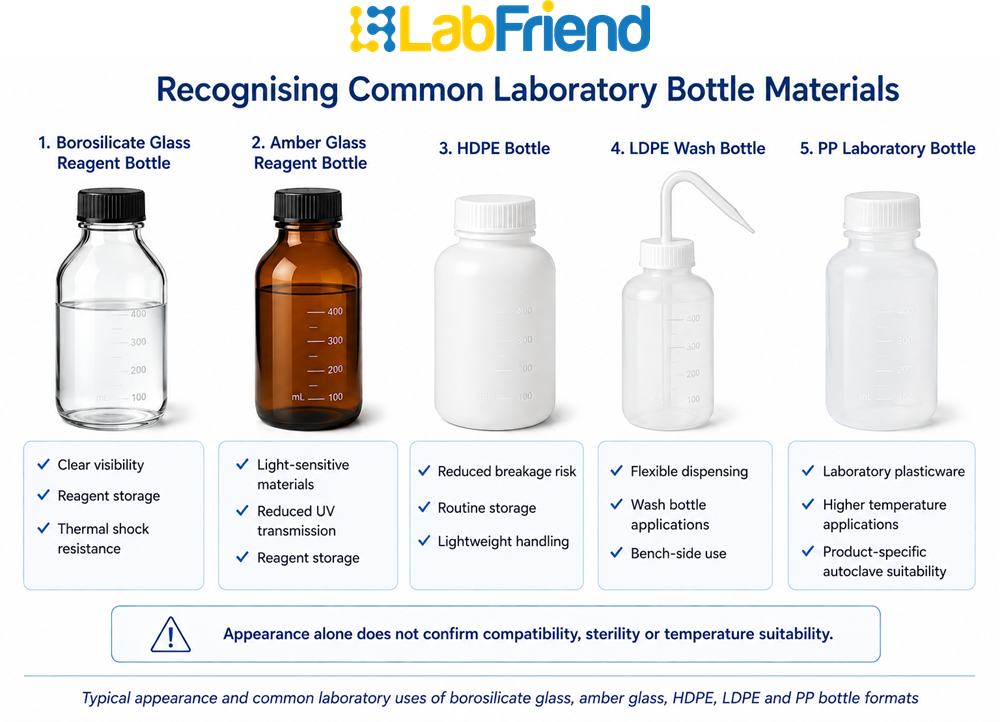
Borosilicate glass laboratory bottles
Borosilicate glass is commonly selected for laboratory reagent bottles, prepared solutions and general laboratory storage where visibility and glass properties are useful. It is often associated with routine laboratory bottle use because clear glass allows users to inspect contents, fill level and visible residues.
Borosilicate glass is characterised by a low coefficient of thermal expansion, which gives it greater resistance to thermal shock than ordinary soda-lime glass and contributes to its widespread use in laboratory containers.
Borosilicate glass may be suitable for many laboratory workflows, but it should not be treated as universally compatible. Suitability depends on the stored substance, concentration, temperature, exposure duration, closure system and manufacturer specification.
Best used for
Borosilicate glass bottles are commonly selected for:
- reagent storage
- prepared solutions
- visible liquid storage
- workflows where contents need to be inspected
- reusable bottle systems where cleaning and application allow
- routine laboratory storage where the lab has standardised on glass bottles
Check before buying
Before selecting borosilicate glass bottles, check:
- chemical compatibility, particularly for hydrofluoric acid, strong alkalis at elevated temperature, or other substances known to attack glass
- volume
- cap/thread type
- closure or liner suitability
- whether clear or amber glass is required
- temperature or autoclave suitability, where relevant
- whether the bottle is intended for pressure or vacuum use
- cleaning and reuse procedure
- breakage risk in the working area
If your material decision points towards glass for routine reagent storage, compare LabFriend UK’s laboratory reagent bottles by volume, format, cap/thread and clear or amber presentation before requesting a quote. LabFriend’s Reagent Bottles category is live under the Vessels pathway.
Amber glass laboratory bottles
Amber glass bottles are commonly selected where reduced light exposure is required for suitable light-sensitive substances. They can be useful where a clear bottle would expose contents to more visible light than is acceptable for the workflow.
However, amber glass should not be treated as universal protection. The required level of light protection depends on the substance, method, exposure time, storage conditions and laboratory procedure.
Amber glass significantly reduces transmission of ultraviolet and some visible wavelengths, but it does not block all light wavelengths and may not provide sufficient protection for highly photosensitive substances.
Best used for
Amber glass bottles are commonly selected for:
- light-sensitive reagents where amber glass is suitable
- prepared solutions that require reduced light exposure
- workflows where visibility is still useful but light exposure should be limited
- laboratories standardising clear and amber reagent bottle formats
Check before buying
Before selecting amber glass bottles, check:
- whether the contents are genuinely light-sensitive
- whether amber glass provides the required protection
- chemical compatibility
- cap and closure compatibility
- volume and fill requirements
- storage duration
- whether the workflow requires a specified container type
If the application requires a reagent bottle and the choice is between clear and amber formats, start with LabFriend UK’s laboratory reagent bottles and confirm the material, colour, closure and specification before ordering.
HDPE laboratory bottles
HDPE is a common laboratory plastic used in many bottle formats where lower breakage risk, lighter handling and routine storage practicality matter. It can be useful for sample handling, field use, routine plastic storage and larger-volume workflows where glass weight or breakage risk is a concern.
Compared with glass, HDPE is more permeable to gases and some organic vapours, which may be relevant for long-term storage of volatile substances.
HDPE is not automatically suitable for every chemical or sample. Compatibility depends on the chemical identity, concentration, temperature, exposure duration and storage conditions.
Best used for
HDPE bottles are commonly selected for:
- routine plastic bottle storage where compatible
- sample handling
- field or transport workflows
- larger-volume handling where reduced weight is useful
- shared laboratory areas where breakage risk matters
- some general-purpose laboratory storage applications
Check before buying
Before selecting HDPE bottles, check:
- chemical compatibility
- storage duration
- temperature conditions
- whether the contents are volatile
- cap and liner suitability
- permeability or adsorption concerns
- method or protocol requirements
- whether a glass bottle is required instead
Where lighter handling or reduced breakage risk is the main driver, begin with LabFriend UK’s laboratory vessels, then narrow the selection by plastic material, bottle format, volume and closure.
LDPE laboratory bottles
LDPE is often associated with flexible bottle applications, including dispensing or wash bottle-style workflows where squeeze flexibility is useful. It may be selected where controlled dispensing, rinsing or bench-side liquid handling is required.
Because LDPE has a lower density and greater flexibility than HDPE, it is particularly useful in squeeze bottles and dispensing applications. However, solvent compatibility and contents labelling are especially important for wash bottle and dispensing use.
Best used for
LDPE bottles are commonly selected for:
- wash bottle-style applications
- flexible dispensing
- routine rinsing where suitable
- bench-side liquid handling
- applications where squeeze control is useful
Check before buying
Before selecting LDPE bottles, check:
- compatibility with the intended liquid
- whether the bottle is suitable for the solvent or reagent
- nozzle or dispensing closure compatibility
- labelling requirements
- whether the contents need light protection
- whether the bottle is intended for repeated use
- local laboratory procedures for decanting and dispensing
If the LDPE decision is part of a broader vessel selection process, use LabFriend UK’s laboratory vessels category as the starting point, then confirm the exact product format and dispensing requirements before ordering.
PP laboratory bottles
PP is widely used across laboratory plasticware and may appear in bottle or container formats where the product specification supports the intended workflow. PP may be selected where the application requires a plastic bottle with specific handling, temperature or laboratory-use characteristics.
However, PP should not be assumed to be autoclavable or chemically suitable unless the product documentation confirms it, even though polypropylene is commonly used in laboratory products designed for steam sterilisation because of its relatively high heat resistance compared with many other commodity plastics. Temperature suitability, autoclave suitability and compatibility must always be checked at product level.
Best used for
PP bottle formats may be selected for:
- laboratory plasticware workflows where PP is specified
- sample or storage applications where the product supports the intended use
- workflows where lower breakage risk is useful
- applications where product-specific temperature or handling characteristics are required
Check before buying
Before selecting PP bottles, check:
- whether the product is specified as PP
- chemical compatibility
- temperature suitability
- autoclave suitability, where required
- cap and closure compatibility
- whether repeated autoclave cycles are allowed
- sample or reagent requirements
- manufacturer documentation
Where PP or another plastic bottle material is being compared for routine liquid storage, LabFriend UK’s narrow-mouth laboratory bottles may be a useful starting point for controlled pouring, while wide-mouth laboratory bottles may be more practical for powders, solids or easier filling. LabFriend has live category pages for both Narrow Mouth Bottles and Wide Mouth Bottles.
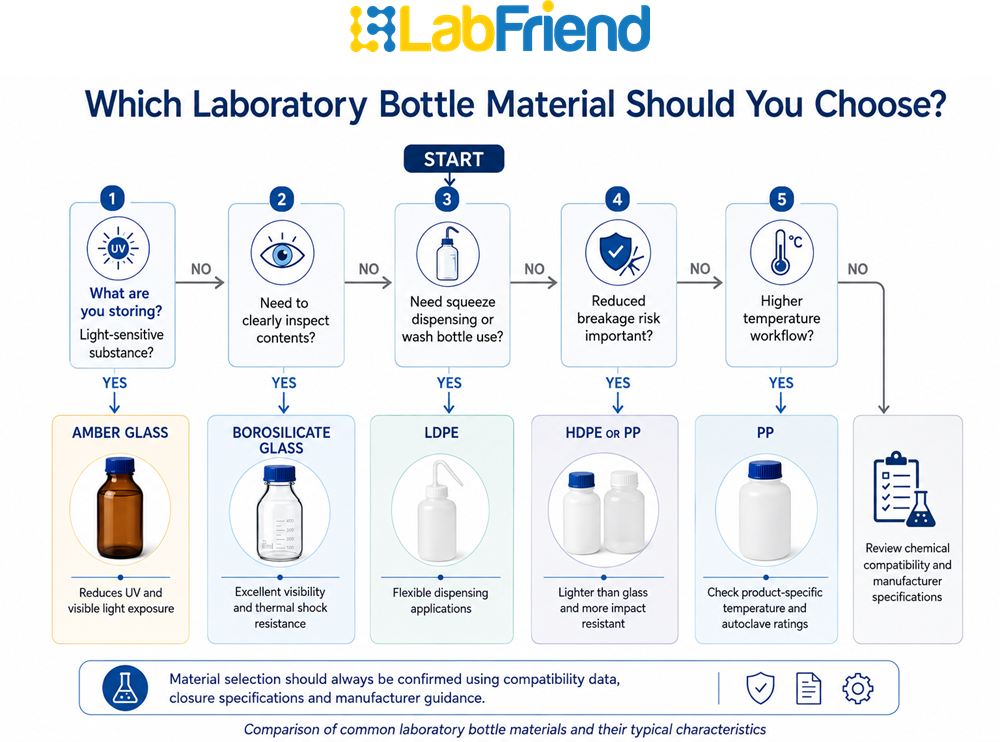
Application-based material selection guide
|
Application |
Usually consider |
Why |
|
Routine reagent storage |
Borosilicate glass, amber glass or suitable plastic |
Depends on compatibility, purity requirements, visibility, light sensitivity and storage duration. |
|
Light-sensitive contents |
Amber glass or another specified light-protective format |
Reduces light exposure where appropriate |
|
Field sampling or transport |
HDPE or another suitable plastic |
Lower breakage risk and lighter handling |
|
Flexible dispensing |
LDPE where suitable |
Supports squeeze dispensing and wash bottle-style workflows |
|
Powders or solids |
Wide-mouth glass or plastic |
Easier filling, access and emptying |
|
Routine liquid pouring |
Narrow-mouth glass or plastic |
Supports controlled pouring |
|
Contamination-sensitive workflows |
Sterile or certified container where specified |
Material alone does not confirm sterility or cleanliness |
|
Space-efficient storage |
Square bottle format where suitable |
Can improve cupboard, bench or fridge organisation |
If the workflow involves liquids and controlled pouring, view narrow-mouth laboratory bottles. If the workflow involves powders, solids, samples or easier filling, browse wide-mouth laboratory bottles.
If storage layout is part of the material decision, compare square laboratory bottles as a space-efficient format option. LabFriend’s Square Bottles category is live under the Vessels pathway.
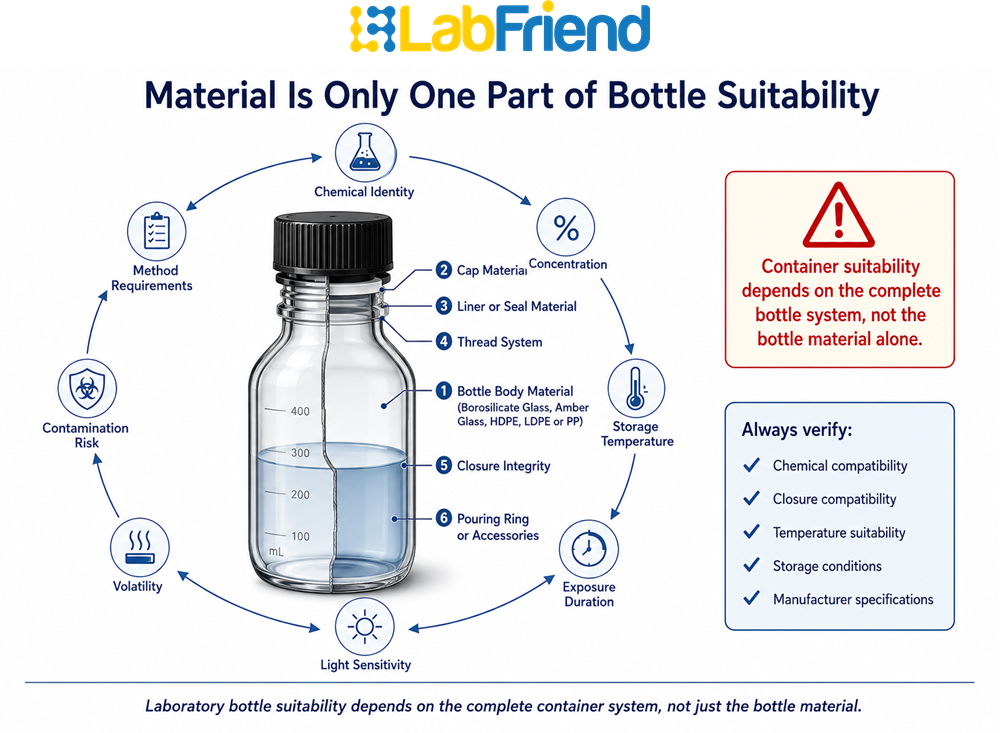
Chemical compatibility and closure checks
Material selection is only one part of bottle suitability. A bottle should be assessed as a complete container system.
Before selecting a laboratory bottle material, check:
- bottle body material
- cap material
- thread type
- liner or seal material
- closure integrity
- pouring ring or accessory compatibility
- stored substance or sample
- concentration
- storage temperature
- exposure duration
- light sensitivity
- volatility
- contamination risk
- method or protocol requirements
Chemical compatibility depends on the chemical identity, concentration, exposure duration, temperature, sample matrix and workflow conditions. Always verify compatibility using manufacturer guidance and internal laboratory procedures.
In some applications, particularly trace analysis or biological sample storage, adsorption of analytes onto plastic surfaces may also influence container suitability.
Sterility, autoclaving and certification are separate from material
Material choice does not automatically confirm sterility, autoclave suitability or cleanliness status.
A laboratory bottle may be made from a material commonly used in laboratories, but that does not mean it is:
- sterile
- DNase-free
- RNase-free
- endotoxin-controlled
- certified
- pre-cleaned
- autoclavable
- suitable for repeated autoclave cycles
- suitable for trace analysis
These characteristics must be confirmed from the product specification or supporting documentation.
If your workflow requires sterile packaging or contamination-sensitive handling, review LabFriend UK’s sterile bottles and bags and confirm the sterility status, packaging format and product specification before ordering. LabFriend’s Sterile Bottles and Bags page is live under the Cleanroom and Sterilisation pathway.
What this guide does not solve
This material guide helps narrow the selection, but it does not replace product documentation or laboratory validation.
Material choice alone does not confirm:
- chemical compatibility
- cap or closure compatibility
- sterility
- purity status
- autoclave suitability
- temperature suitability
- trace analysis suitability
- regulatory suitability
- method suitability
- sample stability
- pressure or vacuum suitability
Procurement efficiency is valuable, but it should not replace technical suitability assessment.
What to check before purchasing laboratory bottles
Before purchasing laboratory bottles, check:
|
Check |
Why it matters |
|
Material |
Determines whether the bottle is a candidate for the workflow |
|
Volume |
Affects storage, headspace, handling and reorder quantity |
|
Mouth style |
Influences filling, pouring and cleaning |
|
Cap/thread |
Prevents closure mismatch |
|
Liner/seal |
May affect leakage, evaporation or compatibility |
|
Clear or amber format |
Important for visibility or light exposure |
|
Sterility status |
Must be confirmed where required |
|
Autoclavability |
Product-specific; never assume |
|
Documentation |
Important for QA, trace or regulated workflows |
|
Reorder code |
Supports repeat purchasing and avoids uncontrolled substitutions |
When the requirement is still broad, route the user first to LabFriend UK’s laboratory vessels. For reagent-focused workflows, use laboratory reagent bottles as the more specific category route.
Common mistakes when choosing laboratory bottle materials
- Treating all plastics as the same
HDPE, LDPE and PP have different properties and should not be used interchangeably without checking product specifications.
- Assuming glass is always suitable
Glass is widely used in laboratories, but compatibility still depends on the substance, concentration, temperature, exposure duration and closure system.
- Assuming amber glass is enough for every light-sensitive substance
Amber glass can reduce light exposure where appropriate, but it may not provide the required protection for every method or substance.
- Ignoring the cap and closure
The bottle body may be suitable while the cap, liner or seal is unsuitable. Always assess the complete container system.
- Confusing material with sterility
A bottle material does not define sterility, DNase-free status, RNase-free status or endotoxin status. These must be confirmed separately.
- Assuming autoclavability from material alone
Some materials may be used in autoclavable products, but the bottle and closure system must be specified for autoclaving.
- Forgetting repeat-order control
Once a suitable material and bottle format are selected, record the product code, volume, cap/thread and pack size for future ordering.
UK laboratory purchasing considerations
Scientists and researchers often define the technical requirement, even when procurement places the order. To avoid delays or unsuitable alternatives, the purchase request should include more than “glass bottle” or “plastic bottle”.
A useful laboratory bottle request should include:
- application
- material
- volume
- mouth style
- cap/thread type
- clear or amber format
- sterile, certified or autoclavable requirement
- pack size
- preferred product code
- whether alternatives can be considered
- any method or workflow restrictions
This helps procurement, lab managers and suppliers route the order correctly and reduces the risk of uncontrolled substitutions.
Relevant LabFriend category pathways
Use the material decision to guide the next browsing step:
- For broad bottle and vessel selection, start with LabFriend UK’s laboratory vessels.
- For reagent storage, compare laboratory reagent bottles.
- For controlled liquid pouring, review narrow-mouth laboratory bottles.
- For powders, solids or easier filling, browse wide-mouth laboratory bottles.
- For space-efficient storage, compare square laboratory bottles.
- For contamination-sensitive workflows, review sterile bottles and bags.
FAQs
What are laboratory bottles made from?
Laboratory bottles may be made from borosilicate glass, amber glass, HDPE, LDPE, PP or other specified materials. The correct choice depends on the substance or sample, storage conditions, workflow and product specification.
What is borosilicate glass used for in laboratory bottles?
Borosilicate glass is commonly selected for reagent storage, prepared solutions and visible liquid storage where glass properties and clear inspection are useful. Suitability should still be checked against the application and manufacturer documentation.
When should amber glass bottles be used?
Amber glass bottles are commonly selected where reduced light exposure is required for suitable light-sensitive contents. The required level of protection depends on the substance, method and storage conditions.
What are HDPE laboratory bottles used for?
HDPE bottles are often used for routine plastic storage, sample handling and transport workflows where lower breakage risk and lighter handling are useful. Compatibility must be verified for the intended contents.
What are LDPE laboratory bottles used for?
LDPE is often associated with flexible dispensing or wash bottle-style applications. Suitability depends on the liquid being dispensed, the closure or nozzle and the laboratory procedure.
What are PP laboratory bottles used for?
PP may be used in laboratory bottle or container formats where the product specification supports the intended workflow. Temperature, chemical compatibility and autoclave suitability should be confirmed at product level.
Are plastic laboratory bottles chemically compatible?
Some plastic bottles may be suitable for specific chemicals or samples, but compatibility depends on plastic type, chemical identity, concentration, temperature and exposure duration. HDPE, LDPE and PP should not be treated as interchangeable.
Are borosilicate glass bottles autoclavable?
Some borosilicate glass bottles may be autoclavable where specified by the manufacturer. The cap, closure and any accessories must also be checked before autoclaving. Autoclave suitability also depends on the closure material, fill volume and operating conditions used during sterilisation.
Which laboratory bottle material is best for reagent storage?
There is no universal best material. Reagent storage may involve borosilicate glass, amber glass or suitable plastic depending on the reagent, compatibility requirements, visibility, light sensitivity and closure system.
Which material is best for wash bottles?
LDPE is commonly associated with flexible wash bottle-style applications, but the correct choice depends on the liquid, dispensing requirement, solvent compatibility and product specification.
Conclusion
Borosilicate glass, amber glass, HDPE, LDPE and PP all have useful roles in laboratory bottle selection, but none should be selected by material name alone. The right choice depends on the application, stored substance or sample, compatibility requirements, bottle format, closure system, temperature conditions and documentation needs.
For routine selection, start with the workflow. Then choose the material, bottle shape, mouth style, cap and volume that fit that workflow. Once the correct bottle is identified, record the specification so future reordering is accurate and consistent.
Compare laboratory bottle materials with LabFriend UK
Written by: Donal O’Sullivan, BSc, Co-Founder and Sales Director, LabFriend UK. Donal brings deep chemistry-led technical expertise across analytical chemistry, biochemistry, environmental monitoring, laboratory instrumentation, consumables and scientific product selection.
Reviewed by: Michael Anderson, MBA, Founder and Managing Director, LabFriend UK. Michael reviews LabFriend UK content for customer relevance, commercial accuracy, operational practicality and alignment with LabFriend UK’s laboratory supply model.
Use this guide to narrow your material choice, then browse LabFriend UK’s laboratory vessels as the broad starting point. For more specific workflows, compare laboratory reagent bottles, narrow-mouth laboratory bottles, wide-mouth laboratory bottles, square laboratory bottles or sterile bottles and bags.
To get in touch to request an “Instant Quote” or talk to the team about your specific requirements simply contact us 😊
Further reading:
Laboratory Bottles: Selection Guide for UK Laboratories
Related Stories

Laboratory Bottle Selection for Lab Managers - Standardising Everyday Storage and Handling
Learn how UK lab managers can standardise laboratory bottle selection by material, volume, mouth style, closure, sterility, compatibility and reorder requirements to reduce stockouts and simplify repeat purchasing.

Glass vs Plastic Laboratory Bottles - Which Should UK Labs Choose
Glass vs Plastic Laboratory Bottles - Which Should UK Labs Choose

How to Select Laboratory Reagent Bottles for Chemical Storage
How to Select Laboratory Reagent Bottles for Chemical Storage

Glass vs Plastic Laboratory Bottles for Procurement Teams: Balancing Cost, Risk and Suitability
Glass vs Plastic Laboratory Bottles for Procurement Teams: Balancing Cost, Risk and Suitability