Laboratory Bottle Labelling and Traceability - What UK Labs Should Record
25 mins read
Laboratory Bottle Labelling and Traceability - What UK Labs Should Record
By Donal O’Sullivan, BSc. Reviewed by Michael Anderson, MBA.
A laboratory bottle label should provide enough information
to identify the container and its contents clearly at the point of use. Where
traceability matters, the physical label may also need to connect the bottle to
associated records such as preparation, batch, lot or other controlled
information. The important question is not whether every laboratory
bottle should carry the same set of fields. It is whether the information
recorded is sufficient for the laboratory's intended identification and
traceability needs. |
Key Takeaways
- A
bottle label should make the container and its contents identifiable
without relying on guesswork.
- The
information required depends on the laboratory workflow; there is no
single universal label for every bottle.
- Dates,
batch or lot information, preparation details and other fields should be
recorded where they are relevant to the material and process.
- A
physical label and an associated record can work together; not every piece
of traceability information needs to fit on the bottle itself.
- Consistent
identifiers help connect a physical bottle to supporting records.
- Relabelling
or transferring material should not break the traceability chain.
- Labels
need to remain readable and associated with the correct container
throughout the relevant period of use.
- Labelling supports traceability but does not replace the laboratory's own controlled procedures.
Why Do Laboratory Bottle Labelling and Traceability Matter?
Laboratories often have multiple bottles containing similar
materials, prepared solutions, reagents or samples. If the identification on
one bottle is unclear, incomplete or no longer matches the associated record,
it can become difficult to establish what the container holds and how it should
be handled.
Good labelling therefore supports more than simple
identification.
It can help a laboratory:
- distinguish
similar containers;
- connect
a bottle to its preparation or source information;
- identify
relevant dates;
- establish
batch or lot relationships where required;
- maintain
controlled status information;
- investigate
unexpected results or discrepancies;
- reduce
ambiguity when material is transferred between locations; and
- maintain
consistent records across repeat workflows.
The level of information needed depends on the laboratory's
process.
A bottle containing a commercially supplied reagent may
require different information from a bottle containing a laboratory-prepared
solution or a sample collected for analysis.
The objective is to record enough information to maintain
reliable identification and traceability without creating unnecessary or
unmanageable labelling requirements.
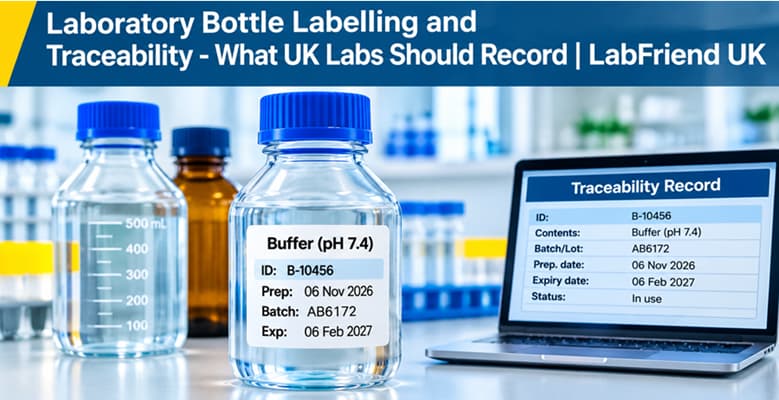
What Information Should a Laboratory Bottle Label Contain?
The label should contain the information needed to identify
the bottle and its contents clearly at the point where the container is being
used.

Depending on the application, this may include:
|
Information |
Why it may be needed |
|
Contents or material identification |
Establishes what the bottle contains or represents |
|
Unique identifier |
Connects the physical bottle with an associated record
where required |
|
Preparation or receipt date |
Establishes when relevant material entered the controlled
workflow |
|
Expiry or use-by information |
Helps identify the period during which the material is
intended to remain suitable for use |
|
Batch or lot information |
Supports source traceability where relevant |
|
Responsible person or area |
Can identify ownership or responsibility where required |
|
Status |
Can distinguish approved, pending, quarantined or other
controlled states where applicable |
|
Storage or handling information |
May be needed where particular conditions are important to
the workflow |
Not every field belongs on every physical label.
The laboratory should determine which information needs to
be immediately visible and which can be maintained in an associated record.
Where a bottle contains a hazardous substance or
preparation, any required hazard identification and handling information should
also be addressed through the laboratory's applicable procedures and regulatory
requirements. Hazard communication is a separate control from general bottle
traceability and should not be assumed to be satisfied by a unique identifier
or material name alone.
Identification and Traceability Are Not the Same Thing
A label identifies a container and, where appropriate,
identifies the material or sample associated with it. Traceability establishes
a reliable connection between that physical container and the information
needed to understand its identity, source, preparation, status or history.

For example, a bottle may carry a unique container or
preparation identifier, while the associated record contains:
- preparation
details;
- source
material;
- batch
or lot information;
- preparation
date;
- responsible
person;
- relevant
supporting documentation; or
- other
controlled information.
This approach can be preferable to placing every possible
field on the physical label.
The important requirement is that the relationship between
the bottle and the associated record remains clear.
If a person cannot reliably determine which record belongs
to a particular bottle, the presence of a label alone does not provide
effective traceability.
What Should Be Recorded in the Associated Record?
The associated record should contain information that is
necessary for the laboratory's workflow but does not need to appear in full on
the physical bottle.
Depending on the application, this can include:
- the
full material or sample description;
- source
or supplier information;
- manufacturer
and product reference;
- batch
or lot information;
- preparation
instructions or record of preparation;
- preparation
date;
- responsible
person;
- relevant
review or approval information;
- storage
location;
- associated
test or sample reference;
- supporting
documentation; and
- status
or disposition information.
The precise requirements should come from the laboratory's
own procedures and the nature of the material.
The aim is to create a reliable connection between the
bottle that is physically handled and the information that explains its
identity and history.
Core Information Versus Application-Specific Information
A useful way to design a labelling system is to distinguish
information that is broadly useful from information that depends on the
particular workflow.
Core identification information
Most controlled laboratory workflows need some way of
identifying:
- what
the container contains or represents; and
- which
record, reference or other identifier belongs to it where traceability
requires that connection.
Application-specific information
Additional information may be required depending on the
material or process, such as:
- preparation
date;
- expiry
or use-by date;
- batch
or lot;
- concentration;
- status;
- storage
condition;
- sample
reference;
- responsible
person; or
- another
method- or procedure-specific identifier.
The laboratory should avoid adding fields simply because
they appear useful in theory.
Every additional field creates another opportunity for
inconsistent recording, outdated information or transcription errors.
A better approach is to identify the information that the
workflow actually needs and make those requirements consistent.
Prepared Solutions and Reagents
Bottles containing laboratory-prepared solutions may require
more information than unopened commercial products because the laboratory may
need to establish how and when the material was prepared.
Depending on the procedure, relevant information may
include:
- solution
or reagent identification;
- concentration
where applicable;
- preparation
date;
- expiry
or review date where applicable;
- preparation
or batch reference;
- responsible
person; and
- associated
preparation record.
The precise fields should be determined by the laboratory's
procedure and the nature of the material.
Do not assume that every prepared solution requires the same
label information.
The important principle is that the physical container
should be identifiable and, where necessary, linked to the information required
to understand its preparation and status.
Sample Bottles and Analytical Traceability
Sample bottles can have different traceability requirements
from reagent or storage bottles.
For a sample workflow, the identifier may need to connect
the physical container with information such as:
- sample
reference;
- collection
information;
- source;
- relevant
date or time;
- associated
project or test reference; and
- other
information required by the laboratory's sampling procedure.
The exact requirements depend on the sampling and testing
process.
This article does not establish a universal sample
chain-of-custody procedure. Where a laboratory has a controlled sampling or
chain-of-custody process, the bottle label and associated records should follow
that established procedure.
Batch and Lot Information
Batch or lot information can be important when the
laboratory needs to trace material back to its source.
For example, a bottle containing a commercial reagent may
need to retain the manufacturer's batch or lot reference in the laboratory
record even if the full information is not practical to display prominently on
the physical label.
Where batch or lot information is relevant, the laboratory
should ensure that it can be connected reliably to the correct bottle.
This is particularly important where multiple bottles
contain similar materials from different batches.
The requirement should remain proportionate to the workflow
rather than treating batch or lot recording as mandatory for every laboratory
bottle.
Dates Need to Be Clearly Defined
Dates can have different meanings, so labels should avoid
ambiguous date fields where the distinction matters.
Depending on the workflow, a date may represent:
- preparation;
- receipt;
- opening;
- expiry;
- review;
or
- another
controlled event.
For example, a preparation date should not automatically be
interpreted as an expiry or use-by date. Where an expiry or use-by date is
required, its basis should come from the applicable manufacturer information,
validated stability information, analytical method or controlled laboratory
procedure rather than being inferred from the preparation date alone.
Where more than one date is relevant, the label or
associated record should make the meaning clear.
The laboratory's procedure should determine which dates need
to be recorded and how they should be represented.
What About Bottle Status?
Some workflows require the laboratory to distinguish between
different container or material statuses.
Examples can include:
- pending;
- approved;
- quarantined;
- rejected;
- expired;
or
- awaiting
review.
Where status information is used, it should be clear what
the status means and how it is controlled.
A status marking that can be changed without a corresponding
record or procedure may create confusion rather than reduce it.
Status information should therefore be part of the
laboratory's controlled process rather than an informal labelling convention.
Keep Labels Readable and Associated With the Correct Bottle
A technically complete label is not useful if it cannot be
read or if it becomes detached from the container.
Consider the actual conditions under which the bottle will
be:
- stored;
- handled;
- transported;
- refrigerated;
- frozen;
- exposed
to moisture;
- cleaned;
or
- otherwise
processed.
The label format and attachment method should be appropriate
for the intended conditions.
The laboratory should also consider whether the information
remains readable throughout the period in which it is needed.
Where bottles are moved between locations, the
identification should remain associated with the correct container.
The objective is not simply to create a label once. It is to
maintain reliable identification throughout the relevant workflow.
Avoid Ambiguous Labelling
A common source of confusion is using abbreviations,
informal names or local terminology that different people may interpret
differently.
A controlled labelling approach should therefore consider:
- consistent
names;
- agreed
abbreviations where abbreviations are necessary;
- clear
identifiers;
- consistent
date formats;
- legible
presentation; and
- terminology
that matches the laboratory's records.
For example, a short abbreviation may be obvious to the
person who prepared the bottle but unclear to another member of the team
several days later.
The best label is not necessarily the longest one. It is the
one that communicates the required information clearly and consistently to
the people who need to use it.
What Happens When a Bottle Is Relabelled?
Relabelling can create a traceability risk if the new label
no longer connects clearly with the original identity or associated record.
Before relabelling, the laboratory should establish:
- why
the bottle is being relabelled;
- which
identity needs to be retained;
- whether
the original identifier must remain traceable;
- whether
the associated record needs to be updated; and
- who
is authorised to make the change.
A new label should not simply overwrite important
information if doing so breaks the history of the container or material.
The appropriate process depends on the laboratory's
procedures.
Where the material itself has changed status, ownership or
identity, the associated records should reflect that change rather than relying
solely on a replacement label.
Transferring Material Between Bottles
Moving material from one bottle to another can also affect
traceability.

The laboratory should be able to establish which new
container corresponds to the original material and which information needs to
be transferred or retained.
Depending on the workflow, this may require:
- retaining
the original material identifier;
- assigning
a new container identifier;
- recording
the transfer;
- recording
the date;
- identifying
the person responsible; or
- updating
the associated record.
The exact requirements depend on the laboratory procedure.
The important principle is that a physical transfer should
not unintentionally sever the relationship between the material and its
relevant records.
A Practical Bottle Labelling and Traceability Framework
A simple framework can help laboratories determine what
information should be recorded.

1. Identify the container or contents
Establish what the bottle contains or represents.
2. Determine whether a unique identifier is needed
If the workflow requires a reliable connection to another
record, assign an identifier that can distinguish the container or material
appropriately.
3. Identify the additional information required
Determine whether dates, batch or lot information, status,
responsible person, storage information or other fields are needed.
4. Decide what belongs on the physical label
Place the information that needs to be visible at the point
of use on the bottle.
5. Decide what belongs in the associated record
Maintain supporting information that does not need to appear
in full on the physical container.
6. Establish how changes will be controlled
Define what happens when a bottle is relabelled,
transferred, expires or changes status.
7. Check that the system remains usable
Confirm that labels remain readable and that the physical
bottle can still be connected reliably to its associated record.
This framework should be adapted to the laboratory's actual
procedures rather than adopted as a universal label specification.
Laboratory Bottle Labelling and Traceability Checklist
|
Check |
Question |
|
Contents identified |
Can the bottle's contents or purpose be identified
clearly? |
|
Unique identifier |
Does the workflow require a unique identifier linking the
bottle to an associated record? |
|
Dates |
Are relevant dates recorded and clearly defined? |
|
Batch / lot |
Is batch or lot information required for the material or
workflow? |
|
Status |
Is any controlled status information required? |
|
Associated record |
Can the physical bottle be reliably connected to its
supporting record? |
|
Prepared material |
Are preparation details recorded where required? |
|
Sample information |
Are relevant sample references recorded where applicable? |
|
Readability |
Will the label remain readable under the intended
conditions? |
|
Relabelling |
Is there a controlled process for replacing or updating
labels? |
|
Transfers |
Can traceability be maintained if material moves to
another bottle? |
|
Procedure alignment |
Does the labelling approach match the laboratory's
established procedure? |
If a critical identification or traceability requirement
cannot be established, resolve it through the laboratory's controlled process
rather than relying on an informal labelling convention.
Common Labelling and Traceability Mistakes
Putting everything on the physical label
More information is not automatically better.
Better approach: keep essential identification
information on the bottle and maintain supporting detail in the associated
record where appropriate.
Using an identifier without a reliable record
A unique number is of limited value if the laboratory cannot
determine what record it refers to.
Better approach: make sure the identifier connects
reliably to the relevant information.
Using ambiguous dates
A date without a defined meaning can create confusion.
Better approach: identify whether the date represents
preparation, receipt, opening, expiry, review or another event.
Assuming batch or lot information is always required
The need for batch or lot information depends on the
material and workflow.
Better approach: record it where it contributes to
the required traceability.
Overwriting information during relabelling
Replacing a label can unintentionally remove useful history.
Better approach: follow a controlled relabelling
process that preserves the required traceability.
Using informal abbreviations
An abbreviation that is obvious to one person may be unclear
to another.
Better approach: use consistent terminology and
agreed abbreviations where appropriate.
Allowing labels to become unreadable
A correct label does not provide reliable identification if
it cannot be read.
Better approach: consider the actual storage and
handling conditions when establishing the labelling method.
Treating labelling as a substitute for procedure
A label cannot compensate for an uncontrolled underlying
process.
Better approach: make bottle identification part of
the laboratory's established procedures for preparation, storage, sampling or
material control.
Frequently Asked Questions
What information should be included on a laboratory
bottle label?
A laboratory bottle label should include enough information
to identify the container and its contents clearly at the point of use.
Depending on the workflow, this may include a unique identifier, relevant
dates, batch or lot information, status or other application-specific
information. The exact fields should be determined by the laboratory's
procedure and traceability requirements.
Does every laboratory bottle need a unique identifier?
No. A unique identifier is most useful where the workflow
requires the physical bottle to be connected reliably to an associated record
or where similar containers need to be distinguished. The laboratory should
determine whether a unique identifier is necessary for the particular
application.
Should batch or lot information be recorded on laboratory
bottle labels?
Batch or lot information should be recorded where it is
relevant to the laboratory's traceability requirements. It may be appropriate
to place the information on the physical label or maintain it in an associated
record, depending on the workflow. It should remain reliably connected to the
correct bottle.
Should expiry or preparation dates be recorded on
laboratory bottles?
Relevant expiry or preparation dates should be recorded when
they are needed to control the material or workflow. The meaning of each date
should be clear because preparation, receipt, opening, expiry and review dates
are not interchangeable.
What is the difference between bottle labelling and
traceability?
Bottle labelling provides information that identifies a
physical container, while traceability connects that container to the
associated information needed to understand its identity, source, preparation,
status or history. Effective traceability may therefore require both a physical
label and an associated record.
What should a laboratory do when a bottle is relabelled
or transferred?
The laboratory should follow its controlled procedure for
relabelling or transferring material and ensure that the required connection
between the physical bottle and its associated records is maintained. Where
necessary, retain the original identifier or record the transfer so that the
material's relevant history is not lost.
Choosing Laboratory Bottles With Traceability in Mind
Labelling and traceability should be considered alongside
the wider bottle specification.
Once the laboratory has established what the container needs
to hold, how it will be used and what information needs to remain associated
with it, the bottle itself can be selected against those requirements.
For broader guidance on laboratory bottle selection, see Laboratory Bottles: Selection Guide for UK Laboratories.
When you are ready to review available bottle options, browse Laboratory Glassware.
Read More
Explore More
Written by: Donal O’Sullivan, BSc, Co-Founder and Sales Director, LabFriend UK. Donal brings deep chemistry-led technical expertise across analytical chemistry, biochemistry, environmental monitoring, laboratory instrumentation, consumables and scientific product selection.
Reviewed by: Michael Anderson, MBA, Founder and Managing Director, LabFriend UK. Michael reviews LabFriend UK content for customer relevance, commercial accuracy, operational practicality and alignment with LabFriend UK’s laboratory supply model.
Frequently asked questions
Delivery times vary by product and supplier. Each product page shows current stock levels and the expected lead time, and we confirm this when you place your order. Most items arrive within 2 to 3 weeks. Specialised items can take longer if they are not in stock. If you need something by a certain date, contact us and we’ll check for you.
Yes. Register for a commercial account and, once it’s approved, you will be able to process orders via PO Once you have a commercial account, you can directly email your purchase orders
Add products to your cart and click Get a Quote. You’ll get a formal quote instantly, ready to send to your email address. For bulk orders or custom requirements, send us your product list and we’ll reply with itemized pricing.
If your item is faulty, not as described or sent in error, let us know within 14 days of delivery and we’ll arrange a return. Change of mind returns are only accepted if the item is unused and in its original packaging. A restocking fee will apply and you pay the return freight. Read our full Returns Policy for details.
Yes, prices are shown including VAT by default. Use the Prices Inc. VAT toggle at the top of the page to view prices without VAT.