

Share :
Compatible Pipette Tips for Gilson Pipettes for Independent Laboratories
Updated On 07/29/2026

By Donal O’Sullivan, BSc. Reviewed by Michael Anderson, MBA.
Independent laboratories operate in an increasingly demanding environment. Whether providing analytical testing, contract research, environmental monitoring, food analysis, pharmaceutical services or specialist scientific consultancy, they are expected to deliver reliable results while maintaining commercial competitiveness and operational efficiency.
These pressures extend beyond instrumentation and laboratory processes into the procurement of routine consumables. Pipette tips are purchased repeatedly throughout the year, making them one of the most significant recurring laboratory consumables. Consequently, many independent laboratories periodically review their purchasing strategies to determine whether compatible pipette tips can provide greater procurement flexibility while continuing to support reliable laboratory liquid handling.
For laboratories using Gilson pipettes, this evaluation requires more than simply identifying an alternative supplier. It requires an understanding of pipette tip compatibility, appropriate validation principles and the relationship between physical fit, workflow performance and long-term procurement strategy.
This guide explains how independent laboratories can evaluate compatible pipette tips for Gilson pipettes, interpret the published LLG Labware compatibility information responsibly and develop a structured approach to supplier assessment.
For a comprehensive overview of pipette tip selection, compatibility and laboratory liquid handling, begin with The Complete Guide to Pipette Tips, Pipetting Accuracy & Laboratory Liquid Handling:
Why Independent Laboratories Review Compatible Pipette Tips
Unlike many larger organisations that operate under centralised procurement frameworks, independent laboratories often have greater flexibility when selecting consumables. This flexibility creates opportunities to improve purchasing efficiency, but it also places greater responsibility on laboratories to evaluate products objectively.
Independent laboratories commonly review compatible pipette tips for several reasons.
Some seek to strengthen supply-chain resilience by reducing dependence on a single manufacturer. Others wish to simplify purchasing across laboratories operating mixed pipette fleets, while many are looking for practical ways to manage recurring consumable costs without compromising laboratory performance.
Whatever the motivation, experienced laboratory managers recognise that compatibility should never be assumed simply because a pipette tip appears to fit a pipette.
Instead, successful supplier diversification is built upon structured technical assessment supported by appropriate procurement evaluation.
Understanding Gilson Pipette Platforms
Gilson pipettes are widely recognised for their precision and are used throughout research laboratories, testing facilities, universities and industrial laboratories.
Many independent laboratories rely on Gilson instruments for routine liquid handling because they provide dependable performance across a broad range of applications.
Before evaluating compatible consumables, laboratories should first understand their own pipette estate.
Questions worth considering include:
- Which Gilson pipette models are used routinely?
- Which volume ranges account for most laboratory work?
- Are pipettes used exclusively for routine analytical work, or do they also support molecular biology and low-volume applications?
- Are multiple pipette manufacturers represented within the laboratory?
Answering these questions provides the context needed for a meaningful compatibility assessment and helps procurement teams determine whether compatible consumables could simplify inventory management while continuing to support laboratory workflows.
Original Manufacturer Consumables and Compatible Alternatives
Laboratories using Gilson pipettes generally have two procurement pathways available.
The first is to continue purchasing original manufacturer pipette tips developed specifically for Gilson instruments.
The second is to evaluate compatible pipette tips that have been designed for use with supported Gilson pipette models and other compatible pipette platforms.
Neither approach should be viewed as inherently superior. The appropriate choice depends upon laboratory procedures, quality requirements, procurement strategy and the results of a structured compatibility assessment.
The purpose of evaluating compatible pipette tips is therefore not to replace original manufacturer consumables automatically, but to determine whether an alternative product can satisfy the laboratory's operational requirements following appropriate evaluation.
Original Gilson Products and Compatible Alternatives
Laboratories reviewing consumable options for Gilson pipettes should begin by understanding both the original manufacturer product range and the available compatible alternatives.
If your laboratory uses Gilson liquid handling systems, you can browse the current Gilson pipette range available from LabFriend UK:
For laboratories wishing to continue using original manufacturer consumables, the available Gilson pipette tips can be viewed here:
Many independent laboratories also evaluate compatible alternatives as part of wider procurement and supplier-diversification initiatives. LabFriend supplies an extensive range of compatible laboratory pipette tips, including the LLG Labware range, which has published compatibility guidance covering selected Gilson pipette families.
The complete compatible range can be explored here:
or specifically:
The purpose of this guide is not to recommend replacing original Gilson consumables automatically. Instead, it explains how laboratories can use published compatibility information to identify suitable products for structured evaluation before routine implementation.
For a broader discussion of compatibility across multiple pipette brands, see:
Optimise Your Pipetting Accuracy with Compatible Pipette Tips
Understanding the Published LLG Labware Compatibility Information
One of the advantages available to laboratories evaluating compatible consumables is the published LLG Labware compatibility guidance, which identifies LLG Labware pipette tip families intended for use with a range of commonly used laboratory pipettes, including selected Gilson models.
For Gilson users, the published compatibility information includes guidance covering pipette families such as:
- Pipetman Classic
- Pipetman G
- Pipetman L
- Pipetman P10L (8- and 12-channel configurations)
Pipetman L models use Gilson’s D-tip ejection system, which differs physically from the cone-fit interface used on Pipetman Classic and Pipetman G; laboratories should confirm which interface their specific Pipetman L model uses before relying on the tip codes below.
The compatibility guidance also maps these pipette families to the relevant LLG Labware tip ranges across commonly used laboratory volume ranges.
This information provides laboratories with a valuable starting point when identifying products for evaluation.
However, it should be interpreted as a compatibility reference rather than as a substitute for laboratory-specific assessment.
Each laboratory remains responsible for confirming that the selected consumable performs satisfactorily within its own workflows and quality requirements.
What Compatible Pipette Tips Mean in Practice
Compatible pipette tips are designed for use with specified pipette platforms and may enable laboratories to broaden their approved supplier base where appropriate validation has been completed.
Sterility and RNase/DNase-free status are separate specifications. Laboratories working with nucleic acid-sensitive applications should confirm both attributes independently rather than assuming one implies the other.
Where a laboratory’s procedures require autoclaving or re-sterilisation of consumables, autoclave compatibility should be confirmed separately, as this is not always implied by as-supplied sterility.
|
Compatible pipette tips are laboratory consumables designed for use with specified pipette platforms. Their suitability should be confirmed through laboratory evaluation, taking account of physical compatibility, workflow performance and the intended application before routine implementation. |
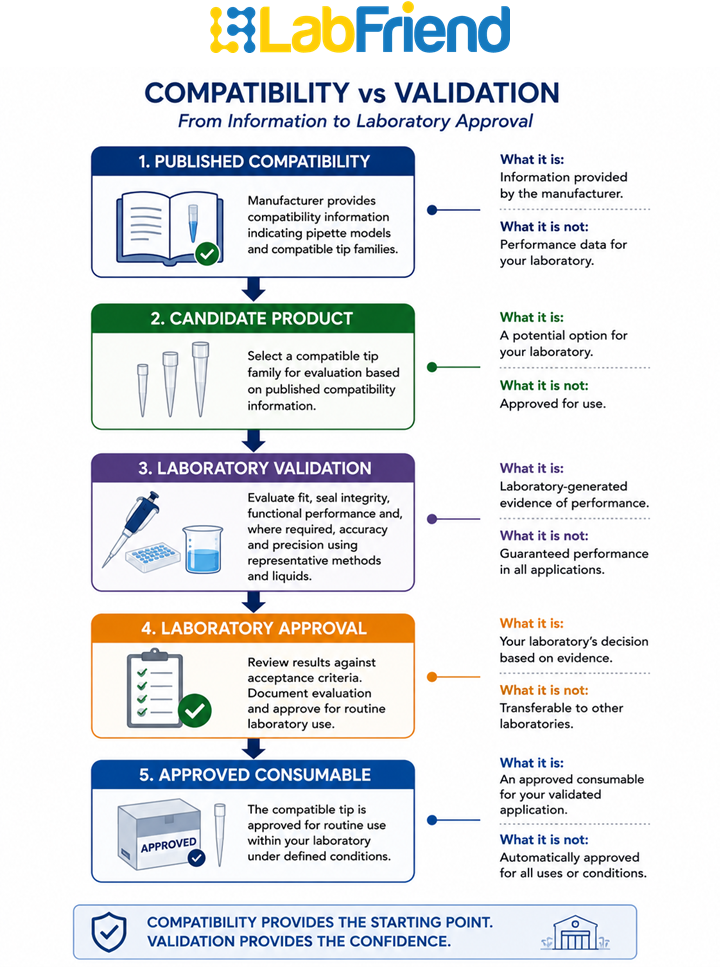
This distinction is important because compatibility should never be interpreted as a guarantee of identical performance under every laboratory condition.
Instead, laboratories should regard compatibility as the starting point for evidence-based evaluation.
Physical Fit and Functional Performance
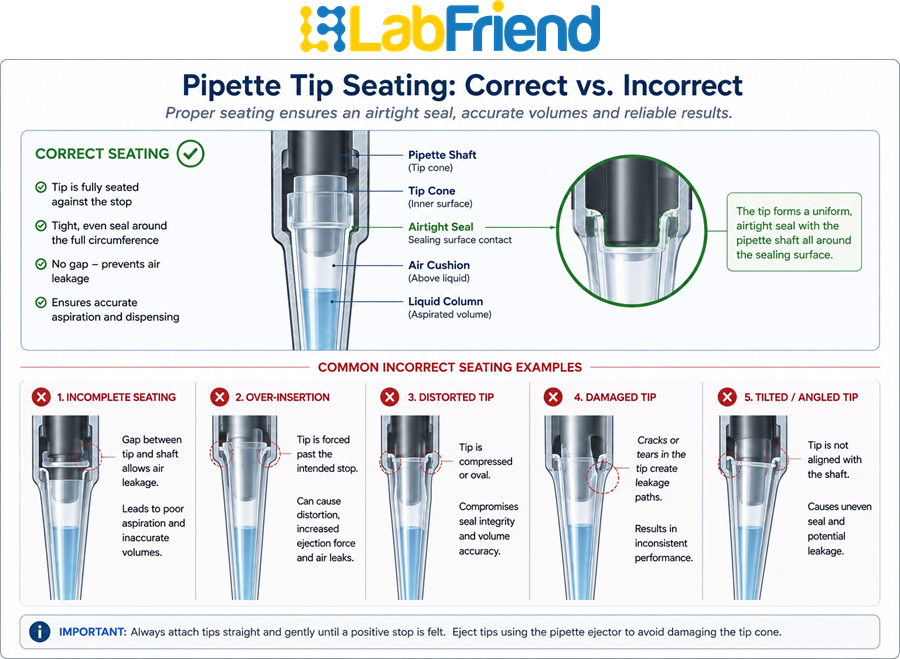
A common misconception during consumable evaluations is that successful attachment to a pipette demonstrates complete compatibility.
In practice, physical attachment represents only the first stage of assessment.
An effective compatibility evaluation also considers whether the pipette tip supports:
- consistent seal integrity;
- reliable aspiration;
- repeatable dispensing;
- predictable operator handling;
- appropriate ejection characteristics; and
- stable performance throughout routine laboratory workflows.
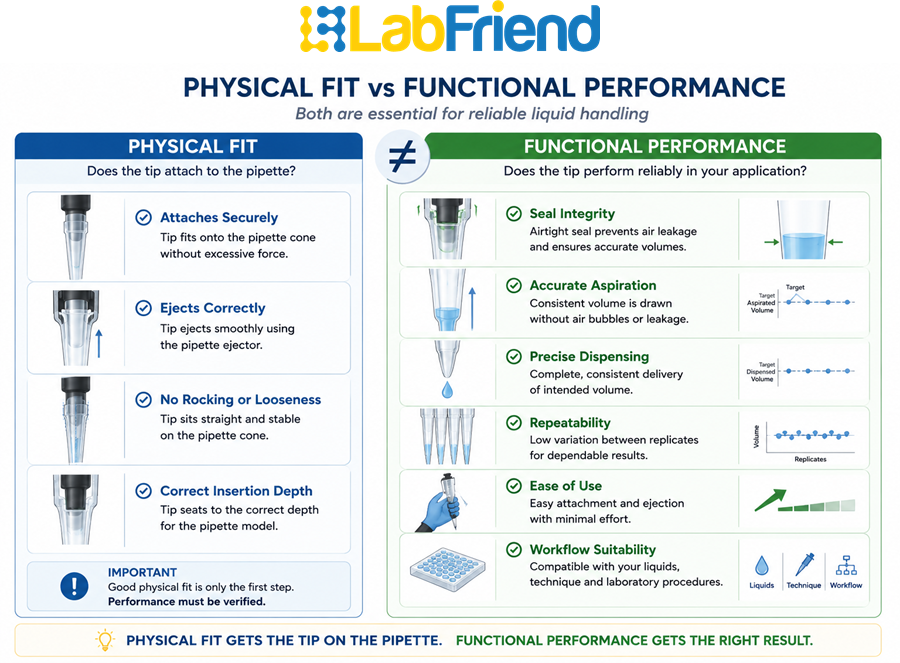
The relationship between these factors is discussed in greater detail in:
Why Pipette Tip Fit Matters for Accurate Laboratory Pipetting
Understanding the distinction between physical fit and functional performance helps laboratories avoid assumptions that could otherwise lead to inconsistent liquid handling.
Procurement Considerations for Independent Laboratories
Independent laboratories often review consumables from both technical and commercial perspectives.
Unlike organisations operating under highly centralised procurement frameworks, independent laboratories may have greater flexibility to introduce alternative suppliers where technical suitability has been demonstrated.
Consequently, procurement decisions often consider a combination of factors including supply continuity, inventory management, purchasing efficiency and operational resilience.
These commercial considerations should complement—not replace—technical evaluation.
A compatible pipette tip that contributes to procurement flexibility while also satisfying laboratory performance requirements may support long-term operational resilience. Conversely, introducing an alternative consumable without appropriate assessment may increase operational risk regardless of its purchase price.
The most effective procurement strategies therefore integrate laboratory validation with commercial evaluation, allowing supplier decisions to be supported by objective evidence rather than assumptions or historical purchasing habits.
Preparing for a Structured Compatibility Assessment
Once a compatible pipette tip has been identified using the published LLG Labware compatibility guidance, the next stage is to establish a structured evaluation process appropriate to the laboratory's workflows and quality procedures.
Rather than relying solely on compatibility listings, experienced laboratories assess physical fit, functional performance and workflow suitability before approving a consumable for routine use.
The second part of this guide explains how independent laboratories can undertake that assessment, compare procurement options objectively and implement supplier diversification while maintaining confidence in laboratory liquid handling performance.
A Structured Compatibility Assessment for Gilson Pipettes
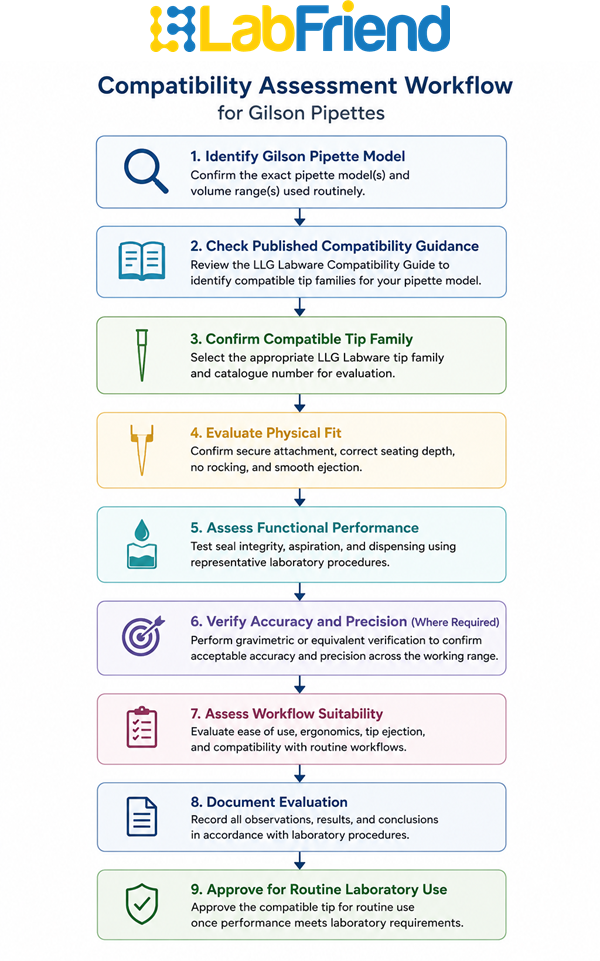
Once a compatible pipette tip has been identified as a potential option, the next stage is to determine whether it performs consistently within the laboratory's own environment. This assessment should be viewed as a structured evaluation rather than a simple product comparison.
The objective is not to prove that a compatible pipette tip is identical to the original manufacturer's consumable. Instead, the aim is to establish whether it provides appropriate performance for the laboratory's intended workflows while supporting procurement objectives such as supplier resilience and operational continuity.
The level of evaluation will naturally vary between laboratories. An independent testing laboratory performing routine environmental analysis may adopt a different approach from a pharmaceutical quality control laboratory operating under a more formal quality management system. Nevertheless, the principles remain the same: decisions should be based on evidence gathered under representative working conditions.
Step 1 – Confirm Compatibility with the Relevant Gilson Pipette Models
The assessment should begin by confirming that the selected LLG Labware pipette tip corresponds with the appropriate Gilson pipette family identified within the published compatibility guidance.
The current compatibility information includes supported Gilson families such as:
- Pipetman Classic
- Pipetman G
- Pipetman L
- Pipetman P10L (8- and 12-channel configurations)
Note that Pipetman P10L is a multichannel pipette (8- or 12-channel); tip loading and ejection across a full row of channels should be assessed separately from single-channel models during Steps 1 and 2 below.
The published compatibility table also maps these pipette families to the appropriate LLG Labware tip ranges for commonly used laboratory volume ranges. This compatibility information should be used as the starting point for evaluation rather than the final stage of product selection.
Laboratories should confirm that the specific pipette models and volume ranges used within their own organisation correspond with the published compatibility information before proceeding further.
Step 2 – Assess Functional Performance
Once physical compatibility has been confirmed, laboratories should evaluate how the pipette tip performs during routine liquid handling.
The assessment should include observations relating to:
- seal integrity;
- aspiration consistency;
- dispensing consistency;
- repeatability during routine operation;
- ease of tip attachment and ejection; and
- overall operator confidence.
Testing should be carried out using representative laboratory procedures wherever possible. Evaluating products under genuine working conditions provides significantly more useful information than isolated bench testing.
Step 3 – Consider Workflow-Specific Requirements
Different laboratory applications place different demands on pipette tips.
Routine aqueous transfers may require a relatively straightforward assessment, whereas workflows involving PCR (polymerase chain reaction), qPCR (quantitative PCR), molecular biology or contamination-sensitive analysis often justify more detailed evaluation.
The tip codes referenced in this guide are non-filter tips. Laboratories undertaking PCR, qPCR or other contamination-sensitive work should also evaluate the filter tip options discussed in the linked resource above before selecting a final product.
Where applicable, laboratories should also refer to the supporting authority articles within the LabFriend Insights Hub, including:
- Pipetting for PCR: How to Maximise Accuracy in DNA Amplification Workflows
- qPCR Pipetting Best Practices: How to Reduce Variability and Improve Accuracy at Low Volumes
- When Should You Use Filter Pipette Tips in qPCR and Molecular Biology?
These resources provide additional context for laboratories undertaking application-specific compatibility assessments.
Published LLG Labware Compatibility Overview for Gilson Pipettes
One of the advantages available to laboratories evaluating compatible consumables is the published LLG Labware Compatibility Guide, which identifies specific LLG Labware pipette tip families designed for use with a range of Gilson pipettes. This compatibility information provides a valuable starting point for laboratories wishing to evaluate alternative consumables while maintaining a structured validation process.
The current compatibility guidance includes support for the following Gilson pipette families:
- Pipetman Classic
- Pipetman G
- Pipetman L
- Pipetman P10L (8- and 12-channel models)
The published compatibility table maps these Gilson pipettes to the following LLG Labware tip families:
In the table below, ‘Racked’ indicates tips supplied in a disposable rack, while ‘Rack Refill’ indicates tips supplied for reloading into a compatible existing rack system.
|
Gilson Pipette Family |
Typical Volume Range |
Recommended LLG Labware Tip |
|
Pipetman Classic / G / L |
0.2–10 microlitres (µL) |
4.694 458 (Sterile Racked XL) |
|
Pipetman Classic / G / L |
2–200 µL |
or |
|
Pipetman Classic / G / L |
200–1000 µL |
or |
|
Pipetman P10L (8/12 Channel) |
Low-volume applications (typically 0.1–10 µL, 8- and 12-channel) |
Corresponding low-volume LLG Labware tip family identified within the published Pipette Tip Compatibility Guide |
The codes shown (e.g. 4.694 458) are LLG Labware catalogue reference numbers, provided for use when ordering or requesting quotations.
These bands reflect tip-compatibility ranges rather than the specification of any single Pipetman model. Laboratories should confirm their specific Pipetman model against Gilson’s published specifications in addition to the LLG Labware compatibility guidance above.
For routine, non-critical applications that do not require sterile tips, laboratories can review LLG Labware’s non-sterile equivalents within the full compatible range: Laboratory Pipette Tips.
These recommendations are derived from the published LLG Labware compatibility guide and are intended to help laboratories identify appropriate products for evaluation. Inclusion within the compatibility table should not be interpreted as confirmation that a particular tip is suitable for every application or laboratory workflow.
Before introducing any compatible consumable into routine use, laboratories should confirm:
- compatibility with the specific Gilson pipette model in use;
- secure tip fit and seal integrity;
- consistent aspiration and dispensing performance;
- suitability for the intended laboratory workflow; and
- compliance with local quality procedures where validation or change control is required.
This evidence-based approach enables independent laboratories to benefit from supplier diversification while maintaining confidence in liquid handling performance and scientific reproducibility.
Procurement Considerations
Independent laboratories often evaluate consumables against a broader range of criteria than purchase price alone.
A structured comparison may include:
|
Procurement Consideration |
Original Gilson Consumables |
Compatible Consumables |
|
Existing laboratory familiarity |
Established |
Requires evaluation |
|
Supplier flexibility |
Single manufacturer |
Broader supplier options |
|
Supply-chain resilience |
Manufacturer dependent |
Opportunity to diversify |
|
Inventory standardisation |
Depends on laboratory fleet |
May simplify mixed-platform environments |
|
Workflow suitability |
Already established |
Should be confirmed locally |
|
Long-term purchasing strategy |
Manufacturer-led |
Laboratory-led procurement flexibility |
|
Unit cost / recurring consumable spend |
Fixed by manufacturer pricing |
Opportunity for cost comparison across suppliers |
The purpose of this comparison is to support balanced procurement decisions rather than promote one purchasing strategy over another.
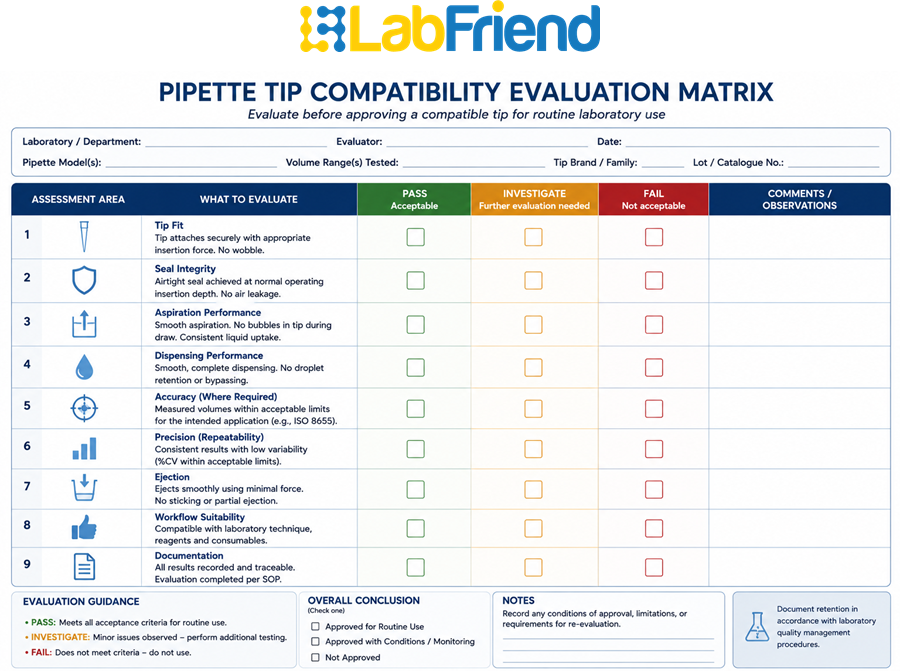
Supplier Evaluation Checklist
Before introducing compatible pipette tips into routine laboratory use, procurement and laboratory personnel may wish to confirm that the following areas have been considered.
|
Evaluation Area |
Completed |
Notes / Sign-off |
|
Correct Gilson model identified |
☐ |
|
|
Published compatibility reviewed |
☐ |
|
|
Physical compatibility confirmed |
☐ |
|
|
Functional performance assessed |
☐ |
|
|
Workflow suitability evaluated |
☐ |
|
|
Laboratory documentation completed |
☐ |
|
|
Procurement approval granted |
☐ |
|
This checklist provides a simple framework that can be adapted to local laboratory procedures.
Mark each item once it has been confirmed, and retain the completed checklist alongside any supporting evaluation records.
Considering LLG Labware Compatible Pipette Tips
Independent laboratories seeking to strengthen procurement resilience may wish to include the LLG Labware range within their supplier evaluation process.
LLG Labware offers a broad portfolio of compatible pipette tips covering multiple laboratory applications and volume ranges. Where the published compatibility guidance identifies support for Gilson pipette families, laboratories can use this information to select appropriate products for technical evaluation.
The complete range can be explored through:
Alternatively, laboratories comparing a wider selection of compatible and manufacturer-specific consumables can browse:
Frequently Asked Questions
Can compatible pipette tips be used with Gilson pipettes?
Many compatible pipette tips are designed for specified Gilson pipette models. Laboratories should confirm compatibility using current compatibility guidance and evaluate performance within their own workflows before routine implementation.
Does inclusion within the published compatibility table guarantee suitability?
No. The published compatibility information identifies products intended for evaluation with specified pipette families. Individual laboratories remain responsible for confirming suitability for their own applications.
Why should independent laboratories evaluate compatible consumables?
A structured supplier evaluation may improve procurement flexibility, strengthen supply resilience and support long-term purchasing efficiency while maintaining confidence in laboratory performance.
Should laboratories document compatibility assessments?
Where appropriate, documenting compatibility assessments supports procurement transparency, quality management and change-control procedures.
Is physical fit sufficient?
No. Physical attachment should be regarded as the beginning of the evaluation process. Functional performance, workflow suitability and laboratory validation remain essential considerations.
Are compatible pipette tips more cost-effective than original manufacturer tips?
Compatible pipette tips can offer procurement flexibility and may support more competitive recurring consumable costs, but cost should be evaluated alongside—not instead of—the technical assessment described in this guide. A lower purchase price does not offset the operational risk of an inadequately validated consumable.
Conclusion
Independent laboratories are increasingly expected to balance scientific performance with commercial efficiency. Evaluating compatible pipette tips for Gilson pipettes is therefore not simply a purchasing exercise but part of a wider strategy that supports procurement resilience, operational continuity and evidence-based decision-making.
The published LLG Labware compatibility guidance provides a valuable foundation for identifying products suitable for evaluation. When combined with laboratory-specific assessment of physical compatibility, functional performance and workflow suitability, it enables procurement teams to make informed decisions that support both technical confidence and long-term supplier flexibility.
Rather than asking whether compatible pipette tips should replace original manufacturer consumables, laboratories should ask whether the proposed consumable has been appropriately evaluated for the work it is expected to perform. This approach reflects good scientific practice while supporting sustainable procurement.
Explore Compatible Pipette Tip Solutions
If your laboratory is reviewing procurement options for Gilson pipettes, explore the available LabFriend ranges:
To continue developing your understanding of compatibility and procurement best practice, we also recommend:
- The Complete Guide to Pipette Tips, Pipetting Accuracy & Laboratory Liquid Handling
- Optimise Your Pipetting Accuracy with Compatible Pipette Tips
- Why Pipette Tip Fit Matters for Accurate Laboratory Pipetting
- How UK Laboratories Validate Third-Party Compatible Pipette Tips
- Universal vs Manufacturer-Specific Pipette Tips for Procurement Teams
Together, these articles form the core of the LabFriend Pipette Tips Authority Hub, helping independent laboratories make informed decisions about consumable selection, supplier validation and long-term procurement strategy.
Written by: Donal O’Sullivan, BSc, Co-Founder and Sales Director, LabFriend UK. Donal brings deep chemistry-led technical expertise across analytical chemistry, biochemistry, environmental monitoring, laboratory instrumentation, consumables and scientific product selection.
Reviewed by: Michael Anderson, MBA, Founder and Managing Director, LabFriend UK. Michael reviews LabFriend UK content for customer relevance, commercial accuracy, operational practicality and alignment with LabFriend UK’s laboratory supply model.
Related Stories

How to Choose the Right Pipette: The Ultimate Guide to Accuracy and Lab Efficiency
Pipette - Primary

Optimise Your Pipetting Accuracy with Compatible Pipette Tips
Pipette Tip Selection Guide

Pipetting for PCR: How to Maximise Accuracy in DNA Amplification Workflows
How to Maximise Accuracy in DNA Amplification Workflows

qPCR Pipetting Best Practices: How to Reduce Variability and Improve Accuracy at Low Volumes
Learn how to reduce qPCR and RT-qPCR variability with accurate low-volume pipetting techniques, mastermix preparation, contamination control, and best-practice liquid handling workflows.