

Share :
Universal vs Manufacturer-Specific Pipette Tips for Procurement Teams
Updated On 07/17/2026

By Donal O’Sullivan, BSc. Reviewed by Michael Anderson, MBA.
Laboratory procurement has evolved beyond simply purchasing consumables at the lowest available price. Today's procurement teams are expected to balance cost, scientific performance, supply continuity, supplier resilience and long-term operational efficiency while supporting laboratories that rely on consistent, repeatable liquid handling.
Pipette tips are among the most frequently purchased laboratory consumables. Because they are used across research, quality control, biotechnology, pharmaceutical development and analytical testing laboratories, even small procurement decisions can have a significant operational and financial impact over time.
One of the most common procurement questions is whether laboratories should continue purchasing manufacturer-specific pipette tips or evaluate universal-compatible alternatives.
There is no single answer for every laboratory. The most appropriate decision depends on workflow requirements, compatibility, quality-system expectations, procurement strategy and the laboratory's appetite for supplier diversification.
For a comprehensive overview of pipette tip selection, liquid handling and laboratory workflows, see LabFriend UK's The Complete Guide to Pipette Tips, Pipetting Accuracy & Laboratory Liquid Handling:
Why Procurement Teams Are Reviewing Pipette Tip Suppliers
Across the UK, laboratories continue to face pressure to improve purchasing efficiency while maintaining scientific confidence.
Procurement reviews are often driven by one or more of the following objectives:
- Improving supply resilience
- Reducing dependency on a single supplier
- Standardising consumables across multiple laboratory sites
- Supporting long-term cost management
- Simplifying purchasing across mixed pipette fleets
- Expanding approved supplier options
Compatible pipette tips have become an increasingly common part of these discussions because they may provide greater procurement flexibility without requiring laboratories to purchase pipette-specific consumables for every instrument platform.
However, procurement decisions should always be supported by appropriate technical evaluation and workflow assessment.
What Are Manufacturer-Specific Pipette Tips?
Manufacturer-specific pipette tips are designed and supplied by the same company that manufactures the pipette.
Examples include original pipette tips supplied for Eppendorf, Gilson, Sartorius and Thermo Scientific pipettes.
Many laboratories continue using manufacturer-specific tips because:
- Existing workflows already use them
- Historical compatibility has been established
- Standard operating procedures reference them
- Laboratory personnel are familiar with their handling characteristics
Manufacturer-specific tips may simplify procurement where laboratories operate a single pipette platform. However, laboratories with mixed pipette fleets may need to purchase multiple tip ranges, increasing purchasing complexity and inventory requirements.
What Are Universal-Compatible Pipette Tips?
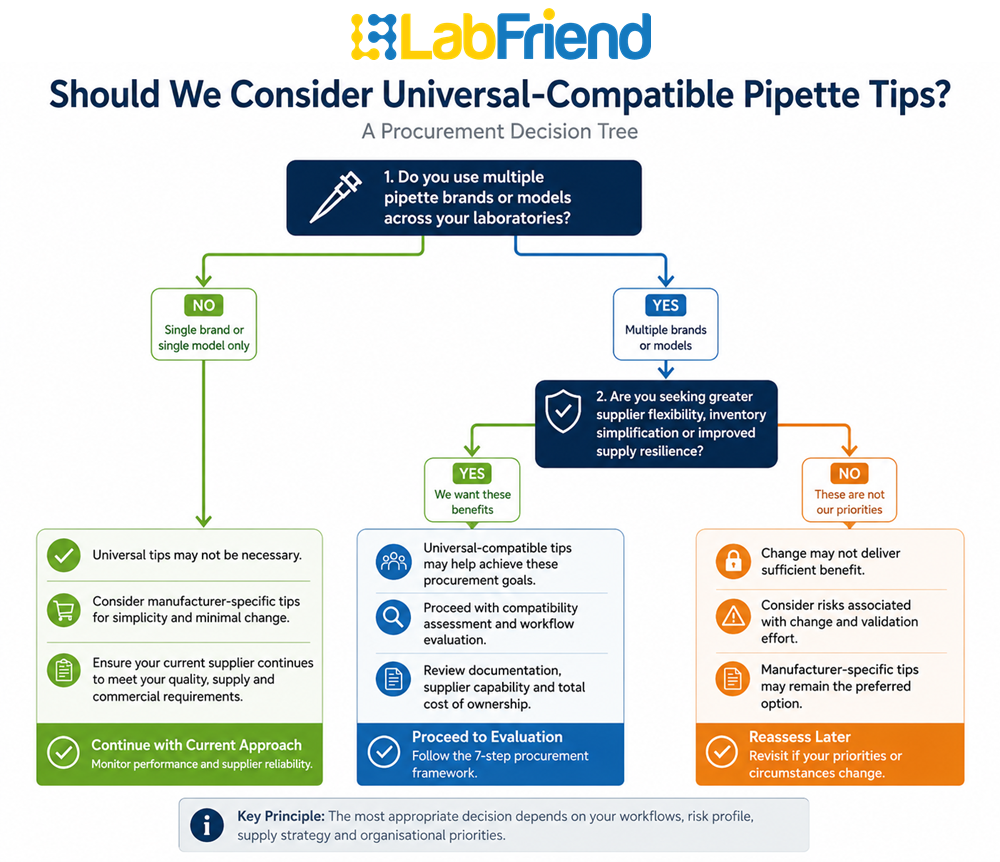
Universal-compatible pipette tips are designed to fit multiple pipette brands rather than being dedicated to a single manufacturer's instruments.
Their purpose is to provide laboratories with:
- Greater supplier flexibility
- Simplified inventory management
- Procurement standardisation
- Compatibility across mixed pipette fleets
- Opportunities to evaluate alternative suppliers
For procurement teams, the key consideration is not whether a pipette tip is labelled "universal", but whether it has been assessed as suitable for the laboratory's intended workflows.
Laboratories wishing to understand compatibility in greater detail should also review:
Optimise Your Pipetting Accuracy with Compatible Pipette Tips
| Universal-compatible pipette tips are designed to fit multiple pipette brands. Their suitability should be confirmed for the intended pipette models and laboratory applications before routine implementation |
Universal vs Manufacturer-Specific Pipette Tips
The following comparison summarises the procurement considerations most laboratories evaluate before introducing an alternative pipette tip supplier.
|
Procurement Consideration |
Universal-Compatible Pipette Tips |
Manufacturer-Specific Pipette Tips |
|
Supplier flexibility |
High |
Usually limited to the original manufacturer |
|
Procurement resilience |
Can support supplier diversification |
Often dependent on a single supplier |
|
Mixed pipette fleets |
May simplify purchasing |
Often requires multiple tip ranges |
|
Inventory complexity |
Potentially reduced |
May increase stock complexity |
|
Existing workflow familiarity |
Requires assessment |
Often already established |
|
Compatibility verification |
Recommended before implementation |
Usually already understood locally |
|
Standardisation opportunities |
Often favourable |
Depends on pipette fleet composition |
|
Total cost evaluation |
Should consider full lifecycle costs |
Should consider full lifecycle costs |
No single option is inherently better.
Instead, procurement teams should evaluate each option against the laboratory's operational, scientific and commercial requirements.
Beyond Purchase Price: Total Cost of Ownership
One of the most common procurement mistakes is evaluating pipette tips solely on unit price.
While purchase cost is important, procurement teams should also consider the broader operational impact of consumable selection.
A structured evaluation may include:
- Stockholding requirements
- Number of suppliers
- Ordering efficiency
- Supplier lead times
- Supply continuity
- Inventory rationalisation
- User acceptance
- Technical suitability
- Repeat purchasing efficiency
These factors often contribute more to the overall value delivered by a consumable than purchase price alone.
Compatibility Should Always Be Confirmed
Regardless of supplier, procurement teams should avoid assuming that a pipette tip is suitable simply because it physically fits a pipette.
As discussed in Why Pipette Tip Fit Matters for Accurate Laboratory Pipetting:
physical attachment is only one aspect of compatibility.
Laboratories should also consider:
- Seal integrity
- Aspiration consistency
- Dispensing consistency
- User experience
- Workflow suitability
This distinction helps reduce implementation risk while supporting more informed purchasing decisions.
Procurement Decisions Should Reflect Laboratory Workflows
Procurement teams rarely purchase pipette tips for a single application.
Instead, consumables are often used across multiple departments with different technical requirements.
Examples include:
|
Laboratory Workflow |
Procurement Consideration |
|
Routine liquid handling |
Inventory efficiency and compatibility |
|
PCR |
Low-volume performance and contamination control |
|
qPCR |
Reproducibility and precision |
|
Cell culture |
Sterility requirements |
|
Analytical testing |
Repeatability and documentation |
|
Molecular biology |
Contamination-control specifications |
For laboratories supporting PCR workflows, additional guidance is available in:
Pipetting for PCR: How to Maximise Accuracy in DNA Amplification Workflows
Laboratories performing low-volume amplification work should also review:
qPCR Pipetting Best Practices: How to Reduce Variability and Improve Accuracy at Low Volumes
These articles provide additional technical context that procurement teams can consider alongside commercial purchasing objectives.
A Structured Procurement Decision Framework
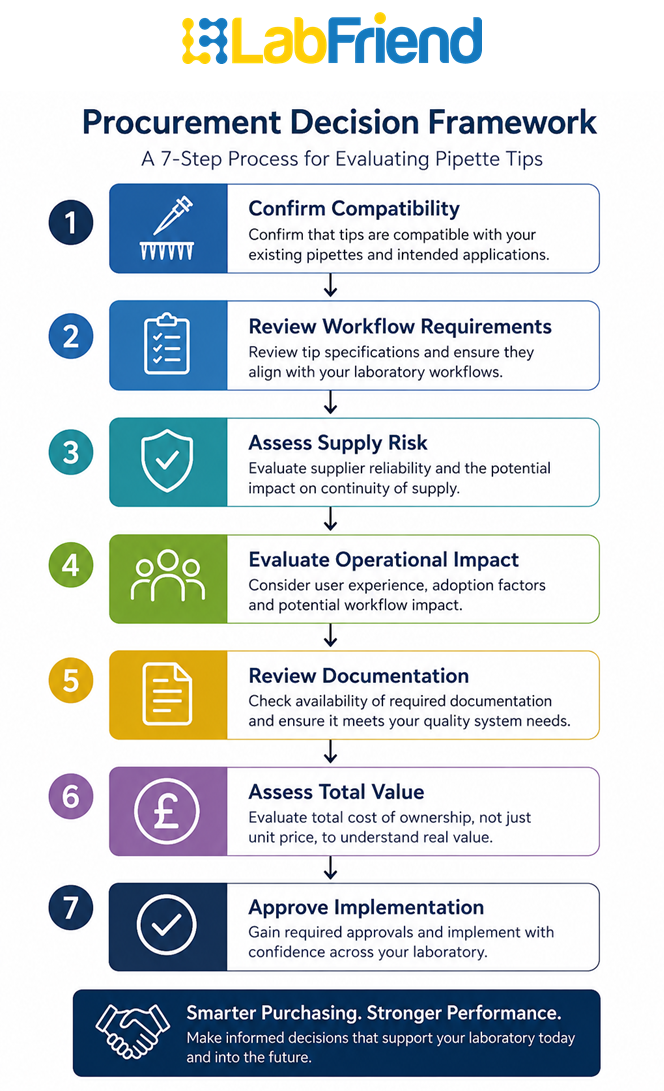
Once technical compatibility has been established, procurement teams should evaluate alternative pipette tips using a structured decision-making process that balances scientific requirements with commercial considerations.
A practical framework consists of seven stages:
- Confirm Technical Compatibility
Before considering commercial factors, verify that the proposed pipette tip is compatible with the laboratory's pipette fleet.
Where possible, compatibility should be assessed using the actual pipette models used within routine laboratory workflows.
- Review Workflow Suitability
Different applications place different demands on pipette tips.
A consumable suitable for routine liquid handling may not be appropriate for:
- PCR workflows
- qPCR workflows
- Molecular biology applications
- Cell culture
- Precision analytical testing
Laboratories should therefore evaluate compatibility within the context of the intended workflow rather than relying on generic compatibility claims.
- Assess Supply Chain Resilience
Supplier resilience has become an increasingly important procurement consideration.
Questions to ask include:
- Can the supplier support long-term availability?
- Are multiple pack formats available?
- Is stock continuity reliable?
- Can supply interruptions be minimised?
Reducing dependency on a single supplier may improve procurement resilience without compromising workflow requirements.
- Evaluate Operational Impact
Procurement decisions affect laboratory operations as well as purchasing.
Areas to consider include:
- Inventory management
- Ordering efficiency
- Warehouse space
- Number of stock-keeping units (SKUs)
- Internal standardisation
- User acceptance
Where laboratories operate multiple pipette platforms, compatible pipette tips may simplify consumables management.
- Review Documentation Requirements
Many UK laboratories operate under documented quality systems.
Depending on the organisation, introducing an alternative consumable may require:
- Product specification review
- Supplier documentation
- Internal assessment records
- Change-control procedures
- Quality approval
The extent of documentation should reflect the laboratory's own procedures and the criticality of the workflow.
- Consider Total Value
Rather than focusing solely on unit price, procurement teams should assess the broader value offered by a consumable.
This may include:
- Reduced purchasing complexity
- Improved supplier flexibility
- Simplified inventory management
- Repeat-order efficiency
- Supply continuity
- Workflow suitability
- Approve Implementation
Implementation should be based on objective evidence gathered throughout the evaluation process.
A structured review provides greater confidence than decisions based solely on historical purchasing patterns or assumptions.
Supplier Evaluation Checklist
The following checklist can support procurement discussions before approving an alternative pipette tip supplier.
|
Evaluation Area |
Assessment Completed |
|
Compatibility with existing pipettes confirmed |
☐ |
|
Seal integrity assessed |
☐ |
|
Workflow suitability reviewed |
☐ |
|
Contamination-control requirements confirmed |
☐ |
|
User evaluation completed |
☐ |
|
Documentation reviewed |
☐ |
|
Supply continuity assessed |
☐ |
|
Procurement approval completed |
☐ |
This checklist is intended as a practical framework and can be adapted to suit local laboratory procedures.
Balancing Risk and Opportunity
Supplier-switching decisions should balance potential benefits against implementation considerations.
|
Potential Opportunity |
Considerations |
|
Greater supplier flexibility |
Compatibility should be confirmed |
|
Improved supply resilience |
Workflow suitability should be assessed |
|
Simplified purchasing |
User acceptance should be evaluated |
|
Reduced inventory complexity |
Documentation may be required |
|
Consumables standardisation |
Application-specific performance should be verified |
This balanced approach supports informed procurement decisions without assuming that one type of pipette tip is universally preferable.
Procurement and Laboratory Collaboration
Successful supplier evaluations are typically collaborative.
Procurement teams, laboratory managers, scientists and quality personnel each contribute different expertise.
For example:
- Procurement teams assess commercial value, supplier capability and continuity of supply.
- Laboratory managers evaluate operational impact and implementation.
- Scientists assess compatibility and workflow suitability.
- Quality teams review documentation and procedural requirements where applicable.
This multidisciplinary approach helps ensure that purchasing decisions align with both commercial objectives and laboratory requirements.
LLG Labware Compatible Pipette Tips
Laboratories reviewing compatible alternatives may wish to include LLG Labware pipette tips within their supplier evaluation process.
LLG Labware provides a range of compatible pipette tips designed to support routine laboratory liquid handling across multiple applications.
Available formats include:
- Standard pipette tips
- Filter pipette tips
- Sterile pipette tips
- Multiple volume ranges
Laboratories can explore the complete Laboratory Pipette Tips range or compare the available LLG Labware range:
As with any consumable change, laboratories should assess compatibility, workflow suitability and operational requirements before implementation.
Frequently Asked Questions
Are universal-compatible pipette tips suitable for every laboratory?
Not necessarily. Suitability depends on the laboratory's workflows, pipette fleet, quality requirements and compatibility assessment.
Should procurement teams focus only on purchase price?
No. Total cost of ownership includes purchasing efficiency, inventory management, supplier resilience, workflow suitability and long-term operational value.
Can compatible pipette tips help simplify procurement?
They may. Where compatibility has been confirmed, universal-compatible pipette tips can help reduce inventory complexity and support standardisation across mixed pipette fleets.
Do laboratories need to validate alternative pipette tips?
Many laboratories carry out a structured assessment before introducing alternative consumables. The extent of the assessment depends on local procedures and workflow requirements.
Can supplier switching improve supply resilience?
Supplier diversification may improve resilience by reducing dependence on a single source, provided technical suitability has been confirmed.
Conclusion
For procurement teams, choosing between universal-compatible and manufacturer-specific pipette tips is not simply a purchasing decision. It is a strategic decision that should balance scientific performance, procurement efficiency, supply continuity and long-term operational value.
A structured evaluation process enables laboratories to assess compatibility, workflow suitability, documentation requirements and supplier capability before implementation. This helps reduce procurement risk while supporting informed, evidence-based purchasing decisions.
Rather than asking which option is universally better, procurement teams should ask which solution best supports the laboratory's current and future operational requirements.
Compare Compatible Pipette Tips for Your Laboratory
If your laboratory is reviewing approved suppliers, standardising consumables or assessing compatible alternatives, explore LabFriend UK's Laboratory Pipette Tips range.
To compare compatible options designed for routine laboratory workflows, view the LLG Labware pipette tip range.
For additional guidance, explore the related resources:
- The Complete Guide to Pipette Tips, Pipetting Accuracy & Laboratory Liquid Handling
- Types of Pipette Tips Explained for Modern Laboratory Workflows
- Optimise Your Pipetting Accuracy with Compatible Pipette Tips
- Why Pipette Tip Fit Matters for Accurate Laboratory Pipetting
- Pipetting for PCR: How to Maximise Accuracy in DNA Amplification Workflows
- qPCR Pipetting Best Practices: How to Reduce Variability and Improve Accuracy at Low Volumes
- When Should You Use Filter Pipette Tips in qPCR and Molecular Biology?
- Sterile vs Non-Sterile Pipette Tips: Which Should Your Laboratory Choose?
Written by: Donal O’Sullivan, BSc, Co-Founder and Sales Director, LabFriend UK. Donal brings deep chemistry-led technical expertise across analytical chemistry, biochemistry, environmental monitoring, laboratory instrumentation, consumables and scientific product selection.
Reviewed by: Michael Anderson, MBA, Founder and Managing Director, LabFriend UK. Michael reviews LabFriend UK content for customer relevance, commercial accuracy, operational practicality and alignment with LabFriend UK’s laboratory supply model.
Related Stories

How to Choose the Right Pipette: The Ultimate Guide to Accuracy and Lab Efficiency
Pipette - Primary

Optimise Your Pipetting Accuracy with Compatible Pipette Tips
Pipette Tip Selection Guide

Pipetting for PCR: How to Maximise Accuracy in DNA Amplification Workflows
How to Maximise Accuracy in DNA Amplification Workflows

qPCR Pipetting Best Practices: How to Reduce Variability and Improve Accuracy at Low Volumes
Learn how to reduce qPCR and RT-qPCR variability with accurate low-volume pipetting techniques, mastermix preparation, contamination control, and best-practice liquid handling workflows.