

Share :
Amber vs Clear Laboratory Bottles: When Does Light Protection Matter?
Updated On 08/17/2026

By Donal O’Sullivan, BSc. Reviewed by Michael Anderson, MBA.
Quick answer
Amber laboratory bottles are generally selected where reduced light exposure is required. Clear laboratory bottles are generally preferred where visibility, inspection, fill-level checks, colour changes, residues or routine identification matter. The correct choice depends on the contents, light sensitivity, storage conditions, exposure time, bottle material, closure system, method requirements and documentation expectations.
For QA/QC laboratories, bottle colour should be treated as one part of the container specification. Amber does not automatically protect every light-sensitive substance, and clear bottles are not automatically unsuitable for controlled workflows. The bottle colour should be selected, documented and repeated consistently where the workflow requires it.
For broader selection guidance, read LabFriend UK’s Laboratory Bottles: Selection Guide for UK Laboratories. Where the decision relates to reagent storage or prepared solutions, compare LabFriend UK’s laboratory reagent bottles by clear or amber format, material, volume and cap/thread.
Why bottle colour matters in QA/QC workflows
In QA/QC laboratories, bottle colour is rarely just a visual preference. It can affect how contents are stored, inspected, identified and controlled. A clear bottle may make it easier to see liquid level, colour change, turbidity (cloudiness caused by suspended particles), residue or contamination. An amber bottle may be selected where the contents require reduced light exposure during storage or routine handling. In practice, “protect from light” usually means a combination of container choice and storage conditions, such as dark cupboard storage or opaque overwrap, not container colour in isolation.
The practical challenge is that both requirements can be valid. A laboratory may need visibility for inspection, but may also need reduced light exposure for a particular reagent or prepared solution. A QA/QC manager therefore needs to decide which requirement matters most for the workflow, and whether the method, SOP, product specification or risk assessment defines the bottle format.
This is especially important where the same reagent is reordered regularly. If one order is supplied in amber glass and the next in clear glass, the difference may create uncertainty even if the bottle volume and closure appear similar. The team may need to check whether the change affects the method, storage conditions or documentation trail.
A controlled bottle-colour decision helps prevent that uncertainty. It gives laboratory users, procurement and suppliers a clear specification to follow.
What amber bottles do and do not solve
Amber bottles are commonly used where contents may be affected by light exposure. In practical laboratory terms, amber glass or amber bottle formats can help reduce light exposure during storage and handling where that protection is required. Amber glass and amber plastic primarily attenuate ultraviolet and short-wavelength, blue-violet visible light, broadly up to around 450–500 nm, rather than blocking the full visible spectrum.
However, amber should not be treated as a universal protection method. Light sensitivity depends on the substance, concentration, exposure duration, light source, storage conditions, bottle material and product specification. An amber bottle may reduce exposure, but it does not automatically make a light-sensitive reagent stable, suitable for long-term storage or protected from every relevant wavelength. Light-transmission performance also differs between amber glass and amber-tinted plastics such as amber HDPE or PET, depending on pigment loading and wall thickness, so “amber” is not itself a single defined specification.
Amber also does not confirm chemical compatibility. Chemical compatibility is governed by the base material, such as borosilicate glass, soda-lime glass, HDPE, LDPE or PP, rather than by the colourant used to tint it, since colour is typically achieved through additives that do not alter the base material’s chemical resistance. It does not confirm sterility, certification, cleanliness, autoclave suitability or regulatory suitability. Those characteristics must be checked separately.
For QA/QC managers, the useful question is not simply, “Should we use amber?” The better question is:
Does this workflow require reduced light exposure, and is the selected amber bottle specified and documented for that use?
Where reagent storage is involved, LabFriend UK’s technical guide to selecting reagent bottles for chemical storage can support the wider material, closure and storage-condition decision.
When clear bottles may be the better choice
Clear laboratory bottles are often the better choice where visibility matters. In routine laboratory work, being able to inspect contents quickly can be important. Users may need to check fill level, colour, clarity, sediment, residue, contamination, mixing status or general appearance.
Clear bottles can also support stockroom and bench identification. In busy QA/QC environments, clear visual checks may reduce handling errors and make it easier to confirm that the bottle contains what the label says it contains. This does not replace labelling, traceability or documentation, but it can support day-to-day control.
Clear bottles may be appropriate for many routine reagents, prepared solutions, buffers, rinsing solutions and general storage workflows where light protection is not required. They may also be preferred where the method or inspection step depends on visibility.
The key point is that clear does not mean uncontrolled. A clear bottle can be entirely appropriate for QA/QC use if the material, closure, documentation and storage conditions match the workflow.
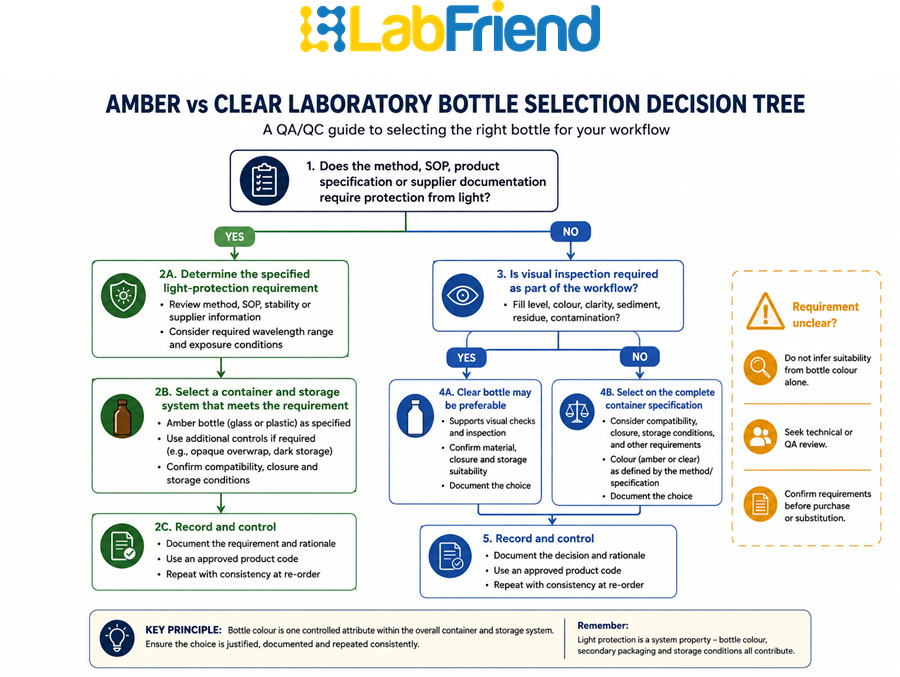
Amber vs clear comparison
Use this table as a quick starting reference, not an approval record — the specific requirement should still be confirmed against the method or SOP before ordering.
|
Selection factor |
Amber bottles |
Clear bottles |
QA/QC decision point |
|
Reduced light exposure |
May be selected where contents require reduced light exposure |
Not intended to reduce light exposure; ordinary clear glass offers negligible, not zero, protection |
Check substance, method and storage conditions |
|
Visibility |
Contents are less visible |
Contents are easier to inspect |
Important for fill level, colour, clarity and residues |
|
Routine identification |
Relies more heavily on labelling |
Visual inspection may support identification |
Labels remain essential in both cases |
|
Reagent storage |
Useful where light sensitivity is part of the specification |
Suitable where light protection is not required |
Confirm against method, SOP or product requirement |
|
QA documentation |
Colour may need to be recorded where specified |
Colour may need to be recorded where specified |
Avoid uncontrolled colour changes |
|
Substitution risk |
Amber should not automatically replace clear |
Clear should not automatically replace amber |
Review before switching bottle colour |
|
Material suitability |
Colour does not confirm material compatibility |
Colour does not confirm material compatibility |
Check glass/plastic and closure separately |
|
Repeat ordering |
Product code should preserve amber specification |
Product code should preserve clear specification |
Record approved bottle colour and code |
|
Repeat sterilisation |
Colourant may fade with repeated autoclave cycles |
No colour-related degradation |
Monitor for cracking or discolouration regardless of bottle colour |
This table should not be used as a shortcut for technical approval. It is a decision framework. The final choice should be based on the contents, workflow and documented requirement.
Light sensitivity, exposure time and storage conditions
Light protection is not only a question of bottle colour. It is also a question of exposure.
A reagent stored in a cupboard, used quickly and exposed only briefly during handling may present a different risk from a reagent stored on an open bench under strong light for a longer period. The same bottle colour may therefore have different practical value in different workflows.
QA/QC managers should consider the light source, storage location, exposure duration, bottle material, frequency of opening and expected storage period. If the method or supplier documentation specifies protection from light, that instruction should take priority over convenience or product availability.
Amber bottles can be part of a light-management strategy, but they are not the whole strategy. Repeated autoclaving cycles and prolonged UV exposure can also gradually degrade the colourant in amber glass and plastic, so light-blocking performance should not be assumed to stay constant over a bottle’s service life. Storage location, secondary containment, labelling, handling practice and documented procedure may also matter.
Where the decision also involves bottle material, LabFriend UK’s Laboratory Bottle Materials Explained provides deeper context on borosilicate glass, amber glass, HDPE, LDPE and PP.
Reagent storage and prepared solutions
Amber versus clear selection is especially relevant for reagent storage and prepared solutions. In these workflows, bottle colour may form part of the approved storage condition.
A prepared solution may need to be protected from light. Another may need to be inspected visually before use. A routine buffer may not require amber storage at all. A QA/QC method may specify the container type, or an internal SOP may define the approved bottle format. In each case, the colour decision should be made from the workflow, not from habit.
For prepared solutions, QA/QC managers should ask whether the solution is light-sensitive, whether visual inspection is required, how long it will be stored, where it will be stored, how often it will be opened, and whether the approved product code already defines clear or amber format.
Light-sensitivity classification, such as “light sensitive” or “protect from light”, is typically defined per-substance on the SDS (Safety Data Sheet) or reagent documentation, and any specific instruction given there should take priority over a general amber assumption. If the reagent bottle is part of a controlled method, bottle colour should be captured in the specification. The product code, material, volume, cap/thread and closure should also be recorded so that repeat orders remain consistent.
Visibility, inspection, labelling and traceability
Clear bottles support visibility, but visibility does not replace labelling. Amber bottles reduce visibility, but that does not remove the need for inspection where inspection is part of the workflow.
In QA/QC environments, labelling and traceability remain central. Bottle labels should identify contents, concentration where relevant, preparation date, expiry or review date where applicable, hazard information where required, owner, batch or lot reference where needed, and any storage condition such as “protect from light”.
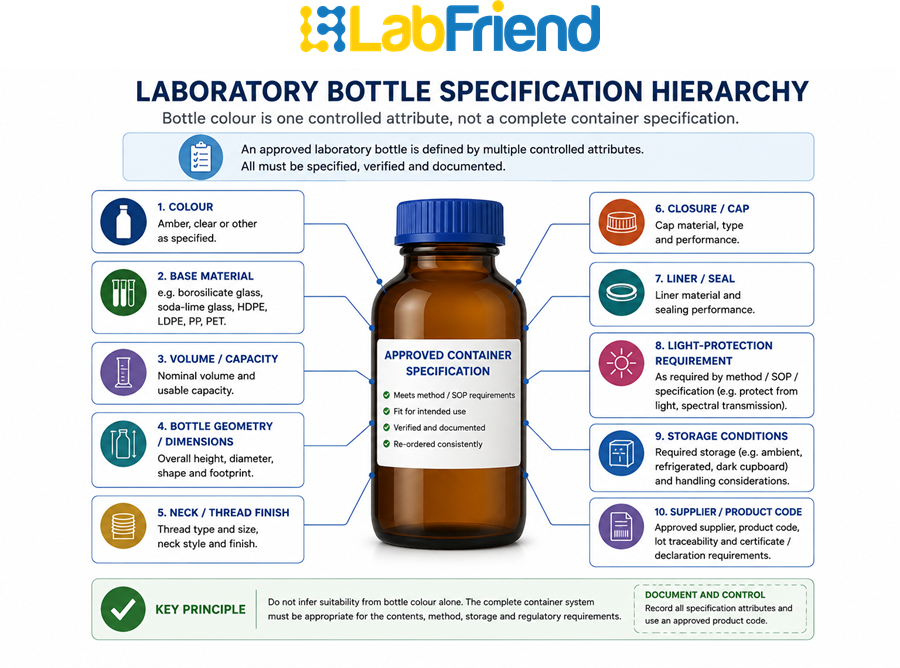
Bottle colour can support this system, but it should not be the only control. A laboratory should not rely on amber colour alone to indicate light sensitivity, and it should not rely on clear colour alone to confirm suitability. The label and documented specification should make the requirement explicit.
Traceability is also important for repeat ordering. If the approved bottle is amber glass with a specific cap and volume, that should be recorded. If clear glass is approved, that should also be recorded. Consistency helps avoid informal substitutions later.
Method, SOP and documentation checks
For QA/QC managers, the method or SOP should carry more weight than convenience. If a method specifies amber storage, clear should not be substituted without review. If a method depends on visual inspection, amber should not be substituted simply because it appears more protective.
Documentation should also be checked where bottle colour forms part of a validated or controlled workflow. This does not mean every routine bottle requires a complex approval process. It means the level of control should match the risk.
A practical QA/QC specification should record the following fields — this table can be used directly as a specification checklist:
|
Specification field |
Why it matters |
|
Bottle colour |
Confirms amber or clear requirement |
|
Bottle material |
Distinguishes amber glass, clear glass, plastic or other materials |
|
Volume |
Supports consistent preparation, storage and repeat ordering |
|
Cap/thread |
Prevents closure mismatch |
|
Closure or liner |
May affect storage suitability |
|
Storage condition |
Records light, temperature or location requirements — a “protect from light” instruction commonly requires secondary controls such as opaque overwrap or dark storage in addition to bottle colour, not bottle colour alone |
|
Method or SOP reference |
Links bottle choice to controlled procedure |
|
Product code |
Supports accurate repeat ordering |
|
Approved alternatives |
Controls substitution where allowed |
This record is useful because it keeps colour selection tied to the workflow rather than individual preference.
The approved bottle colour and product code should also be communicated to procurement and, where relevant, to the supplier on the purchase order. Documentation held only internally does not prevent a supplier-side substitution at fulfilment.
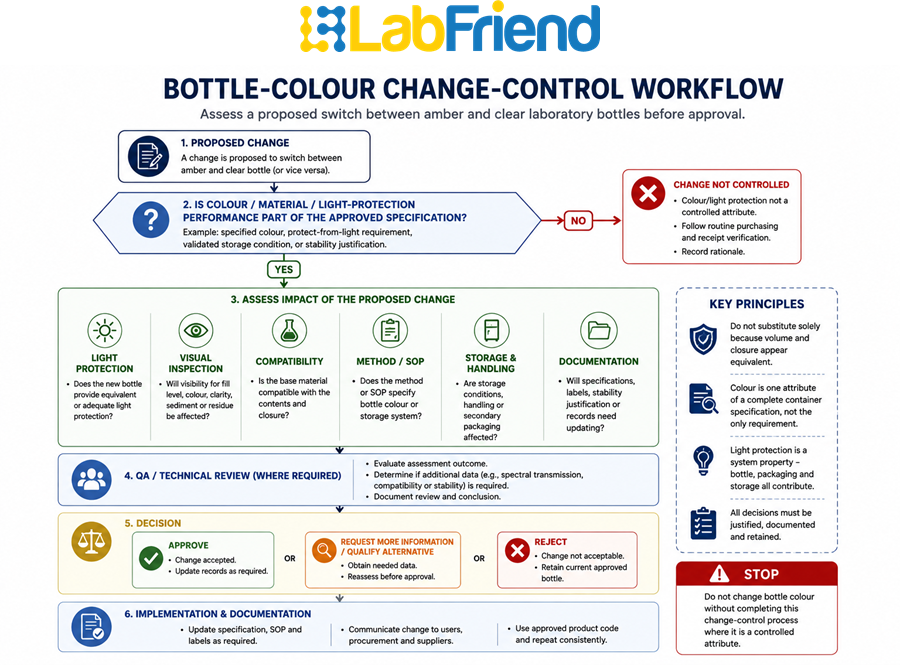
Switching between amber and clear: when review is needed
Switching from clear to amber or amber to clear may seem minor, but in QA/QC workflows it can be a specification change.
A switch from amber to clear should be reviewed where light sensitivity is known or possible, where the method specifies protection from light, where the label or SOP references amber storage, or where the product has previously been approved in amber format. Older SDS versions or legacy SOPs may not explicitly flag light sensitivity, so the absence of a stated requirement should not be treated as confirmation that light protection is unnecessary.
A switch from clear to amber should also be reviewed where visibility matters. If users need to inspect colour, clarity, fill level, precipitate, residue or contamination, amber may reduce useful visibility. In some workflows, that may be acceptable. In others, it may not.
|
Proposed colour change |
Review required? |
Why |
|
Clear to amber for routine storage |
Usually yes |
May affect visibility and established procedure |
|
Amber to clear for light-sensitive contents |
Yes |
May remove required reduced light exposure |
|
Clear to amber where method requires visual inspection |
Yes |
May interfere with inspection |
|
Amber to clear where method allows either |
Confirm documentation |
Product code and specification may still need updating |
|
Same colour, different material |
Yes |
Colour does not confirm material compatibility |
|
Same colour, different cap or closure |
Yes |
Closure suitability must be checked separately |
In the table above, “Yes” and “Usually yes” mean the change should be reviewed before it is made; “Confirm documentation” means the change may be acceptable, but the specification record still needs to be updated to reflect it.
Where bottles have already been filled in the wrong colour while a review is pending, they should be held under interim controls, such as opaque secondary containment or dark storage, until the review confirms whether they remain fit for use.
The safest approach is simple: if bottle colour is part of the approved requirement, do not change it casually.
What this article does not solve
This article helps QA/QC managers compare amber and clear laboratory bottles. It does not confirm that a specific bottle is chemically compatible, sterile, certified, pre-cleaned, autoclavable, freezer-suitable, pressure-rated, vacuum-rated or method-approved.
Amber colour does not confirm chemical compatibility. Clear colour does not confirm inspection suitability. Bottle colour does not confirm cap, liner, seal, closure or material suitability.
Those checks must come from product documentation, manufacturer information, SDS, COSHH (Control of Substances Hazardous to Health) assessment, method requirements, SOPs and local laboratory procedures.
What to check before buying
Before selecting amber or clear laboratory bottles, confirm the workflow requirement rather than choosing by appearance.
|
Check |
Question to ask |
|
Contents |
What reagent, solution or sample will be stored? |
|
Light sensitivity |
Does the substance or method require reduced light exposure? |
|
Visibility |
Does the user need to inspect fill level, colour, clarity or residues? |
|
Storage duration |
How long will the contents remain in the bottle? |
|
Storage location |
Will the bottle be stored on a bench, shelf, cupboard, fridge or controlled area? |
|
Material |
Is the required bottle glass, amber glass, plastic or another material? |
|
Closure |
Does the cap, liner or seal need to meet a specific requirement? |
|
Method or SOP |
Does a controlled procedure define the bottle colour or format? |
|
Documentation |
Is certification, sterility, pre-cleaning or other documentation required? |
|
Repeat ordering |
Is the approved colour and product code recorded? |
|
Quality system |
Does an accredited or regulated quality system, such as ISO 17025 or GMP, require documented justification for the bottle colour selected? |
This checklist supports the decision, but it does not replace product-specific documentation.
Where to compare bottle options once the colour requirement is clear
Once the colour requirement is clear, compare bottle options that match the workflow rather than selecting by colour alone.
For reagent storage and prepared solutions, start with LabFriend UK’s laboratory reagent bottles, comparing clear or amber format alongside material, volume, cap/thread and closure requirements.
For broader bottle and vessel comparison, use LabFriend UK’s laboratory vessels. Where the amber versus clear decision also involves material choice, review glass vs plastic laboratory bottle considerations and laboratory bottle materials.
If the correct colour, material, closure or documentation requirement is uncertain, contact LabFriend UK for support before ordering. The correct sequence is: confirm the colour requirement, check the full bottle specification, then compare suitable options.
FAQs
When should I use amber laboratory bottles?
Amber laboratory bottles are generally used where reduced light exposure is required. They may be appropriate for light-sensitive reagents, prepared solutions or workflows where the method or SOP specifies protection from light.
When should I use clear laboratory bottles?
Clear laboratory bottles are useful where visibility matters. They can support fill-level checks, colour inspection, clarity checks, residue inspection and routine identification where reduced light exposure is not required.
Do amber bottles protect all light-sensitive reagents?
No. Amber bottles should not be treated as universal protection for every light-sensitive substance. Suitability depends on the substance, exposure conditions, storage duration, bottle material and product specification.
Are clear bottles suitable for reagent storage?
Yes, clear bottles may be suitable for reagent storage where light protection is not required and the material, closure, volume and documentation requirements are appropriate for the workflow.
Can I switch from clear to amber reagent bottles?
Only after checking the workflow. Amber may reduce visibility, which can matter where inspection of colour, clarity, fill level or residues is required. Controlled workflows may also require documentation updates.
Can I switch from amber to clear reagent bottles?
Only after review. If the contents are light-sensitive, or if the method, SOP or label specifies protection from light, switching to clear may not be acceptable.
Does amber glass confirm chemical compatibility?
No. Amber colour, in glass or tinted plastic, does not confirm chemical compatibility. Compatibility depends on the bottle material, contents, concentration, storage duration, temperature, cap, liner and product documentation.
Does bottle colour affect sample inspection?
Yes. Clear bottles generally allow easier visual inspection. Amber bottles reduce visibility, which may matter where the user needs to observe colour, clarity, sediment, residue or fill level.
What should QA/QC labs document when choosing bottle colour?
QA/QC labs should document the approved bottle colour, material, volume, cap/thread, closure, storage condition, product code, method or SOP reference, and any approved alternatives.
Does bottle colour confirm sterility or certification?
No. Sterility, certification, pre-cleaning and purity-related claims must be confirmed separately from product documentation. They do not follow from amber or clear colour.
What happens if the wrong bottle colour is used for a light-sensitive reagent?
Undetected light exposure can affect reagent stability or result validity. Any suspected exposure should be flagged for review under the relevant method or QA procedure rather than assumed to be inconsequential.
What should I do if I’m not sure whether a reagent is light-sensitive?
Check the SDS, supplier documentation or method first. Where it remains unclear, consult the QA/QC or technical lead before assuming either amber or clear is acceptable.
Conclusion
Amber versus clear laboratory bottle selection should be based on the workflow, not habit. Amber bottles may be appropriate where reduced light exposure is required. Clear bottles may be preferable where visibility, inspection and routine identification are important.
For QA/QC laboratories, the safest approach is to treat bottle colour as one specification field within the complete container system. The contents, material, volume, cap/thread, closure, storage conditions, method requirements, documentation and repeat-order record all matter.
Once the requirement is clear, compare LabFriend UK’s laboratory reagent bottles or broader laboratory vessels by colour, material, volume and closure format.
Compare amber and clear laboratory bottle options
Confirm whether reduced light exposure, visibility, method requirements and documentation needs matter for the workflow. Then compare LabFriend UK’s laboratory reagent bottles, review broader laboratory vessels, or contact LabFriend UK for support matching bottle colour, material and closure requirements.
Read more from LabFriend UK
- Laboratory Bottles: Selection Guide for UK Laboratories
- How to Select Laboratory Reagent Bottles for Chemical Storage
- Laboratory Bottle Materials Explained
- Glass vs Plastic Laboratory Bottles: Which Should UK Labs Choose?
Useful links
- Laboratory Glassware | LabFriend UK
- Pre-Cleaned Laboratory Bottles
- Amber Bottles search route
- Clear Bottles search route
Written by: Donal O’Sullivan, BSc, Co-Founder and Sales Director, LabFriend UK. Donal brings deep chemistry-led technical expertise across analytical chemistry, biochemistry, environmental monitoring, laboratory instrumentation, consumables and scientific product selection.
Reviewed by: Michael Anderson, MBA, Founder and Managing Director, LabFriend UK. Michael reviews LabFriend UK content for customer relevance, commercial accuracy, operational practicality and alignment with LabFriend UK’s laboratory supply model.
Related Stories

Autoclavable Laboratory Bottles - What to Check Before Buying
Autoclavable Laboratory Bottles - What to Check Before Buying

Narrow-Mouth vs Wide-Mouth Bottles for Lab Managers - Reducing Handling Errors and Stock Complexity
Narrow-Mouth vs Wide-Mouth Bottles for Lab Managers - Reducing Handling Errors and Stock Complexity

Narrow-Mouth vs Wide-Mouth Laboratory Bottles: Which Should You Choose?
Narrow-Mouth vs Wide-Mouth Laboratory Bottles: Which Should You Choose?

Amber vs Clear Reagent Bottles for Procurement Teams - Specification and Substitution Checks
Amber vs Clear Reagent Bottles for Procurement Teams - Specification and Substitution Checks