

Share :
Types of Pipette Tips Explained for Modern Laboratory Workflows
Updated On 07/17/2026

By Donal O’Sullivan, BSc. Reviewed by Michael Anderson, MBA.
Choosing the Right Pipette Tip Matters More Than Many Laboratories Realise
Pipette tips are among the most frequently used laboratory consumables, yet they are often selected with less scrutiny than pipettes, reagents, or analytical instruments. In reality, the choice of pipette tip can significantly influence liquid handling accuracy, contamination control, sample recovery, workflow reproducibility, and overall laboratory efficiency.
Whether performing routine liquid transfers, preparing qPCR reactions, handling expensive enzymes, or operating automated liquid handling systems, selecting the correct pipette tip helps laboratories maintain reliable and reproducible results.
For scientists, laboratory managers, and procurement teams, understanding the differences between pipette tip types is an important part of building robust laboratory workflows.
What Is a Pipette Tip?
A pipette tip is the disposable consumable component attached to a pipette that allows liquids to be aspirated and dispensed accurately.
Although pipette tips may appear simple, they are engineered to support specific laboratory applications and workflow requirements. Differences in geometry, materials, manufacturing quality, surface treatments, sterility, and compatibility can influence laboratory performance.
Why Pipette Tip Selection Matters
Many laboratory teams focus on pipette calibration and operator technique when investigating liquid handling variability. However, pipetting accuracy should be considered a system property: the pipette, selected tip, liquid properties, operator technique, calibration status, and environmental conditions all contribute to delivered volume performance.
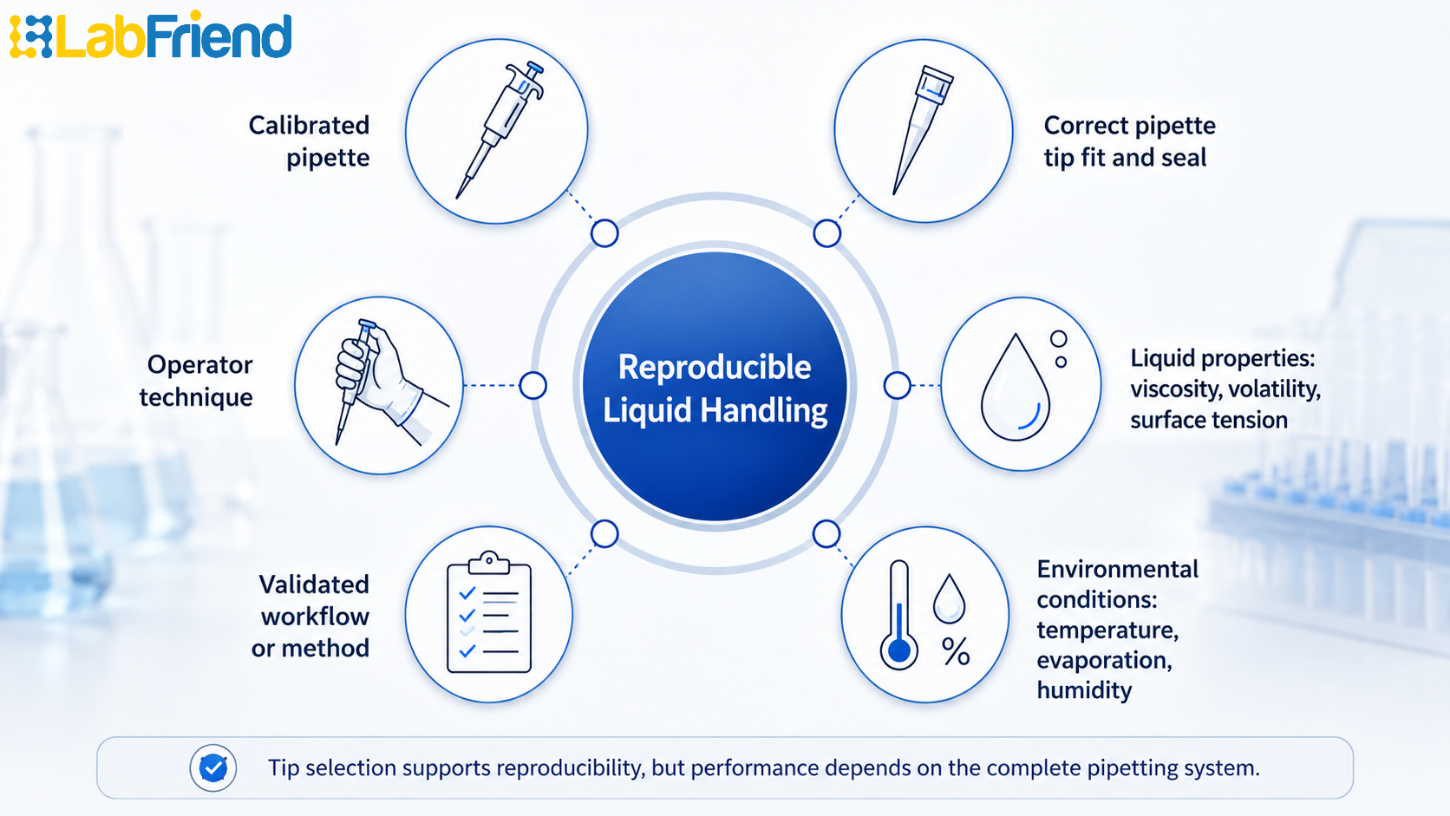
However, pipette tip selection can also influence:
- Aspiration consistency
- Dispensing accuracy
- Low-volume reproducibility
- Sample recovery
- Aerosol contamination control
- Seal integrity
- Operator-to-operator consistency
Using an unsuitable pipette tip may contribute to:
- Inconsistent liquid transfer
- Sample loss
- Pipette leakage
- Poor reproducibility
- Cross-contamination
- Increased troubleshooting
- Workflow inefficiencies
The most suitable pipette tip depends on:
- The application
- The liquid being handled
- Required contamination control
- Pipette compatibility
- Workflow validation requirements
- Automation requirements
The Main Types of Pipette Tips Used in Modern Laboratories
Standard Pipette Tips
Standard pipette tips are the most widely used format in laboratory liquid handling.
They are commonly selected for routine applications where enhanced contamination control or specialised surface treatments are not required.
Common Uses
- Buffer preparation
- Routine sample transfer
- Reagent preparation
- Analytical testing
- Teaching laboratories
- General liquid handling
Advantages
- Cost-effective
- Broadly available
- Suitable for routine workflows
- Available across multiple volume ranges
Considerations
Laboratories should still evaluate:
- Pipette compatibility
- Sealing performance
- Manufacturing consistency
- Sterility requirements
- Packaging format
Best For
Routine liquid handling workflows where contamination-sensitive conditions are not the primary concern.
Explore Standard Pipette Tips for Routine Laboratory Workflows
For routine liquid handling, sample preparation and general laboratory applications, explore LabFriend UK's range of standard pipette tips available in multiple volume ranges and packaging formats.
Filter Pipette Tips
Filter pipette tips contain an internal aerosol barrier designed to help reduce contamination entering the pipette shaft during aspiration. Filter tips reduce the risk of aerosol-mediated pipette contamination but do not replace unidirectional workflow design, segregated pre- and post-amplification areas, appropriate negative controls, validated reagents, or good molecular biology practice.
They are frequently used in workflows where contamination control is particularly important.
Common Uses
- PCR
- qPCR
- Molecular biology
- Nucleic acid handling
- Microbiology
- Clinical research
Advantages
- Helps reduce aerosol contamination
- Protects pipette internals
- Supports contamination-sensitive workflows
- Commonly used in amplification workflows
Considerations
Scientists should recognise that:
- Filter tips are not automatically sterile
- Filter tips are not automatically RNase-free
- Filter tips are not automatically DNase-free
- Filter tips are not automatically low-retention
These specifications should be confirmed individually.
Some filter tips may have reduced effective capacity or altered aspiration behaviour compared with non-filter tips; users should check the manufacturer’s stated volume range and validate performance for critical assays.
Best For
PCR and qPCR workflows where contamination control is a key consideration.
Explore Filter Pipette Tips for PCR, qPCR and Molecular Biology
For a more detailed discussion, see:
When Should You Use Filter Pipette Tips in qPCR and Molecular Biology?
Low-Retention Pipette Tips
Low-retention pipette tips are designed to reduce liquid adhesion to the internal surface of the tip.
For protein, enzyme, and other biomolecule workflows, laboratories should consider both residual liquid retention and possible adsorption of biomolecules to plastic surfaces. These are related but distinct sources of sample loss.
Common Uses
- Protein workflows
- Enzyme handling
- Viscous liquids
- Expensive reagents
- Low-volume dispensing
- Molecular biology workflows
Advantages
- Improved sample recovery
- Reduced reagent waste
- May reduce residual liquid retention for some difficult or high-value samples, depending on liquid chemistry and validated performance.
- Potentially improved dispensing consistency
Considerations
Performance can vary depending on:
- Liquid chemistry
- Surface tension
- Viscosity
- Reagent composition
- Tip manufacturing process
Not all low-retention technologies perform identically across every application.
Best For
Protein, enzyme, and viscous liquid workflows where maximising sample recovery is important.
Explore Low-Retention Pipette Tips for Protein, Enzyme and Viscous Liquid Workflows
When sample recovery and reagent conservation are important, low-retention pipette tips may help support more consistent liquid handling performance. Explore LabFriend UK's range of low-retention pipette tips.
Browse Low-Retention Pipette Tips
Positive-Displacement Pipette Tips
Positive-displacement pipette tips, sometimes used with capillary-piston systems, are designed for applications where standard air-displacement pipetting may be less reliable.
Unlike conventional air-displacement pipettes, positive-displacement systems place the piston in direct contact with the liquid or use a disposable piston within the tip. This can help improve liquid transfer performance when handling samples whose physical properties differ substantially from water.
Common Uses
- Viscous liquids
· Volatile solvents
· Dense liquids
· Foaming solutions
· High-value reagents
· Low-volume transfer of difficult samples
· Samples where evaporation or residual liquid loss may affect reproducibility
Advantages
- Better suited to liquids that are difficult to pipette by air displacement
· Reduced influence of liquid viscosity, density, volatility, and vapour pressure
· Improved control when handling challenging or high-value samples
· Can support more reproducible transfer of non-aqueous or physically unusual liquids
Considerations
Laboratories should still evaluate:
- Compatibility with the specific positive-displacement pipette
· The appropriate volume range
· Whether disposable piston tips or capillaries are required
· Chemical compatibility with the liquid being handled
· Workflow validation requirements
· Cost and availability compared with standard air-displacement tips
Best For
Positive-displacement tips are commonly selected for viscous, volatile, dense, foaming, or high-value liquids where air-displacement pipetting may give less reliable volume transfer.
Sterile Pipette Tips
Sterile pipette tips are commonly selected when additional contamination control measures are required.
Sterility should not be assumed to mean that a pipette tip is DNase-free, RNase-free, DNA-free, endotoxin-free, pyrogen-free, or PCR-clean. These are separate product claims and should be verified from the manufacturer’s specification, certificate of analysis, or product documentation before use in sensitive workflows.
Common Uses
- Cell culture
- Microbiology
- Sterile reagent preparation
- Biological sample handling
- Sensitive laboratory workflows
Sterile pipette tips must still be handled aseptically. Sterility can be compromised by poor storage, repeated rack opening, contact with non-sterile surfaces, or inappropriate bench technique.
Advantages
- Additional contamination control
- Suitable for aseptic workflows
- Available with additional purity certifications
Potential Certifications
Depending on the product, sterile tips may also be:
- DNase-free
- RNase-free
- Endotoxin tested
- Pyrogen tested
Endotoxin and pyrogen claims are not interchangeable; laboratories should confirm the test method, acceptance limit, and relevance to the intended application.
These certifications vary by manufacturer and product range and should always be verified before purchase.
Explore Sterile Pipette Tips for Cell Culture and Contamination-Sensitive Applications
For workflows requiring additional contamination-control measures, explore LabFriend UK's range of sterile pipette tips available for a variety of biological and microbiological applications.
Commonly selected for
Cell culture and contamination-sensitive biological workflows.
Conductive Pipette Tips
Conductive pipette tips are designed for automated liquid handling platforms that utilise capacitive liquid level detection (cLLD).
Common Uses
- Automated liquid handling
- Pharmaceutical laboratories
- High-throughput screening
- CRO workflows
- Robotic liquid handling systems
Advantages
- Supports liquid level detection
- Enables automation workflows
- Supports validated automated liquid-level detection and liquid-handling routines on compatible platforms.
- Suitable for high-throughput environments
Considerations
Automation compatibility depends on:
- Platform requirements
- Rack geometry
- Conductivity specifications
- Robotic hardware configuration
Commonly selected for
Automated liquid handling workflows and robotic laboratory systems.
Universal vs Manufacturer-Specific Pipette Tips
Many laboratories choose between:
- Manufacturer-specific pipette tips
- Universal-compatible pipette tips
Manufacturer-Specific Pipette Tips
These tips are designed for use with a specific pipette brand or model.
Potential benefits include:
- Defined compatibility
- Established workflow validation
- Familiarity within existing protocols
Universal-Compatible Pipette Tips
Universal-compatible pipette tips are designed to fit multiple pipette brands.
Potential benefits include:
- Procurement flexibility
- Supplier diversification
- Reduced purchasing complexity
- Standardisation opportunities
However, laboratories should validate:
- Seal integrity
- Pipette fit
- Low-volume performance
- Reproducibility
- Workflow suitability
particularly before implementing alternatives within validated workflows.
In regulated, accredited, or validated workflows, changing tip manufacturer or tip format should be treated as a consumable change that may require documented verification, comparison testing, or method requalification.
Explore Compatible Pipette Tips for Popular Laboratory Pipettes
Many laboratories use validated compatible pipette tips to support procurement flexibility, supplier diversification and repeat-order standardisation. Explore LabFriend UK's range of compatible pipette tips, including LLG Labware universal formats.
Browse Compatible Pipette Tips
For a detailed discussion, see:
Optimise Your Pipetting Accuracy with Compatible Pipette Tips
Comparison Table: Common Pipette Tip Types
|
Tip type |
Best suited for |
Key advantage |
What to verify before use |
|
Standard pipette tips |
Routine liquid handling, buffer preparation, reagent transfer, teaching laboratories |
Cost-effective option for general workflows |
Pipette fit, seal integrity, volume range, sterility requirements |
|
Filter pipette tips |
PCR, qPCR, nucleic acid handling, microbiology, contamination-sensitive workflows |
Helps reduce aerosol-mediated contamination of the pipette shaft |
Sterility, DNase-free/RNase-free status, DNA-free or PCR-clean claims, effective volume range |
|
Low-retention pipette tips |
Proteins, enzymes, viscous liquids, detergents, expensive or low-volume reagents |
May reduce residual liquid retention and improve sample recovery |
Suitability for the liquid chemistry, surface treatment performance, adsorption risk, volume accuracy |
|
Positive-displacement tips |
Viscous, volatile, dense, foaming, or difficult-to-pipette liquids |
Reduces dependence on the air cushion used in standard air-displacement pipetting |
Compatibility with the positive-displacement pipette, volume range, chemical compatibility, cost |
|
Sterile pipette tips |
Cell culture, microbiology, sterile reagent preparation, biological sample handling |
Supports aseptic workflows when handled correctly |
Sterility claim, packaging integrity, DNase/RNase-free status, endotoxin or pyrogen limits where relevant |
|
Conductive pipette tips |
Automated liquid handling, robotic platforms, high-throughput workflows |
Supports capacitive liquid-level detection on compatible systems |
Platform compatibility, rack geometry, conductivity specification, liquid class settings |
|
Universal-compatible tips |
Laboratories using multiple pipette brands or seeking supplier flexibility |
Procurement flexibility and potential standardisation across pipette types |
Fit, seal, leakage, low-volume performance, reproducibility, workflow validation requirements |
|
Manufacturer-specific tips |
Validated workflows, regulated environments, brand-specific pipette systems |
Defined compatibility with a specific pipette model or range |
Continued supply, certificate requirements, suitability for validated methods, cost implications |
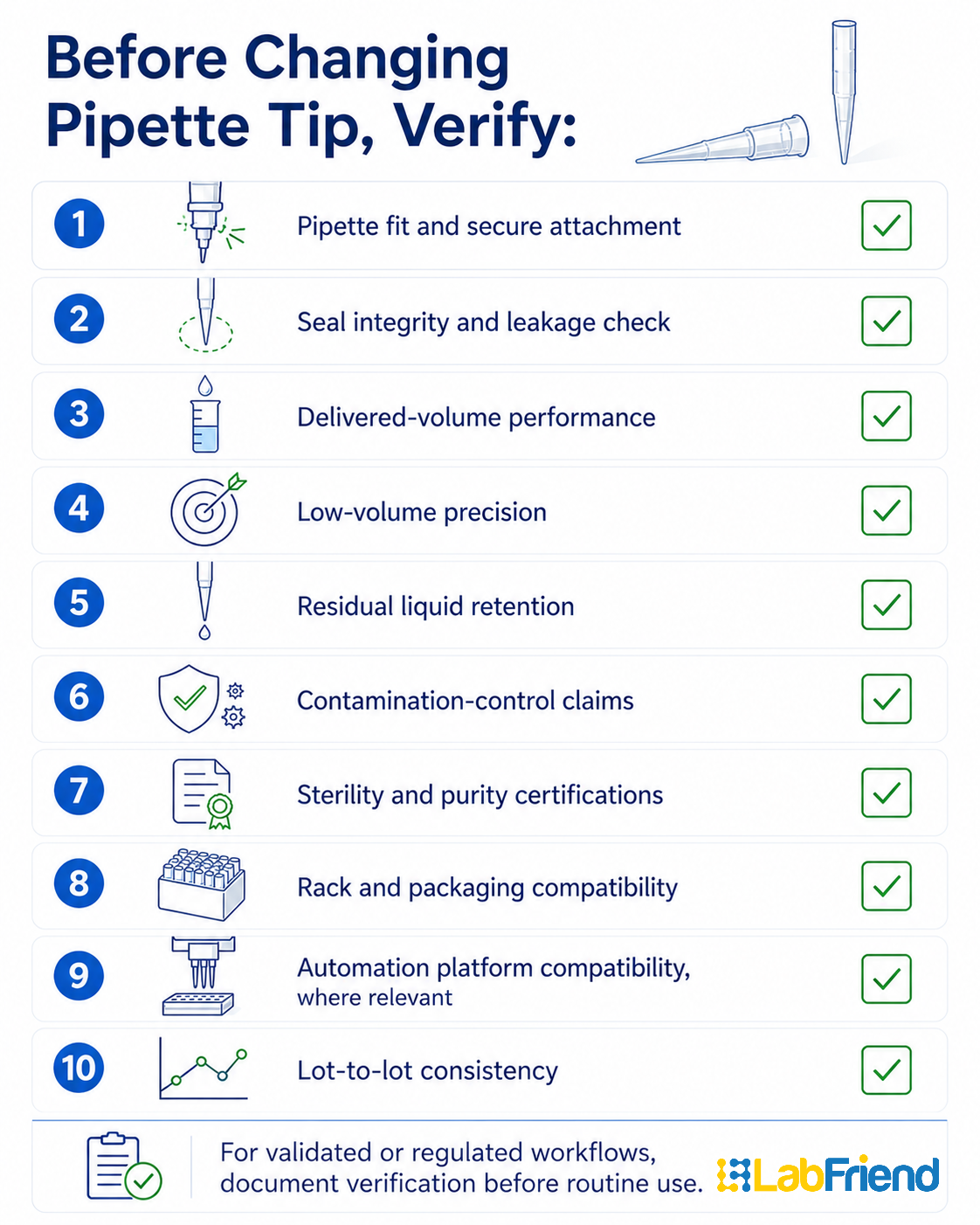
How to Choose the Right Pipette Tip: A Practical Decision Framework
Selecting a pipette tip should begin with the scientific and workflow requirements of the application, rather than with price or availability alone. A suitable tip should be compatible with the pipette, appropriate for the liquid being handled, and supported by the required contamination-control or purity specifications.
1. Define the application
Start by identifying the workflow. Routine buffer transfer, PCR setup, cell culture, protein handling, and automated liquid handling may each require different tip characteristics.
2. Assess contamination-control requirements
Determine whether the workflow requires sterile, filter, DNase-free, RNase-free, DNA-free, endotoxin-tested, pyrogen-tested, or PCR-clean tips. These claims should be verified individually from the manufacturer’s documentation.
3. Consider the liquid properties
Viscous, volatile, foaming, protein-containing, or high-value liquids may require low-retention tips, positive-displacement systems, or workflow-specific validation to support reliable transfer.
4. Confirm pipette or platform compatibility
Check that the tip fits securely, forms an appropriate seal, and is compatible with the pipette or automated liquid handling platform. For universal-compatible tips, compatibility should be verified before routine use.
5. Check volume range and low-volume performance
Ensure the selected tip is suitable for the required working volume, particularly for low-volume dispensing where small deviations can have a larger proportional effect.
6. Review workflow validation requirements
For regulated, accredited, or validated workflows, changing tip type, supplier, or format should be treated as a consumable change that may require documented verification or requalification.
7. Balance procurement needs with technical suitability
Supply continuity, cost, and supplier flexibility are important, but they should not compromise required purity, fit, compatibility, or validated liquid-handling performance.
How Scientists Choose the Right Pipette Tip
Scientists typically evaluate pipette tips based on several practical considerations.
Application Requirements
Different workflows have different requirements.
For example:
|
Workflow |
Common Tip Type |
|
PCR |
Filter Tips |
|
qPCR |
Filter Tips |
|
Cell Culture |
Sterile Tips |
|
Protein Analysis |
Low-Retention Tips |
|
Automation |
Conductive Tips |
|
Routine Liquid Handling |
Standard Tips |
Contamination Risk
Workflows involving amplified DNA, RNA, or sensitive biological samples often require additional contamination-control measures.
Sample Characteristics
Viscous liquids, proteins, enzymes, and low-volume reagents may benefit from specialised tip designs.
Pipette Compatibility
Compatibility should always be confirmed before introducing alternative tip formats into laboratory workflows.
Common Mistakes When Choosing Pipette Tips
Assuming All Pipette Tips Perform the Same
Different tip designs may vary in:
- Seal quality
- Dispensing consistency
- Manufacturing tolerances
- Surface properties
Focusing Only on Price
Lower-cost consumables do not always reduce overall workflow costs if:
- Reproducibility decreases
- Troubleshooting increases
- Validation becomes necessary
- Contamination events occur
Using Standard Tips for Contamination-Sensitive Workflows
PCR and molecular biology workflows often require additional contamination-control measures beyond routine liquid handling.
Ignoring Compatibility Validation
Universal-compatible tips can perform very well, but laboratories should validate compatibility before implementation. Confirm fit, seal, delivered volume, and workflow suitability before routine use.
Procurement Considerations for UK Laboratories
Laboratories increasingly evaluate pipette tips based on:
- Supply continuity
- Procurement flexibility
- Repeat-order consistency
- Supplier responsiveness
- Stock availability
- Compatibility coverage
This is particularly relevant for:
- CROs
- Independent testing laboratories
- SME biotechnology companies
- University research groups
Many organisations are looking to simplify consumables purchasing while maintaining workflow reliability and scientific confidence. Procurement decisions should not compromise required purity, fit, validated performance, or assay-specific contamination-control requirements.
LLG Labware Universal Pipette Tips
LLG Labware universal pipette tips provide laboratories with a compatible consumables option designed to support a broad range of pipettes commonly used throughout European and UK laboratories.
The range includes:
- Standard tips
- Filter tips
- Sterile formats
- Multiple volume options
- Universal-compatible designs
For laboratories evaluating compatible alternatives, LLG Labware tips may support:
- Procurement flexibility
- Supplier diversification
- Repeat-order standardisation
- Cost-management initiatives
Explore Compatible Pipette Tips for Popular Laboratory Pipettes
Many laboratories use validated compatible pipette tips to support procurement flexibility, supplier diversification and repeat-order standardisation. Explore LabFriend UK's range of compatible pipette tips, including LLG Labware universal formats.
Browse Compatible Pipette Tips
LLG Labware universal pipette tips are marketed as compatible consumables for a range of commonly used pipettes; laboratories should confirm compatibility using manufacturer guidance and in-house verification before implementation.
Frequently Asked Questions
What type of pipette tips are commonly selected for PCR?
Filter tips are commonly selected for PCR and qPCR because they reduce the risk of aerosol-mediated pipette contamination. Depending on the assay, laboratories may also require sterile, DNase-free, RNase-free, DNA-free, or PCR-clean certified tips.
Are universal pipette tips reliable?
Many laboratories successfully use universal-compatible pipette tips. Reliability depends on compatibility, validation, workflow requirements, and pipette fit.
When should low-retention pipette tips be used?
Low-retention tips are often used for proteins, enzymes, viscous liquids, and expensive reagents where maximising sample recovery is important.
Do sterile pipette tips need to be used for all biological workflows?
Not necessarily. The appropriate level of contamination control depends on the application, workflow sensitivity, and laboratory procedures.
What should laboratories validate before switching pipette tip suppliers?
Laboratories should typically evaluate:
- Pipette compatibility
- Seal integrity
- Low-volume performance
- Reproducibility
- Contamination-control requirements
- Workflow suitability
Do filter pipette tips prevent all PCR contamination?
No. Filter pipette tips help reduce the risk of aerosol-mediated contamination entering the pipette shaft, but they do not prevent all sources of PCR contamination. Good PCR practice still requires appropriate workflow separation, careful reagent handling, clean work areas, negative controls, and validated assay procedures.
Are sterile pipette tips always RNase-free or DNase-free?
No. Sterility, RNase-free status, DNase-free status, DNA-free status, and PCR-clean status are separate product claims. A sterile pipette tip should not be assumed to be suitable for nucleic acid workflows unless the relevant certifications are confirmed from the manufacturer’s documentation.
When should I use low-retention pipette tips instead of standard tips?
Low-retention pipette tips are useful when residual liquid retention may affect sample recovery, dispensing consistency, or reagent use. They are often selected for proteins, enzymes, detergents, viscous samples, expensive reagents, and low-volume workflows. Their performance should still be checked with the specific liquid being handled.
When are positive-displacement tips better than low-retention tips?
Positive-displacement tips are usually more appropriate when the liquid’s physical properties make air-displacement pipetting unreliable. This includes viscous, volatile, dense, foaming, or difficult-to-pipette liquids. Low-retention tips mainly address liquid adhesion to the tip surface, whereas positive-displacement systems address the limitations of the air cushion in standard pipetting.
Can I use universal-compatible tips in a validated method?
Possibly, but not without verification. In validated, regulated, or accredited workflows, changing to a universal-compatible tip should be treated as a consumable change. Laboratories should confirm fit, seal integrity, delivered volume performance, contamination-control requirements, and workflow suitability before routine use.
Do sterile pipette tips stay sterile after opening?
Only if they are handled and stored correctly. Sterility can be compromised by repeated rack opening, poor storage, contact with non-sterile surfaces, or inappropriate bench technique. For aseptic work, sterile tips should be used in a way that preserves their sterile status during handling.
What certificates or product claims should I check before buying pipette tips?
Check the claims that matter for the intended workflow. These may include sterile, DNase-free, RNase-free, DNA-free, PCR-clean, endotoxin-tested, pyrogen-tested, low-retention, filtered, conductive, or automation-compatible. The relevant claims should be confirmed from the manufacturer’s specification, certificate of analysis, or product documentation.
Conclusion
Pipette tips should be treated as part of the liquid-handling system, not as interchangeable plastic consumables. The performance of a pipetting workflow depends on the combined interaction between the pipette, tip, liquid, user technique, environmental conditions, and method requirements.
Fit and seal integrity can affect aspiration and dispensing consistency. Surface properties can influence residual liquid retention, sample recovery, and handling of proteins, enzymes, viscous liquids, or low-volume reagents. Product claims such as sterile, filtered, low-retention, DNase-free, RNase-free, endotoxin-tested, or PCR-clean should be verified against the needs of the application rather than assumed from the tip category alone.
For automated workflows, tip selection becomes even more platform-specific. Conductivity, rack geometry, robotic compatibility, liquid-level detection, and validated liquid classes can all influence whether a tip is suitable for routine use.
Choosing the right pipette tip therefore requires more than matching a nominal volume range. Laboratories should match tip type, purity claims, sterility, compatibility, and surface characteristics to the intended workflow. Where results are critical, regulated, or validated, any change in tip type, supplier, or format should be verified before routine implementation.
By treating pipette tips as an integral part of the liquid-handling system, laboratories can better support reproducibility, contamination control, sample integrity, and reliable workflow performance.
Further Reading:
The Complete Guide to Pipette Tips
Browse Laboratory Pipette Tips
Explore LabFriend UK's range of:
- Standard Pipette Tips
- Filter Pipette Tips
- Low-Retention Pipette Tips
- Compatible Pipette Tips
- Sterile Pipette Tips
- Contact us to discuss Automation-Compatible Pipette Tips
Designed to support modern laboratory workflows across research, testing, biotechnology, and analytical laboratories.
Written by: Donal O’Sullivan, BSc, Co-Founder and Sales Director, LabFriend UK. Donal brings deep chemistry-led technical expertise across analytical chemistry, biochemistry, environmental monitoring, laboratory instrumentation, consumables and scientific product selection.
Reviewed by: Michael Anderson, MBA, Founder and Managing Director, LabFriend UK. Michael reviews LabFriend UK content for customer relevance, commercial accuracy, operational practicality and alignment with LabFriend UK’s laboratory supply model.
Related Stories

How to Choose the Right Pipette: The Ultimate Guide to Accuracy and Lab Efficiency
Pipette - Primary

Optimise Your Pipetting Accuracy with Compatible Pipette Tips
Pipette Tip Selection Guide

Pipetting for PCR: How to Maximise Accuracy in DNA Amplification Workflows
How to Maximise Accuracy in DNA Amplification Workflows

qPCR Pipetting Best Practices: How to Reduce Variability and Improve Accuracy at Low Volumes
Learn how to reduce qPCR and RT-qPCR variability with accurate low-volume pipetting techniques, mastermix preparation, contamination control, and best-practice liquid handling workflows.