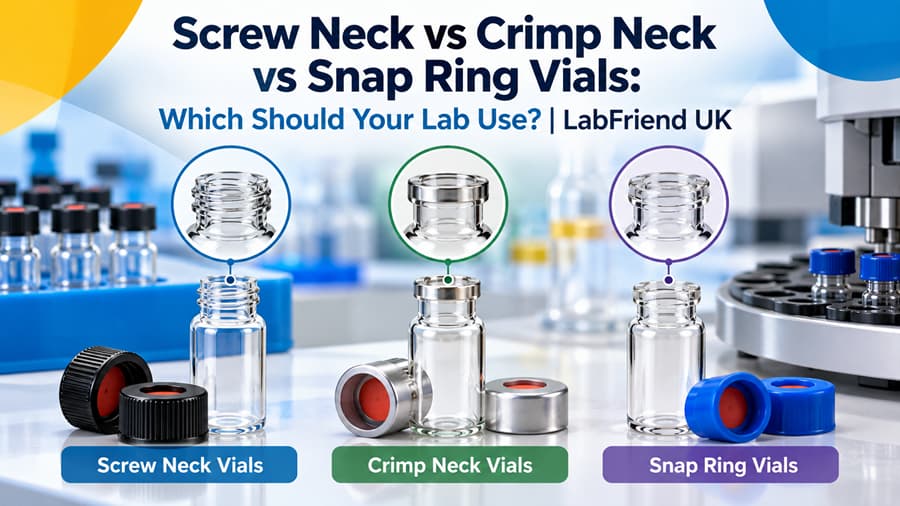
Screw Neck vs Crimp Neck vs Snap Ring Vials: Which Should Your Lab Use?
28 mins read
Screw Neck vs Crimp Neck vs Snap Ring Vials: Which Should Your Lab Use?
By Donal O’Sullivan, BSc. Reviewed by Michael Anderson, MBA.
Screw neck, crimp neck and snap ring chromatography vials
can all be suitable choices, but there is no single closure format that is
best for every laboratory workflow. Screw neck vials offer straightforward cap application and
removal without separate crimping tools. Crimp neck vials use a crimped closure
and are commonly considered where a secure, consistently applied closure is
important. Snap ring vials provide another tool-free closure approach, but
their suitability depends on the vial, closure and autosampler configuration. |
Key Takeaways
- There
is no universally best chromatography vial closure. Screw, crimp and
snap ring formats have different practical characteristics, and
suitability depends on the application.
- Autosampler
compatibility is a gating requirement. A vial should not be selected
simply because its nominal volume or closure format appears suitable.
- Consider
the complete vial and closure assembly. Vial dimensions, closure
design, cap and septum all contribute to whether the configuration is
suitable.
- Screw
neck formats can simplify routine handling. Caps can normally be
fitted and removed without crimping and decapping equipment.
- Crimp
closures require appropriate application. The vial, cap, septum and
crimping process need to form a suitable assembly for the intended method.
- Do
not assume a closure-format change is analytically neutral. For
established methods, changing the vial or closure configuration should be
assessed against applicable laboratory and method requirements.
What Is the Difference Between Screw Neck, Crimp Neck and Snap Ring Vials?
The main difference is how the closure is attached to the
vial.
A screw neck vial has a threaded neck and accepts a
corresponding screw cap. A crimp neck vial has a neck designed for a closure
that is mechanically crimped into position. A snap ring vial uses a compatible
closure that is pressed or snapped onto the vial neck.

That apparently simple difference can affect laboratory
handling, the way the closure is applied and removed, the equipment required
and the range of compatible vial-and-closure combinations available.
It does not, by itself, tell you whether a vial is suitable
for a particular analytical method.
For broader guidance covering vial material, septa and other
selection factors, see How to Choose Chromatography Vials and Septa for HPLC, GC and Headspace Analysis.
Screw Neck vs Crimp Neck vs Snap Ring Vials: Quick Comparison
|
Decision factor |
Screw neck |
Crimp neck |
Snap ring |
|
How the closure is applied |
Compatible cap screws onto threaded vial neck |
Compatible cap is crimped onto vial |
Compatible closure snaps onto vial neck |
|
Separate closure tool normally required |
No for routine manual application |
Yes, for conventional crimping |
No for routine manual application |
|
Routine opening and closing |
Straightforward with the appropriate screw cap |
Usually requires appropriate crimping and, where removal
is needed, decapping |
Straightforward with the appropriate snap closure |
|
Reclosure |
Generally practical where the cap and application permit |
Less convenient where the closure must be removed and
replaced |
Can be practical where the closure system is designed for
it |
|
Seal considerations |
Depends on the complete vial/cap/septum combination and
correct application |
Depends on the complete vial/cap/septum combination and
quality of the crimp |
Depends on the complete vial/cap/septum combination and
correct application |
|
Autosampler compatibility |
Must be confirmed |
Must be confirmed |
Must be confirmed |
|
Headspace/application suitability |
Application-specific; verify the complete assembly |
Application-specific; crimp formats are used in many
headspace configurations, but suitability must still be verified |
Application-specific; do not infer suitability from
closure format alone |
|
Key selection check |
Thread, cap, septum, dimensions and instrument
compatibility |
Vial, cap, septum, crimping arrangement and instrument
compatibility |
Vial neck, closure, septum and instrument compatibility |

The comparison should therefore be used to narrow the
choice, not as a substitute for checking the manufacturer's specifications for
the actual vial and closure system.
When Should You Consider Screw Neck Vials?
Screw neck vials are attractive where simple routine
handling and straightforward opening and closing are important.
The cap is fitted by screwing it onto the threaded vial
neck. This removes the need for a separate crimping tool during routine closure
and can make the format convenient where laboratories prepare many samples or
need to access individual vials manually.
Screw closures can also be useful where reopening or
replacing a closure forms part of the laboratory workflow.
However, convenience should not be confused with universal
suitability.
The thread and cap must correspond to the vial, and the
assembled vial still needs to meet the requirements of the autosampler and
analytical method. A cap that can physically be screwed onto a vial does not by
itself establish that the complete assembly is appropriate for the application.
Screw neck vials may be worth considering when:
- tool-free
cap application is useful;
- samples
need convenient manual access;
- reopening
or reclosure may be required;
- the
laboratory wants a straightforward routine preparation workflow;
- a
suitable screw vial/cap/septum configuration is specified or accepted for
the instrument and method.
The final point is the important one. Ease of use comes
after technical suitability.
When Should You Consider Crimp Neck Vials?
Crimp neck vials use a closure that is mechanically formed
around the vial neck using an appropriate crimping process.
They are widely used across chromatography applications, but
the quality of the assembled closure depends on more than simply choosing a
vial labelled "crimp".
The vial, cap and septum must form an appropriate
combination, and the closure needs to be applied correctly. The crimping
arrangement therefore becomes part of the practical workflow.
This creates a different handling decision from screw neck
formats. Laboratories using crimp closures need an appropriate method of
applying the cap and, where removal is required, an appropriate way to remove
it.
Crimp neck vials may be worth considering when:
- the
analytical workflow already specifies a crimp closure;
- the
laboratory has suitable crimping equipment and an established closure
process;
- the
available vial/cap/septum configuration meets the application
requirements;
- a
secure mechanically applied closure is important to the particular
workflow;
- the
specified autosampler or method requires or supports the configuration.
Crimp should not automatically be interpreted as better
sealing in every application. Closure performance depends on the complete
assembly, including the vial, cap and septum, as well as correct crimp
application and the operating conditions. With crimp closures, both
under-crimping and over-crimping can result in an incorrectly formed closure,
so the crimping tool and its adjustment should be appropriate for the specified
vial-and-cap system.
When Should You Consider Snap Ring Vials?
Snap ring vials provide a third approach.
A compatible closure is pressed or snapped onto the vial
neck rather than screwed into place or mechanically crimped. This can provide
straightforward tool-free closure while avoiding a threaded neck.
For laboratories comparing formats primarily on workflow,
this can make snap ring vials attractive where rapid manual closure is useful.
The same technical caution applies, however: a closure that
is convenient to apply is not automatically appropriate for a particular
autosampler or method.
Snap ring vials may be worth considering when:
- tool-free
closure is desirable;
- the
laboratory prefers a push-on or snap-on closure workflow;
- the
appropriate vial and closure combination is available;
- the
complete configuration is compatible with the intended autosampler and
method.
Snap ring should therefore be treated as its own closure
system rather than as a generic substitute for either screw or crimp vials.
Autosampler Compatibility Comes Before Closure Preference
A laboratory may prefer the handling characteristics of one
format, but that preference is secondary if the resulting vial assembly is not
suitable for the autosampler.
Compatibility can depend on the complete assembly, not
simply the words screw neck, crimp neck or snap ring.

Relevant checks may include the vial and closure dimensions,
the cap and septum configuration and the requirements of the particular
instrument or autosampler.
Two vials with similar nominal capacities are not
necessarily interchangeable.
Where detailed compatibility needs to be established, use
the dedicated guide to autosampler vial, cap and insert compatibility rather than relying on closure format
alone.
Manufacturer compatibility information for the actual
instrument and vial system should take precedence over assumptions based on
generic vial descriptions.
Does Closure Format Determine Seal Integrity?
Not on its own.
It is tempting to rank closure systems as though screw,
crimp or snap automatically determines how effectively the vial is sealed. In
practice, the relevant question is whether the complete closure assembly is
suitable and correctly applied for the intended conditions.
Factors can include:
- the
vial and neck design;
- the
compatible cap or closure;
- the
septum;
- how
the closure is applied;
- the
sample and method;
- the
operating conditions.
With screw closures, correct engagement between the cap and
vial is important, and the closure should be applied in accordance with the
manufacturer's instructions rather than assuming that greater tightening
necessarily produces a better seal. With crimp closures, cap dimensions,
crimping-tool suitability and crimp adjustment become additional variables.
Snap closures likewise depend on using the intended vial and closure
combination correctly.
This is why broad claims such as "crimp always seals
better" or "screw caps are always good enough" are not useful
selection rules.
The required level of closure performance should instead be
established from the application and supported by appropriate manufacturer
information for the system being considered.
Where sample loss, evaporation or exposure to the atmosphere
would materially affect the analysis, closure performance should be considered
against the actual sample and storage or analysis conditions. Do not assume
that the same closure configuration will perform identically for every solvent,
temperature, storage period or analytical workflow.
What About Reopening and Resealing?
This is one area where the closure format has an obvious
effect on day-to-day handling.

Screw closures are generally straightforward to remove and
refit, provided the closure system and workflow permit it. Snap closures can
also provide convenient manual access where the particular design supports
removal and reclosure. However, physical reclosure does not by itself
demonstrate that the original seal performance has been restored; follow the
manufacturer's instructions where maintaining a defined closure performance is
important.
A conventional crimp closure is different. Once applied,
accessing the vial generally involves removing the crimped closure. A removed
crimp closure should not be assumed to provide the same closure performance if
reapplied; use a new compatible closure where required by the manufacturer,
method or laboratory procedure.
That does not make crimp vials inferior. It means repeated
access and the required closure performance after reopening are workflow
criteria that should be considered before selecting the closure system.
If a sample is prepared, closed once and then analysed
without further access, convenient reclosure may have little importance. If
analysts routinely need to reopen samples, the handling implications become
more significant.
Which Closure Format Should You Use for Headspace Analysis?
Do not select a headspace vial on closure format alone.
Headspace analysis can place particular demands on the vial
and closure assembly, and suitability should be determined from the
requirements of the method, instrument and specific components being used.
Crimp closures are used in many headspace vial systems, but
the fact that a vial has a crimp neck does not itself demonstrate that it is
suitable for a particular headspace application.
Likewise, the existence of screw-closure headspace systems
does not mean an arbitrary screw vial and cap combination can be substituted.
For this specialist decision, see How to Choose Headspace Vials, Caps and Septa for GC and Volatile Sample Analysis.
The practical rule is simple: verify the complete vial,
cap and septum configuration against the intended headspace method and
instrument.
A Practical Closure-Format Decision Framework
Rather than asking which vial format is universally best,
work through the actual requirements of the method.
|
If your priority is... |
What to consider |
|
Simple tool-free closure |
Screw neck or an appropriate snap ring system may simplify
routine handling. |
|
Easy manual reopening |
A suitable screw closure is often straightforward to
remove and refit; assess the actual closure system if repeated access
matters. |
|
An established crimp-based workflow |
Retaining the specified compatible crimp vial/cap/septum
assembly may be more appropriate than changing format for convenience alone. |
|
Autosampler compatibility |
Check the complete vial assembly against instrument
requirements before considering handling preference. |
|
Headspace or volatile-sample work |
Verify the specific vial, cap, septum and closure system
against the application and instrument; do not select by neck format alone. |
|
Changing an existing vial format |
Determine whether the change could affect the established
method or laboratory controls before treating the alternative as
interchangeable. |
|
Routine high-throughput preparation |
Consider how closure application, opening and any required
tooling affect the practical workflow, after compatibility is established. |
This framework deliberately does not nominate an overall
winner. Different laboratories—and different methods within the same
laboratory—can reasonably reach different conclusions.
Can You Change from One Vial Closure Format to Another?
Potentially, but a closure-format change should not
automatically be treated as a like-for-like substitution.
Moving from crimp to screw, screw to snap, or another
configuration can change more than the way an analyst closes the vial. The vial
geometry and complete closure assembly may also change.
For an established analytical method, consider whether the
proposed configuration remains suitable for the instrument and method and
whether applicable laboratory controls require the change to be assessed before
routine use.
This is particularly important where vial and closure
characteristics could affect sample containment, instrument interaction or
analytical performance.
A supplier describing two products as chromatography vials
does not establish analytical equivalence.
Common Mistakes When Choosing Chromatography Vial Closures
Choosing by convenience before compatibility
Tool-free closure can be attractive, but ease of handling
cannot compensate for an unsuitable vial or closure assembly.
Start with the instrument and method requirements.
Assuming all vials of the same closure type are
interchangeable
"Screw neck" describes a closure format, not a
complete technical specification.
The same principle applies to crimp and snap ring vials.
Check the actual dimensions, closure and septum configuration required.
Treating the cap and septum as separate from the vial
decision
The vial is only one part of the sample-container system.
A technically appropriate selection considers the vial, cap
and septum together.
Assuming crimp automatically means a better seal
Crimping provides a mechanically applied closure, but actual
suitability depends on the components, application of the closure and operating
conditions.
The closure format alone is not enough to support a
universal performance claim.
Assuming screw or snap closures are interchangeable
because neither requires a crimper
They use different neck and closure designs.
Tool-free application is a shared handling characteristic,
not evidence of physical or analytical interchangeability.
Selecting a headspace vial from closure type alone
Headspace suitability involves more than neck style. The
complete vial, cap and septum assembly needs to be appropriate for the
application and instrument.
Changing vial format without considering the established
method
A seemingly minor consumables change can alter the
sample-container configuration.
Where a method is established, controlled or otherwise
subject to laboratory requirements, determine whether the proposed change needs
assessment before implementation.
A Seven-Step Vial Closure Selection Checklist
Before choosing between screw neck, crimp neck and snap ring
chromatography vials:
- Start
with the analytical method. Establish what the method requires from
the sample container and closure.
- Check
the instrument or autosampler requirements. Confirm that the proposed
vial and closure configuration is appropriate, including the dimensions
and closure profile relevant to the instrument. Where needle penetration
through a septum is required, confirm that the complete closure and septum
configuration is suitable for the instrument's sampling arrangement.
- Define
the closure requirement. Consider whether tool-free handling,
mechanically applied closure or another workflow characteristic matters.
- Consider
sample access. Decide whether the vial will normally remain closed
after preparation or needs to be reopened.
- Check
the complete assembly. Assess the vial, cap and septum together rather
than selecting the neck format independently. Confirm that the septum is
suitable for the sample and analytical workflow and that its thickness and
construction are appropriate for the closure and instrument requirements.
- Check
application-specific requirements. Where headspace, volatile samples
or other demanding conditions are involved, verify suitability for those
conditions rather than extrapolating from the closure name.
- Control
changes to established workflows. If replacing an existing vial
configuration, determine what compatibility or method assessment is
required before routine adoption.
Once those questions have been answered, the handling
advantages of each closure format can be considered without compromising the
technical requirements of the workflow.
Frequently Asked Questions
What is the difference between screw neck, crimp neck and
snap ring chromatography vials?
The main difference is how the closure attaches to the vial.
Screw neck vials use a threaded cap, crimp neck vials use a closure
mechanically crimped around the vial neck, and snap ring vials use a compatible
closure pressed or snapped into position. The format affects handling and
closure application, but the complete vial, cap and septum assembly still needs
to be suitable for the instrument and analytical method.
Are crimp vials better than screw neck vials?
Neither crimp nor screw neck vials are universally
better; the appropriate format depends on the method, instrument and workflow.
Crimp closures require appropriate application, while screw closures provide
convenient tool-free opening and closing. Compare the complete vial and closure
configuration rather than assuming one format is inherently superior.
Can screw, crimp and snap ring vials be used in the same
autosampler?
Screw, crimp and snap ring vials can only be used in the
same autosampler where each complete vial assembly is compatible with that
instrument. Autosampler suitability depends on the requirements of the
instrument and the dimensions and configuration of the complete vial assembly.
Closure format alone does not establish compatibility. Check the instrument and
vial-system specifications before substituting one format for another.
Which vial closure is suitable for headspace analysis?
Use a vial and closure system specifically suitable for the
intended headspace method and instrument. Crimp closures are used in many
headspace configurations, but a crimp neck alone does not establish
suitability. Check the complete vial, cap and septum assembly and the
applicable operating requirements.
Can I change chromatography vial closure formats without
affecting my method?
Do not assume that changing closure format is analytically
neutral. A change from screw to crimp, crimp to snap or another configuration
can alter the vial and closure assembly. For an established method, confirm
instrument compatibility and determine whether applicable laboratory or method
controls require assessment before the new configuration is introduced.
Choose the Closure Format Around the Method
The choice between screw neck, crimp neck and snap ring
vials should begin with technical compatibility, not a preference for
one closure style.
Establish what the analytical method and autosampler
require. Then consider the practical differences between the formats: how the
closure is applied, whether tooling is required, how often samples need to be
accessed and whether application-specific requirements affect the choice.
Once those requirements are understood, laboratories can compare chromatography vials and septa using the specifications relevant to their
workflow. For applications where a broader vial range is useful, browse laboratory vials.
Read More
- How to Choose Chromatography Vials and Septa for HPLC, GC and Headspace Analysis
- Autosampler Vial Compatibility: How to Avoid Incorrect Vial, Cap and Insert Selection
- How to Choose Headspace Vials, Caps and Septa for GC and Volatile Sample Analysis
- The Complete Guide to Chromatography Consumables for UK Laboratories
Explore More
Written by: Donal O’Sullivan, BSc, Co-Founder and Sales Director, LabFriend UK. Donal brings deep chemistry-led technical expertise across analytical chemistry, biochemistry, environmental monitoring, laboratory instrumentation, consumables and scientific product selection.
Reviewed by: Michael Anderson, MBA, Founder and Managing Director, LabFriend UK. Michael reviews LabFriend UK content for customer relevance, commercial accuracy, operational practicality and alignment with LabFriend UK’s laboratory supply model.
Frequently asked questions
Delivery times vary by product and supplier. Each product page shows current stock levels and the expected lead time, and we confirm this when you place your order. Most items arrive within 2 to 3 weeks. Specialised items can take longer if they are not in stock. If you need something by a certain date, contact us and we’ll check for you.
Yes. Register for a commercial account and, once it’s approved, you will be able to process orders via PO Once you have a commercial account, you can directly email your purchase orders
Add products to your cart and click Get a Quote. You’ll get a formal quote instantly, ready to send to your email address. For bulk orders or custom requirements, send us your product list and we’ll reply with itemized pricing.
If your item is faulty, not as described or sent in error, let us know within 14 days of delivery and we’ll arrange a return. Change of mind returns are only accepted if the item is unused and in its original packaging. A restocking fee will apply and you pay the return freight. Read our full Returns Policy for details.
Yes, prices are shown including GST by default. Use the Prices Inc. GST toggle at the top of the page to view prices without GST.