HPLC Solvent Handling Best Practices: Bottles, Caps, Tubing and Safety Considerations
22 mins read
HPLC Solvent Handling Best Practices: Bottles, Caps, Tubing and Safety Considerations
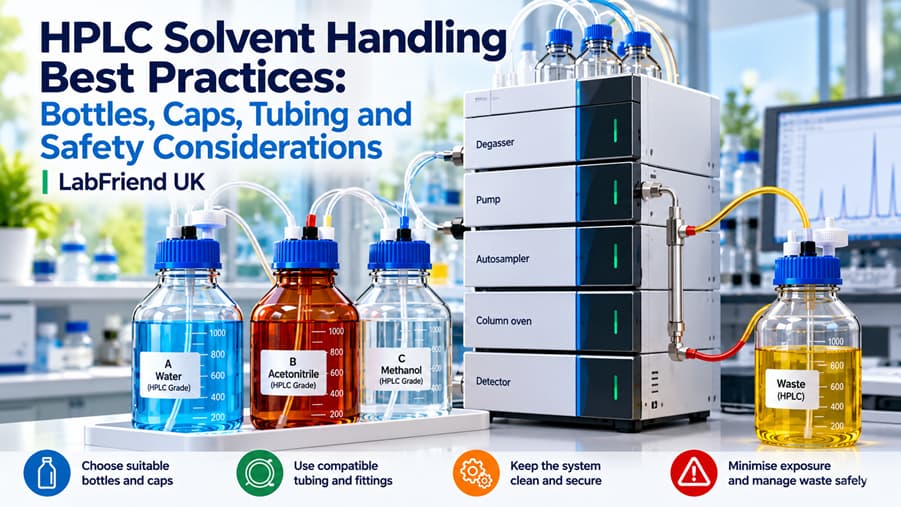
By Donal O’Sullivan, BSc. Reviewed by Michael Anderson, MBA.
Good HPLC solvent handling depends on treating the
mobile-phase and waste pathways as connected systems rather than as a
collection of separate accessories. The bottle or reservoir, cap, tubing, fittings and waste
components all need to suit the solvent, instrument connection and laboratory
workflow. Poorly matched or improvised components can create avoidable handling
problems, while unnecessarily open solvent containers can increase exposure to
the surrounding environment. |
Key Takeaways
- Treat
solvent handling as a complete pathway. The reservoir, closure,
tubing, fittings and waste route need to work together.
- Check
compatibility rather than relying on material names alone. Suitability
can depend on solvent composition, concentration, temperature, exposure
time and the specific workflow.
- Use
appropriate closures and connections. Caps, ports and fittings should
match the container and tubing arrangement required by the HPLC system.
- Keep
mobile-phase and waste pathways controlled. Avoid unnecessary open
exposure, insecure connections and improvised routing.
- Inspect
solvent-handling components routinely. Damaged, degraded, contaminated
or unsuitable tubing, fittings and closures should be investigated and
replaced where appropriate.
- Do not treat accessory changes as a substitute for instrument troubleshooting. A solvent-handling problem may occur outside the instrument, but not every HPLC performance issue is caused by bottles, caps or tubing.
Think of HPLC Solvent Handling as a Connected Workflow
An HPLC solvent-handling arrangement typically includes
several connected elements:
- mobile
phase prepared or supplied in a suitable container;
- a
bottle or reservoir used at the instrument;
- a
cap or closure carrying the required tubing or other connections;
- solvent
inlet tubing and fittings;
- the
HPLC system itself;
- outlet
or waste tubing;
- a
suitable waste collection container and closure arrangement.

Each part serves a different function, but the interfaces
between them matter.
A suitable bottle is of limited value if the cap does not
fit securely. Correct tubing may still cause problems if the fitting is wrong
for the connection. A well-controlled mobile-phase side does not remove the
need to consider how waste solvent is collected.
Laboratories looking for the wider preparation context can
also see our guide to HPLC sample preparation consumables, which covers filters, vials, syringes and
other preparation steps alongside solvent handling.
Choosing Mobile-Phase Bottles and Reservoirs
The starting point is the container holding the mobile
phase.
Selection should reflect the established workflow rather
than a generic assumption that one laboratory bottle format is suitable for
every HPLC application.
Useful questions include:
- Is
the container material suitable for the intended solvent system?
- Is
the capacity appropriate for expected consumption?
- Does
the neck or closure format match the required cap?
- Is
the container practical for preparation, handling and replacement?
- Can
the laboratory maintain the required cleanliness and identification
controls?
- Does
the arrangement allow the necessary tubing connections without
improvisation?
Capacity deserves particular attention.
A container that is unnecessarily large may leave more
mobile phase prepared than the workflow requires. A container that is too small
may require frequent intervention or replacement. The appropriate volume
depends on the laboratory's method, run duration, sequence size and local
operating procedure.
Material compatibility should not be inferred solely from a
generic description such as "glass", "plastic" or
"PTFE". Where compatibility is important, laboratories should check
the relevant manufacturer information against the actual solvent composition
and use conditions.
Why Solvent Caps and Closures Matter
The cap is the interface between the solvent container and
the rest of the HPLC solvent pathway.
Depending on the system, a closure may need to accommodate
one or more tubing lines and other components. The correct configuration
therefore depends on the bottle, the instrument and the laboratory's
established arrangement.
A practical solvent-cap check should consider:
- whether
the closure correctly fits the bottle;
- the
number and type of required ports;
- compatibility
with the selected tubing and fittings;
- whether
the reservoir has the pressure-equalisation arrangement required by the
instrument, such as a suitable vent or vent valve, so that solvent
withdrawal does not create excessive negative pressure; a conventional
solvent reservoir must not be made airtight unless the manufacturer
specifies a suitable alternative arrangement;
- whether
unused ports are appropriately managed;
- whether
the assembled closure remains secure during normal use.
Laboratories should avoid assuming that a cap with the
correct thread is automatically suitable for the complete workflow.
Port dimensions, tubing connections, materials and ancillary
components can all affect whether the assembled system is appropriate.

An improvised closure can also make routine work harder.
Tubing may be poorly supported, connections may be inconsistent between users
and future replacement may become dependent on remembering how an individual
setup was assembled.
A defined, repeatable arrangement is easier to inspect and
reproduce.
Selecting HPLC Solvent Tubing
Tubing is another area where apparently similar components
may have different requirements.
Before replacing or specifying tubing, check:
- material;
- internal
and external dimensions where relevant;
- fitting
or connection requirements;
- solvent-contact
suitability;
- required
length;
- routing
around the instrument;
- manufacturer
or instrument requirements.
Avoid selecting tubing solely because it appears to fit
physically.
The solvent composition and operating conditions can affect
material suitability, and connection dimensions need to match the surrounding
system. Tubing
and fittings must also be suitable for the pressure conditions at their
intended location. The reservoir-to-pump inlet pathway generally operates at
low or sub-atmospheric pressure, whereas tubing within the pressurised
instrument flow path may require substantially higher pressure ratings.
Components suitable for solvent inlet or waste transfer must not be assumed
suitable for high-pressure instrument connections.

Tubing should also be routed sensibly. Avoid unnecessary
strain, sharp bends, kinking or poorly supported connections that could
interfere with normal solvent delivery.
The objective is not to create the shortest possible route
at any cost. It is to maintain an appropriate and manageable connection between
the solvent source and the system.
Check Fittings and Connections as Part of the System
A tubing change often involves more than the tube itself.
Fittings, connectors and adapters should be checked as part
of the same assembly because the performance of the connection depends on the
complete interface.
Before replacing a component, confirm:
|
Workflow element |
What to verify |
Why it matters |
|
Solvent bottle / reservoir |
Capacity, material, neck or closure format and workflow
suitability |
Establishes an appropriate mobile-phase source |
|
Cap / closure |
Bottle fit, ports and required interface arrangement |
Supports a controlled solvent connection |
|
Tubing |
Material, dimensions, length and solvent suitability |
Provides the solvent pathway |
|
Fittings / connectors |
Correct connection and secure fit |
Helps avoid unsuitable or unreliable interfaces |
|
Waste tubing |
Material, routing and connection |
Supports controlled transfer to the waste container |
|
Waste container / closure |
Capacity, material and suitable closure arrangement |
Supports organised waste collection |
The specifications required for a particular HPLC system
should come from the relevant instrument, accessory and laboratory
documentation rather than from a universal table.
Minimise Unnecessary Solvent Exposure
Mobile phase may be exposed to the surrounding laboratory
environment during preparation, transfer, storage or instrument use.
The practical objective is to avoid unnecessary
exposure while maintaining whatever venting or other arrangements the system
requires.
Laboratories should therefore avoid treating a completely
open bottle as the default simply because tubing needs to enter the container.
A suitable cap or closure can provide a more controlled
arrangement for the required connections.
The exact effect of solvent exposure depends on the solvent
system and workflow, so it is not appropriate to assume that every open
container will produce the same degree of evaporation, contamination or
compositional change.
Where solvent composition or environmental exposure is
particularly important to the method, laboratories should apply their validated
procedure and relevant technical guidance.
Control the Waste Pathway Too
Solvent handling does not end when the mobile phase has
passed through the HPLC system.
The waste pathway should receive the same practical
attention as the inlet side.
Check that:
- waste
tubing is suitable for the solvents being collected;
- the
tubing reaches and connects appropriately with the receiving container;
- the
collection container has sufficient usable capacity;
- the
closure arrangement suits the laboratory's waste-handling procedure;
- containers
are identified and managed according to local laboratory requirements;
- tubing
is routed so that normal activity does not easily disturb the connection.
The waste-container closure must also allow safe management of displaced air and solvent vapours as liquidenters the container. A tightly sealed container without a suitable
pressure-relief or venting arrangement can develop excessive internal pressure.
Where required by the solvent hazards and laboratory procedures, use a
compatible, purpose-designed vented closure or vapour-control arrangement, such
as an appropriate exhaust filter or connection to an approved extraction
system. Confirm that the selected arrangement is suitable for the collected
solvent mixture and anticipated waste flow; do not assume that an ordinary
airtight cap or an unrestricted open container provides adequate protection.

Do not improvise waste-container arrangements simply because
the solvent is leaving the analytical system rather than entering it.
Waste solvent remains part of the laboratory's
chemical-handling process.
Specific storage, segregation, ventilation, disposal and
safety requirements depend on the chemicals involved and the laboratory's
procedures. Laboratories should follow their risk assessments, safety
documentation and applicable organisational or regulatory requirements.
Contamination Control Without Expanding the Workflow
Solvent-handling components can come into contact with
mobile phase before it enters the analytical system.
That makes cleanliness and material suitability important.
Potential contamination controls include:
- using
components appropriate for the intended analytical workflow;
- keeping
bottles and closures clean;
- avoiding
unnecessary handling of solvent-contact surfaces;
- replacing
visibly damaged or contaminated components;
- following
appropriate preparation and cleaning procedures;
- avoiding
unassessed material substitutions.
However, the presence of an unexpected chromatographic or MS
signal does not establish that a solvent-handling accessory is the cause.
Contamination can arise from multiple parts of the
analytical workflow. Where LC-MS background, extractables, leachables or
adsorption are the principal problem, that requires a more specific
contamination investigation rather than simply replacing solvent bottles or
tubing.
Common HPLC Solvent-Handling Mistakes
Assuming all laboratory bottles are interchangeable
Containers that look similar can differ in material, neck
format, capacity and intended use.
Choosing a cap based only on thread size
Thread compatibility is only one part of the complete
closure arrangement. Ports, tubing, fittings and system requirements also
matter.
Replacing tubing with whatever fits
Physical fit alone does not establish material or workflow
suitability.
Leaving unnecessary openings around tubing
Where the system permits a more controlled closure
arrangement, unnecessary open exposure may make solvent handling less
controlled.
Ignoring the waste side
Well-managed mobile-phase handling should be matched by an
appropriate waste route and collection arrangement.
Using damaged or degraded components indefinitely
Tubing, caps, fittings and connectors should be inspected as
part of routine laboratory operation. Components showing deterioration,
contamination or loss of suitable function should be assessed and replaced
where necessary.
Treating every HPLC problem as a solvent-handling problem
Leaks, pressure changes, poor chromatography or unstable
performance can have many causes. Solvent-handling components are one area to
inspect, not a complete troubleshooting diagnosis.
A Practical HPLC Solvent-Handling Check List
Before routine use, laboratories can apply a short workflow
check.
1. Confirm the solvent requirement
Know which mobile phase is being used and any
method-specific handling requirements.
2. Check the reservoir
Confirm that the container is suitable for the solvent,
volume and closure arrangement.
3. Check the cap
Make sure it fits the container and provides the required
connections.
4. Check tubing and fittings
Confirm material, dimensions and connection suitability
against the established system.
5. Inspect the route
Look for kinks, strain, insecure connections, contamination
or other obvious abnormalities. Check that the reservoir contains sufficient
mobile phase for the planned operation and that any solvent inlet filter is
correctly positioned, adequately immersed and free from obvious blockage or
damage. After replacing or disturbing solvent inlet tubing or filters, follow
the instrument manufacturer's instructions for priming or purging the affected
solvent line before normal operation.
6. Check the waste side
Confirm the waste tubing, container, capacity and closure
arrangement.
7. Replace unsuitable components deliberately
Use the established specification rather than making an
emergency substitution based only on appearance or availability.
This simple system-level check helps keep solvent-handling
decisions consistent without turning routine HPLC operation into a complex
engineering exercise.
Supporting Reliable Day-to-Day HPLC Operation
For a laboratory manager, the practical objective is
repeatability.
If different users routinely assemble solvent pathways
differently, use improvised components or replace tubing without checking its
specification, the laboratory creates avoidable variation in how equipment is
operated.
A defined setup can make day-to-day management easier by
establishing:
- the
normal reservoir format;
- the
correct closure configuration;
- the
required tubing and fittings;
- the
expected waste arrangement;
- the
specification to use when replacement components are needed.
This does not guarantee instrument uptime or analytical
performance. It does, however, make the supporting workflow more controlled and
reduces dependence on individual memory.
For laboratories needing the broader
chromatography-consumables context, The Complete Guide to Chromatography Consumables for UK Laboratories places
solvent-handling accessories within the wider HPLC, GC and sample-preparation
landscape.
Frequently Asked Questions
What should laboratories check when choosing bottles for
HPLC mobile phase?
Laboratories should check the bottle material, capacity,
closure format and suitability for the intended solvent and workflow.
The container also needs to work with the required cap and
tubing arrangement. Material compatibility should not be assumed from a generic
description alone; where compatibility is important, confirm it against
relevant manufacturer information and the actual solvent conditions.
Why do HPLC solvent caps and closures matter?
HPLC solvent caps and closures provide the interface between
the mobile-phase container and the tubing used by the analytical system, while
also supporting the pressure-equalisation arrangement required by the
instrument.
The correct setup depends on the bottle, required ports,
tubing and instrument configuration. A conventional solvent reservoir should
not be made airtight unless the manufacturer specifies a suitable alternative
arrangement for pressure equalisation.
How should laboratories choose tubing for an HPLC
solvent-handling setup?
HPLC solvent tubing should be selected according to
material, dimensions, fittings, solvent suitability and the pressure conditions
at its intended location.
Tubing used between a reservoir and pump inlet or for waste
transfer should not automatically be assumed suitable for pressurised
instrument connections. Laboratories should use the established system
specification and check manufacturer documentation where solvent compatibility,
pressure rating or operating conditions are relevant.
How can laboratories reduce unnecessary solvent exposure
during HPLC handling?
Laboratories can reduce unnecessary solvent exposure by
using an appropriate container and closure arrangement while maintaining any
venting or other connections required by the system.
The effect of exposure varies with the solvent and workflow,
so laboratories should not assume that every open container creates the same
analytical consequence. Method-specific handling requirements should take
priority.
What should be checked in an HPLC waste-solvent setup?
An HPLC waste-solvent setup should use suitable tubing, an
appropriate receiving container and a closure arrangement that safely manages
both incoming liquid and displaced air or solvent vapours.
The container should have sufficient capacity, and any
venting or vapour-control arrangement should suit the collected solvent mixture
and laboratory procedure. Waste storage, segregation and disposal should follow
the laboratory's risk assessments and applicable requirements.
When should HPLC solvent-handling tubing or accessories
be replaced?
HPLC solvent-handling components should be assessed for
replacement when they are damaged, degraded, contaminated, no longer connect
correctly or are otherwise unsuitable for the established workflow.
Replacement intervals should not be invented universally.
Where manufacturers or laboratory procedures specify inspection or replacement
requirements, those requirements should be followed.
Keep the Solvent Pathway Controlled
Effective HPLC solvent handling is mainly about control and
consistency.
Use suitable bottles and closures, confirm tubing and
fitting requirements, manage the waste pathway deliberately and avoid
unassessed substitutions simply because a component appears to fit.
The correct configuration depends on the laboratory's
solvent system, instrument and established workflow, so technical suitability
should always come before purchasing convenience.
When you have identified the components your workflow
requires, you can browse
HPLC solvent-handling accessories from LabFriend UK.
Read More
- The Complete Guide to Chromatography Consumables for UK Laboratories
- HPLC Sample Preparation Consumables — Filters, Vials, Syringes and Solvent Handling
Explore More
Written by: Donal O’Sullivan, BSc, Co-Founder and Sales Director, LabFriend UK. Donal brings deep chemistry-led technical expertise across analytical chemistry, biochemistry, environmental monitoring, laboratory instrumentation, consumables and scientific product selection.
Reviewed by: Michael Anderson, MBA, Founder and Managing Director, LabFriend UK. Michael reviews LabFriend UK content for customer relevance, commercial accuracy, operational practicality and alignment with LabFriend UK’s laboratory supply model.
Frequently asked questions
Delivery times vary by product and supplier. Each product page shows current stock levels and the expected lead time, and we confirm this when you place your order. Most items arrive within 2 to 3 weeks. Specialised items can take longer if they are not in stock. If you need something by a certain date, contact us and we’ll check for you.
Yes. Register for a commercial account and, once it’s approved, you will be able to process orders via PO Once you have a commercial account, you can directly email your purchase orders
Add products to your cart and click Get a Quote. You’ll get a formal quote instantly, ready to send to your email address. For bulk orders or custom requirements, send us your product list and we’ll reply with itemized pricing.
If your item is faulty, not as described or sent in error, let us know within 14 days of delivery and we’ll arrange a return. Change of mind returns are only accepted if the item is unused and in its original packaging. A restocking fee will apply and you pay the return freight. Read our full Returns Policy for details.
Yes, prices are shown including GST by default. Use the Prices Inc. GST toggle at the top of the page to view prices without GST.