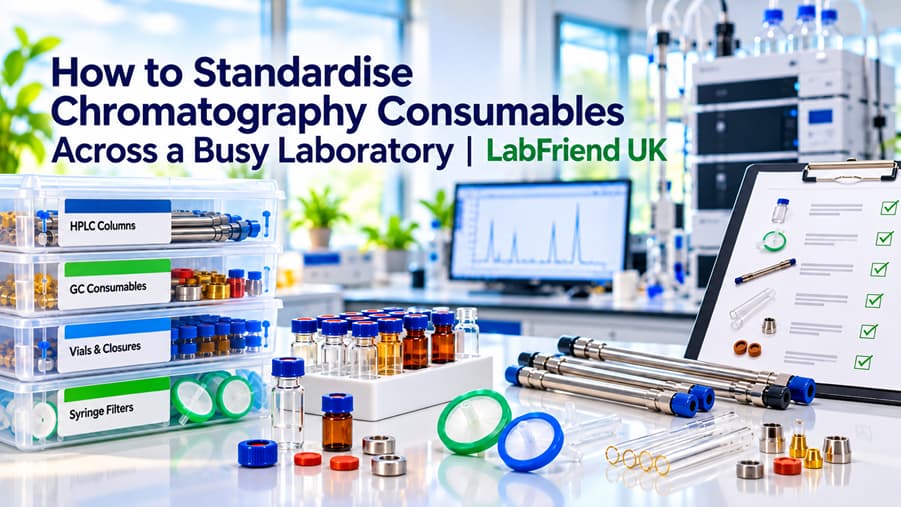
How to Standardise Chromatography Consumables Across a Busy Laboratory
23 mins read
How to Standardise Chromatography Consumables Across a Busy Laboratory
By Donal O’Sullivan, BSc. Reviewed by Michael Anderson, MBA.
Standardising chromatography consumables means creating a
controlled list of products and specifications that the laboratory can purchase
repeatedly with confidence. It does not mean reducing the number of
products simply to make purchasing easier. A useful standardisation programme identifies genuine
duplication, records the technical requirements that must be preserved and
makes clear which products are approved for each workflow. Where different
methods, instruments or samples genuinely require different consumables, those
differences should remain. |
Key Takeaways
- Standardise
approved requirements, not just product names. Record enough
information to preserve the technical specification the laboratory
actually needs.
- Remove
only genuine duplication. Similar descriptions or nominal
specifications do not by themselves establish that two chromatography
consumables are interchangeable.
- Keep
separate products where the application requires them. Different
instruments, methods, samples or controlled procedures can justify
different consumables.
- Use
an approved-product list as the operational control. It should show
what is routinely used, where it is used and what alternatives have been
accepted.
- Treat
alternatives separately from primary products. A proposed substitute
should not enter routine purchasing until its suitability has been
established through the laboratory's appropriate technical process.
- Use
standardisation to simplify repeat ordering, not to bypass technical
decisions. Cost, availability and supplier convenience come after
suitability.
What Does Chromatography Consumables Standardisation Mean?
In a busy laboratory, chromatography consumables can
accumulate gradually.
One analyst orders a preferred vial. Another method uses a
slightly different septum. A new instrument introduces another syringe filter
or column specification. Supplier codes change. Different teams create their
own descriptions for the same item.
Over time, the purchasing system can contain multiple
products that appear to perform the same job, alongside other products that
look similar but are actually required for different technical reasons.
Standardisation is the process of bringing that complexity
under control.
The objective is to define:
- which
consumables are approved for routine use;
- which
specification applies to each workflow;
- which
products are genuinely duplicated;
- which
approved alternatives may be used;
- and
which differences must be preserved.
That distinction matters. A laboratory should not reduce ten
SKUs to five simply because five is easier to manage. It should reduce ten to
five only where the remaining products continue to satisfy the controlled
requirements of the relevant workflows.
For broader context on the different consumable groups
involved in chromatography, see The Complete Guide to Chromatography Consumables for UK Laboratories.
Why Do Busy Laboratories Accumulate Duplicate Consumables?
Duplicate or near-duplicate products often arise for
understandable reasons.
Different people order the same requirement differently
One team may record a manufacturer catalogue number, another
a supplier code and another a shortened description. The purchasing system can
then make a single approved item look like several different products.
Historical products remain active
A laboratory may move to a new product but continue to carry
the previous item in its ERP, spreadsheet or local stock list.
Similar products are added without checking existing
approvals
A new buyer or scientist may source a product that appears
suitable without realising that an approved version is already in use elsewhere
in the laboratory.
Different workflows genuinely need different
specifications
Not all apparent duplication is waste.
Two chromatography vials, filters or columns may look
similar in a purchasing report while serving different methods or instruments.
The first task is therefore to distinguish true duplication from necessary
technical variation.

What Should a Laboratory Standardise?
Standardisation is most useful for consumables that are
purchased repeatedly and for which the laboratory can define a stable approved
requirement.
Potential areas include:
- chromatography
vials, caps and septa;
- routine
syringe filters;
- recurring
GC consumables;
- established
HPLC or UHPLC column specifications;
- approved
guard-column configurations;
- sample-preparation
consumables;
- commonly
repeated chromatography accessories.
The correct level of standardisation will differ between
laboratories.
A routine vial configuration used across several compatible
autosamplers may be a good candidate for consolidation. A specialised vial,
filter or column required for one particular method may need to remain
separate.
The same principle applies across the category: standardise
where requirements genuinely align; preserve variation where they do not.
For laboratories working specifically on vial and septa
purchasing, the Chromatography Vials and Septa Buying Guide for UK Laboratory Procurement Teams provides
the more detailed product-family controls.
Build an Approved Chromatography Consumables List
The practical centre of a standardisation programme is an
approved-product list.
This can be maintained within an ERP, purchasing system,
controlled spreadsheet or other laboratory-approved record. The format matters
less than the clarity of the information.
A useful record might include:
|
Field |
What to record |
Why it matters |
When technical review may be needed |
|
Consumable category |
Vial, septum, filter, column, liner, ferrule or other
defined group |
Makes the list easier to organise and review |
Usually not required for classification alone |
|
Approved product identity |
Manufacturer and catalogue or part number where available |
Reduces ambiguity during repeat ordering |
When the product identity changes |
|
Controlled specification |
The characteristics required by the workflow |
Preserves the basis on which the item was approved |
When a proposed alternative differs |
|
Laboratory use |
Relevant method, instrument, application or work area |
Helps prevent an approved product being used outside its
intended context |
When use is extended to another workflow |
|
Supplier reference |
Approved supplier code where useful |
Supports purchasing traceability |
If the supplier code cannot be linked clearly to the
approved item |
|
Primary / alternative status |
Normal item or approved alternative |
Prevents an unreviewed substitute becoming routine by
accident |
Before adding a new alternative |
|
Pack information |
Pack size where operationally relevant |
Reduces ordering errors and duplicate records |
Normally commercial unless product identity changes |
|
Technical owner |
Laboratory, QA or other responsible function where
required |
Makes escalation responsibility clear |
When the specification or approved use changes |
The list should contain enough information for someone
unfamiliar with the history of the product to understand what can be reordered
and what requires confirmation.

How to Identify Genuine Duplicate SKUs
SKU rationalisation should begin with evidence, not
assumptions.
A useful review groups products by function and then asks
whether the records actually represent the same controlled requirement.
For each apparent duplicate, check:
- Is
it the same manufactured product under different supplier codes?
- Does
it have the same controlled technical specification?
- Is
it approved for the same instrument, method or workflow?
- Does
either record contain a restriction that the other does not?
- Is
one product historical or no longer routinely used?
- Has
the laboratory already approved one as an alternative to the other?
Only after those questions are resolved should records be
consolidated.
Generic descriptions are particularly risky. Terms such as
“2 mL autosampler vial”, “0.22 µm syringe filter” or “C18 column” may describe
a broad class of product without identifying everything that matters to a
particular workflow.
The purpose of standardisation is to remove unnecessary
complexity without deleting information that protects technical suitability.
Primary Products and Approved Alternatives
A standardised list does not have to mean one product for
every requirement.
For important repeat-use consumables, it can be useful to
distinguish between:
- primary
approved product — the normal repeat-order item;
- approved
alternative — a product whose suitability has been assessed and
documented for specified workflows, including any required compatibility
checks, performance verification or formal change approval;
- proposed
alternative — a product that has not yet been accepted for routine
use.

This distinction gives purchasing teams more flexibility
without turning supplier availability into a technical decision.
If the primary item becomes unavailable, procurement can
check whether an approved alternative already exists rather than starting an
urgent substitution exercise.
However, the term alternative should not
automatically be treated as meaning equivalent. Where suitability
depends on method performance, instrument compatibility, material, geometry or
another controlled characteristic, the appropriate laboratory or QA function
should determine whether the proposed change can be accepted.
Where Standardisation Can Create Technical Risk
Standardisation becomes unsafe when purchasing simplicity
takes priority over the analytical requirement.
Consolidating by generic description
Two consumables can share a generic description while
differing in characteristics that matter to the workflow.
Assuming nominal specifications establish equivalence
Matching a single specification field is not enough to
establish that products can be interchanged across every application.
Standardising across incompatible instruments
A consumable accepted on one instrument should not
automatically be assumed suitable for another.
Removing method-specific products as “duplicates”
An apparently unusual SKU may exist because an established
method or controlled procedure requires it.
Introducing an alternative for commercial reasons alone
Lower price, shorter lead time or easier availability may
justify investigating an alternative. They do not establish technical
suitability.
A good standardisation exercise therefore includes
laboratory users in the decision wherever technical requirements could be
affected.
How Standardisation Improves Repeat Ordering
Once the approved list is established, repeat purchasing
becomes much clearer.
Instead of starting with a generic requirement such as
“order HPLC vials”, the buyer can work from a controlled product record
containing the approved identity and relevant specification.
That can reduce:
- ambiguous
requisitions;
- unnecessary
supplier searches;
- duplicate
product creation;
- repeated
questions about which product was used previously;
- accidental
ordering of a similar but unapproved item.
Standardisation also makes it easier to see which products
genuinely recur across the laboratory.
That information can support later stock-control and reorder
planning, but the two activities should not be confused. Standardisation
defines what should be bought; stock control determines when and how much
should be reordered.
A Practical Seven-Step Standardisation Workflow
A busy laboratory can approach chromatography-consumables
standardisation in seven stages.

1. Inventory the current products
Bring together the existing chromatography-consumables
records from purchasing systems, local lists and routine laboratory use.
Focus first on products that recur regularly rather than
trying to rationalise every specialist item at once.
2. Group products by requirement
Organise items by function and workflow—for example vials,
filters, columns or routine GC consumables.
Do not treat everything within a product category as
technically equivalent.
3. Confirm the controlled specification
For each regularly used item, establish which
characteristics must be preserved for its approved use. Depending on the
consumable, these may include dimensions, material composition, chemical
compatibility, instrument compatibility and relevant operating limits. For
example, vial requirements may include closure type and autosampler
compatibility; syringe-filter requirements may include membrane material and
pore size; and column requirements may include stationary-phase chemistry,
dimensions and particle size. Record only those characteristics necessary to
preserve suitability for the relevant workflow.
Where necessary, involve the scientist, laboratory manager,
QA function or other technical owner.

4. Identify genuine duplication
Separate duplicate commercial records from products that are
technically distinct.
Remove old or redundant records only when the laboratory is
confident that the distinction is no longer required.
5. Define primary products and approved alternatives
Record the normal repeat-use item and any alternatives that
have already been appropriately accepted.
Do not place unreviewed substitutes onto the approved list
simply to increase purchasing flexibility.
6. Assign ownership
Define who can maintain the list and who must approve
technical changes.
This prevents the standard from gradually changing through
informal substitutions or duplicate product creation.
7. Review the list periodically
A standardised list should remain controlled but not static.
Products can be discontinued, manufacturers can change
references, methods can change and new equipment can create new requirements.
Periodic review helps keep the list useful without turning every routine
reorder into a fresh selection exercise.
A product may also change without receiving a new catalogue
number. Where the laboratory becomes aware of changes to its materials, design,
manufacturing specifications or other characteristics relevant to the approved
use, the responsible technical function should assess whether the existing
approval remains valid. Routine reorders do not require fresh technical
approval unless a relevant change or concern has been identified.
Frequently Asked Questions
What does it mean to standardise chromatography
consumables?
Standardising chromatography consumables means defining a
controlled set of approved products and specifications for routine laboratory
use. The aim is to remove unnecessary variation while preserving the
technical requirements of each method, instrument or workflow.
A good standardisation system records what can be reordered
routinely and identifies where separate products or technical approval are
still required.
Which chromatography consumables can a laboratory
standardise?
Laboratories can consider standardising recurring
chromatography consumables where the required specification is stable and
shared across suitable workflows. Examples may include vials, caps, septa,
syringe filters, routine GC consumables and established column configurations.
Products should remain separate where different methods,
instruments, samples or controlled procedures require different specifications.
Should similar chromatography consumables be consolidated
into one SKU?
Only genuine duplicates should be consolidated into one
SKU. Similar descriptions or nominal specifications do not by themselves
establish that two chromatography consumables are interchangeable.
Before consolidation, confirm product identity, controlled
specifications, intended use and any method or instrument restrictions that
need to be preserved.
How should approved alternatives be recorded?
Approved alternatives should be recorded separately from
the primary product and only after their suitability has been assessed and
documented for the specified workflow. The record should make clear which
alternative has been accepted, for what use and any relevant conditions
attached to that approval.
A proposed substitute should remain separate until any
required compatibility checks, performance verification or formal change
approval has been completed.
Who should approve changes to a standardised
chromatography consumable?
Technical changes should be approved by the laboratory
function responsible for the affected method, instrument or controlled
workflow. Procurement or purchasing teams can identify alternatives and
compare documented information, but they should not be expected to determine
analytical equivalence where scientific or quality assessment is required.
The appropriate approval route will depend on the
laboratory's own procedures.
How often should an approved chromatography consumables
list be reviewed?
Review an approved chromatography consumables list when
relevant products, methods, equipment or supply arrangements change, and
periodically according to the laboratory's own controls. There is no single
review frequency that is appropriate for every laboratory.
The important control is that discontinued products, changed
references, new alternatives and other relevant changes are assessed before the
list becomes unreliable.
Make Standardisation a Technical Control, Not Just a Purchasing Exercise
The most useful standardisation programmes do more than
shorten a purchasing list.
They define which chromatography consumables are routinely
approved, preserve the specifications that matter and make genuine alternatives
easier to manage. That gives laboratory managers a clearer basis for reducing
unnecessary SKU variation while keeping technical decisions where they belong.
Once the laboratory has defined its repeat-use requirements,
LabFriend UK can help you build a standard chromatography consumables list around those approved
specifications.
Read More
- The Complete Guide to Chromatography Consumables for UK Laboratories
- Chromatography Vials and Septa Buying Guide for UK Laboratory Procurement Teams
Explore More
Written by: Donal O’Sullivan, BSc, Co-Founder and Sales Director, LabFriend UK. Donal brings deep chemistry-led technical expertise across analytical chemistry, biochemistry, environmental monitoring, laboratory instrumentation, consumables and scientific product selection.
Reviewed by: Michael Anderson, MBA, Founder and Managing Director, LabFriend UK. Michael reviews LabFriend UK content for customer relevance, commercial accuracy, operational practicality and alignment with LabFriend UK’s laboratory supply model.
Frequently asked questions
Delivery times vary by product and supplier. Each product page shows current stock levels and the expected lead time, and we confirm this when you place your order. Most items arrive within 2 to 3 weeks. Specialised items can take longer if they are not in stock. If you need something by a certain date, contact us and we’ll check for you.
Yes. Register for a commercial account and, once it’s approved, you will be able to process orders via PO Once you have a commercial account, you can directly email your purchase orders
Add products to your cart and click Get a Quote. You’ll get a formal quote instantly, ready to send to your email address. For bulk orders or custom requirements, send us your product list and we’ll reply with itemized pricing.
If your item is faulty, not as described or sent in error, let us know within 14 days of delivery and we’ll arrange a return. Change of mind returns are only accepted if the item is unused and in its original packaging. A restocking fee will apply and you pay the return freight. Read our full Returns Policy for details.
Yes, prices are shown including GST by default. Use the Prices Inc. GST toggle at the top of the page to view prices without GST.