

Share :
Autosampler Vial Compatibility: How to Avoid Incorrect Vial, Cap and Insert Selection
Updated On 08/28/2026

Autosampler vial compatibility is one of the easiest chromatography consumables issues to underestimate. A vial may look correct, have the expected volume and appear to fit the tray, but still cause problems if the dimensions, neck type, cap, septum, insert or bottom profile are not right for the instrument and method.
In HPLC (high-performance liquid chromatography), UHPLC (ultra-high-performance liquid chromatography), GC (gas chromatography) and headspace workflows, the vial is not just a small container. It is part of the sample introduction system. The autosampler must recognise, hold, move, pierce and sample from the vial consistently. The needle must access the sample at the correct depth. The cap and septum must suit the vial and needle. Any insert must sit correctly and allow the sample to be recovered without creating avoidable dead volume or access problems.
Incorrect vial, cap or insert selection can create practical issues that look like method problems. A sample may not be picked up correctly. Injection reproducibility may suffer. The needle may strike an insert or fail to reach the liquid. A cap may sit too high or seal poorly. A septum may core, shed material, resist piercing or introduce contamination. A substitute vial may appear similar but behave differently in the autosampler.
This guide explains how to avoid incorrect autosampler vial, cap and insert selection by treating the vial assembly as a controlled chromatography consumable. It is intended to support both bench-level method decisions and procurement or repeat-ordering decisions, since both groups influence which vial assembly ends up in routine use. For wider chromatography consumables guidance across HPLC, UHPLC, GC, headspace, SPE, TLC, sample preparation, filtration and columns, read The Complete Guide to Chromatography Consumables for UK Laboratories.
LabFriend UK supplies Chromatography Vials & Septa, wider Laboratory Vials, related GC consumables and broader chromatography supplies for UK laboratories.
Quick answer: how do you avoid incorrect autosampler vial selection?
Avoid incorrect autosampler vial selection by specifying the complete vial assembly, not just the vial volume.
The approved specification should include the vial volume, dimensions, neck type, cap format, septum material, insert design, bottom profile, instrument compatibility, sampling depth and method requirements. A 2mL vial, for example, should not be treated as automatically interchangeable with every other 2mL vial. The same applies to caps, septa and inserts.
|
Compatibility factor |
Why it matters |
|
Vial dimensions |
Affects tray fit, handling and autosampler movement |
|
Vial volume |
Affects sample volume, headspace, method setup and recovery |
|
Neck type |
Determines compatible caps and closure formats |
|
Cap format |
Affects closure height, sealing and needle access |
|
Septum material |
Affects piercing, resealing, compatibility and contamination risk |
|
Insert design |
Affects low-volume recovery, sampling depth and dead volume (the sample volume that remains inaccessible to the needle and cannot be injected) |
|
Bottom profile |
Affects residual volume and sample access |
|
Substitution control |
Prevents visually similar but incompatible products being used |
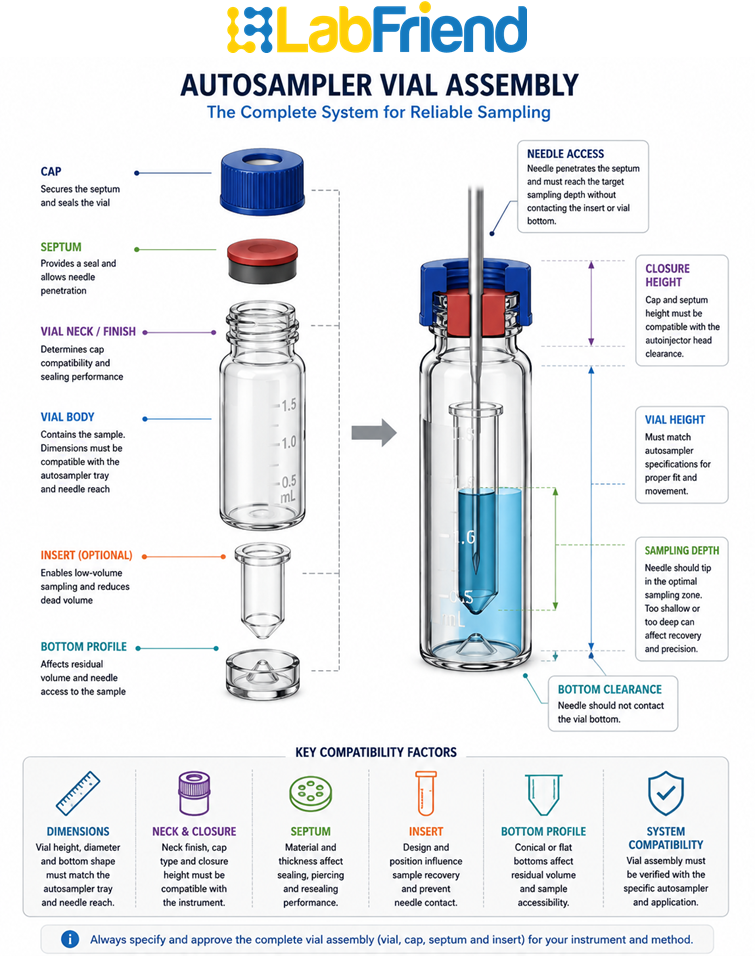
Important: this guide is written for analytical scientists, QA/QC staff and laboratory procurement teams who select, approve or reorder autosampler vials, caps, septa and inserts.
The safest purchasing approach is to record the vial, cap, septum and insert together as one repeat-use specification. Where the method is validated, client-specified, trace-sensitive or routinely repeated, substitutions should be reviewed before use.
Why autosampler vial compatibility matters
Autosampler compatibility matters because the vial assembly interacts directly with the instrument. The autosampler is designed to work with specific vial dimensions, tray formats, closure heights and needle movements. When a vial assembly is incorrect, the problem may appear as poor injection precision, missing sample, carryover, needle damage, failed sequences or inconsistent results.
In manual workflows, an analyst can often see and adjust for small handling differences. Autosamplers are less forgiving. They operate repeatedly and precisely, but only when the consumables match the physical and method requirements of the system.
The risk increases in busy laboratories because purchasing decisions are often repeated quickly. Once a vial description has been entered into a purchasing system, it may be reordered many times. If the original specification is incomplete, the laboratory may not notice the risk until a product is substituted, a method is transferred, a new instrument is installed or a low-volume workflow behaves unexpectedly.
For scientists and QA/QC teams, the practical point is simple: vial compatibility is not a cosmetic issue. It protects injection consistency, method continuity and repeat ordering.
Where this fits within quality systems
For laboratories operating under GLP, GMP or ISO 17025, the vial, cap, septum and insert used in a validated method are typically part of the documented method conditions. A change to any of these components should be assessed through the laboratory's existing change-control process before routine use, in the same way as a change to a column or reagent would be.
Why visually similar vials can behave differently
Many autosampler vials look almost identical at a glance. They may have the same nominal volume, similar glass colour and similar general shape. That visual similarity can create a false sense of interchangeability.
Small physical differences can still matter. Vial height, diameter, shoulder shape, neck finish, thread profile, crimp finish, base design and wall geometry may influence autosampler fit or needle access. Even when the vial itself fits, the cap, septum or insert may change the effective assembly height or sampling behaviour.
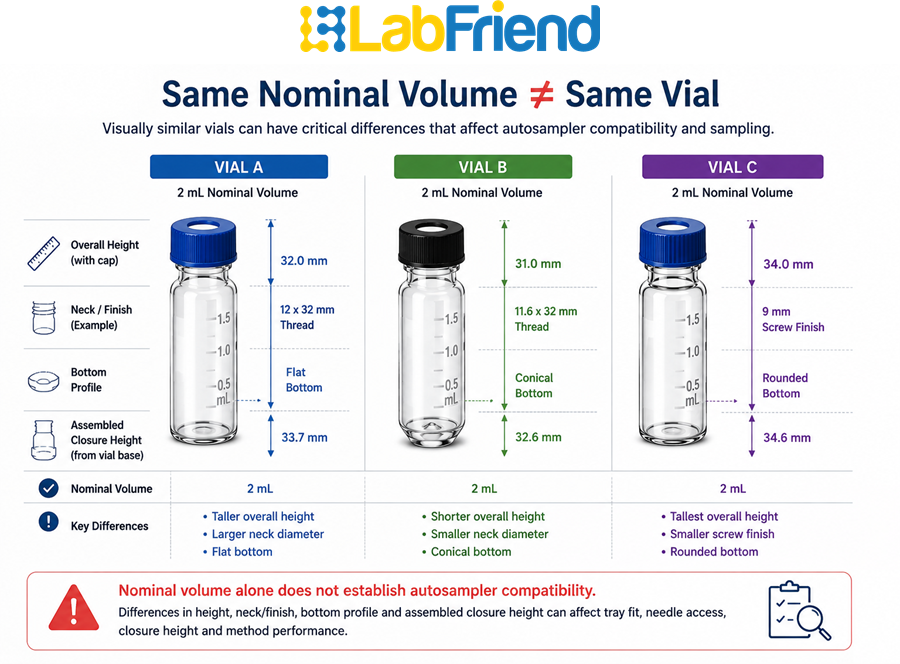
This is why descriptions such as “standard autosampler vial” or “2mL chromatography vial” are rarely enough for controlled repeat purchasing. The laboratory needs enough detail to ensure the same assembly is reordered.
A compatibility error may not always be dramatic. The autosampler may still run, but injection precision may be weaker, sample recovery may be poorer, or occasional failures may appear. These intermittent problems are often the hardest to diagnose.
Vial dimensions, volume and tray fit
Vial dimensions affect whether the vial sits correctly in the autosampler tray and whether the system can handle it reliably. Height and diameter are especially important, but the overall vial profile can also matter.
Many autosampler trays follow standard rack footprints (for example ANSI/SLAS microplate-format layouts), so vial height and diameter should be checked against both the tray and the instrument's own specifications rather than the rack format alone.
Vial volume is also important, but volume alone does not confirm compatibility. A 2mL vial may be suitable for many chromatography workflows, but that does not mean every 2mL vial has the same dimensions, neck type, bottom profile or closure behaviour.
For low-volume methods, the vial volume and insert selection become more important. A vial that works well for routine sample volumes may not be suitable where only a small amount of sample is available. In those cases, the laboratory may need a compatible insert or a low-volume vial format.
Where plastic vials are used instead of glass, solvent and reagent compatibility should be checked specifically, since some solvents can interact with certain plastics in ways that do not occur with glass.
A repeat-use vial specification should include the nominal volume, physical format, neck type, glass type, bottom profile and instrument or tray association. This prevents procurement from selecting a visually similar alternative that does not behave the same way in the autosampler.
For wider vial options, LabFriend UK’s Laboratory Vials category provides a supporting product route.
Neck type, cap format and closure height
The vial neck determines which cap or closure system can be used. Screw, crimp and snap formats are not interchangeable unless the vial and cap are specifically designed for that closure type.
Neck finish is typically specified using standard designations such as 8-425, 9-425, 10-425, 13-425 (ND13), 18-400, or 20mm crimp/snap (ND20). Two vials described only as “screw neck” may still use different thread designations and therefore accept different caps.
Crimp closures require a crimping tool to apply a consistent seal and a decapper to remove them, while snap closures are fitted and removed by hand; this affects both sealing consistency and laboratory workflow.
For autosampler use, the cap does more than close the vial. It affects the height and presentation of the septum, the way the needle enters the vial, and the consistency of sealing. A cap that appears to fit may still create problems if the closure height, thread engagement or septum positioning is wrong.
For screw caps, inconsistent application torque can under- or over-seal the vial; for crimp caps, crimping pressure that is too low may leave a poor seal, while pressure that is too high can damage the septum. Where available, a controlled crimping tool or documented torque approach helps keep sealing consistent across a batch.
Closure choice should therefore be treated as part of compatibility control. The question is not simply whether the cap can be attached. The question is whether the cap, septum and vial create a repeatable assembly for the autosampler and method.
A future closure-format article may compare screw, crimp and snap vials in more detail. In this article, the key point is narrower: closure format should be checked as part of autosampler compatibility, not selected by convenience alone.
Understanding vial neck finish and closure sizing
Neck finish designations describe the thread or crimp diameter and profile of a vial’s opening, and they determine which caps physically fit. Common designations include 8-425 and 9-425 (used for many 2mL screw-neck vials), 10-425 and 13-425/ND13 (used for larger screw-neck and some crimp/snap formats), and 20mm crimp or snap, most often associated with headspace and larger GC vials. Recording the neck finish alongside the vial volume prevents a cap from being ordered that fits a different, similarly sized vial.
Septum material, piercing and resealing behaviour
The septum is the surface the autosampler needle must pierce. Its material, thickness, lining and fit can influence needle penetration, resealing behaviour, evaporation control, contamination risk and sample compatibility.
Common septum constructions include PTFE/silicone laminates and red rubber/PTFE laminates, where the PTFE face contacts the sample and the silicone or rubber layer provides resealing after piercing.
A septum that works well in one workflow may not be ideal in another. Some methods prioritise chemical compatibility. Others prioritise low background, resealing performance, needle durability or solvent resistance. In GC and headspace workflows, temperature and volatile sample containment may also be relevant.
A common selection mistake is to choose the correct vial but pair it with a poorly matched cap and septum. This can create problems even when the vial dimensions are correct. The needle may not pierce cleanly. The septum may core (where a fragment of septum material detaches and enters the vial or needle path) or shed particulate material. The seal may be inconsistent. In sensitive methods, background or extractables may become more visible.
Needle gauge also affects this risk. A narrower needle generally reduces coring risk but must still be matched to septum thickness and hardness for reliable, repeated piercing.
Laboratories should record septum material and cap format as part of the vial specification. The approved product should not be reduced to “vial and cap” if the septum is method-critical.
Inserts, low-volume samples and needle access
Vial inserts are used when the available sample volume is low or when the laboratory wants to improve sample recovery from a small volume. They can be useful, but they introduce additional compatibility variables.
The insert must fit the vial correctly. It must sit in the expected position. The autosampler needle must be able to access the sample without striking the insert, drawing air or leaving too much residual volume. The insert shape, internal volume and bottom design can all affect suitability.
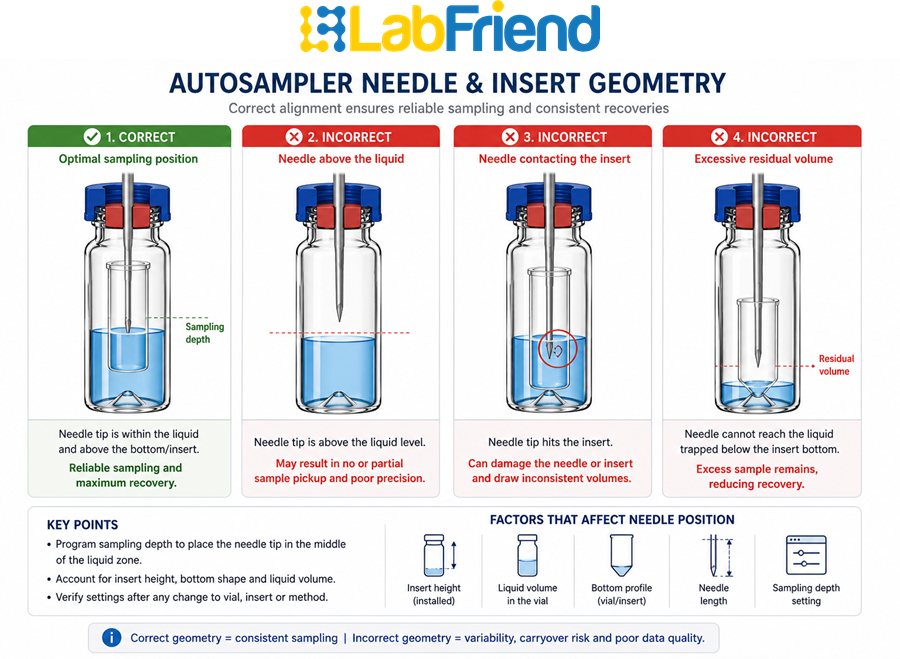
Common fixed micro-inserts range from approximately 0.1mL to 0.3mL, in glass or polymer, either fused into the vial base or supplied as a separate component that seats inside a standard vial.
Incorrect insert selection can create poor reproducibility, incomplete sample pickup or unexpected carryover. It can also create practical handling issues if the insert moves, sits unevenly or is mismatched to the vial.
For low-volume HPLC and UHPLC workflows, insert selection should be linked to sample volume, needle depth, injection volume, required recovery and method sensitivity. For GC workflows, the same principle applies where inserts or vial formats are used for small-volume samples.
A good repeat-use specification records the insert type alongside the vial and cap. The insert should not be treated as a generic accessory where the method depends on low-volume recovery.
Bottom profile, sampling depth and residual volume
The bottom profile of a vial or insert can affect how much sample remains inaccessible after the autosampler draws from the vial. Flat-bottom, conical, rounded, spring-loaded or reduced-volume (fixed-insert) designs may behave differently depending on the instrument and needle position.
Sampling depth matters most when sample volume is limited. If the needle does not reach the sample consistently, or if the geometry leaves too much residual liquid, injection reproducibility may suffer. The laboratory may see variability that looks like a method issue when the underlying problem is the vial or insert format.
Recovery refers to how much of the loaded sample can actually be injected; residual volume is the portion left behind after sampling. The two are related but not identical, and both should be considered for low-volume methods.
This does not mean one bottom profile is best for every method. It means the vial or insert geometry should be matched to the sample volume, injection requirement and autosampler settings.
Where a method has been developed using a specific vial or insert format, changing that format should be reviewed before routine use.
HPLC and UHPLC autosampler considerations
HPLC and UHPLC autosamplers place strong emphasis on repeatable injection and low contamination risk. Vials, caps, septa and inserts must support that requirement.
For HPLC, common compatibility concerns include sample recovery, solvent compatibility, septum behaviour, particulate contamination, cap fit and needle access. In UHPLC, smaller injection volumes and higher method sensitivity can make small compatibility errors more visible.
Low-volume methods require particular care. If the wrong insert is used, the needle may not access the sample reliably or the residual volume may be too high. If the wrong septum is selected, coring or contamination may affect repeat injections. If the cap height differs from the approved format, needle penetration may be inconsistent.
Scientists should treat the vial assembly as part of the method environment. Procurement should not substitute vials, caps or inserts purely on visual similarity or nominal volume.
For trace-sensitive or LC-MS work, certified or pre-cleaned vials are available as a distinct product category, manufactured and packaged to reduce extractables and background contamination.
GC and headspace autosampler considerations
GC autosampler workflows introduce different compatibility concerns because the vial assembly may interact with volatile samples, septa, syringes and temperature-sensitive workflows.
For routine GC liquid injection, vial and cap compatibility still matters because the autosampler must access the sample cleanly and repeatedly. Septum behaviour can affect needle penetration, coring and contamination. Poor vial or closure selection may also contribute to evaporation or inconsistent sample handling where volatile components are present.
Headspace workflows require additional care because vials, caps and septa may be heated, sealed, pressurised and pierced. This article does not replace a dedicated headspace vial selection guide, but the compatibility principle is the same: the vial, cap and septum must be selected as a matched assembly and checked against the instrument and method.
Headspace analysis typically uses 10mL or 20mL vials with a 20mm crimp or magnetic cap, so cap and septum compatibility with the specific headspace autosampler model should be confirmed rather than assumed.
For GC-relevant consumables, LabFriend UK’s GC Consumables category provides a supporting route where the workflow extends beyond the vial assembly.
Incorrect substitutions and repeat-order risk
Most autosampler vial compatibility problems are not caused by laboratories ignoring compatibility completely. They are often caused by incomplete repeat-order data.
A buyer may see “2mL screw vial” and select an alternative that appears equivalent. A supplier may suggest a substitute with similar wording. A pack may be changed because the original item is unavailable. A laboratory may switch from one cap/septum combination to another without reviewing needle access or method sensitivity.
These substitutions may be acceptable in some workflows, but they should not be uncontrolled. Visual similarity is not a compatibility check.
The risk is highest where the method is validated, client-specified, trace-sensitive, low-volume, high-throughput or routinely repeated across multiple analysts or instruments. In these cases, the approved vial, cap, septum and insert specification should be recorded clearly and substitutions should be reviewed before use.
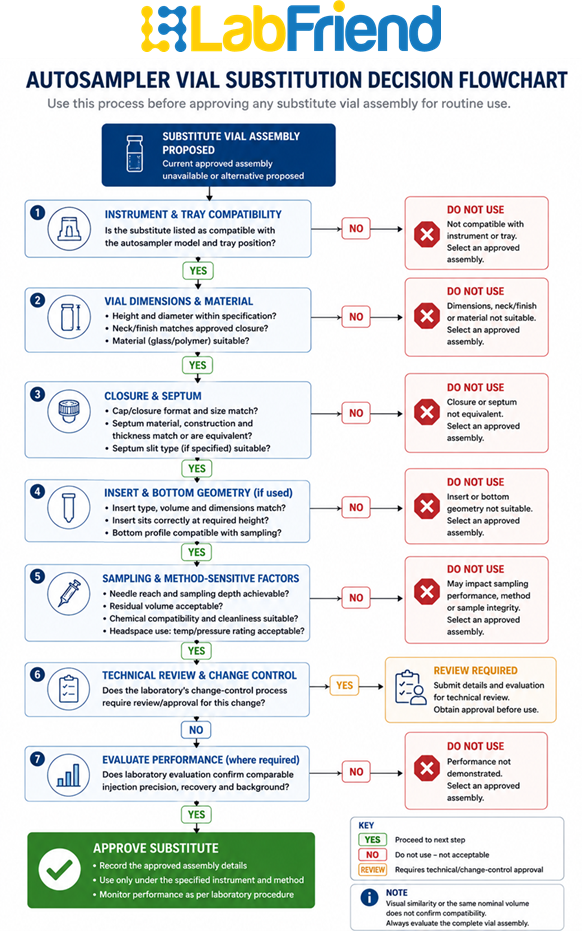
Laboratories operating more than one autosampler model, or working across multiple sites, carry an additional version of this risk: a vial assembly approved for one instrument may not automatically suit another. Where possible, standardising on a single approved vial assembly per method, and re-confirming compatibility whenever the method runs on a different instrument, reduces this risk.
First checks when results look like a vial or insert problem
Where injection precision, missing sample or unexpected carryover appears without a clear method cause, it is worth first confirming: whether the vial, cap, septum and insert match the approved specification exactly; whether a recent reorder introduced a substitute product; whether the cap and septum are seated and sealing correctly; and whether the insert (if used) is correctly positioned and undamaged. These checks can rule out a consumables cause before more time-consuming method troubleshooting begins.
Building an approved autosampler vial specification
An approved specification turns compatibility knowledge into practical purchasing control. It helps scientists, lab managers and procurement teams reorder the correct assembly without relying on memory or vague descriptions.
|
Specification field |
What to record |
|
Application |
HPLC, UHPLC, GC, headspace or method name |
|
Instrument / tray |
Autosampler or tray format where relevant |
|
Vial volume |
Nominal volume and format |
|
Vial dimensions |
Height, diameter or product-specific format where required |
|
Neck type |
Screw, crimp, snap or specified closure |
|
Glass / material |
Clear glass, amber glass, plastic, or method-required material, including glass type where relevant (e.g. Type I borosilicate vs soda-lime glass) |
|
Cap format |
Cap type, size and closure style |
|
Septum material |
Exact approved material or product description |
|
Insert |
Insert type, volume, shape and compatibility |
|
Bottom profile |
Flat, conical, reduced-volume or method-specific |
|
Approved alternatives |
Specific alternatives only, not generic equivalents |
|
Reorder route |
LabFriend category, quote reference, SKU or internal code |
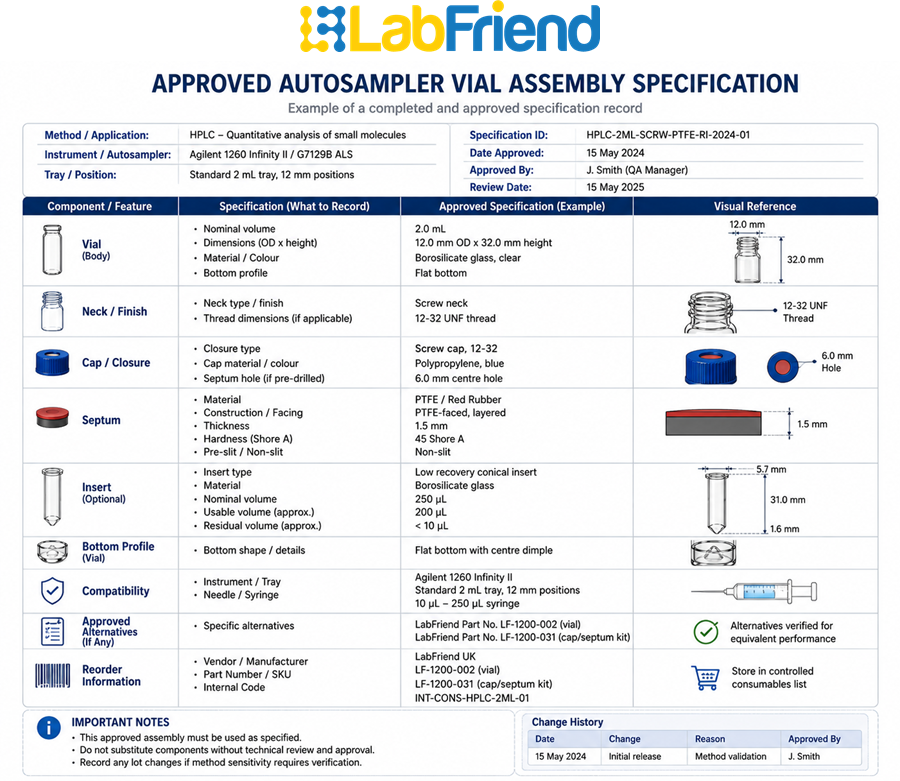
In practice, this specification is usually held alongside the method SOP, and may reference the supplier's product data sheet or certificate of analysis for the approved vial, cap, septum and insert. Keeping this reference current makes it easier to confirm compatibility when a product is discontinued or a substitute is proposed.
This record does not need to be complicated. It simply needs to be specific enough to prevent the wrong product being bought repeatedly.
Where LabFriend UK fits
LabFriend UK supports laboratories through ecommerce-led product discovery, quotation support and repeat purchasing convenience. That is valuable for autosampler vial compatibility because the goal is not only to find a vial once. The goal is to keep the correct vial assembly available for repeat workflows.
Browse Chromatography Vials & Septa for vial, cap and septum options, or use Laboratory Vials for wider vial formats. For broader chromatography purchasing, use chromatography supplies.
For help matching repeat-use vial, cap, septum or insert specifications, contact LabFriend UK with the instrument, method, vial format and any approved specification you need to maintain.
Common mistakes when selecting autosampler vials, caps and inserts
The first mistake is choosing by vial volume alone. Volume matters, but it does not confirm dimensions, neck type, cap compatibility, insert fit or autosampler handling.
The second mistake is assuming visually similar products are interchangeable. Small differences in vial, cap or insert design may matter in repeat workflows.
The third mistake is separating the vial from the cap and septum during purchasing. Autosampler compatibility depends on the complete assembly.
The fourth mistake is treating inserts as generic. Insert shape, position and volume can affect low-volume sample recovery and needle access.
The fifth mistake is allowing procurement substitutions without technical review. This is especially risky where methods are validated, trace-sensitive, low-volume or repeated routinely.
Conclusion: specify the vial assembly, not just the vial
Autosampler vial compatibility depends on the complete assembly. The vial, cap, septum and insert must work together with the autosampler, tray, needle path, sample volume and method.
Incorrect selection can create problems that look like instrument, method or sample issues. A vial may fit but not sample correctly. A cap may close but present the septum poorly. An insert may improve recovery in one workflow but create access problems in another. A substitute may look equivalent but behave differently in the instrument.
The practical recommendation is to document the approved vial assembly and control substitutions. For routine chromatography workflows, that means recording the vial format, cap, septum, insert, instrument association and approved alternatives clearly enough for repeat purchasing.
For wider chromatography consumables guidance, read The Complete Guide to Chromatography Consumables for UK Laboratories. To source vial assemblies, browse Chromatography Vials & Septa, explore Laboratory Vials, or contact LabFriend UK for help matching repeat-use specifications.
Frequently Asked Questions
What does autosampler vial compatibility mean?
Autosampler vial compatibility means the vial, cap, septum and insert are suitable for the autosampler tray, needle path, sample volume, method and workflow. Compatibility should be checked at the complete assembly level, not by vial volume alone.
Are all 2mL autosampler vials interchangeable?
No. Two vials may have the same nominal volume but differ in dimensions, neck type, bottom profile, cap compatibility or insert suitability. In practical terms, "2mL" describes capacity, not a single fixed design. Laboratories should confirm the full specification before substituting.
Why does cap selection matter for autosampler vials?
Cap selection affects closure height, septum position, sealing and needle access. A vial may be correct, but an unsuitable cap or septum can still create autosampler or method problems.
Why do vial inserts cause compatibility problems?
Vial inserts can cause problems if they do not fit correctly, sit at the wrong height, create dead volume or prevent the needle from accessing the sample reliably. Insert choice should be matched to the vial, sample volume and autosampler needle depth.
What should be recorded for repeat autosampler vial purchasing?
Record the application, instrument, vial volume, dimensions, neck type, cap format, septum material, insert type, bottom profile, approved alternatives and reorder route.
Can I substitute autosampler vials from another supplier?
Only where the specification has been checked and the method allows substitution. Visual similarity or the same nominal volume is not enough to confirm compatibility.
Do vial specifications need to be reviewed when a method is transferred to a new instrument or autosampler?
Yes. Autosampler models can differ in tray format, needle geometry and closure height tolerance even when the method itself is unchanged. The approved vial, cap, septum and insert specification should be re-checked against the receiving instrument before the method goes into routine use there.
Do HPLC and GC autosamplers need different vial checks?
Some checks overlap, such as vial dimensions, cap fit and needle access. GC and headspace workflows may place additional emphasis on volatile sample containment, septa and temperature or pressure conditions.
Where can UK laboratories buy autosampler-compatible vials, caps and inserts?
LabFriend UK supplies chromatography vials, septa, laboratory vials and related consumables through its online catalogue. Laboratories can browse relevant categories or contact LabFriend UK for repeat-use specification support.
Read more from LabFriend UK
- The Complete Guide to Chromatography Consumables for UK Laboratories
- Chromatography Vials and Septa Buying Guide for UK Laboratory Procurement Teams
Useful Links
- Browse Chromatography Vials & Septa
- Browse Laboratory Vials
- Browse GC Consumables
- Browse Chromatography Supplies
Related Stories

HPLC Column Purchasing Checklist for QA-QC and Procurement Teams
HPLC Column Purchasing Checklist for QA/QC and Procurement Teams

How to Choose an HPLC Column - Particle Size, Column Dimensions and Guard Columns
How to Choose an HPLC Column - Particle Size, Column Dimensions and Guard Columns

Autosampler Vial Compatibility Checklist for Procurement Teams
Autosampler Vial Compatibility Checklist for Procurement Teams

GC Troubleshooting Guide: How Consumables Affect Leaks, Carryover, Ghost Peaks and Poor Reproducibility
GC Troubleshooting Guide: How Consumables Affect Leaks, Carryover, Ghost Peaks and Poor Reproducibility