Vial Closure Formats Explained for Laboratory Procurement Teams
22 mins read
Vial Closure Formats Explained for Laboratory Procurement Teams
By Donal O’Sullivan, BSc. Reviewed by Michael Anderson, MBA.
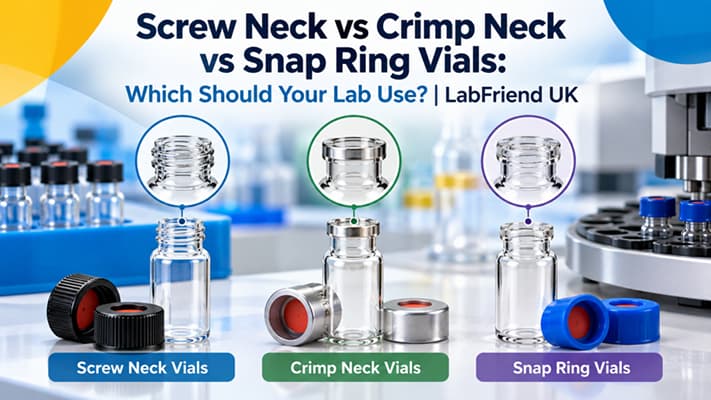
For laboratory procurement teams, screw neck, crimp neck
and snap ring are important specification fields, but they are not complete
purchasing specifications on their own. A repeat order should preserve the vial and closure system
already approved for the laboratory workflow. That may require recording the
vial format, manufacturer or product reference, dimensions, compatible cap or
closure, septum specification and any instrument-compatibility requirements
that form part of the approved configuration. |
Key Takeaways
- Closure
format is part of the purchasing specification, not the whole
specification. “Screw neck”, “crimp neck” or “snap ring” alone may not
identify the required vial system sufficiently.
- Record
the complete approved configuration. The vial, cap or closure and
septum may all need to be controlled together.
- Do
not infer compatibility from the closure name. Two products described
using the same general closure format are not necessarily interchangeable.
- Use
manufacturer and product references wherever they form part of the
approved specification. Generic descriptions create unnecessary
ambiguity during repeat purchasing.
- Treat
proposed alternatives as specification changes until their suitability has
been established. Procurement can compare documented specifications,
but technical acceptance may need to remain with the laboratory or QA
function.
- Escalate uncertainty rather than substituting by appearance or description. Availability, price or supplier convenience should not replace technical suitability.
Why Vial Closure Format Matters to Procurement
Chromatography vials are recurring consumables, which makes
them particularly vulnerable to specification drift.
An initial order may have been selected carefully by a
scientist or laboratory manager. Several repeat orders later, the purchasing
record may have been reduced to something such as:
- 2mL
screw vial;
- crimp
vial;
- clear
autosampler vial;
- snap
cap vial.
Those descriptions may be convenient, but they may not
preserve enough information to reproduce the approved vial and closure
assembly.
Closure format is only one characteristic. A procurement
record may also need to preserve the specific vial dimensions, neck
configuration, closure, septum and product reference required by the
laboratory.
This is why repeat purchasing should be based on a
controlled specification rather than a broad product description.
For wider purchasing controls covering chromatography vials
and septa, including product references and approved alternatives, see the Chromatography Vials and Septa Buying Guide for UK Laboratory Procurement Teams.
What Do Screw Neck, Crimp Neck and Snap Ring Mean for Purchasing?

At procurement level, the three terms describe different
ways in which the closure attaches to the vial.
|
Closure format |
Basic distinction |
Procurement implication |
|
Screw neck |
A compatible cap screws onto a threaded vial neck. |
Record the required vial and corresponding cap or closure
specification rather than simply ordering a generic “screw vial”. |
|
Crimp neck |
A compatible closure is mechanically crimped around the
vial neck. |
The vial and closure need to be specified as a compatible
system. Where the laboratory controls a particular crimp configuration, that
requirement should be preserved. |
|
Snap ring |
A compatible closure is pressed or snapped onto the vial
neck. |
Record the exact vial and closure configuration rather
than treating all tool-free vial systems as interchangeable. |
These distinctions are useful when identifying products, but
they do not establish whether a vial is suitable for a particular instrument or
analytical method.
That decision belongs to the approved technical
specification.
What Should Procurement Record for Repeat Orders?
A useful procurement record should allow another buyer to
reorder the same approved configuration without having to reconstruct the
technical requirement from memory.

Depending on the laboratory's controls, the record may
include the following.
1. Manufacturer or approved supplier reference
Where available, record the manufacturer name and
manufacturer catalogue or part number that form part of the approved
specification. Record an approved supplier product code as additional
purchasing traceability where relevant.
These identifiers are more reliable than relying on a
shortened product description alone, but a supplier code should not be assumed
to establish manufacturer or product identity unless that relationship is
documented.
If a manufacturer or supplier code changes, do not assume
the replacement is technically identical merely because it is presented as a
successor or alternative. Check what has actually changed.
2. Vial closure format
Record whether the approved vial is:
- screw
neck;
- crimp
neck; or
- snap
ring.
This provides an important first level of identification,
but it should not normally be the only controlled field.
3. Vial specification where relevant
If nominal volume, vial dimensions, neck or thread
specification, vial material, colour, surface treatment or a particular insert
or high-recovery design forms part of the approved configuration, preserve it
in the purchasing record.
These characteristics can affect instrument fit, sample
compatibility, sample recovery or protection of the sample, depending on the
application. Two vials with similar descriptions or nominal capacities should
not automatically be treated as interchangeable.
4. Cap or closure specification
The closure should be considered together with the vial.
Record the approved cap or closure reference where this is
required to maintain the selected assembly.
5. Septum specification
Where the septum forms part of the approved vial system,
record the approved product reference or sufficient controlled information to
identify it. Depending on the approved configuration, this may include septum
material or layer construction, thickness, and whether it is pre-slit, bonded
or otherwise supplied as a defined cap-and-septum assembly.
Procurement should not substitute a different septum simply
because the vial itself appears unchanged.
6. Instrument or autosampler requirement
If the laboratory has documented a particular
instrument-compatibility requirement, preserve it as part of the purchasing
specification or supporting record.
Closure type alone does not establish autosampler
compatibility.
For a more detailed procurement-level compatibility check,
see the Autosampler Vial Compatibility Checklist for Procurement Teams.
Why Generic Descriptions Create Reorder Risk
The problem with descriptions such as “2mL screw vial” is
not that they are necessarily incorrect. It is that they may be incomplete.

A broad description can hide differences in:
- vial
dimensions;
- neck
and closure configuration;
- cap
or septum specification;
- manufacturer
reference;
- instrument
compatibility;
- approved
laboratory use.
A purchasing description should therefore be detailed enough
to preserve the specification that the laboratory actually approved.
This is particularly important when a buyer inherits an
existing purchasing record. If the description is ambiguous, the safer approach
is to resolve the specification before the next repeat order rather than
continuing the ambiguity.
How Should Procurement Handle Proposed Alternatives?
Alternative products can be commercially useful,
particularly where availability, lead time or supplier choice is important.
The control point is to distinguish commercial comparison
from technical approval.
Procurement can compare documented information such as
product references, closure format and stated specifications. However, where a
proposed change could affect instrument compatibility, the vial assembly or an
established analytical method, technical acceptance should remain with the
appropriate laboratory or QA function.

A practical comparison record can look like this:
|
Check |
Existing approved item |
Proposed alternative |
Action |
|
Closure format |
Record approved format |
Confirm proposed format |
Investigate any difference |
|
Vial specification |
Record controlled specification |
Compare documented specification |
Escalate unresolved differences |
|
Cap / closure |
Record approved closure |
Compare the proposed closure with documented manufacturer
compatibility and the controlled vial specification |
Refer any unresolved or changed vial–closure configuration
for technical confirmation |
|
Septum |
Record approved specification |
Compare proposed specification |
Refer technical differences to laboratory |
|
Manufacturer / product reference |
Record current approved reference |
Record proposed reference |
Maintain traceable decision record |
|
Instrument requirement |
Record where controlled |
Obtain relevant compatibility information |
Technical confirmation where required |
The word alternative is preferable to equivalent
until there is an adequate basis for treating the products as equivalent for
the intended use.
Price or availability can justify investigating an
alternative. They do not establish technical suitability.
When Should Procurement Refer the Decision Back to the Laboratory?
Procurement should seek technical confirmation where the
proposed purchase differs materially from the controlled requirement or where
the available information is insufficient to establish that the same approved
configuration is being supplied.
Typical escalation points include:
- a
different closure format;
- a
changed vial or manufacturer reference;
- differences
in dimensions;
- a
different cap, closure or septum configuration;
- uncertain
autosampler compatibility;
- a
supplier-proposed substitute that has not previously been approved;
- incomplete
documentation preventing a reliable specification comparison.
This division of responsibility is useful.
Procurement owns accurate purchasing and supplier
communication. Laboratory users or QA functions retain technical authority
where compatibility, method suitability or controlled change may be affected.
Common Vial-Closure Purchasing Errors
Ordering from an abbreviated description
“Crimp vial” or “screw autosampler vial” may not contain
enough information for reliable repeat purchasing.
Control: retain the fuller approved product or system
specification.
Assuming the same closure format means the same product
Closure format is one characteristic, not proof of
interchangeability.
Control: compare the actual controlled specification.
Recording the vial but not the closure
A vial may be purchased correctly while the wrong cap or
septum is ordered separately.
Control: where the laboratory treats them as an
approved assembly, record the components together.
Treating a new supplier's recommendation as automatic
equivalence
A supplier may identify a potentially suitable alternative,
but that does not by itself establish technical equivalence.
Control: compare the documented specification and
obtain the appropriate technical approval where required.
Allowing availability to override the specification
A product that can be delivered quickly is not automatically
the correct substitute.
Control: resolve suitability before changing the
approved configuration.
A Practical Vial-Closure Procurement Checklist
Before placing or changing a repeat order, check:
- What
is the approved vial reference?
Use the controlled manufacturer or supplier reference where available. - What
closure format is required?
Confirm screw neck, crimp neck or snap ring. - Which
vial characteristics are controlled?
Preserve any controlled requirements for nominal volume, dimensions, neck or thread specification, material, colour, surface treatment, insert or other defined vial construction. - What
cap or closure is required?
Confirm the closure against the vial rather than purchasing each component independently by generic description. - What
septum specification is required?
Record the approved septum or cap-and-septum reference and any controlled construction details needed to distinguish it, such as material, layer construction, thickness or pre-slit status. - Are
there instrument or autosampler requirements?
Check the laboratory's approved compatibility information rather than inferring fit from closure type. - Is
the order an exact repeat or a proposed change?
Treat a changed product or configuration as an alternative until its suitability has been established. A change of supplier should also be treated as an alternative where it changes, or does not clearly preserve, the manufacturer, product identity or controlled specification. - Who
must approve a technical difference?
Refer compatibility or method-related differences to the appropriate laboratory or QA contact.
For broader context on how chromatography consumables fit
together across laboratory workflows, see The Complete Guide to Chromatography Consumables for UK Laboratories.
Frequently Asked Questions
What information should procurement record when ordering
chromatography vials?
Procurement should record enough information to reproduce
the laboratory's approved vial and closure configuration reliably. This may
include the manufacturer or product reference, closure format, relevant vial
dimensions, cap or closure, septum specification and any controlled
instrument-compatibility requirement.
The exact record should reflect what the laboratory has
approved rather than relying on a generic vial description.
Is screw neck, crimp neck or snap ring enough information
for a repeat order?
Closure format alone is usually not a complete
repeat-order specification. It identifies how the closure attaches to the
vial, but it does not necessarily identify the exact vial, cap, septum or
instrument-compatible configuration required by the laboratory.
Use the approved product or system specification wherever
available.
Can procurement substitute one vial closure format for
another?
Procurement should not substitute one vial closure format
for another without appropriate technical confirmation. Changing from screw
to crimp, crimp to snap ring or another configuration changes the vial and
closure system and may also affect compatibility with the laboratory's
instrument or method.
Where the technical impact is uncertain, refer the proposed
change to the appropriate laboratory or QA function.
How should procurement assess chromatography vials from a
new supplier?
First establish whether the new supplier is providing the
identical, traceable manufacturer item or a different or uncertain product.
A change of supplier alone does not necessarily create a technical product
change where the manufacturer, product identity and controlled specification
are clearly preserved.
Where the product or specification changes, compare the
proposed vial against the approved purchasing specification and obtain
appropriate technical confirmation for unresolved differences before treating
it as an approved alternative.
When should a vial substitution be referred to the
laboratory or QA team?
Refer a proposed substitution where it changes or cannot
be shown to preserve a technically controlled part of the approved vial system.
Examples include different dimensions, closure configuration, septum
specification, instrument compatibility or a product change affecting an
established method.
Procurement should not be expected to determine analytical
equivalence where that decision requires scientific or quality assessment.
Keep the Purchasing Record as Precise as the Laboratory
Requirement
Good vial procurement is not simply about ordering the right
quantity of the right general product type.
The purchasing record needs to preserve the specification
that matters to the laboratory.
For screw neck, crimp neck and snap ring vials, that means
treating closure format as one controlled field within the wider vial
system—not as a shortcut for the entire specification.
Where an approved configuration is already established,
repeat it accurately. Where an alternative is proposed, compare it against that
specification and obtain technical confirmation where required.
If you already have an approved vial specification and need
pricing or availability, request a quote for approved vial formats.
Read More
- Chromatography Vials and Septa Buying Guide for UK Laboratory Procurement Teams
- Autosampler Vial Compatibility Checklist for Procurement Teams
- The Complete Guide to Chromatography Consumables for UK Laboratories
Explore More
Written by: Donal O’Sullivan, BSc, Co-Founder and Sales Director, LabFriend UK. Donal brings deep chemistry-led technical expertise across analytical chemistry, biochemistry, environmental monitoring, laboratory instrumentation, consumables and scientific product selection.
Reviewed by: Michael Anderson, MBA, Founder and Managing Director, LabFriend UK. Michael reviews LabFriend UK content for customer relevance, commercial accuracy, operational practicality and alignment with LabFriend UK’s laboratory supply model.
Frequently asked questions
Delivery times vary by product and supplier. Each product page shows current stock levels and the expected lead time, and we confirm this when you place your order. Most items arrive within 2 to 3 weeks. Specialised items can take longer if they are not in stock. If you need something by a certain date, contact us and we’ll check for you.
Yes. Register for a commercial account and, once it’s approved, you will be able to process orders via PO Once you have a commercial account, you can directly email your purchase orders
Add products to your cart and click Get a Quote. You’ll get a formal quote instantly, ready to send to your email address. For bulk orders or custom requirements, send us your product list and we’ll reply with itemized pricing.
If your item is faulty, not as described or sent in error, let us know within 14 days of delivery and we’ll arrange a return. Change of mind returns are only accepted if the item is unused and in its original packaging. A restocking fee will apply and you pay the return freight. Read our full Returns Policy for details.
Yes, prices are shown including GST by default. Use the Prices Inc. GST toggle at the top of the page to view prices without GST.