

Share :
How to Choose Headspace Vials, Caps and Septa for GC and Volatile Sample Analysis
Updated On 08/10/2026

By Donal O’Sullivan, BSc. Reviewed by Michael Anderson, MBA.
Headspace GC and volatile sample analysis place unusual demands on vials, caps and septa. In a routine autosampler vial workflow, the vial mainly contains the liquid sample before injection. In headspace analysis, the vial may be heated, sealed, pressurised, pierced and used to contain volatile compounds in the gas phase above the sample. That makes the vial, cap and septum a method-supporting system rather than three separate purchasing items. This guide is written for analytical chemists, QA/QC scientists and laboratory procurement teams responsible for selecting headspace-compatible vials, caps and septa.
The wrong headspace vial may not fit the autosampler correctly. The wrong cap may not seal consistently. The wrong septum may be unsuitable for the temperature, pressure, solvent, sample or needle conditions. Even when each item looks similar, small differences in vial format, closure style, septum material or compatibility can affect method reliability, sample containment and repeatability.
This guide focuses specifically on headspace vial, cap and septum selection for GC, GC-MS and volatile sample analysis. For broader chromatography vial purchasing, use LabFriend UK’s Chromatography Vials & Septa and Laboratory Vials categories. For wider chromatography consumables guidance, including HPLC, UHPLC, GC, sample preparation, syringe filters and columns, read The Complete Guide to Chromatography Consumables for UK Laboratories.
LabFriend UK also supplies GC consumables, wider gas chromatography products and broader chromatography supplies for UK laboratories.
Quick answer: how should you choose headspace vials, caps and septa?
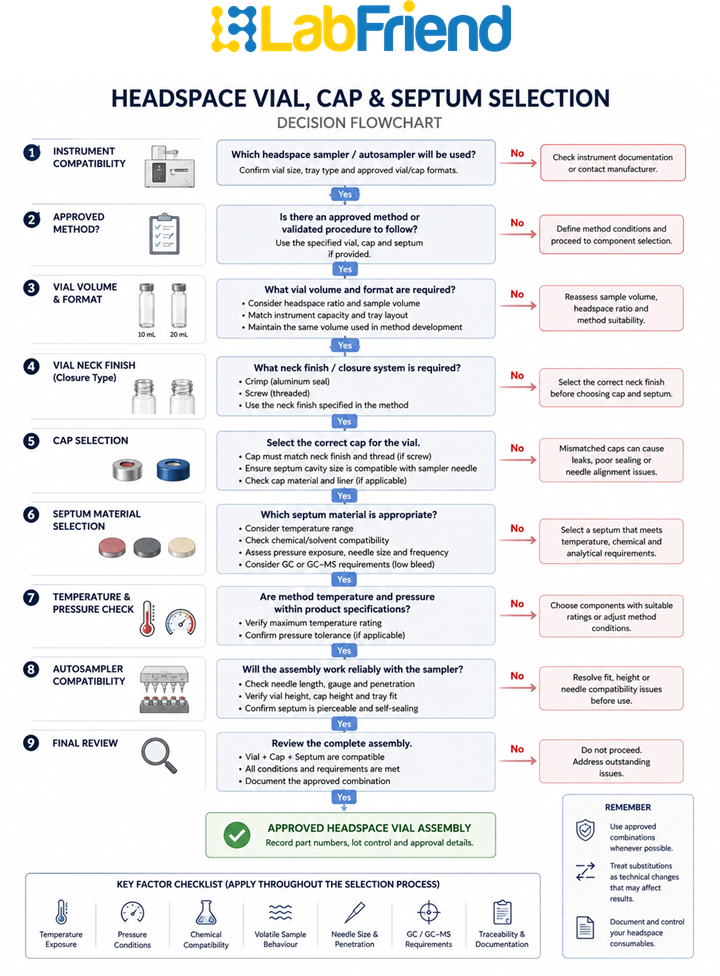
Choose headspace vials, caps and septa as a matched sample containment system. Start with the instrument and method, then confirm vial volume, vial neck finish, closure type, cap format, septum material, temperature exposure, pressure conditions, volatile sample behaviour and autosampler compatibility.
Do not choose the vial first and assume any cap or septum will work. In headspace workflows, sealing performance and compatibility are central to the method. A vial, cap and septum combination that works for one headspace method may not be suitable for another.
- Instrument and headspace sampler compatibility
- Vial volume and format
- Vial neck finish and closure type
- Cap format
- Septum material
- Temperature and pressure exposure
- Autosampler-specific handling requirements
|
Selection factor |
Why it matters |
|
Vial volume |
Affects headspace ratio, instrument compatibility and method setup |
|
Closure type |
Influences sealing approach, handling and compatibility |
|
Cap format |
Must match vial neck finish and instrument requirements |
|
Septum material |
Affects needle penetration, sealing, temperature exposure and chemical compatibility |
|
Temperature / pressure exposure |
Must be checked against product and method documentation |
|
Autosampler compatibility |
Prevents loading, handling or piercing problems |
|
Volatile sample behaviour |
Increases the importance of sealing consistency and repeatable preparation |
The safest approach is to record the approved vial, cap and septum together. Treat substitutions as technical changes where method performance, volatile sample integrity, traceability or reproducibility could be affected.
Why headspace vial selection is different from routine vial selection
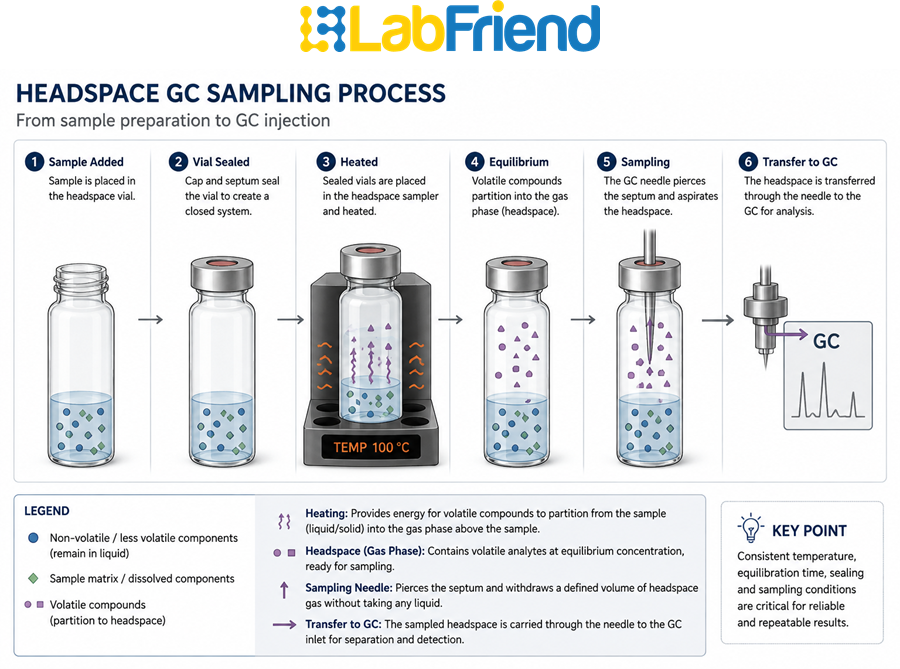
Headspace analysis changes the role of the vial. The vial is no longer only a sample container. It becomes part of the analytical environment.
During headspace GC, the sample is sealed inside the vial and heated under method-defined conditions. Volatile components partition into the gas phase, and the instrument samples the headspace above the liquid or solid sample. This means the vial must maintain containment while being exposed to temperature, pressure and needle penetration.
That is why headspace vial selection should be more controlled than routine vial purchasing. The vial must fit the autosampler. The cap must match the vial neck and closure system. The septum must tolerate the method conditions and allow suitable needle penetration. The complete assembly must support consistent sample preparation.
For a scientist, the practical risk is that a poor choice may not always fail obviously. Instead, it may appear as variability, loss of volatile analytes, contamination, poor repeatability, failed sequences or unexplained method behaviour.
Treat the vial, cap and septum as one system
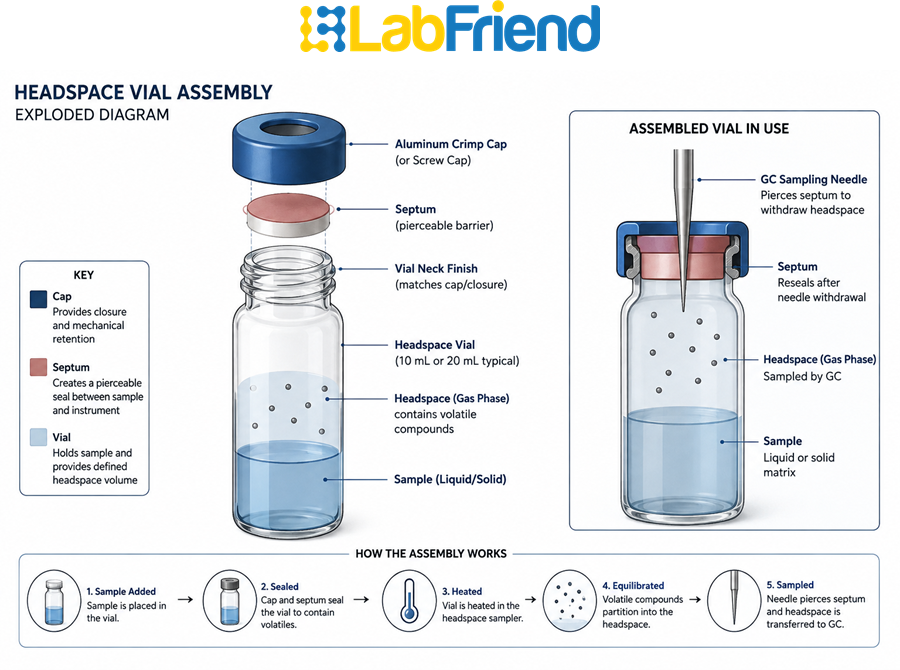
A headspace vial should not be selected in isolation from the cap and septum. The three parts work together.
The vial provides the sample container and neck finish. The cap applies the closure. The septum forms the pierceable barrier between the sample environment and the instrument needle. If any part is mismatched, the system may not perform as intended.
This matters most when laboratories switch suppliers, change pack formats or accept substitutes. Two vials may look similar, but have different neck finishes or dimensional tolerances. Two caps may appear interchangeable, but fit differently. Two septa may share a general material description but differ in thickness, lining, cleanliness, temperature suitability or intended use.
For routine purchasing, the approved specification should list the vial, cap and septum together. For method-sensitive workflows, the combination should be treated as controlled consumables.
Choosing headspace vial volume and format
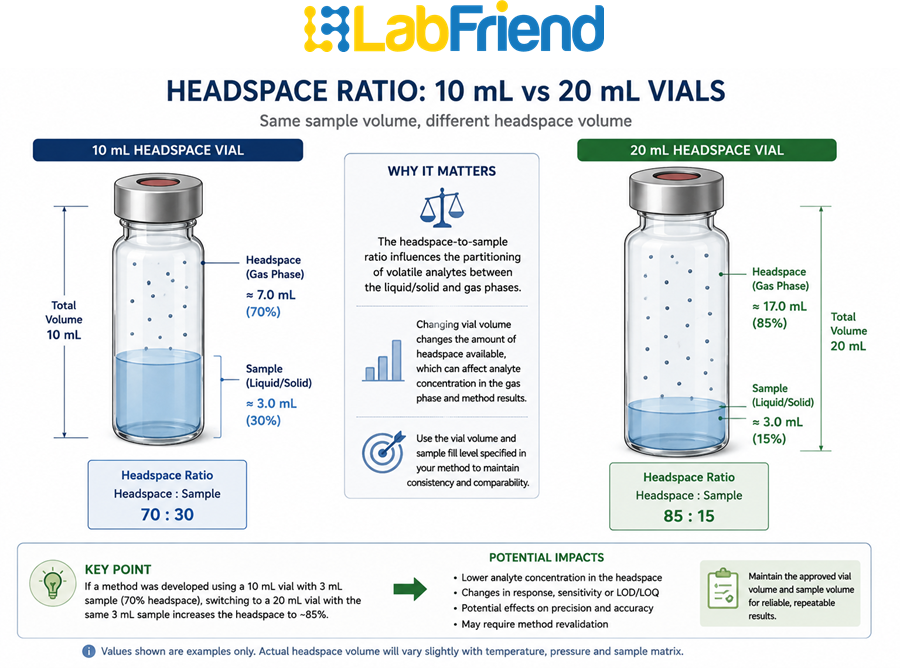
Headspace vial volume is normally method- and instrument-led. Common headspace vial formats include 10 mL and 20 mL styles, but the correct size depends on the headspace sampler, tray configuration, method conditions and sample volume. Some instruments and methods also use 6 mL or 22 mL headspace vials, so the applicable size should always be confirmed against the instrument and method rather than assumed from common formats alone.
The vial volume affects the ratio between sample volume and headspace volume, often referred to as the phase ratio. That ratio can influence the method and should not be changed casually. If a method has been developed using a specific vial volume and fill level, switching vial size may affect comparability. Where a vial volume must be changed from a validated method, the sample fill volume should be adjusted proportionally to preserve the original phase ratio.
Vial format also matters. Headspace vials are available in different neck finishes and closure styles. The correct format must match the autosampler and closure system. A vial that is chemically suitable but physically incompatible is still the wrong vial.
For repeat purchasing, record the vial volume, neck type, glass type, manufacturer reference, pack size and method association. That prevents ambiguous descriptions such as “20 mL headspace vials” from creating reorder mistakes.
Crimp vs screw headspace vials
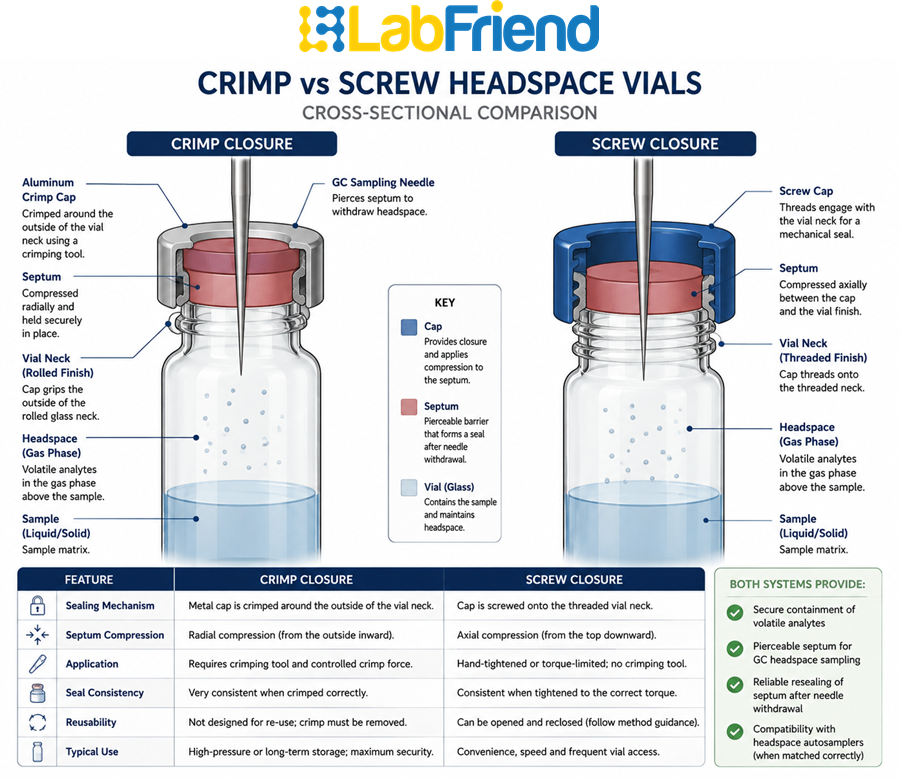
Crimp and screw headspace vials are both used in laboratory workflows, but they should not be treated as interchangeable. The right choice depends on instrument compatibility, method requirements, sealing preference and laboratory handling practice. Some modern headspace and SPME-capable autosamplers also use magnetic caps as a third closure format, alongside crimp and screw.
Crimp closures are commonly used where a mechanically crimped seal is required. They can provide consistent closure when applied correctly, but they require suitable crimping tools and correct technique. Poor crimping can create sealing inconsistency.
Screw closures can offer easier handling in some workflows and may reduce dependence on crimping tools. However, the cap and septum must still match the vial and method conditions. Screw closure convenience does not remove the need for compatibility checks.
|
Closure format |
Practical consideration |
Main caution |
|
Crimp headspace vial |
Often used where a mechanically crimped seal is part of the workflow |
Requires correct cap, crimp tool and crimping technique |
|
Screw headspace vial |
May simplify handling in some laboratory workflows |
Must still match vial, septum and instrument requirements |
|
Magnetic headspace cap |
Used with some modern headspace and SPME-capable autosamplers |
Confirm autosampler compatibility and septum fit before purchasing |
|
Other formats |
May be instrument- or method-specific |
Confirm compatibility before purchasing |
Neither format is universally better. The best choice is the one documented for the instrument, method and laboratory workflow.
Choosing the correct cap
The cap is the mechanical part of the closure system. It must match the vial neck finish, septum type and instrument requirements. A cap that does not fit correctly can compromise sealing or create handling problems.
In headspace workflows, cap consistency matters because the sample may be heated and exposed to pressure. If the closure is poorly matched, poorly crimped or unsuitable for the method, the vial assembly may not behave consistently.
The buying decision should capture the closure format, cap size, compatibility with vial type, intended septum, pack size and any instrument-specific requirements. For laboratories running repeat methods, caps should be ordered with the approved vial and septum specification rather than treated as a generic accessory.
Choosing the correct septum material
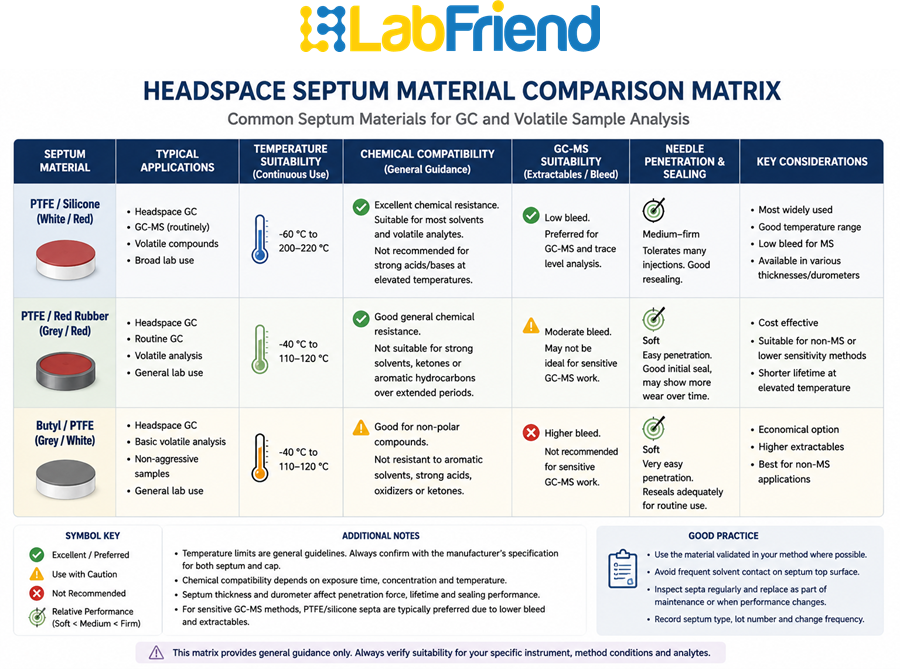
The septum is one of the most important parts of a headspace vial assembly because it is pierced by the sampling needle and helps maintain the sealed sample environment. Septum selection can affect needle penetration, resealing behaviour (how well the septum reseals after being pierced), chemical compatibility, contamination risk and performance under method conditions. Septum thickness and hardness affect the force needed for needle penetration and the rate of needle blunting or damage, in addition to their role in sealing. Needle penetration also carries a coring risk, where small fragments of septum material can be sheared off and block the sampling needle or enter the GC system as particulate contamination.
Common headspace septa may use combinations such as PTFE-lined silicone, PTFE/red rubber, butyl/PTFE or related material constructions. The right construction depends on the product range and intended application. PTFE/silicone septa are generally favoured for automated autosampler-based GC and GC-MS headspace work because of lower bleed and better high-temperature tolerance, while butyl/PTFE septa are more typically associated with manual or pharmacopoeial static headspace testing, such as residual solvent methods. The exact choice should be based on the sample, solvent, temperature exposure, instrument needle and method requirements.
A septum that suits one volatile sample workflow may not suit another. For example, chemically aggressive samples, trace-level GC-MS workflows, high-temperature conditions or sensitive analytes may require tighter review. It is also important to check whether the septum is supplied pre-assembled with the cap or purchased separately.
For technical purchasing, avoid generic descriptions such as “headspace septa” where the method needs a specific material, thickness or format. Record the exact approved septum specification.
Volatile sample handling and sealing risk
Volatile sample analysis places particular importance on sealing. If volatile components are lost before analysis, the result may be affected. If sample containment varies between vials, reproducibility may suffer.
The purpose of good vial, cap and septum selection is not simply to stop visible leaks. It is to support consistent sample containment under the conditions defined by the method. That includes preparation, storage before analysis, heating, equilibration, needle penetration and sampling.
Laboratories should pay particular attention where samples are highly volatile, low concentration, solvent-rich, odorous, reactive or contamination-sensitive. In these workflows, small closure differences may matter more than they would in routine liquid autosampler vial use.
The safest approach is to validate or confirm the vial/cap/septum combination within the method conditions rather than assuming visual similarity equals equivalence.
Temperature, pressure and instrument compatibility
Headspace workflows often involve heating and pressure exposure, but suitability must be checked against the exact product and method documentation. It is not safe to assume that a vial, cap or septum is suitable for a temperature or pressure condition because it is labelled as “headspace” in general terms. Pressure inside a sealed headspace vial builds up both from thermal expansion of the headspace gas during equilibration and, in balanced-pressure or pressure-loop headspace samplers, from active pressurisation of the vial with carrier gas before sample transfer.
Instrument compatibility should also be confirmed. The vial dimensions, closure height, cap type and septum presentation must suit the headspace sampler. Even a technically suitable vial assembly can create problems if it does not load, pierce or handle correctly in the instrument.
Where method documentation specifies a vial and closure system, that should be followed. Where a laboratory is selecting a new format, the method conditions, instrument manual and manufacturer compatibility information should guide the decision.
GC-MS, contamination and extractables considerations
In GC-MS and trace volatile workflows, background contamination can become more visible. Vials, caps and septa may contribute background if they are unsuitable for the method or if the product quality is not appropriate for sensitive analysis. Common contamination mechanisms include siloxane bleed from silicone-containing septa, plasticiser or adhesive extractables from certain cap linings, and surface adsorption on lower-quality glass. Some vials, caps and septa are also supplied with certification for low extractables or GC-MS-grade cleanliness, which is a relevant purchasing consideration for sensitive methods.
This does not mean every GC-MS method requires the same specialist vial and septum. It means the laboratory should be more careful when choosing and substituting consumables. Septum bleed, extractables (chemical residues that can migrate from a material into the sample or gas phase), handling contamination, storage and packaging may all be relevant depending on the method.
For sensitive methods, scientists should consider blanks, recovery, background response and method documentation before changing vial, cap or septum type. Procurement should not substitute headspace vial assemblies without technical review where GC-MS performance or trace-level reproducibility is important.
Building a repeat-use headspace vial specification
Once a suitable headspace vial, cap and septum combination has been selected, it should be documented for repeat purchasing. This is especially important for QA/QC laboratories, CROs and busy analytical teams where the same method is run repeatedly.
A good specification record should include:
|
Field |
What to record |
|
Application |
GC headspace, GC-MS, volatile sample analysis or method name |
|
Vial volume |
10 mL, 20 mL or method-specific volume |
|
Vial format |
Crimp, screw or instrument-specific format |
|
Glass type / colour |
Clear, amber or method-required format |
|
Cap type |
Crimp cap, screw cap or specified closure |
|
Septum material |
Exact approved material or product description |
|
Temperature / pressure notes |
Only where supported by method or product documentation |
|
Instrument compatibility |
Headspace sampler / autosampler requirement |
|
Approved alternatives |
Specific alternatives only, not generic substitutions |
|
Reorder route |
LabFriend category, quote reference, SKU or internal code |
|
Cleanliness / certification |
Certified GC-MS grade, pre-cleaned, or standard grade, where applicable. |
This record helps scientists maintain method consistency and helps procurement avoid ordering “near equivalents” that have not been reviewed.
Substitution control and purchasing mistakes
The most common purchasing mistake is treating headspace vials, caps and septa as separate commodity items. In reality, the combination matters.
A substitute vial may not match the sampler. A substitute cap may not seal the same way. A substitute septum may behave differently under heat, pressure or needle penetration. A change in any one part can affect the assembly.
Substitution may be acceptable where the method allows it and the alternative has been reviewed. It should not happen simply because the product description is similar, the size appears correct, or the alternative is cheaper.
For laboratories with regulated, client-specified, validated or trace-level methods, substitution control is especially important. The cost of a purchasing mistake may be far higher than the price difference between consumables.
Where LabFriend UK fits
LabFriend UK supports laboratories through online product search, category-led purchasing, quotation support and repeat purchasing convenience. For headspace workflows, this means scientists and purchasing teams can use LabFriend UK to source vials, caps, septa and related GC consumables while keeping repeat-use specifications clear.
Browse Chromatography Vials & Septa for vial, cap and septum options, or use Laboratory Vials for wider vial formats. For related GC workflow products, browse GC consumables and wider gas chromatography products.
For repeat-use specification support, contact LabFriend UK with the vial format, cap type, septum material, instrument and method requirements you need to match.
Common mistakes when choosing headspace vials, caps and septa
The first mistake is selecting the vial and leaving the cap and septum as an afterthought. In headspace workflows, the closure system is central to performance.
The second mistake is assuming that all 20 mL headspace vials are interchangeable. Volume alone does not confirm neck finish, closure compatibility, autosampler compatibility or method suitability.
The third mistake is switching from crimp to screw, or screw to crimp, without checking method and instrument requirements. Handling convenience should not override compatibility.
The fourth mistake is using generic septum descriptions. Septum material, lining, thickness and intended application may matter, especially for heated, volatile or GC-MS workflows.
The fifth mistake is allowing procurement substitution without technical review. This is particularly risky where the method depends on volatile sample integrity, trace analysis or documented repeatability.
Conclusion: choose headspace vial assemblies as controlled method consumables
Headspace vials, caps and septa should be selected as a complete vial assembly. The vial contains the sample, the cap provides the closure, and the septum creates the pierceable barrier that must work under the conditions of the method.
For GC, GC-MS and volatile sample analysis, the right choice depends on vial volume, closure format, cap compatibility, septum material, instrument fit, temperature exposure, pressure conditions and sample behaviour. No single vial, cap or septum combination is right for every headspace method.
The practical recommendation is to start with the method and instrument, choose the vial/cap/septum combination as a matched system, and document the approved specification for repeat purchasing. This protects analytical consistency and reduces the risk of avoidable purchasing errors.
For wider chromatography consumables guidance, read The Complete Guide to Chromatography Consumables for UK Laboratories. To source headspace-compatible vial assemblies, browse Chromatography Vials & Septa, explore Laboratory Vials, browse GC consumables, or contact LabFriend UK if you need help confirming the right vial, cap and septum combination for your instrument and method.
Frequently Asked Questions
What are headspace vials used for?
Headspace vials are used in headspace GC and GC-MS workflows where volatile components in the gas phase above a liquid or solid sample are analysed. The vial, cap and septum must work together to support sample containment and instrument compatibility.
How do I choose a headspace vial?
Choose a headspace vial by checking instrument compatibility, vial volume, closure type, method requirements, sample volatility, temperature exposure and pressure conditions. The cap and septum should be selected at the same time.
Are crimp or screw headspace vials better?
In short, choose based on your instrument and method, not personal preference. Neither is universally better. Crimp vials may be preferred where a mechanically crimped seal is part of the method, while screw vials may simplify handling in some workflows. The correct choice depends on instrument, method and compatibility requirements.
Why does septum material matter in headspace GC?
Septum material affects sealing, needle penetration, resealing behaviour, chemical compatibility and contamination risk. In heated or volatile workflows, the wrong septum may affect method consistency.
Can I use routine autosampler vials for headspace analysis?
Routine autosampler vials should not be assumed suitable for headspace analysis. Headspace workflows may involve heating, pressure and volatile sample containment, so headspace-specific vial, cap and septum compatibility should be confirmed.
Can headspace vial caps and septa be substituted?
In short, treat substitution as a controlled decision, not a routine swap. Only where the method and instrument allow it. Substituting caps or septa may affect sealing, needle penetration, contamination, volatile sample containment or repeatability.
What should be recorded for repeat headspace vial purchasing?
Record the application, vial volume, vial format, glass type, cap type, septum material, instrument compatibility, method restrictions, approved alternatives and reorder route.
Where can UK laboratories buy headspace vials, caps and septa?
LabFriend UK supplies chromatography vials, septa, laboratory vials and GC consumables through its online catalogue. Laboratories can browse the relevant categories or contact LabFriend UK for repeat-use specification support.
Are headspace vials and septa reusable?
Headspace septa are generally single-puncture, single-use consumables, and headspace vials are typically not reused between samples. This is relevant when planning repeat-purchase quantities for busy analytical workflows.
Read more from LabFriend UK
- The Complete Guide to Chromatography Consumables for UK Laboratories
- How to Choose Chromatography Vials and Septa for HPLC GC and Headspace Analysis
Browse LabFriend.co.uk
- Browse Chromatography Vials & Septa
- Browse Laboratory Vials
- Browse GC Consumables
- Browse Gas Chromatography Products
Written by: Donal O’Sullivan, BSc, Co-Founder and Sales Director, LabFriend UK. Donal brings deep chemistry-led technical expertise across analytical chemistry, biochemistry, environmental monitoring, laboratory instrumentation, consumables and scientific product selection.
Reviewed by: Michael Anderson, MBA, Founder and Managing Director, LabFriend UK. Michael reviews LabFriend UK content for customer relevance, commercial accuracy, operational practicality and alignment with LabFriend UK’s laboratory supply model.
Related Stories

HPLC Column Purchasing Checklist for QA-QC and Procurement Teams
HPLC Column Purchasing Checklist for QA/QC and Procurement Teams

How to Choose an HPLC Column - Particle Size, Column Dimensions and Guard Columns
How to Choose an HPLC Column - Particle Size, Column Dimensions and Guard Columns

Autosampler Vial Compatibility Checklist for Procurement Teams
Autosampler Vial Compatibility Checklist for Procurement Teams

Autosampler Vial Compatibility: How to Avoid Incorrect Vial, Cap and Insert Selection
Autosampler Vial Compatibility: How to Avoid Incorrect Vial, Cap and Insert Selection