

Share :
How to Choose Chromatography Vials and Septa for HPLC GC and Headspace Analysis
Updated On 07/17/2026

By Donal O’Sullivan, BSc. Reviewed by Michael Anderson, MBA.
Choosing the correct chromatography vial and septum is not simply a matter of selecting a 2 mL vial from a catalogue. The correct choice depends on the chromatography technique, autosampler compatibility, closure type, sample chemistry, volatility, analyte sensitivity, injection method and repeat-order requirements.
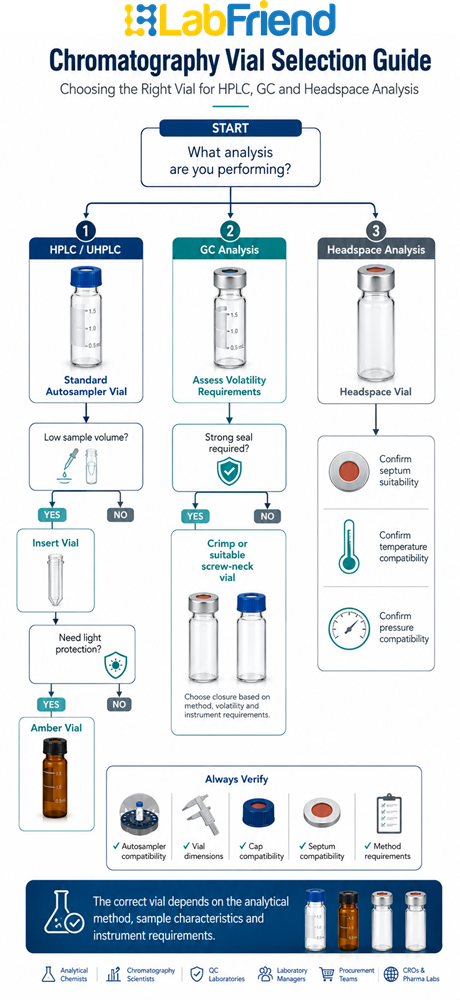
For most HPLC, UHPLC, GC and headspace workflows, laboratories should select vials and septa by working through five questions:
- Which instrument or autosampler will use the vial?
- What vial volume, dimensions and neck type are required?
- Does the sample need clear glass, amber glass, plastic, an insert or a low-adsorption format?
- Which cap and septum combination is compatible with the sample and injection method?
- Can the exact specification be reordered consistently?
This guide is part of LabFriend UK’s wider chromatography consumables guide for UK laboratories, which covers vials, septa, syringe filters, HPLC columns, GC consumables, SPE products and TLC workflows.
Quick answer: how should you choose chromatography vials and septa?
Choose chromatography vials and septa by matching the vial system to the method, not by volume alone. Check autosampler compatibility, vial dimensions, neck type, glass or plastic material, insert requirement, cap format, septum material, solvent compatibility, sample volatility and any trace-analysis or LC-MS sensitivity requirements.
For routine HPLC or GC analysis, many laboratories standardise around a small number of approved vial and septa formats. For headspace GC, volatile samples, LC-MS workflows, trace analysis or validated methods, substitutions should be reviewed carefully before use.
LabFriend UK supplies chromatography vials and septa and broader laboratory vials for routine and specialist laboratory workflows.
Why vial and septa selection matters
Chromatography vials and septa sit directly between the prepared sample and the analytical instrument. A poorly selected vial or septum can affect sample integrity before the chromatographic separation even begins.
Incorrect selection may contribute to:
- poor autosampler fit
- sample evaporation
- vial leakage
- septum coring
- extractables or leachables
- analyte adsorption
- carryover
- contamination
- poor injection reproducibility
- failed or repeated runs
- incorrect reorders
- method inconsistency
For UK CROs, independent testing laboratories, QA/QC teams and SME biotech companies, these issues can create more than scientific inconvenience. They can delay reporting, interrupt client work, increase reanalysis costs and create urgent procurement work.
A good vial and septa choice should support three outcomes:
|
Outcome |
What it means in practice |
|
Method suitability |
The vial, cap and septum match the instrument, sample and technique |
|
Analytical consistency |
The consumable does not introduce avoidable contamination, leakage or variability |
|
Repeat purchasing |
The specification can be recorded and reordered accurately |
For laboratories using chromatography every week, vials and septa should be treated as repeat-order consumables rather than one-off purchases.
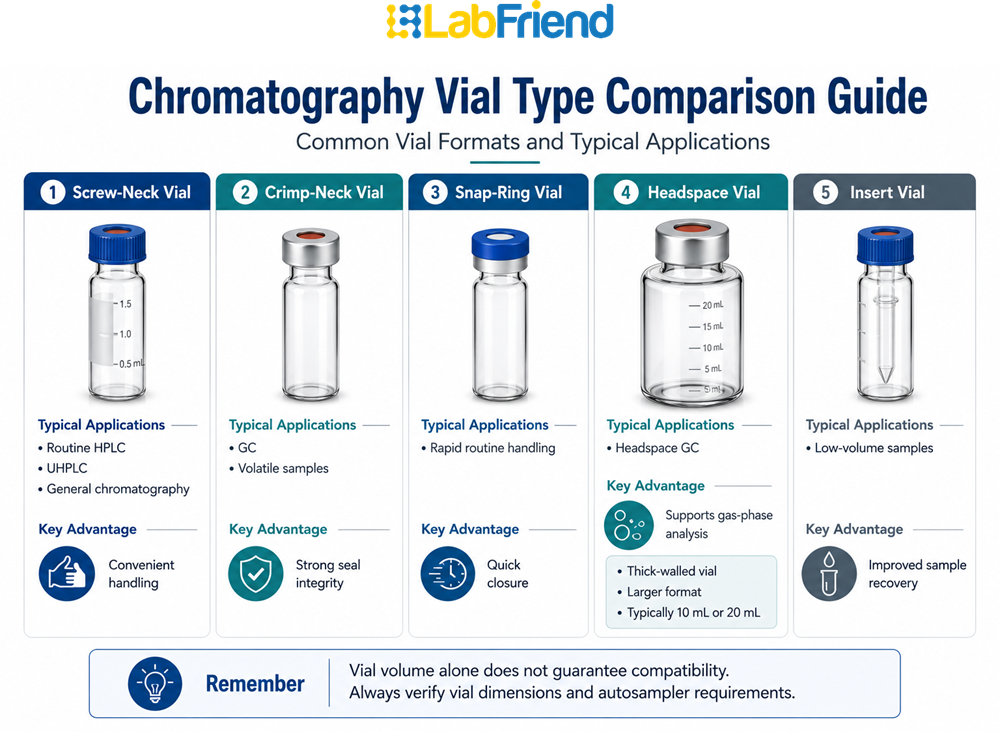
The main chromatography vial types
Chromatography vials are usually selected by technique, closure type and autosampler compatibility.
|
Vial type |
Common use |
Typical buying consideration |
|
Screw neck vials |
Routine HPLC, UHPLC and GC workflows |
Convenient closure, easy handling, cap compatibility |
|
Crimp neck vials |
GC, HPLC and workflows needing secure closure |
Requires crimping tools; strong seal consistency when correctly applied |
|
Snap ring vials |
Fast handling workflows where compatible |
Quick closure, but compatibility must be confirmed |
|
Headspace vials |
Headspace GC and volatile sample workflows |
Pressure, temperature and closure suitability must be checked |
|
Micro-insert vials |
Low-volume or limited sample workflows |
Insert fit, residual volume and autosampler needle depth matter |
|
Amber vials |
Light-sensitive samples |
Reduces light exposure but does not guarantee suitability for every analyte |
|
Plastic vials |
Certain storage or sample handling workflows |
Material compatibility and analyte adsorption must be reviewed |
Vial dimensions should also be confirmed against autosampler requirements. Nominal vial volume alone does not guarantee compatibility, as height, diameter and neck specification may differ between vial formats.
The Vials & Septa category should be the main commercial destination for buyers comparing chromatography vial formats. For broader vial purchasing outside chromatography-specific workflows, the Laboratory Vials category is also relevant.
|
Vial Type |
Typical Applications |
Key Advantage |
|
Screw Neck |
Routine HPLC/UHPLC |
Convenient handling |
|
Crimp Neck |
Volatile samples, GC |
Strong seal integrity |
|
Snap Ring |
Fast routine handling |
Quick closure |
|
Headspace Vial |
Headspace GC |
Supports gas-phase analysis |
|
Insert Vial |
Low-volume samples |
Improved sample recovery |
Step 1: Confirm autosampler compatibility
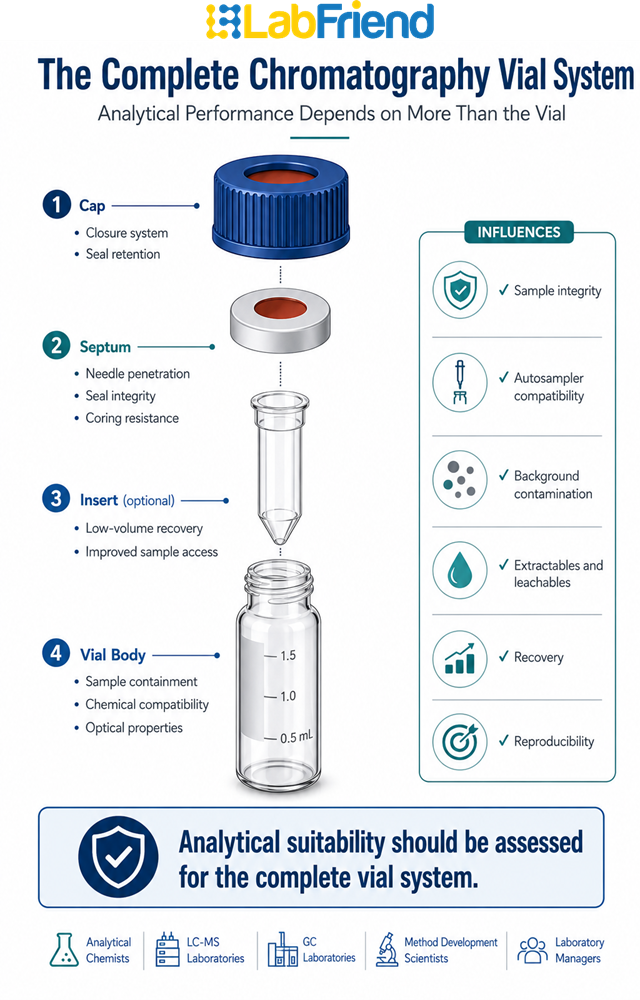
Autosampler compatibility should be checked before any other selection factor. A vial that looks correct may still be unsuitable if its dimensions, bottom profile, cap height or insert arrangement do not match the instrument.
Check:
- vial diameter
- vial height
- nominal volume
- neck finish
- closure system
- cap height after closure
- insert compatibility
- bottom profile
- tray compatibility
- needle depth
- manufacturer or instrument guidance
For procurement teams, “2 mL chromatography vial” is not enough information. A reorder record should include vial type, neck size, closure type, pack size, manufacturer code and any approved alternative.
Many routine autosampler vials are described as 2 mL vials, although actual usable volume may vary by manufacturer and vial geometry.
Practical point for UK laboratories
If a laboratory uses several HPLC, GC or LC-MS systems, do not assume a single vial format is compatible with every autosampler. Standardisation is useful, but only when the selected vial format is technically compatible with the instruments and methods in use.
Step 2: Choose the correct vial closure format
The three common vial closure systems are screw neck, crimp neck and snap ring.
|
Closure type |
Best suited to |
Main advantage |
Watch point |
Closure integrity requirement |
|
Screw neck |
Routine HPLC, UHPLC and GC workflows |
Easy to open, close and reorder |
Cap and septum must match the vial thread |
Reliable with correctly matched cap and septum |
|
Crimp neck |
Secure-seal workflows and some GC/headspace applications |
Strong closure integrity when correctly crimped |
Requires correct crimper and technique |
High when correctly crimped |
|
Snap ring |
Fast handling where compatible |
Quick closure |
Not suitable for every autosampler or sealing requirement |
Confirm for volatile, GC or headspace methods |
Closure integrity requirement is particularly relevant for volatile samples, GC and headspace workflows.
Screw neck vials
Screw neck vials are widely used because they are easy to handle and reseal. They are often practical for routine HPLC and GC workflows where convenience and repeat ordering matter.
Choose screw neck vials when:
- the autosampler is compatible
- ease of handling is important
- users need to open and close vials without tools
- the method does not require a crimped closure
- procurement needs simple repeat ordering
Crimp neck vials
Crimp neck vials use an aluminium crimp cap to form the closure. They can be useful where secure closure is important, provided the correct cap, septum and crimping method are used.
LabFriend UK carries validated live product examples such as LLG-Crimp Neck Vials, Economy Line ND11, Wide Opening, 1.5 mL Clear Glass, Pack of 1000, which the product page identifies as clear glass ND11 crimp neck vials in a bulk pack format.
Choose crimp neck vials when:
- the method or instrument requires them
- closure integrity is important
- the lab can crimp consistently
- users have the correct crimping tools
- the vial, cap and septum specification is clearly recorded
Snap ring vials
Snap ring vials are designed for quick cap application. They can be useful where speed of handling matters, but should only be selected where autosampler and closure compatibility are confirmed.
Choose snap ring vials when:
- the autosampler accepts the format
- rapid closure is useful
- the sample does not require a more specific closure system
- the closure method is accepted by the workflow
Step 3: Select the vial material
Most chromatography vial selection starts with glass, but glass type, surface behaviour and plastic alternatives can all matter.
Clear glass vials
Clear glass vials are common in routine chromatography because users can see the sample, check fill levels and inspect for particulates or visible issues.
They are often suitable for:
- routine HPLC
- routine GC
- general analytical sample preparation
- visual inspection workflows
- non-light-sensitive samples
Always check the manufacturer specification where the sample is chemically aggressive, trace-sensitive or method-controlled.
Amber glass vials
Amber vials reduce light exposure and are commonly selected for light-sensitive samples. They are useful where photodegradation or light exposure could affect the sample.
Amber glass can reduce exposure to UV and visible light but does not eliminate all degradation pathways.
Use amber vials where:
- the analyte is light-sensitive
- the method specifies amber glass
- reduced light exposure is required during storage or handling
- the laboratory wants to standardise light-sensitive sample handling
Amber glass does not automatically make a vial suitable for every light-sensitive sample. Suitability still depends on the sample, closure, storage time, storage conditions and method requirements.
Plastic chromatography vials
Plastic vials may be used in some workflows where breakage risk, handling or material requirements differ from glass. However, plastic selection should be method-specific.
Before using plastic vials, check:
- solvent compatibility
- sample compatibility
- analyte adsorption
- extractables and leachables risk
- storage duration
- temperature conditions
- autosampler compatibility
For trace analysis or LC-MS workflows, plastic vials should be reviewed carefully because background contamination, adsorption or extractables may affect results.
Low-adsorption or specialised vial surfaces
Some workflows may require low-adsorption, deactivated or certified low-background vial formats. These may be relevant where analyte recovery, trace-level detection or background signal control is critical.
In highly sensitive LC-MS methods, vial, insert and septum extractables may contribute background signals, ion suppression effects or interference with low-level analyte detection.
Low-adsorption vial technologies may be beneficial where analyte recovery is affected by interaction with glass surfaces, particularly for proteins, peptides, some pharmaceuticals and trace-level analytes.
Consider specialised vial formats where:
- sample volume is limited
- analyte loss is unacceptable
- LC-MS background is a concern
- trace analysis is being performed
- the method has contamination sensitivity
- analyte adsorption has been observed
Do not assume a specialised vial is automatically better for every routine workflow. It should be selected where the method or sample justifies the specification.
For wider context on glassware material and analytical use, see LabFriend UK’s Scientist’s Guide to Laboratory Glassware, which notes that chromatography vials support sample integrity in analytical testing.
Extractables, Leachables and Background Contamination
Modern analytical methods are increasingly sensitive to contamination arising from consumables. Vials, inserts, caps and septa may contribute extractable compounds, background signals or analyte interactions that affect trace-level measurements. Where analytical sensitivity is critical, laboratories should evaluate low-background consumables and avoid unvalidated substitutions.
Step 4: Decide whether you need an insert
Vial inserts are used when the sample volume is too low for reliable injection from a standard vial. They reduce the effective internal volume and help position the sample for autosampler access.
Insert selection should consider insert geometry, sample recovery requirements, autosampler needle position and compatibility with the parent vial.
Common insert types include:
- conical inserts
- flat-bottom inserts
- fixed inserts
- removable inserts
- low-volume inserts
Use inserts when:
- sample volume is limited
- analyte is expensive
- injection volume is small
- sample recovery matters
- the autosampler needle needs a smaller sample pool
Check carefully:
- insert dimensions
- vial compatibility
- needle depth
- residual volume
- insert material
- risk of insert movement
- whether the insert affects sample recovery
For procurement, the insert should be recorded as part of the full vial system. Do not reorder the vial alone if the workflow depends on a specific insert.
Step 5: Choose the correct septum material
The septum is the sample-facing barrier between the vial contents and the external environment. It must support needle penetration while maintaining suitable sealing performance for the application.
Common septa selection factors include:
- solvent compatibility
- sample volatility
- number of injections
- resealing behaviour
- temperature exposure
- needle type
- coring resistance
- extractables and leachables risk
- coring risk
- sample contamination sensitivity
Poor septum selection may increase the risk of coring, where fragments of septum material are removed during needle penetration.
|
Septum type / facing |
Typical selection logic |
Watch point |
|
PTFE-faced septa |
Chemical resistance on the sample-facing side |
Backing material also matters |
|
Silicone/PTFE septa |
Common in many chromatography workflows |
Check temperature and solvent suitability |
|
Rubber/PTFE septa |
Often used where resealing is important |
Check extractables and method suitability |
|
Butyl/PTFE septa |
May be used in selected gas or headspace workflows |
Must match method and closure requirements |
|
PTFE-only septa |
Useful where chemical resistance matters |
May not reseal like backed septa |
LabFriend UK carries product examples such as LLG Labware Septa N8 PTFE Virgin White, where the product page identifies PTFE septa designed for ND8 crimp caps.
Septum coring
Septum coring occurs when the needle removes small fragments from the septum during penetration. This can introduce particles into the vial or injection pathway.
Coring risk may be influenced by:
- septum material
- septum thickness
- needle type
- needle sharpness
- injection frequency
- cap alignment
- closure quality
If coring is observed, review the septum material, needle type, cap fit and injection method before reordering the same product.
Step 6: Match the vial and septum to the technique
HPLC and UHPLC
For HPLC and UHPLC, vial and septum selection should support clean injection, low contamination risk and autosampler compatibility.
Prioritise:
- correct vial dimensions
- suitable cap and septum
- low background where needed
- compatible inserts for low-volume samples
- clear or amber glass as required
- repeatable closure
- low particle and contamination risk
For UHPLC and sensitive detection workflows, the vial system should be reviewed alongside sample preparation, filtration and column protection. LabFriend’s Ultimate Syringe Filter Guide explains how pore size, membrane material and filter diameter affect HPLC/UHPLC sample preparation and column protection.
GC
For GC, vials and septa must support reliable sample containment, injection reproducibility and compatibility with the autosampler and method.
Prioritise:
- septum compatibility
- solvent and sample volatility
- cap closure integrity
- autosampler compatibility
- needle penetration behaviour
- contamination control
- repeatable purchasing
For headspace GC, the closure system becomes even more important because the vial may be heated and the sample is volatile. Always check manufacturer and instrument guidance for vial, cap and septum suitability.
Headspace septa must be suitable for the temperatures, pressures and repeated puncture requirements associated with the analytical method.
LC-MS and trace analysis
LC-MS and trace-level workflows may be more sensitive to background signals, adsorption and extractables.
For trace-analysis and LC-MS workflows, contamination-control considerations may extend beyond the vial to include caps, septa, inserts and sample preparation consumables.
Prioritise:
- low-background vial options where appropriate
- septa with suitable extractables profile
- low-adsorption surfaces if required
- clean handling and storage
- method verification before substitution
- avoiding casual product changes
For broader filtration and sample preparation considerations, LabFriend’s Ultimate Guide to Laboratory Filtration for UK Laboratories covers membrane chemistry, pore size, sample integrity and instrument protection in analytical workflows.
Headspace analysis
Headspace vials are typically available in larger formats such as 10 mL and 20 mL and are designed to accommodate both sample volume and the gas phase required for headspace analysis.
For headspace analysis, check:
- vial volume
- cap and septum compatibility
- closure integrity
- headspace method requirements
- sample volatility
- heating conditions
- pressure-related manufacturer guidance
- instrument compatibility
Do not substitute headspace vials, caps or septa based only on size. The complete system matters.
Analytical suitability should be assessed for the complete vial system, including the vial body, cap, septum and any insert used.
Quick selection table: which vial and septum should you choose?
|
Workflow |
Vial consideration |
Septum consideration |
Do not overlook |
|
Routine HPLC |
Autosampler-compatible clear or amber vial |
Suitable PTFE-faced septum |
Insert need and reorder code |
|
UHPLC |
Clean vial with low contamination risk |
Low-background where required |
Sample prep and filtration |
|
GC |
Compatible GC vial format |
Septum compatible with injection method |
Needle penetration and volatility |
|
Headspace GC |
Headspace-rated vial format where specified |
Closure and septum suited to headspace method |
Manufacturer/instrument requirements |
|
LC-MS |
Low-background or low-adsorption vial where justified |
Low extractables where needed |
Verify during method development |
|
Light-sensitive samples |
Amber vial |
Compatible closure system |
Amber is not universal protection |
|
Low-volume samples |
Insert vial or micro-insert |
Closure that preserves sample |
Needle depth and residual volume |
|
Routine repeat use |
Standardised approved vial |
Standardised approved septum |
Product code, pack size and approved alternatives |
Procurement and repeat-order considerations
For scientists, the vial and septum must work technically. For lab managers and procurement teams, the specification must also be easy to buy again.
A repeat-ready chromatography vial record should include:
|
Specification |
Why it matters |
|
Vial volume |
Avoids incorrect size selection |
|
Vial dimensions |
Supports autosampler compatibility |
|
Neck type |
Determines cap compatibility |
|
Closure type |
Screw, crimp or snap ring |
|
Material |
Clear glass, amber glass, plastic or specialised surface |
|
Insert type |
Needed for low-volume workflows |
|
Cap type |
Must match vial and method |
|
Septum material |
Affects sealing, injection and compatibility |
|
Pack size |
Supports stock planning and cost control |
|
Manufacturer code |
Reduces reorder ambiguity |
|
LabFriend SKU or URL |
Supports repeat purchasing |
|
Approved alternative |
Helps manage stock or supplier changes |
|
Technical restrictions |
Protects validated or sensitive methods |
For routine use, this information should be stored in an approved consumables list. This helps reduce incorrect substitutions, urgent purchasing and fragmented supplier use.
For validated, regulated or accredited methods, changes to vial, cap or septum specifications may require technical assessment, equivalence review or formal change control.
LabFriend UK’s About page confirms the business supports laboratories with quotation support, account-based purchasing, repeat ordering and product selection support. Buyers can also use the Contact Us page where a structured enquiry form is available.
Where LLG Labware fits
LLG Labware can be relevant where UK laboratories need value-conscious, dependable options for routine workflows. LabFriend’s About page describes LLG Labware as a dependable, cost-effective laboratory product range designed for routine laboratory workflows.
Consider LLG Labware vial or septa options where:
- the product is used routinely
- the workflow is not locked to a specific validated consumable
- vial, cap and septum specifications can be matched clearly
- repeat availability matters
- procurement wants to reduce unnecessary over-specification
- the technical user has approved the option
Do not substitute blindly. Avoid uncontrolled changes where the method is validated, client-specified, contamination-sensitive, trace-level, LC-MS-sensitive or documentation-dependent.
For broader value-alternative sourcing, review the LLG Labware range at LabFriend UK.
Common mistakes when choosing chromatography vials and septa
Mistake 1: Choosing by volume only
A 2 mL vial is not automatically interchangeable with another 2 mL vial. Neck type, height, diameter, bottom profile, cap system and autosampler compatibility all matter.
Mistake 2: Treating the vial and septum as separate decisions
The vial, cap and septum work as a system. A suitable vial with the wrong septum can still cause evaporation, contamination, coring or poor injection performance.
Mistake 3: Ignoring autosampler compatibility
Instrument compatibility should be confirmed before purchase. Do not rely on visual similarity.
Mistake 4: Assuming amber vials solve every light-sensitivity issue
Amber glass reduces light exposure, but it does not automatically validate suitability for every light-sensitive analyte or method.
Mistake 5: Substituting septa without review
Visually similar septa can differ in material, thickness, resealing behaviour, extractables and temperature suitability.
Mistake 6: Not recording the exact reorder specification
Recurring vial and septa purchases should be recorded by product code, format, material, closure, septum and pack size. Reordering from memory increases risk.
Mistake 7: Over-specifying routine workflows
Not every routine workflow requires specialised low-background or low-adsorption vials. Select the specification the workflow needs, not the highest-cost option by default.
When should substitutions require technical approval?
Substitutions should be reviewed carefully where a vial or septum could affect analytical performance, sample integrity or documentation requirements.
Technical approval is particularly important for:
- validated methods
- pharmaceutical QA/QC
- client-specified CRO workflows
- LC-MS or trace analysis
- headspace GC
- contamination-sensitive work
- regulated or audited workflows
- methods with known adsorption or recovery issues
- workflows requiring specific documentation
Even if two vials appear similar, they may differ in glass type, closure geometry, septum material, surface behaviour, pack format or compatibility with the autosampler.
Final recommendation
For most UK laboratories, the best chromatography vial and septum combination is the one that matches the instrument, sample, method and purchasing process.
Start with autosampler compatibility. Then confirm vial type, material, closure, septum, insert requirement and any special method considerations such as volatility, light sensitivity, LC-MS background or trace-level contamination risk.
For recurring HPLC, GC, LC-MS or headspace workflows, record the exact vial, cap and septum specification so it can be reordered consistently. This helps scientists protect analytical performance while helping lab managers and procurement teams reduce stockouts, incorrect substitutions and unnecessary purchasing complexity.
Browse chromatography vials and septa at LabFriend UK, explore broader laboratory vials, or contact LabFriend UK for help with repeat-use chromatography vial and septa requirements.
Frequently Asked Questions
How do I choose chromatography vials?
Choose chromatography vials by checking autosampler compatibility, vial dimensions, volume, neck type, material, cap system, septum material, insert requirement and sample sensitivity. Do not select by vial volume alone.
Are screw neck, crimp neck and snap ring vials interchangeable?
Not necessarily. Screw neck, crimp neck and snap ring vials use different closure systems and may not be compatible with the same autosampler, cap system or method requirement.
What is the difference between HPLC vials and GC vials?
HPLC and GC vials may look similar, but selection depends on autosampler compatibility, closure type, septum material, sample volatility, injection method and application. Always check instrument and method requirements before substituting.
When should I use amber chromatography vials?
Amber chromatography vials are used where reduced light exposure is needed for light-sensitive samples. They should still be checked against the sample, storage conditions and method requirements.
What septum material should I choose?
Septum choice depends on solvent compatibility, injection method, resealing needs, volatility, temperature exposure and contamination sensitivity. PTFE-faced septa are commonly used because PTFE provides chemical resistance on the sample-facing side, but the full septum construction still matters.
What is septum coring?
Septum coring occurs when the needle removes small pieces of septum material during injection. This can introduce particles into the vial or injection pathway and may affect the method.
When should I use vial inserts?
Use vial inserts where sample volume is limited, analyte is expensive, residual volume matters or the autosampler needs a smaller sample pool for reliable injection.
Can I substitute chromatography vials for a lower-cost alternative?
Sometimes, but not blindly. Substitution may be suitable for routine workflows where the specification can be matched and the technical user approves the change. Avoid uncontrolled substitution in validated, client-specified, LC-MS, headspace or trace-analysis workflows.
What should procurement record when buying chromatography vials and septa?
Procurement should record the vial volume, dimensions, neck type, closure type, material, cap, septum material, insert requirement, pack size, manufacturer code, LabFriend SKU or URL, approved alternatives and any method restrictions.
How can laboratories reduce vial and septa stockouts?
Laboratories can reduce stockouts by standardising approved vial and septa formats, recording monthly usage, setting reorder points, keeping approved alternatives and requesting quotes for repeat-use products before stock becomes critical.
Are all 2 mL chromatography vials interchangeable?
No. Vials with the same nominal volume may differ in height, diameter, neck design, glass specification and autosampler compatibility. Always confirm compatibility with the instrument and method requirements before substitution.
Does LC-MS require special vials?
Not always, but highly sensitive LC-MS workflows may benefit from low-adsorption or low-background vials, inserts and septa where sample recovery, contamination control or trace-level detection are important. Selection should be based on method requirements rather than marketing claims.
Written by: Donal O’Sullivan, BSc, Co-Founder and Sales Director, LabFriend UK. Donal brings deep chemistry-led technical expertise across analytical chemistry, biochemistry, environmental monitoring, laboratory instrumentation, consumables and scientific product selection.
Reviewed by: Michael Anderson, MBA, Founder and Managing Director, LabFriend UK. Michael reviews LabFriend UK content for customer relevance, commercial accuracy, operational practicality and alignment with LabFriend UK’s laboratory supply model.
Read more relevant consumables guides
- The Complete Guide to Chromatography Consumables for UK Laboratories
- The Ultimate Syringe Filter Guide: Pore Size, Membranes and Applications
- The Ultimate Guide to Laboratory Filtration for UK Laboratories
- The Scientist’s Guide to Laboratory Glassware: Material, Precision and Selection
Related Stories

Chromatography Vials and Septa Buying Guide for UK Laboratory Procurement Teams
Chromatography Vials and Septa Buying Guide for UK Laboratory Procurement Teams

How to Reduce LC-MS Contamination Risk from Vials, Filters, Septa and Solvent Handling Consumables
How to Reduce LC-MS Contamination Risk from Vials, Filters, Septa and Solvent Handling Consumables

The Complete Guide to Chromatography Consumables for UK Laboratories
The Complete Guide to Chromatography Consumables for UK Laboratories

HPLC Sample Preparation Consumables - Filters Vials Syringes and Solvent Handling
HPLC Sample Preparation Consumables - Filters Vials Syringes and Solvent Handling