

Share :
How UK Laboratories Can Standardise Routine Filtration Consumables Without Overpaying
Updated On 07/17/2026

By Donal O’Sullivan, BSc. Reviewed by Michael Anderson, MBA.
Executive Summary
Every laboratory aims to produce accurate, reproducible analytical data while operating within increasingly demanding financial constraints. Procurement teams are under pressure to control expenditure, laboratory managers are expected to improve operational efficiency and scientists require dependable consumables that support validated analytical methods. This article is written for all three audiences: procurement teams, laboratory managers and scientists working together to reach the same outcome. At first glance, these objectives can appear to compete with one another.
In practice, they are closely aligned.
One of the most effective ways to reduce the overall cost of laboratory filtration is not by purchasing the cheapest syringe filters or negotiating marginally lower unit prices. Sustainable savings are more often achieved by reducing unnecessary complexity within the laboratory's filtration portfolio. Standardising validated membrane platforms, rationalising duplicate products and aligning procurement decisions with scientific requirements frequently deliver greater operational benefits than focusing on catalogue price alone.
Many laboratories gradually accumulate a surprisingly large range of filtration consumables. Different departments purchase products independently, new analytical methods introduce additional membrane types and individual scientists naturally develop preferences based on previous experience. Over time, a laboratory that initially required only a handful of filtration products may find itself managing dozens of similar stock items, often performing overlapping functions.
This growth rarely happens because of poor management. It is usually the result of organic laboratory development.
The consequence, however, is increased procurement complexity, duplicated inventory, inconsistent analytical practice and reduced purchasing efficiency.
This article explains how laboratories can review their existing filtration portfolio, identify opportunities for evidence-based standardisation and develop procurement strategies that reduce operational cost while protecting scientific quality. The emphasis throughout is not on reducing choice for its own sake, but on ensuring that every filtration consumable retained within the laboratory serves a clearly defined analytical purpose.
For readers seeking a broader understanding of filtration principles before considering procurement strategy, our cornerstone resource provides an excellent starting point:
The Ultimate Guide to Laboratory Filtration for UK Laboratories
Why Filtration Procurement Becomes More Complex Than Necessary
Very few laboratories deliberately design an inefficient procurement system.
Instead, complexity usually develops gradually through a series of entirely reasonable decisions.
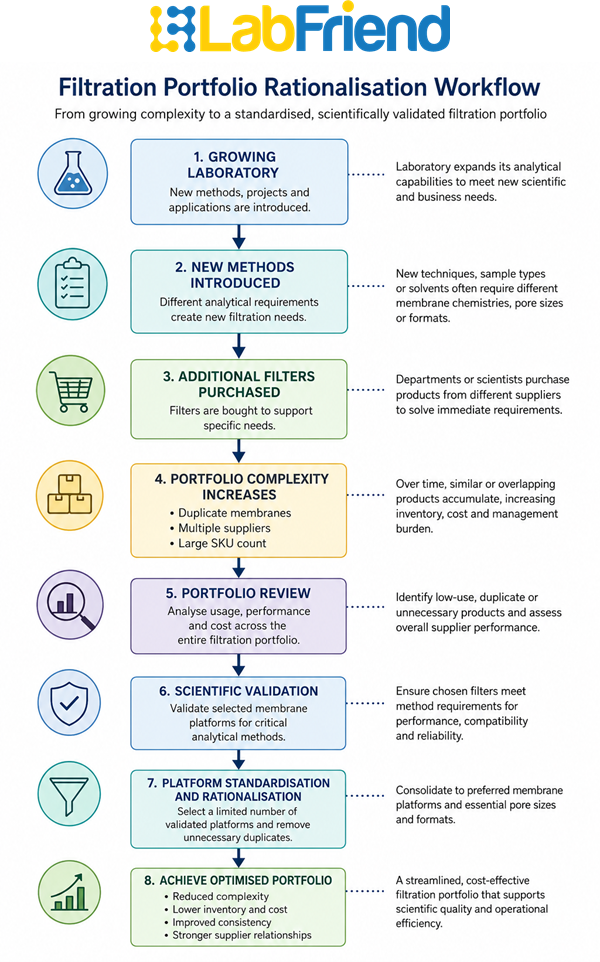
A new chromatography method requires a different membrane material. A research project introduces an unfamiliar solvent system. An individual department identifies a supplier that offers a product particularly well suited to one application. Another laboratory within the organisation recommends an alternative syringe filter that has worked successfully elsewhere.
Each decision is justified in isolation.
Collectively, however, they often produce a filtration portfolio that becomes increasingly difficult to manage.
Over several years, laboratories may discover that they are stocking multiple membrane chemistries, several pore sizes, duplicate filter diameters and products from numerous manufacturers that fulfil almost identical technical roles.
From a scientific perspective this may appear harmless.
From an operational perspective it introduces unnecessary complexity.
Procurement teams must manage additional suppliers, warehouse staff maintain larger inventories and scientists face an expanding range of consumables that may appear interchangeable despite subtle technical differences.
Perhaps most significantly, opportunities to standardise validated working practices become progressively more difficult to identify.
Procurement Complexity Often Reflects Scientific Success
It is important to recognise that procurement complexity is not necessarily a sign of poor laboratory management.
Growing laboratories naturally diversify.
An environmental testing laboratory may expand into pharmaceutical analysis. A university research department may acquire new analytical instrumentation that supports increasingly sophisticated projects. A contract laboratory may begin serving additional industrial sectors, each bringing unique sample preparation requirements.
Every expansion introduces legitimate technical reasons for acquiring new filtration consumables.
The challenge arises when those products remain within the laboratory long after the original need has diminished or when similar products are added without reviewing whether an existing validated alternative could satisfy the same requirement.
The result is often a filtration portfolio that reflects years of historical purchasing decisions rather than the current analytical needs of the laboratory.
Recognising this distinction is important.
The objective of standardisation is not to remove scientifically justified products. It is to identify unnecessary duplication while preserving the flexibility required for specialist applications.
The Difference Between Variety and Unnecessary Duplication
Experienced laboratory managers understand that variety and duplication are not the same thing.
A laboratory supporting pharmaceutical quality control, environmental monitoring and life science research will almost certainly require more than one membrane chemistry. Different analytical methods legitimately demand different filtration characteristics.
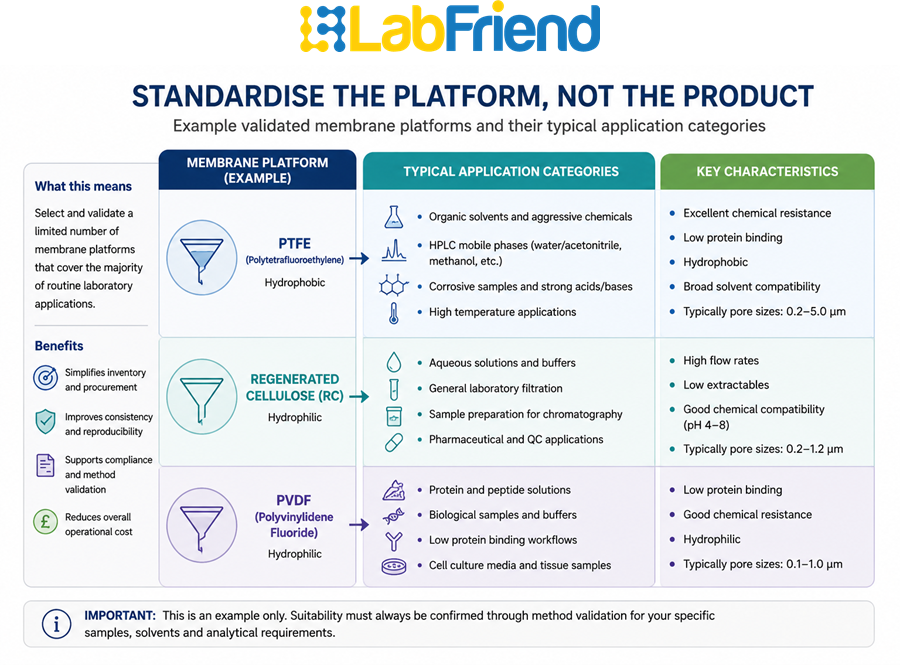
Maintaining PTFE for aggressive organic solvents while using PVDF for protein-containing biological samples, where its low non-specific protein binding preserves analyte recovery, and regenerated cellulose for routine aqueous applications represents purposeful technical diversity.
Maintaining three different brands of equivalent PTFE syringe filters because they were purchased by different departments over several years represents something entirely different.
The first approach reflects scientific necessity.
The second often reflects procurement history.
Distinguishing between these two situations is one of the most valuable exercises a laboratory can undertake when reviewing its filtration strategy.
The Hidden Cost of an Expanding Filtration Portfolio
Laboratories naturally monitor the purchase price of consumables because invoices provide immediate visibility of expenditure.
The true cost of a fragmented filtration portfolio, however, extends well beyond the unit price printed within a catalogue.
Every additional stock-keeping unit introduces small operational demands that, when multiplied across months or years, become increasingly significant.
Inventory levels increase because each product requires minimum stock holdings.
Purchasing becomes more time-consuming because more suppliers and product codes must be managed.
Training becomes more complicated because scientists must understand when apparently similar products should be selected.
Method transfers become more difficult because laboratories may not share common filtration platforms.
Quality investigations become more involved because additional consumable variables must be considered whenever unexpected analytical behaviour occurs.
Individually these effects may appear modest.
Collectively they influence both laboratory efficiency and operational cost.
Looking Beyond Purchase Price
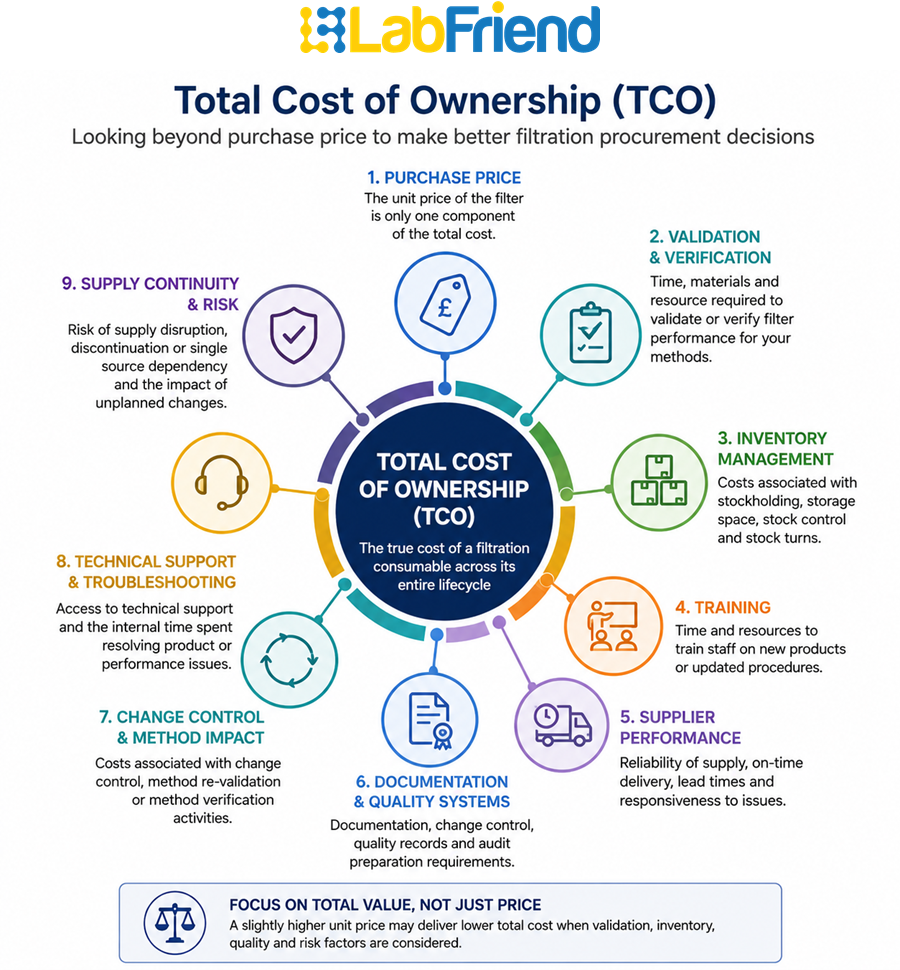
One of the most useful changes a laboratory can make is shifting procurement discussions away from purchase price alone and towards total operational value.
Consider two hypothetical syringe filters.
The first is slightly less expensive but requires the laboratory to maintain an additional supplier relationship, separate validation records and dedicated inventory.
The second costs marginally more per unit but aligns with an existing validated membrane platform already used elsewhere within the organisation.
Viewed purely through the lens of catalogue price, the first product appears more attractive.
Viewed from the perspective of operational efficiency, inventory management and analytical consistency, the second may represent the stronger long-term decision.
This illustrates why mature laboratories increasingly evaluate procurement using the concept of total cost of ownership rather than initial purchase price — factoring in inventory, training, validation and supplier support alongside unit cost.
Practical Laboratory Scenario — A Growing Pharmaceutical QC Laboratory
A medium-sized pharmaceutical quality control laboratory had expanded steadily over a period of eight years.
During that time, individual analytical teams selected syringe filters that best suited their immediate projects. Each choice was technically sound and fully justified within the context of the method being developed.
When the laboratory eventually reviewed its consumable portfolio, it identified more than twenty different syringe filter stock codes.
Several membrane types were duplicated across multiple suppliers.
Some products were retained even though the analytical methods they supported had long since been retired.
Others differed only in packaging configuration rather than technical specification.
The review did not seek to reduce scientific capability.
Instead, the laboratory examined each product against current analytical requirements, existing validation data and future procurement strategy.
The outcome was a significantly simplified filtration portfolio that retained every scientifically necessary membrane while eliminating unnecessary duplication.
Purchasing became more straightforward, inventory holdings were reduced and training new analysts became considerably easier because approved filtration platforms were clearly documented.
Perhaps the most important observation was that analytical performance did not decline.
It improved.
Scientists spent less time deciding which filter to select because validated guidance already existed.
The procurement exercise therefore strengthened both operational efficiency and scientific consistency.
Key outcome: Fewer stock codes, stronger analytical consistency.
Standardisation Is About Better Decisions, Not Fewer Choices
The word standardisation occasionally creates understandable concern within laboratories.
Scientists may worry that procurement initiatives are intended primarily to reduce cost, potentially limiting access to specialist consumables required for demanding analytical work.
Effective standardisation should achieve precisely the opposite.
Its purpose is to ensure that routine analytical activities rely on well-validated, consistently available filtration platforms while preserving the flexibility needed for genuinely specialised applications.
A laboratory does not become scientifically stronger by maintaining the largest possible inventory.
It becomes stronger by understanding exactly why each consumable remains within that inventory and ensuring that every product contributes demonstrably to analytical quality.
This philosophy underpins successful procurement strategies across many of the UK's most effective analytical laboratories.
It also explains why procurement discussions should always begin with scientific validation rather than commercial negotiation.
Before a laboratory can standardise its filtration consumables with confidence, it must first establish which products genuinely support validated analytical methods. Scientific validation provides the foundation upon which every successful procurement strategy is built.
Laboratories occasionally begin procurement reviews by asking how many products can be removed from inventory. While understandable from a commercial perspective, this is rarely the most productive starting point. A more valuable question is:
"Which filtration consumables have been demonstrated to deliver the analytical performance our laboratory requires?"
Once that question has been answered, opportunities for rationalisation usually become much clearer.
Why Standardisation Should Begin with Scientific Validation
Filtration consumables should never be standardised simply because they appear similar or because one product carries a lower purchase price than another.
Two syringe filters may share the same diameter and pore size while differing significantly in extractable/leachable profile, non-specific analyte binding and surface wettability. Likewise, two membrane materials may perform equally well for one analytical method yet produce noticeably different recoveries for another, often as a result of differential analyte adsorption onto the membrane surface.
For this reason, experienced laboratories regard scientific validation as the first stage of procurement rather than the final stage.
Validation provides confidence that a chosen membrane consistently supports analytical performance. For laboratories working with LC-MS or other trace-level techniques, validation should also confirm that a membrane's extractable profile will not interfere with analytical detection. Procurement then builds upon that evidence by identifying where the same validated platform can support additional laboratory activities.
This sequence is important because it ensures commercial efficiency is achieved without introducing unnecessary analytical risk.
Readers wishing to understand how membrane selection should be validated before procurement decisions are made should also refer to:
How UK Laboratories Can Validate Filtration Membrane Chemical Compatibility
Similarly, laboratories developing chromatography methods should consider:
Best Syringe Filters for HPLC and UHPLC Sample Preparation
These resources explain the technical principles that should underpin procurement decisions.
Standardising the Platform Rather Than the Product
One of the most effective concepts adopted by mature laboratories is the idea of standardising validated filtration platforms rather than individual catalogue items.
For example, a laboratory may determine that regenerated cellulose membranes satisfy the majority of routine aqueous analytical applications, while PTFE membranes remain essential for aggressive organic solvents and PVDF is retained for protein-containing biological samples, where its low non-specific protein binding preserves analyte recovery. Where a laboratory routinely moves between aqueous and moderate-polarity organic-aqueous samples, nylon membranes are frequently adopted as a further standardisation platform, owing to their broad chemical compatibility across both sample types.
Within each platform, a limited number of validated pore sizes and filter diameters are approved. In practice, this often means settling on a single default pore size, such as 0.22 µm or 0.45 µm, for the majority of routine filtration, with the alternative reserved for applications that specifically require it.
This approach delivers consistency without sacrificing technical flexibility.
Instead of maintaining numerous products with overlapping functionality, the laboratory develops a structured portfolio in which every consumable has a clearly defined analytical purpose.
Scientists gain confidence because product selection becomes simpler.
Procurement benefits because purchasing volumes become concentrated across fewer product lines.
Suppliers are able to provide more focused technical support because the laboratory's requirements are better defined.
The result is not fewer scientific choices.
It is better organised scientific choices.
Building a Rational Filtration Portfolio
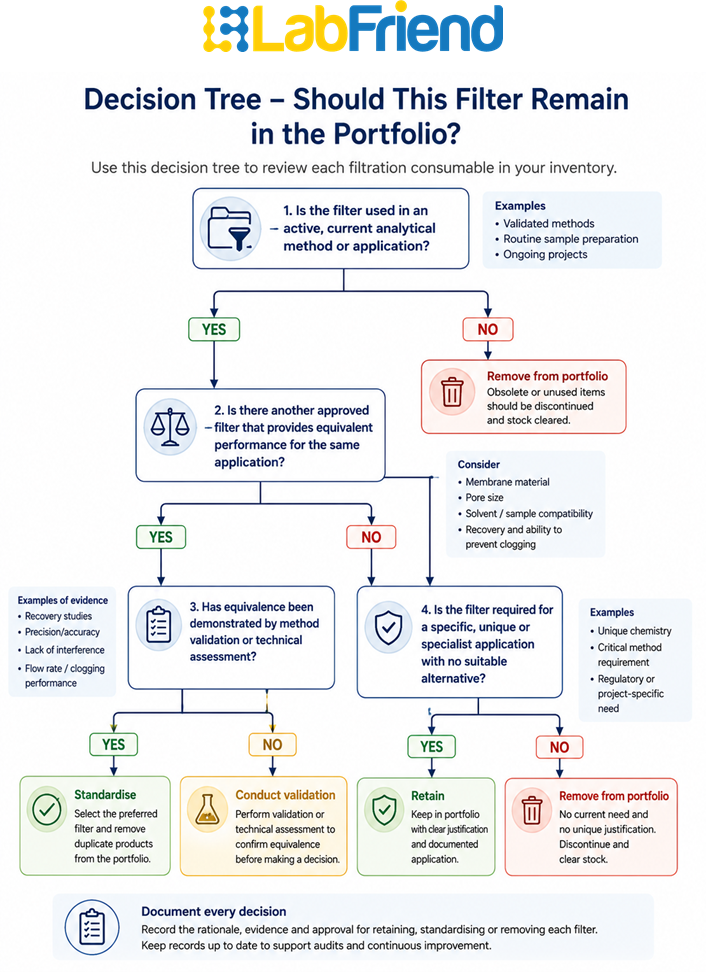
Developing a rational filtration portfolio requires laboratories to move beyond historical purchasing patterns and examine how consumables are actually used today.
The most successful portfolio reviews are collaborative exercises involving laboratory managers, senior scientists, quality representatives and procurement teams.
Each group contributes a different perspective.
Scientists understand analytical requirements.
Quality teams understand validation and compliance.
Procurement understands inventory, supplier performance and purchasing efficiency.
When these perspectives are combined, laboratories often discover opportunities that would not have been visible through isolated departmental reviews.
For example, two departments may use different syringe filters for applications that have almost identical technical requirements simply because the methods were developed independently.
Equally, a specialist membrane retained for a discontinued project may continue to occupy inventory despite no longer supporting active laboratory work.
The objective is not to eliminate products aggressively.
Instead, it is to ensure that every retained product continues to add measurable value.
A Structured Portfolio Review
Rather than reviewing catalogue pages one product at a time, experienced laboratories evaluate filtration consumables according to their role within the analytical workflow.
Typical questions include:
- Which membrane platforms support the greatest number of validated methods?
- Which consumables are purchased only occasionally?
- Are duplicate products performing the same technical function?
- Have historical purchasing decisions created unnecessary overlap?
- Are there opportunities to reduce inventory without affecting analytical capability?
Answering these questions often reveals that rationalisation is possible without altering validated analytical procedures.
In many cases, the greatest efficiencies arise not from changing existing methods but from preventing unnecessary duplication when new methods are introduced.
This proactive approach gradually improves portfolio efficiency while preserving scientific continuity.
Comparison Table — Fragmented Procurement vs Standardised Procurement
|
Procurement Characteristic |
Fragmented Portfolio |
Standardised Portfolio |
|
Membrane platforms |
Numerous overlapping options |
Limited number of validated platforms |
|
Suppliers |
Multiple suppliers for similar products |
Preferred supplier strategy where appropriate |
|
Inventory |
Large number of low-volume stock items |
Concentrated inventory around validated products |
|
Training |
Product selection varies between scientists |
Consistent guidance supported by SOPs |
|
Purchasing leverage |
Dispersed spend |
Greater purchasing consistency |
|
Analytical consistency |
Higher potential for variation |
Improved standardisation across departments |
At first glance, this comparison appears to focus primarily on procurement.
Its more significant implication, however, concerns analytical quality.
When scientists routinely select from a smaller number of validated filtration platforms, variability introduced through consumable choice naturally decreases. Procurement efficiency therefore becomes a consequence of scientific standardisation rather than its primary objective.
Practical Laboratory Scenario — University Research Laboratory
University laboratories often represent one of the most challenging procurement environments because research priorities change frequently.
A chemistry department may support pharmaceutical research one year and environmental analysis the next. Doctoral students introduce new experimental methods, grant-funded projects require specialist consumables and research groups frequently purchase products independently.
The resulting filtration portfolio can expand rapidly.
A university laboratory reviewing its consumable inventory found that several research groups had independently purchased PTFE syringe filters from different manufacturers for broadly similar applications.
Each product had been selected for entirely valid reasons at the time.
However, once the research teams compared validation data and analytical requirements, they recognised that a single validated PTFE platform could support the majority of solvent-intensive workflows across the department.
Specialist filters remained available where justified, but routine procurement became considerably simpler.
Importantly, the initiative was led by scientific evidence rather than purchasing targets.
This distinction helped secure support from researchers who might otherwise have viewed standardisation as a purely commercial exercise.
Key outcome: A single validated platform, secured through scientific evidence rather than a purchasing mandate.
Comparison Table — Hidden Costs of SKU Proliferation
|
Hidden Cost |
Operational Impact |
|
Additional inventory lines |
Increased stockholding and storage requirements |
|
Duplicate membrane platforms |
Greater purchasing complexity |
|
Multiple suppliers |
More supplier management and inconsistent technical support |
|
Product selection uncertainty |
Increased training requirements |
|
Low-volume purchases |
Reduced purchasing leverage |
|
Inconsistent consumable use |
Greater potential for analytical variation |
These hidden costs rarely appear as individual budget items.
Instead, they accumulate gradually across purchasing, inventory management, staff training and laboratory operations.
Because they are distributed throughout the organisation, they are often overlooked during procurement reviews focused solely on unit pricing.
Recognising these indirect costs enables laboratories to make more informed commercial decisions.
Decision Framework — Scientific Validation Before Procurement
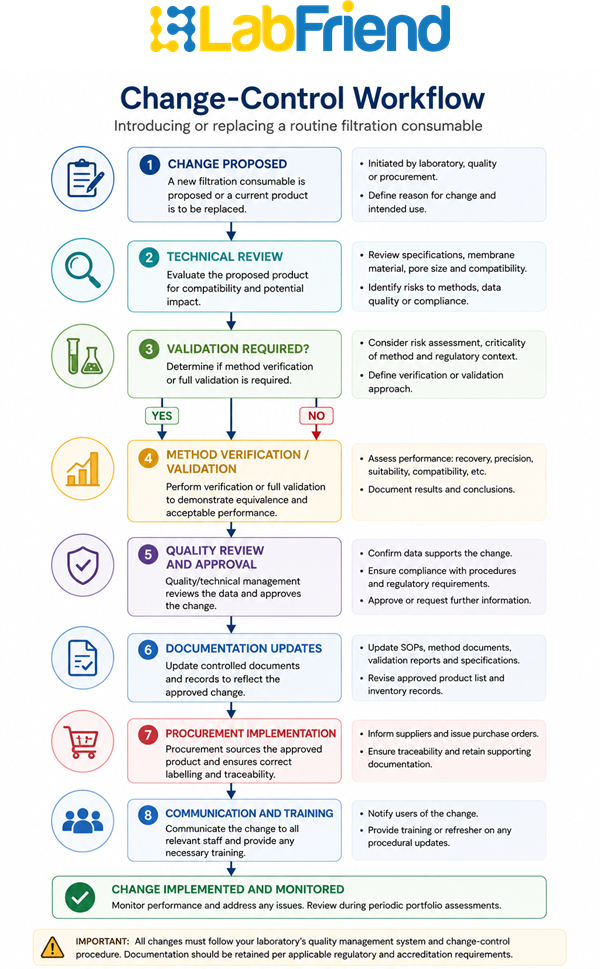
Successful laboratories typically follow a structured sequence before introducing a new filtration consumable into routine use. This sequence should also align with the laboratory's formal quality system — for example ISO/IEC 17025 or applicable GxP requirements — so that filtration validation is traceable within existing quality documentation.
- Define the analytical application.
- Select candidate membrane platforms based on scientific suitability.
- Validate performance using representative samples, assessing analyte recovery, extractables/leachables and flow characteristics as appropriate.
- Review compatibility with existing approved filtration platforms.
- Determine whether an existing validated consumable already satisfies the requirement.
- Introduce a new product only where clear technical justification exists.
- Update procurement records and laboratory SOPs where appropriate.
The framework deliberately places scientific evaluation ahead of purchasing.
Doing so ensures that procurement supports laboratory quality systems rather than operating independently of them.
Practical Laboratory Scenario — Environmental Testing Laboratory
An environmental laboratory processing water, soil and wastewater samples had gradually accumulated several filtration products intended to address different sample conditions.
Following a portfolio review, the laboratory compared actual method usage against purchasing records.
The review revealed that some specialist syringe filters had not been used for more than two years, while several routine applications relied upon three technically equivalent membrane platforms purchased from different suppliers.
Rather than selecting the lowest-cost option, the laboratory reviewed historical validation data, instrument performance and analyst feedback.
A preferred platform was identified for routine work, while genuinely specialist products were retained for applications that continued to require them.
The outcome extended beyond procurement.
Training became more consistent, inventory planning became easier and scientists reported greater confidence because product selection guidance was now clearly documented rather than based on individual experience.
Key outcome: Clearer product-selection guidance and easier training.
Reducing Cost Without Increasing Risk
One of the reasons procurement initiatives occasionally meet resistance within scientific organisations is the perception that cost reduction inevitably requires technical compromise.
In well-managed laboratories, the opposite is often true.
Reducing unnecessary product variation frequently strengthens quality systems because validated consumables become more widely adopted, purchasing becomes more consistent and opportunities for inadvertent product substitution are reduced.
Cost savings therefore emerge not because laboratories purchase lower-quality consumables, but because they purchase more intelligently.
This distinction is fundamental.
An evidence-based procurement strategy does not ask laboratories to spend less at any cost.
It helps laboratories spend more effectively by ensuring that every filtration consumable supports a defined analytical purpose and forms part of a coherent long-term operational strategy.
Although validation and portfolio rationalisation form the technical foundations of filtration procurement, long-term success depends equally on how laboratories manage supplier relationships, review purchasing performance and embed standardisation within everyday laboratory operations.
Many procurement initiatives achieve impressive short-term results but gradually lose momentum because the underlying processes are not maintained. New analytical methods are introduced, individual departments purchase products independently and historical purchasing habits begin to reappear. Before long, the filtration portfolio has started to expand once again.
Preventing this cycle requires procurement to become part of laboratory governance rather than a one-off cost reduction exercise.
Working More Effectively with Laboratory Suppliers
One of the most overlooked aspects of laboratory procurement is the role that suppliers can play beyond simply delivering products.
The strongest supplier relationships are collaborative rather than transactional.
An experienced laboratory supplier understands membrane chemistry, filtration workflows and analytical applications. That expertise can help laboratories review existing consumable portfolios, identify opportunities for standardisation and evaluate whether newly introduced methods genuinely require additional filtration products.
This collaborative approach differs significantly from selecting suppliers solely on catalogue price.
The lowest purchase price does not always represent the lowest operational cost if technical support is limited, supply continuity is inconsistent or product quality varies between batches.
Laboratories that view suppliers as long-term technical partners often benefit from:
- more consistent product availability;
- improved technical guidance;
- faster resolution of application questions;
- support during method development;
- assistance with portfolio rationalisation.
These benefits are difficult to quantify on an individual purchase order, yet they contribute significantly to operational resilience over time.
Supplier Consolidation Should Support Scientific Objectives
Supplier consolidation is frequently discussed within procurement departments because reducing the number of vendors can simplify purchasing administration and improve commercial leverage.
From a laboratory perspective, however, consolidation should never become an objective in itself.
Instead, the question should be:
"Can a smaller number of technically capable suppliers continue to support every validated analytical requirement?"
If the answer is yes, consolidation may reduce administrative complexity while strengthening technical consistency.
If the answer is no, specialist suppliers should remain part of the procurement strategy where they continue to provide unique scientific value.
This balanced approach reflects the reality that effective laboratory procurement must always remain subordinate to analytical quality.
Practical Laboratory Scenario — Contract Analytical Services
A contract analytical laboratory served clients across pharmaceutical, environmental and industrial sectors.
Historically, each business unit maintained independent purchasing arrangements for filtration consumables. Although this approach provided flexibility, it also resulted in duplicate supplier agreements, overlapping product ranges and inconsistent membrane selection for comparable analytical methods.
The laboratory initiated a cross-functional review involving laboratory managers, senior analysts, procurement specialists and quality representatives.
Rather than asking which products were cheapest, the team first mapped every routinely used syringe filter against the analytical methods it supported.
This exercise revealed that a relatively small number of validated membrane platforms covered the majority of routine laboratory work.
Supplier relationships were subsequently reviewed.
Rather than reducing suppliers aggressively, the laboratory identified preferred partners capable of supporting multiple membrane platforms while maintaining technical expertise and reliable stock availability.
Within twelve months the organisation had simplified purchasing processes, reduced duplicate inventory and improved consistency between laboratory departments without compromising analytical capability.
The most significant outcome was not the reduction in stock codes.
It was the increased confidence that every routinely purchased filtration consumable had a documented scientific justification.
Key outcome: Documented scientific justification for every routinely purchased consumable.
Comparison Table — Scientific Procurement Versus Price-Driven Procurement
|
Procurement Approach |
Price-Driven Purchasing |
Evidence-Based Procurement |
|
Primary focus |
Lowest unit price |
Total operational value |
|
Product selection |
Catalogue comparison |
Validated analytical suitability |
|
Supplier relationships |
Transactional |
Technical partnership |
|
Inventory management |
Reactive |
Planned and standardised |
|
Laboratory consistency |
Variable |
Improved through validated platforms |
|
Long-term operational impact |
Potential hidden costs |
Greater efficiency and consistency |
Viewed superficially, these approaches may appear similar because both involve purchasing laboratory consumables.
The distinction lies in the decision-making process.
Evidence-based procurement recognises that the purchase price of a syringe filter represents only one element of its overall value. Reliability, validation history, technical support and compatibility with existing laboratory procedures frequently exert a much greater influence on long-term operational performance.
Decision Framework — Maintaining a Standardised Filtration Portfolio
Successful laboratories rarely regard standardisation as a project with a defined end date.
Instead, they establish a repeatable governance process.
A practical review cycle typically includes:
- Review analytical methods introduced since the previous assessment.
- Confirm that existing validated membrane platforms continue to satisfy laboratory requirements.
- Examine purchasing data for emerging duplication.
- Review supplier performance, continuity of supply and technical support.
- Remove obsolete products associated with retired analytical methods.
- Update standard operating procedures and approved product lists.
- Communicate portfolio changes through staff training and quality documentation.
By repeating this process periodically, laboratories prevent unnecessary complexity from gradually returning.
Practical Laboratory Scenario — Food & Beverage Testing Laboratory
A food testing laboratory supported microbiological analysis, chemical contaminant testing and routine quality assurance for multiple manufacturing clients.
As the laboratory expanded, individual analytical teams introduced specialist filtration products to support new customer projects.
During an annual procurement review, the laboratory recognised that many of these products had become permanent inventory despite limited ongoing demand.
Rather than removing products indiscriminately, scientists reviewed each membrane against current analytical requirements and historical validation data.
Products supporting active specialist methods remained available.
Consumables that duplicated existing validated filtration platforms were gradually phased out as inventory was replenished.
The review reduced purchasing complexity while preserving every technically justified analytical capability.
Perhaps more importantly, the exercise established a documented review methodology that could be repeated annually rather than relying on occasional large-scale procurement exercises.
Key outcome: A repeatable annual review process, not a one-off exercise.
Frequently Asked Questions
Should every laboratory standardise its filtration consumables?
Most laboratories benefit from some degree of standardisation. The objective is not to minimise product choice, but to ensure that routinely stocked consumables have clear technical justification and support validated analytical methods.
Will standardisation reduce analytical flexibility?
No. Well-designed standardisation programmes retain specialist filtration products where they remain scientifically necessary while reducing unnecessary duplication in routine applications.
How many syringe filter types should a laboratory stock?
There is no universal number. The number is driven by two variables: how many membrane chemistries are genuinely required, and how many diameter/pore-size combinations are needed within each. The appropriate range depends on the laboratory's analytical activities, although many organisations discover that historical purchasing has created more duplication than genuine technical diversity.
Is purchasing the lowest-cost syringe filter the best procurement strategy?
Not necessarily. Purchase price should be considered alongside validation, analytical performance, supplier reliability and total operational cost.
Why do laboratories accumulate duplicate filtration products?
Growth, new analytical methods, independent departmental purchasing and historical procurement decisions frequently result in overlapping product portfolios.
How often should a filtration portfolio be reviewed?
Many laboratories benefit from reviewing approved consumables annually or whenever significant analytical methods are introduced or retired.
Does standardisation simplify laboratory training?
Yes. Approved filtration platforms supported by documented guidance reduce uncertainty for new analysts and encourage consistent working practices.
Should procurement teams decide membrane selection?
Membrane selection should remain a scientific decision supported by laboratory specialists. Procurement then implements purchasing strategies based upon validated technical requirements.
Can supplier consolidation improve laboratory efficiency?
Where technically appropriate, reducing unnecessary supplier duplication can simplify purchasing, inventory management and technical support.
What is meant by total cost of ownership?
Total cost of ownership considers inventory, training, validation, operational efficiency, supplier performance and analytical consistency in addition to purchase price.
How does standardisation improve analytical consistency?
Using validated filtration platforms consistently across departments reduces unnecessary variability and supports reproducible analytical practice.
Should laboratories retain specialist filtration products?
Yes. Products supporting validated specialist methods should remain available even when routine consumables are standardised.
What role does documentation play?
Approved product lists, standard operating procedures and validation records ensure that procurement decisions remain transparent, repeatable and scientifically justified.
Can procurement strengthen laboratory quality systems?
Yes. When procurement follows validated scientific guidance, it reinforces analytical consistency and supports quality management objectives.
Where can laboratories obtain technical advice on filtration standardisation?
Laboratories should seek guidance from experienced scientific suppliers capable of supporting both technical filtration decisions and long-term procurement strategy.
Continue Your Filtration Learning
To explore the technical topics underpinning procurement standardisation, the following resources provide complementary guidance:
- The Ultimate Guide to Laboratory Filtration for UK Laboratories
- The Ultimate Syringe Filter Guide: Pore Size, Membranes and Applications
- Best Syringe Filters for HPLC and UHPLC Sample Preparation
- Choosing the Right Syringe Filter for Organic Solvents
- Hydrophilic vs Hydrophobic Membranes: How to Choose the Right Filter for Your Laboratory Application
- The Complete Guide to Chromatography Consumables for UK Laboratories
Conclusion
Laboratory filtration procurement is often viewed as a purchasing activity, yet the most successful laboratories recognise that it is fundamentally an extension of scientific method development and quality management.
The objective is not simply to reduce expenditure on consumables. It is to ensure that every filtration product routinely stocked by the laboratory has a defined analytical purpose, supports validated methods and contributes positively to operational efficiency.
When procurement is driven primarily by purchase price, laboratories risk introducing unnecessary complexity, duplicate inventory and avoidable analytical variation. By contrast, when procurement begins with scientific validation, opportunities naturally emerge to rationalise membrane platforms, simplify supplier relationships and improve purchasing consistency without compromising technical performance.
This approach delivers benefits that extend well beyond the stores department. Scientists spend less time selecting between overlapping products, training becomes more straightforward, inventory management becomes more efficient and laboratories gain greater confidence that routine analytical work is supported by validated, well-understood filtration consumables.
Ultimately, effective standardisation is not about restricting scientific choice.
It is about ensuring that every choice retained within the laboratory is purposeful, evidence-based and aligned with the long-term objectives of analytical quality, operational efficiency and sustainable procurement.
Discuss Your Laboratory Filtration Standardisation Strategy with LabFriend
Whether you are reviewing an established filtration portfolio, introducing new analytical methods or looking to simplify procurement across multiple laboratory teams, LabFriend can help you evaluate your current filtration strategy and identify opportunities for evidence-based standardisation.
Explore our Laboratory Filtration Equipment:
Browse our range of Syringe Filters:
If your laboratory is planning a filtration portfolio review, our technical team can also help you compare membrane platforms, discuss application requirements and identify practical opportunities to simplify procurement while maintaining analytical confidence.
Written by: Donal O’Sullivan, BSc, Co-Founder and Sales Director, LabFriend UK. Donal brings deep chemistry-led technical expertise across analytical chemistry, biochemistry, environmental monitoring, laboratory instrumentation, consumables and scientific product selection.
Reviewed by: Michael Anderson, MBA, Founder and Managing Director, LabFriend UK. Michael reviews LabFriend UK content for customer relevance, commercial accuracy, operational practicality and alignment with LabFriend UK’s laboratory supply model.
Related Stories

Complete Guide to Centrifuge Tubes
Complete Guide to Centrifuge Tubes

The Ultimate Guide to Laboratory Filtration for UK Laboratories
The Ultimate Guide to Laboratory Filtration for UK Laboratories

Polypropylene vs Polystyrene Centrifuge Tubes
Polypropylene vs Polystyrene Centrifuge Tubes: Which Is Best for Laboratory Workflows?

PTFE vs PES Syringe Filters: Which Membrane Should You Choose?
PTFE vs PES Syringe Filters: Differences, Solvent Compatibility and Laboratory Applications