

Share :
How to Reduce Aerosol Contamination in qPCR Pipetting Workflows
Updated On 08/10/2026

By Donal O’Sullivan, BSc. Reviewed by Michael Anderson, MBA.
Quantitative Polymerase Chain Reaction (qPCR) has become one of the most sensitive and widely used analytical techniques in modern molecular biology. Whether supporting gene expression studies, pathogen detection, pharmaceutical research or clinical diagnostics, qPCR allows laboratories to detect extremely small quantities of nucleic acid with remarkable precision.
However, the same sensitivity that makes qPCR such a powerful analytical tool also makes it particularly vulnerable to contamination. Even minute quantities of unintended nucleic acid introduced during sample preparation can influence assay performance, contribute to false-positive results or necessitate costly repeat analyses.
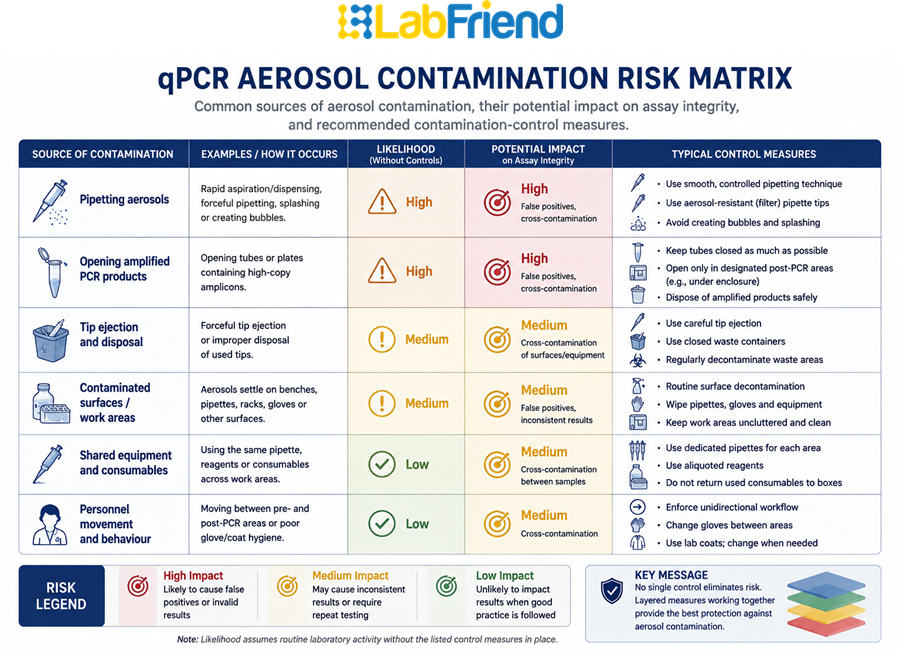
Among the various contamination pathways encountered in molecular biology laboratories, aerosol contamination remains one of the most significant. Aerosols generated during routine pipetting can carry amplified DNA, RNA or other biological material between samples, laboratory equipment and work areas if appropriate controls are not in place.
Reducing aerosol contamination is therefore not achieved through a single product or laboratory procedure. Instead, successful contamination control relies upon multiple complementary measures including thoughtful laboratory design, disciplined pipetting technique, appropriate consumable selection, effective equipment management and well-defined laboratory procedures.
If you are looking for a broader introduction to laboratory pipette tips, liquid handling and compatibility, begin with The Complete Guide to Pipette Tips, Pipetting Accuracy & Laboratory Liquid Handling before returning to this application-specific guide.
Understanding Aerosol Contamination in qPCR
To control aerosol contamination effectively, it is first necessary to understand how it occurs.
During routine pipetting operations, very small liquid droplets can become suspended in the air. These microscopic droplets, known as aerosols, may contain DNA, RNA, amplified PCR products or other biological material depending on the workflow being performed.
Although individual aerosol particles are often invisible, they can represent an important contamination pathway within molecular biology laboratories because they may settle onto laboratory surfaces, pipettes, gloves or open reaction vessels.
In highly sensitive qPCR assays, where only very small quantities of target nucleic acid may be present, unintended introduction of contaminating material can influence experimental outcomes far more readily than in many routine laboratory procedures.
For this reason, experienced laboratories treat aerosol control as an integral component of quality management rather than an isolated laboratory practice.
It is also worth noting that the risk profile differs depending on the stage of the workflow. Aerosols generated during sample preparation typically carry a limited quantity of unamplified template, whereas aerosols arising after amplification may carry amplicon present at extremely high copy numbers. For this reason, post-amplification aerosols generally represent the greater contamination risk and warrant the most stringent controls.
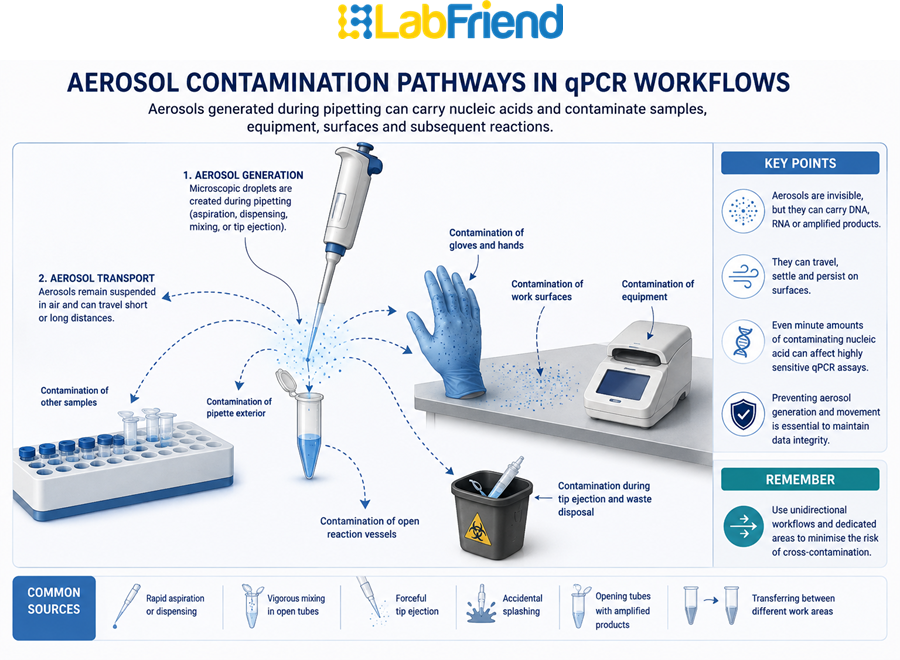
How Aerosols Are Generated During Pipetting
Aerosol formation is not limited to unusual laboratory events. It can occur during many everyday liquid handling activities if appropriate techniques are not followed.
Examples include:
- rapid aspiration or dispensing of liquids;
- repeated mixing within open vessels;
- forceful ejection of pipette tips;
- accidental splashing during sample transfer;
- opening reaction tubes containing amplified PCR products; and
- transferring samples between different laboratory workstations.
While these activities are often routine, they demonstrate that contamination prevention depends upon both operator technique and workflow design.
Importantly, aerosols should not be viewed solely as a consequence of poor laboratory practice. Even well-trained personnel can generate aerosols during normal pipetting operations. The objective is therefore to minimise opportunities for aerosol movement and reduce the likelihood that contaminating material reaches subsequent samples or laboratory equipment.
Why Aerosol Contamination Matters
The consequences of aerosol contamination extend beyond individual experimental results.
For laboratories responsible for research, quality control or regulated testing, contamination can lead to:
- false-positive amplification;
- inconsistent assay performance;
- unnecessary repeat testing;
- increased reagent consumption;
- delayed project completion;
- reduced confidence in analytical data; and
- additional investigation within laboratory quality systems.
For QA and QC managers, contamination events may also trigger corrective actions, root-cause investigations or review of laboratory procedures.
Preventing contamination is therefore considerably more efficient than investigating contamination after it has occurred.
This preventative philosophy underpins many aspects of modern molecular biology laboratory design and operating practice.
Building a Contamination-Control Strategy
One of the most common misconceptions is that aerosol contamination can be eliminated simply by selecting a particular consumable.
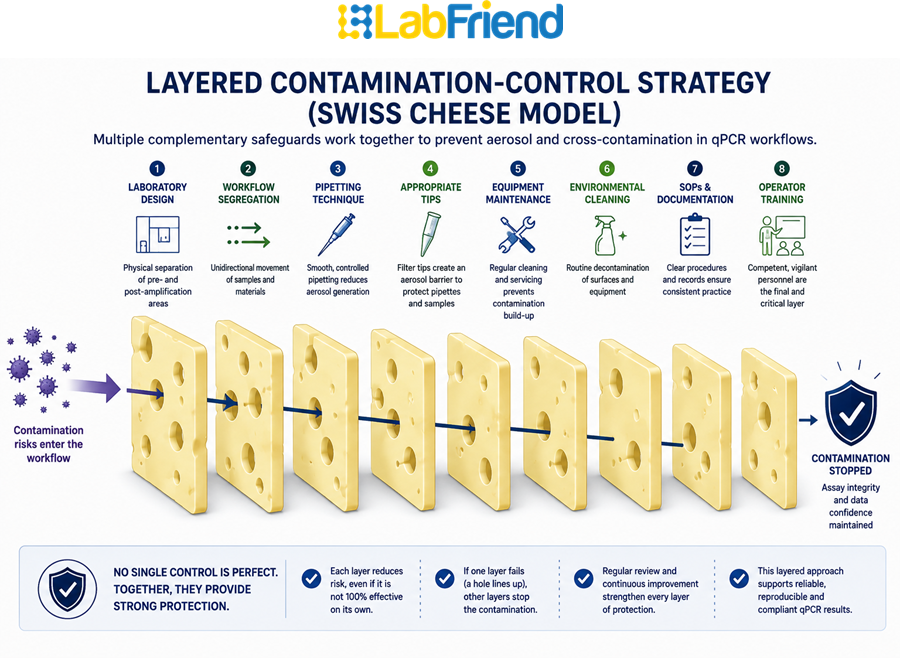
In reality, successful contamination control relies upon multiple complementary safeguards working together.
Effective laboratories typically integrate:
- structured laboratory workflows;
- careful pipetting technique;
- appropriate use of pipette tips;
- equipment maintenance;
- environmental cleaning;
- sample segregation;
- use of no-template (negative) controls to monitor for contamination within each qPCR run;
- operator training; and
- documented laboratory procedures.
Each measure reduces risk incrementally. Collectively, they provide a far more robust contamination-control strategy than relying upon any single intervention.
The Role of Pipetting Technique
Good pipetting technique remains one of the simplest and most effective ways of reducing opportunities for aerosol generation.
Experienced molecular biologists generally aim to:
- aspirate and dispense liquids smoothly;
- avoid unnecessarily rapid pipetting;
- minimise splashing;
- prevent accidental contact between pipette tips and contaminated surfaces;
- change pipette tips at appropriate stages within the workflow; and
- organise work to minimise unnecessary movement between pre- and post-amplification areas.
These practices are already familiar to many laboratories but remain fundamental because contamination prevention depends largely upon consistent execution of routine procedures.
Readers seeking broader guidance on PCR liquid handling should also consult the dedicated LabFriend article on Pipetting for PCR: How to Maximise Accuracy in DNA Amplification Workflows, together with qPCR Pipetting Best Practices: How to Reduce Variability and Improve Accuracy at Low Volumes, both of which complement this contamination-focused guide.
Filter Pipette Tips as Part of a Broader Strategy
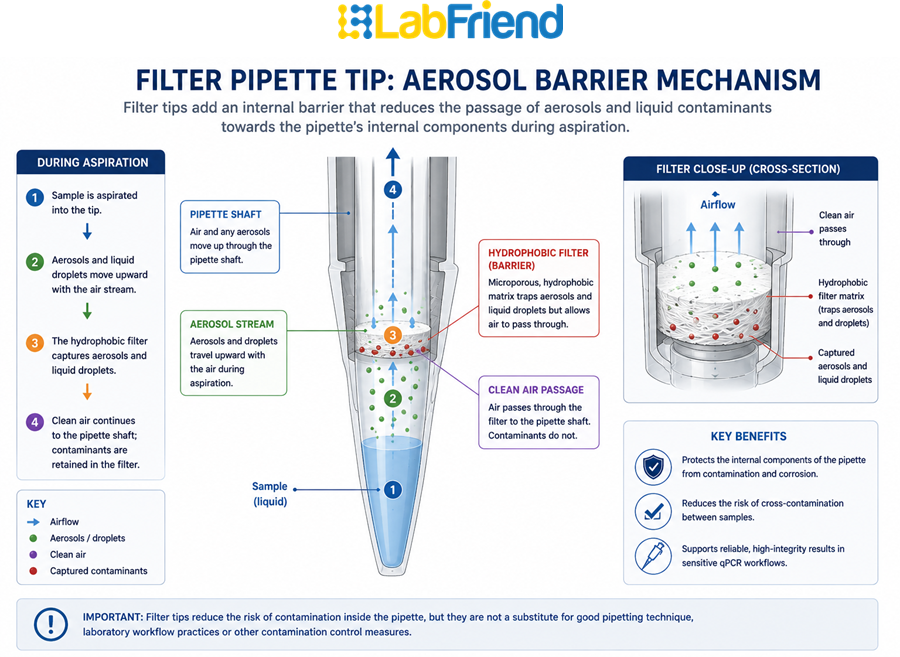
Filter pipette tips are widely used in molecular biology laboratories because they introduce an aerosol barrier between the sample and the internal components of the pipette. These products are also commonly referred to as aerosol-barrier or aerosol-resistant tips, reflecting their function within contamination-sensitive workflows.
Their purpose is to help reduce the movement of aerosols and liquid contaminants towards the pipette body during aspiration, typically through a hydrophobic membrane fitted within the tip, thereby supporting contamination-control procedures and helping protect laboratory equipment from inadvertent sample carryover.
However, it is important to recognise that filter pipette tips represent only one element of an effective contamination-control strategy. They should not be viewed as a substitute for appropriate laboratory design, validated procedures or good pipetting technique.
Laboratories considering when filter pipette tips are appropriate for PCR and qPCR applications should refer to the dedicated LabFriend guidance on When Should You Use Filter Pipette Tips in qPCR and Molecular Biology?, which explores product selection in greater detail.
Protecting Assay Integrity Through Layered Controls
The most successful molecular biology laboratories rarely rely on a single safeguard to maintain assay integrity. Instead, they implement multiple overlapping controls that collectively reduce contamination risk throughout the workflow.
This layered approach recognises that contamination can arise from equipment, laboratory layout, consumables, operator technique or environmental factors. By addressing each of these areas systematically, laboratories create more resilient workflows that support reliable qPCR performance and reduce the likelihood of false-positive amplification or unnecessary repeat testing.
In Part 2 of this guide, we examine practical contamination-control measures that laboratories can implement immediately, explore the role of laboratory organisation and consumable selection, provide a structured contamination-prevention checklist and answer the most frequently asked questions about aerosol contamination in qPCR workflows.
Practical Strategies for Reducing Aerosol Contamination
Understanding how aerosol contamination occurs is only the first step. The greatest improvements in assay reliability are achieved when laboratories translate that understanding into consistent working practices that reduce opportunities for contamination throughout the qPCR workflow.
Rather than relying on a single intervention, experienced molecular biology laboratories adopt a layered approach in which laboratory design, operator technique, equipment management and consumable selection work together to minimise contamination risk. This philosophy recognises that no individual control measure can eliminate every potential contamination pathway, but that multiple complementary safeguards can significantly improve workflow robustness.
Organising the Laboratory Environment
The physical organisation of the laboratory has a direct influence on contamination control. Good laboratory design helps prevent amplified DNA and other potential contaminants from moving between different stages of the workflow.
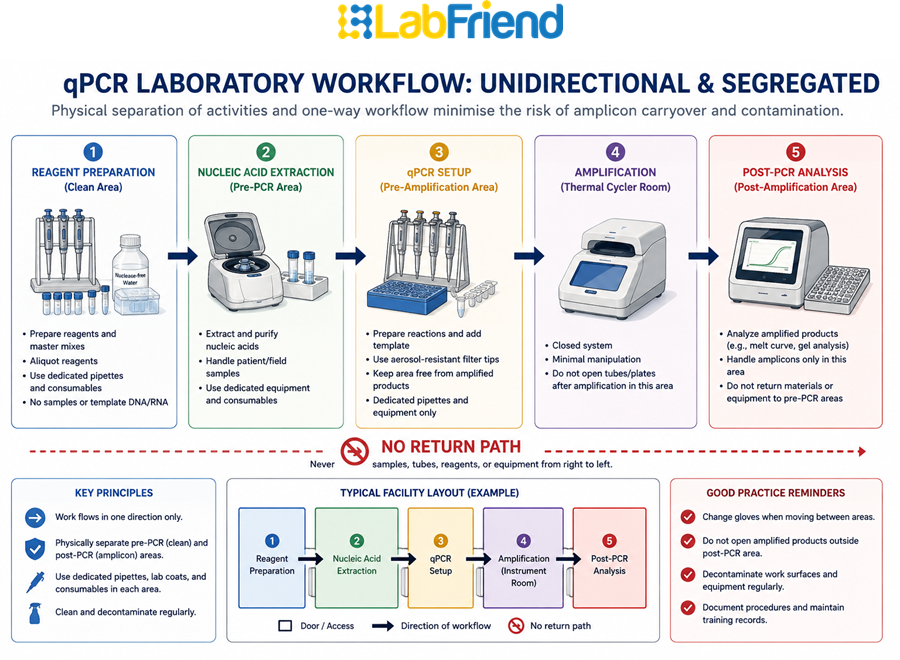
Many laboratories therefore separate activities into distinct areas wherever practical, for example:
- reagent preparation;
- sample preparation;
- nucleic acid extraction;
- PCR reaction setup; and
- post-amplification analysis.
Maintaining clear separation between pre-amplification and post-amplification activities reduces the likelihood that amplified DNA will inadvertently contaminate fresh reactions.
Where dedicated laboratory rooms are not available, procedural separation, carefully managed workflow direction and disciplined housekeeping can still make an important contribution to contamination control.
Where possible, laboratories also benefit from dedicating specific equipment, such as pipettes and racks, to individual work areas, reducing the likelihood that equipment itself becomes a vector for cross-contamination between zones.
Equipment Management and Good Laboratory Practice
Pipettes themselves can become vectors for contamination if they are not maintained appropriately.
Routine inspection, calibration and preventative maintenance help ensure consistent liquid handling while reducing the likelihood that contamination accumulates within pipette mechanisms.
Good laboratory practice also includes:
- cleaning work surfaces and equipment regularly using validated decontamination reagents or UV treatment where specified in laboratory procedures;
- inspecting pipettes for signs of contamination;
- checking pipette tip cones and seals for wear or damage, as a compromised seal can increase aerosol generation during aspiration and dispensing;
- changing gloves whenever contamination is suspected;
- replacing pipette tips between samples and reagents in accordance with laboratory procedures;
- avoiding unnecessary movement between clean and post-PCR work areas;
- following documented laboratory SOPs consistently; and
- considering dedicated PCR workstations or UV cabinets for pre-amplification setup where workflow volume and risk warrant additional engineering controls.
These routine activities are often viewed as basic laboratory practice, yet they remain among the most effective methods of supporting contamination control over the long term.
Readers interested in broader pipetting accuracy should also review Pipetting for PCR: How to Maximise Accuracy in DNA Amplification Workflows, which complements the contamination-focused guidance presented here.
Selecting Appropriate Pipette Tips
Consumable selection plays an important role within a wider contamination-control strategy.
For many qPCR workflows, laboratories choose filter pipette tips because the integrated aerosol barrier helps reduce the movement of aerosols towards the pipette body during aspiration.
However, filter pipette tips should not be viewed as a complete contamination-control solution.
Instead, they should be regarded as one component of an integrated laboratory strategy that also includes:
- effective laboratory organisation;
- disciplined pipetting technique;
- appropriate equipment maintenance;
- consideration of positive displacement pipettes for viscous, volatile or highly sensitive applications where additional carryover control is required;
- operator training;
- validated laboratory procedures; and
- careful sample handling.
Laboratories considering product selection should also review:
- Best Pipette Tips for PCR and qPCR Workflows
- When Should You Use Filter Pipette Tips in qPCR and Molecular Biology?
- Sterile vs Non-Sterile Pipette Tips - Which Should Your Laboratory Choose?
Together, these complementary resources explain how consumable selection supports contamination prevention without overstating the capabilities of any individual product.
A Practical Aerosol Contamination Checklist
The following checklist provides a practical framework that laboratories can incorporate into routine quality reviews.
|
Control Area |
Good Practice |
|
Laboratory workflow |
Maintain clear separation between pre- and post-PCR activities wherever possible. |
|
Pipetting technique |
Aspirate and dispense smoothly while avoiding unnecessary splashing. |
|
Pipette tips |
Use products appropriate for the workflow and change tips according to laboratory procedures. |
|
Pipette maintenance |
Inspect, clean and calibrate pipettes routinely (e.g., at intervals defined by laboratory SOPs). |
|
Laboratory housekeeping |
Clean work surfaces and equipment according to validated procedures (e.g., before and after each session). |
|
Operator behaviour |
Change gloves when appropriate and minimise unnecessary movement between work areas (e.g., between pre- and post-PCR zones). |
|
Quality procedures |
Follow SOPs consistently and document contamination-control measures where required. |
While straightforward, consistent application of these practices contributes significantly to maintaining reliable qPCR workflows.
Frequently Asked Questions
What causes aerosol contamination during qPCR?
Aerosol contamination occurs when microscopic droplets containing nucleic acids or other biological material become airborne during laboratory activities such as pipetting, mixing, opening reaction tubes or dispensing liquids. These aerosols may subsequently settle onto equipment, work surfaces or open reaction vessels if appropriate controls are not in place.
Can filter pipette tips completely prevent contamination?
No. Filter pipette tips help reduce the movement of aerosols into the pipette body and are widely used in contamination-sensitive workflows. They primarily prevent aerosols from entering the pipette shaft rather than preventing aerosol formation at the tip orifice itself, so good pipetting technique remains essential. However, they represent only one element of a broader contamination-control strategy that also includes laboratory organisation, good pipetting technique, equipment maintenance and validated procedures.
How can laboratories detect whether contamination has occurred?
Laboratories typically include no-template (negative) controls within each qPCR run to monitor for contamination. Unexpected amplification in these controls, together with atypical Ct values or unusual melt-curve profiles, can indicate that contamination has taken place and that corrective action is required.
Why is aerosol contamination particularly important in qPCR?
qPCR is capable of detecting extremely small quantities of nucleic acid. Consequently, even very low levels of unintended contamination may influence assay results, increase the likelihood of false-positive amplification or require repeat testing.
Should every qPCR workflow use filter pipette tips?
Many laboratories routinely select filter pipette tips for qPCR because they support contamination-control strategies. Nevertheless, consumable selection should always reflect laboratory procedures, application requirements and local quality systems.
What is the most effective way to reduce contamination?
No single intervention is sufficient on its own. The most reliable laboratories combine appropriate laboratory design, disciplined pipetting technique, suitable consumables, equipment maintenance and consistent adherence to standard operating procedures.
Conclusion
Reducing aerosol contamination in qPCR workflows requires a systematic approach rather than reliance on any individual product or laboratory practice.
Understanding how aerosols are generated enables laboratories to implement practical controls that reduce opportunities for contamination throughout sample preparation, reaction setup and amplification workflows. Combined with good laboratory organisation, disciplined pipetting technique and appropriate consumable selection, these measures help maintain assay reliability while supporting reproducible molecular biology results.
For QA and QC managers, contamination prevention should be regarded as an ongoing element of laboratory quality management rather than a reactive response to isolated contamination events. By embedding layered contamination-control measures into everyday laboratory practice, organisations can strengthen confidence in analytical data while reducing unnecessary repeat testing and investigation.
Explore Laboratory Pipette Tip Solutions
Selecting appropriate consumables forms one part of an effective contamination-control strategy.
LabFriend offers a comprehensive range of laboratory pipette tips suitable for molecular biology, PCR and qPCR workflows. Laboratories evaluating products for contamination-sensitive applications can explore the available ranges through the Laboratory Pipette Tips category.
You may also find the following authority resources valuable:
- The Complete Guide to Pipette Tips, Pipetting Accuracy & Laboratory Liquid Handling
- Best Pipette Tips for PCR and qPCR Workflows
- Pipetting for PCR: How to Maximise Accuracy in DNA Amplification Workflows
- qPCR Pipetting Best Practices - How to Reduce Variability and Improve Accuracy at Low Volumes
- When Should You Use Filter Pipette Tips in qPCR and Molecular Biology?
- Sterile vs Non-Sterile Pipette Tips: Which Should Your Laboratory Choose?
- Why Pipette Tip Fit Matters for Accurate Laboratory Pipetting
Together, these publications form part of the LabFriend Pipette Tips Authority Hub, providing UK laboratories with evidence-based guidance on contamination control, consumable selection, liquid handling best practice and the development of reliable molecular biology workflows.
Written by: Donal O’Sullivan, BSc, Co-Founder and Sales Director, LabFriend UK. Donal brings deep chemistry-led technical expertise across analytical chemistry, biochemistry, environmental monitoring, laboratory instrumentation, consumables and scientific product selection.
Reviewed by: Michael Anderson, MBA, Founder and Managing Director, LabFriend UK. Michael reviews LabFriend UK content for customer relevance, commercial accuracy, operational practicality and alignment with LabFriend UK’s laboratory supply model.
Related Stories

Low-Retention Pipette Tips for Protein and Enzyme Workflows
Low-Retention Pipette Tips for Protein and Enzyme Workflows

Pipetting Technique Errors That Affect Laboratory Reproducibility
Pipetting Technique Errors That Affect Laboratory Reproducibility

Why Pipette Tips Leak or Fall Off During Laboratory Pipetting
Why Pipette Tips Leak or Fall Off During Laboratory Pipetting

Troubleshooting Low-Volume Pipetting in PCR & qPCR Workflows
Troubleshooting Low-Volume Pipetting in PCR & qPCR Workflows