Best Pipette Tips for PCR and qPCR Workflows
21 mins read
Best Pipette Tips for PCR and qPCR Workflows
By Donal O’Sullivan, BSc. Reviewed by Michael Anderson, MBA.
Polymerase Chain Reaction (PCR) and quantitative PCR (qPCR) underpin some of the most important analytical techniques used in modern life science laboratories. From routine research and biotechnology development to clinical diagnostics and pharmaceutical quality control, these methods depend on precise, repeatable liquid handling.
While considerable attention is often given to thermocyclers, enzymes and assay chemistry, one of the most influential components of any PCR workflow is frequently overlooked: the pipette tip.
Every transfer of DNA, RNA, primers, probes, enzymes and master mixes presents an opportunity to either preserve assay integrity or introduce unnecessary variability. Selecting the appropriate pipette tip helps laboratories minimise contamination risk, improve dispensing consistency and protect valuable samples throughout the workflow.
If you're looking for a broader overview of pipette tip design, compatibility and laboratory liquid handling, begin with The Complete Guide to Pipette Tips, Pipetting Accuracy & Laboratory Liquid Handling before returning to this application-specific guide.
Why Pipette Tip Selection Matters in PCR and qPCR
PCR workflows are considerably more demanding than many routine laboratory liquid handling applications.
Unlike general sample preparation, PCR and qPCR frequently involve:
- transferring extremely small liquid volumes (typically in the range of 0.5–20 µL);
- handling valuable enzymes and reagents;
- working with low-copy nucleic acid samples;
- maintaining exceptionally high standards of contamination control; and
- generating highly reproducible analytical data.
In these environments, consistency becomes just as important as accuracy.
Even where pipettes are correctly calibrated and operators follow established laboratory procedures, inappropriate consumable selection can contribute to inconsistent aspiration, variable dispensing performance, increased sample retention or unnecessary contamination risk.
For this reason, experienced molecular biology laboratories increasingly regard pipette tip selection as part of their quality management process rather than simply a purchasing decision.
Choosing products that are appropriate for the intended application supports reliable workflows while helping laboratories reduce repeat testing, minimise reagent waste and improve confidence in analytical results.
Selecting the Best Pipette Tip Starts with Understanding the Workflow
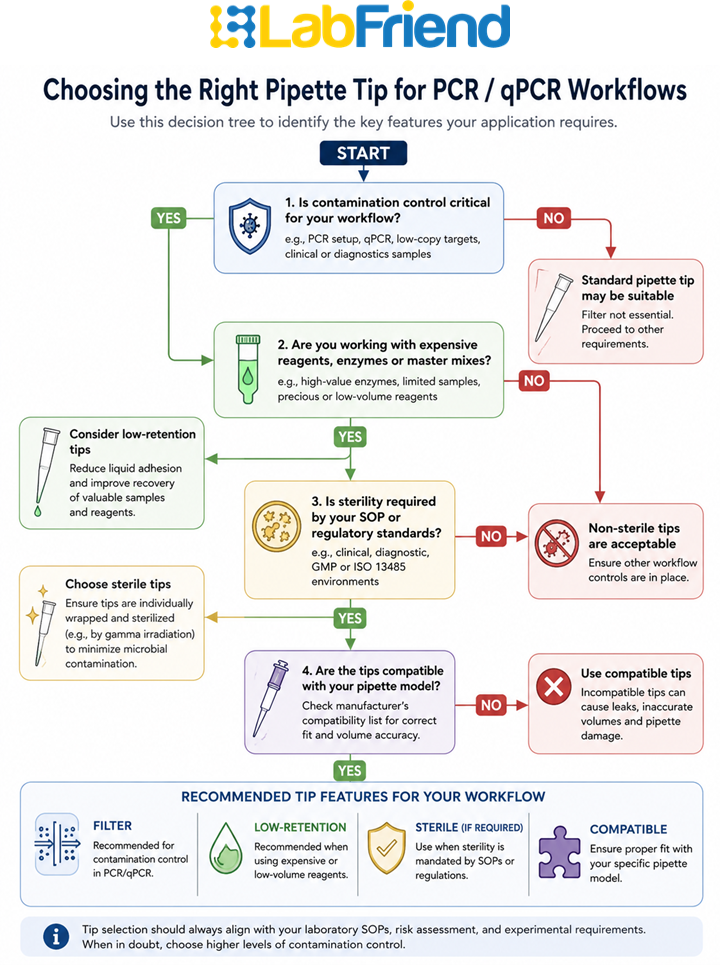
One of the most common procurement mistakes is assuming that every PCR experiment requires exactly the same consumables.
In practice, laboratories perform a wide variety of molecular biology applications, each placing different demands on pipette performance and consumable selection.
For example:
- routine endpoint PCR may have different requirements from highly sensitive qPCR;
- research laboratories may prioritise flexibility across multiple applications;
- regulated environments may place greater emphasis on documented contamination control;
- laboratories handling expensive reagents may seek to maximise liquid recovery and minimise sample loss.
Consequently, the objective is not to identify a universally "best" pipette tip. Instead, laboratories should determine which product characteristics best support the workflow being performed.
A structured evaluation generally considers:
|
Workflow Question |
Why It Matters |
|
Is contamination control critical? |
May influence whether filter pipette tips are appropriate. |
|
Are valuable reagents being transferred? |
May justify considering low-retention pipette tips. |
|
Does the workflow require aseptic handling? |
May influence whether sterile consumables are appropriate. |
|
Which pipette platform is being used? |
Compatibility remains essential for accurate liquid handling. |
|
Are laboratory SOPs or quality systems prescribing particular consumables? |
Product selection should always align with established laboratory procedures. |
This application-led approach allows laboratories to balance scientific requirements with operational efficiency rather than purchasing consumables based solely on price or historical preference.
The Key Characteristics of PCR and qPCR Pipette Tips
Although pipette tips are often grouped together as a single consumable category, several product characteristics influence their suitability for molecular biology applications.
Filter Pipette Tips
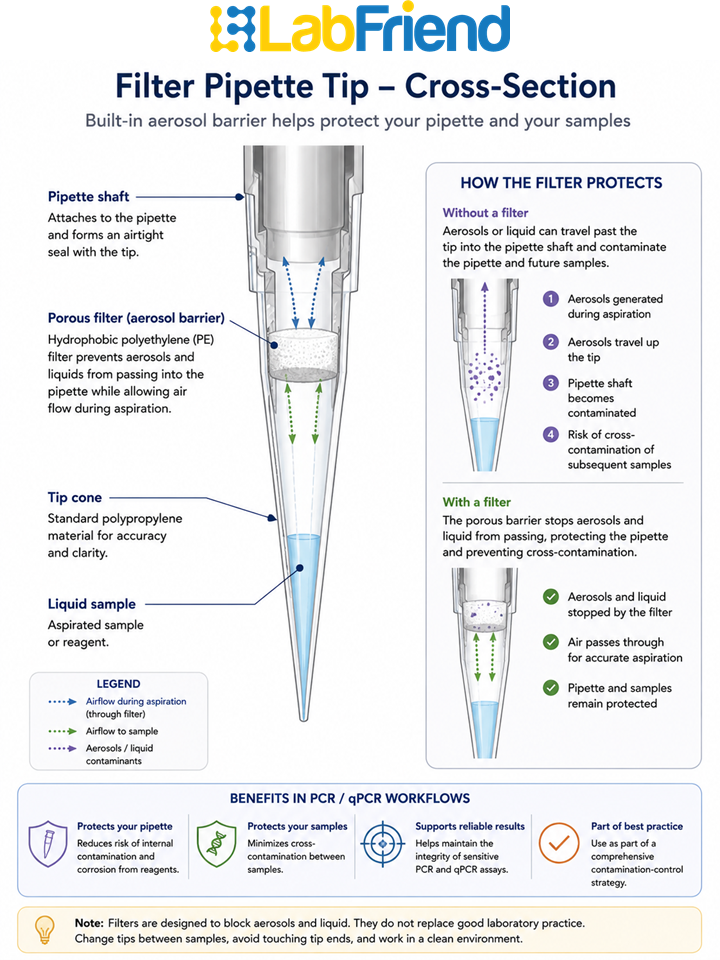
Filter pipette tips incorporate an internal aerosol barrier designed to help reduce the movement of aerosols towards the pipette body during aspiration.
In practical terms, this reduces the risk of carrying trace material from one sample into the next, or into the pipette itself.
For many molecular biology laboratories, they form an important component of broader contamination-control procedures, particularly when handling amplified DNA, RNA or highly sensitive qPCR assays.
This aerosol-barrier function primarily protects against carryover of amplified DNA (amplicon) or other trace material between samples, which is a different risk to the microbial contamination addressed by sterility.
A more detailed discussion of contamination-control applications is available in When Should You Use Filter Pipette Tips in qPCR and Molecular Biology?.
Sterility
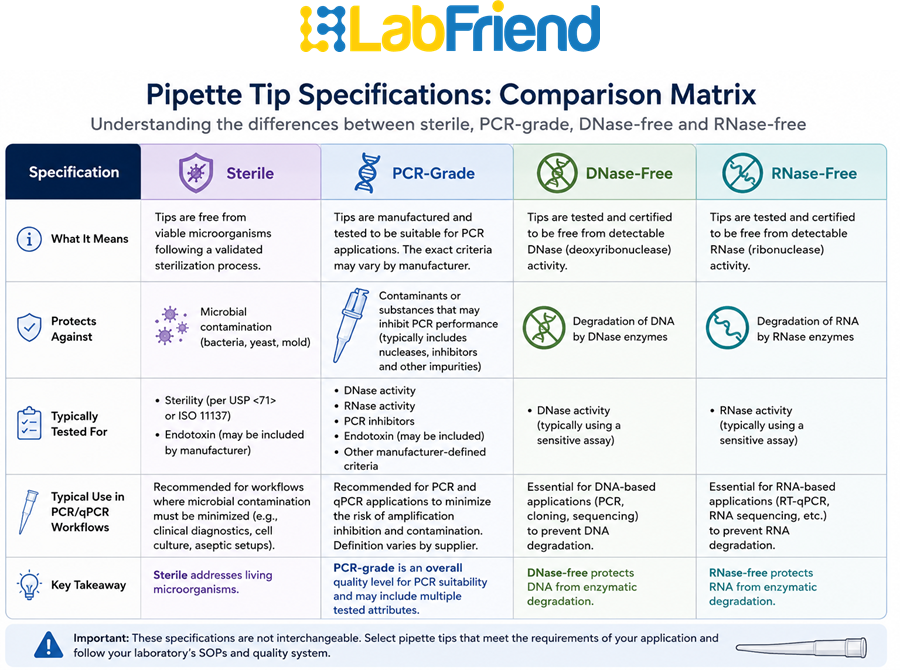
Sterility should always be considered in the context of the workflow rather than treated as a universal requirement.
Many laboratories performing contamination-sensitive molecular biology work choose sterile consumables, while other routine PCR applications may be appropriately supported by non-sterile products that align with laboratory procedures.
It is also important to distinguish between sterile, DNase/RNase-free and PCR-grade specifications, as these describe different product attributes.
PCR-grade is a manufacturer-defined designation rather than a universally standardised regulatory term, so laboratories should review the specific testing claims made by each supplier rather than assume equivalence between brands.
Further guidance is available in Sterile vs Non-Sterile Pipette Tips – Which Should Your Laboratory Choose?.
Low-Retention Performance
PCR workflows frequently involve valuable enzymes, master mixes and low-volume samples.
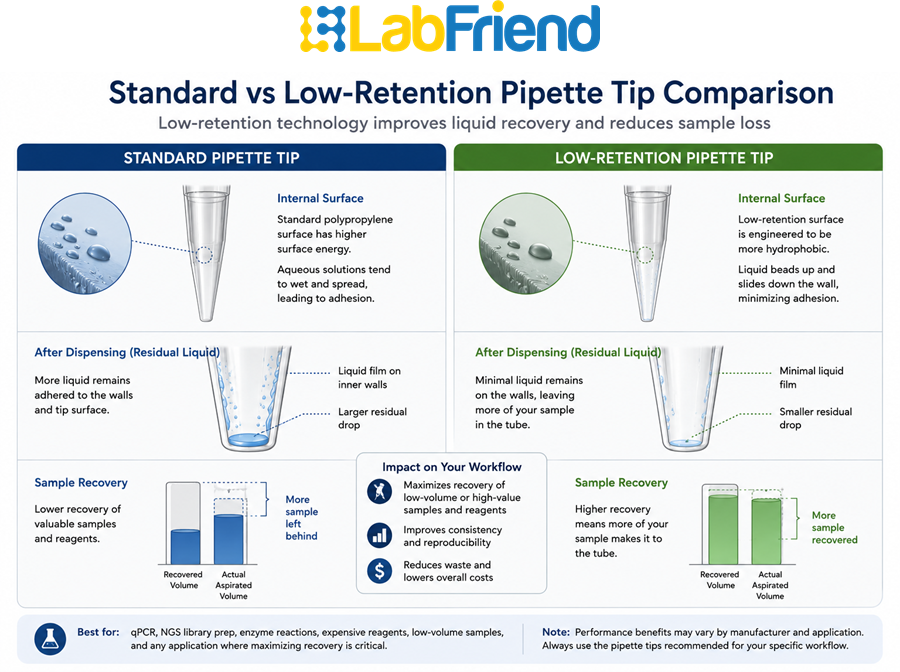
Low-retention pipette tips are designed to reduce liquid adhesion to the internal surface of the tip, helping maximise sample recovery where reagent conservation is particularly important.
This is typically achieved through specialised surface treatments, such as modified polypropylene or hydrophobic coatings, that reduce surface tension between the liquid and the tip wall.
Although not every workflow requires low-retention technology, laboratories handling expensive molecular biology reagents often evaluate whether these products provide measurable workflow benefits.
Compatibility
Reliable liquid handling also depends on secure compatibility between the pipette and the consumable.
Laboratories should ensure that selected pipette tips are suitable for their pipette platform and validated according to laboratory procedures.
Compatibility validation should confirm both a secure physical seal and accurate, precise performance across the pipette's stated volume range, rather than physical fit alone.
For laboratories considering compatible consumables, Universal vs Manufacturer-Specific Pipette Tips – What Scientists Need to Know provides further guidance.
Single-Channel vs Multichannel Formats
Laboratories running high-throughput qPCR on 96- or 384-well plates should also consider multichannel tip compatibility alongside the single-tip characteristics discussed above. Consistent fit and performance across every channel is important for maintaining reproducibility across a plate.
A Practical Selection Framework
Rather than selecting consumables by habit, laboratories should align pipette tip characteristics with workflow requirements.
|
Laboratory Requirement |
Characteristics to Consider |
|
Routine PCR |
High-quality compatible pipette tips with reliable fit and manufacturing consistency |
|
qPCR |
Filter pipette tips, with consideration for contamination-sensitive workflows |
|
Valuable enzymes or master mixes |
Low-retention pipette tips may help maximise sample recovery |
|
Regulated or aseptic workflows |
Sterile consumables where required by laboratory procedures |
|
Mixed laboratory applications |
A consistent product family offering multiple configurations across compatible pipette platforms |
No single configuration is appropriate for every laboratory. Instead, the most effective purchasing decisions combine scientific requirements, operational efficiency and laboratory quality systems to select products that support reliable day-to-day performance.
Browse Laboratory Pipette Tips
Laboratories wishing to compare compatible pipette tip options can browse the current Laboratory Pipette Tips range available from LabFriend UK.
Choosing Between Different Types of PCR and qPCR Pipette Tips
Selecting the most appropriate pipette tip for PCR or qPCR is rarely about finding a single "best" product. Instead, laboratories should evaluate which combination of features best supports the analytical requirements of the workflow, the laboratory's quality procedures and the characteristics of the samples being handled.
The following comparisons provide a practical framework for making informed purchasing decisions.
Filter vs Non-Filter Pipette Tips
One of the first decisions laboratories make when purchasing pipette tips for molecular biology is whether to use filter or non-filter products.
Filter pipette tips contain an internal aerosol barrier that helps reduce the movement of aerosols towards the pipette body during aspiration. They are widely used in PCR and qPCR laboratories because they form one component of a broader contamination-control strategy alongside good laboratory practice, appropriate pipetting technique and routine equipment maintenance.
However, this does not mean every PCR workflow automatically requires filter tips. Laboratories should assess the likelihood and consequences of contamination within the context of their own applications.
For example, research laboratories routinely handling amplified DNA, RNA or highly sensitive qPCR assays may prioritise filter tips to support assay integrity. Conversely, some routine endpoint PCR applications may be appropriately supported by high-quality non-filter tips where laboratory risk assessments and standard operating procedures permit their use.
Understanding the workflow is therefore more important than following a universal purchasing rule.
For a more detailed discussion of contamination control and aerosol barriers, readers can refer to When Should You Use Filter Pipette Tips in qPCR and Molecular Biology?.
Sterile vs Non-Sterile Pipette Tips
Sterility is another specification that should be considered carefully rather than assumed to be essential for every molecular biology application.
Laboratories working within regulated environments, clinical diagnostics or contamination-sensitive workflows frequently specify sterile consumables as part of established quality procedures. Other laboratories may determine that non-sterile pipette tips are entirely appropriate for routine PCR applications where contamination risks are controlled through other validated procedures.
Importantly, laboratories should distinguish between:
- sterile products;
- DNase/RNase-free products;
- PCR-grade consumables; and
- certified nuclease-free consumables.
These terms describe different manufacturing controls and product characteristics and should not be regarded as interchangeable.
In practice, this means a product carrying one of these claims does not automatically carry the others, so each specification should be verified independently against the workflow's requirements.
Further guidance is available in Sterile vs Non-Sterile Pipette Tips – Which Should Your Laboratory Choose?.
Low-Retention vs Standard Pipette Tips
PCR and qPCR frequently involve transferring expensive enzymes, master mixes and precious biological samples in very small volumes. Even modest liquid retention within the pipette tip can contribute to reagent loss over the course of repeated experiments.
Low-retention pipette tips are manufactured with surface properties that reduce liquid adhesion, helping maximise sample recovery where adsorption could otherwise become significant.
This benefit is most pronounced at very low volumes, such as the sub-20 µL transfers typical of qPCR, where surface adhesion represents a proportionally larger share of the total volume transferred.
Laboratories commonly evaluate low-retention products when working with:
- proteins;
- enzymes;
- viscous master mixes;
- nucleic acid preparations; or
- expensive reagents where conservation is commercially and scientifically important.
For many routine PCR applications, standard high-quality pipette tips remain entirely appropriate. The decision should always be based on application requirements rather than assuming that premium specifications automatically improve every workflow.
Universal vs Manufacturer-Specific Pipette Tips
Many laboratories evaluate both original manufacturer consumables and compatible alternatives during procurement.
Manufacturer-specific pipette tips are designed specifically for particular pipette models, while compatible products are engineered to perform with one or more supported pipette platforms.
The choice depends on factors including:
- compatibility validation;
- laboratory quality procedures;
- procurement strategy;
- operational cost;
- availability; and
- documented performance within the intended application.
Laboratories considering compatible products may find further guidance in Universal vs Manufacturer-Specific Pipette Tips – What Scientists Need to Know.
Product Selection Matrix
The following framework summarises the characteristics laboratories may wish to consider for common molecular biology applications.
|
Application |
Filter |
Sterile |
Low-Retention |
Typical Purchasing Consideration |
|
Routine PCR |
Optional |
Workflow dependent |
Optional |
Select products aligned with laboratory SOPs and contamination risk assessment. |
|
Quantitative PCR (qPCR) |
Frequently considered |
Often appropriate |
Frequently beneficial |
Prioritise reproducibility and contamination control. |
|
DNA/RNA preparation |
Often considered |
Workflow dependent |
Beneficial |
Protect valuable samples and minimise sample loss. RNA work carries a specific RNase-contamination risk distinct from general nuclease-free claims, so RNase-free certification should be checked explicitly. |
|
Protein or enzyme handling |
Optional |
Workflow dependent |
Strongly considered |
Reduce liquid adhesion and maximise reagent recovery. |
|
Mixed laboratory use |
Depends on workflow |
Depends on workflow |
Optional |
Standardise where possible while maintaining application suitability. |
Rather than prescribing a single solution, this framework supports structured evaluation based on scientific, operational and commercial requirements.
Common Purchasing Mistakes
Laboratories can often improve both workflow consistency and procurement efficiency by avoiding several common mistakes.
These include:
- selecting consumables solely on purchase price;
- assuming all PCR workflows require identical pipette tips;
- overlooking compatibility with existing pipette platforms;
- confusing sterile, PCR-grade and nuclease-free specifications;
- introducing alternative consumables without appropriate laboratory evaluation;
- overlooking the potential value of low-retention products when handling expensive reagents;
- overlooking proper tip storage and handling, such as keeping racked tips sealed and away from potential aerosol or dust exposure; and
- switching pipette tip lots or suppliers without re-verifying performance against laboratory procedures, which can introduce unrecognised variability even where the replacement product appears equivalent on paper.
A structured purchasing process helps ensure consumable selection supports both analytical quality and long-term operational efficiency.
Frequently Asked Questions
What are the best pipette tips for PCR?
The most appropriate pipette tip depends on contamination risk, sample type, reagent value, workflow sensitivity and laboratory procedures. There is no universally "best" product for every PCR application.
Should I always use filter pipette tips for qPCR?
Many laboratories choose filter pipette tips for qPCR because they help reduce aerosol transfer as part of broader contamination-control procedures. Individual laboratories should always follow their own validated protocols.
Are low-retention pipette tips worth using?
Where valuable enzymes, proteins or low-volume reagents are routinely handled, low-retention pipette tips may improve sample recovery and reduce reagent waste.
Does sterile mean PCR-grade?
No. Sterility, PCR-grade manufacturing and DNase/RNase-free certification describe different product characteristics. For example, a product can be certified DNase/RNase-free without being manufactured or packaged as sterile, and vice versa. Laboratories should review product specifications carefully before purchasing.
Can compatible pipette tips be used for PCR?
Compatible pipette tips may be entirely suitable where they have been validated for the relevant pipette platform and evaluated within the laboratory's own quality procedures.
Does pipette tip volume range matter for PCR and qPCR?
Yes. Selecting a tip whose rated volume range matches, rather than sits at the extreme end of, the dispensing volume supports better accuracy and precision. This is particularly relevant for the low-volume transfers common in qPCR.
Conclusion
Choosing the best pipette tips for PCR and qPCR workflows is fundamentally about matching consumable characteristics to the demands of the application.
Factors such as contamination control, sample value, reagent recovery, compatibility and laboratory quality procedures all influence which products are most appropriate. By taking an application-led approach rather than relying on habit or purchase price alone, laboratories can improve workflow consistency while making more informed procurement decisions.
Pipette tips should therefore be viewed as an integral component of the liquid handling system rather than simply another laboratory consumable. Selecting products that align with scientific requirements helps protect valuable samples, supports reproducible molecular biology workflows and contributes to long-term operational efficiency.
Explore Laboratory Pipette Tip Solutions
To compare compatible pipette tip options for a wide range of laboratory applications, browse the Laboratory Pipette Tips category from LabFriend UK.
You may also find these related expert guides useful:
- The Complete Guide to Pipette Tips, Pipetting Accuracy & Laboratory Liquid Handling
- Pipetting for PCR: How to Maximise Accuracy in DNA Amplification Workflows
- qPCR Pipetting Best Practices: How to Reduce Variability and Improve Accuracy at Low Volumes
- When Should You Use Filter Pipette Tips in qPCR and Molecular Biology?
- Sterile vs Non-Sterile Pipette Tips – Which Should Your Laboratory Choose?
- Universal vs Manufacturer-Specific Pipette Tips – What Scientists Need to Know
This article forms part of the LabFriend Pipette Tips Authority Hub, helping UK laboratories make evidence-informed decisions about liquid handling consumables, contamination control and molecular biology workflow optimisation.
Written by: Donal O’Sullivan, BSc, Co-Founder and Sales Director, LabFriend UK. Donal brings deep chemistry-led technical expertise across analytical chemistry, biochemistry, environmental monitoring, laboratory instrumentation, consumables and scientific product selection.
Reviewed by: Michael Anderson, MBA, Founder and Managing Director, LabFriend UK. Michael reviews LabFriend UK content for customer relevance, commercial accuracy, operational practicality and alignment with LabFriend UK’s laboratory supply model.
Frequently asked questions
Delivery times vary by product and supplier. Each product page shows current stock levels and the expected lead time, and we confirm this when you place your order. Most items arrive within 2 to 3 weeks. Specialised items can take longer if they are not in stock. If you need something by a certain date, contact us and we’ll check for you.
Yes. Register for a commercial account and, once it’s approved, you will be able to process orders via PO Once you have a commercial account, you can directly email your purchase orders
Add products to your cart and click Get a Quote. You’ll get a formal quote instantly, ready to send to your email address. For bulk orders or custom requirements, send us your product list and we’ll reply with itemized pricing.
If your item is faulty, not as described or sent in error, let us know within 14 days of delivery and we’ll arrange a return. Change of mind returns are only accepted if the item is unused and in its original packaging. A restocking fee will apply and you pay the return freight. Read our full Returns Policy for details.
Yes, prices are shown including VAT by default. Use the Prices Inc. VAT toggle at the top of the page to view prices without VAT.