Compatible Pipette Tips for Eppendorf Pipettes | Validation & Selection Guide
23 mins read
Compatible Pipette Tips for Eppendorf Pipettes | Validation & Selection Guide

By Donal O’Sullivan, BSc. Reviewed by Michael Anderson, MBA.
Eppendorf pipettes are widely used throughout UK research, biotechnology, pharmaceutical, clinical and analytical laboratories because of their precision, ergonomics and long-established reputation for reliable liquid handling. As laboratories continue to focus on operational efficiency and procurement resilience, many are reviewing whether compatible (sometimes referred to as third-party or universal) pipette tips can provide an appropriate alternative to manufacturer-specific consumables without compromising workflow performance.
For procurement managers, laboratory managers and quality professionals, this question extends beyond simple product compatibility. It involves balancing scientific performance with supplier resilience, inventory management, purchasing efficiency and long-term cost control. Selecting a compatible pipette tip should therefore be approached as a structured technical and procurement decision rather than simply choosing a lower-cost consumable.
This guide explains how UK laboratories can evaluate compatible pipette tips for Eppendorf pipettes, the factors that should be considered before introducing alternative consumables into routine use, and how a documented evaluation process can support confident supplier decisions.
For a comprehensive overview of pipette tip selection, liquid handling accuracy and laboratory workflows, begin with The Complete Guide to Pipette Tips, Pipetting Accuracy & Laboratory Liquid Handling:
Why Laboratories Evaluate Compatible Pipette Tips
Procurement strategies have changed significantly over the last decade. Laboratory managers are now expected to maintain reliable scientific performance while also improving purchasing efficiency and reducing supply-chain risk.
Historically, many laboratories purchased consumables from the same manufacturer that supplied their instruments. While this approach often simplified procurement, it could also increase dependence on a single supplier and reduce purchasing flexibility.
Today, many laboratories periodically review compatible consumables as part of wider procurement initiatives that aim to:
- strengthen supply continuity;
- reduce dependence on a single supplier;
- simplify purchasing across multiple laboratory sites;
- improve stock management;
- support long-term cost optimisation; and
- broaden approved supplier options.
Importantly, evaluating compatible consumables should never mean assuming that all alternatives are interchangeable. Instead, laboratories should determine whether a compatible pipette tip is suitable for the intended workflow through an appropriate technical assessment.
This evidence-based approach supports procurement confidence while maintaining scientific integrity.
Understanding Eppendorf Pipette Platforms
Eppendorf manufactures a broad range of adjustable-volume microlitre pipettes used across routine laboratory liquid handling, molecular biology, microbiology, pharmaceutical development and analytical testing.
Many laboratories standardise on Eppendorf pipettes because of their reputation for accuracy, ergonomics and repeatability. Others operate mixed pipette fleets containing instruments from several manufacturers.
If your laboratory is reviewing its existing pipette estate, LabFriend offers a range of Eppendorf pipettes suitable for research and routine laboratory applications:
Understanding the composition of the laboratory's pipette fleet is an important first step before evaluating compatible consumables, particularly where multiple instrument platforms are used.
Original Manufacturer and Compatible Pipette Tips
When considering consumables for Eppendorf pipettes, laboratories generally have two procurement pathways.
The first is to continue using original manufacturer pipette tips that have been developed specifically for Eppendorf instruments.
The second is to evaluate compatible pipette tips designed to fit Eppendorf pipettes while also supporting other compatible pipette platforms.
Laboratories wishing to review original manufacturer consumables can browse the available Eppendorf pipette tips range:
Alternatively, laboratories exploring broader procurement options may wish to compare the complete Full Laboratory Pipette Tips Range range, which includes compatible solutions for a variety of laboratory workflows:
The most appropriate choice depends on technical requirements, laboratory procedures, procurement strategy and workflow validation.
What Are Compatible Pipette Tips?
Compatible pipette tips are consumables designed to fit one or more pipette platforms while providing reliable liquid handling performance when used within appropriate laboratory workflows.
They are commonly evaluated by laboratories seeking greater procurement flexibility or wishing to reduce reliance on a single consumables supplier.
|
Compatible pipette tips are pipette tips designed to fit specified pipette platforms and support appropriate liquid handling performance when assessed and validated for the intended laboratory application. |
It is important to distinguish compatibility from equivalence. A compatible pipette tip is not automatically identical to an original manufacturer consumable. Rather, its suitability should be established through laboratory assessment before routine implementation.
This distinction is central to good procurement practice and helps laboratories make informed purchasing decisions based on evidence rather than assumption.
Physical Compatibility Is Only the Starting Point
One of the most common misconceptions encountered during supplier evaluations is that a pipette tip is suitable simply because it attaches securely to the pipette.
In reality, physical attachment represents only the first stage of compatibility.
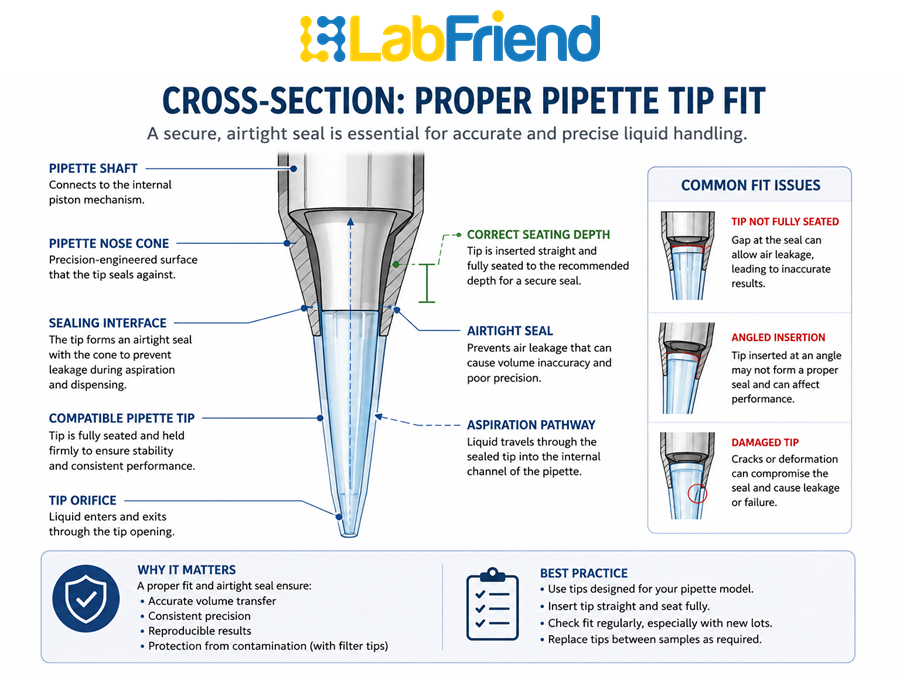
Laboratories should also consider whether the tip provides:
- reliable seal integrity;
- consistent aspiration;
- consistent dispensing;
- appropriate ejection force;
- acceptable operator experience; and
- reproducible workflow performance.
These factors determine whether a compatible pipette tip is suitable for routine laboratory use.
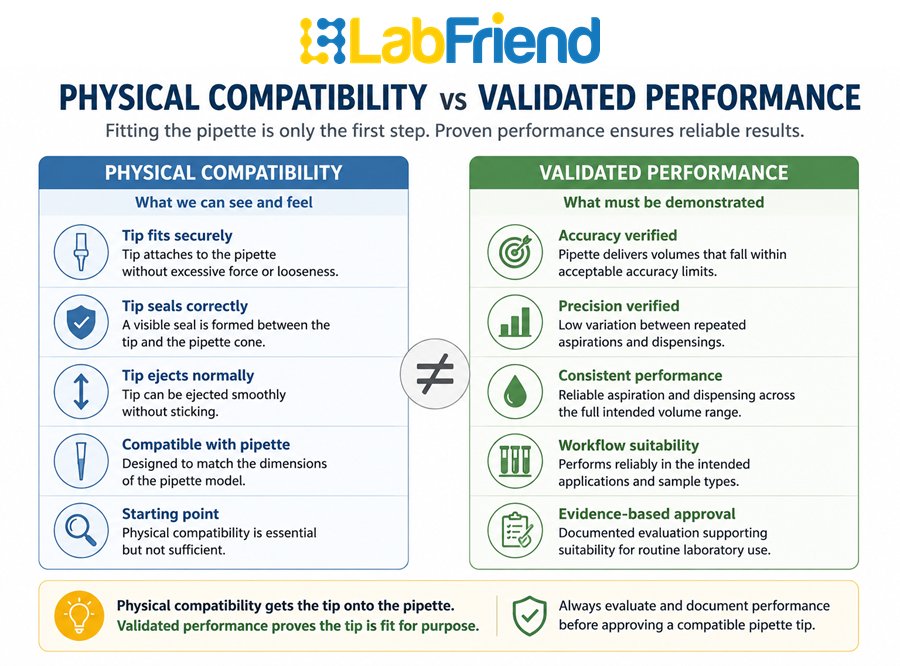
The relationship between physical attachment and overall performance is explored in greater detail in Optimise Your Pipetting Accuracy with Compatible Pipette Tips:
Why Validation Matters
A structured validation process enables laboratories to assess whether a compatible pipette tip is appropriate for their own workflows rather than relying solely on product descriptions or purchasing assumptions.
Validation does not necessarily require an extensive formal qualification programme for every laboratory. The level of assessment should be proportionate to the application, quality-system requirements and operational risk.
For example, laboratories performing routine buffer preparation may adopt a different evaluation approach from those working with low-volume PCR (polymerase chain reaction), regulated pharmaceutical testing or contamination-sensitive molecular biology workflows.
The objective is to gather sufficient evidence to support confident implementation.
Practical Principle
Laboratories should evaluate compatible pipette tips within the workflows in which they will actually be used, using representative pipettes, operators and sample types wherever possible.
Procurement Considerations Beyond Purchase Price
Although cost remains an important purchasing factor, procurement teams increasingly recognise that the true value of a laboratory consumable extends well beyond its unit price.
A compatible pipette tip may contribute to operational efficiency by supporting:
- simplified purchasing;
- improved inventory management;
- broader supplier choice;
- reduced dependence on a single manufacturer;
- more resilient supply chains; and
- streamlined consumables standardisation.
Equally, laboratories must consider the resources required to evaluate, approve and implement any alternative consumable.
The most effective procurement decisions therefore balance scientific performance, operational practicality and long-term commercial value.
Building a Defensible Supplier Evaluation Process
The strongest procurement decisions are based on documented evidence rather than preference.
An effective supplier evaluation should consider three complementary questions:
- Is the pipette tip physically compatible with the Eppendorf pipette platform?
- Does it consistently support the laboratory's intended workflows?
- Does the supplier provide the level of quality, continuity and technical support expected by the organisation?
Answering these questions through a structured evaluation process helps laboratories reduce implementation risk while supporting informed purchasing decisions.
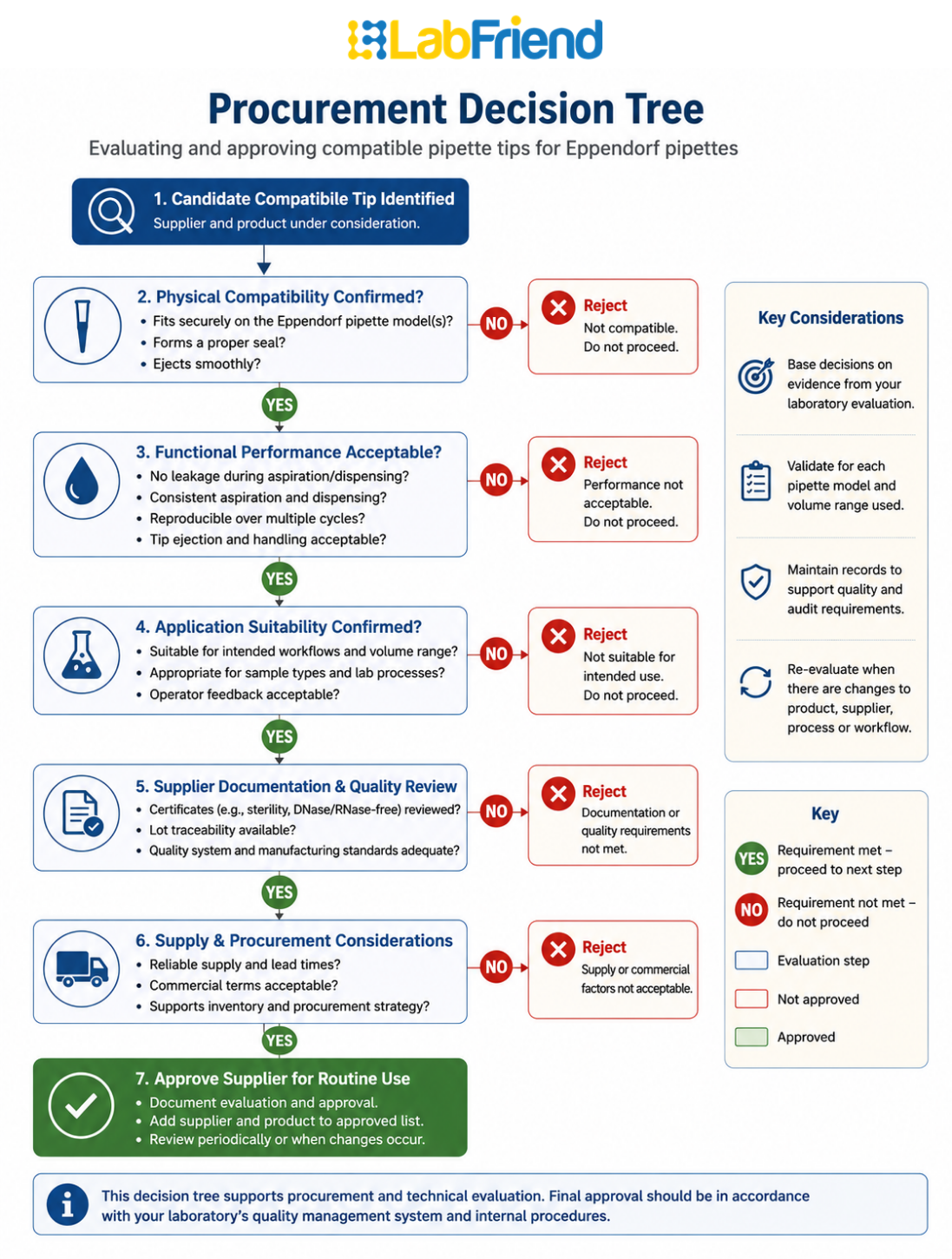
The next section of this guide explains how UK laboratories can develop a practical validation workflow, compare compatible and original manufacturer consumables, and document supplier evaluations in a manner that supports both procurement confidence and scientific reproducibility.
A Practical Validation Workflow for Compatible Pipette Tips
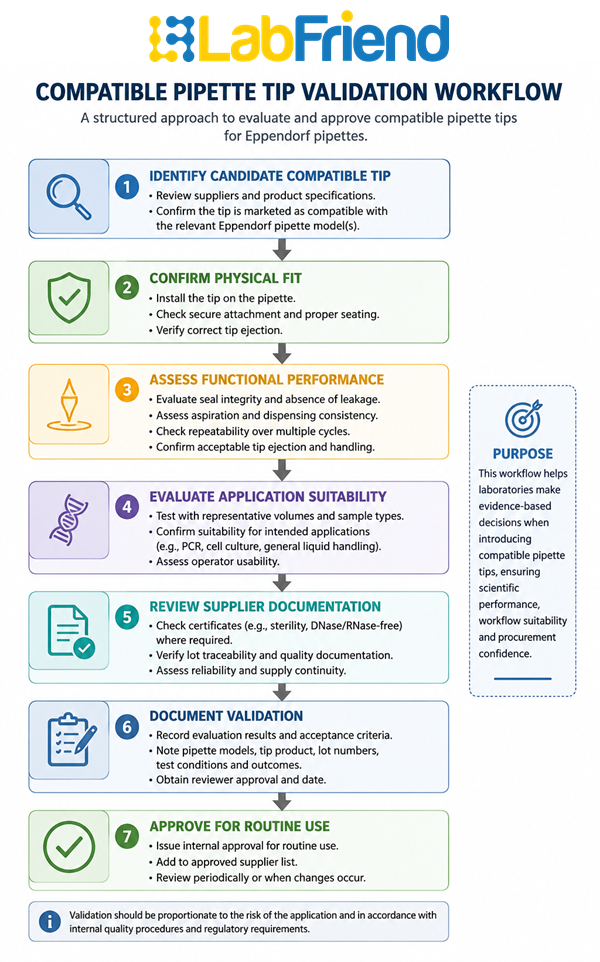
Once a laboratory has identified a compatible pipette tip for evaluation, the next step is to undertake a structured assessment that reflects both the technical requirements of the workflow and the organisation's procurement policies.
The objective is not to prove that a compatible tip is identical to the original manufacturer's product. Rather, it is to establish whether the proposed consumable performs consistently within the laboratory's intended applications and can be introduced with confidence.
Although the depth of evaluation will vary between organisations, most assessments benefit from following a logical sequence that builds evidence before routine implementation.
Step 1 – Confirm Physical Compatibility
The evaluation begins by confirming that the pipette tip fits the intended Eppendorf pipette models correctly.
At this stage, laboratories should consider:
- consistency of attachment;
- stability during aspiration and dispensing;
- ease of fitting and removal; and
- compatibility across all relevant pipette volume ranges.
Physical attachment alone should never be regarded as evidence of overall suitability. It is simply the foundation upon which further evaluation is built.
Step 2 – Assess Functional Performance
Once physical compatibility has been confirmed, attention should turn to functional performance during normal laboratory use.
Typical observations include:
- seal integrity;
- aspiration consistency;
- dispensing consistency;
- reproducibility over repeated cycles; and
- operator handling characteristics.
Where possible, testing should be performed using representative laboratory liquids and the applications for which the consumable is intended.
ISO 8655, the recognised international standard for piston-operated volumetric apparatus, provides the established technical framework for assessing pipette performance and can usefully inform how a laboratory structures its own compatible-tip evaluation.
Volumetric accuracy and precision are typically assessed through gravimetric testing, in which dispensed volumes are determined by weighing on a calibrated balance and converting mass to volume. This provides an objective, repeatable basis for comparing a compatible pipette tip's performance against expected tolerances.
Step 3 – Evaluate Workflow Suitability
A compatible tip that performs well during routine liquid handling may require additional assessment before being introduced into more demanding workflows.
Applications such as PCR, qPCR (quantitative PCR) and molecular biology often involve low transfer volumes or contamination-sensitive procedures, where even minor variations in performance may become more significant.
Laboratories working in these areas should also review:
- Pipetting for PCR: How to Maximise Accuracy in DNA Amplification Workflows
- qPCR Pipetting Best Practices: How to Reduce Variability and Improve Accuracy at Low Volumes
Where contamination control forms part of the evaluation, laboratories should also consider:
Comparing Procurement Considerations
The decision between original manufacturer consumables and compatible alternatives should be based on structured evaluation rather than assumptions.
|
Procurement Consideration |
Original Eppendorf Tips |
Compatible Pipette Tips |
|
Existing familiarity |
Established in many laboratories |
Lower initial familiarity; established through evaluation |
|
Supplier flexibility |
Single manufacturer route |
Broader supplier choice |
|
Inventory standardisation |
Depends on pipette fleet |
May simplify mixed-platform laboratories |
|
Supply resilience |
Dependent on original supply chain |
Opportunity to diversify supply |
|
Workflow suitability |
Already established locally |
Should be confirmed through evaluation |
|
Long-term procurement strategy |
Manufacturer-led |
Laboratory-led supplier choice |
This comparison should be viewed as a decision-support tool rather than a recommendation. Every laboratory should assess the option that best aligns with its scientific, operational and commercial requirements.
Supplier Evaluation Checklist
Documenting a supplier assessment helps create a transparent and repeatable procurement process.
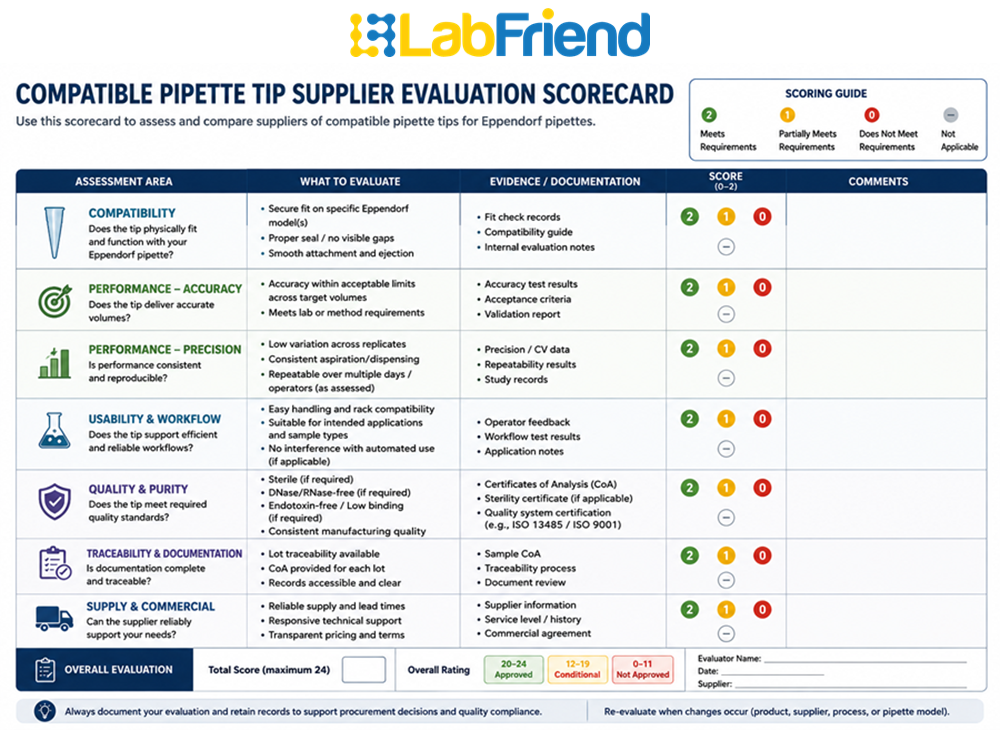
Many laboratories incorporate similar checklists into their internal purchasing or change-control procedures.
Laboratories operating under a formal quality management system, such as ISO/IEC 17025, GLP or GMP, may also need to retain completed supplier evaluation records as part of their change-control documentation.
Considering LLG Labware as a Compatible Alternative
Laboratories seeking to broaden their approved supplier base may wish to evaluate the LLG Labware range of compatible pipette tips.
LLG Labware products are designed to support routine laboratory liquid handling and are available in a variety of formats, including standard, sterile and filter pipette tips across multiple volume ranges.
Rather than viewing LLG Labware as a direct replacement by default, laboratories should include these products within the same structured evaluation process applied to any other compatible consumable.
The available range can be explored through:
For laboratories comparing a wider selection of compatible and manufacturer-specific consumables, the full category can be viewed here:
Full Laboratory Pipette Tips Range
Frequently Asked Questions
Can compatible pipette tips be used with Eppendorf pipettes?
Many compatible pipette tips are designed for use with Eppendorf pipettes. However, each laboratory should assess compatibility, workflow suitability and performance before routine implementation.
Are compatible pipette tips identical to original Eppendorf tips?
Not necessarily. Compatible products should be evaluated on their own merits rather than assumed to be equivalent to the original manufacturer's consumables.
Should laboratories document compatibility evaluations?
Where quality systems or internal procedures require it, documenting compatibility assessments can support procurement decisions and change-control processes.
Can compatible tips improve procurement flexibility?
They may. Introducing additional approved suppliers can help improve supply resilience and reduce dependence on a single manufacturer, provided technical suitability has been confirmed.
What is the most important part of a compatibility assessment?
A successful evaluation considers physical fit, functional performance and suitability for the intended laboratory workflow rather than focusing on any single characteristic.
Does switching to compatible pipette tips affect my pipette's existing calibration?
No. Calibration applies to the pipette instrument itself, not to the tips used with it. Compatible pipette tip performance should be assessed separately from, and in addition to, the pipette's existing calibration record.
Conclusion
Selecting pipette tips for Eppendorf pipettes is no longer simply a question of remaining with the original manufacturer or choosing an alternative based on price alone. Modern laboratory procurement requires a broader perspective that balances technical performance, supply resilience, purchasing efficiency and operational risk.
Compatible pipette tips can provide valuable procurement flexibility when they are introduced through a structured assessment process. By confirming physical compatibility, evaluating functional performance and reviewing workflow suitability, laboratories can make evidence-based decisions that support both scientific confidence and commercial objectives.
Ultimately, the strongest procurement strategies are those that combine rigorous technical evaluation with practical purchasing considerations, ensuring that consumables continue to meet the needs of both the laboratory and the organisation it supports.
Once a compatible pipette tip has been approved, it is good practice to periodically re-review its performance, for example following a supplier lot change or at a defined interval, to maintain ongoing confidence in the consumable.
Explore Pipette Tip Options for Your Laboratory
Whether you are reviewing your current Eppendorf consumables, evaluating compatible alternatives or developing a broader supplier strategy, LabFriend offers a comprehensive range of laboratory liquid handling products.
Explore:
- Eppendorf Pipettes
- Eppendorf Pipette Tips
- Full Laboratory Pipette Tips Range
- LLG Labware Pipette Tips
For additional technical guidance, continue exploring the LabFriend Insights hub, including:
- The Complete Guide to Pipette Tips, Pipetting Accuracy & Laboratory Liquid Handling
- Optimise Your Pipetting Accuracy with Compatible Pipette Tips
- Why Pipette Tip Fit Matters for Accurate Laboratory Pipetting
- How UK Laboratories Validate Third-Party Compatible Pipette Tips
Together, these resources provide a structured knowledge base to support informed laboratory purchasing decisions and the successful implementation of compatible pipette tips. Other informative pipetting articles can be explored in our Insights Hub
Written by: Donal O’Sullivan, BSc, Co-Founder and Sales Director, LabFriend UK. Donal brings deep chemistry-led technical expertise across analytical chemistry, biochemistry, environmental monitoring, laboratory instrumentation, consumables and scientific product selection.
Reviewed by: Michael Anderson, MBA, Founder and Managing Director, LabFriend UK. Michael reviews LabFriend UK content for customer relevance, commercial accuracy, operational practicality and alignment with LabFriend UK’s laboratory supply model.
Frequently asked questions
Delivery times vary by product and supplier. Each product page shows current stock levels and the expected lead time, and we confirm this when you place your order. Most items arrive within 2 to 3 weeks. Specialised items can take longer if they are not in stock. If you need something by a certain date, contact us and we’ll check for you.
Yes. Register for a commercial account and, once it’s approved, you will be able to process orders via PO Once you have a commercial account, you can directly email your purchase orders
Add products to your cart and click Get a Quote. You’ll get a formal quote instantly, ready to send to your email address. For bulk orders or custom requirements, send us your product list and we’ll reply with itemized pricing.
If your item is faulty, not as described or sent in error, let us know within 14 days of delivery and we’ll arrange a return. Change of mind returns are only accepted if the item is unused and in its original packaging. A restocking fee will apply and you pay the return freight. Read our full Returns Policy for details.
Yes, prices are shown including VAT by default. Use the Prices Inc. VAT toggle at the top of the page to view prices without VAT.