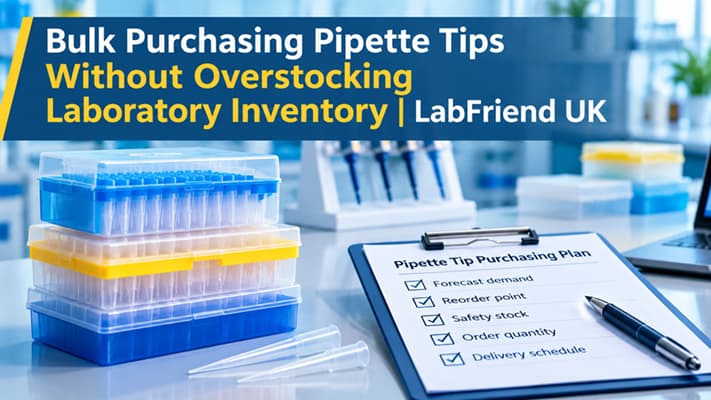
Bulk Purchasing Pipette Tips Without Overstocking Laboratory Inventory
25 mins read
Bulk Purchasing Pipette Tips Without Overstocking Laboratory Inventory
By Donal O’Sullivan, BSc. Reviewed by Michael Anderson, MBA.
Bulk purchasing pipette tips can help laboratories organise
repeat consumables supply and reduce the administrative work associated with
frequent small orders. However, buying larger quantities does not automatically
reduce overall purchasing costs or improve supply continuity. For contract research organisations (CROs), testing
laboratories and other facilities managing changing workloads, the challenge is
to purchase enough pipette tips to support scheduled work without tying up
unnecessary budget or storage space. An effective purchasing approach starts with actual
consumption, expected demand and realistic replenishment times. These factors
help determine whether larger orders, more frequent deliveries or a combination
of both will best support the laboratory. |
Key Takeaways
- Base
bulk purchasing decisions on actual consumption. Historical usage provides
a useful starting point, but planned projects and changing workloads must
also be considered.
- Separate
purchasing quantity from stockholding quantity. A larger purchasing
commitment does not necessarily mean every pack must be delivered and
stored at once.
- Calculate
reorder points using demand and replenishment lead time. Include a
justified allowance for uncertainty rather than applying an arbitrary
safety-stock percentage.
- Account
for the full cost of inventory. Storage, administration, obsolete stock
and emergency purchasing can offset apparent unit-price savings.
- Maintain
approved pipette-tip specifications. A purchasing decision must not
introduce unsuitable consumables or unassessed changes to established
workflows.
- Review purchasing arrangements regularly. Consumption, project schedules and supplier performance can change, making an earlier ordering plan less appropriate.
Why Bulk Pipette-Tip Purchasing Requires Careful Planning
Pipette tips are recurring consumables in many laboratory
workflows. Their consumption may be relatively predictable in routine testing
but more variable in CRO environments where project volumes, methods and
customer requirements change.
Bulk purchasing can offer operational advantages when the
quantity ordered reflects realistic demand. Potential benefits include fewer
purchase orders, reduced administrative effort and greater visibility of future
consumables requirements.
The difficulty arises when purchasing decisions are driven
primarily by pack price or order size.
A laboratory may secure a lower price per tip but
subsequently discover that:
- Consumption
is lower than expected.
- A
project has been delayed or cancelled.
- The
laboratory requires a different approved tip specification.
- Storage
capacity is insufficient.
- Existing
stock must be used before newly purchased quantities.
- Additional
expenditure is needed for urgent supplies of other tip formats.
These situations do not necessarily make bulk purchasing
unsuitable. They demonstrate why the purchasing quantity should be evaluated
alongside inventory exposure and the laboratory's operating requirements.
The objective is not to hold the smallest possible stock or
obtain the lowest possible unit price. It is to maintain sufficient suitable
consumables while avoiding unnecessary inventory.
The Hidden Costs of Buying Too Many Pipette Tips
The purchase price is only one element of the total cost of
supplying pipette tips to a laboratory.
Several operational costs can become significant when stock
levels are poorly controlled.
Storage and handling
Pipette-tip racks, refill systems and bulk packs require
suitable storage space. Larger inventories may increase the time needed to
receive deliveries, allocate stock, maintain records and retrieve the correct
items.
Storage requirements should also reflect the manufacturer's
instructions and the laboratory's contamination-control procedures.
Capital tied up in inventory
Stock that will not be used for several months represents
expenditure that cannot be allocated to other laboratory needs.
For laboratories managing multiple projects, unnecessary
inventory can reduce purchasing flexibility when new requirements arise.
Obsolete or unsuitable stock
Changes to laboratory methods, equipment or approved
consumables specifications can leave previously purchased tips unsuitable for
future work.
Pipette tips should not be assumed to be interchangeable
merely because they share a nominal volume range or appear physically similar.
Emergency purchasing
Excess stock of one tip format does not prevent shortages of
another.
For example, a laboratory may hold substantial quantities of
standard tips while running short of a filtered or otherwise specifically
approved format required for scheduled work.
The result may be an urgent purchase despite an apparently
well-stocked consumables store.
These costs should be considered alongside the broader
principles of reducing pipette-tip consumables costs without increasing workflow risk.
Start With Actual Pipette-Tip Consumption
Before deciding how many pipette tips to purchase, establish
how many are used over a representative period.
For a laboratory with reasonably consistent operations,
recent purchasing and stock-issue records may provide an initial estimate.
However, purchasing records alone can be misleading when orders have been
irregular or stock levels have changed substantially.
Where reliable inventory records exist, consumption over a
period can be estimated as:
Consumption = Opening stock + Stock received − Closing stock
This calculation assumes that stock adjustments, transfers,
disposals and returns have been accounted for appropriately.
For example, consider a laboratory with the following
records for one approved tip specification.
|
Inventory measure |
Quantity |
|
Opening stock |
12,000 tips |
|
Deliveries received |
30,000 tips |
|
Closing stock |
18,000 tips |
|
Calculated consumption |
24,000 tips |

If this covers four representative weeks, average
consumption is approximately 6,000 tips per week.
This is a useful planning baseline, not a guaranteed
forecast.
Account for changing project demand
CRO consumption can change significantly between projects.
A new analytical programme may increase the number of
samples processed. Conversely, a completed or delayed project may reduce
demand.
Purchasing forecasts should therefore consider:
- Expected
sample volumes and processing schedules.
- Planned
project starts, completions and potential delays.
- Differences
in tip consumption between methods.
- Historical
periods of unusually high or low activity.
- Known
changes to equipment or laboratory workflows.
Where demand is uncertain, consider developing a
normal-demand estimate and a higher-demand scenario rather than relying on a
single average.
Forecast by tip specification
Consumption should be assessed separately for materially
different pipette-tip specifications.
A laboratory might use several nominal volume ranges,
filtered and non-filtered formats, or particular products approved for defined
equipment and methods.
Combining all tips into one consumption figure can conceal
shortages of individual formats.
The purchasing forecast should preserve the distinctions
needed to maintain technical and workflow suitability.
For a broader explanation of tip formats and selection
considerations, see The Complete Guide to Pipette Tips, Pipetting Accuracy & Laboratory LiquidHandling.
How to Calculate a Practical Reorder Point
A reorder point indicates when the laboratory should
initiate replenishment.
It is not necessarily the quantity that should be purchased.
A simple planning model is:
Reorder point = Expected consumption during replenishment
lead time + Safety stock
The model is useful when the assumptions are explicit and
periodically reviewed.
Step 1: Establish expected consumption
Use representative consumption records and adjust for known
upcoming work. Where demand is reasonably stable, an average consumption rate
can provide a practical starting point.
For example, a laboratory may expect to use 6,000 tips per
week. However, if consumption is concentrated around particular projects,
sample batches or scheduled laboratory activities, the forecast should reflect
when that demand is expected to occur rather than assuming that usage is evenly
distributed.
A simple average-demand calculation may underestimate the
stock needed before a period of unusually high activity. Where this is
material, assess the expected demand during the actual replenishment period and
adjust the purchasing plan accordingly.
Step 2: Establish replenishment lead time
Lead time should reflect the interval between placing an
order and having usable stock available to the laboratory.
This may include order processing, supplier preparation,
transport, goods receipt and any necessary internal stock-release activities.
A quoted dispatch time should not automatically be treated
as the complete replenishment lead time.
Step 3: Determine an appropriate uncertainty allowance
Safety stock is an additional quantity intended to help
manage variation in demand or replenishment time.
There is no universally correct safety-stock percentage for
laboratory pipette tips.
The allowance should reflect the consequences of a shortage,
observed demand variation, lead-time reliability and the laboratory's ability
to respond to unexpected requirements.
Illustrative reorder-point calculation
 Under these assumptions, the
laboratory would initiate replenishment when its inventory position reaches or
falls below 15,000 tips, subject to its established stock-review arrangements.
For this calculation, inventory position means usable stock
on hand plus quantities already on order, minus quantities committed to
requirements that have not yet been fulfilled. Stock that is damaged, expired,
quarantined or otherwise unavailable for use should not be counted as usable
inventory.
Using inventory position rather than physical stock alone
helps prevent unnecessary repeat orders when replenishment is already in
progress. The calculation must use consistent units and account for outstanding
commitments to avoid overstating the stock available to meet future demand.
The 3,000-tip safety-stock allowance is illustrative, not a
recommended standard. It would need to be justified using the laboratory's
actual demand variation, supplier performance and shortage risk.
If the supplier's lead time or the laboratory's expected
consumption changes, the reorder point should be recalculated.
Bulk Order Quantity Is Not the Same as Reorder Point
A common inventory-planning mistake is to treat the reorder
point as the quantity that should be ordered.
These are separate decisions.
The reorder point determines when replenishment should
begin. The order quantity determines how much stock should be purchased or
received.
For example, a laboratory with a reorder point of 15,000
tips might decide to replenish in quantities of 24,000 tips if that is
consistent with its forecast, storage capacity and purchasing arrangements.
However, the laboratory should also account for outstanding
orders and expected consumption before the delivery arrives.
Ordering 24,000 additional tips every time physical stock
reaches 15,000 could lead to excessive inventory if previous deliveries remain
outstanding.
Use a target stock level where appropriate
An alternative is to establish a target inventory position.
Under this approach:
Replenishment quantity = Target inventory position − Current
inventory position
The target should be based on forecast demand over the
relevant review and replenishment period, together with a justified uncertainty
allowance.
This approach can be useful where purchasing is reviewed at
regular intervals or where orders are consolidated across multiple consumables.
Any calculated quantity must also be adjusted for available
pack sizes, minimum order requirements and operational constraints.
Choosing Between Larger Orders and More Frequent Deliveries
Bulk purchasing does not necessarily require the laboratory
to receive its entire anticipated requirement in one delivery.
The appropriate arrangement depends on consumption, storage
capacity, supplier terms and delivery reliability.
 Scheduled or staged deliveries
should only be included in the purchasing plan where the supplier has
explicitly agreed to provide them.
Before relying on such an arrangement, confirm the delivery
schedule, quantities, applicable commercial terms and how changes or delays
will be managed. A commitment to purchase a larger quantity does not, by
itself, establish that the supplier has reserved stock or guaranteed
availability for future deliveries.
Where continuity depends on future deliveries, the
laboratory should understand whether the arrangement represents an agreed
delivery schedule, a purchasing forecast or a confirmed allocation of stock.
These arrangements may have different implications for supply reliability.
Standardisation Opportunities Without Expanding Inventory
For bulk purchasing to remain manageable, the laboratory
needs reliable information about which pipette-tip specifications are routinely
consumed.
A controlled purchasing list can help distinguish
high-volume consumables from occasional or project-specific requirements.
Useful information includes:
- Approved
product description and specification.
- Manufacturer
and product reference where relevant.
- Pack
format and quantity per pack.
- Typical
consumption and anticipated project demand.
- Replenishment
lead time.
- Storage
requirements and any applicable use-by restrictions.
- Current
stock and outstanding orders.
This does not mean reducing the number of approved tip
specifications simply to make ordering easier.
Different applications may require different formats,
materials, sterility characteristics or compatibility requirements.
Consolidation is only appropriate where technical suitability has already been
established.
For Bulk Purchasing Pipette Tips Without Overstocking
Laboratory Inventory, the purpose of maintaining an approved purchasing list is
to improve quantity forecasting and inventory control, rather than to undertake
a broader laboratory-wide procurement standardisation programme.
Product Consolidation and Pack-Size Decisions
Pack size can influence the practicality of a bulk purchase.
For example, the same nominal quantity of pipette tips may
be supplied in different packaging configurations, depending on the product.
These configurations can affect storage, handling, waste management and
replenishment arrangements.
When comparing purchasing quantities, consider the number of
usable tips per purchasing unit rather than relying solely on the price of a
box or case.
The laboratory should also confirm that the chosen packaging
format is appropriate for its established handling and contamination-control
procedures.
A lower price per tip may be less attractive if the pack
format creates operational difficulties or leads to more stock being held than
the laboratory can reasonably use.
Where tip formats are already approved, reviewing pack
quantities and delivery schedules is generally a more direct inventory-planning
activity than changing the consumable itself.
Making Repeat Ordering More Efficient
Repeat purchasing becomes easier when ordering decisions are
based on consistent records rather than occasional stock checks or urgent
requests.
A practical approach is to maintain a repeat-order schedule
for frequently used pipette-tip specifications.
For each specification, record:
- Recent
consumption and expected near-term demand.
- Available
usable stock and outstanding purchase orders.
- The
agreed reorder point or stock-review interval.
- The
quantity required to reach the planned stock level.
- Expected
delivery dates and any material changes to supplier lead time.
The purchasing team can then review exceptions, such as
unexpected increases in usage, delayed deliveries or changes to project
schedules.
This reduces reliance on individual staff members
remembering when particular items need replenishment.
Use review intervals that match the risk
High-consumption tips with limited stock coverage may
require more frequent monitoring than products used occasionally.
A fixed monthly review may be sufficient for some
laboratories but unsuitable for a high-throughput operation with rapidly
changing demand.
The interval should reflect consumption rate, stock
coverage, replenishment time and the consequences of running short.
Check Whether the Purchasing Plan Is Working
Inventory reviews should assess more than whether stock is
available. They should also identify whether purchasing quantities remain
appropriate for actual laboratory demand.
Useful indicators include:
- Stock
coverage: How long the available usable stock is expected to last at the
current forecast consumption rate.
- Forecast
accuracy: Whether actual usage is consistently higher or lower than the
quantities anticipated.
- Excess
stock: Whether particular tip specifications are accumulating faster than
they are consumed.
- Replenishment
reliability: Whether deliveries are arriving within the lead times used
for purchasing calculations.
- Stock
shortages: Whether essential tip specifications have become unavailable
when required for scheduled work.
Where stock coverage is increasing without a corresponding
rise in expected demand, review the order quantity or delivery frequency before
committing to further bulk purchases.
Where shortages occur despite apparently adequate stock,
check whether the forecast, lead-time assumption, stock records or
specification-level allocation requires correction.
The purpose of this review is to maintain an appropriate
balance between supply continuity and inventory exposure as laboratory
requirements change.
What to Check With a Supplier Before Placing a Bulk Order
Supplier discussions should focus on whether the proposed
purchasing arrangement supports the laboratory's actual demand.
The following checklist can help CRO operations managers and
laboratory purchasing teams evaluate an arrangement.
Bulk purchasing checklist
·
Confirm the exact approved pipette-tip
specifications and pack quantities.
·
Establish the expected order-processing and
delivery lead time.
·
Ask whether the quoted quantities and delivery
arrangements are available.
·
Confirm any minimum order quantities or
applicable pricing conditions.
·
Discuss whether scheduled or staged deliveries
can be agreed, if needed.
·
Clarify how shortages, delayed deliveries or
changed requirements would be handled.
·
Check relevant storage, packaging and product
documentation.
·
Record the agreed commercial and delivery terms
before committing to larger quantities.
Supplier evaluation should consider responsiveness and
reliability alongside price. An attractive bulk price offers limited benefit if
delivery arrangements cannot support the laboratory's operational requirements.
When Bulk Purchasing Can Create More Risk Than Value
Larger orders are not always the best purchasing choice.
Particular caution is appropriate when:
Demand is uncertain. A project-dependent consumable may be
difficult to forecast accurately, especially when the next phase of work has
not been confirmed.
Specifications may change. Planned method changes or
equipment introductions may affect which tips can be used.
Storage is constrained. Additional stock can interfere with
efficient inventory management or exceed available suitable storage capacity.
Stock has limited usable life. Where products have
manufacturer-defined expiry dates, sterility-related restrictions or other
storage conditions, the planned consumption period must remain appropriate.
Lead times are already short and dependable. More frequent
replenishment may be practical without maintaining a large inventory.
The purchase relies on unconfirmed supplier arrangements.
Future delivery availability, staged supply or price protection should not be
assumed without agreement.
A lower unit price should not override these considerations.
For laboratories with uncertain project schedules, smaller
initial quantities followed by planned replenishment may provide a better
balance between continuity and financial exposure.
A Practical Purchasing Framework for CRO Operations Managers
A useful bulk-purchasing decision can be organised around
five questions.
 This framework helps distinguish a
genuinely useful bulk-purchasing arrangement from an order that simply
increases inventory.
The result should be a purchasing plan that can be reviewed
and adjusted as the laboratory's requirements change.
Frequently Asked Questions
Is buying pipette tips in bulk always cheaper?
Bulk purchasing is only more economical when the total
purchasing and inventory costs justify the quantity ordered. A lower unit price
can be offset by storage costs, unused stock, additional handling or changes in
laboratory demand. Compare the full cost of purchasing and holding the stock,
rather than evaluating the unit price alone.
How can laboratories calculate how many pipette tips to
order?
Laboratories can estimate order quantities by combining
forecast consumption, the desired stock coverage period, current inventory and
outstanding orders. Start with representative usage records and adjust for
planned project activity. The final quantity should also reflect pack sizes,
supplier lead times and storage capacity. A reorder point determines when to
replenish; it does not automatically determine how many tips to purchase.
What is a suitable reorder point for pipette tips?
A suitable reorder point is the expected consumption during
replenishment lead time plus an appropriate safety-stock allowance. For
example, a laboratory using 6,000 tips weekly with a two-week lead time would
expect to consume 12,000 tips during replenishment, before adding any justified
allowance for uncertainty. The appropriate threshold depends on actual demand
variation and supply reliability.
How much safety stock should a laboratory keep?
Safety stock should be based on demand variability,
replenishment reliability and the operational consequences of a shortage. There
is no universal percentage suitable for every laboratory or pipette-tip
specification. Frequently used tips supporting time-sensitive work may justify
a different allowance from occasional-use consumables. Review the allowance
when project demand or supplier performance changes.
Can CROs purchase pipette tips in bulk without storing
the full quantity?
CROs can reduce immediate stockholding if a supplier agrees
to scheduled or staged deliveries under a suitable purchasing arrangement. This
separates the quantity committed for purchase from the quantity received at one
time. Availability, pricing, delivery schedules and any commitment conditions
must be confirmed with the supplier; such arrangements should not be assumed to
be standard.
How often should laboratories review pipette-tip
inventory?
Laboratories should review pipette-tip inventory often
enough to identify replenishment needs before available stock becomes
insufficient. The appropriate frequency depends on consumption, lead time,
demand variation and the consequences of a shortage. High-use specifications or
rapidly changing CRO projects may need more frequent checks than predictable,
low-volume requirements.
Plan Bulk Pipette-Tip Purchasing Around Your Laboratory's
Needs
Effective bulk purchasing is about matching consumables
supply to realistic laboratory demand.
By monitoring consumption, setting practical reorder points
and reviewing purchasing quantities, laboratories can reduce unnecessary
inventory exposure while supporting continuity of work.
For CROs and other laboratories with changing project
requirements, the most useful purchasing arrangement is one that remains
responsive to demand rather than simply maximising the quantity purchased.
Planning a bulk pipette-tip purchase?
Contact LabFriend UK to discuss your pipette-tip
specifications, expected usage and purchasing requirements. Our sales team can
help you explore suitable purchasing and supply options for your laboratory.
Read More
- How UK Laboratories Reduce Pipette Tip Consumables Costs Without Increasing Workflow Risk — Consider the wider cost and workflow implications of
consumables purchasing.
- The Complete Guide to Pipette Tips, Pipetting Accuracy & Laboratory Liquid Handling — Explore pipette-tip formats, selection considerations and
technical suitability.
Explore More
- Laboratory Pipette Tips — Explore the LabFriend UK range of pipette tips.
- Contact LabFriend UK — Discuss bulk purchasing requirements and potential
supply arrangements with the sales team.
Written by: Donal O’Sullivan, BSc, Co-Founder and Sales Director, LabFriend UK. Donal brings deep chemistry-led technical expertise across analytical chemistry, biochemistry, environmental monitoring, laboratory instrumentation, consumables and scientific product selection.
Reviewed by: Michael Anderson, MBA, Founder and Managing Director, LabFriend UK. Michael reviews LabFriend UK content for customer relevance, commercial accuracy, operational practicality and alignment with LabFriend UK’s laboratory supply model.
Frequently asked questions
Delivery times vary by product and supplier. Each product page shows current stock levels and the expected lead time, and we confirm this when you place your order. Most items arrive within 2 to 3 weeks. Specialised items can take longer if they are not in stock. If you need something by a certain date, contact us and we’ll check for you.
Yes. Register for a commercial account and, once it’s approved, you will be able to process orders via PO Once you have a commercial account, you can directly email your purchase orders
Add products to your cart and click Get a Quote. You’ll get a formal quote instantly, ready to send to your email address. For bulk orders or custom requirements, send us your product list and we’ll reply with itemized pricing.
If your item is faulty, not as described or sent in error, let us know within 14 days of delivery and we’ll arrange a return. Change of mind returns are only accepted if the item is unused and in its original packaging. A restocking fee will apply and you pay the return freight. Read our full Returns Policy for details.
Yes, prices are shown including VAT by default. Use the Prices Inc. VAT toggle at the top of the page to view prices without VAT.