Autosampler Vial Compatibility Checklist for Procurement Teams
29 mins read
Autosampler Vial Compatibility Checklist for Procurement Teams
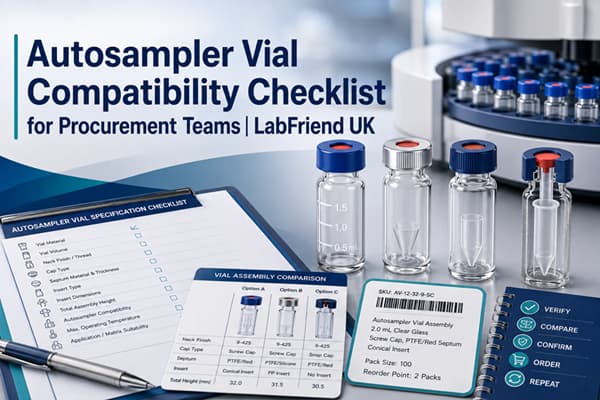
By Donal O’Sullivan, BSc. Reviewed by Michael Anderson, MBA.
Autosampler vial purchasing looks straightforward until something goes wrong. A procurement team may receive a request for “2mL HPLC vials”, “caps and septa”, “autosampler inserts” or “equivalent chromatography vials”. On paper, that may appear enough to place an order. In practice, it can be too vague. This checklist is written for procurement and purchasing staff rather than laboratory scientists, so it uses plain language wherever possible.
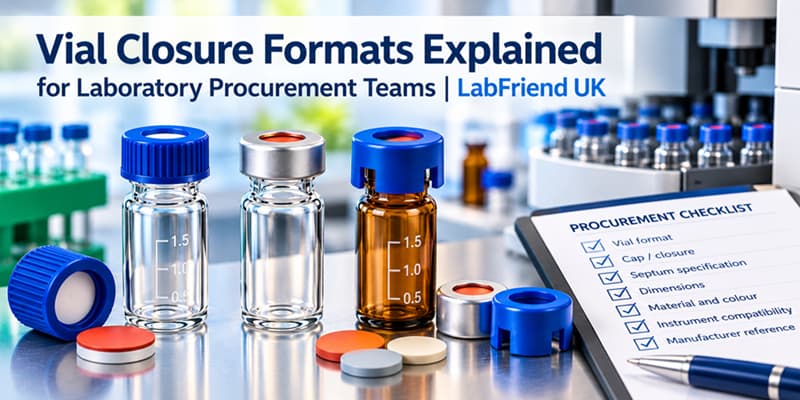
In HPLC (high-performance liquid chromatography), UHPLC (ultra-high-performance liquid chromatography), GC (gas chromatography) and headspace workflows, the vial, cap, septum and insert form part of the sample introduction system. In plain terms, the septum is the small disc in the cap that the autosampler needle pierces to reach the sample, and the insert is a smaller liner used inside the vial for low sample volumes. The autosampler must hold the vial correctly, pierce the septum cleanly, access the sample at the right depth and handle the assembly consistently. A vial that looks similar to the approved item may still differ in height, diameter, neck type, closure style, bottom profile, glass type, cap compatibility or insert fit. Needle gauge and tip style also interact with septum material and thickness, affecting how cleanly the needle pierces and reseals.
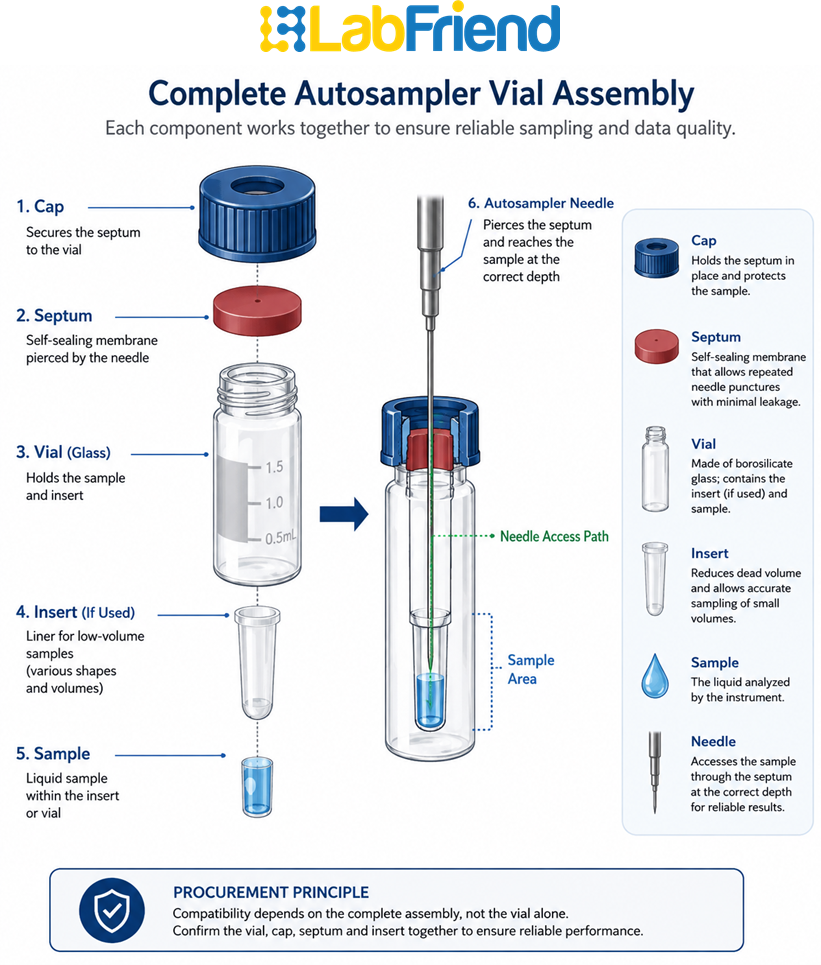
For procurement teams, the risk is not usually a lack of effort. The risk is incomplete information. A buyer may be asked to source an alternative quickly, reduce cost, replace an out-of-stock item or standardise repeat purchases across a laboratory. Without the right technical fields, a well-intentioned substitution can create avoidable problems for the lab.
The cost of getting this wrong is rarely limited to the price of the item. An incompatible vial assembly can mean a failed sequence, lost sample, repeated analysis or instrument downtime — costs that quickly outweigh any saving made on the original purchase.
This checklist explains what procurement teams should confirm before ordering or substituting autosampler vials, caps, septa and inserts. For broader chromatography consumables guidance, read The Complete Guide to Chromatography Consumables for UK Laboratories.
LabFriend UK supplies Chromatography Vials & Septa, wider Laboratory Vials, filtered chromatography vial and septa options, vial accessories, related GC consumables and broader chromatography supplies for UK laboratories.
Quick answer: what should procurement confirm before ordering autosampler vials?
Procurement should confirm the complete autosampler vial assembly before ordering. That means the vial, cap, septum and insert should be checked together, not purchased from partial descriptions.
At minimum, procurement should confirm:
|
Procurement field |
What to confirm |
|
Application |
HPLC, UHPLC, GC, headspace, LC-MS or named method |
|
Instrument / autosampler |
System, tray format or approved vial format where known |
|
Vial volume |
Nominal volume, such as 2mL, 10mL or 20mL |
|
Vial dimensions |
Height, diameter and physical format where specified, noting that tray clearance depends on the assembled height once the cap is fitted, not the vial alone |
|
Neck type |
Screw, crimp, snap or other closure type, including the neck finish designation where known (for example 8-425, 9-425, 10-425, 11mm crimp or 20mm headspace crimp) |
|
Cap format |
Cap size, closure style, septum facing material (such as PTFE or silicone) and whether cap/septum is pre-assembled |
|
Septum material |
Exact material or approved product description |
|
Insert type |
Insert volume, shape, fit and low-volume requirement |
|
Bottom profile |
Flat, conical, reduced-volume or method-specific |
|
Approved alternatives |
Specific alternatives only, not generic equivalents |
|
Substitution rule |
Who approves changes before purchase |
|
Reorder reference |
SKU, quote reference, manufacturer code or internal code |
The safest rule is simple: procurement should not substitute autosampler vials, caps, septa or inserts unless the laboratory has confirmed the alternative is suitable for the instrument and method.
Why partial descriptions cause wrong vial purchases
Partial descriptions are one of the main reasons autosampler vial orders go wrong. “2mL vial” describes volume, but not compatibility. “HPLC vial” describes a workflow, but not the exact vial assembly. “Cap and septum” does not confirm cap size, septum material, closure type or needle compatibility. “Insert” does not confirm volume, shape, position or fit.
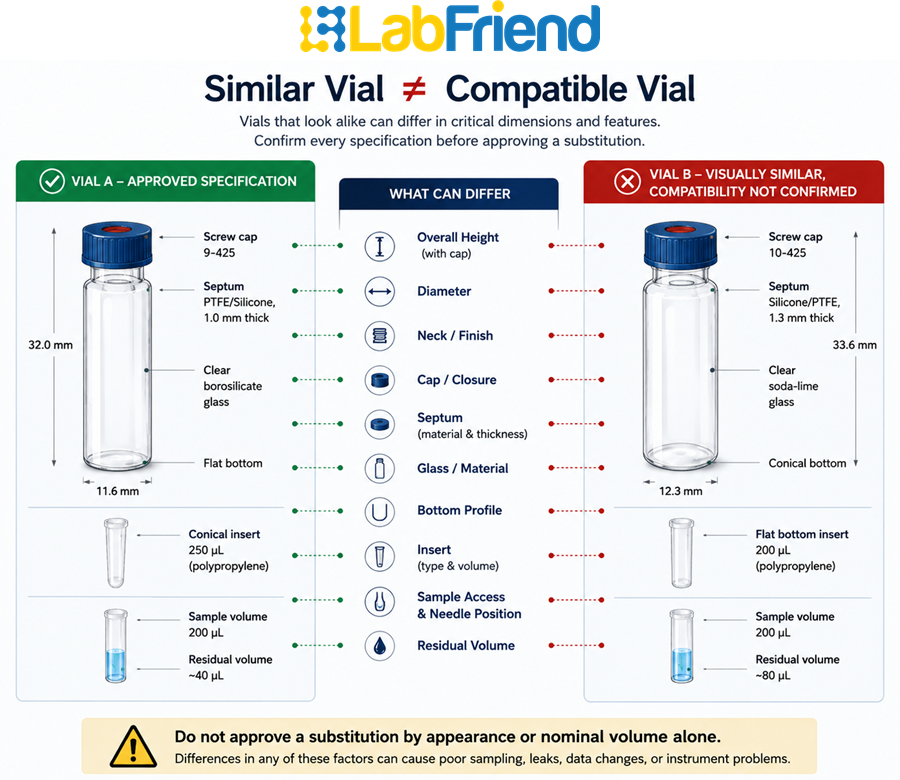
These descriptions may be enough for an informal discussion, but they are not enough for controlled repeat purchasing. The purchasing record needs to capture the details that affect whether the product works in the autosampler.
This is especially important when suppliers change, alternatives are proposed or products are ordered under time pressure. A visually similar item may appear acceptable to procurement but create practical problems for analysts. The vial may fit the tray but not allow reliable needle access. The cap may close but present the septum at the wrong height. Where the needle repeatedly punctures an unsuitable septum, it can also core the material, shedding fragments into the sample or the needle path. The insert may sit differently in the vial and affect sample recovery.
For technical background on vial, cap and septum selection, read LabFriend UK’s guide on how to choose chromatography vials and septa for HPLC, GC and headspace analysis. This procurement checklist builds on that guidance by focusing on what buyers need to confirm before ordering.
Procurement checklist for vial, cap, septum and insert selection
A procurement checklist should help buyers avoid ambiguity. It should also make escalation easier when technical confirmation is needed.
|
Item |
Procurement check |
Why it matters |
|
Vial volume |
Confirm nominal volume and sample volume requirement |
Volume alone does not prove compatibility |
|
Vial dimensions |
Confirm height, diameter or approved format |
Affects tray fit and autosampler handling |
|
Neck type |
Confirm screw, crimp, snap or other finish |
Determines compatible cap or closure |
|
Glass / material |
Confirm clear, amber, plastic or method-required format, including glass type (Type I borosilicate versus soda-lime) where low-extractables or trace-level analysis is involved |
May affect sample protection, visibility or method requirement |
|
Cap type |
Confirm size, closure and whether cap is supplied separately |
Affects sealing and septum presentation |
|
Septum material |
Confirm exact approved material or product description |
Affects piercing, resealing, solvent compatibility and contamination risk |
|
Insert |
Confirm insert volume, design (fixed or removable, conical or flat-bottom), material and vial compatibility |
Affects low-volume recovery and needle access |
|
Bottom profile |
Confirm whether vial or insert geometry is specified |
Affects residual (dead) volume — the sample left unreachable by the needle — and sample access |
|
Accessories |
Confirm crimper, decapper, rack or storage requirement |
Supports consistent handling and workflow organisation |
|
Pack size |
Confirm preferred pack quantity |
Helps control repeat ordering and stock planning |
|
Approved alternatives |
Confirm exact allowed alternatives |
Prevents uncontrolled substitution |
|
Documentation |
Confirm datasheet, supplier reference or internal code |
Helps repeat purchasing and audit trail |
Vials, caps and septa should also be stored according to the supplier’s guidance — typically in a clean, dry area away from direct sunlight and solvent vapours — to avoid contamination or seal degradation before use.
This checklist is not meant to make procurement responsible for technical method validation. Its purpose is to help procurement identify missing information before an order is placed.
What to ask the laboratory before placing an order
When the request is incomplete, procurement should ask targeted questions rather than guessing. The goal is to get enough information to place the right order without slowing the laboratory unnecessarily.
The most useful questions are practical:
- Which instrument or autosampler will use these vials?
- Is this for HPLC, UHPLC, GC, headspace or LC-MS?
- Is the vial, cap, septum and insert combination already approved?
- Are substitutions allowed?
- Is there a manufacturer code, supplier code, quote reference or previous order?
- Are inserts required for low-volume samples?
- Is a specific septum material required?
- Is the cap supplied separately or pre-assembled with the septum?
- Are accessories such as crimpers, decappers, racks or storage boxes needed?
These questions help procurement protect the laboratory from incorrect purchases while keeping the process commercially efficient.
When to use filtered vial and accessory routes
Filtered category routes are useful when procurement already understands the purchasing need. They help narrow the product search without forcing the buyer to browse the full Laboratory Vials category.
For chromatography-specific vial assemblies, use the filtered chromatography vial and septa options. This is the most relevant route when the purchasing need involves autosampler vials, caps, septa or related chromatography vial products.
For supporting tools and storage products, use the filtered vial accessories route. This is more appropriate for crimping tools, opening pliers, racks, boxes and related handling or storage accessories.
The broader Laboratory Vials category remains useful where the buyer needs to compare wider vial formats. The Chromatography Vials & Septa category should remain the main commercial route for chromatography vial assemblies.
How to handle supplier substitutions and potential alternatives
Supplier substitutions are common in procurement. They may be needed because of price, availability, lead time, pack size or supplier consolidation. The problem is not substitution itself. The problem is uncontrolled substitution.
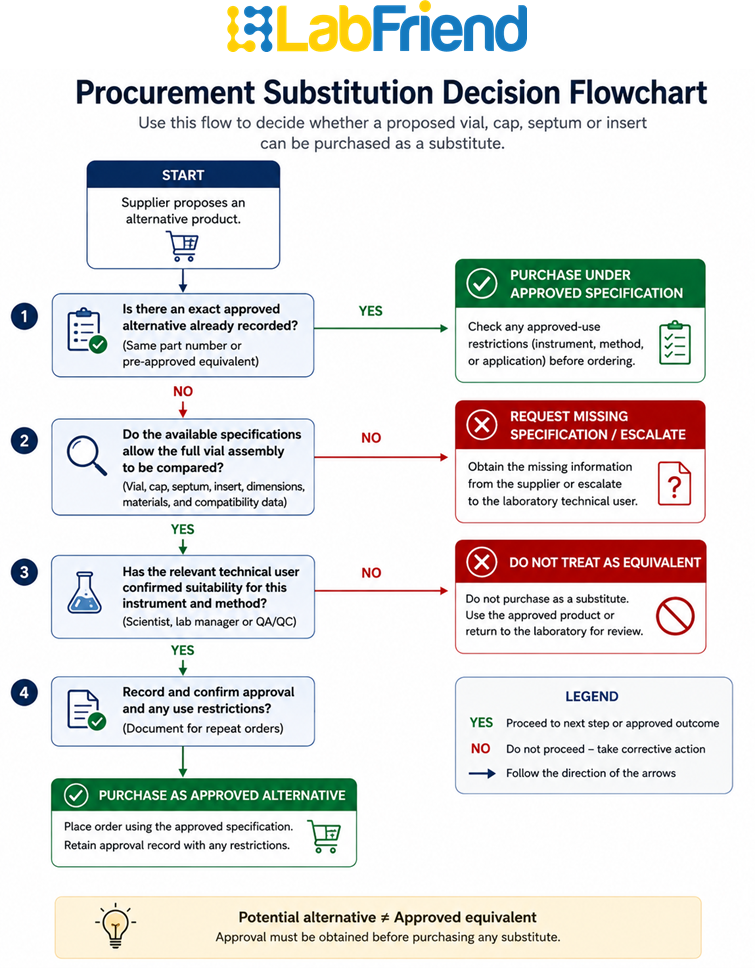
Autosampler vial alternatives should be treated as potential alternatives, not automatic equivalents. Procurement should avoid telling the laboratory that a product is equivalent unless the specification has been checked and the relevant technical user has approved it.
A suitable alternative may need to match the vial volume, dimensions, neck type, cap format, septum material, insert design, bottom profile and autosampler compatibility. In sensitive workflows, the lab may also need to consider extractables, leachables, low-background requirements, headspace sealing, volatile sample containment or LC-MS suitability. Headspace workflows in particular need a septum rated for the incubation temperature and repeated puncture without leaking volatile analytes.
The safest procurement wording is:
“This appears to be a potential alternative based on the available specification. Please confirm technical suitability before substitution.”
That protects the purchasing process without making unsupported compatibility claims.
This wording works well in a purchase order comment, supplier email or internal request note — anywhere the substitution needs a documented, non-committal flag.
How to record approved alternatives
Approved alternatives are valuable. They reduce stockout risk, support supplier flexibility and help procurement avoid repeated technical queries. But they must be recorded clearly.
A good approved alternative record should include the original product, approved alternative, reason for approval, approving person or team, date of approval and any restrictions. For example, an alternative may be acceptable for routine HPLC but not for LC-MS. Another may be acceptable for general autosampler use but not for headspace workflows.
|
Record field |
What to capture |
|
Original product |
Manufacturer code, supplier code or internal code |
|
Approved alternative |
Exact alternative product, not generic description |
|
Approved use |
Method, instrument, workflow or laboratory area |
|
Restrictions |
Where the alternative must not be used |
|
Approval owner |
Scientist, lab manager, QA/QC manager or technical lead |
|
Approval date |
Helps review and audit decisions |
|
Reorder route |
LabFriend URL, quote reference, SKU or internal purchasing code |
This record turns technical approval into practical repeat purchasing control.
Approved alternatives should also be reviewed periodically rather than treated as permanent. Supplier formulations, pack sizes and manufacturing sources can change, so an alternative approved twelve months ago may not still be equivalent today.
When to escalate to the scientist, lab manager or QA/QC manager
Procurement does not need to escalate every vial purchase. Routine reorder lines with complete approved specifications can usually proceed normally. Escalation is needed when the risk is higher.
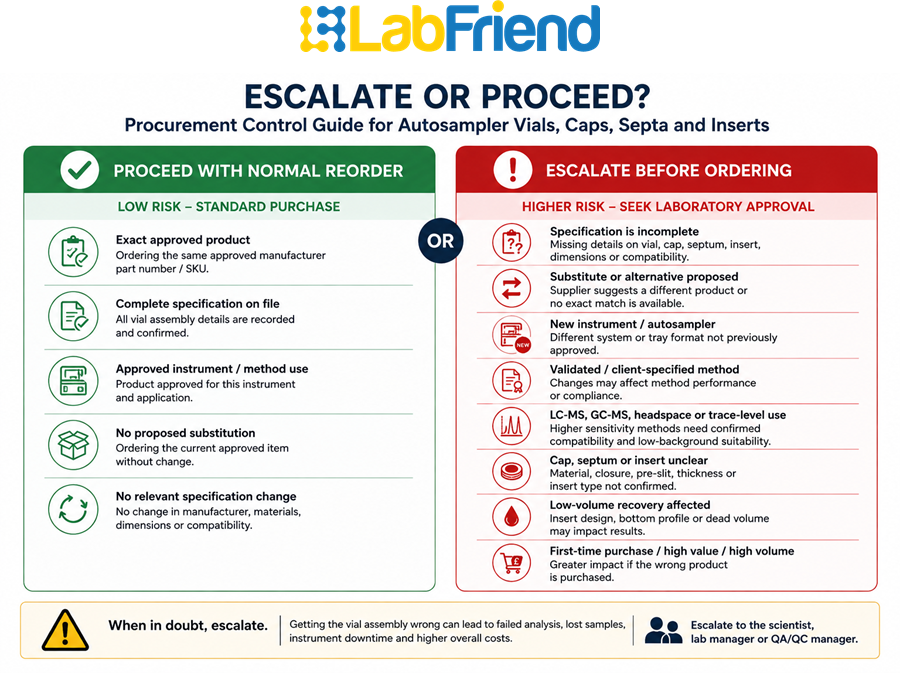
Procurement should escalate before ordering where:
- the requested product description is incomplete,
- an alternative or substitute is being considered,
- the item is used in a validated, regulated or client-specified method,
- the workflow is LC-MS, GC-MS, headspace or trace-level,
- the product affects low-volume sample recovery,
- the cap, septum or insert specification is unclear,
- a new instrument or autosampler is involved,
- the buyer is unsure whether the vial assembly is complete,
- the order is unusually high value or high volume for a first-time purchase.
Escalation should be seen as a control, not a delay. It prevents avoidable rework, returns, failed sequences and repeat-order confusion.
How to reduce repeat-order errors
Repeat-order errors usually happen because the original order record is not specific enough. Once the correct vial assembly has been confirmed, procurement should capture the full specification for future use.
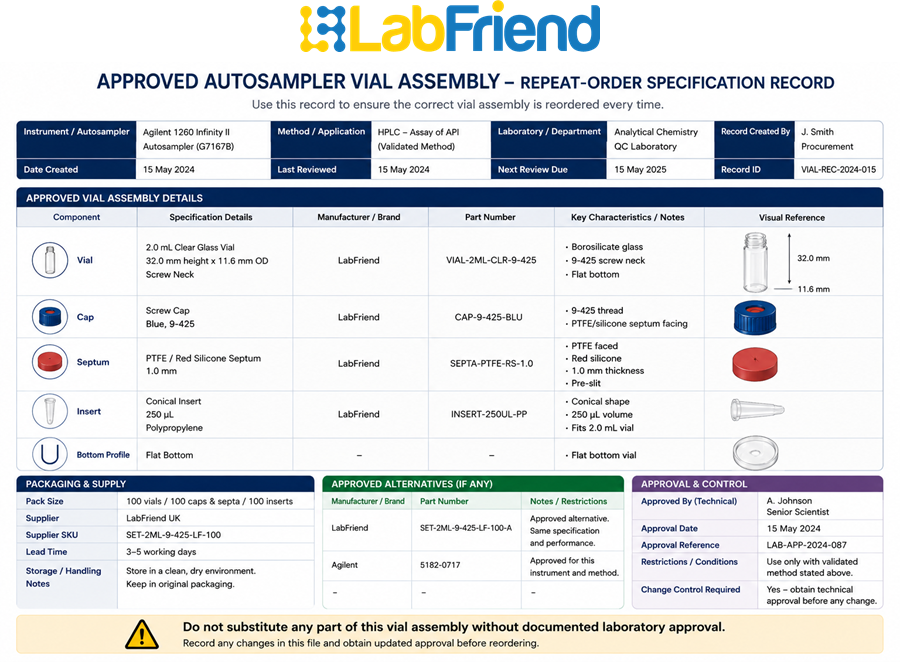
For repeat chromatography workflows, the purchasing record should include the vial, cap, septum and insert together. It should also include the approved category route, supplier reference, pack size and any approved alternatives.
This is where a supplier such as LabFriend UK can support the procurement process. If the lab can identify the approved vial assembly once, future orders can become easier, faster and more consistent.
For HPLC and UHPLC workflows where vial selection sits alongside sample preparation, the article HPLC Sample Preparation Consumables provides useful related context. Where contamination sensitivity is important, the article on reducing LC-MS contamination risk from consumables may also help technical users review vial, septum and sample-contact choices.
Where a laboratory operates across multiple sites or instruments, procurement should check that the approved vial assembly is consistent across locations. Standardising on one confirmed specification reduces the risk of a site-specific substitution being treated as generally approved.
What this checklist does not solve
This checklist helps procurement reduce purchasing and substitution errors. It does not replace technical method assessment.
Correct vial procurement will not solve every chromatography issue. It will not fix poor sample preparation, incorrect filtration, instrument faults, method mismatch, dirty samples, carryover from other sources or unsuitable storage conditions. It also cannot prove compatibility with a specific autosampler unless that compatibility is supported by product documentation or confirmed by the laboratory.
The checklist should therefore be used as a procurement control. It helps buyers identify what information is needed, when to ask questions and when to escalate. Technical suitability remains the responsibility of the laboratory where method performance, validation, traceability or client reporting could be affected.
What to check before purchase
Before placing a new autosampler vial, cap, septum or insert order, procurement should confirm four things.
First, confirm the application. HPLC, UHPLC, GC, headspace and LC-MS workflows may have different requirements.
Second, confirm the assembly. The vial, cap, septum and insert should be checked together, not as separate generic items.
Third, confirm the reorder record. The buyer should know whether this is a repeat approved item, a new request or a proposed substitution.
Fourth, confirm the approval route. If the specification is incomplete or the product is being substituted, procurement should know who can approve the change.
In short: confirm the application, confirm the full assembly, confirm the reorder record, and confirm the approval route.
This approach reduces the risk of ordering a product that appears commercially suitable but fails the laboratory’s workflow requirements.
Where LabFriend UK fits
LabFriend UK supports laboratories through ecommerce-led product discovery, quotation support and repeat purchasing convenience. That matters for procurement teams because vial purchasing is often repeat-driven. The goal is not simply to find a product once; it is to keep the correct vial assembly available for future orders.
Procurement teams can browse Chromatography Vials & Septa, use filtered chromatography vial and septa options, browse vial accessories, or review wider Laboratory Vials.
For related GC workflows, GC consumables may also be relevant. For broader purchasing across the category, use chromatography supplies.
For repeat-use specification support, contact LabFriend UK with the current product code, method use, instrument details and any approved alternatives.
Common procurement mistakes
The first mistake is ordering from a partial description. “2mL vial” is not enough where autosampler compatibility matters.
The second mistake is separating the vial from the cap, septum and insert. Procurement records should capture the complete assembly.
The third mistake is accepting a substitute as equivalent without technical confirmation. Similar wording does not prove compatibility.
The fourth mistake is missing accessory requirements. Crimpers, decappers, racks, storage boxes and handling products may be needed to support the workflow.
The fifth mistake is failing to record approved alternatives. If an alternative has been accepted by the lab, procurement should preserve that decision for repeat orders.
Conclusion: procurement can prevent vial compatibility errors before they reach the lab
Autosampler vial compatibility is not only a laboratory issue. Procurement teams play an important role in preventing incorrect vial, cap, septum and insert purchases before they disrupt workflows.
The most effective approach is to move away from partial descriptions and toward confirmed repeat-use specifications. Procurement should know the application, instrument, vial format, cap, septum, insert, accessory requirement, approved alternatives and substitution rules before placing or changing an order.
This does not mean procurement needs to become the technical authority on every method. It means procurement should have the right checklist, ask the right questions and escalate when the risk is technical rather than purely commercial.
For wider chromatography consumables guidance, read The Complete Guide to Chromatography Consumables for UK Laboratories. To support repeat-order control, browse Chromatography Vials & Septa, filtered chromatography vial and septa options, vial accessories, or contact LabFriend UK for help building a repeat-use autosampler vial specification.
Frequently Asked Questions
What should procurement check before buying autosampler vials?
Procurement should check the application, instrument, vial volume, dimensions, neck type, cap format, septum material, insert type, bottom profile, pack size, approved alternatives and substitution rules before ordering autosampler vials.
Is “2mL HPLC vial” enough information to place an order?
Usually not. A 2mL HPLC vial description does not confirm dimensions, neck type, cap compatibility, septum material, insert fit, bottom profile or autosampler compatibility.
Can procurement substitute autosampler vials from another supplier?
Only where the specification has been checked and the laboratory has confirmed the alternative is suitable. Procurement should treat substitutes as potential alternatives, not automatic equivalents.
What information should be recorded for repeat vial orders?
A repeat vial record should include vial format, cap type, septum material, insert type, instrument or method association, pack size, supplier reference, approved alternatives and any substitution restrictions.
When should procurement escalate a vial purchase to the lab?
Procurement should escalate when the specification is incomplete, an alternative is proposed, the method is validated or client-specified, the workflow is trace-sensitive, or the cap, septum or insert requirement is unclear.
Why do caps and septa matter in procurement?
Caps and septa affect sealing, needle access, piercing, resealing, evaporation control and contamination risk. A correct vial with the wrong cap or septum can still create workflow problems.
Do vial accessories need to be specified?
Yes, where they support the workflow. Crimpers, decappers, racks, storage boxes and handling accessories may be required for consistent vial preparation, storage or organisation.
Where can procurement teams buy chromatography vials and accessories in the UK?
LabFriend UK supplies chromatography vials, septa, laboratory vials, vial accessories and related chromatography consumables through its online catalogue. Procurement teams can browse relevant categories or contact LabFriend UK for repeat-use specification support.
What should procurement do if an order is urgent and the full specification is not yet available?
Place the order on hold if possible, or clearly flag it as unconfirmed. Contact the requesting scientist or lab manager for the missing details before committing to a supplier — an unconfirmed order still carries the same compatibility risk under time pressure.
Read more from LabFriend UK
- The Complete Guide to Chromatography Consumables for UK Laboratories
- How to Choose Chromatography Vials and Septa for HPLC GC and Headspace Analysis
Explore LabFriend UK
- Browse Chromatography Vials & Septa
- Browse Chromatography Vial and Septa Options
- Browse Vial Accessories
- Browse Laboratory Vials
Written by: Donal O’Sullivan, BSc, Co-Founder and Sales Director, LabFriend UK. Donal brings deep chemistry-led technical expertise across analytical chemistry, biochemistry, environmental monitoring, laboratory instrumentation, consumables and scientific product selection.
Reviewed by: Michael Anderson, MBA, Founder and Managing Director, LabFriend UK. Michael reviews LabFriend UK content for customer relevance, commercial accuracy, operational practicality and alignment with LabFriend UK’s laboratory supply model.
#
Frequently asked questions
Delivery times vary by product and supplier. Each product page shows current stock levels and the expected lead time, and we confirm this when you place your order. Most items arrive within 2 to 3 weeks. Specialised items can take longer if they are not in stock. If you need something by a certain date, contact us and we’ll check for you.
Yes. Register for a commercial account and, once it’s approved, you will be able to process orders via PO Once you have a commercial account, you can directly email your purchase orders
Add products to your cart and click Get a Quote. You’ll get a formal quote instantly, ready to send to your email address. For bulk orders or custom requirements, send us your product list and we’ll reply with itemized pricing.
If your item is faulty, not as described or sent in error, let us know within 14 days of delivery and we’ll arrange a return. Change of mind returns are only accepted if the item is unused and in its original packaging. A restocking fee will apply and you pay the return freight. Read our full Returns Policy for details.
Yes, prices are shown including GST by default. Use the Prices Inc. GST toggle at the top of the page to view prices without GST.