

Share :
HPLC Sample Preparation Consumables - Filters Vials Syringes and Solvent Handling
Updated On 08/05/2026

By Donal O’Sullivan, BSc. Reviewed by Michael Anderson, MBA.
HPLC sample preparation is one of the most important control points in routine analytical workflows. Before a sample reaches the column, the laboratory has already made several consumable choices that can affect contamination risk, reproducibility, injection quality, column protection and repeat-order reliability.
For QA/QC laboratories, the goal is not simply to prepare a sample quickly. The goal is to prepare it consistently, using consumables that match the method, instrument and documentation requirements.
This guide is part of LabFriend UK’s wider chromatography consumables content hub. For the full overview of HPLC, UHPLC, GC, SPE, TLC, vials, filters, columns and chromatography workflow consumables, read The Complete Guide to Chromatography Consumables for UK Laboratories.
LabFriend UK supplies products for chromatography sample preparation, chromatography vials and septa, HPLC accessories and HPLC columns to support routine and specialist analytical workflows.
|
Quick answer: which consumables matter most in HPLC sample preparation? The most important HPLC sample preparation consumables are syringe filters, chromatography vials, caps and septa, syringes, solvent handling products, mobile phase containers, tubing, fittings, guard columns and column protection accessories. For QA/QC workflows, these should be selected by method requirement, sample matrix, solvent compatibility, particulate load, analyte sensitivity, autosampler compatibility, contamination risk and repeat-order control. |
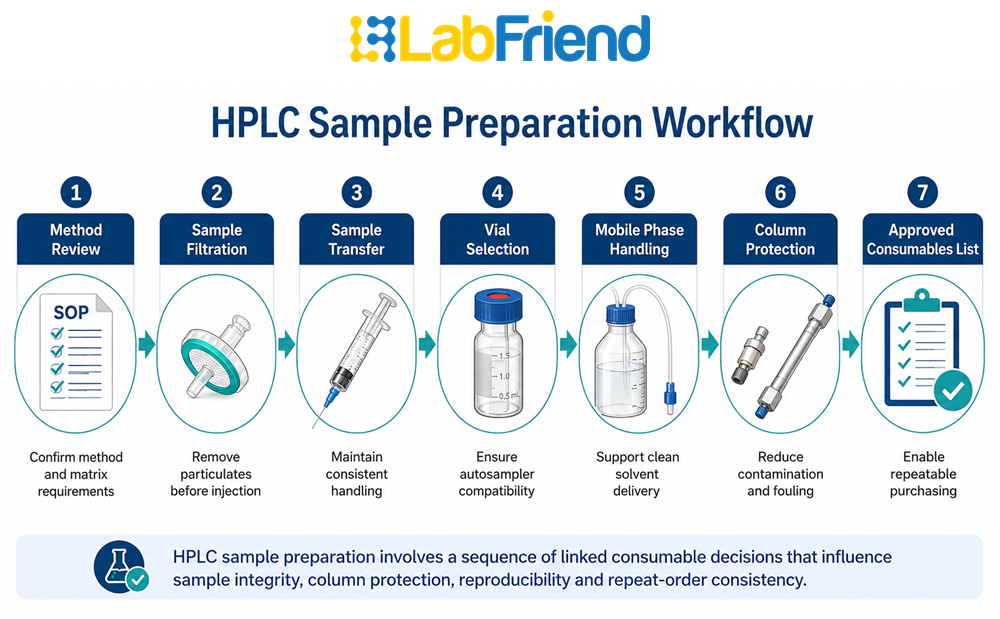
A practical HPLC sample preparation workflow usually includes:
|
Workflow stage |
Consumables involved |
Why it matters |
|
Sample clarification |
Syringe filters, filter membranes, syringes |
Removes particulates before injection |
|
Sample transfer |
Syringes, pipettes, vials, inserts |
Supports repeatable handling and recovery |
|
Sample containment |
Vials, caps, septa, inserts |
Protects sample integrity before injection |
|
Mobile phase handling |
Bottles, solvent caps, tubing, inlet filters |
Supports clean, stable solvent delivery |
|
Injection readiness |
Autosampler-compatible vials and closures |
Reduces injection and compatibility issues |
|
Column protection |
Guard columns, inline filters, suitable filtration |
Helps reduce particulate and matrix-related column problems |
|
Repeat purchasing |
Approved product lists and reorder records |
Supports consistency, availability and audit readiness |
Why HPLC sample preparation consumables matter in QA/QC laboratories
In QA/QC environments, small sample preparation differences can create larger workflow problems. The wrong consumable may contribute to contamination, analyte loss, particulates, carryover, poor recovery, pressure increases, failed injections or inconsistent results.
Typical consequences include:
- repeated sample preparation
- repeated injections
- column blockage or pressure increases
- baseline noise or unexpected peaks
- poor recovery
- avoidable troubleshooting
- delayed batch release or reporting
- uncertainty around method consistency
- urgent replacement orders
- undocumented substitutions
For QA/QC managers, the key question is:
Can the laboratory prepare samples consistently, document the approved consumables clearly, and reorder the same specification without ambiguity?
If the answer is no, the issue is not just technical. It is also operational and commercial.
HPLC sample preparation workflow overview
A practical HPLC sample preparation workflow can be viewed as seven linked stages:
- Confirm the method and matrix.
- Clarify or filter the sample where required.
- Transfer the sample using suitable syringes or handling tools.
- Select the correct vial, cap, septum and insert.
- Manage mobile phase and solvent handling.
- Protect the column and instrument flow path.
- Record the approved consumables for repeat purchasing.
Each stage uses consumables that may look routine but can affect analytical consistency.
Step 1: Confirm method, sample matrix and sensitivity requirements
Before selecting consumables, confirm the analytical context.
Check:
- HPLC or UHPLC method
- detector type
- sample matrix
- solvent system
- analyte sensitivity
- particulate load
- sample volume
- injection volume
- column chemistry
- method documentation
- contamination sensitivity
- whether LC-MS compatibility is relevant
- whether substitutions require approval
This matters because the same filter, vial or septum may be suitable for one workflow and unsuitable for another.
For example, a routine UV HPLC method may have different contamination sensitivity from an LC-MS/MS method. A relatively clean solvent standard may need different preparation from an environmental, food, biological, polymer or dirty process sample.
Step 2: Choose the right syringe filter
Syringe filters are commonly used to remove particulates before HPLC or UHPLC injection. They can help protect the column, autosampler and flow path, but the filter must match the sample and method.
Key syringe filter variables include:
Some methods may require evaluation of filter pre-rinsing procedures during method development to minimise potential contributions from extractables or manufacturing residues.
|
Selection factor |
Typical options |
Why it matters |
|
Pore size |
0.22 µm, 0.45 µm |
Affects particulate removal and clogging tendency |
|
Membrane material |
PTFE, PES, nylon, PVDF, RC, CA and others |
Must match solvent, analyte and workflow |
|
Diameter |
13 mm, 25 mm and other formats |
Should suit sample volume and throughput |
|
Housing material |
Often polypropylene or other plastics |
Must be compatible with sample and solvent |
|
Sterility |
Sterile or non-sterile |
Relevant only where sterile handling is required |
|
Binding profile |
Standard or low-binding variants |
Important for sensitive analytes |
|
Extractables risk |
Method-dependent |
Relevant for trace and LC-MS workflows |
Filter diameter influences throughput and filtration efficiency. Larger diameter filters generally provide greater filtration area and may be preferable for larger sample volumes, viscous samples or matrices with higher particulate loads.
For a deeper filtration-specific resource, read LabFriend UK’s Ultimate Syringe Filter Guide: Pore Size, Membranes, and Applications.
Step 3: Select the correct pore size
Many HPLC workflows use either 0.45 µm or 0.22 µm filtration, but the choice should not be made by habit alone.
|
Pore size |
Typical use consideration |
Watch point |
|
0.45 µm |
Often used for general HPLC particulate removal |
May not be fine enough for every UHPLC or fine-particle-sensitive workflow |
|
0.22 µm |
Often selected where additional particulate removal is desired, including some UHPLC applications and contamination-sensitive workflows |
May clog more easily with dirty or viscous samples |
Consider:
- column particle size
- whether the method uses conventional HPLC or UHPLC hardware
- sample particulate load
- sample viscosity
- matrix complexity
- injection volume
- expected throughput
- pressure sensitivity
- analyte recovery
- method requirements
- instrument requirements
UHPLC systems often employ smaller particle-size columns and narrower flow paths, making effective particulate control particularly important.
For QA/QC laboratories, the selected pore size should be recorded as part of the approved method consumables list. Avoid switching between 0.45 µm and 0.22 µm without review where method consistency matters.
Step 4: Match membrane chemistry to the solvent and analyte
There is no single best syringe filter membrane for every HPLC workflow. Membrane choice depends on solvent compatibility, analyte behaviour, binding risk, extractables risk and method sensitivity.
|
Membrane |
Typical selection logic |
QA/QC caution |
|
PTFE |
Often selected for organic solvents and aggressive solvent workflows |
Standard PTFE membranes are hydrophobic and may require pre-wetting before use with aqueous samples; hydrophilic PTFE variants are available. Confirm suitability for the intended solvent system. |
|
PES |
Often considered for aqueous workflows |
Check solvent and analyte suitability |
|
Nylon |
Broad general use where compatible |
May bind some analytes; verify suitability |
|
PVDF |
Often considered where low protein binding is relevant |
Check solvent compatibility and method fit |
|
Regenerated cellulose |
Broadly compatible with many aqueous and mixed aqueous-organic solvent systems; always verify manufacturer solvent compatibility data. |
Confirm with specific solvent mixture |
|
Cellulose acetate |
Often used in aqueous or biological contexts |
Check chemical compatibility carefully |
Always check manufacturer compatibility data for the specific solvent mixture and method.
Where analyte recovery is critical, filter suitability should ideally be confirmed experimentally during method development or verification studies. Certain analytes may adsorb to filter membranes, vial surfaces or sample-contact materials, potentially affecting quantitative results.
For LC-MS, trace analysis and contamination-sensitive workflows, consider extractables, leachables and background signal during method development or product approval.
LC-MS methods may be particularly sensitive to background contamination from consumables. Filters, vials, septa and solvent-handling components selected for routine UV detection may not always be suitable for trace-level mass spectrometric applications.
Step 5: Use suitable syringes for sample transfer and filtration
Syringes are often overlooked in HPLC sample preparation, but they influence sample handling, filtration pressure and repeatability.
Check:
- syringe volume
- plunger smoothness
- barrel material
- solvent compatibility
- Luer connection
- dead volume
- sample viscosity
- filtration pressure
- whether disposable or reusable formats are appropriate
- whether the syringe is compatible with the chosen filter
The syringe and filter should work together. A syringe that is too small, poorly matched or difficult to control can make filtration inconsistent, especially with viscous or particulate-loaded samples.
For repeat QA/QC workflows, the approved syringe volume and type should be documented alongside the filter specification.
Step 6: Choose the right vial, cap, septum and insert
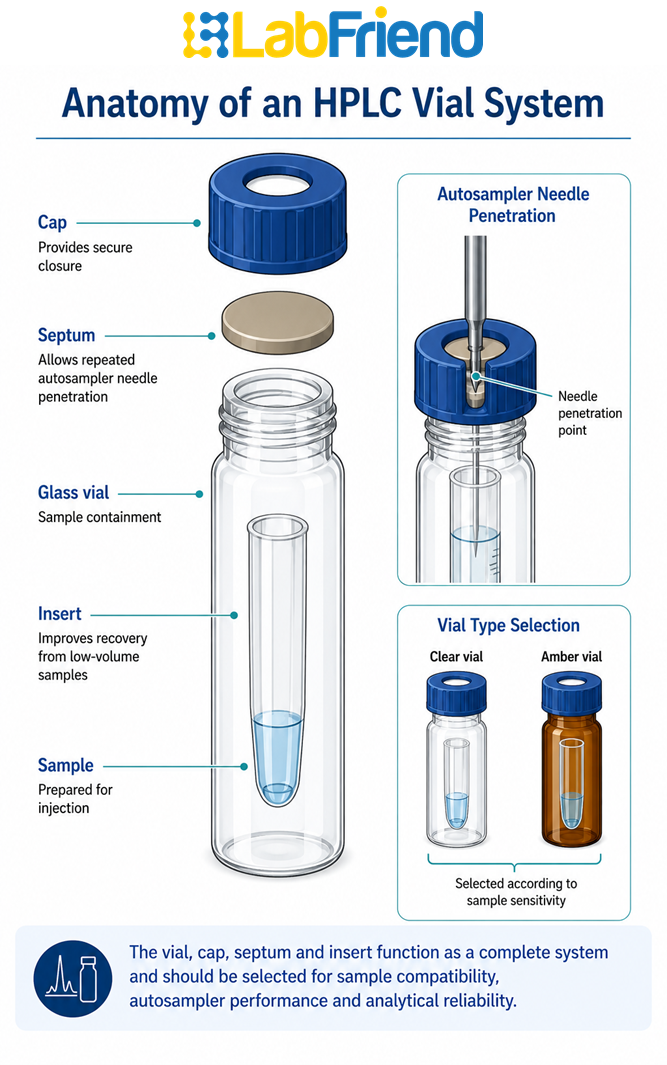
After filtration or transfer, the sample usually enters a chromatography vial. The vial system should match the autosampler, sample chemistry and injection workflow.
Record:
- vial volume
- vial height and diameter
- neck type
- screw, crimp or snap closure
- clear or amber glass
- glass or plastic material
- insert requirement
- cap type
- septum material
- septum thickness
- septum puncture resistance and suitability for repeated needle penetrations
- autosampler compatibility
- pack size
- manufacturer code
- whether certified, LC-MS tested or low-background variants are required
- approved alternatives
A suitable filter with the wrong vial, cap or septum can still create problems.
For low-volume samples, vial inserts may improve sample recovery and reduce the risk of insufficient sample aspiration by the autosampler. Insert geometry should be compatible with both the vial and the autosampler needle design.
Poor vial selection may contribute to evaporation, adsorption, contamination, incorrect sampling depth or autosampler errors.
Where samples remain in autosamplers for extended periods, vial and closure selection should also support sample stability by minimising evaporation, contamination and unwanted interactions with sample-contact surfaces.
LabFriend UK’s Vials & Septa category is the primary commercial destination for chromatography vial and septa selection. The broader Laboratory Vials category may also be useful where buyers are comparing wider vial formats.
Step 7: Manage mobile phase and solvent handling
HPLC sample preparation does not stop with the sample vial. Mobile phase handling and solvent management can also affect system stability and reproducibility.
Depending on the instrument configuration and method, solvent degassing may also be important to minimise dissolved gas-related baseline disturbance and pump performance issues.
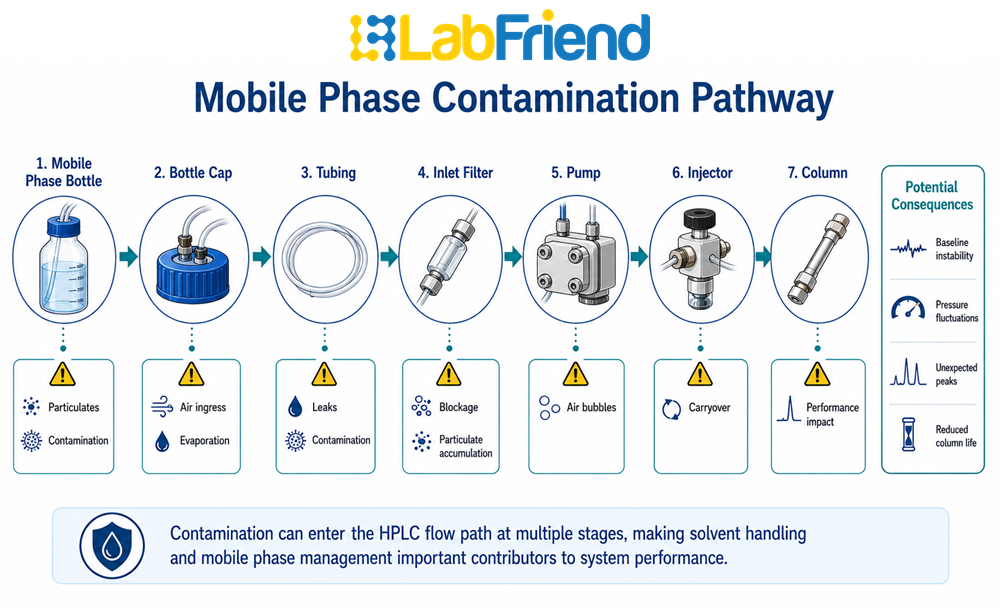
Important solvent handling consumables include:
Depending on the method and solvent source, laboratories may also filter mobile phases before use to reduce particulate contamination and protect pumps, injector components and columns.
- mobile phase bottles
- solvent bottle caps
- safety caps
- waste caps
- inlet filters
- tubing
- fittings
- connectors
- solvent lines
- solvent filtration products where relevant
- bottle labels and storage controls
Poor solvent handling can contribute to:
- particulates
- air ingress
- contamination
- evaporation
- unstable baselines
- pressure instability
- leaks
- inconsistent mobile phase quality
The HPLC Accessories category should be used for solvent handling, tubing, fittings and related HPLC workflow products.
Step 8: Protect the column and flow path
HPLC columns are central to method performance. Sample preparation consumables should help protect the column, not create avoidable stress on it.
Column protection may involve:
- filtering samples where required
- using suitable pore size and membrane chemistry
- avoiding particulate-loaded injections
- selecting compatible vials and septa
- maintaining clean mobile phase handling
- using guard columns or guard cartridges where appropriate
- using low-dead-volume fittings where required
- maintaining solvent inlet filters and tubing
Guard columns and guard cartridges can help protect the analytical column from particulates or strongly retained matrix components, but they do not replace appropriate sample preparation or system maintenance.
The HPLC Columns category is the relevant route for column-related purchasing.
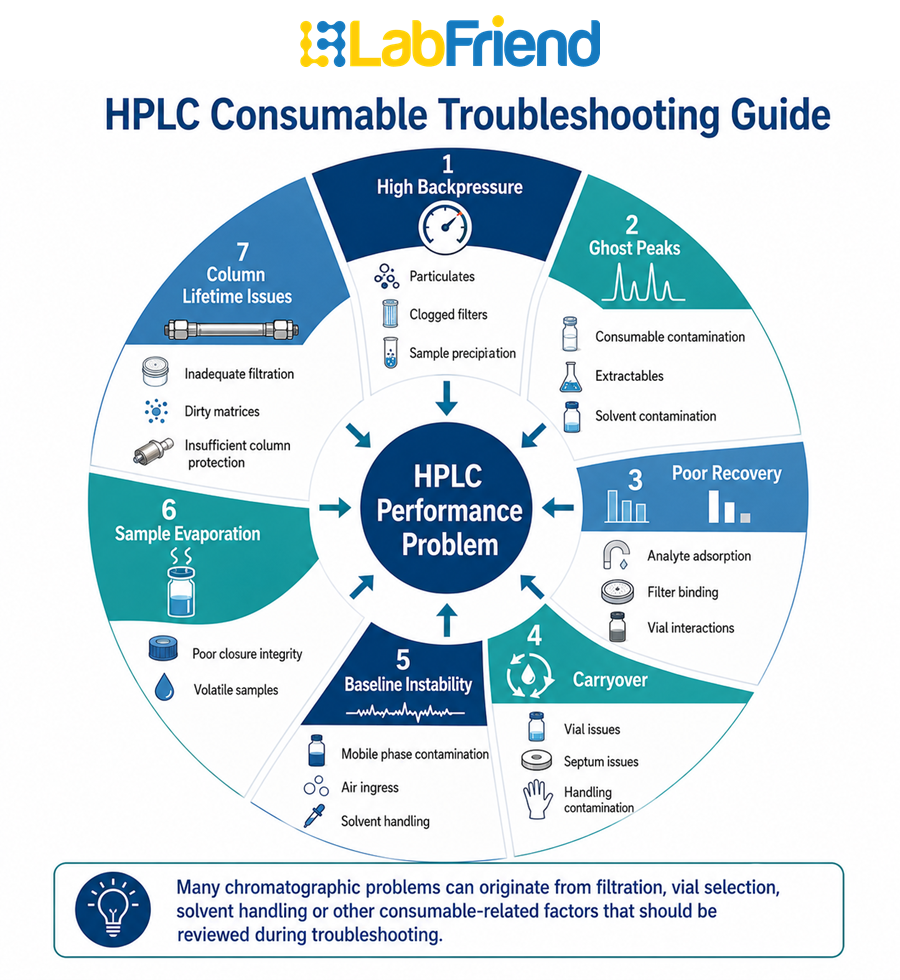
Common HPLC sample preparation failures
|
Problem |
Possible consumable-related causes |
What to review |
|
High backpressure |
Particulates, clogged filter, dirty matrix, sample precipitation, column blockage |
Filter pore size, sample matrix, column protection |
|
Ghost peaks |
Vial, septum, filter, solvent contamination, consumable extractables/leachables or handling contamination |
Consumable background and solvent handling |
|
Poor recovery |
Analyte binding to filter, vial or surface |
Membrane, vial surface, sample chemistry |
|
Carryover |
Vial/septum issues, syringe or autosampler contamination |
Vial system, wash solvents, sample handling |
|
Poor reproducibility |
Variable filtration, inconsistent vial fill, syringe issues |
Syringe, filter, vial and injection process |
|
Baseline instability |
Mobile phase contamination, air, solvent handling issues |
Bottles, caps, tubing, solvent preparation |
|
Sample evaporation |
Poor cap/septum fit or volatile sample handling |
Closure system and sample storage |
|
Column lifetime issues |
Poor filtration, dirty samples, incompatible sample prep |
Filter, matrix, guard column, sample cleanup |
These issues may also have instrument, method or maintenance causes. The role of this article is to identify consumable-related checks that QA/QC teams can control through specification and purchasing discipline.
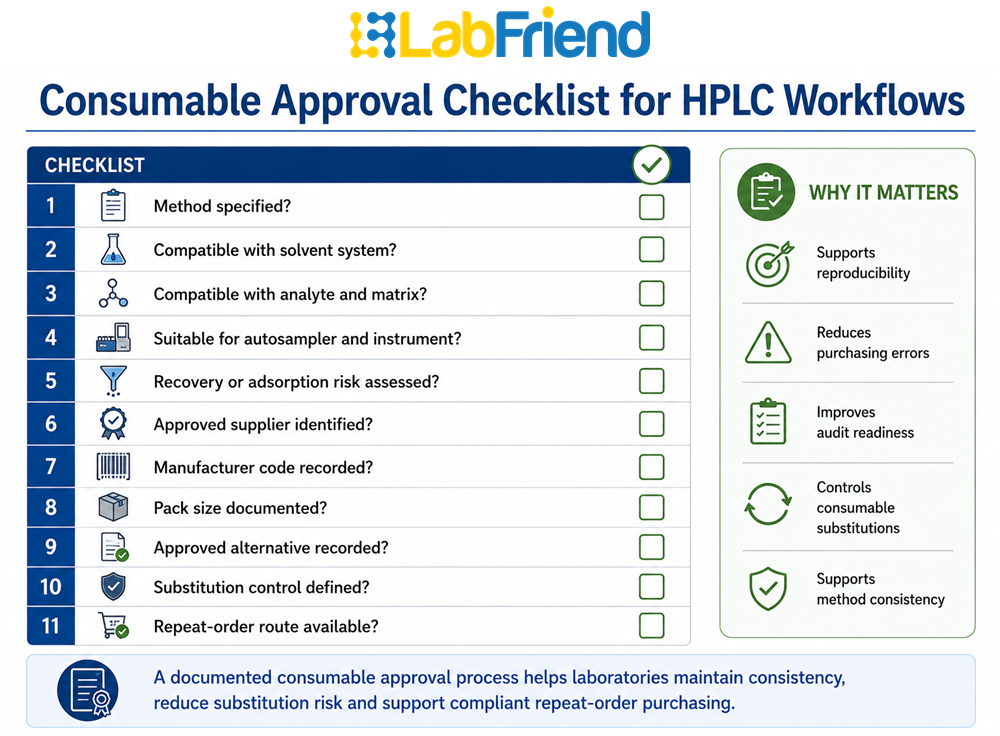
Product selection framework for QA/QC teams
Use the following framework when approving or reviewing HPLC sample preparation consumables.
|
Decision point |
QA/QC question |
|
Method relevance |
Is this consumable specified in the method or SOP? |
|
Compatibility |
Is it compatible with the solvent, analyte and sample matrix? |
|
Reproducibility |
Could changing this item affect recovery, contamination or precision? |
|
Documentation |
Is the manufacturer code, pack size and specification recorded? |
|
Substitution control |
Can procurement substitute this item, or does QA/QC approval apply? |
|
Repeat supply |
Is the product available through a reliable repeat-order route? |
|
Risk level |
Is the workflow routine, validated, client-specified, LC-MS-sensitive or contamination-sensitive? |
For validated, regulated, client-specified or contamination-sensitive workflows, consumables should not be changed casually. Even apparently small changes in membrane, vial, septum, syringe or solvent handling product may need review.
Repeat purchasing and approved consumable lists
HPLC sample preparation consumables are recurring purchases for many QA/QC laboratories. They should be managed as an approved list, not as ad hoc catalogue selections.
A repeat-order record should include:
|
Item |
Specification to record |
|
Syringe filter |
Membrane, pore size, diameter, housing, sterility, pack size, manufacturer code |
|
Syringe |
Volume, material, connection type, disposable/reusable status |
|
Vial |
Volume, dimensions, neck type, material, colour, insert requirement |
|
Cap/septum |
Closure type, septum material, cap size, pre-slit status where relevant |
|
Solvent bottle/cap |
Bottle material, cap thread, tubing connection, venting requirement |
|
Tubing/fittings |
Material, internal diameter, pressure rating, connection type |
|
Guard column |
Chemistry, dimensions, compatibility, cartridge holder if needed |
|
Supplier route |
LabFriend URL, SKU, quote route or approved supplier details |
|
Approval status |
Approved, restricted, technical review required, or no substitution |
This helps procurement and QA/QC teams reduce wrong orders, stockouts and undocumented substitutions.
When substitutions need technical approval
Substitutions should be reviewed carefully where a consumable could affect analytical performance, method consistency or documentation requirements.
Technical approval is especially important for:
- validated methods
- pharmaceutical QA/QC
- client-specified methods
- LC-MS or trace analysis
- contamination-sensitive methods
- regulated or audited workflows
- low-volume or low-recovery samples
- known adsorption or recovery issues
- methods with historical trending requirements
- workflows where column performance is critical
In validated methods, changes to consumables may require documented assessment under the laboratory’s change-control procedures. The extent of evaluation will depend on the potential impact on recovery, precision, contamination risk, chromatographic performance and method robustness.
Do not substitute filters, vials, septa, syringes or solvent handling components based on price alone. A lower-cost alternative may be appropriate for routine workflows, but it should be matched by specification and reviewed where the method requires it.
Where LabFriend UK fits
LabFriend UK supports UK laboratories with access to chromatography consumables, sample preparation products, HPLC accessories and related analytical workflow supplies.
The About LabFriend page describes LabFriend UK as a specialist online supplier of laboratory consumables, scientific equipment and laboratory instruments serving UK organisations, with competitive pricing, broad product availability, quotation support and responsive customer support. It also notes that Bishops Scientific UK Limited, trading as LabFriend UK, was founded by Michael Anderson and Donal O’Sullivan, with Donal bringing more than 30 years of laboratory distribution experience.
For HPLC sample preparation workflows, LabFriend UK can help buyers compare relevant product areas, including:
- Chromatography Sample Preparation
- Vials & Septa
- Laboratory Vials
- HPLC Accessories
- HPLC Columns
- Chromatography
For repeat-use requirements, buyers can also contact LabFriend UK for quotation or sourcing support.
Common mistakes when buying HPLC sample preparation consumables
Mistake 1: Using the same syringe filter for every sample
One membrane and pore size will not suit every solvent, analyte or sample matrix. Check method suitability before standardising.
Mistake 2: Choosing pore size by habit
0.45 µm and 0.22 µm filters have different workflow implications. Select based on method, column, matrix and instrument sensitivity.
Mistake 3: Ignoring membrane compatibility
Incorrect membrane selection can contribute to analyte loss, contamination, filter failure or poor recovery.
Mistake 4: Treating the vial as a storage item only
The vial, cap and septum are part of the injection workflow. Autosampler compatibility and septum suitability matter.
Mistake 5: Not controlling solvent handling
Poor solvent handling can affect baseline stability, contamination risk and system reliability.
Mistake 6: Reordering without full specification records
A product description such as “HPLC filter” or “2 mL vial” is not enough for repeat QA/QC purchasing.
Mistake 7: Substituting consumables without technical review
Cost control matters, but uncontrolled substitutions can create hidden cost through reruns, investigations or inconsistent results.
Final recommendation
HPLC sample preparation consumables should be selected as part of a controlled workflow, not as isolated catalogue items.
For QA/QC laboratories, the safest approach is to start with the method and matrix, then confirm the filter membrane and pore size, syringe, vial, cap, septum, solvent handling products and column protection requirements. Record the approved specifications so procurement can reorder the same products consistently.
For broader chromatography planning, use The Complete Guide to Chromatography Consumables for UK Laboratories as the parent reference for this cluster.
Browse chromatography sample preparation products, review chromatography vials and septa, explore HPLC accessories, or contact LabFriend UK for support with repeat-use HPLC sample preparation consumables.
Frequently Asked Questions
What consumables are used in HPLC sample preparation?
Common HPLC sample preparation consumables include syringe filters, syringes, chromatography vials, caps, septa, vial inserts, solvent bottles, solvent caps, tubing, fittings, inlet filters, guard columns and column protection accessories.
What pore size should I use for HPLC sample filtration?
Many HPLC workflows use 0.45 µm filtration for general particulate removal, while UHPLC or finer-particle-sensitive workflows may use 0.22 µm. The correct pore size depends on the method, column, sample matrix, particulate load and instrument requirements.
Which syringe filter membrane is best for HPLC?
There is no single best membrane for every HPLC method. PTFE, PES, nylon, PVDF, regenerated cellulose and cellulose acetate each have different solvent and analyte compatibility considerations. Always check the method and manufacturer compatibility data.
Why do vials and septa matter in HPLC sample preparation?
Vials and septa affect sample containment, autosampler compatibility, evaporation, contamination risk and injection consistency. The vial, cap and septum should be treated as a complete system.
Can poor sample preparation damage an HPLC column?
Poor sample preparation can contribute to particulates, matrix contamination or strongly retained material reaching the column. This may increase backpressure, affect performance or shorten useful column life. Column issues can also have other causes, so sample preparation should be reviewed alongside method and instrument conditions.
When should QA/QC approve a consumable substitution?
QA/QC should review substitutions where the method is validated, regulated, client-specified, LC-MS-sensitive, contamination-sensitive, recovery-sensitive or historically trended. Even apparently similar consumables may differ in materials, dimensions, extractables, adsorption behaviour or compatibility.
How can laboratories reduce HPLC sample preparation stockouts?
Laboratories can reduce stockouts by recording approved consumable specifications, monitoring usage, setting reorder points, identifying approved alternatives and keeping repeat-order records for filters, vials, syringes, solvent handling products and column protection items.
Where can I buy HPLC sample preparation consumables from LabFriend UK?
LabFriend UK supplies chromatography sample preparation products, vials and septa, laboratory vials, HPLC accessories and HPLC columns through its online platform. Buyers can browse the relevant categories or contact LabFriend UK for quotation support.
Written by: Donal O’Sullivan, BSc, Co-Founder and Sales Director, LabFriend UK. Donal brings deep chemistry-led technical expertise across analytical chemistry, biochemistry, environmental monitoring, laboratory instrumentation, consumables and scientific product selection.
Reviewed by: Michael Anderson, MBA, Founder and Managing Director, LabFriend UK. Michael reviews LabFriend UK content for customer relevance, commercial accuracy, operational practicality and alignment with LabFriend UK’s laboratory supply model.
Read More Block
Read more from LabFriend UK
- The Complete Guide to Chromatography Consumables for UK Laboratories
- The Ultimate Syringe Filter Guide: Pore Size, Membranes, and Applications
- Browse Chromatography Sample Preparation
- Browse Chromatography Vials and Septa
- Browse HPLC Accessories
- Browse HPLC Columns
Related Stories

The Complete Guide to Chromatography Consumables for UK Laboratories
The Complete Guide to Chromatography Consumables for UK Laboratories

HPLC Sample Preparation Consumables for CROs and High-Throughput Testing Laboratories
HPLC Sample Preparation Consumables for CROs and High-Throughput Testing Laboratories

0.22µm vs 0.45µm Filters for HPLC and UHPLC Sample Preparation
0.22µm vs 0.45µm Filters for HPLC and UHPLC Sample Preparation

Syringe Filter Membrane Compatibility for HPLC UHPLC and Chromatography Solvents
Syringe Filter Membrane Compatibility for HPLC UHPLC and Chromatography Solvents