How to Reduce LC-MS Contamination Risk from Vials, Filters, Septa and Solvent Handling Consumables
35 mins read
How to Reduce LC-MS Contamination Risk from Vials, Filters, Septa and Solvent Handling Consumables
By Donal O’Sullivan, BSc. Reviewed by Michael Anderson, MBA.
LC-MS and LC-MS/MS workflows are highly sensitive analytical systems. That sensitivity is valuable because it allows laboratories to detect low-level analytes, but it also means that small amounts of contamination from consumables, solvents, sample preparation products or handling materials can become visible in the chromatogram or mass spectrum.
For laboratories running LC-MS methods, contamination control is not only an instrument issue. It is also a consumables issue.
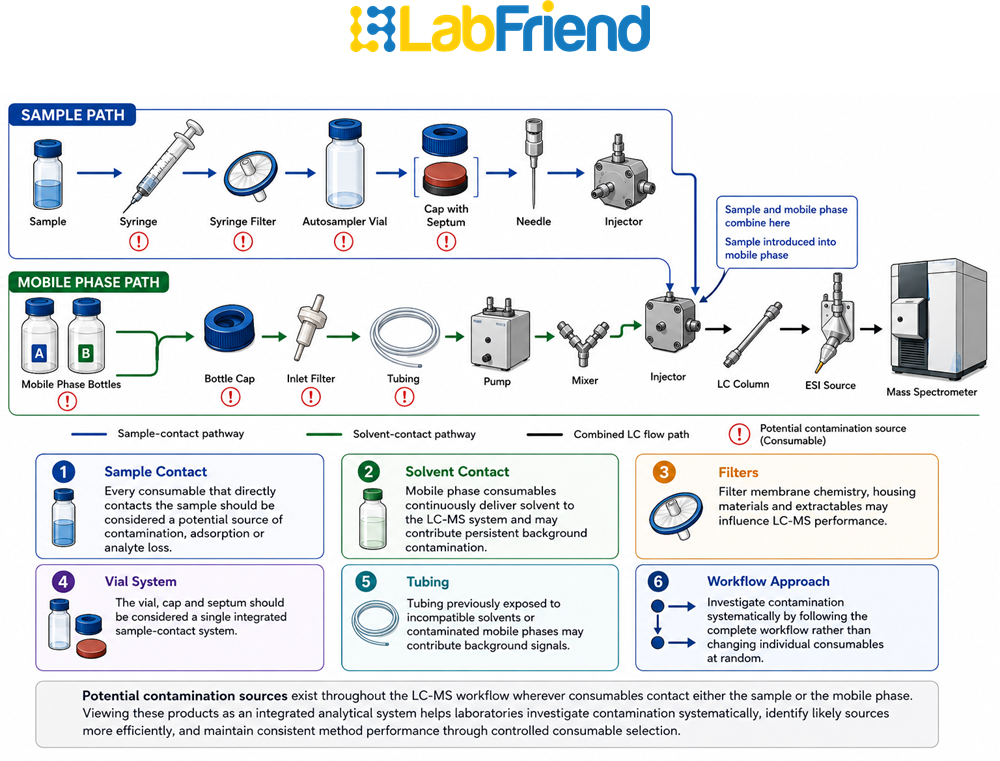
This is what makes LC-MS contamination particularly difficult for busy laboratories. The visible problem may appear as a peak, a noisy blank, a recovery issue or an unexplained background signal, but the source may sit much earlier in the workflow. A vial change, a different septum, a new syringe filter membrane, an alternative solvent cap or a substituted tubing material can all affect the result.
For that reason, LC-MS consumables should be managed as part of the analytical method environment. The aim is not to eliminate every possible risk through over-specification. The aim is to understand which consumables contact the sample or solvent, control the highest-risk points, and make sure any approved specification can be reordered consistently.
Vials, caps, septa, syringe filters, syringes, tubing, fittings, solvent bottles, solvent caps and sample preparation devices can all introduce or contribute to background signals, ghost peaks, ion suppression, poor reproducibility or unexpected interferences if they are not selected and controlled carefully.
This guide is part of LabFriend UK’s wider chromatography consumables content hub. For the full overview of HPLC, UHPLC, GC, SPE, TLC, vials, filters, columns and chromatography workflow consumables, read The Complete Guide to Chromatography Consumables for UK Laboratories.
LabFriend UK supplies chromatography vials and septa, laboratory vials, chromatography sample preparation products, HPLC accessories and wider chromatography products for analytical laboratories.
|
Quick answer: how can laboratories reduce LC-MS contamination from consumables? Laboratories can reduce LC-MS contamination risk by treating every sample-contact and solvent-contact consumable as a potential contamination source. Start with the full workflow rather than one product. Review the vial, cap, septum, syringe filter, syringe, solvent bottle, cap, tubing, fittings and any sample preparation devices that contact the sample or mobile phase. The most practical approach is to isolate the source of contamination, confirm which consumables are in contact with the sample or solvent, and then control those items through approved specifications and repeat-order records. |
Important: This guide focuses on contamination originating from consumables. LC-MS background signals may also arise from instrument contamination, mobile phase preparation, laboratory environment, sample matrix, carryover or method design. Consumables should therefore be evaluated as one part of a systematic troubleshooting process.
|
Control point |
What to check |
|
Vials |
Glass quality, surface treatment, cleanliness, adsorption risk, extractables risk |
|
Caps and septa |
Septum material, facing, backing, coring risk, extractables and solvent exposure |
|
Syringe filters |
Membrane chemistry, pore size, housing material, extractables, binding and solvent compatibility |
|
Syringes |
Barrel and plunger material, extractables, solvent compatibility and carryover risk |
|
Solvent bottles and caps |
Bottle cleanliness, cap material, tubing compatibility and exposure to mobile phase |
|
Tubing and fittings |
Material compatibility, leachables, dead volume and contamination from previous use |
|
Sample preparation devices |
Sorbent, frits, plastics, binding behaviour and solvent exposure |
|
Procurement controls |
Approved specifications, controlled alternatives and repeat-order accuracy |
The key point is simple: do not treat LC-MS consumables as generic HPLC consumables unless the method and technical review support that choice.
Why LC-MS contamination risk is different
LC-MS systems combine liquid chromatography separation with mass spectrometry detection. The mass spectrometer may detect low-level compounds that would not be visible, or would be less obvious, in less sensitive detection workflows.
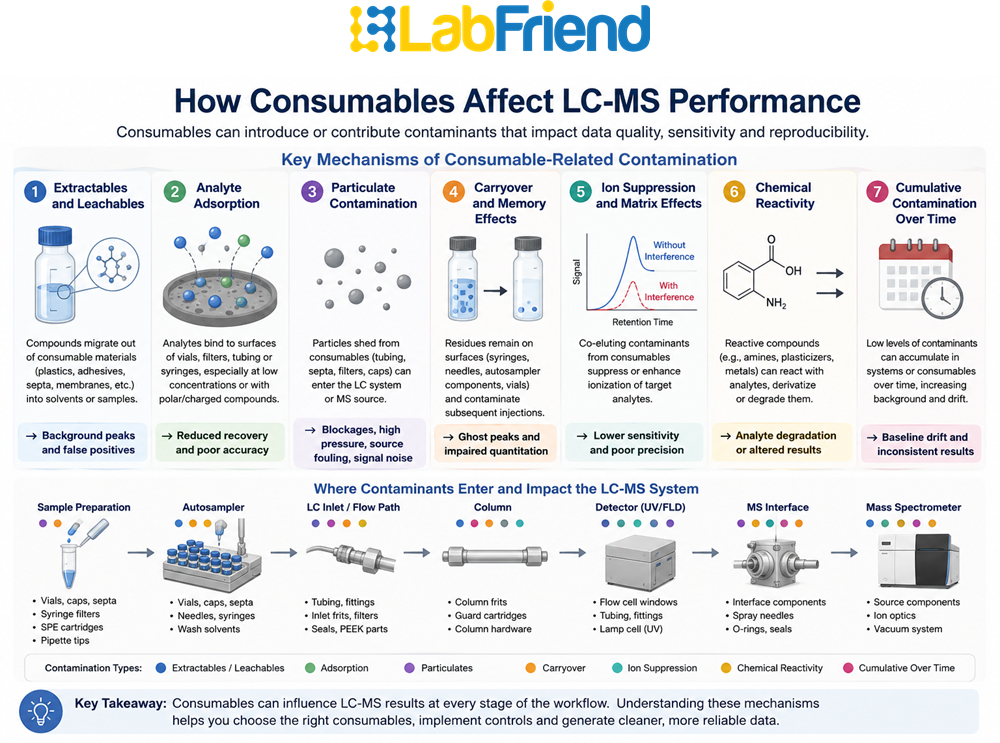
This means LC-MS workflows are generally more likely to detect background signals arising from extractables, leachables, manufacturing residues, solvent impurities, laboratory contamination or compounds desorbing from previously exposed surfaces. A consumable that performs acceptably in a routine HPLC-UV method may still create a visible background issue in a trace-level LC-MS method.
That does not mean every LC-MS workflow requires the most specialised consumable available. Over-specifying every product can create unnecessary cost and procurement complexity. The more practical approach is to identify the points in the workflow where consumables touch the sample or mobile phase, assess the level of analytical sensitivity, and control the products most likely to affect the method.
In routine HPLC-UV workflows, a small background contribution may not always be obvious. In LC-MS, the same background contribution may interfere with sensitivity, quantitation, reproducibility or interpretation.
This is why LC-MS consumable changes should be deliberate rather than casual.
Ion suppression and ion enhancement are often invisible
Not every contamination problem appears as a visible chromatographic peak. Some contaminants suppress or enhance ionisation efficiency within the mass spectrometer, altering analyte response without producing a clearly identifiable interference peak. This is particularly important for electrospray ionisation (ESI), where non-volatile contaminants, surfactants, polymers or other co-eluting compounds may reduce or alter analyte signal intensity. Where unexplained changes in sensitivity or recovery occur, laboratories should consider both visible background peaks and ionisation effects during troubleshooting.
Common LC-MS contamination symptoms linked to consumables
Consumable-related contamination can show up in several ways. Some symptoms appear during blank runs, while others only become obvious when the sample matrix, solvent system or detection mode makes the problem visible.
Use the table below as a starting point, not as a final diagnosis. LC-MS contamination can also come from solvents, instruments, methods, laboratory environment or sample handling.
|
Symptom |
Possible consumable-related cause |
What to review |
|
Unexpected background peaks |
Vials, septa, filters, solvent caps, tubing or mobile phase containers |
Sample-contact and solvent-contact materials |
|
Ghost peaks |
Carryover, septum particles, contaminated vials or filters |
Vial/septum system and sample handling |
|
Ion suppression |
Matrix or leachable contribution |
Sample preparation devices, filters and vials |
|
Poor reproducibility |
Inconsistent filtration, adsorption, variable handling |
Filter membrane, vial surface and transfer steps |
|
High blank response |
Contaminated solvent path, vial, cap, filter or blank preparation process |
Blank preparation workflow and consumable controls |
|
Analyte loss |
Adsorption to vial, filter membrane, tubing or plasticware |
Low-bind surfaces and recovery testing |
|
Baseline instability |
Solvent handling or system contamination |
Mobile phase bottles, caps, tubing and inlet products |
|
Particle-related pressure issues |
Poor filtration or shedding materials |
Filter selection and sample handling |
The value of this approach is that it stops the investigation becoming too general. Instead of asking, “What is wrong with the LC-MS?”, the laboratory can ask, “Where in the workflow did the sample or solvent contact a material that may have contributed to this result?”
Start with the blank
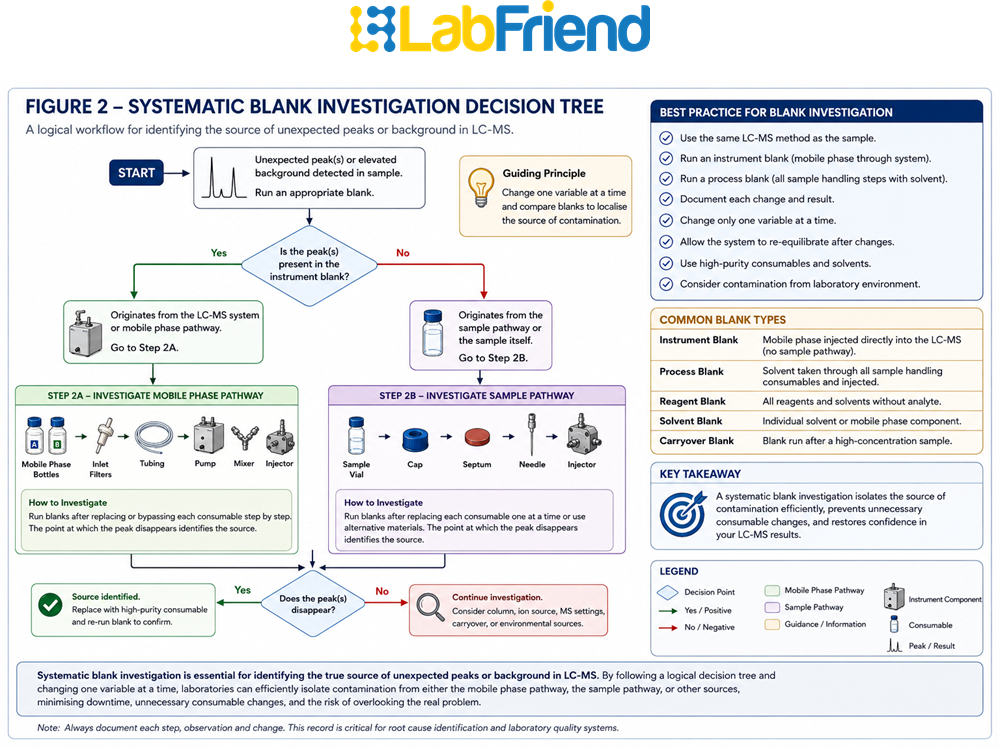
When investigating possible LC-MS contamination, the blank is often the most useful starting point. A high blank response may indicate that the issue is being introduced before the sample reaches the instrument.
The important point is to separate the workflow into stages. If the blank looks clean at the solvent stage but shows contamination after filtration, the filter, syringe or filtration process becomes more relevant. If the signal appears after using a particular vial and cap combination, the vial, cap, septum or storage conditions deserve closer review.
A simple blank investigation can move through:
- Instrument baseline blank, where appropriate.
- Solvent blank.
- Vial blank.
- Cap and septum blank.
- Filtered solvent blank.
- Syringe-filter blank.
- Mobile phase bottle blank.
- Sample preparation device blank.
- Full workflow blank.
For example, if a laboratory sees a recurring background peak only after filtered solvent is transferred into the autosampler vial, it would be reasonable to investigate the filter membrane, filter housing, syringe, vial and septum as a connected sample-contact system. Changing only the vial may not solve the problem if the contamination is being introduced during filtration. Changing only the filter may not solve the problem if the issue is related to the septum or vial surface.
Avoid changing several consumables at once during troubleshooting where practical. If the vial, filter, syringe and cap are all changed together, the method may improve, but the laboratory may still not know which item caused the original problem. That makes future repeat purchasing and substitution control weaker.
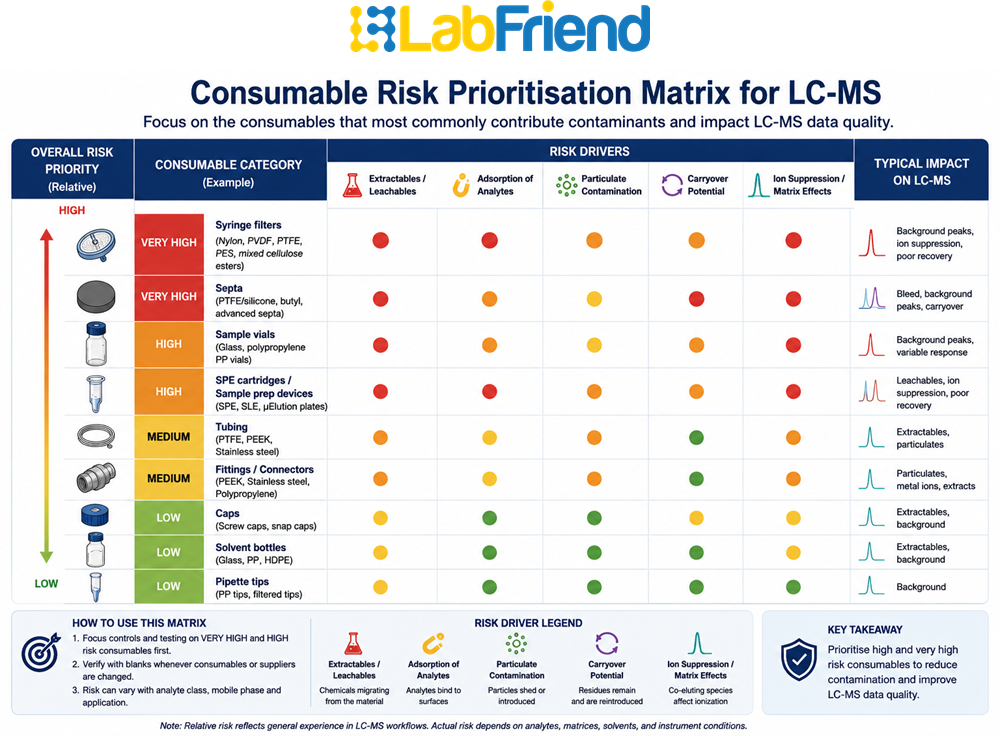
Vials: glass, surface and cleanliness matter
The vial is one of the most obvious LC-MS contamination control points, but it is still easy to underestimate. The sample may sit in the vial for minutes, hours or longer before injection. During that time, the sample is exposed to the vial surface, any insert, the closure environment and any residues introduced during handling.
Vial-related problems usually arise in three ways. The first is contamination from residues, extractables or handling. The second is analyte loss through adsorption onto the vial or insert surface. The third is inconsistency caused by switching between vial types, suppliers or materials without review.
When selecting vials for LC-MS workflows, consider:
|
Vial factor |
LC-MS relevance |
|
Glass type |
May affect background, surface behaviour and method consistency |
|
Surface treatment |
May reduce adsorption risk for selected analytes |
|
Amber vs clear |
Relevant for light-sensitive analytes, but not a universal solution |
|
Plastic vs glass |
Plastic vials may present different adsorption behaviour and may contribute different extractables or leachables compared with borosilicate glass, depending on polymer composition and solvent compatibility |
|
Insert type |
Insert material and geometry may affect recovery or contamination |
|
Certified or low-background claims |
Should be checked against product documentation |
|
Pack handling |
Storage, cleanliness and handling can influence contamination risk |
A low-background or specialised vial may be appropriate where the method is sensitive to background peaks, adsorption or recovery issues. But it should not be assumed that the highest-specification vial is necessary for every LC-MS workflow. The right choice depends on the analyte, solvent system, detection sensitivity, storage conditions and method requirements.
For vial selection, LabFriend UK’s Vials & Septa category is the primary route, while the broader Laboratory Vials category can support wider vial requirements.
Caps and septa: small components can create visible background
Caps and septa are often treated as accessories, but in LC-MS workflows they are part of the sample-contact system. The septum is pierced by the autosampler needle, and depending on fill level, solvent volatility and storage conditions, the underside of the septum may be exposed to solvent vapour or direct contact.
Repeated puncturing can also generate septum particles, sometimes described as coring, or alter resealing performance, potentially increasing contamination or evaporation risk during extended autosampler residence times.
Septa can fail the workflow in different ways from vials. A vial issue may be related to surface adsorption or cleanliness. A septum issue may be related to extractables, coring, particles, resealing behaviour or solvent exposure. A cap issue may be related to closure fit, evaporation or incorrect matching with the vial neck.
When selecting septa for LC-MS or trace-level workflows, check the sample-facing material, backing material, thickness, pre-slit status, resealing behaviour, solvent compatibility and any available extractables information. Do not substitute septa based only on cap size or visual similarity.
The full vial, cap and septum system matters. A suitable vial can still perform poorly if paired with an unsuitable septum. A good septum can still cause problems if the cap does not close correctly or if the vial neck format is wrong.
Syringe filters: membrane, housing and extractables risk
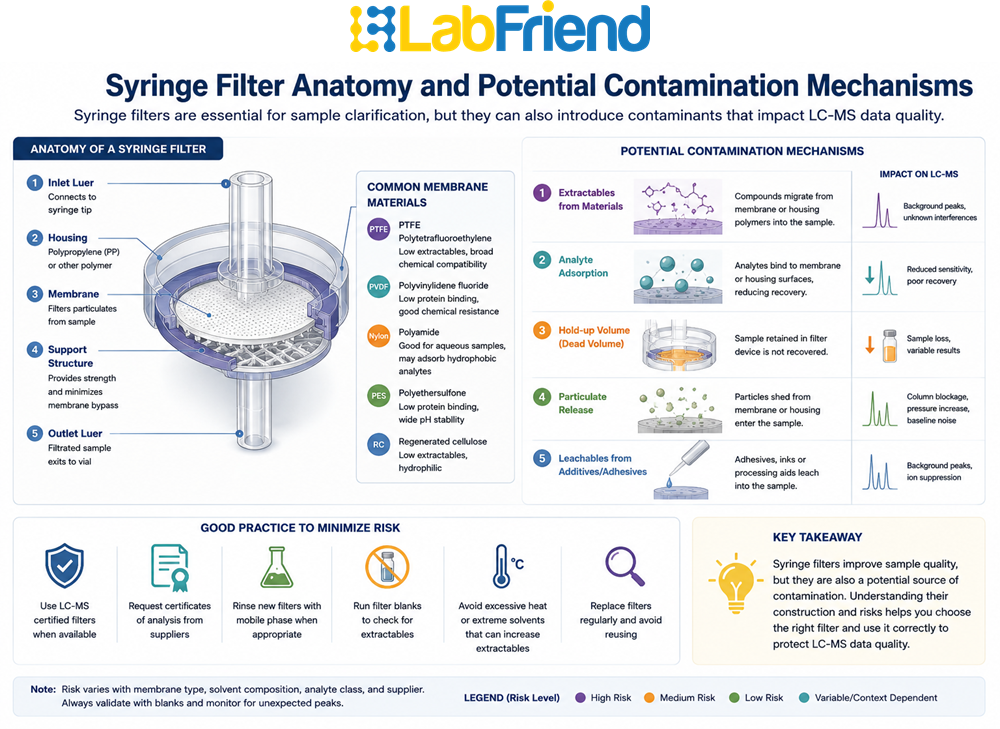
Syringe filters are a common LC-MS sample preparation control point. They are often used to remove particulate matter before injection, helping to protect the column, injector, switching valves and other components within the LC flow path. But they can also introduce contamination or analyte loss if the membrane, housing or handling process is not suitable for the method.
This is where many laboratories make the mistake of selecting by pore size alone. Pore size matters, but it is only one part of the decision. For LC-MS, the membrane chemistry, housing material, extractables profile, binding behaviour, filter diameter and solvent compatibility can all affect the outcome.
|
Factor |
LC-MS consideration |
|
Pore size |
0.22 µm may be used where finer filtration is required; 0.45 µm may be suitable for other workflows |
|
Membrane chemistry |
Must match solvent and analyte behaviour |
|
Housing material |
Can contribute extractables or compatibility issues |
|
Filter diameter |
Should match sample volume and hold-up concerns |
|
Binding risk |
Important where analyte recovery is critical |
|
Extractables |
Important for trace-level and LC-MS methods |
|
Pre-rinsing |
May reduce extractable background for some membrane and solvent combinations but should only be adopted where method verification demonstrates no adverse effect on analyte recovery, concentration or precision |
|
One filter per sample |
Helps reduce carryover risk |
The filter should be treated as part of the method environment, not just as a disposable particle-removal tool. If the method is sensitive to background signal or recovery, a filter change may need the same level of review as a vial or septum change.
LabFriend UK’s Ultimate Syringe Filter Guide explains how pore size, membrane material and filter diameter affect HPLC/UHPLC workflows, including solvent compatibility and extractables considerations.
For LC-MS methods, avoid assuming that a filter suitable for routine HPLC is automatically suitable for trace-level LC-MS. Suitability depends on the solvent system, analyte, detection sensitivity and method requirements.
Membrane compatibility remains method specific
No syringe filter membrane is universally suitable for LC-MS. PTFE, PVDF, PES, nylon, regenerated cellulose and cellulose acetate membranes each have different solvent compatibility, analyte binding characteristics and extractables profiles. Membrane selection should therefore be based on the validated analytical method, solvent composition and analyte chemistry rather than membrane popularity alone.
Syringes and sample transfer
Syringes are sometimes overlooked because attention goes to the filter membrane. In practice, the syringe and filter work together. The syringe barrel, plunger, connection and handling process may all influence contamination, carryover or recovery.
A syringe that is poorly matched to the filter can also make filtration inconsistent. Excessive pressure, high sample viscosity, poor connection fit or unsuitable material compatibility can all affect the preparation step.
For LC-MS workflows, review the syringe material, plunger construction, solvent compatibility, dead volume, connection type and whether the syringe is single-use or reused. A reused syringe may be acceptable in some workflows, but it introduces a different carryover and cleaning-control question from single-use sample preparation.
A useful troubleshooting rule is this: if contamination appears after filtration, do not investigate the filter alone. Investigate the syringe, filter and filtered sample container as a connected system.
Solvent handling products and mobile phase containers
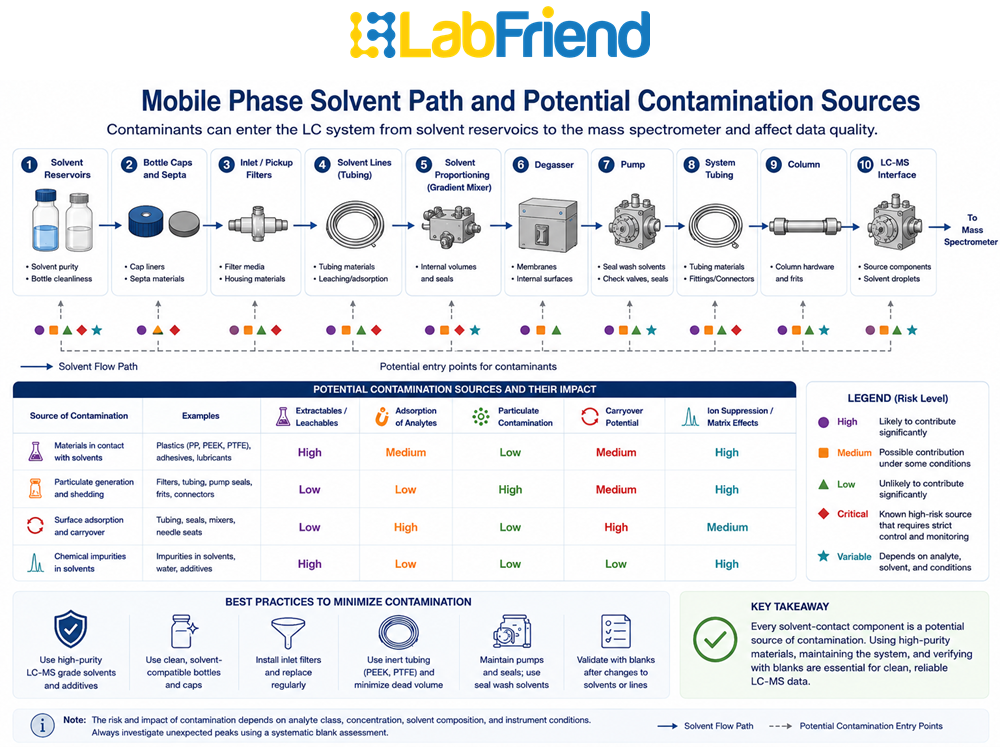
LC-MS contamination can come from the solvent path as well as the sample path. This is particularly important because the mobile phase is continuously introduced into the LC-MS system. A small contamination source in a bottle, cap, tube or inlet component may create a persistent background problem.
Solvent handling products can fail quietly. A bottle may have residue from previous use. A cap may be made from a material that is not ideal for the solvent system. Tubing may have aged, absorbed contaminants or been exposed to unsuitable solvents. Fittings may trap residues or introduce dead volume.
|
Solvent handling item |
What to check |
|
Mobile phase bottles |
Cleanliness, material, residue history and storage |
|
Bottle caps |
Material compatibility and exposure to solvent vapour |
|
Solvent tubing |
Compatibility, age, internal cleanliness and connection quality |
|
Inlet filters |
Cleanliness, compatibility and replacement status |
|
Fittings |
Material, dead volume, previous contamination and connection integrity |
|
Waste caps |
Venting, solvent compatibility and handling practice |
When troubleshooting LC-MS contamination, laboratories often focus first on the sample vial or filter. That is sensible, but it can miss the mobile phase pathway. If contamination appears in solvent blanks or persists across multiple samples, solvent bottles, caps, tubing and inlet products should be reviewed.
The HPLC Accessories category is the relevant commercial route for solvent handling accessories, tubing, fittings and HPLC workflow components.
Mobile phase quality is equally important
Even high-quality consumables cannot compensate for unsuitable mobile phases. LC-MS methods generally require solvents and additives of appropriate LC-MS grade because impurities, non-volatile residues or inconsistent reagent quality may contribute directly to background signal, ion suppression or instrument contamination.
Tubing, fittings and flow-path consumables
Tubing and fittings are easy to overlook because they are not always replaced as frequently as filters, vials or septa. However, they can still contribute to LC-MS background if they are incompatible, contaminated, aged or exposed to unsuitable solvents.
The risk is not always obvious. Fittings, sample loops, unions and low-flow connections may retain residues within dead-volume regions that are not visually apparent. Tubing may be physically intact but have a history of exposure to a different solvent system or sample type. A replacement part may match the physical dimensions but differ in material or internal surface behaviour.
For LC-MS workflows, replacement tubing and fittings should be chosen by method compatibility and instrument requirements, not only by size. Dead volume, material compatibility, pressure suitability and connection quality all matter.
This is especially important in laboratories running multiple methods or switching between applications, where the previous workflow can influence the next one if the flow path is not controlled properly.
Sample preparation devices
Some LC-MS workflows use SPE cartridges, filtration devices, plates, tubes, reservoirs or cleanup consumables before injection. These products can improve method performance by removing matrix components, but they also become part of the contamination-control picture.
A sample preparation device may introduce background through sorbent chemistry, frit material, housing plastic, residual manufacturing process contaminants, processing aids or packaging-derived compounds or solvent incompatibility. It may also affect analyte recovery through binding or incomplete elution.
For LC-MS workflows, sample preparation consumables should be evaluated as part of the whole method. The question is not only whether the device performs the cleanup step. The question is whether it supports acceptable blank response, recovery, reproducibility and compatibility with the detection sensitivity required.
This is where method-specific approval matters. A sample preparation product may be useful and reliable in one workflow and unsuitable in another.
Controlled substitutions: when to be especially careful
Supplier switching and alternative products can be commercially useful, especially where laboratories are trying to reduce cost, improve availability or build approved backup options. But LC-MS workflows need more control than routine general laboratory purchasing.
The risk with substitutions is not simply that a product is “better” or “worse.” The risk is that it is different in a way that matters to the method. A different septum, filter housing, vial surface or tubing material may change the blank response, analyte recovery or background profile.
Technical approval should be required where:
- the method is validated or formally verified under GMP, GLP, ISO 17025 or equivalent quality systems
- the method is client-specified
- the work is regulatory or audit-sensitive
- analytes are measured at low levels
- LC-MS/MS sensitivity is critical
- historical data must remain comparable
- recovery is known to be difficult
- the method is prone to adsorption
- background peaks have been a previous issue
- the substitution changes sample-contact material
- the substitution changes solvent-contact material
Substitutions may still be appropriate for routine workflows where specifications can be matched and technical users approve the change. The important point is that approval should be controlled and documented, not assumed.
Where LLG Labware may fit
LabFriend UK supplies the LLG Labware range, which may be relevant where laboratories want dependable, cost-effective options for routine workflows. For LC-MS workflows, any substitution should be controlled carefully.
LLG Labware or other alternative product routes may be considered where the workflow is routine enough to allow evaluation, the specification can be matched clearly, the product documentation supports the intended use, and the technical user approves the change.
For sensitive LC-MS methods, the laboratory may also need to test blank response, recovery or method suitability before adding an alternative product to an approved list.
Do not present any alternative product as universally equivalent for LC-MS unless the specific workflow and technical approval support that decision.
Practical LC-MS contamination troubleshooting checklist
Once the main risk areas are understood, a simple troubleshooting framework can help the laboratory work methodically. The purpose of the checklist below is not to replace method investigation. It is to help isolate whether the contamination may be linked to consumables.
|
Step |
Question |
Action |
|
1 |
Does the contamination appear in a solvent blank? |
Review solvent, bottle, cap, tubing and mobile phase handling |
|
2 |
Does it appear in a vial blank? |
Review vial, insert, cap and septum |
|
3 |
Does it appear after filtration? |
Review filter membrane, housing, syringe and pre-rinse procedure |
|
4 |
Does it appear only with one consumable manufacturing lot or batch? |
Check batch change history and repeat with approved product |
|
5 |
Does it appear after supplier substitution? |
Compare old and new product specifications and blank response |
|
6 |
Does the analyte recovery change? |
Review adsorption to vial, filter, tubing or sample prep device |
|
7 |
Is the method LC-MS/MS or trace-level? |
Apply stricter substitution and documentation controls |
|
8 |
Are several variables changing at once? |
Return to a controlled approved consumables list |
|
9 |
Does the contamination occur only in one ionisation mode or polarity? |
Compare positive and negative ion data to help distinguish consumable-related contamination from analyte-specific effects. |
A useful principle is to move from the simplest blank to the full workflow. If the contamination appears early, focus on the early contact points. If it appears only after the full preparation process, widen the investigation to include every product that contacts the sample.
Approved consumable records for LC-MS workflows
For recurring LC-MS workflows, laboratories should maintain approved consumable records. This is not just a procurement exercise. It is part of method consistency.
A good approved record helps scientists avoid uncontrolled changes and helps procurement reorder accurately. It also helps the laboratory understand what changed if contamination appears after a supplier switch, product substitution or pack change.
|
Consumable |
Specification to record |
|
Vial |
Material, volume, dimensions, surface treatment, colour, insert status, manufacturer code |
|
Cap/septum |
Closure type, septum material, facing, thickness, pre-slit status, manufacturer code |
|
Syringe filter |
Membrane, pore size, diameter, housing, sterility status, extractables claim, manufacturer code |
|
Syringe |
Volume, material, connection, single-use/reusable status |
|
Solvent bottle |
Material, volume, cap type, previous use restriction |
|
Solvent cap |
Material, connection type, venting, tubing compatibility |
|
Tubing/fittings |
Material, dimensions, pressure suitability, instrument compatibility |
|
SPE/sample prep device |
Sorbent, bed mass, format, frit material, housing, product code |
|
Approval status |
Approved, restricted, no substitution, technical review required |
|
Repeat-order route |
LabFriend URL, SKU, quote reference or supplier code |
This is particularly valuable for CROs, independent testing laboratories, QA/QC teams and SME biotech companies where the same LC-MS workflow may be repeated frequently and where delays, reruns or unexplained background signals have a direct operational cost.
How procurement can support LC-MS contamination control
Procurement teams can reduce contamination risk by making sure technical specifications are not lost during ordering. Many contamination or substitution problems begin when a precise technical requirement becomes a vague purchasing description.
Descriptions such as “LC-MS vial,” “HPLC filter,” “low-background septa,” “2 mL vial,” “PTFE syringe filter” or “solvent bottle cap” may not be enough for a sensitive method.
Procurement should request the full approved specification, including manufacturer code, dimensions, material, pack size, compatibility restrictions and substitution rules. Where alternatives are being considered, procurement should confirm whether technical approval is required before purchase.
This does not slow down purchasing in the long term. It makes repeat purchasing easier because approved specifications can be quoted, reordered and reviewed consistently.
Where LabFriend UK fits
LabFriend UK helps laboratories source chromatography and sample preparation consumables through an ecommerce-led UK supply model. For LC-MS contamination-control workflows, the most useful starting point is usually a clear record of the approved consumables already in use, followed by a review of where alternatives may be appropriate.
Relevant LabFriend UK routes include:
- Chromatography Vials and Septa
- Laboratory Vials
- Chromatography Sample Preparation
- HPLC Accessories
- Chromatography Products
- LLG Labware
- Contact LabFriend UK
For repeat-use LC-MS workflows, the best approach is to record the approved consumable specification and use that record for future quotes and repeat orders.
Common mistakes when trying to reduce LC-MS contamination
Mistake 1: Changing several consumables at once
This makes it difficult to identify the contamination source. If the problem disappears after several changes, the laboratory may still not know which product caused the issue.
Mistake 2: Assuming routine HPLC consumables are suitable for LC-MS
Some routine consumables may be suitable, but LC-MS workflows may have stricter background, recovery and contamination requirements.
Mistake 3: Focusing only on the vial
Vials matter, but filters, syringes, septa, tubing, fittings and solvent handling products can also contribute.
Mistake 4: Ignoring the septum
The septum can be exposed to solvent vapour, needle penetration and sample-contact conditions. It should be part of the approved specification.
Mistake 5: Selecting syringe filters by pore size only
Membrane chemistry, housing material, extractables, binding and solvent compatibility also matter.
Mistake 6: Not documenting approved alternatives
If an alternative has been tested and approved, record it. If it has not, do not treat it as approved.
Mistake 7: Assuming low-background claims remove the need for method verification
Product claims can support selection, but method-specific verification is still important in sensitive workflows.
Final recommendation
LC-MS contamination control should be managed as a complete consumables workflow, not as a single product choice.
Start by reviewing the sample path and solvent path. Check vials, inserts, caps, septa, filters, syringes, tubing, fittings, solvent bottles, caps and sample preparation devices. Use blanks to isolate likely contamination sources, avoid changing too many variables at once, and maintain approved consumable records for repeat-use methods.
For laboratories using LC-MS routinely, this approach also supports better purchasing discipline. Once the approved specification is clear, procurement can reorder accurately, identify controlled alternatives where appropriate, and reduce the risk of accidental substitutions.
For broader chromatography consumables planning, use The Complete Guide to Chromatography Consumables for UK Laboratories as the parent reference for this cluster.
Browse chromatography vials and septa, review chromatography sample preparation products, explore HPLC accessories, or contact LabFriend UK for help sourcing repeat-use LC-MS consumables.
Good laboratory practices that reduce consumable-related contamination
In addition to selecting suitable consumables, laboratories can reduce contamination risk by handling vials with clean gloves, minimising open-vial exposure, storing consumables in clean packaging until use, preparing mobile phases using clean glassware, avoiding unnecessary sample transfers, and documenting approved consumable specifications through formal change-control procedures.
Frequently Asked Questions
What causes LC-MS contamination from consumables?
LC-MS contamination from consumables can arise from extractables, leachables, residues, particles, adsorption, carryover or incompatible materials in vials, septa, syringe filters, syringes, tubing, fittings, solvent bottles, solvent caps or sample preparation devices.
Can chromatography vials cause LC-MS background peaks?
Yes, vials can contribute to background peaks where residues, surface interactions, extractables or handling contamination are present. The risk depends on vial material, surface, cleanliness, storage conditions, method sensitivity and sample chemistry.
Can septa cause LC-MS contamination?
Septa can contribute contamination through extractables, leachables, coring, particles, solvent exposure or poor material compatibility. The septum should be treated as part of the approved LC-MS vial system.
Are all syringe filters suitable for LC-MS?
No. Syringe filters vary by membrane material, pore size, housing, extractables, binding behaviour and solvent compatibility. A filter suitable for routine HPLC may not be suitable for every LC-MS method.
Suitability should also consider the intended ionisation technique, for example electrospray ionisation, because very low-level extractables that are insignificant for UV detection may still be detectable by MS.
How do I know whether a syringe filter is suitable for LC-MS?
Check the method requirements, solvent compatibility, analyte recovery, extractables risk, membrane chemistry, housing material and manufacturer documentation. For sensitive workflows, verify suitability through blanks, recovery checks or method-specific approval.
Should LC-MS consumables be pre-rinsed?
Some workflows may use pre-rinsing to reduce filter or consumable background, but this should be assessed against the method. Where pre-rinsing is adopted, the procedure should be defined within the analytical method or laboratory SOP and verified during method development or change control.
Can solvent bottles and caps cause LC-MS contamination?
Yes. Mobile phase bottles, caps, tubing and inlet components can contribute contamination if they are incompatible, contaminated, poorly cleaned, aged or used with unsuitable solvents.
When should consumable substitutions be technically approved?
Substitutions should be technically approved where the method is validated, client-specified, LC-MS/MS-sensitive, trace-level, recovery-sensitive, contamination-prone, regulated or historically trended.
How can procurement reduce LC-MS contamination risk?
Procurement can help by recording approved consumable specifications, avoiding vague product descriptions, checking substitution rules, maintaining approved alternatives and setting repeat-order records for sensitive workflows.
Where can I buy LC-MS sample preparation consumables from LabFriend UK?
LabFriend UK supplies chromatography vials and septa, laboratory vials, chromatography sample preparation products, HPLC accessories and wider chromatography products through its online platform. Buyers can browse the relevant categories or contact LabFriend UK for quotation support.
Written by: Donal O’Sullivan, BSc, Co-Founder and Sales Director, LabFriend UK. Donal brings deep chemistry-led technical expertise across analytical chemistry, biochemistry, environmental monitoring, laboratory instrumentation, consumables and scientific product selection.
Reviewed by: Michael Anderson, MBA, Founder and Managing Director, LabFriend UK. Michael reviews LabFriend UK content for customer relevance, commercial accuracy, operational practicality and alignment with LabFriend UK’s laboratory supply model.
Read more from LabFriend UK
- The Complete Guide to Chromatography Consumables for UK Laboratories
- The Ultimate Syringe Filter Guide: Pore Size, Membranes, and Applications
- Browse Chromatography Products
- Browse Chromatography Vials and Septa
- Browse Chromatography Sample Preparation
- Browse HPLC Accessories
Frequently asked questions
Delivery times vary by product and supplier. Each product page shows current stock levels and the expected lead time, and we confirm this when you place your order. Most items arrive within 2 to 3 weeks. Specialised items can take longer if they are not in stock. If you need something by a certain date, contact us and we’ll check for you.
Yes. Register for a commercial account and, once it’s approved, you will be able to process orders via PO Once you have a commercial account, you can directly email your purchase orders
Add products to your cart and click Get a Quote. You’ll get a formal quote instantly, ready to send to your email address. For bulk orders or custom requirements, send us your product list and we’ll reply with itemized pricing.
If your item is faulty, not as described or sent in error, let us know within 14 days of delivery and we’ll arrange a return. Change of mind returns are only accepted if the item is unused and in its original packaging. A restocking fee will apply and you pay the return freight. Read our full Returns Policy for details.
Yes, prices are shown including VAT by default. Use the Prices Inc. VAT toggle at the top of the page to view prices without VAT.