

Share :
Amber vs Clear Reagent Bottles for Procurement Teams - Specification and Substitution Checks
Updated On 08/20/2026

By Donal O’Sullivan, BSc. Reviewed by Michael Anderson, MBA.
Quick answer
Procurement teams should not treat amber and clear reagent bottles as interchangeable simply because the volume, material or product description appears similar. Bottle colour can be a controlled specification field. Before buying, substituting or requesting a quote, procurement should confirm whether the workflow requires reduced light exposure, visibility for inspection, a specific material, cap/thread, closure, documentation status, approved product code or QA/QC (quality assurance/quality control) review.
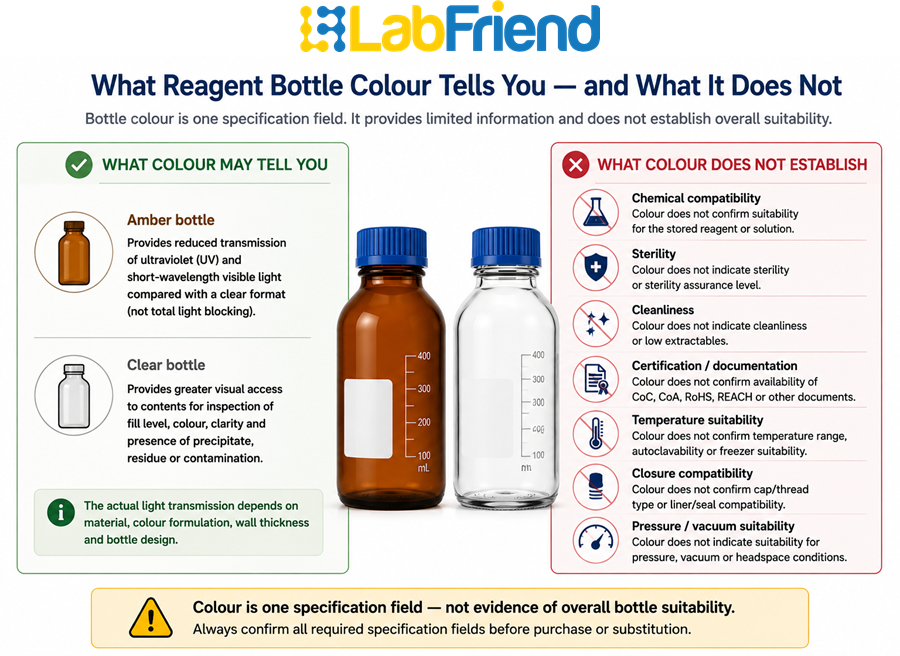
Amber reagent bottles are generally selected where reduced light exposure is required. Amber glass and amber-tinted plastics primarily attenuate UV and short-wavelength visible light rather than blocking all light, so the protection they offer is partial, not absolute. Clear reagent bottles may be preferred where visibility, fill-level checks, colour inspection, clarity checks or routine identification matter. Ordinary clear glass still provides some inherent UV attenuation and is not a zero-protection material, even though it is not treated as a light-protective specification. Neither colour confirms chemical compatibility, sterility, certification, cleanliness, temperature suitability or closure suitability on its own.
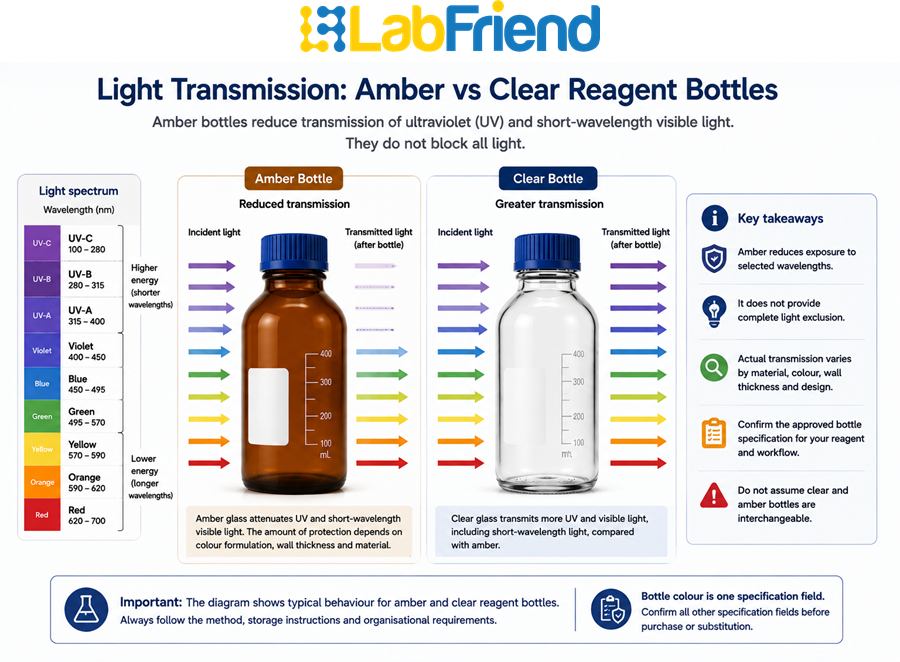
For broader bottle-selection context, read LabFriend UK’s Laboratory Bottles: Selection Guide for UK Laboratories. Once the approved colour requirement is confirmed, procurement teams can compare laboratory reagent bottles by amber or clear format, material, volume and cap/thread.
Why amber vs clear reagent bottle decisions matter in procurement
For procurement teams, amber versus clear reagent bottle selection can look like a simple buying choice. The request may arrive as “500 ml reagent bottles”, “amber glass bottles”, “clear GL45 bottles” or “same as last time”. If the product code is missing, it can be tempting to search for the nearest available match and proceed.
That is where mistakes can happen.
In controlled laboratory environments, bottle colour may reflect a technical requirement. Amber may have been selected because the stored reagent, prepared solution or sample needs reduced light exposure. Clear may have been selected because the user needs to inspect colour, clarity, fill level, precipitate, residue or contamination before use. In other cases, colour may simply be historical preference, but procurement should not assume that without checking.
The procurement risk is not just ordering the wrong colour. It is ordering a bottle that appears close enough but differs in material, cap/thread, closure, pack size, documentation status or approved product code. A clear bottle may not be acceptable where an SOP requires protection from light. An amber bottle may not be acceptable where visibility is part of the workflow. A bottle with the same nominal volume may still be unsuitable if the cap, liner or material differs.
The practical procurement goal is therefore not to choose amber or clear independently. It is to capture the approved specification clearly enough that the right bottle can be bought, quoted and reordered consistently.
Bottle colour is a specification field, not a preference
In practice, this simply means colour should be captured and approved alongside the other purchasing details, not decided on its own. Bottle colour should be treated as one field within the complete reagent bottle specification. It sits alongside volume, material, mouth style, thread, cap, liner, closure, pack size, documentation and approved product code.
This matters because procurement often works from incomplete descriptions. “Amber reagent bottle” may not be enough. The laboratory may need amber glass rather than amber plastic, a specific volume, a GL thread, a particular cap type, a particular liner, a clear labelling area, a defined pack size or an approved manufacturer reference. Light-blocking performance can differ between amber glass and amber-tinted plastics depending on pigment loading and wall thickness, so material and colour should be confirmed together rather than treated as interchangeable attributes. Similarly, “clear reagent bottle” may not be enough if the team expects borosilicate glass, a defined closure or a particular product code.
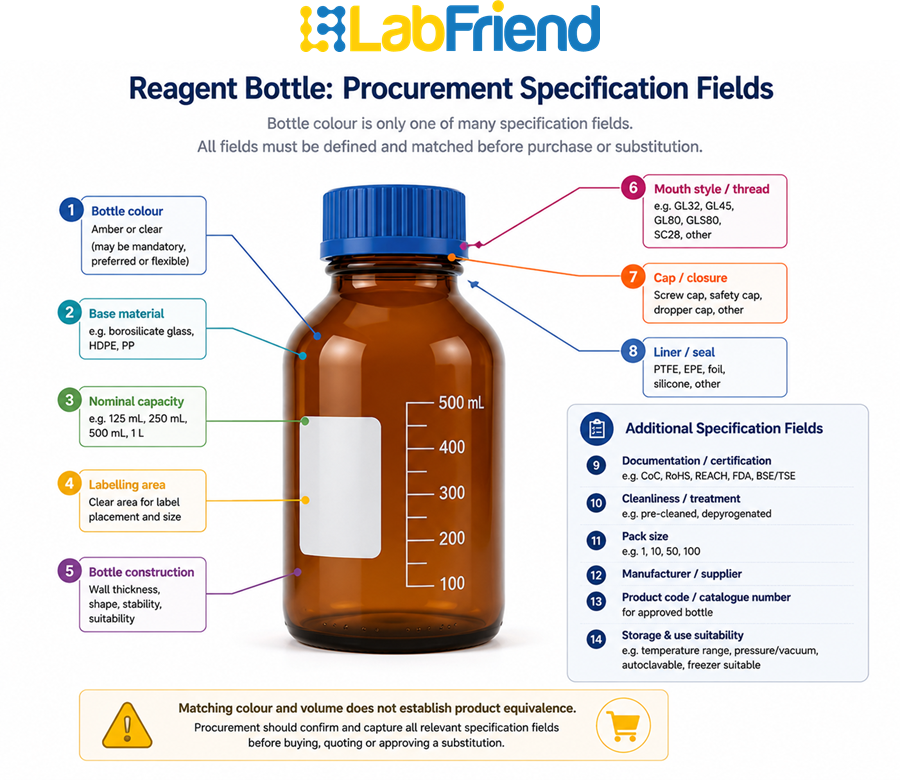
A good procurement process asks whether colour is mandatory, preferred or flexible. If it is mandatory, the reason should be recorded. If it is flexible, acceptable alternatives should be documented. If it is unknown, procurement should pause before substituting.
The key question is:
Is amber or clear part of the approved technical requirement, or is it only an informal preference?
If the answer is not known, procurement should ask the laboratory user, QA/QC contact or method owner before placing the order.
When amber should not be substituted with clear
Amber should not be substituted with clear where reduced light exposure is part of the requirement. This may be stated in a method, SOP, label instruction, product specification, internal risk assessment or user request. It may also be implied by the nature of the reagent or prepared solution, although procurement should not make that judgement alone.
A switch from amber to clear can be risky because it may remove a control that the laboratory expects. Even where the same volume and closure are available in clear format, the change may affect how the reagent is stored, handled, labelled or documented.
Procurement should be particularly cautious where the bottle is used for light-sensitive reagents, prepared solutions with defined storage conditions, QA/QC methods, retained samples, regulated workflows (for example, ISO 17025-accredited testing or GMP-controlled processes) or repeat orders where amber has already been approved.
The table below gives a quick reference for common situations and the recommended action for each.
|
Procurement situation |
Recommended action |
|
Existing approved product is amber |
Do not substitute clear without technical approval |
|
SOP or method refers to light protection |
Keep amber requirement unless method owner approves change |
|
Label says “protect from light” |
Treat clear substitution as high risk |
|
User specifically requested amber |
Confirm whether amber is mandatory or preferred |
|
Amber product unavailable |
Ask whether a technically approved alternative exists |
|
Supplier offers clear equivalent |
Check material, closure, documentation and colour requirement before accepting |
The important point is that availability does not create suitability. A clear bottle may be easier to source, cheaper or available in the same nominal capacity, but that does not make it an approved substitute.
When clear should not be substituted with amber
Substituting amber for clear can also create problems. Amber may appear to be the safer option because it offers reduced light exposure, but that is not always the correct procurement decision. Repeated autoclaving cycles and prolonged UV exposure can gradually fade the colourant in amber glass and plastic, so light-blocking performance should not be assumed constant over time.
Clear bottles may have been selected because the laboratory needs visibility. Users may need to inspect fill level, colour, clarity, sediment, precipitate, residue, contamination or mixing status. If an amber bottle reduces visibility, the workflow may become less practical or less controlled.
Clear bottles may also be part of an established method, SOP, training process or stockroom system. Changing to amber can create confusion if users expect a clear bottle, if labels have been designed for clear storage, or if product codes no longer match previous orders.
Procurement should therefore avoid the assumption that amber is automatically an upgrade. It is only appropriate where the full specification and workflow still match the requirement.
|
Procurement situation |
Recommended action |
|
Existing approved product is clear |
Do not substitute amber without checking visibility needs |
|
Users inspect colour or clarity |
Confirm amber will not interfere with inspection |
|
Fill-level visibility matters |
Confirm users can still manage the workflow |
|
Method or SOP specifies clear |
Keep clear requirement unless technically reviewed |
|
Amber product appears “more protective” |
Do not treat protection as beneficial unless required |
|
Product code changes with colour |
Record and approve the new specification before ordering |
A procurement substitution should preserve the workflow, not just the general product description.
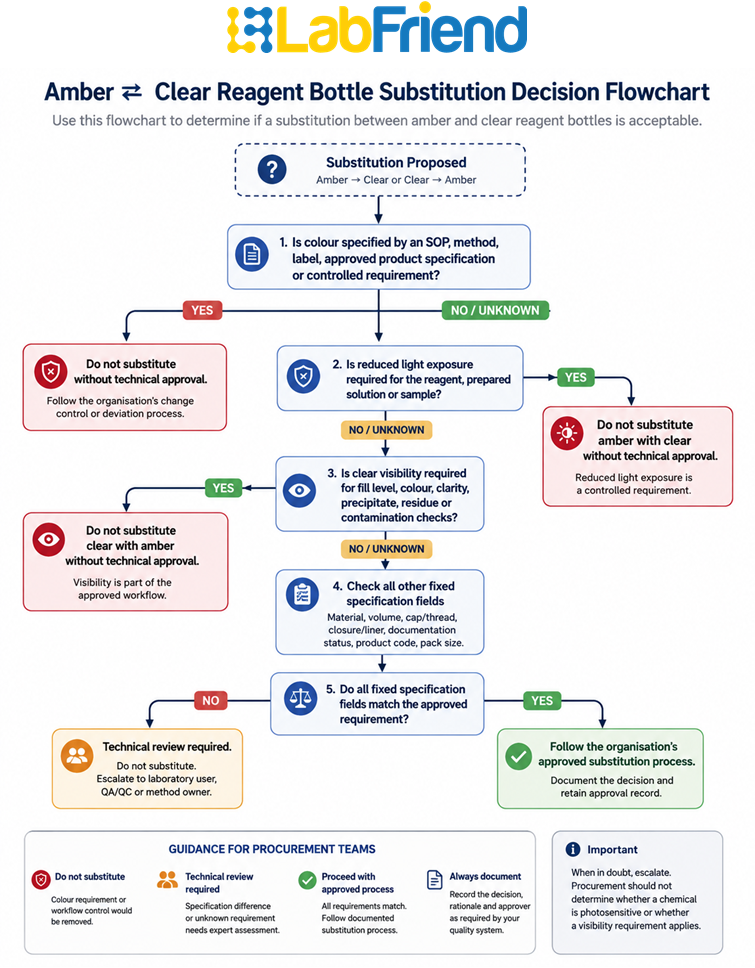
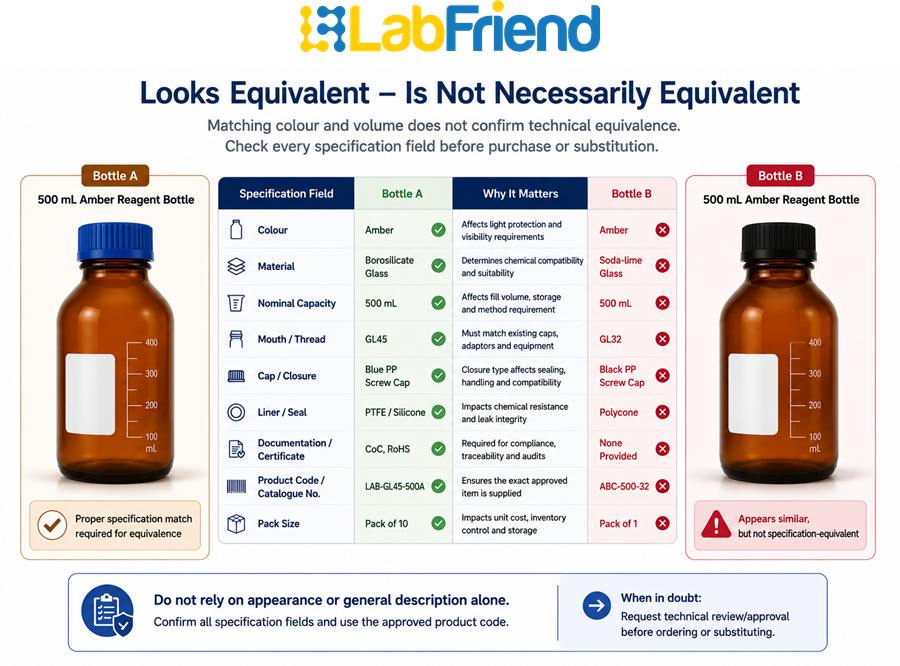
Quote-ready amber or clear reagent bottle specification
A quote request for amber or clear reagent bottles should be specific enough to prevent ambiguity. The aim is to make the supplier response accurate and make the repeat order easier later.
Procurement should avoid quote requests that rely only on broad descriptions such as “amber bottles”, “clear reagent bottles” or “500 ml laboratory bottles”. These descriptions leave too much room for mismatch.
A quote-ready specification should include the approved colour, material, volume, cap/thread, closure requirement, pack size, quantity, product code if known, acceptable alternatives and any documentation requirement. If the bottle is being used in a controlled workflow, the request should also state that substitutions require approval.
|
Quote field |
What to capture |
|
Bottle colour |
Amber, clear, or either if technically acceptable |
|
Bottle material |
Amber glass, clear glass, HDPE, PP or other required material |
|
Volume |
Nominal capacity (rated volume, not necessarily maximum usable fill) and any preferred working-volume context |
|
Mouth / thread |
GL thread (e.g. GL45, GL32) or other relevant thread detail where specified |
|
Cap and closure |
Supplied cap, replacement cap, liner or seal requirement, including liner material (e.g. PTFE-lined vs unlined) where the reagent may react with the seal |
|
Pack size |
Required pack format or acceptable pack range |
|
Quantity |
Order quantity and expected repeat requirement |
|
Product code |
Current approved product code or manufacturer reference |
|
Documentation |
Certificate of analysis, certificate of conformity, sterility, pre-cleaning, batch traceability or other documentation if required |
|
Labelling area |
Whether a clear, unobstructed labelling area is required, and any label size or placement constraint |
|
Approved alternatives |
Whether alternatives are allowed and what must match |
|
Substitution rule |
Whether colour, material or closure can be substituted without review |
The most useful quote request is one that tells the supplier not only what the buyer wants, but what must not be changed.
Acceptable alternatives and substitution controls
Acceptable alternatives are valuable in procurement. They can improve supply resilience, reduce delays and support supplier-switching discussions. However, alternatives must be controlled. An alternative is not acceptable simply because it is available, cheaper or visually similar.
For amber and clear reagent bottles, acceptable alternatives should be defined around the critical specification fields. If colour is mandatory, the alternative must preserve colour. If material is mandatory, it must preserve material. If cap/thread is mandatory, it must preserve the closure system. If documentation is mandatory, it must preserve the documentation requirement.
Procurement should classify each specification field as either fixed, reviewable or flexible.
|
Specification field |
Fixed |
Reviewable |
Flexible |
|
Bottle colour |
Required by method, SOP or light/visibility need |
Unclear requirement, needs technical check |
No technical colour requirement confirmed |
|
Material |
Required for compatibility or workflow |
Alternative material proposed |
Material not critical for routine use |
|
Cap/thread |
Must match existing closure system |
Similar closure proposed |
Closure is non-critical and approved |
|
Documentation |
Certification, sterility or pre-cleaning required |
Alternative documentation proposed |
No special documentation required |
|
Product code |
Approved product code only |
Equivalent proposed for review |
Product code not fixed |
|
Pack size |
Stockroom requires defined pack |
Alternative pack size affects storage |
Pack size flexible |
In practice: “Fixed” means do not substitute without named approval; “Reviewable” means check with the technical or QA/QC owner before substituting; “Flexible” means substitution does not require approval.
This structure helps procurement ask better questions. It also protects the laboratory from uncontrolled substitutions.
For reagent-specific suitability checks, procurement teams can use LabFriend UK’s technical guide to selecting reagent bottles for chemical storage alongside the buying specification.
When comparing or switching suppliers, procurement should confirm the alternate supplier's product meets the same fixed specification fields, such as colour, material, cap/thread and documentation, rather than relying on a similar product description, since supplier switching is a common trigger for undetected substitution.
Product-code capture and repeat ordering
Amber and clear reagent bottle errors often appear at reorder stage. Amber and clear versions of an otherwise identical bottle are usually assigned distinct manufacturer product codes rather than a shared code with a colour attribute, so the colour itself must be captured as part of the code, not assumed from it. The first order may be clarified by email or phone, but if the product code is not captured properly, the next buyer may reorder from a description alone.
That is a weak control.
Procurement should record the approved product code, manufacturer reference where available, bottle colour, material, volume, cap/thread, pack size and any agreed alternative. The record should also show who approved the specification and whether substitutions are allowed.
This is especially important where a laboratory repeatedly orders the same reagent bottle for QA/QC, production support, analytical work or routine prepared solutions. A consistent product-code record reduces avoidable clarification and helps maintain continuity.
A useful repeat-order record might include:
|
Repeat-order field |
Recommended detail |
|
Internal item name |
Laboratory’s preferred description |
|
Approved product code |
Exact LabFriend or manufacturer product reference |
|
Colour |
Amber or clear |
|
Material |
Amber glass, clear glass, HDPE, PP or other |
|
Volume |
Nominal capacity |
|
Cap/thread |
Thread and supplied cap details |
|
Closure / liner |
Specific liner, seal or closure requirement |
|
Documentation status |
Certificate of analysis, certificate of conformity, sterility or pre-cleaning documentation required, if any |
|
Pack size |
Unit of purchase |
|
Approved alternatives |
Named alternatives or “technical review required” |
|
User group |
Department, lab, project or method owner |
|
Reorder trigger |
Minimum stock level, order frequency, or demand cue (e.g. project start, method validation) that should prompt a reorder |
|
Approval note |
QA/QC, lab manager or technical owner approval |
The benefit is practical. Procurement can reorder with confidence, the laboratory receives the bottle it expects, and the supplier has a clearer basis for quoting or suggesting alternatives.
Documentation, method, SOP and QA/QC checks
Procurement should know when to escalate. Not every bottle purchase needs a formal technical review, but amber versus clear substitutions should be checked whenever bottle colour may affect the workflow.
A method, SOP, product label, internal specification or QA/QC requirement should override convenience. If the document specifies amber, procurement should not buy clear unless the technical owner approves the change. If visibility is part of the workflow, procurement should not switch to amber just because it is available.
Documentation requirements also need separate attention. Bottle colour does not confirm that a bottle is sterile, certified, pre-cleaned, suitable for a regulated method or supplied with the documentation the laboratory needs. Colour tint is achieved through additives to the base material (for example, iron oxide in glass or pigments in plastic) and does not alter that material's chemical resistance; compatibility is governed by the base material itself, such as borosilicate glass or HDPE, not by colour. If documentation is required, it must be requested and confirmed separately.
Where material choice is also part of the decision, procurement teams can review LabFriend UK’s Laboratory Bottle Materials Explained before accepting an alternative.
Where the original approving contact is no longer available, for example following a staff change, procurement should escalate to the current QA/QC lead or laboratory manager rather than treating the historical approval as sufficient on its own, particularly for long-running repeat orders.
Common procurement mistakes
One common mistake is buying by colour and volume alone. “Amber, 500 ml” or “clear, 1 litre” does not define the complete bottle requirement. Material, thread, cap, closure, pack size and documentation may all matter.
A second mistake is assuming amber is always better. Amber may be necessary where reduced light exposure is required, but it may reduce visibility where inspection matters.
A third mistake is assuming clear is the default substitute. Clear bottles may be suitable for many routine workflows, but they should not replace amber where light protection is specified.
A fourth mistake is accepting a supplier alternative without checking what has changed. The alternative may differ in material, cap, closure, pack size, certification, cleanliness or manufacturer specification.
A fifth mistake is failing to capture the approved product code after the first order. This leads to repeated clarification, inconsistent reorders and preventable errors.
Procurement teams can avoid most of these problems by treating amber and clear as controlled specification fields rather than descriptive preferences.
What this article does not solve
This article helps procurement teams specify and buy amber or clear reagent bottles more accurately. It does not confirm that a specific bottle is chemically compatible, sterile, certified, pre-cleaned, autoclavable, freezer-suitable, pressure-rated, vacuum-rated or method-approved.
Those checks must come from product documentation, manufacturer information, the SDS (safety data sheet), COSHH (Control of Substances Hazardous to Health) assessment, method requirements, SOPs and local laboratory procedures.
Procurement should also avoid making technical substitutions independently. Where bottle colour, material, closure or documentation status forms part of a controlled requirement, the appropriate laboratory, QA/QC or technical owner should approve any change before purchase.
What procurement should check before buying
Before buying amber or clear reagent bottles, procurement should confirm the approved requirement and any substitution limits.
|
Check |
Procurement question |
|
Colour requirement |
Is amber or clear mandatory, preferred or flexible? |
|
Reason for colour |
Is the colour linked to light protection, visibility, method, SOP or preference? |
|
Material |
Is the required bottle amber glass, clear glass, plastic or another material? |
|
Volume |
What nominal capacity and pack size are required? |
|
Cap/thread |
Is a specific thread, cap, liner or closure required? |
|
Documentation |
Is certification, sterility, pre-cleaning or other documentation needed? |
|
Product code |
Is there an approved product code or previous order reference? |
|
Alternatives |
Are alternatives allowed, and which fields must match exactly? |
|
Technical approval |
Who must approve a colour, material or closure substitution? |
|
Repeat ordering |
Should this item be added to a standard reorder list? |
This checklist should be used before requesting a quote, accepting an alternative or placing a repeat order.
Where to compare bottle options once the colour requirement is confirmed
Once the approved colour requirement is confirmed, procurement can move from specification to product comparison.
For amber or clear reagent bottle options, start with LabFriend UK’s laboratory reagent bottles. Compare colour, material, volume, cap/thread, closure and pack size against the approved requirement.
If procurement is still comparing broader bottle and vessel types, review laboratory glassware, where bottle type, material and closure may need to be considered together. For the wider parent category, laboratory consumables and glassware provides broader category context across related laboratory consumables and glassware.
If the colour, material, closure, documentation status or acceptable alternative is unclear, contact LabFriend UK for support with amber or clear reagent bottle specifications before requesting a quote.
The correct procurement sequence is: confirm the approved colour requirement, check the full specification, define substitution limits, then compare suitable products or request a quote.
FAQs
What should procurement check before buying amber reagent bottles?
Procurement should confirm whether amber is mandatory, why reduced light exposure is required, the required material, volume, cap/thread, closure, pack size, documentation status, approved product code and whether alternatives are allowed.
What should procurement check before buying clear reagent bottles?
Procurement should confirm whether clear is required for visibility, inspection, fill-level checks, routine identification or method expectations. Material, closure, documentation and product code should also be checked.
Can procurement substitute clear reagent bottles for amber reagent bottles?
Only after technical review (sign-off from the QA/QC contact, method owner or laboratory manager) where amber is part of the approved requirement. If the method, SOP, label or internal specification requires reduced light exposure, clear should not be substituted without approval.
Can procurement substitute amber reagent bottles for clear reagent bottles?
Only after checking the workflow. Amber may reduce visibility, which can matter where users need to inspect fill level, colour, clarity, residue or contamination.
What should be included in an amber or clear reagent bottle quote request?
A quote request should include bottle colour, material, volume, cap/thread, closure, pack size, quantity, product code if known, documentation requirements, acceptable alternatives and substitution limits.
Does amber colour confirm chemical compatibility?
No. Amber colour does not confirm chemical compatibility. Compatibility depends on material, contents, concentration, storage duration, temperature, closure and manufacturer documentation.
Are clear reagent bottles suitable for controlled workflows?
Yes, clear reagent bottles may be suitable where light protection is not required and visibility, inspection or routine identification are important. Suitability still depends on the full specification.
When should bottle colour require technical approval?
Technical approval should be required when bottle colour is specified by a method, SOP, label, QA/QC requirement, light-sensitivity need, visibility requirement or previous approved product code.
How should procurement record approved bottle colour?
Procurement should record the approved colour alongside product code, material, volume, cap/thread, closure, pack size, documentation status, approved alternatives and the approving user or technical owner.
How can procurement reduce amber and clear reagent bottle reorder errors?
Procurement can reduce errors by using approved product codes, recording colour and closure details, defining acceptable alternatives, preserving technical exceptions and avoiding reorders from description alone.
What should procurement do if the wrong bottle colour was ordered and has already been received or used?
The receiving laboratory or QA/QC contact should be notified so they can assess whether the substitution affects the workflow, and the order record should be corrected before any repeat order is placed.
Who should approve a bottle colour substitution if there is no named QA/QC contact?
Approval should default to the laboratory user or method owner who requested the original specification. Procurement should not proceed with a substitution based on its own judgement alone.
Conclusion
Amber versus clear reagent bottle procurement should be controlled by specification, not assumption. Amber may be required where reduced light exposure matters. Clear may be required where visibility, inspection and routine identification matter. Neither colour confirms suitability on its own.
For procurement teams, the safest approach is to capture the complete approved specification before buying or substituting: colour, material, volume, cap/thread, closure, documentation status, product code and acceptable alternatives. Where the requirement is technical, QA/QC or method-led, procurement should not make colour substitutions without review.
Once the approved requirement is clear, compare LabFriend UK’s laboratory reagent bottles, review broader laboratory glassware, or use the parent laboratory consumables and glassware category for wider context.
Request a quote for amber or clear reagent bottles
Confirm the approved bottle colour, material, volume, cap/thread, closure, documentation needs, product code and acceptable alternatives first. Then compare LabFriend UK’s laboratory reagent bottles or contact LabFriend UK for support preparing a quote-ready amber or clear reagent bottle specification.
Read more from LabFriend UK
- Laboratory Bottles: Selection Guide for UK Laboratories
- How to Select Laboratory Reagent Bottles for Chemical Storage
- Laboratory Bottle Materials Explained
- Laboratory Reagent Bottles
- Laboratory Glassware
- Laboratory Consumables & Glassware
Written by: Donal O’Sullivan, BSc, Co-Founder and Sales Director, LabFriend UK. Donal brings deep chemistry-led technical expertise across analytical chemistry, biochemistry, environmental monitoring, laboratory instrumentation, consumables and scientific product selection.
Reviewed by: Michael Anderson, MBA, Founder and Managing Director, LabFriend UK. Michael reviews LabFriend UK content for customer relevance, commercial accuracy, operational practicality and alignment with LabFriend UK’s laboratory supply model.
Related Stories

Autoclavable Laboratory Bottles - What to Check Before Buying
Autoclavable Laboratory Bottles - What to Check Before Buying

Narrow-Mouth vs Wide-Mouth Bottles for Lab Managers - Reducing Handling Errors and Stock Complexity
Narrow-Mouth vs Wide-Mouth Bottles for Lab Managers - Reducing Handling Errors and Stock Complexity

Narrow-Mouth vs Wide-Mouth Laboratory Bottles: Which Should You Choose?
Narrow-Mouth vs Wide-Mouth Laboratory Bottles: Which Should You Choose?

Amber vs Clear Laboratory Bottles: When Does Light Protection Matter?
Amber vs Clear Laboratory Bottles: When Does Light Protection Matter?