

Share :
Chromatography Vials and Septa Buying Guide for UK Laboratory Procurement Teams
Updated On 07/17/2026

By Donal O’Sullivan, BSc. Reviewed by Michael Anderson, MBA.
Procurement teams play an important role in keeping chromatography workflows running smoothly. For HPLC, UHPLC, GC, LC-MS and headspace analysis, vials and septa are not just low-cost consumables. They are routine-use laboratory consumables that need to match the instrument, method, sample type, closure system and technical user requirements.
The safest procurement approach is to standardise the specification before standardising the supplier.
This procurement guide is part of LabFriend UK’s wider chromatography consumables content hub. For the full technical overview of vials, septa, syringe filters, HPLC columns, GC consumables, SPE products and TLC workflows, read The Complete Guide to Chromatography Consumables for UK Laboratories.
For most UK laboratories, procurement teams should record the exact vial, cap and septum specification, confirm whether substitutions require technical approval, agree approved alternatives where appropriate, and set up a clear repeat-order route.
LabFriend UK supplies chromatography vials and septa, broader laboratory vials, and can support procurement teams with recurring-use product sourcing through the Contact Us route.
Quick answer: what should procurement check before buying chromatography vials and septa?
Before buying chromatography vials and septa, procurement should check:
|
Procurement check |
Why it matters |
|
Instrument or autosampler compatibility |
Prevents buying vials that do not fit the system |
|
Vial volume and dimensions |
“2mL vial” is not enough detail |
|
Neck type |
Determines cap compatibility |
|
Closure format |
Screw neck, crimp neck and snap ring formats are not automatically interchangeable |
|
Glass or plastic material |
Affects sample suitability and method compatibility |
|
Bottom Profile |
Round-Bottom Vials: Highly recommended for elevated temperatures and pressures, and are preferred for robotic arm or magnetic grippers. The curved bottom reduces stress points, making it robust against the higher pressures generated during incubation for Headspace Analysis. Flat-Bottom Vials: Offer maximum stability in sample racks and are ideal for systems where the needle is brought to the vial rather than the vial being robotically lifted |
|
Clear or amber glass |
Important for light-sensitive samples |
|
Insert requirement |
Needed for low-volume workflows |
|
Cap type |
Must match vial format and method |
|
Septum material |
Affects solvent compatibility, sealing and needle penetration |
|
Pack size |
Supports stock planning and cost control |
|
Manufacturer code |
Reduces reorder ambiguity |
|
Approved alternatives |
Helps avoid stockouts without uncontrolled substitutions |
|
Technical approval rules |
Protects validated, sensitive or client-specified methods |
The key procurement principle is simple: do not buy by product description alone when the workflow depends on exact compatibility.
Why chromatography vials and septa create procurement risk
Chromatography vials and septa often look interchangeable on a product listing. In practice, small specification differences can affect instrument fit, closure performance, sample handling or method consistency.
Procurement risk usually appears in four ways:
- The wrong vial is ordered because the description was too generic.
- A cap or septum does not match the vial format.
- A substitute product is purchased without technical approval.
- A repeat order is delayed because the previous specification was not recorded.
For procurement teams supporting CROs, independent testing laboratories, QA/QC laboratories, SME biotech companies and university analytical labs, these mistakes can create avoidable disruption. A low-value consumable can become a high-friction problem if it delays sample analysis, interrupts a routine method or creates unnecessary troubleshooting.
The procurement problem: “2mL chromatography vial” is not enough
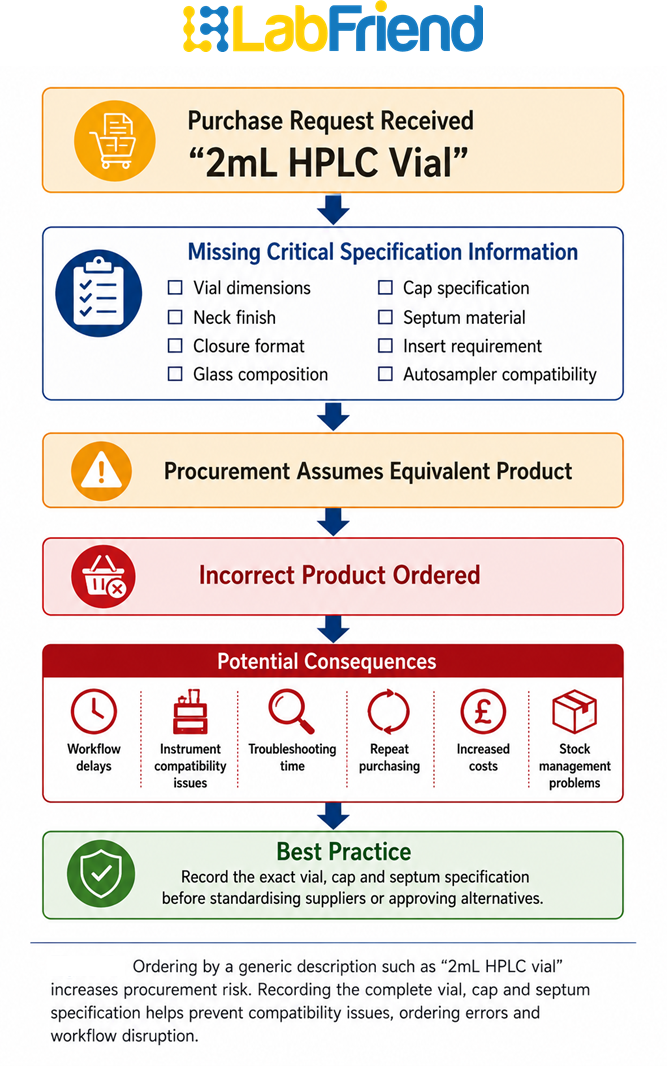
A common purchasing problem is that technical users request a “2mL vial” or “HPLC vial” without giving enough detail for accurate procurement.
That description does not confirm:
- vial height
- vial diameter
- bottom profile
- neck finish
- screw, crimp or snap closure
- clear or amber glass
- glass composition, surface treatment or low-adsorption characteristics
- insert requirement
- cap material
- septum material
- septum thickness
- pack size
- manufacturer code
- autosampler compatibility
- whether alternatives are approved
For repeat purchasing, procurement should move from informal product descriptions to controlled product records.
A stronger internal record would be:
2mL clear glass screw neck autosampler vial, 9 mm thread, compatible cap and PTFE/silicone septum, pack size 100 or 1,000, approved for routine HPLC method X, alternatives require scientist approval.
This level of detail reduces ambiguity and makes supplier comparison more reliable.
Procurement checklist for chromatography vials
Use this checklist before placing or repeating an order.
|
Field to record |
Example procurement note |
|
Product family |
Chromatography vial |
|
Application |
HPLC, GC, LC-MS, headspace, sample storage |
|
Instrument / autosampler |
Record model if known |
|
Vial volume |
1.5 mL, 2 mL, 10 mL, 20 mL, etc. |
|
Dimensions |
Height and diameter where available |
|
Bottom Profile |
Round or Flat |
|
Neck type |
ND8, ND9, ND11, ND18, ND20, etc. |
|
Closure type |
Screw neck, crimp neck, snap ring |
|
Material |
Clear glass, amber glass, plastic, or specialised low-adsorption vial materials |
|
Insert |
Yes / no; type and volume |
|
Pack size |
100, 1,000, or other |
|
Current manufacturer code |
Exact code from existing pack or invoice |
|
LabFriend URL or SKU |
Add once confirmed |
|
Approved alternatives |
Record only after technical sign-off |
|
Reorder frequency |
Weekly, monthly, quarterly |
|
Minimum stock level |
Set with lab manager or end user |
|
Substitution control |
Free to substitute, technical approval required, or no substitution |
Procurement teams can use Laboratory Vials for broader vial searches and Vials & Septa for chromatography-focused vial and septa requirements.
Procurement checklist for caps and septa
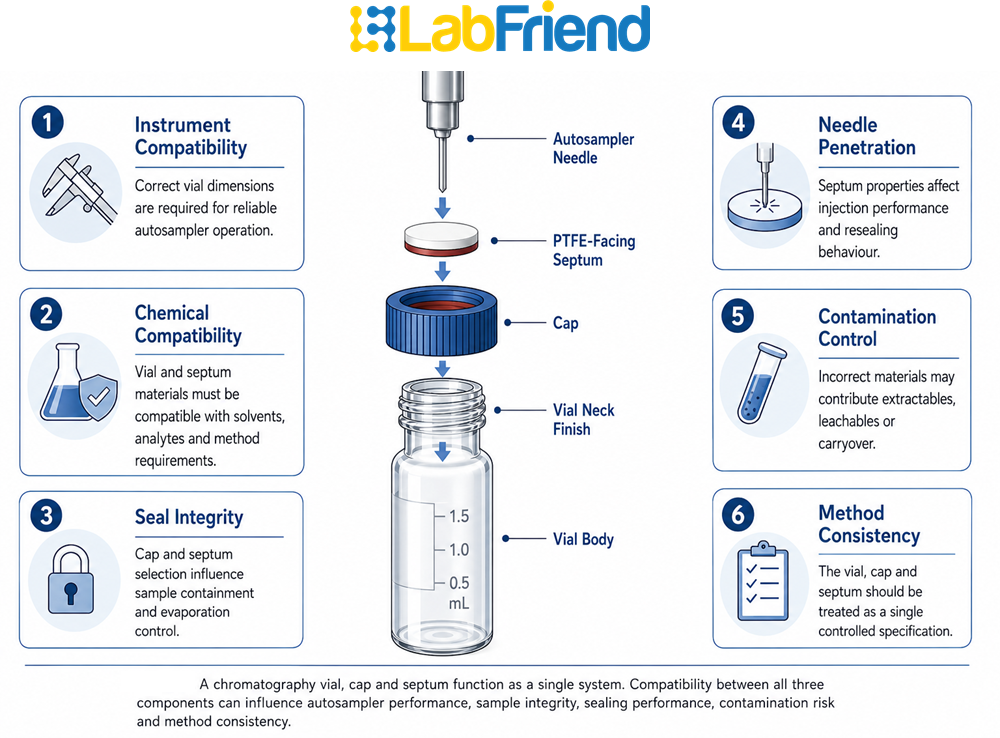
Caps and septa should not be treated as secondary items. The vial, cap and septum work as a system.
|
Field to record |
Why it matters |
|
Cap format |
Must match vial neck and closure type |
|
Cap size |
Must match vial neck finish |
|
Septum material |
Affects chemical compatibility and sealing behaviour |
|
Septum facing |
PTFE-facing may be needed for solvent contact |
|
Backing material |
Influences resealing and penetration behaviour |
|
Septum thickness |
Can affect needle penetration force, resealing performance and autosampler operation |
|
Pre-slit status |
May affect needle penetration, resealing performance and suitability for pressurised applications |
|
Temperature or headspace suitability |
Important where vials are heated |
|
Pack size |
Supports stock control |
|
Manufacturer code |
Prevents reorder mistakes |
|
Approved alternative |
Must be technically accepted |
A common procurement error is to reorder the vial correctly but change the cap or septum unintentionally. In chromatography workflows, the closure system is part of the specification.
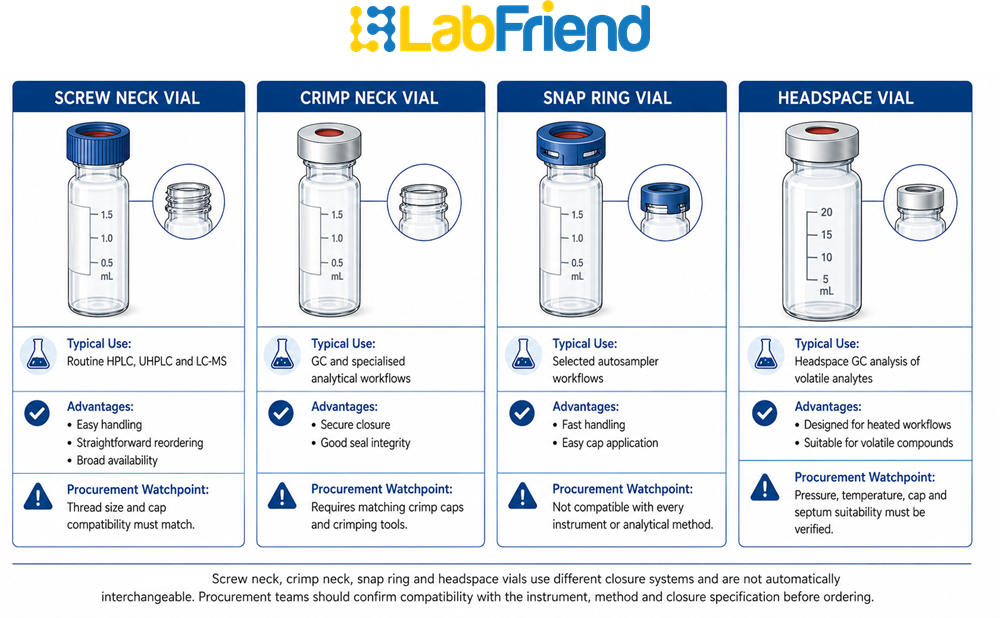
Screw neck, crimp neck and snap ring vials: procurement differences
|
Closure format |
Procurement advantage |
Procurement watch point |
|
Screw neck vials |
Easy to understand, reorder and handle |
Thread size and cap compatibility must be correct |
|
Crimp neck vials |
Useful where secure closure is required |
Requires matching crimp caps and crimping tools |
|
Snap ring vials |
Fast handling where compatible |
Not suitable for every instrument or method |
|
Headspace vials |
Specifically designed for headspace sampling of volatile analytes |
Cap, septum, pressure and temperature suitability must be checked |
Procurement should avoid switching closure formats unless the technical user confirms compatibility. A screw neck vial may not be a suitable replacement for a crimp neck vial, even if the nominal volume is similar.
When procurement should not substitute vials or septa without technical approval
Substitution control is essential for chromatography consumables. Some routine workflows may tolerate approved alternatives. Others should not be changed without technical review.
Technical approval should be required where the workflow involves:
- validated methods
- regulated QA/QC testing
- client-specified CRO work
- LC-MS, LC-MS/MS or trace-level analytical methods
- headspace GC
- volatile samples
- contamination-sensitive analysis
- low-volume samples
- known adsorption or recovery issues
- specific autosampler compatibility requirements
- methods where historical results must remain comparable
Procurement should not assume equivalence based on price, appearance or nominal volume alone.
Where approved alternatives can help procurement
Approved alternatives are useful when they are controlled properly. They can help laboratories reduce supply risk, improve quote competitiveness and avoid urgent purchasing problems.
Approved alternatives may be suitable where:
- the product is used routinely
- the specification can be matched clearly
- the technical user has reviewed the alternative
- the method is not highly validation-sensitive
- the product is not client-specified
- the laboratory wants a backup option for stock availability
- the alternative is recorded in the procurement file
Approved alternatives should be documented, not remembered informally.
A useful procurement field is:
Approved alternative: Yes / No / Technical approval required before use
This helps procurement teams avoid last-minute decision-making when stock is low.
How to compare suppliers for chromatography vials and septa
Price matters, but it should not be the only comparison point. Procurement teams should compare suppliers across commercial and operational criteria.
|
Supplier evaluation criterion |
Why it matters |
|
Product range |
Reduces fragmented purchasing |
|
Clear specification data |
Helps avoid wrong orders |
|
Availability |
Supports repeat workflows |
|
Quote responsiveness |
Reduces procurement delays |
|
Pack size options |
Supports usage planning |
|
Support for alternatives |
Helps supplier switching |
|
Online ordering route |
Reduces admin burden |
|
Repeat purchasing support |
Helps recurring consumables management |
|
Access to value ranges |
Supports cost control |
|
Ability to source adjacent consumables |
Supports category consolidation |
LabFriend UK positions itself as a specialist online supplier for UK laboratories, combining competitive pricing, broad product availability, fast quotation workflows and responsive support. Procurement teams can review the business background on the About LabFriend page or submit a sourcing request through Contact Us.
Standardising vial and septa purchasing
Standardisation does not mean forcing every laboratory method to use the same vial. It means reducing unnecessary variation while protecting workflows that genuinely need specific products.
A practical standardisation process is:
- List all currently used chromatography vials, caps and septa.
- Group them by workflow, instrument and method.
- Identify duplicates or near-duplicates.
- Confirm which items are technically critical.
- Agree which routine products can be standardised.
- Identify approved alternatives where appropriate.
- Record exact reorder details.
- Set minimum stock levels.
- Review usage every quarter.
This helps procurement reduce avoidable SKU spread without creating technical risk.
Building a repeat-order record
For recurring chromatography vials and septa, procurement should maintain a repeat-order record.
|
Repeat-order field |
Example |
|
Product type |
2mL autosampler vial |
|
Workflow |
Routine HPLC |
|
End user / department |
Analytical chemistry |
|
Instrument |
HPLC system 1 / autosampler X |
|
Vial format |
Clear glass screw neck |
|
Cap/septum |
Matching 9 mm cap with PTFE/silicone septum |
|
Pack size |
1,000 |
|
Monthly usage |
2 packs |
|
Minimum stock |
1 pack |
|
Preferred supplier |
LabFriend UK |
|
Approved alternative |
Listed only if approved |
|
Last quoted price |
Add internal record |
|
Reorder trigger |
When stock reaches minimum level |
|
Technical owner |
Named scientist or lab manager |
|
Procurement owner |
Named buyer |
This supports repeat purchasing and reduces the chance of stockouts.
Where LLG Labware may fit
LLG Labware can be useful where procurement teams want dependable, cost-effective products for routine laboratory workflows. LabFriend UK provides access to the LLG Labware range, which may be relevant where laboratories are looking for value alternatives for routine consumables.
For chromatography vials and septa, procurement should consider LLG Labware alternatives only where:
- the required specification can be matched
- the technical user approves the option
- the workflow is routine enough to allow substitution
- pack size and availability support repeat purchasing
- the product is recorded as an approved alternative
LLG Labware should not be presented as an automatic substitute for every chromatography method. Use it as part of a controlled supplier-switching process.
Cost control without creating technical risk
The best procurement outcome is not always the cheapest vial or septum. The best outcome is the lowest practical total cost without creating workflow disruption.
Poorly controlled cost cutting can create hidden costs, including:
- repeated analysis
- wasted samples
- delayed reporting
- scientist time spent troubleshooting
- urgent replacement orders
- duplicated supplier admin
- incorrect stockholding
- rejected substitutions
Better cost control comes from:
- approved product lists
- supplier consolidation
- pack-size optimisation
- quote comparison
- repeat-order planning
- controlled alternatives
- avoiding unnecessary over-specification
- reducing urgent one-off orders
Procurement should challenge over-specification, but not override method-critical requirements.
Questions procurement should ask the technical user
Before changing supplier or product, ask:
- Is this vial, cap or septum used in a validated or client-specified method?
- Which instrument or autosampler does it need to fit?
- Is the closure format fixed?
- Is the septum material specified by the method?
- Is the sample volatile, light-sensitive, trace-level or LC-MS-sensitive?
- Is an insert required?
- Can an alternative be tested or approved?
- What is the typical monthly usage?
- What minimum stock level should we hold?
- Who signs off substitutions?
These questions help procurement buy efficiently without creating avoidable technical risk.
Recommended procurement workflow
For UK laboratories purchasing chromatography vials and septa repeatedly, the recommended workflow is:
|
Step |
Action |
Owner |
|
1 |
Identify current vial, cap and septum specifications |
Scientist / lab manager |
|
2 |
Confirm method-critical requirements |
Scientist / QA/QC where relevant |
|
3 |
Record exact product details |
Procurement |
|
4 |
Check supplier availability and quote route |
Procurement |
|
5 |
Identify approved alternatives where suitable |
Scientist + procurement |
|
6 |
Set reorder point and pack size |
Lab manager + procurement |
|
7 |
Place first controlled order |
Procurement |
|
8 |
Review performance and ordering accuracy |
Technical user |
|
9 |
Add to repeat-order list |
Procurement |
|
10 |
Review quarterly |
Procurement + lab manager |
This approach is especially useful for CROs, private testing laboratories and SME biotech companies where recurring chromatography workflows depend on consistent consumable availability.
Common procurement mistakes
Mistake 1: Buying by generic description
“2mL vial” is too vague. Procurement needs the full vial, cap and septum specification.
Mistake 2: Treating caps and septa as interchangeable
Caps and septa must match the vial format and method requirements.
Mistake 3: Changing supplier without technical review
Supplier switching can be commercially sensible, but technical approval is needed for sensitive or controlled workflows.
Mistake 4: Not recording pack size
Pack size affects price comparison, stock planning and reorder frequency.
Mistake 5: Assuming all amber vials are suitable for all light-sensitive samples
Amber glass reduces exposure to UV and visible light, but the degree of protection required depends on the analyte and method.
Mistake 6: Missing insert requirements
Low-volume workflows may depend on a specific insert. Reordering only the vial can cause workflow problems.
Mistake 7: Not setting reorder points
Recurring vials and septa should have minimum stock levels and reorder triggers.
Procurement summary table
|
Procurement objective |
Best practice |
|
Avoid wrong orders |
Record exact vial, cap and septum specifications |
|
Reduce stockouts |
Set reorder points and usage-based minimum stock |
|
Reduce cost |
Compare pack sizes, suppliers and approved alternatives |
|
Support supplier switching |
Use controlled technical approval |
|
Protect method consistency |
Do not substitute sensitive workflows without sign-off |
|
Simplify purchasing |
Consolidate routine vial and septa formats |
|
Improve repeat buying |
Build a repeat-order list with LabFriend UK |
Final recommendation
Chromatography vials and septa should be managed as repeat-use technical consumables, not generic low-cost catalogue items.
For procurement teams, the priority is to make the technical specification commercially manageable. Record the vial format, cap type, septum material, pack size, manufacturer code, LabFriend URL or SKU, approved alternatives and substitution rules. Then use that record to support repeat purchasing, supplier comparison and stock control.
For broader chromatography consumables planning, including HPLC, UHPLC, GC, LC-MS, SPE and TLC workflows, procurement teams should also use The Complete Guide to Chromatography Consumables for UK Laboratories as the parent reference for this content cluster.
Browse chromatography vials and septa, review broader laboratory vials, explore LLG Labware alternatives where appropriate, or contact LabFriend UK for help sourcing recurring-use chromatography vial and septa requirements.
Frequently Asked Questions
What should procurement check before buying chromatography vials?
Procurement should check the vial volume, dimensions, neck type, closure format, material, colour, insert requirement, cap type, septum material, pack size, manufacturer code, approved alternatives and any method restrictions.
Are chromatography vials interchangeable?
Not always. Vials with the same nominal volume may differ in dimensions, neck finish, closure format, glass type, insert compatibility and autosampler compatibility.
Can procurement substitute chromatography vials to reduce cost?
Sometimes, but only where the specification can be matched and the technical user approves the alternative. Substitutions should be controlled for validated, client-specified, LC-MS, headspace or contamination-sensitive workflows.
What information should be recorded for repeat ordering?
Record the exact vial, cap and septum specification, pack size, manufacturer code, LabFriend SKU or URL, monthly usage, minimum stock level, approved alternatives and technical approval rules.
What is the difference between screw neck, crimp neck and snap ring vials?
They use different closure systems. Screw neck vials use threaded caps, crimp neck vials use crimp caps, and snap ring vials use snap closures. They are not automatically interchangeable.
Why does septum material matter?
Septum material can affect solvent compatibility, extractables and leachables, sealing performance, needle penetration, resealing behaviour, coring risk and contamination risk. Procurement should not change septum material without technical review.
Should procurement buy the cheapest chromatography vial?
Not automatically. The cheapest vial may not be the lowest-cost option if it causes compatibility problems, repeat analysis, urgent replacement orders or workflow disruption.
How can laboratories reduce chromatography vial stockouts?
They can standardise routine vial formats, record monthly usage, set reorder points, agree approved alternatives and build a repeat-order list with a responsive supplier.
Where can procurement buy chromatography vials and septa from LabFriend UK?
Procurement teams can browse chromatography vials and septa through the Vials & Septa category, review broader laboratory vial options, or contact LabFriend UK for sourcing and quotation support.
Written by: Donal O’Sullivan, BSc, Co-Founder and Sales Director, LabFriend UK. Donal brings deep chemistry-led technical expertise across analytical chemistry, biochemistry, environmental monitoring, laboratory instrumentation, consumables and scientific product selection.
Reviewed by: Michael Anderson, MBA, Founder and Managing Director, LabFriend UK. Michael reviews LabFriend UK content for customer relevance, commercial accuracy, operational practicality and alignment with LabFriend UK’s laboratory supply model.
Read More Block
Read more from LabFriend UK
- The Complete Guide to Chromatography Consumables for UK Laboratories
- The Ultimate Syringe Filter Guide: Pore Size, Membranes, and Applications
- Browse Chromatography Products
- Browse Chromatography Vials and Septa
- Explore LLG Labware
Related Stories

How to Reduce LC-MS Contamination Risk from Vials, Filters, Septa and Solvent Handling Consumables
How to Reduce LC-MS Contamination Risk from Vials, Filters, Septa and Solvent Handling Consumables

How to Choose Chromatography Vials and Septa for HPLC GC and Headspace Analysis
How to Choose Chromatography Vials and Septa for HPLC, GC and Headspace Analysis

The Complete Guide to Chromatography Consumables for UK Laboratories
The Complete Guide to Chromatography Consumables for UK Laboratories

HPLC Sample Preparation Consumables - Filters Vials Syringes and Solvent Handling
HPLC Sample Preparation Consumables - Filters Vials Syringes and Solvent Handling