

Share :
How to Prevent Centrifuge Tube Leaks, Cracks and Sample Loss
Updated On 08/20/2026

By Donal O’Sullivan, BSc. Reviewed by Michael Anderson, MBA.
Opening answer
Centrifuge tube leaks, cracks and sample loss can usually be reduced by checking the following before routine use:
- Tube specification
- Product-specific RCF (Relative Centrifugal Force) rating
- Rotor and adapter support
- Cap closure
- Fill volume
- Sample density
- Chemical compatibility
- Temperature history
- Handling practice
No centrifuge tube should be treated as leak-proof, crack-proof or sample-loss-proof unless the exact claim is supported by product documentation.
In practice, tube failure is rarely caused by one factor alone. A tube may physically fit the rotor but be poorly supported. A cap may be closed but not seated correctly. A tube may be the right volume but filled too close to its working limit. A product may be familiar in one workflow but unsuitable after chemical exposure, freezing or supplier substitution.
Laboratories reviewing suitable formats can start with LabFriend UK’s centrifuge tubes, then narrow their selection by material, volume, cap design, RCF rating and manufacturer documentation. For broader tube-selection context, read the Complete Guide to Centrifuge Tubes.
Why centrifuge tubes leak, crack or lose sample
Leaks, cracks and sample loss are often treated as product defects, but the cause can sit anywhere in the workflow. The tube itself matters, but so do the rotor, adapter, cap, sample volume, sample density, temperature exposure, chemical exposure and user handling.
A tube can leak if the cap is not suitable for the workflow, if it is not closed correctly, if the tube is overfilled, if the sample expands, or if the tube is stressed during centrifugation. A tube can crack if it is used above its documented RCF rating, poorly supported in the rotor, weakened by chemical exposure, exposed to low temperatures outside its specification, or handled roughly after becoming brittle.
Sample loss can also happen without obvious cracking. Material may escape during cap opening, transfer, rotor imbalance during centrifugation, poor pellet handling, decanting or repeated switching between tube formats. In high-throughput or repeat workflows, small handling issues can become recurring losses.
The safest approach is to treat leakage and cracking as workflow risks, not just product problems.
Failure is usually a system issue
A centrifuge tube works as part of a system. The system includes the tube body, cap, sample, rotor, adapter, centrifugation condition, temperature condition, chemical exposure and handling method. If one part of that system changes, the risk profile can change.
For example, a laboratory may switch supplier and keep the same nominal volume. The new tube may still be 50 mL, but it may have a different wall design, cap design, material, dimensions, RCF rating or closure behaviour. It may fit the same rotor but sit differently in the adapter. It may feel similar during handling but behave differently under force.
That is why troubleshooting should begin with the full workflow, not only the tube name.
|
Symptom |
Possible contributing factors |
What to check first |
|
Tube leaks during centrifugation |
Cap closure, overfilling, seal design, rotor angle, RCF, sample density |
Cap seating, fill volume, RCF rating and rotor support |
|
Tube cracks |
RCF too high, poor adapter support, low-temperature history, chemical exposure, material stress |
Tube rating, rotor fit, material and temperature history |
|
Cap loosens or fails |
Thread design, closure practice, pressure change, incompatible sample, handling |
Cap type, closure method and fill level |
|
Sample loss during transfer |
Poor tube size choice, pellet disturbance, repeated decanting, unsuitable format |
Working volume, pellet visibility and handling workflow |
|
Recurring failures after supplier switch |
Different specification, cap, dimensions, material or documentation |
Accepted specification and substitute comparison |
This table should guide investigation, not replace product documentation or laboratory SOPs.
RCF, RPM and rotor support
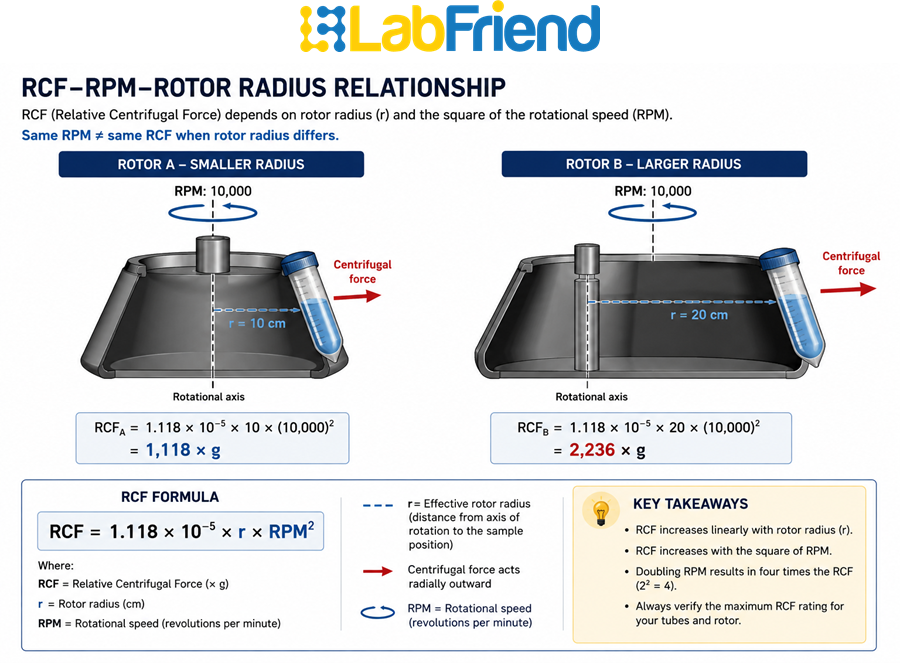
Centrifugation force is one of the most important contributors to tube stress. A tube should be checked against its product-specific maximum RCF rating and the centrifuge setup in which it will be used.
RPM (Revolutions Per Minute) alone is not enough. The force applied to the tube depends on rotor radius as well as speed. In practical terms, spinning faster or using a larger rotor pushes the sample harder against the tube wall. RCF is expressed as a multiple of standard gravity (×g) and increases with the square of rotational speed, so small changes in RPM can produce large changes in force. A setting that appears routine on one centrifuge may create a different RCF in another rotor. This matters because tube stress, sample load and adapter support all interact during the run.
Rotor support is equally important. A tube that physically fits into a bucket or rotor cavity is not automatically suitable. The tube may be unsupported in the wrong area, sit at the wrong angle, interfere with cap clearance or experience uneven stress during acceleration and braking.
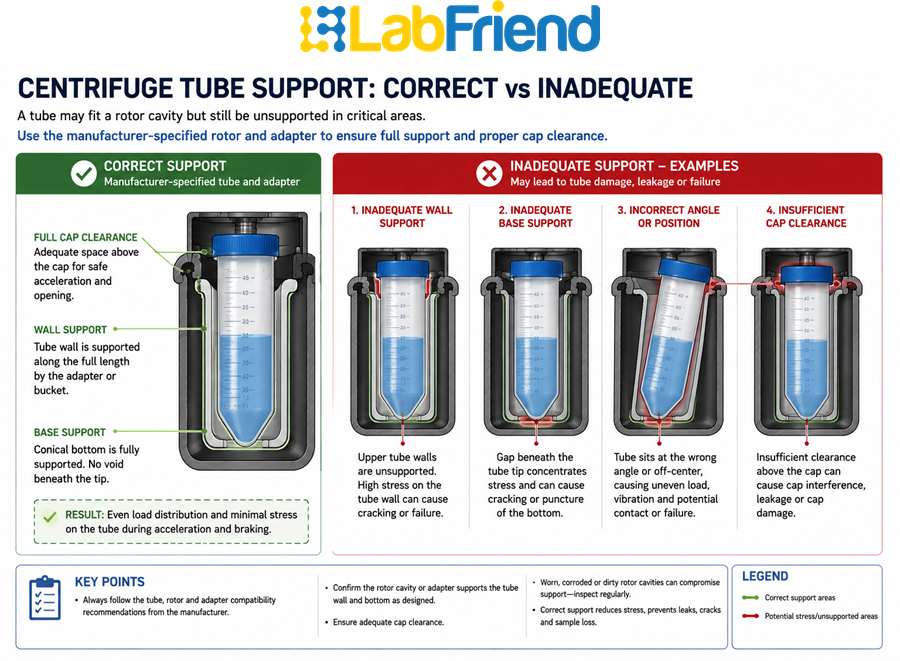
Rotor and bucket condition should also be checked. Worn, corroded or debris-contaminated rotor cavities can create uneven support and additional stress even when the tube itself is suitable and correctly rated.
Before routine use, check the tube’s RCF rating, rotor type, adapter fit, fill conditions and cap clearance together. For technical background, read centrifuge tube RCF and rotor compatibility.
Fill volume, headspace and sample density
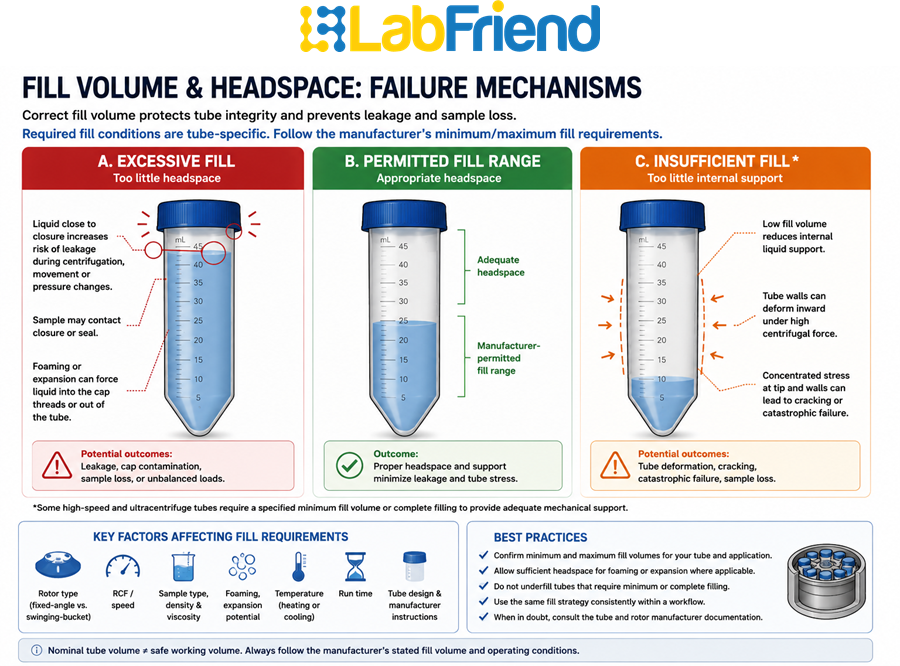
Overfilling is a common contributor to leakage and sample loss. A tube may have a nominal volume, but the working volume for a specific workflow may be lower depending on cap design, sample type, mixing, centrifugation and temperature conditions.
Headspace matters because liquid movement, foaming, expansion, deceleration and handling can all affect pressure and leakage risk. Dense samples can also increase stress during centrifugation. Because centrifugal force acts on sample mass, denser samples generate greater loading on the tube wall at the same RCF setting. A tube that performs acceptably with a light aqueous sample may need additional review when used with denser material.
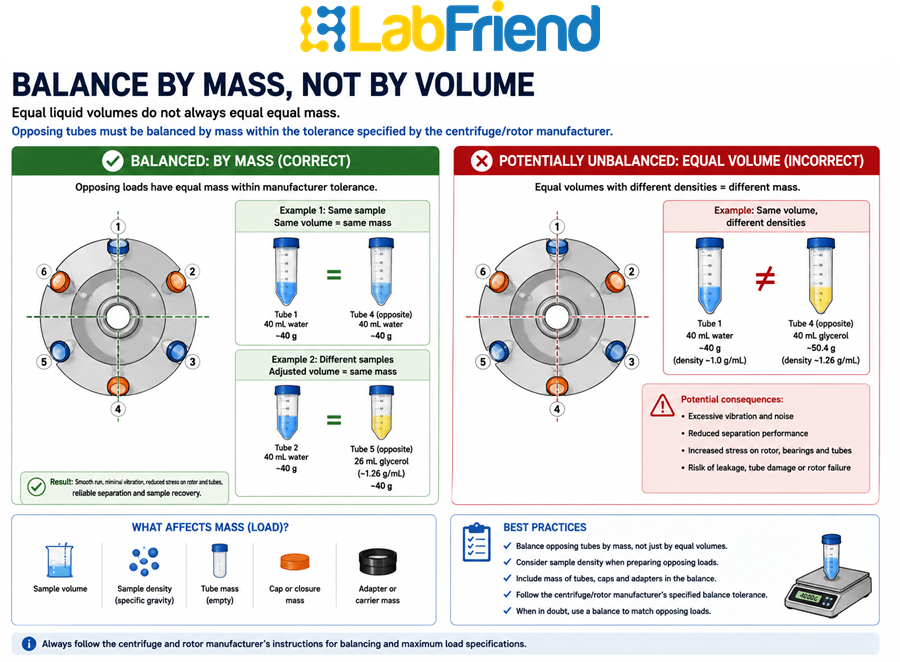
Balancing also matters. Poor balance can increase vibration and stress on tubes, caps and rotors. Tubes should be balanced by weight, not just by position, since even visually matched tubes can differ enough in mass to create vibration. Even where the tube itself is suitable, imbalance may contribute to leakage, cap movement or poor pellet recovery.
A practical rule is to avoid treating nominal capacity as the only volume limit. The laboratory should check the product specification, workflow conditions and centrifuge instructions before setting routine fill volumes.
Cap design, closure and handling
Cap design has a major influence on leakage risk. Screw caps, snap caps, plug seals, thread design and gasket or liner materials can behave differently depending on sample type, fill volume, handling and centrifugation conditions.
A secure cap is useful, but it does not remove the need for correct closure practice. Cross-threading, under-tightening, over-tightening, damaged threads, contamination on the sealing surface or repeated reuse outside intended conditions may all affect closure performance, since even a well-designed cap depends on correct thread engagement and seating force to seal effectively.
|
Cap / closure factor |
Why it matters |
|
Thread design |
Influences closure seating and handling consistency |
|
Seal or gasket |
May affect leakage control where present |
|
Cap material |
May differ from tube body material |
|
Closure force |
Too little or too much force may create problems |
|
Cap clearance |
Must be compatible with rotor, bucket or adapter |
|
Repeated opening |
Can affect handling consistency and contamination risk |
|
Contamination on thread |
May interfere with closure or sealing surface |
Cap choice should follow the workflow. A cap that is convenient for bench handling may not be suitable for every centrifugation, storage or transport condition.
Tube material and workflow suitability
Tube material affects how the tube behaves under mechanical stress, chemical exposure and temperature conditions. Polypropylene, polystyrene, polycarbonate, PPCO (polypropylene copolymer) and other materials may all appear in laboratory tube workflows, but material name alone does not confirm suitability.
The material must be assessed against the sample, RCF, rotor support, temperature exposure, chemical exposure and intended handling. A tube that is suitable for routine sample preparation may not be suitable after freezing, exposure to a solvent, higher-speed centrifugation or repeated handling.
When leakage or cracking occurs, review whether the tube material is appropriate for the full workflow. Do not assume suitability from past use in a different application.
Tube age and storage history should also be considered. Polymer materials can degrade slowly over time, so laboratories should follow manufacturer guidance on shelf life and avoid using stock that has exceeded its recommended storage period.
Chemical compatibility and material stress
Chemical exposure can weaken, soften, swell or stress tube materials. This can include environmental stress cracking (ESC), where the combination of chemical contact and mechanical load — such as centrifugal force — causes cracking at stress levels the material would otherwise tolerate. The effect may depend on reagent identity, concentration, temperature, exposure time and whether the tube is later centrifuged.
This is particularly important where tubes are used with solvents, aggressive reagents, additives, preservatives or non-routine sample matrices. A tube may appear acceptable during static contact but behave differently under centrifugation.
The cap and closure materials should also be considered. The tube body may be suitable while the cap, liner or seal is less suitable for the same exposure.
If chemical exposure is part of the workflow, compatibility should be checked using manufacturer guidance and product-specific documentation before the tube is used routinely.
Temperature exposure and freeze–thaw stress
Temperature history can affect tube performance. Cold exposure, freezer storage, thawing and repeated freeze–thaw cycles may change how a tube behaves during later handling or centrifugation. Some materials may become more brittle at low temperature, and caps or seals may behave differently after cooling. Polymer materials vary in how they respond to cold; some become noticeably more brittle at low temperature than others, so material type should be checked against the intended cold-chain conditions.
A tube should not be assumed suitable for freezing, ultra-low storage or cryogenic-adjacent workflows (handling near very low, sub-freezing temperatures) unless the product specification supports that use. If a tube is centrifuged after cold exposure, the laboratory should check whether temperature and mechanical force create a combined stress risk.
This is especially important for valuable samples, cell culture workflows, biobanking-related handling (long-term frozen sample storage), molecular biology samples and project work where sample loss could create delay or rework.
Storage conditions can matter as much as active use. Prolonged exposure to direct sunlight, UV light or elevated ambient temperature during storage may also degrade some tube materials over time.
Supplier switching and recurring failures
Leakage or cracking sometimes appears after a product change. The new tube may look similar to the old one, but small specification differences can matter.
A potential substitute should be compared against the accepted product and the workflow requirement before routine use. The comparison should include nominal volume, working volume, dimensions, material, cap design, RCF rating, sterility or other required claims, packaging and documentation.
Procurement efficiency is valuable but should not replace technical suitability assessment. If a tube is used repeatedly, the accepted specification should be preserved during repeat ordering.
For wider purchasing context, read high-usage centrifuge tube purchasing.
Sample organisation and handling control
Not every sample-loss problem starts inside the centrifuge. Some losses happen at the bench because tubes are mixed up, handled repeatedly, transferred unnecessarily or stored in unsuitable racks.
Good sample organisation can reduce avoidable handling errors. Racks can help separate projects, formats, users, time points or sample types. They can also reduce unnecessary tube movement and improve workflow consistency.
Labelling practice can also affect handling safety and consistency. Marks should be made using a solvent- and temperature-resistant method, positioned away from graduation lines, cap seating areas and the regions expected to experience the greatest mechanical stress.
Where laboratories are reviewing bench organisation alongside tube selection, LabFriend UK’s test tube racks category can support sample handling and layout.
Common mistakes that increase failure risk
- Assuming a tube is suitable because it fits
Physical fit is only one requirement. The tube still needs appropriate RCF rating, adapter support, cap clearance, fill conditions and material suitability.
- Treating nominal volume as working volume
A 15 mL or 50 mL label does not mean the tube should always be filled to that level for every workflow. Working volume depends on sample behaviour, cap design and centrifugation conditions.
- Ignoring sample density
Dense samples may increase mechanical stress during centrifugation. Sample type and density should be considered when setting fill volume and centrifugation conditions.
- Reusing a tube format after chemical exposure
Chemical exposure may change material behaviour. A workflow involving solvents, aggressive reagents or unusual sample matrices should trigger compatibility review.
- Switching supplier without comparing specifications
Similar-looking tubes can differ in dimensions, material, cap design, RCF rating and documentation. Substitute products should be checked before routine use.
- Assuming screw-cap means leak-proof
Screw caps may improve closure control in some workflows, but they do not guarantee leak-proof performance. Closure design and correct handling still matter.
What this article does not solve
This article helps laboratories reduce the risk of centrifuge tube leaks, cracks and sample loss. It does not guarantee that any specific tube will prevent leakage, cracking, deformation, cap failure, contamination or sample loss.
It also does not confirm suitability for any specific centrifuge, rotor, chemical exposure, low-temperature condition, clinical workflow, diagnostic use, GMP (Good Manufacturing Practice) process, regulated method or validated assay.
Those decisions must be made using product documentation, manufacturer information, centrifuge and rotor instructions, internal SOPs and the laboratory’s actual workflow requirements.
Where failures are recurring, the laboratory should review the workflow systematically rather than assuming the cause is only the tube.
What to check before purchase
Before purchasing centrifuge tubes for a workflow where leakage, cracking or sample loss would matter, check the following:
Use this table as a quick pre-purchase reference — work through each row before finalising a tube order.
|
Check |
Decision question |
|
Tube specification |
Does the product match the intended workflow? |
|
RCF rating |
Is the tube rated for the required centrifugation condition? |
|
Rotor and adapter fit |
Is the tube properly supported, not just physically present? |
|
Cap design |
Does the closure suit the sample and handling pattern? |
|
Fill volume |
Is there appropriate working volume and headspace? |
|
Sample density |
Could sample load increase tube stress? |
|
Balance |
Will tubes be balanced correctly during centrifugation? |
|
Chemical exposure |
Could reagents affect tube or cap material? |
|
Temperature history |
Will freezing, thawing or cold storage affect use? |
|
Documentation |
Are specifications supported by manufacturer information? |
|
Substitute control |
Would an alternative preserve the accepted specification? |
|
Visual inspection |
Has the tube been checked for existing cracks, cloudiness or discolouration before use? |
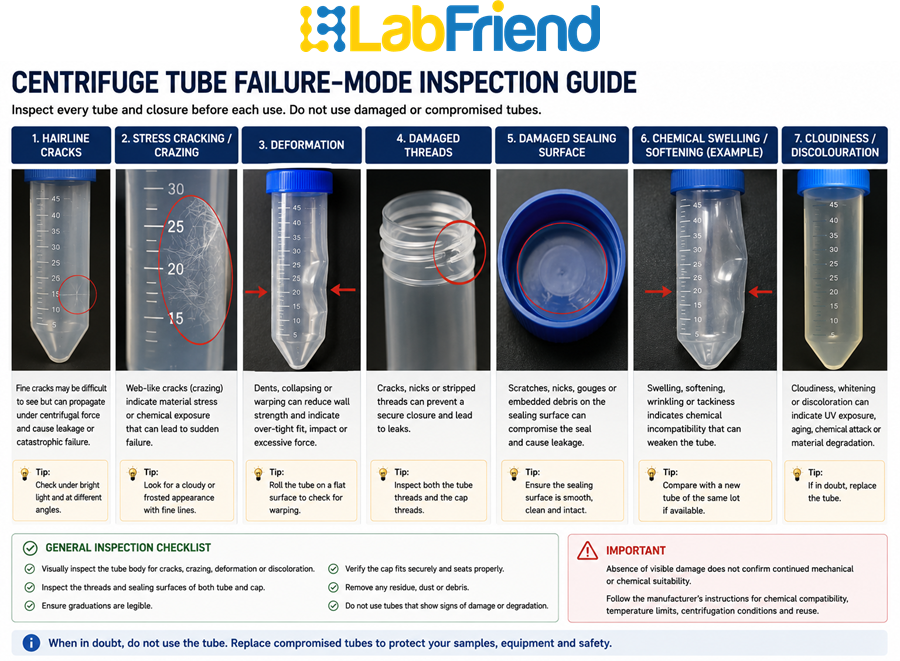
This checklist is a troubleshooting aid, not a performance guarantee.
Frequently asked questions
Why do centrifuge tubes leak?
Centrifuge tubes may leak because of cap closure issues, overfilling, unsuitable fill volume, sample movement, rotor angle, cap design, chemical exposure, temperature exposure or use outside the product specification.
Why do centrifuge tubes crack during centrifugation?
Cracking can be linked to excessive RCF, poor rotor or adapter support, incompatible sample conditions, low-temperature stress, chemical exposure, overfilling, material limitations or previous handling damage.
How can I reduce sample loss in centrifuge tubes?
Use a tube format suited to the workflow, avoid unnecessary transfers, check fill volume, ensure cap closure, confirm RCF and rotor compatibility, balance tubes correctly and avoid unsuitable substitutes.
Does overfilling cause centrifuge tube leakage?
Overfilling can increase leakage risk, especially during centrifugation, mixing, temperature change or handling. Working volume should be checked against the product and workflow.
Does rotor compatibility affect tube cracking?
Yes. A tube that fits physically may still be poorly supported. Rotor type, adapter support, cap clearance and RCF should be checked together.
Can chemical incompatibility cause tube failure?
Yes. Chemical exposure may affect material strength or cap performance. Compatibility should be verified against the reagent, concentration, exposure time and manufacturer guidance.
Can freezing make centrifuge tubes crack?
Cold exposure or freeze–thaw handling may affect tube behaviour. Freezing can also cause aqueous samples to expand, increasing internal pressure against the tube wall and cap. Low-temperature suitability should be checked against product documentation before routine use.
Are screw-cap centrifuge tubes leak-proof?
Not automatically. Screw caps may support secure closure in some workflows, but leak-proof performance should not be assumed unless product documentation explicitly supports the claim.
What should I check before switching centrifuge tube supplier?
Compare volume, dimensions, material, cap design, RCF rating, required claims, packaging and documentation. A similar-looking tube may not behave the same way.
What is the biggest mistake when troubleshooting tube failure?
The biggest mistake is looking for a single cause too quickly. Leakage, cracking and sample loss are often caused by several workflow factors interacting.
What should I do if a centrifuge tube leaks or breaks during a run?
Stop the centrifuge and allow it to come to a complete stop before opening the lid — do not attempt to open it while it is still spinning or decelerating. Follow the laboratory’s spill and biosafety procedures for cleanup and decontamination, and inspect the rotor and adapters for damage or contamination before further use.
Conclusion
Centrifuge tube leaks, cracks and sample loss can usually be reduced by treating the tube as part of a complete workflow system. Tube specification, RCF rating, rotor support, adapter fit, cap closure, fill volume, sample density, chemical exposure, temperature history and handling practice all matter.
The safest troubleshooting approach is to avoid assumptions. A tube that fits the rotor is not automatically suitable. A screw cap is not automatically leak-proof. A familiar material is not automatically compatible with every sample. A cheaper substitute is not automatically equivalent.
Laboratories should review the cause, preserve accepted specifications during repeat ordering and check product documentation before changing tube format or supplier.
To compare suitable options, browse LabFriend UK’s centrifuge tubes. For wider selection guidance, return to the Complete Guide to Centrifuge Tubes.
Read more from LabFriend UK:
- Complete Guide to Centrifuge Tubes
- Understanding RCF, RPM and Rotor Compatibility for Centrifuge Tubes
- Choosing 15mL and 50mL Centrifuge Tubes for High-Usage Laboratories
- Browse LabFriend UK Centrifuge Tubes
Written by: Donal O’Sullivan, BSc, Co-Founder and Sales Director, LabFriend UK. Donal brings deep chemistry-led technical expertise across analytical chemistry, biochemistry, environmental monitoring, laboratory instrumentation, consumables and scientific product selection.
Reviewed by: Michael Anderson, MBA, Founder and Managing Director, LabFriend UK. Michael reviews LabFriend UK content for customer relevance, commercial accuracy, operational practicality and alignment with LabFriend UK’s laboratory supply model.
Related Stories

Extractables and Leachables in Analytical Filtration Explained
Extractables and Leachables in Analytical Filtration Explained

How Lab Managers Can Standardise Centrifuge Tube Purchasing Without Increasing Technical Risk
How Lab Managers Can Standardise Centrifuge Tube Purchasing Without Increasing Technical Risk

Low Protein Binding Membranes Explained for Laboratory Filtration
Low Protein Binding Membranes Explained for Laboratory Filtration

Choosing Tube Racks for 15mL and 50mL Centrifuge Tubes
Choosing Tube Racks for 15mL and 50mL Centrifuge Tubes