

Share :
Choosing 15mL and 50mL Centrifuge Tubes for High-Usage Laboratories
Updated On 07/17/2026

By Donal O’Sullivan, BSc. Reviewed by Michael Anderson, MBA.
Opening answer
High-usage laboratories should standardise 15mL and 50mL centrifuge tubes by workflow, not by price or habit alone. The right approach is to define where each tube size is approved for use, confirm the required material, sterility or aseptic status, cap type, RCF rating, rotor compatibility and documentation requirements, then build a repeat-order process around those approved formats.
For many busy laboratories, 15mL tubes are practical for routine medium-volume sample preparation, smaller pellets, aliquots and day-to-day bench handling. 50mL tubes are more suitable for larger sample volumes, cell culture workflows, media preparation, environmental samples and processes where using several smaller tubes would create unnecessary handling.
The goal is not to force every team to use the same tube. The goal is to reduce unnecessary product variation while protecting technical suitability. Lab managers reviewing routine purchasing can start with LabFriend UK’s centrifuge tubes, then use the guidance below to decide which 15mL and 50mL formats should be approved for recurring use.
Why high-usage laboratories need a different purchasing model
In a low-usage laboratory, centrifuge tubes may be bought occasionally as a simple catalogue item. In a high-usage laboratory, they behave differently. They become recurring consumables, stock-control items, workflow continuity risks and repeat purchasing opportunities.
This matters for CROs, independent testing laboratories, SME biotech companies, university research groups and QA/QC laboratories where tube consumption is regular and operationally important.
The purchasing risk is clear. If every team buys slightly different 15mL and 50mL tubes, the laboratory may lose control of stockholding, reorder timing, user preference, supplier choice and spend visibility.
The technical risk is just as important. If procurement standardises too aggressively, the laboratory may replace suitable workflow-specific tubes with products that are cheaper or easier to source but not appropriate for the method.
The correct answer sits between those two risks: standardise where workflows allow it, but never let procurement efficiency override technical suitability.
The direct decision rule for lab managers
A high-usage laboratory should usually keep both 15mL and 50mL centrifuge tubes available where workflows justify them.
15mL tubes are normally the better default for routine medium-volume work, smaller sample preparation, aliquots, smaller pellets and workflows where storage footprint matters.
50mL tubes are normally the better default for larger sample volumes, larger suspensions, media handling, environmental or food testing samples, and processes where multiple 15mL tubes would increase handling time.
The purchasing task is not to eliminate one size. It is to define where each size belongs, which variants are approved, and how they are reordered.
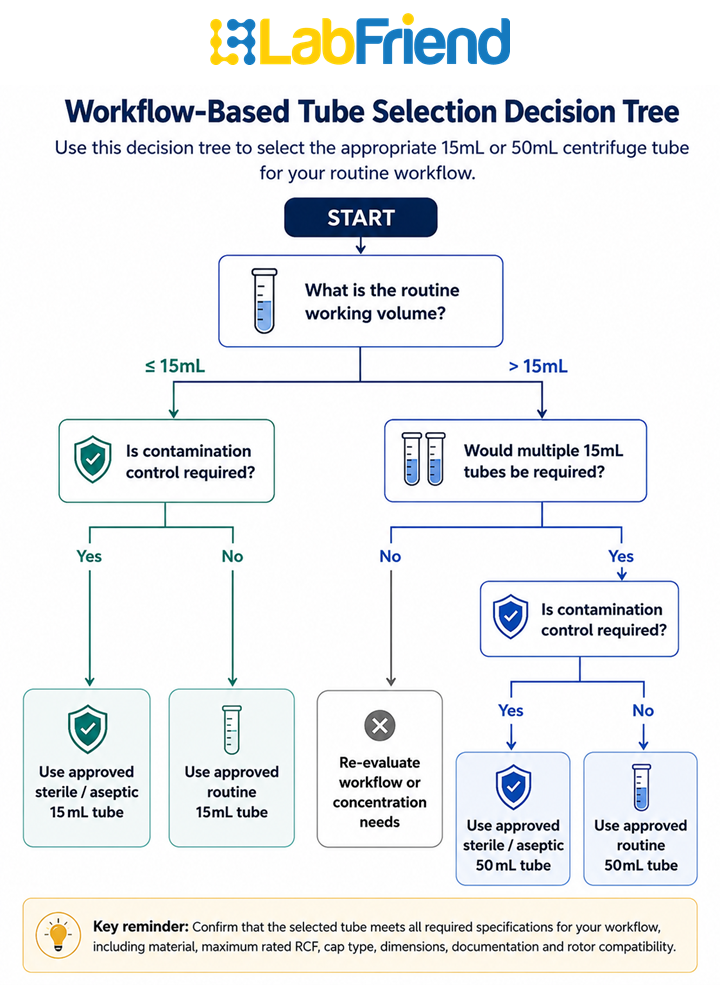
For the more technical volume-selection comparison, see 15 ml vs 50 ml Centrifuge Tubes - How to Choose the Right Volume for Your Workflow.
15mL vs 50mL purchasing comparison
|
Procurement factor |
15mL centrifuge tubes |
50mL centrifuge tubes |
|
Best purchasing role |
Routine medium-volume format |
Larger-volume workflow format |
|
Typical use pattern |
Frequent use across many benches |
High use in larger-volume workflows |
|
Main operational benefit |
Efficient handling and storage |
Reduces transfers for larger samples |
|
Main procurement risk |
Too many similar variants across teams |
Overuse where smaller tubes would be sufficient |
|
Storage impact |
Lower footprint per tube |
Higher footprint per tube |
|
Workflow risk if unavailable |
Smaller workflows may be forced into larger tubes |
Larger workflows may require multiple smaller tubes |
|
Standardisation opportunity |
Approve default routine and sterile/aseptic versions |
Approve default routine and sterile/aseptic versions |
|
Accessory need |
15mL racks and storage formats |
50mL racks and larger storage space |
|
Reorder planning |
Often frequent and predictable |
Often linked to project or batch activity |
|
Governance rule |
Use where smaller format is technically sufficient |
Use where larger capacity genuinely reduces handling |
The real problem: too many similar products
Most high-usage laboratories do not struggle because they have no centrifuge tubes. They struggle because they have too many similar ones.
Different teams may buy different brands for the same workflow. Some may use sterile or aseptic tubes where non-sterile tubes would be suitable. Others may order 50mL tubes because 15mL tubes are temporarily unavailable. Over time, small uncontrolled purchasing decisions create avoidable SKU complexity.
A better approach is to create a small approved tube set.
For example, a high-usage laboratory may approve a routine 15mL PP conical tube, a sterile or aseptic 15mL tube for contamination-sensitive work, a routine 50mL PP conical tube, and a sterile or aseptic 50mL format for specific biological workflows. That structure is much easier to manage than allowing every department to choose independently.
This does not remove technical judgement. It creates a controlled framework for making technical judgement repeatable.
Do not standardise by volume alone
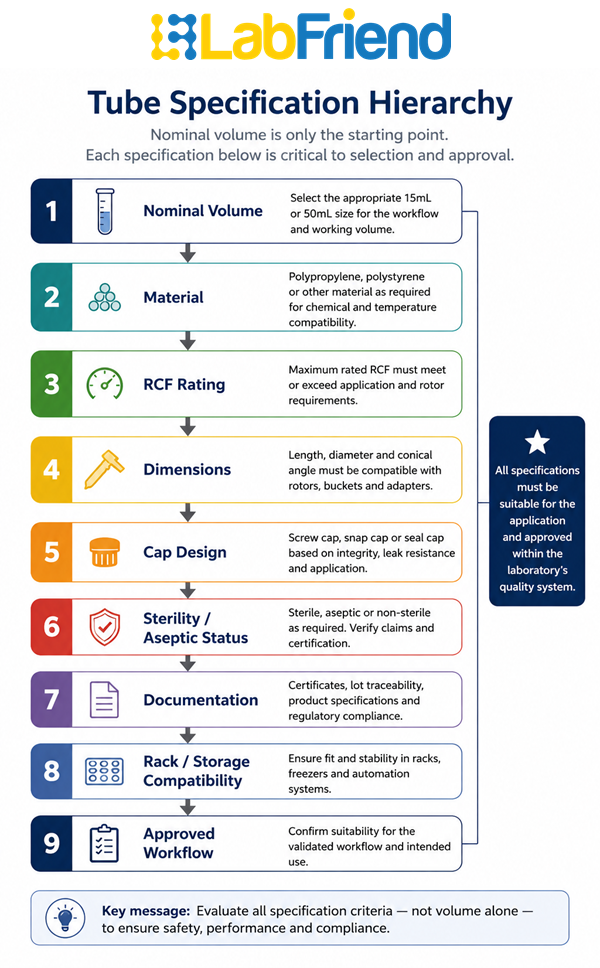
A tube’s nominal volume is only the starting point. High-usage laboratories should standardise around a specification, not just around “15mL” or “50mL.”
For each approved tube, the laboratory should understand the material, bottom shape, cap type, RCF rating, sterility or aseptic status, packaging format, documentation requirements, rack compatibility and approved use cases.
This matters because two tubes with the same volume can still differ in cap design, wall strength, dimensions, packaging, RCF rating and contamination-control claims. A 50mL tube used for routine buffer handling may not be suitable for the same workflow as a 50mL tube used in a controlled biological process.
For material-related decisions, read polypropylene vs polystyrene centrifuge tubes. For contamination-control decisions, read sterile vs non-sterile centrifuge tubes.
Approved tube matrix for high-usage labs
|
Approved item |
Main decision |
Typical owner |
|
15mL routine tube |
Which routine workflows can use it? |
Lab manager / technical lead |
|
15mL sterile or aseptic tube |
Which contamination-sensitive workflows require it? |
Technical lead |
|
50mL routine tube |
Which larger-volume workflows can use it? |
Lab manager |
|
50mL sterile or aseptic tube |
Which biological or sensitive workflows require it? |
Technical lead |
|
15mL / 50mL rack |
Which benches or departments need it? |
Lab manager |
|
Approved substitute |
What conditions allow substitution? |
Technical lead and procurement |
|
Restricted-use tube |
Which workflows require approval before purchase? |
QA / technical lead |
This matrix should be adapted to the laboratory’s actual workflows, but the principle is consistent: routine tubes should be easy to reorder, while specialist tubes should remain technically controlled.
RCF and rotor compatibility should be part of purchasing control
Lab managers do not need to become centrifuge engineers, but they do need to ensure that approved tubes are suitable for the centrifuges, rotors and adapters used in the laboratory.
A product should not be approved for repeat ordering until the laboratory has checked whether the tube’s maximum RCF, dimensions, cap design, material and fill conditions are suitable for the intended workflow. Volume alone is not enough.
This is especially important where several teams share centrifuges or where tubes are switched between fixed-angle and swinging-bucket workflows. A tube may be the right nominal size and still be unsuitable if it is poorly supported in the adapter or used beyond its documented rating.
For a deeper explanation, read Understanding RCF, RPM and Rotor Compatibility for Centrifuge Tubes.
Reorder planning for 15mL and 50mL tubes
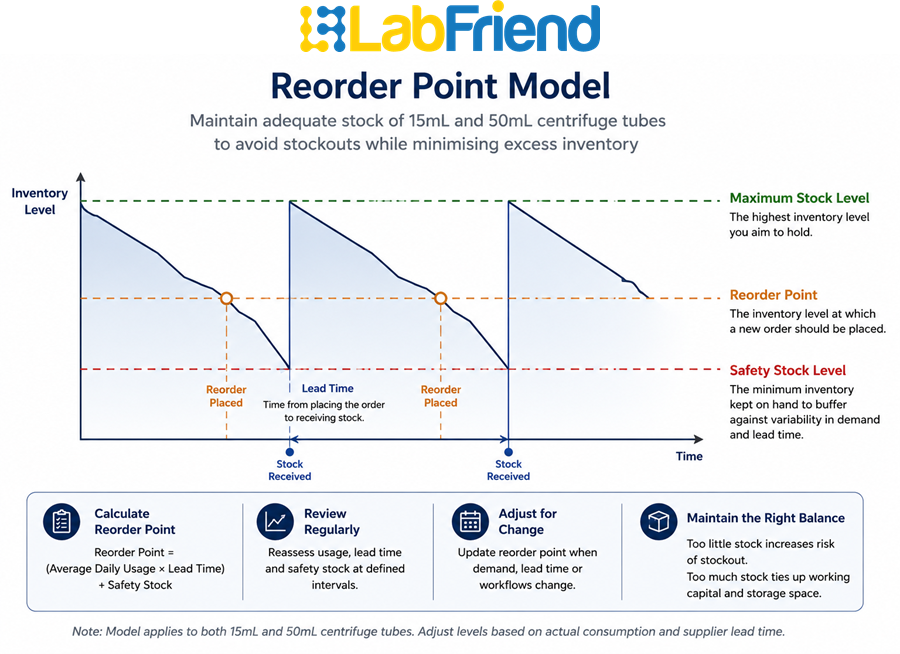
High-usage laboratories should not wait until the last pack is opened before reordering. Centrifuge tubes are predictable repeat consumables in many laboratory environments, so they should have defined reorder points.
A practical reorder model starts with monthly usage. Once the laboratory knows how many packs of each tube format are used per month, it can add a lead-time buffer and set a minimum stock level. The reorder point should reflect how critical the tube is to the workflow.
For example, routine 15mL non-sterile tubes may need a simple monthly reorder rule. A sterile or aseptic 50mL tube used in a project-critical workflow may need a larger safety buffer. A specialist tube used occasionally should not necessarily be stocked in the same way as a core routine tube.
The important point is to track 15mL and 50mL demand separately. They may sit in the same product category, but they do not always behave the same way operationally.
Reorder planning table
|
Tube format |
Typical demand pattern |
Suggested control |
|
15mL routine non-sterile |
Frequent, broad use |
Core stock item with minimum stock level |
|
15mL sterile or aseptic |
Medium or workflow-specific use |
Controlled stock item with technical approval |
|
50mL routine non-sterile |
Medium to high use in larger-volume workflows |
Departmental or core stock item |
|
50mL sterile or aseptic |
Project or workflow-sensitive use |
Controlled stock item with buffer stock |
|
Specialist high-RCF or documented tubes |
Lower frequency but higher technical risk |
Restricted-use item with approval before substitution |
When to use LLG Labware as a value route
For routine high-usage laboratories, LLG Labware can be a useful value route where the specification matches the workflow.
For example, LabFriend UK lists LLG 50mL PP aseptic centrifuge tubes. This type of product page is useful because it allows the lab manager to review the specification rather than comparing by price alone.
The correct question is not:
“Is this cheaper?”
The correct question is:
“Does this meet the required specification for the workflow, and can it be reordered consistently?”
Where an LLG Labware option meets the laboratory’s technical requirement, it may support a stronger value-led purchasing model. Where the specification does not match the workflow, it should not be treated as an automatic substitute.
This is particularly important for claims such as sterility, aseptic status, DNase-free status, RNase-free status, RCF rating and compatibility. These must be checked product by product.
Supplier switching checklist
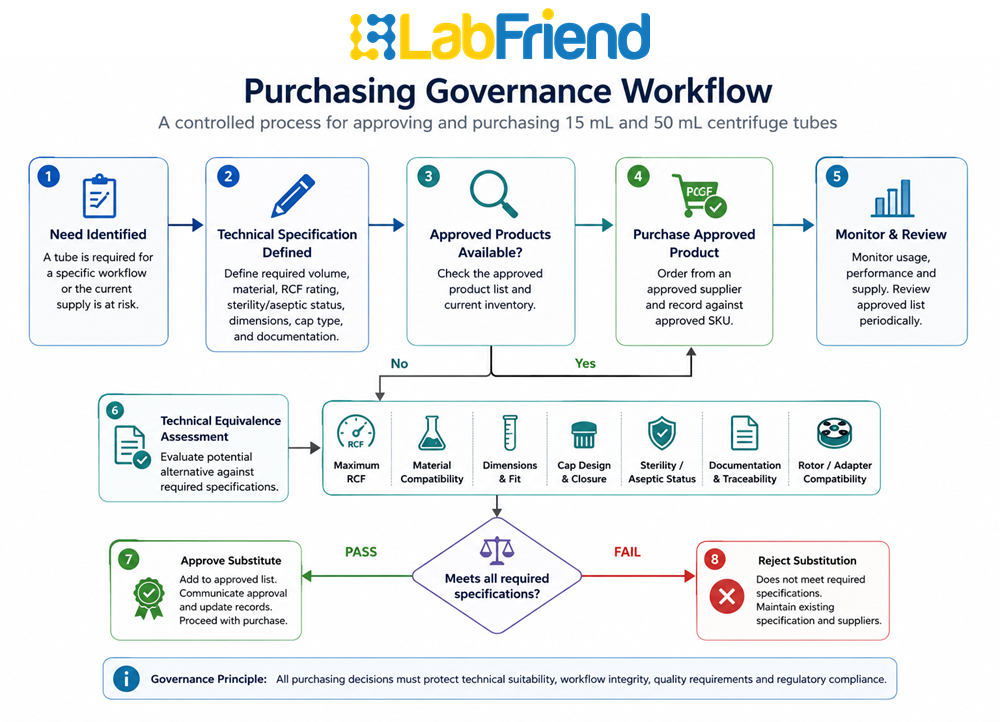
A supplier switch can be sensible where it improves value, availability, service or ordering simplicity. But for centrifuge tubes, switching should be controlled.
|
Switching check |
Why it matters |
|
Volume |
Confirms whether the replacement is genuinely suitable for the same workflow |
|
Dimensions |
Confirms rotor, adapter and rack fit |
|
Material |
Avoids assuming PP, PS or other materials are interchangeable |
|
Cap design |
Affects handling, closure and leakage risk |
|
RCF rating |
Confirms suitability for centrifugation conditions |
|
Sterility or aseptic status |
Protects contamination-control workflows |
|
DNase/RNase claims |
Must be explicit where relevant |
|
Packaging |
Affects storage, cleanliness and workflow convenience |
|
Documentation |
Supports QA, SOP or method-control requirements |
|
User acceptance |
Confirms the product works practically at the bench |
|
Repeat supply route |
Prevents one-off substitution becoming a recurring problem |
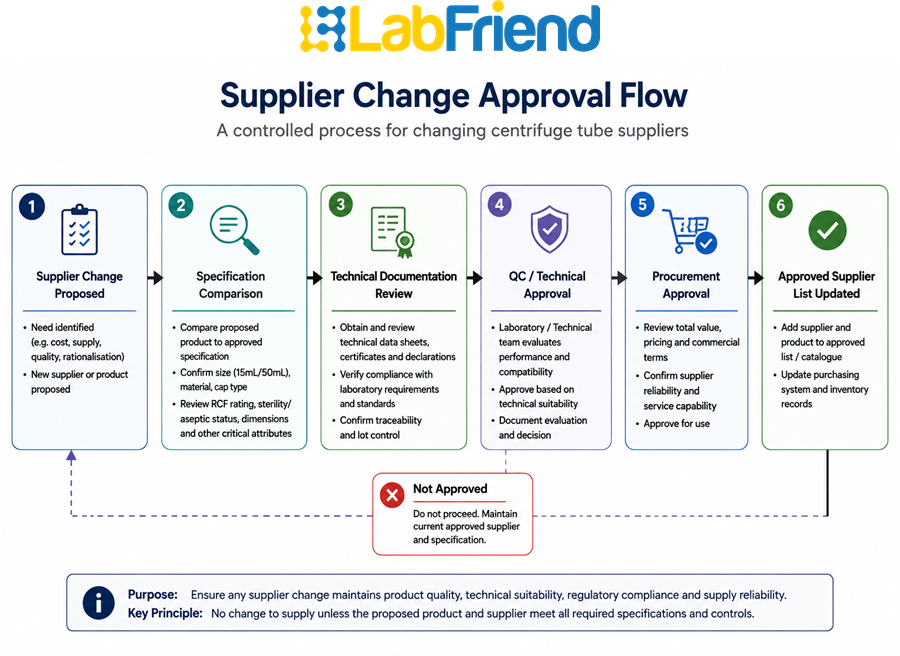
If a substitute fails a required technical check, it should not be approved simply because it is cheaper or easier to buy.
For wider procurement standardisation, read standardising centrifuge tube purchasing.
Tube racks are part of the purchasing system
High-usage laboratories should not standardise tubes without considering how the tubes are stored, handled and moved.
Tube racks support sample organisation, batch control, bench workflow, short-distance transport and separation of 15mL and 50mL formats. They also help teams maintain consistent layouts where many samples are handled together.
LabFriend UK’s Tube Racks category is a relevant adjacent route for laboratories standardising centrifuge tube workflows.
A rack should still be checked against the actual tubes being used. Compatibility with 15mL and 50mL formats is useful, but it does not remove the need to consider bench layout, storage method, sample handling process and workflow requirements.
How to build an approved tube list
A simple approved tube list can prevent many recurring purchasing problems.
The list should identify the approved product, the accepted substitute, the pack size, the required specification, the reorder point, the technical owner and the purchasing owner. It should also state where the tube can be used and where it must not be used.
For routine workflows, this does not need to be overcomplicated. A one-page approved product table may be enough. For QA/QC, accredited or regulated environments, the laboratory’s own quality system may require more formal control.
The approved list should be reviewed periodically. If usage increases, a new workflow starts, or teams report issues with fit, leakage, packaging or availability, the approved list should be updated.
Common mistakes in high-usage tube purchasing
Treating 15mL and 50mL tubes as one purchasing category
They are related, but they do different jobs. Track usage and reorder points separately.
Reducing SKUs without technical review
SKU reduction is useful only where workflow suitability is protected. Removing variants too aggressively can create technical risk.
Buying by lowest unit price
The lowest unit price may be poor value if it causes handling issues, extra transfers, documentation problems or unsuitable substitution.
Ignoring sterile versus non-sterile variants
Sterile or aseptic formats should be used where required, but not overused where non-sterile tubes are technically sufficient.
Forgetting rack compatibility
Tube racks are part of the workflow. A tube standardisation project is weaker if storage and handling are ignored.
Failing to define substitute rules
If the approved product is unavailable, teams need to know what substitute is acceptable and who can approve it.
What this article does not solve
This article helps lab managers structure 15mL and 50mL centrifuge tube purchasing. It does not replace product-specific technical verification.
It does not confirm RCF compatibility, rotor compatibility, chemical compatibility, low-temperature suitability, cryogenic suitability, DNase-free status, RNase-free status, endotoxin-free status, clinical suitability, diagnostic suitability, GMP suitability or method validation status for any specific product.
Those decisions must be made using manufacturer documentation, product specifications and the laboratory’s own workflow requirements.
Practical procurement framework
A high-usage laboratory can use a six-step approach.
|
Step |
Action |
Outcome |
|
1 |
Segment tube usage by 15mL, 50mL, sterile/aseptic, non-sterile and department |
Clear view of demand |
|
2 |
Define approved formats for routine workflows |
Reduced unnecessary variation |
|
3 |
Confirm technical requirements for each format |
Lower substitution risk |
|
4 |
Set reorder points by format |
Fewer stockouts |
|
5 |
Define approved substitutes |
Faster, safer purchasing decisions |
|
6 |
Review usage regularly |
Better control as workflows change |
This framework keeps procurement practical without weakening technical control.
UK laboratory purchasing considerations
For UK laboratories with recurring centrifuge tube demand, the purchasing model should support reliable access to approved products, clear specifications, easy repeat ordering, price visibility and controlled substitution.
This is especially important for CROs managing client project timelines, independent testing laboratories processing regular sample volumes, SME biotech companies scaling workflows, university groups balancing budget and specification, and QA/QC laboratories needing consistency.
LabFriend UK’s commercial opportunity is strongest when a first centrifuge tube order becomes a repeat purchasing relationship. That requires more than a one-off product sale. It requires helping the customer identify the formats they use regularly, the specifications they need, the accessories that support the workflow and the reorder pattern that avoids disruption.
When the approved formats are known, the next step is to review LabFriend UK’s centrifuge tubes and build a repeatable purchasing route around the products that fit the laboratory’s workflows.
Frequently asked questions
Should high-usage labs use both 15mL and 50mL centrifuge tubes?
Yes, in most cases. 15mL tubes are better for routine medium-volume handling, while 50mL tubes are better for larger-volume workflows. The laboratory should define where each format is approved for use.
Should a lab manager standardise on one centrifuge tube brand?
Standardising on fewer products can improve control, but only if the chosen products meet workflow requirements. Do not standardise on brand or price alone.
How many centrifuge tube SKUs should a high-usage lab keep?
There is no fixed number. A practical starting point is to define approved routine 15mL and 50mL formats, then add sterile, aseptic or specialist variants only where workflows require them.
Are sterile centrifuge tubes always better for high-usage labs?
No. Sterile or aseptic tubes should be used where the workflow requires them. Using sterile formats for all workflows may increase cost without technical benefit.
Does sterile mean DNase-free or RNase-free?
No. Sterility, DNase-free status and RNase-free status are separate claims. Check product documentation where molecular biology or contamination-sensitive workflows require those specifications.
Can procurement substitute one 50mL centrifuge tube for another?
Only after checking material, dimensions, cap type, RCF rating, sterility or aseptic status, documentation and workflow suitability.
How should labs set reorder points for centrifuge tubes?
Track monthly usage by format, add a lead-time buffer, and set a minimum stock level for each approved tube type. Review usage regularly.
Are LLG Labware centrifuge tubes suitable as value alternatives?
They can be suitable where their specifications match the workflow. The correct approach is to compare product data, not assume equivalence.
Should tube racks be included in centrifuge tube standardisation?
Yes. High-usage laboratories should standardise racks alongside tubes where sample organisation, transport and bench workflow matter.
What is the biggest procurement mistake with centrifuge tubes?
The biggest mistake is reducing SKUs without checking technical suitability. Procurement control should simplify purchasing, not weaken workflow reliability.
Conclusion
High-usage laboratories should manage 15mL and 50mL centrifuge tubes as a repeat-consumables category, not as occasional catalogue purchases.
The best approach is to define where each tube size is used, separate routine and specialist demand, confirm technical requirements, create an approved tube list, set reorder points, include tube racks and handling accessories, and define controlled substitution rules.
This protects the laboratory from stockouts, uncontrolled SKU growth and unsuitable substitutions while creating a stronger repeat-purchasing model.
To start reviewing approved formats, browse LabFriend UK’s centrifuge tubes. For technical compatibility checks, read Understanding RCF, RPM and Rotor Compatibility for Centrifuge Tubes.
Written by: Donal O’Sullivan, BSc, Co-Founder and Sales Director, LabFriend UK. Donal brings deep chemistry-led technical expertise across analytical chemistry, biochemistry, environmental monitoring, laboratory instrumentation, consumables and scientific product selection.
Reviewed by: Michael Anderson, MBA, Founder and Managing Director, LabFriend UK. Michael reviews LabFriend UK content for customer relevance, commercial accuracy, operational practicality and alignment with LabFriend UK’s laboratory supply model.
Related Stories

Complete Guide to Centrifuge Tubes
Complete Guide to Centrifuge Tubes

The Ultimate Guide to Laboratory Filtration for UK Laboratories
The Ultimate Guide to Laboratory Filtration for UK Laboratories

Polypropylene vs Polystyrene Centrifuge Tubes
Polypropylene vs Polystyrene Centrifuge Tubes: Which Is Best for Laboratory Workflows?

PTFE vs PES Syringe Filters: Which Membrane Should You Choose?
PTFE vs PES Syringe Filters: Differences, Solvent Compatibility and Laboratory Applications