

Share :
Understanding RCF RPM and Rotor Compatibility for Centrifuge Tubes
Updated On 07/17/2026

By Donal O’Sullivan, BSc. Reviewed by Michael Anderson, MBA.
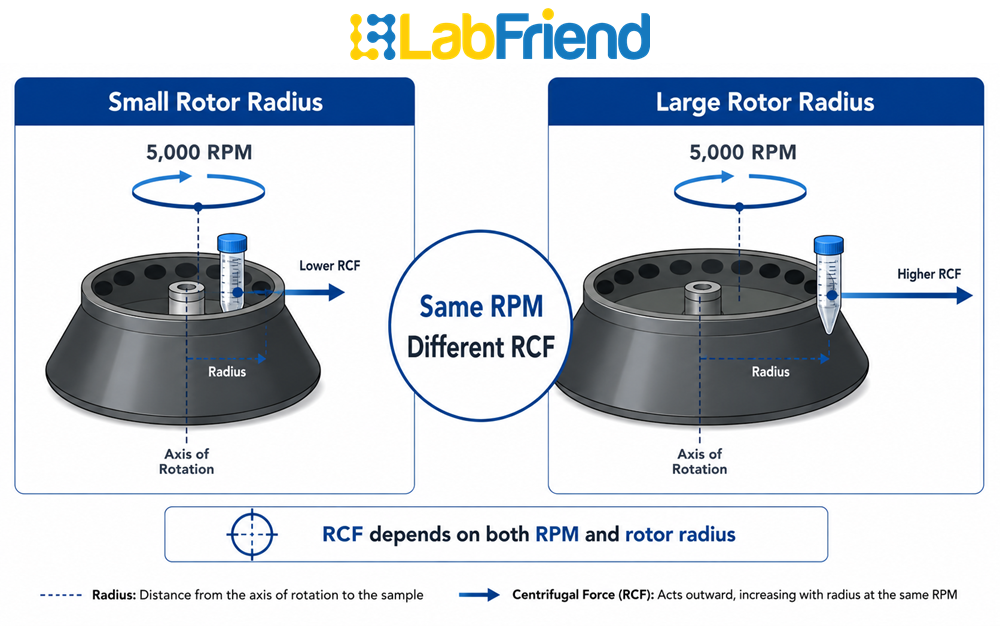
When choosing centrifuge tubes, laboratories should check RCF rating, RPM settings and rotor compatibility together. RPM tells you how fast the centrifuge rotor spins, but RCF tells you the relative centrifugal force experienced by the sample. Two centrifuges running at the same RPM can generate different RCF values if their rotor radii are different.
For safe and suitable tube selection, check that the tube’s maximum rated RCF, material, cap design, dimensions, fill volume and temperature conditions are compatible with the centrifuge rotor, adapter and workflow. Volume alone is not enough. A 15mL or 50mL centrifuge tube may fit the general application but still be unsuitable if the rotor, adapter or RCF conditions are wrong.
Laboratories comparing options can start with LabFriend UK’s centrifuge tubes, then verify the exact product specification before use. For broader selection guidance, see the Complete Guide to Centrifuge Tubes.
Why this matters
Centrifuge tubes are routinely used in sample preparation, cell culture, microbiology, molecular biology, environmental testing, food testing and general laboratory workflows. Because they are familiar consumables, it is easy to treat them as simple containers.
That is a mistake.
During centrifugation, the tube is exposed to mechanical stress. The level of stress depends on the relative centrifugal force, rotor design, adapter fit, sample volume, tube geometry, material and cap closure. If these factors are not checked, the laboratory may increase the risk of leakage, cracking, cap failure, sample loss, poor pellet formation or inconsistent results.
The practical question is not:
“Will this tube hold my sample?”
The better question is:
“Is this tube suitable for this centrifuge, this rotor, this force, this sample and this workflow?”
What is RPM?
RPM means revolutions per minute. It describes how many times the centrifuge rotor rotates each minute.
RPM is easy to see on many centrifuge displays, but it does not fully describe the force applied to a sample. A centrifuge running at 5,000 RPM with a small rotor radius does not generate the same force as a centrifuge running at 5,000 RPM with a larger rotor radius.
That is why protocols and tube specifications often refer to RCF, not just RPM.
What is RCF?
RCF means relative centrifugal force. It is usually expressed as × g, meaning multiples of Earth’s gravitational force.
RCF is the force experienced by material within the sample during centrifugation. Because samples occupy a finite volume, RCF varies slightly across the length of the tube. Rotor manufacturers may specify minimum, maximum or average radius when reporting RCF, so laboratories should use the convention stated in the rotor documentation. MilliporeSigma describes RCF conversion as requiring RPM and rotor radius, and Eppendorf similarly explains that rotor radius is needed to convert between rpm and rcf.
A commonly used formula is:
RCF = 1.118 × 10⁻⁵ × r × RPM²
Where:
- RCF = relative centrifugal force, expressed as × g
- r = radial distance in centimetres from the axis of rotation to the point at which RCF is being calculated, often the tube bottom or maximum sample position, depending on manufacturer convention
- RPM = revolutions per minute
Thermo Fisher also presents the same relationship between RPM, rotor radius and RCF in centrifuge guidance.
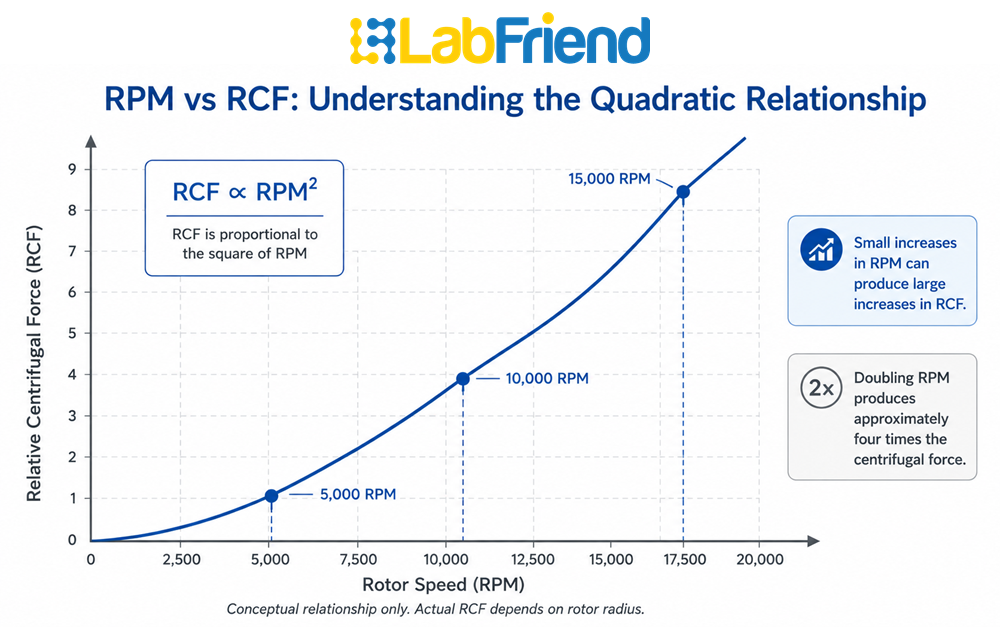
The important practical point is that RCF rises with the square of RPM. A modest increase in RPM can produce a much larger increase in force.
RPM vs RCF: practical comparison
|
Factor |
RPM |
RCF |
|
What it measures |
Rotor speed |
Force experienced by the sample |
|
Unit |
Revolutions per minute |
× g |
|
Depends on rotor radius? |
No, RPM itself is just speed |
Yes |
|
Used for protocol transfer? |
Less reliable across different rotors |
More useful across different rotors |
|
Relevant to tube stress? |
Indirectly |
Directly |
|
Should be checked against tube rating? |
Yes, through conversion to RCF where needed |
Yes, directly |
If a protocol states only RPM, the laboratory may need to calculate the corresponding RCF using the rotor radius. If a tube specification states maximum RCF, the centrifuge setup must not exceed that product-specific limit under the intended conditions.
Why the same RPM can mean different force
The same RPM does not always mean the same centrifugation force because rotor radius changes the distance between the axis of rotation and the sample.
For example:
- a compact microcentrifuge rotor has a smaller radius
- a larger benchtop or swinging-bucket rotor may have a larger radius
- adapters can change the effective sample position
- tube length and bucket geometry can affect where the sample sits relative to the rotation axis
Because RCF depends on radius, the same RPM can generate different × g values in different rotors. This is why laboratories should avoid transferring RPM settings from one centrifuge to another without checking the rotor-specific RCF.
What rotor compatibility means for centrifuge tubes
Rotor compatibility is not just about whether the tube physically fits.
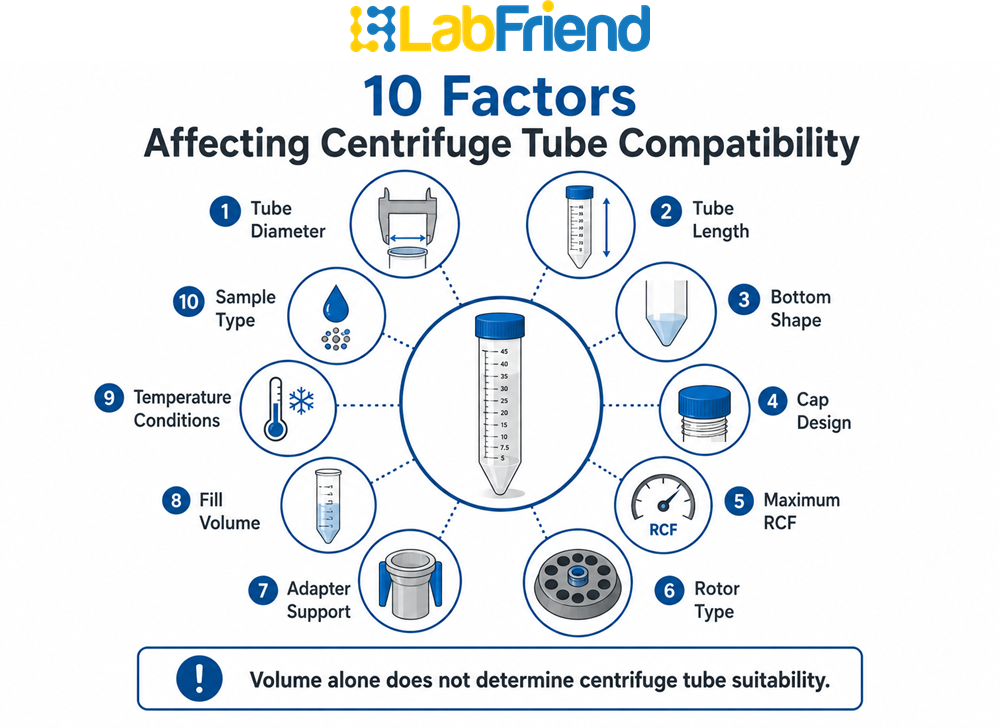
A centrifuge tube should be checked against:
- Tube diameter
The tube must fit securely in the rotor, bucket or adapter. - Tube length
The tube must fit without cap interference or lid contact. - Bottom shape
Conical, round-bottom and self-standing tubes may require different support. - Cap design
Screw caps, plug caps or snap caps may behave differently under force and handling. - Maximum rated RCF
The tube must be suitable for the intended centrifugation force. - Rotor type
Fixed-angle and swinging-bucket rotors can impose different handling and sedimentation conditions. - Adapter support
A tube may require a specific adapter to support the tube body properly. - Fill volume
Overfilling or under-supporting a tube can affect leakage risk and centrifugation behaviour. - Balancing requirements
Tubes should be loaded and balanced according to centrifuge manufacturer instructions. Imbalance can increase vibration, reduce centrifuge performance and increase mechanical stress on tubes, rotors and drive systems. - Temperature conditions
Refrigerated centrifugation or low-temperature storage may affect material properties such as flexibility and impact resistance and should be evaluated against manufacturer guidance. - Sample type
Density, viscosity, solvent exposure and particulate load can all affect suitability.
Where laboratories are reviewing equipment as well as consumables, LabFriend UK’s benchtop centrifuges and separating and centrifuging equipment categories provide relevant commercial routes.
Fixed-angle vs swinging-bucket rotors
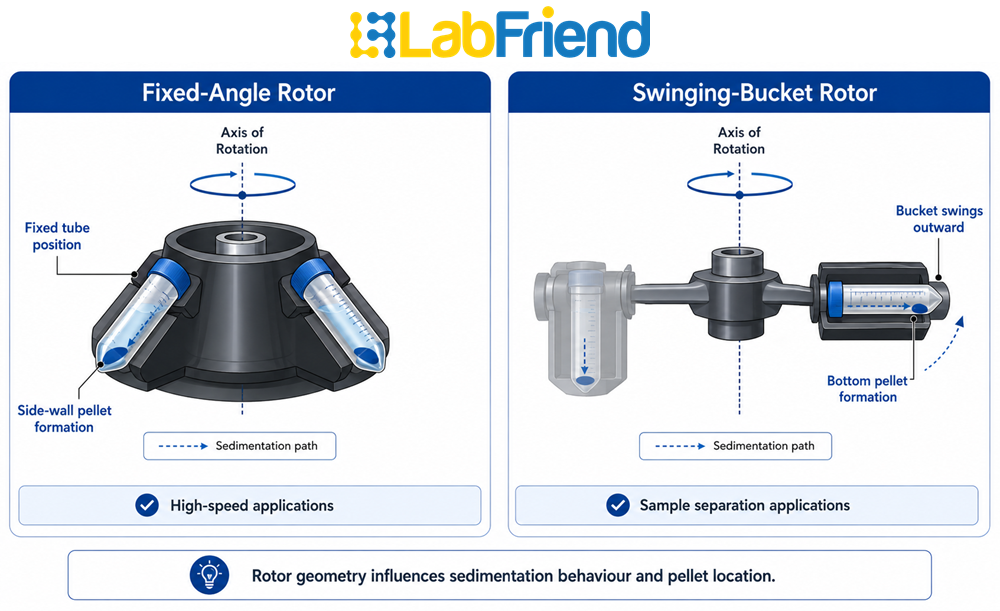
Fixed-angle rotors
In a fixed-angle rotor, tubes are held at a fixed angle during centrifugation. Pellets typically form along the side or lower wall of the tube depending on the rotor angle and sample conditions.
Check:
- tube angle compatibility
- tube wall support
- cap clearance
- rotor cavity dimensions
- maximum RCF for both tube and rotor
- whether the tube bottom shape is suitable
Swinging-bucket rotors
In a swinging-bucket rotor, tubes or buckets swing outward during centrifugation. Pellets may form more directly at the bottom of the tube depending on the setup.
Check:
- bucket compatibility
- adapter fit
- tube height
- cap clearance
- balancing requirements
- maximum RCF for the tube, bucket and adapter system
The same tube may behave differently in different rotor formats. Suitability should be confirmed against the centrifuge and rotor documentation.
Product specifications: what to look for
A centrifuge tube product page may include useful information such as:
- nominal capacity
- material
- dimensions
- bottom shape
- autoclavability
- maximum RCF
- sterility status
- graduation
- manufacturer number
- pack size
Maximum RCF ratings are often determined under manufacturer-specified conditions and may depend on factors such as fill volume, temperature and rotor support. Laboratories should review the product documentation for any stated limitations.
For example, one LabFriend UK product page for 15mL centrifuge tube specifications shows product-specific data including nominal capacity, material and maximum RCF. This is exactly the type of product-level information laboratories should check before use.
This does not mean the same values apply to all 15mL tubes, all tubes from the same brand, or all tubes with the same material. RCF rating is product-specific.
RCF compatibility decision framework
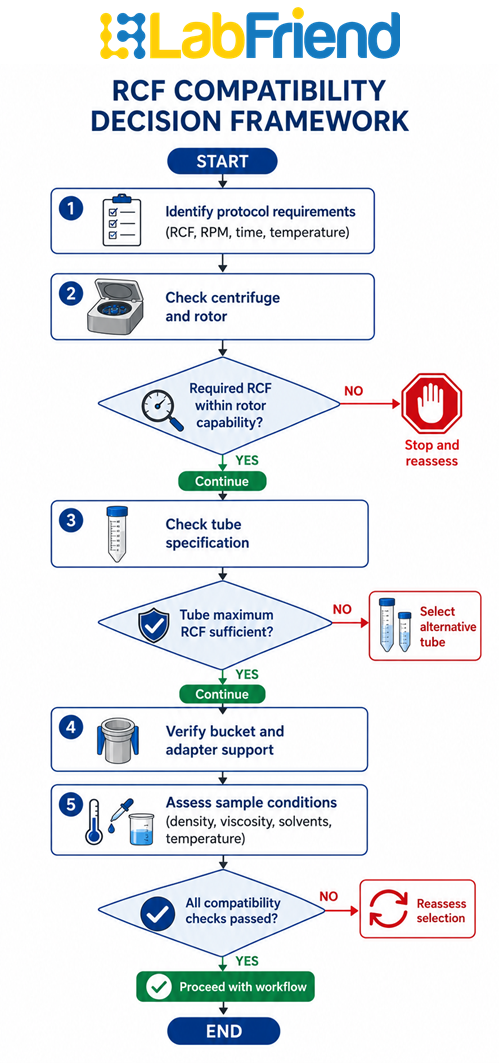
Use this practical sequence before selecting or switching centrifuge tubes.
Step 1: Identify the required workflow force
Check whether the protocol specifies:
- RCF in × g
- RPM
- centrifugation time
- temperature
- rotor type
- sample volume
- sample type
If the protocol gives RPM only, calculate or confirm the RCF using the rotor radius.
Step 2: Check the centrifuge and rotor
Confirm:
- rotor model
- rotor type
- maximum rotor speed
- maximum rotor RCF
The allowable operating limit is determined by the lowest applicable rating within the system, including the rotor, bucket, adapter and tube.
- adapter requirements
- tube size compatibility
- balancing requirements
Step 3: Check the tube specification
Confirm:
- maximum rated RCF
- nominal capacity
- working volume guidance
- material
- cap design
- bottom shape
- dimensions
- temperature suitability where relevant
- sterility or purity claims where required
Step 4: Check the adapter or bucket
Confirm that the tube is supported correctly. A tube that is too loose, too tall, poorly supported or incorrectly seated may not be suitable even if its nominal volume appears correct.
Step 5: Check the sample conditions
Consider:
- sample density
- viscosity
- solvent exposure
- biological material
- particulate load
- fill level
- temperature
Step 6: Document the decision where needed
For routine research workflows, a practical internal check may be enough. For quality-controlled, accredited or regulated workflows, local quality procedures may require documentation, change control or method verification.
Compatibility checklist
|
Check |
Why it matters |
Evidence source |
|
Tube volume |
Confirms whether the tube can hold the intended sample volume |
Product page or datasheet |
|
Working volume |
Reduces overfilling and leakage risk |
Manufacturer guidance |
|
Tube dimensions |
Confirms fit in rotor, bucket or adapter |
Product specification |
|
Bottom shape |
Affects seating and pellet location |
Product specification |
|
Cap design |
Affects closure and leakage risk |
Product specification |
|
Maximum RCF |
Confirms mechanical suitability for force |
Product specification |
|
Rotor radius |
Needed for RPM to RCF conversion |
Centrifuge or rotor manual |
|
Rotor type |
Affects tube angle, support and sample behaviour |
Centrifuge manual |
|
Adapter fit |
Ensures tube is properly supported |
Rotor/accessory documentation |
|
Material |
Affects chemical, temperature and mechanical suitability |
Product specification |
|
Sterility/purity |
Relevant to contamination-sensitive workflows |
Product documentation |
|
Temperature conditions |
Relevant to refrigerated or low-temperature workflows |
Manufacturer documentation |
Common mistakes when checking RCF and rotor compatibility
Mistake 1: Assuming RPM equals force
RPM is speed. RCF is force. The same RPM can produce different forces in different rotors because rotor radius matters.
Mistake 2: Assuming all 15mL or 50mL tubes have the same RCF rating
They do not. Maximum RCF can vary by tube design, material, cap type and manufacturer.
Mistake 3: Checking only whether the tube fits
Physical fit is not enough. The tube must also be supported correctly and suitable for the intended force, temperature and sample conditions.
Mistake 4: Ignoring adapters
Adapters can be essential for correct support. A poorly supported tube may be at greater risk of deformation, cracking or leakage.
Mistake 5: Transferring a protocol between centrifuges without conversion
A protocol using RPM on one centrifuge may not produce the same RCF on another centrifuge.
Mistake 6: Treating sterility as a mechanical specification
Sterility says nothing about RCF rating, rotor compatibility or mechanical strength. For contamination-control decisions, read sterile vs non-sterile centrifuge tubes.
Mistake 7: Treating material choice as secondary
Material matters. Polypropylene and polystyrene centrifuge tubes may have substantially different mechanical, temperature and chemical resistance characteristics, which can affect centrifugation suitability depending on the workflow. For material selection, read polypropylene vs polystyrene centrifuge tubes.
What this does not solve
Correct RCF and rotor compatibility checks do not automatically solve every centrifuge tube selection issue.
They do not confirm:
- chemical compatibility
- solvent resistance
- low-temperature suitability
- cryogenic suitability
- DNase-free status
- RNase-free status
- endotoxin-free status
- clinical suitability
- diagnostic suitability
- GMP suitability
- sample recovery performance
- method validation status
RCF-rated centrifuge tubes still require compatibility checks for rotor, adapter, fill volume and sample type. Procurement efficiency is valuable but should not replace technical suitability assessment.
What to check before purchase
Before buying centrifuge tubes for a workflow involving centrifugation, check:
- Nominal volume
Is the tube size appropriate for the sample? - Working volume
Is the fill volume suitable for the intended spin? - Maximum RCF
Does the tube specification support the intended force? - Rotor compatibility
Does the tube fit the rotor or bucket correctly? - Adapter requirements
Is the correct support adapter available? - Material
Is the tube material appropriate for the sample and conditions? - Cap design
Is the closure suitable for the workflow and handling requirement? - Sterility status
Is sterile packaging required? - Purity claims
Are DNase-free, RNase-free, endotoxin-free or PCR-clean claims required and documented? - Temperature conditions
Will the tube be used in refrigerated centrifugation, freezer storage or low-temperature workflows? - Documentation
Does the laboratory need product certificates, batch traceability or manufacturer datasheets? - Repeat availability
Can the product be reordered consistently once accepted into the workflow?
Laboratories ready to compare available options can browse LabFriend UK’s centrifuge tubes.
How to verify before switching centrifuge tubes
Supplier switching can be sensible when the new product offers suitable specification, availability or value. But a centrifuge tube switch should not be based on volume and price alone.
Before switching:
- compare maximum RCF ratings
- compare tube dimensions
- compare material
- compare cap style
- compare bottom shape
- compare sterility and purity claims
- check rotor and adapter fit
- test representative sample conditions where required
- check documentation requirements
- confirm whether the change affects SOPs or quality-controlled methods
- record the decision if required by the laboratory’s quality system
If the laboratory is standardising multiple tube types, the procurement team may also find the article on standardising centrifuge tube purchasing useful.
UK purchasing considerations
For UK laboratories, centrifuge tube selection is both a technical and operational decision. The tube must be suitable for the method, but the laboratory also needs reliable repeat access to approved consumables.
This matters for:
- CROs managing client project timelines
- independent testing laboratories processing repeat sample volumes
- SME biotech companies scaling workflows
- university research groups balancing budget and specification
- QA/QC laboratories needing documentation and consistency
A practical purchasing process should define:
- approved tube formats
- approved RCF limits
- accepted rotor/adaptor combinations
- sterile and non-sterile variants
- documentation requirements
- reorder quantities
- substitute-product rules
For laboratories managing centrifuge accessories alongside tubes, tube racks can support sample organisation and workflow consistency.
Product and category connection
LabFriend UK provides commercial routes for laboratories reviewing both centrifuge tubes and centrifugation workflows.
Relevant starting points include:
- centrifuge tubes for routine and specialist tube selection
- benchtop centrifuges for equipment review
- separating and centrifuging equipment for broader workflow context
- tube racks for sample organisation and handling
Always check the product page and manufacturer documentation before selecting a tube for a specific centrifugation condition.
Frequently asked questions
What is the difference between RCF and RPM?
RPM is rotor speed, measured in revolutions per minute. RCF is the force experienced by the sample, expressed as × g. RCF depends on both RPM and rotor radius.
Why is RCF more useful than RPM?
RCF is more useful when comparing centrifugation conditions across different rotors because the same RPM can produce different forces depending on rotor radius.
Can I use RPM instead of RCF?
You can use RPM where the centrifuge, rotor and protocol are fixed and understood, but RCF is usually more transferable between instruments. If a protocol specifies RCF and your centrifuge uses RPM, convert using the rotor radius.
How do I calculate RCF from RPM?
A common formula is: RCF = 1.118 × 10⁻⁵ × r × RPM², where r is rotor radius in centimetres. Always confirm with your centrifuge or rotor documentation.
Do all centrifuge tubes have the same maximum RCF?
No. Maximum RCF is product-specific. It can vary by material, tube geometry, wall design, cap type and manufacturer.
Is a tube safe to use if it fits in the rotor?
Not necessarily. Physical fit is only one requirement. You must also check RCF rating, adapter support, fill volume, cap clearance, material suitability and sample conditions.
Does tube material affect RCF compatibility?
Yes, material can affect mechanical suitability, temperature behaviour and chemical compatibility. However, specific suitability must be checked using product documentation.
Are sterile centrifuge tubes stronger than non-sterile tubes?
Not automatically. Sterility is a contamination-control specification, not a mechanical-strength specification. Check RCF rating separately.
Can I use the same centrifuge tube in fixed-angle and swinging-bucket rotors?
Possibly, but it depends on the tube, rotor, bucket, adapter and manufacturer specifications. Do not assume cross-compatibility.
What should I check if centrifuge tubes crack or leak?
Check maximum RCF, rotor compatibility, adapter support, fill volume, cap closure, material suitability, sample type and temperature conditions.
Conclusion
RCF, RPM and rotor compatibility should be checked together whenever a laboratory selects centrifuge tubes for centrifugation.
RPM tells you how fast the rotor spins. RCF tells you the force applied to the sample. Rotor radius links the two. Tube compatibility then depends on whether the tube, cap, material, dimensions, adapter and workflow can safely support the intended conditions.
The safest practical approach is:
- Confirm the required centrifugation force.
- Convert RPM and RCF where needed.
- Check the rotor and adapter.
- Check the tube’s product-specific maximum RCF.
- Confirm material, cap, fill volume and documentation requirements.
- Standardise only after technical suitability is confirmed.
Written by: Donal O’Sullivan, BSc, Co-Founder and Sales Director, LabFriend UK. Donal brings deep chemistry-led technical expertise across analytical chemistry, biochemistry, environmental monitoring, laboratory instrumentation, consumables and scientific product selection.
Reviewed by: Michael Anderson, MBA, Founder and Managing Director, LabFriend UK. Michael reviews LabFriend UK content for customer relevance, commercial accuracy, operational practicality and alignment with LabFriend UK’s laboratory supply model.
To compare suitable options, browse LabFriend UK’s centrifuge tubes, or use the Complete Guide to Centrifuge Tubes for broader selection guidance.
Related Stories

Hydrophilic vs Hydrophobic Membranes: How to Choose the Right Filter for Your Laboratory Application
Hydrophilic vs Hydrophobic Membranes: How to Choose the Right Filter for Your Laboratory Application

Choosing Centrifuge Tubes for Molecular Biology and PCR Workflows
Choosing Centrifuge Tubes for Molecular Biology and PCR Workflows

How UK Laboratories Can Validate Filtration Membrane Chemical Compatibility
How UK Laboratories Can Validate Filtration Membrane Chemical Compatibility | LabFriend UK

Complete Guide to Centrifuge Tubes
Complete Guide to Centrifuge Tubes