

Share :
Complete Guide to Centrifuge Tubes
Updated On 07/17/2026

By Donal O’Sullivan, BSc. Reviewed by Michael Anderson, MBA.
How UK Laboratories Choose the Right Tubes for Sample Integrity, Workflow Reliability and Efficient Purchasing
Centrifuge tubes are among the most widely used consumables in modern laboratories. They are used daily across:
-
- molecular biology,
- cell culture,
- microbiology,
- clinical diagnostics,
- environmental testing,
- biobanking,
- pharmaceutical research,
- industrial laboratories.
Despite being considered a routine consumable, centrifuge tube selection can directly affect:
-
- sample integrity (including contamination prevention, analyte stability and prevention of sample loss),
- contamination risk,
- centrifugation performance under specified RCF and temperature conditions,
- workflow efficiency,
- storage stability,
- laboratory operating costs.
Choosing the wrong tube may result in:
-
- tube cracking,
- leakage,
- failed assays,
- sample contamination,
- workflow disruption,
- unnecessary consumables spend.
This guide explains the major centrifuge tube types, materials, workflow considerations and purchasing decisions laboratories should evaluate when selecting centrifuge tubes for routine and specialised applications.
What Are Centrifuge Tubes?
Centrifuge tubes are laboratory vessels designed to hold liquid samples, suspensions and some viscous biological materials during centrifugation, storage, transport and preparation workflows.
They are manufactured to withstand:
-
- centrifugal force,
- wide temperature ranges encountered during freezing, thawing, centrifugation and sterilisation,
- chemical exposure,
- repeated handling.
Different tube types are optimised for:
-
- sample volume,
- sterility requirements,
- molecular biology compatibility,
- cryogenic storage,
- high-speed centrifugation within manufacturer-specified RCF limits,
- contamination-sensitive workflows.
The Most Common Types of Centrifuge Tubes
15ml Centrifuge Tubes
15ml centrifuge tubes are commonly used for:
-
- routine sample preparation,
- cell pelleting,
- reagent preparation,
- low-to-medium volume workflows.
They are popular in:
-
- university laboratories,
- CROs,
- routine testing environments.
Typical features include:
-
- conical bottoms,
- graduation markings,
- sterile or non-sterile options,
- screw-cap closures.
For laboratories processing moderate sample volumes, 15ml tubes often provide a strong balance between handling convenience and storage efficiency.
50ml Centrifuge Tubes
50ml centrifuge tubes are widely used in:
-
- larger sample preparation workflows,
- cell culture,
- media preparation,
- environmental testing,
- higher-volume centrifugation workflows.
These are among the highest-consumption tube formats in many laboratories because they support:
-
- larger batch processing,
- fewer sample transfers,
- reduced handling time.
Laboratories purchasing 50ml tubes should evaluate:
-
- wall strength,
- cap sealing performance,
- maximum rated RCF,
- sterility validation,
- polypropylene quality,
- rotor compatibility.
Microcentrifuge Tubes
Microcentrifuge tubes are typically available in:
-
- 5ml,
- 5ml,
- 2ml formats.
These are heavily used in:
-
- molecular biology,
- PCR preparation,
- DNA/RNA workflows,
- protein analysis.
For contamination-sensitive molecular workflows, laboratories should prioritise:
-
- manufacturer-validated DNase/RNase-free centrifuge tubes,
- low-binding surfaces designed to minimise nucleic acid or protein adsorption,
- sterile handling compatibility,
- PCR-clean consumables where required.
It is important to note that sterile tubes are not automatically DNase/RNase-free or PCR-clean.
Choosing the Right Centrifuge Tube Material
Tube material has a major impact on:
-
- chemical compatibility,
- temperature tolerance,
- centrifugation performance,
- sterilisation compatibility.
Polypropylene Centrifuge Tubes
Polypropylene (PP) is the most widely used centrifuge tube material because it offers:
-
- strong chemical resistance,
- autoclavability within manufacturer-recommended cycle limits,
- broad temperature tolerance,
- durability under centrifugation,
- suitability for many low-temperature storage applications.
Cryogenic-grade polypropylene tubes are commonly preferred for:
-
- molecular biology,
- microbiology,
- cryogenic storage workflows,
- high-speed centrifugation.
However, not all polypropylene tubes are certified for liquid nitrogen storage or true cryogenic applications. Laboratories should always verify manufacturer specifications for ultra-low temperature compatibility.
For most laboratories, polypropylene tubes remain the preferred general-purpose option.
Polystyrene Centrifuge Tubes
Polystyrene (PS) centrifuge tubes are typically selected where:
-
- optical clarity is important,
- aggressive chemicals are not involved,
- lower mechanical stress is expected.
However, PS tubes generally offer:
-
- lower chemical resistance,
- lower heat tolerance,
- reduced suitability for cryogenic applications.
Chemical compatibility should always be verified against the specific solvents and reagents used within the workflow.
Sterile vs Non-Sterile Centrifuge Tubes
One of the most important purchasing decisions is whether to use sterile or non-sterile tubes.
Sterile Centrifuge Tubes
Sterile centrifuge tubes are essential for:
-
- cell culture,
- microbiology,
- molecular biology,
- contamination-sensitive workflows,
- pharmaceutical and clinical applications.
These tubes help reduce the risk of:
-
- microbial contamination,
- sample compromise,
- failed experiments.
Laboratories working with sensitive biological materials should prioritise:
-
- manufacturer-validated sterile tubes,
- manufacturer-validated DNase/RNase-free products where appropriate,
- high-quality sealing systems.
Non-Sterile Centrifuge Tubes
Non-sterile centrifuge tubes are often appropriate for:
-
- routine chemistry,
- non-sensitive sample handling,
- educational laboratories,
- industrial workflows.
They can provide:
- lower cost-per-unit,
- reduced consumables spend for non-critical applications.
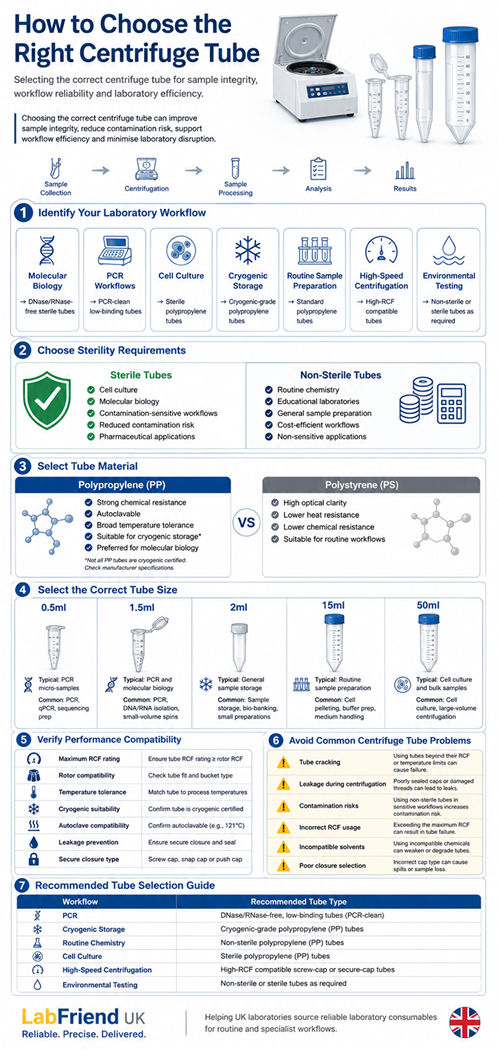
How to Choose the Correct Tube Size
Tube size should align with:
-
- sample volume,
- centrifuge rotor compatibility,
- storage requirements,
- workflow efficiency.
Oversized tubes may:
-
- waste storage space,
- increase consumables cost,
- reduce centrifugation efficiency.
Undersized or improperly filled tubes may:
-
- increase overflow risk,
- compromise safe handling,
- require additional transfer steps,
- reduce centrifugation stability.
For many laboratories:
-
- 15ml tubes support routine medium-volume workflows,
- 50ml tubes support bulk preparation,
- microcentrifuge tubes support molecular workflows.
Understanding RCF and RPM Compatibility
Not all centrifuge tubes tolerate the same centrifugation forces.
Laboratories should always verify:
-
- maximum rated RCF (relative centrifugal force),
- compatible rotor specifications,
- temperature performance,
- manufacturer operating limits.
RCF is generally a more accurate measure than RPM because centrifugal force also depends on rotor radius.
Using tubes beyond their specified limits can lead to:
-
- cracking,
- leakage,
- structural tube failure,
- sample loss.
This is particularly important in:
-
- high-speed centrifugation,
- refrigerated centrifugation,
- cryogenic workflows.
Cryogenic Storage Considerations
Laboratories storing samples at low temperatures should select tubes specifically designed and validated for:
-
- freezer storage,
- ultra-low temperature storage,
- liquid nitrogen compatibility where required.
Cryogenic-compatible tubes help reduce risks associated with:
-
- brittleness,
- cap failure,
- tube cracking,
- sample evaporation.
Cryogenic-grade polypropylene tubes are commonly preferred for low-temperature laboratory storage because of their durability and thermal resistance. However, laboratories should confirm whether tubes are certified for liquid nitrogen vapour phase or liquid phase storage before use.
Molecular Biology and PCR Workflows
PCR and molecular biology applications require additional attention to:
-
- contamination control,
- nucleic acid integrity,
- low sample retention.
Important considerations include:
-
- manufacturer-validated DNase-free tubes,
- manufacturer-validated RNase-free tubes,
- low-binding surfaces,
- sterile handling compatibility,
- PCR-clean consumables where required.
Laboratories performing sensitive amplification workflows should avoid low-quality tubes that may introduce contamination, sample adsorption or inconsistent experimental results.
Preventing Common Centrifuge Tube Problems
Tube Cracking
Tube cracking is often caused by:
-
- excessive RCF,
- incompatible chemicals,
- low-quality plastics,
- cryogenic stress,
- repeated thermal cycling,
- repeated autoclaving beyond manufacturer specifications.
Leakage During Centrifugation
Leakage can result from:
-
- poor cap sealing,
- incompatible closures,
- overfilling,
- incorrect balancing.
Screw-cap centrifuge tubes are often preferred where transport, high-speed centrifugation and contamination prevention are important.
Sample Contamination
Contamination risks increase when:
-
- non-sterile tubes are used incorrectly,
- tubes are poorly sealed,
- workflow controls are inconsistent,
- inappropriate consumables are used for molecular workflows.
Sterile and contamination-controlled tubes are often essential for:
-
- biotech laboratories,
- pharmaceutical workflows,
- sensitive research environments.
Procurement Considerations for Laboratories
For laboratories with recurring consumables demand, centrifuge tube selection should also consider:
-
- supply reliability,
- batch consistency,
- repeat availability,
- stock continuity,
- operational standardisation.
Many laboratories reduce workflow disruption by:
-
- standardising tube formats,
- consolidating suppliers,
- using repeat purchasing arrangements,
- reducing SKU complexity.
Reliable supply is often more operationally important than simply selecting the lowest unit price.
Choosing a Laboratory Consumables Supplier
When evaluating centrifuge tube suppliers, laboratories should consider:
-
- product quality consistency,
- technical suitability,
- stock availability,
- delivery reliability,
- transparent pricing,
- account support,
- breadth of compatible consumables.
For operational laboratories, supplier reliability can directly affect:
-
- turnaround times,
- workflow continuity,
- procurement efficiency.
How LabFriend UK Supports UK Laboratories
LabFriend UK supports laboratories across the UK with access to:
Our focus is helping laboratories source products that are:
-
- reliable,
- technically appropriate,
- commercially practical,
- consistently available.
Reliable laboratory consumables for routine and specialist workflows.
Next Read
Laboratory Centrifuge Maintenance: A Guide to Safety and Longevity | LabFriend UK
Frequently Asked Questions About Centrifuge Tubes
What are centrifuge tubes used for?
Centrifuge tubes are used for:
-
- sample preparation,
- centrifugation,
- storage,
- transport,
- molecular biology workflows,
- cell culture,
- routine laboratory processing.
They are designed to withstand centrifugal force while helping maintain sample integrity and workflow reliability.
What is the difference between 15ml and 50ml centrifuge tubes?
15ml centrifuge tubes are commonly used for:
-
- routine sample preparation,
- smaller sample volumes,
- molecular biology workflows,
- routine laboratory processing.
- 50ml centrifuge tubes are generally preferred for:
- larger sample volumes,
- cell culture,
- media preparation,
- higher-volume centrifugation workflows.
The correct size depends on:
-
- sample volume,
- centrifuge compatibility,
- workflow requirements,
- storage considerations.
What material are centrifuge tubes made from?
Most centrifuge tubes are manufactured from:
-
- polypropylene (PP),
- polystyrene (PS).
Polypropylene tubes are generally preferred because they offer:
-
- strong chemical resistance,
- broad temperature tolerance,
- autoclavability,
- suitability for many cryogenic workflows.
Polystyrene tubes are typically selected where:
-
- optical clarity is important,
- lower mechanical stress is expected.
What is the difference between polypropylene and polystyrene centrifuge tubes?
Polypropylene centrifuge tubes typically provide:
-
- higher chemical resistance,
- better temperature tolerance,
- greater durability during centrifugation,
- suitability for low-temperature workflows.
- Polystyrene centrifuge tubes typically provide:
- greater optical clarity,
- lower heat resistance,
- lower chemical compatibility.
Polypropylene is generally the preferred choice for molecular biology, cryogenic storage and high-speed centrifugation applications.
Are all centrifuge tubes sterile?
No.
Centrifuge tubes are available in both:
-
- sterile,
- non-sterile formats.
Sterile centrifuge tubes are typically required for:
-
- cell culture,
- microbiology,
- contamination-sensitive workflows,
- pharmaceutical and clinical laboratories.
- Non-sterile tubes are often suitable for:
- routine chemistry,
- general sample handling,
- industrial workflows.
Are sterile centrifuge tubes automatically DNase- and RNase-free?
No.
Sterile tubes are not automatically:
-
- DNase-free,
- RNase-free,
- PCR-clean.
- Laboratories performing molecular biology or PCR workflows should always verify manufacturer specifications for:
- DNase-free certification,
- RNase-free certification,
- molecular biology compatibility.
Can centrifuge tubes be autoclaved?
Many polypropylene centrifuge tubes can be autoclaved within manufacturer-recommended limits.
However:
-
- not all tubes are autoclavable,
- repeated autoclaving can reduce tube performance over time,
- incorrect autoclave conditions may cause deformation or failure.
- Always verify:
- manufacturer specifications,
- temperature limits,
- cycle recommendations.
Polystyrene tubes are generally less suitable for autoclaving.
What does RCF mean for centrifuge tubes?
RCF stands for:
Relative Centrifugal Force
It measures the actual centrifugal force applied to the tube during centrifugation.
RCF is generally more important than RPM because centrifugal force also depends on rotor radius.
Using tubes above their rated RCF may result in:
-
- tube cracking,
- leakage,
- sample loss,
- structural failure.
Can centrifuge tubes be used for cryogenic storage?
Some centrifuge tubes are designed for:
-
- freezer storage,
- ultra-low temperature storage,
- cryogenic workflows.
- However, not all tubes are certified for:
- liquid nitrogen storage,
- true cryogenic applications.
- Laboratories should always verify:
- cryogenic certification,
- manufacturer specifications,
- liquid nitrogen compatibility.
Cryogenic-grade polypropylene tubes are commonly preferred for low-temperature applications.
Why do centrifuge tubes crack?
Tube cracking may occur because of:
-
- excessive RCF,
- incompatible chemicals,
- low-quality plastics,
- repeated thermal cycling,
- cryogenic stress,
- autoclaving beyond manufacturer limits.
Selecting tubes appropriate for the workflow and centrifugation conditions helps reduce failure risk.
Why do centrifuge tubes leak during centrifugation?
Leakage is often caused by:
-
- poor cap sealing,
- incorrect closures,
- overfilling,
- incompatible tube selection,
- incorrect balancing.
- Screw-cap tubes are often preferred for:
- transport,
- high-speed centrifugation,
- contamination-sensitive workflows.
What are low-binding centrifuge tubes?
Low-binding centrifuge tubes are designed to reduce:
-
- protein adsorption,
- nucleic acid binding,
- sample retention on tube walls.
- These tubes are commonly used in:
- molecular biology,
- PCR workflows,
- protein analysis,
- low-concentration sample preparation.
Which centrifuge tubes are best for molecular biology?
-
- Molecular biology workflows typically require:
- DNase-free tubes,
- RNase-free tubes,
- low-binding surfaces,
- contamination-controlled handling,
- sterile compatibility where appropriate.
Laboratories performing sensitive amplification or nucleic acid workflows should avoid low-quality consumables that may compromise sample integrity.
What type of centrifuge tube should be used for cell culture?
Cell culture workflows generally require:
-
- sterile centrifuge tubes,
- high-quality sealing systems,
- contamination-controlled consumables.
Polypropylene tubes are commonly preferred because of their durability and compatibility with common laboratory workflows.
How should centrifuge tubes be stored?
Centrifuge tubes should generally be stored:
in clean, dry laboratory conditions, away from direct sunlight,
within manufacturer-recommended temperature ranges,
in contamination-controlled environments where required.
Sterile products should remain sealed until use.
How can laboratories reduce centrifuge tube contamination risks?
Laboratories can reduce contamination risks by:
-
- using sterile tubes where appropriate,
- selecting DNase/RNase-free products for molecular workflows,
- using correct handling procedures,
- minimising repeated tube opening,
- standardising workflow practices.
High-quality sealing systems and workflow-compatible consumables also help improve sample integrity.
What should laboratories consider when choosing a centrifuge tube supplier?
Laboratories should evaluate:
-
- product quality consistency,
- stock availability,
- delivery reliability,
- technical suitability,
- supplier support,
- repeat supply continuity,
- compatibility with laboratory workflows.
For operational laboratories, reliable supply and consistent product quality are often more important than simply selecting the lowest unit price.
Written by: Donal O’Sullivan, BSc, Co-Founder and Sales Director, LabFriend UK. Donal brings deep chemistry-led technical expertise across analytical chemistry, biochemistry, environmental monitoring, laboratory instrumentation, consumables and scientific product selection.
Reviewed by: Michael Anderson, MBA, Founder and Managing Director, LabFriend UK. Michael reviews LabFriend UK content for customer relevance, commercial accuracy, operational practicality and alignment with LabFriend UK’s laboratory supply model.
Related Stories

The Ultimate Guide to Laboratory Filtration for UK Laboratories
The Ultimate Guide to Laboratory Filtration for UK Laboratories

Polypropylene vs Polystyrene Centrifuge Tubes
Polypropylene vs Polystyrene Centrifuge Tubes: Which Is Best for Laboratory Workflows?

PTFE vs PES Syringe Filters: Which Membrane Should You Choose?
PTFE vs PES Syringe Filters: Differences, Solvent Compatibility and Laboratory Applications

Standardising Polypropylene vs Polystyrene Centrifuge Tubes Across Laboratory Workflows
Standardising Polypropylene vs Polystyrene Centrifuge Tubes Across Laboratory Workflows